
Our readers keep the lights on and my morning glass full of iced black tea. As an Amazon Associate, I earn from qualifying purchases.
Specs are compiled from manufacturer listings and verified buyer reviews and can change over time — please confirm the key details on the product page before buying.
Water that shoots through your pipes at over 100 PSI (pounds per square inch, the force of the flow) can hammer your plumbing, wear out your water heater, and waste gallons every month. A 1-inch pressure regulator bolts onto your main water line to dial that force down to something your home can handle — typically around 50 to 60 PSI — protecting everything from your washing machine to your sprinkler system. The trick is picking one that actually holds its setting without drifting or failing within a year.
I’m Min — the founder and writer behind Gadgets Feed. This guide is built by comparing the manufacturers’ published specifications and the patterns across verified customer reviews, so you get each pick’s real strengths and trade-offs instead of marketing spin.
If your water pressure spikes or your old valve is failing, these are the top-rated options to help you find the best 1 inch pressure regulator for your specific water conditions.
Quick Picks
- Watts LFN45B Series 1″ Lead-Free Cast Copper — Best Overall
- DERPIPE Pressure Regulator Water Valve 1″ NPT — Best for Specialty Use
- Snooweerin NR3XLDU 1″ Brass Pressure Reducing — Great Value
- Zurn Wilkins 1-NR3XL 1″ Pressure Reducing Valve — Compact & Reliable
- Zurn Wilkins 1-600XL 1″ Pressure Reducing Valve — Premium Performer
- MEANLIN MEASURE 1″ Brass Water Pressure — Budget Pick
How To Choose The Best 1 Inch Pressure Regulator
Picking a pressure regulator means matching three things: your incoming water pressure, the material that connects to your pipes, and how much fine-tuning you want over the final output. Here is what to look for.
Maximum Pressure Rating
Your regulator must survive the worst spike your municipal supply throws at it, not just the average flow. A valve rated for 100 PSI works for normal residential lines, but if you ever get a pressure surge from the main, you need a 300 or 400 PSI rating to keep the internal diaphragm from blowing out.
Adjustable Pressure Range
Every home runs at a different ideal pressure. A regulator with an adjustable range (typically 25 to 75 PSI) lets you set the exact output your fixtures need — lower for an ice machine at 20 PSI, higher for a sprinkler system at 60 PSI. A fixed pre-set at 50 PSI is convenient, but you lose the ability to dial it down or up later.
Body Material and Connection Type
Brass and lead-free cast copper silicon alloy handle corrosion far better than plated steel in long-term water contact. Bronze bodies also offer better resistance to light freezing. For connections, a union inlet (two separable nuts) saves you from cutting pipe when you replace the valve — you just unscrew the unions instead of re-threading the whole line.
Quick Comparison
| Model | Best For | Maximum Pressure | Adjustable Range | Body Material | Amazon |
|---|---|---|---|---|---|
| Watts LFN45B | Whole-home protection | 400 PSI | 25-75 PSI | Cast Copper Silicon Alloy | $77.13Amazon |
| DERPIPE 304 SS | Ice machines & RV | 240 PSI | 0-140 PSI | Stainless Steel 304 | $75.99$79.99Amazon |
| Snooweerin NR3XLDU | Direct replacement for old NR3XL | 100 PSI | Preset ~50 PSI | Brass / Bronze | $99.99$149.99Amazon |
| Zurn Wilkins 1-NR3XL | Reliable brand replacement | 75 PSI | Preset ~60 PSI | Brass / Stainless Steel | $242.65$274.99Amazon |
| Zurn Wilkins 1-600XL | High-flow commercial | 300 PSI | Adjustable | Bronze | $407.15$483.99Amazon |
| MEANLIN MEASURE XJ-387 | Budget irrigation fix | 250 PSI | 0-220 PSI (gauge) | Brass | $26.99Amazon |
In‑Depth Reviews
1. Watts LFN45B Series 1″ Lead-Free Cast Copper Silicon Alloy Pressure Reducing Valve

Survives incoming spikes up to 400 PSI — compared to 100 PSI max for typical budget valves — and adjusts from 25 to 75 PSI to match your home perfectly.
The most important job of a pressure regulator is not failing during a sudden surge. The Watts LFN45B is rated for 400 PSI (pounds per square inch), compared to the Snooweerin NR3XLDU at 100 PSI, so a sudden municipal water hammer (a rapid pressure spike) won’t wreck its internal diaphragm. It adjusts smoothly from 25 to 75 PSI, with a standard factory setting at 50 PSI (345 kPa), and includes a built-in thermal expansion bypass that lets water flow back into the main line if outlet pressure exceeds supply pressure — a real safety net for closed-loop systems.
Buyers report this is a direct replacement for the older Watts N35B, sharing the same 7.38 x 5.62 x 2.44-inch dimensions. One owner mentioned that Teflon tape failed on the threads and switched to pipe dope for a leak-free seal. The removable integral stainless steel strainer catches sediment, and the sealed spring cage with stainless steel screws makes it suitable for waterwork pit installations where you don’t want to dig it up for service.
What makes it a winner
- 400 PSI maximum pressure rating — handles surges that would destroy competitor 100 PSI valves
- Adjustable 25-75 PSI range gives you fine control for any home system
- Thermal expansion bypass protects closed-loop water heaters from pressure spikes
The trade-off
- Some units arrive slightly above the 50 PSI preset (delivering 55 PSI instead)
- Thread sealant choice matters — pipe dope works better than Teflon tape here
Reach for this if: You want a single regulator that can withstand the highest incoming water pressure (400 PSI) and still give you precise 25-75 PSI adjustment for years.
skip it if you need a tool-free install with pre-attached unions — this model comes with union nuts and O-rings but requires basic wrench work.
2. DERPIPE Pressure Regulator Water Valve 1″ NPT Stainless Steel 304
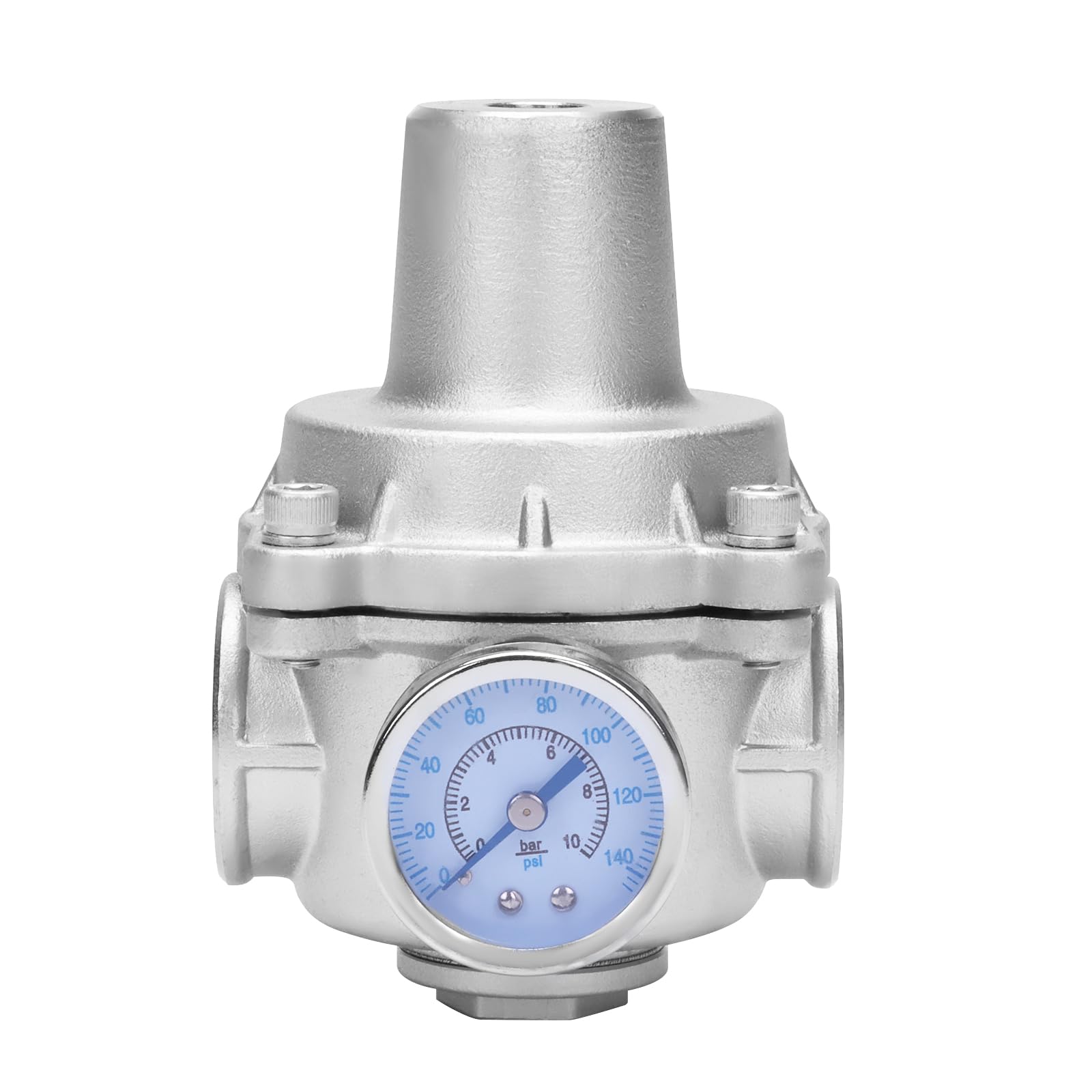
Its Stainless Steel 304 body (a chromium-nickel alloy that resists rust far longer than plated brass) makes it the pick for outdoor or commercial kitchen setups where corrosion is the real enemy.
If your setup lives outdoors or in a commercial kitchen, you want a body that does not rust — this DERPIPE regulator uses Stainless Steel 304 with 1-inch NPT female inlets and outlets. It handles up to 240 PSI and adjusts from 0 to 140 PSI using a simple screwdriver, so you can tune it all the way down to 20 PSI for an ice machine or up to 60 PSI for a garden hose. One reviewer noted dropping water pressure from 80 PSI to 20 PSI for a commercial ice machine, and another solved an overfilling pool fill valve by setting it to roughly 20 PSI.
The catch: a few buyers found the output could not be adjusted above 40 PSI regardless of inlet pressure, and manufacturer tech support was unresponsive. That makes this a better fit for low-pressure applications where you need consistent 20-40 PSI output — not for a whole home that needs 50-60 PSI across multiple fixtures. It is noticeably heavier than the MEANLIN MEASURE valve, and the included pressure gauge is a practical touch for dialing in your exact setting.
The standout feature: Full stainless steel 304 body with a 0-140 PSI adjustable range makes it ideal for specialty low-pressure setups like ice machines, RV water systems, and pool fill valves where consistent 20 PSI output protects sensitive equipment.
Best for: Targeted low-pressure applications (ice makers, RVs, pool fillers) where corrosion resistance and a built-in gauge matter more than whole-home coverage.
pass on it if: You need steady pressure above 40 PSI, as some units reportedly cap out well below their 140 PSI spec.
3. Snooweerin NR3XLDU 1″ Brass Pressure Reducing Valve Double Union FNPT
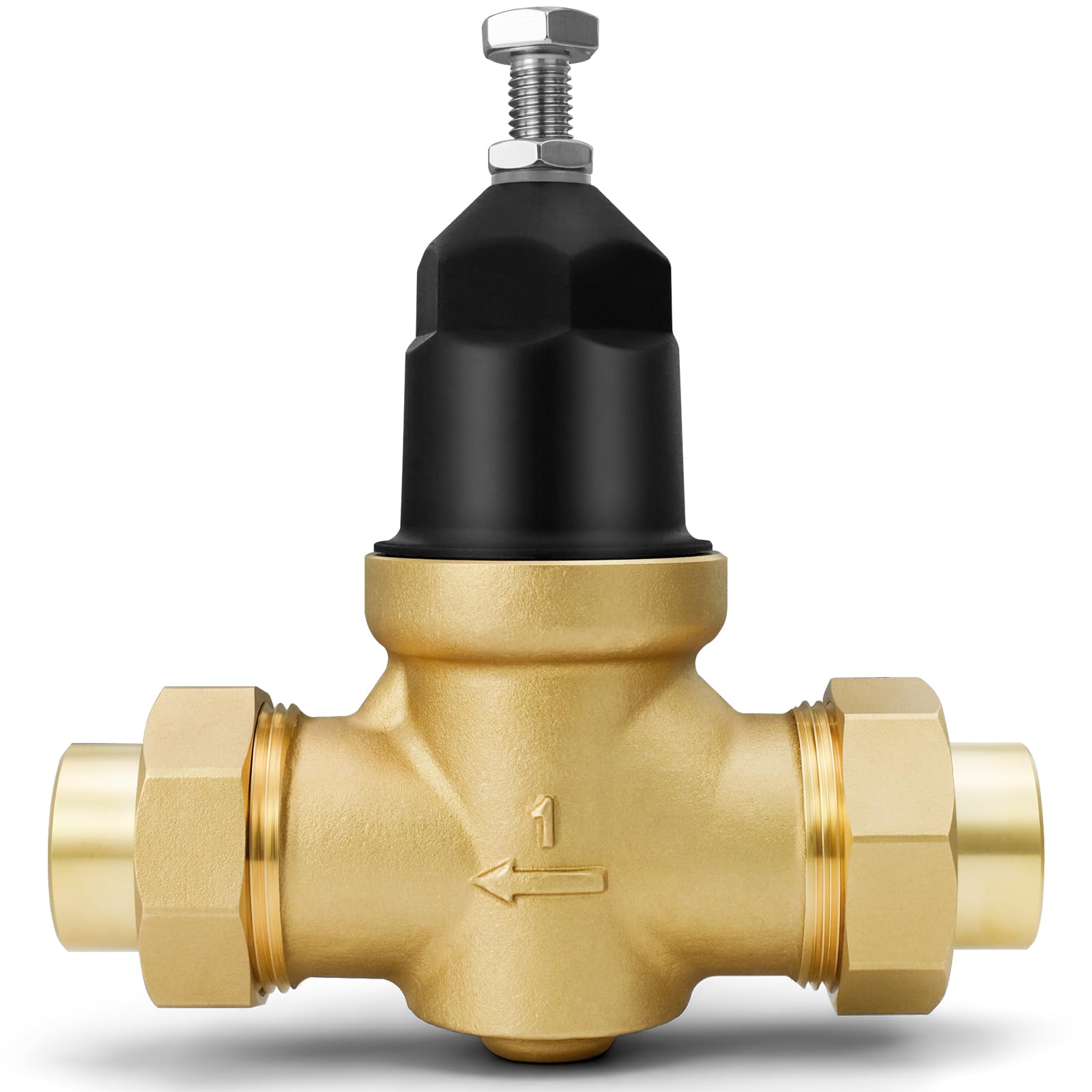
Double union FNPT connections let you install it by hand without cutting or re-threading your pipes — a perfect drop-in replacement for a tired NR3XL.
If your existing pressure reducing valve is a name-brand NR3XL (a common residential model with a specific 6.25 x 2.5 x 5-inch footprint), this Snooweerin NR3XLDU is an exact match — one buyer mentioned it was a “simple replacement” for his old unit that had lasted 8 years. It comes with double union FNPT (female national pipe thread) connections, so you can install it by hand without cutting or re-threading your pipes. The built-in stainless steel filter traps sediment before it reaches your fixtures, and the all-brass body resists corrosion in typical residential water lines.
The maximum pressure is 100 PSI, compared to the Watts LFN45B’s 400 PSI rating, so this is best for homes where the incoming pressure stays under 100 PSI. Buyers warn that the threads are razor sharp — one owner sandpapered them after slicing his palm. The valve ships preset to 50 PSI (50 lbs PSI), and the included large Teflon tape roll is a nice bonus. One reviewer who worked in water his whole life called it “a good one” and said it comes with everything you need for a standard install.
Why it stands out
- Double union FNPT connections allow tool-free installation and easy future removal
- Exact dimensional match for legacy NR3XL models — no pipe modification needed
- Built-in stainless steel filter and brass body resist corrosion in standard residential water
Watch out for
- Threads are dangerously sharp — handle with care or sand them before installation
- 100 PSI max rating is low compared to the 400 PSI Watts LFN45B; not for homes with frequent pressure surges
Reach for this if: You are replacing a worn NR3XL and want the easiest possible swap without re-piping, plus a built-in sediment filter.
Look elsewhere if: Your incoming water pressure regularly spikes above 100 PSI — the Watts LFN45B’s 400 PSI rating is safer for that.
4. Zurn Wilkins 1-NR3XL 1″ Pressure Reducing Valve Single Union
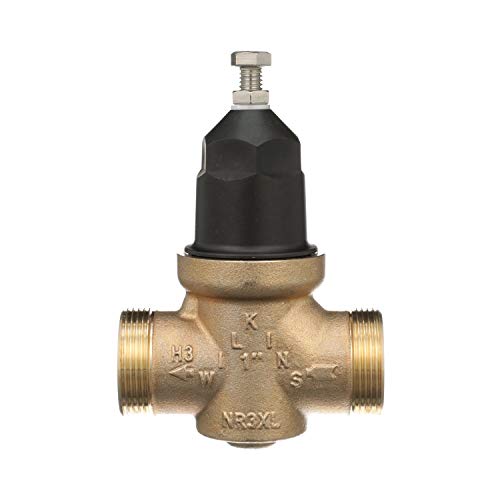
Its cartridge-loaded design means you can replace the internal working parts without removing the valve body from the pipe — a real time-saver in a cramped utility closet.
Zurn is a familiar name in commercial and residential plumbing, and the 1-NR3XL continues that reputation with a compact 4.94 x 2.5 x 6.25-inch footprint. The short lay length (the distance between inlet and outlet connections) lets you install it in tight spots where a longer regulator would not fit. It is ASSE Listed 1003 (American Society of Sanitary Engineering standard for pressure-reducing valves) and meets NSF/ANSI 61 for drinking water safety.
Owners mention it lowers incoming high water pressure easily — one owner installed it on a sprinkler system and said it “worked as intended.” It ships preset at 60 PSI, so if your home needs a lower setting (like 50 PSI for standard fixtures), you will need to adjust it with a screwdriver. A common complaint: the valve only includes one flat washer, but you need two for a leak-free seal; one owner recommends a Danco slip joint washer #36643B as a substitute. At 75 PSI max pressure, it is the lowest-rated model here, so it is strictly for homes with already moderate incoming pressure.
The defining quality: Zurn’s compact cartridge-loaded body saves space and makes internal repairs possible without cutting the pipe — a real advantage for tight installations where you cannot afford to unsweat a joint.
Best for: Homes with limited installation space and incoming pressure under 75 PSI where a trusted brand name and cartridge-serviceability are priorities.
Not for: High-pressure mains — at 75 PSI max, it cannot handle the surges the 400 PSI Watts LFN45B absorbs easily.
5. Zurn Wilkins 1-600XL 1″ Pressure Reducing Valve
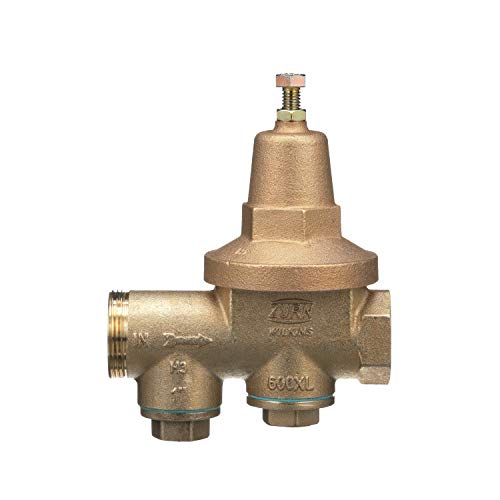
Its balanced bronze body holds steady pressure even with three faucets open — a massive improvement over regulators that drop 20 PSI with one fixture running.
If you have experienced pressure drop every time someone turns on a shower while the washing machine fills, the Zurn Wilkins 1-600XL is built to solve exactly that. One owner reported that their old regulator (an EB45) dropped 20 PSI with a single faucet open, but this new Zurn loses only a few PSI with three faucets running — a massive improvement for multi-fixture homes. It is a 1-inch valve with a bronze body (bronze resists corrosion better than standard brass in chlorinated municipal water) and a balanced design that protects the system from inlet pressure changes. The maximum pressure rating is 300 PSI, which sits between the budget 100 PSI regulators and the 400 PSI Watts above, making it suitable for most residential lines with occasional surges.
The fiber union gasket speeds up installation and the stainless steel strainer screen can be removed with a single cap. One owner who bought this about five years ago said it was “easy to install and I completely forgot about it” — still working flawlessly after half a decade. At 6.4 x 3.3 x 7.25 inches, it is slightly larger than the compact Zurn 1-NR3XL, so measure your space before ordering. Its premium price reflects the bronze build and steady-flow performance that competing budget regulators cannot match.
Why it earns its premium spot
- Bronze body resists corrosion better than standard brass, especially in chlorinated water
- Balanced design holds steady pressure even with multiple fixtures open — minimal drop from 20 PSI to just a few PSI
- 300 PSI max rating handles surges while staying below the 400 PSI Watts LFN45B for standard residential use
Consider this
- Larger footprint (6.4 x 3.3 x 7.25 in) than the compact Zurn 1-NR3XL
- Premium cost — for budget builds, the MEANLIN MEASURE or Snooweerin options are more affordable
Reach for this if: Your home has multiple high-flow fixtures (showers, washing machines, sprinklers) and you want steady pressure without the “drop” that plagues cheaper regulators.
it’s not for you if: You need the absolute smallest body for a tight space — the Zurn 1-NR3XL’s 4.94-inch length fits better there.
6. MEANLIN MEASURE 1″ Brass Water Pressure Regulating Valve with Gauge

On paper a steal: a 1-inch brass valve with a 0-220 PSI pressure gauge and a 250 PSI maximum pressure rating for under 30 dollars.
It is marketed for faucets, heaters, and water purifiers, and one buyer used it successfully to regulate pressure to a tiny home, saying it “worked great at a portion of the price of the other ones.” The brass body resists corrosion reasonably well in most residential water conditions.
However, the real-world reliability is unreliable. Several customers note the adjustment is “almost impossible” and the valve “doesn’t hold pressure constant” — one called it “pure junk.” The included pressure gauge also fails on some units. The threads are loose, so you need thick yellow Teflon tape and pipe dope to get a seal. At 250 PSI max, it technically beats the Snooweerin NR3XLDU’s 100 PSI and the Zurn 1-NR3XL’s 75 PSI on paper, but the inconsistent quality means you cannot trust that number in practice. For a temporary irrigation fix or a low-stakes application where failure means a wet floor rather than a flooded basement, it may be worth the gamble.
The honest take: A budget entry that works for some (tiny homes, irrigation) but fails for others due to inconsistent adjustment and gauge accuracy — not recommended for a main water line.
Only buy this if: Your budget is tight, the application is low-risk (a garden hose or temporary irrigation), and you are comfortable with yellow tape and paste to seal loose threads.
Skip it for: Any critical main-line install where a pressure regulator failure could damage your plumbing or appliances.
Understanding the Specs
Maximum Pressure Rating (PSI)
This is the highest incoming pressure the valve can survive without breaking. Think of it like a tire’s speed rating — just because a tire is rated for 130 mph does not mean you drive that fast, but it keeps you safe if you hit a bump at 80 mph. A 400 PSI regulator (like the Watts LFN45B) absorbs sudden municipal water hammer without blowing its diaphragm, while a 100 PSI unit (like the Snooweerin NR3XLDU) works fine for normal residential lines but may fail during a surge. Always pick a max rating at least 2x your typical incoming pressure for safety.
Adjustable Pressure Range
This is the range you can dial the output to using a screwdriver or adjustment nut. A valve with a 25-75 PSI range lets you match the exact pressure your fixtures need — 20-30 PSI for an ice machine or irrigation drip line, 50-60 PSI for standard household faucets and showers, or 60-75 PSI for sprinkler systems. Fixed pre-sets (like 50 or 60 PSI) are easier but remove your ability to fine-tune later. The broader the range, the more applications the same valve covers.
FAQ
Will a 1 inch pressure regulator fit my existing pipes?
What happens if my incoming pressure exceeds the valve’s maximum rating?
Can I install a 1-inch pressure regulator myself?
How do I adjust the output pressure?
How long does a 1-inch pressure regulator typically last?
Do I need a pressure regulator if my incoming water is under 60 PSI?
What is the difference between a pressure reducing valve and a pressure regulator?
Will a 1-inch regulator reduce my water flow?
Can I use a 1-inch pressure regulator for an RV or irrigation system?
What does “lead-free” mean in a pressure regulator?
Final Thoughts: The Verdict
If you want one dependable pick, the best 1 inch pressure regulator winner is the Watts LFN45B because its 400 PSI max rating, 25-75 PSI adjustment range, and thermal expansion bypass protect your entire plumbing system while staying affordable. If you want a direct replacement for a worn NR3XL with tool-free double-union install, grab the Snooweerin NR3XLDU. And for high-flow homes where pressure drop is a real problem, the standout is the Zurn Wilkins 1-600XL with its balanced bronze body that keeps pressure steady even with three faucets open.
How We Picked
We do not accept paid placement. Every pick is matched to a real buyer and a real use-case; we do not hands-on test units.
Sources & Methodology
Specifications: manufacturer listings and product documentation. Review insights: verified customer reviews, as of July 2026. Pricing: not shown on this page (it changes often); check the current price via the retailer link.
As an Amazon Associate, Gadgets Feed earns from qualifying purchases. This does not affect which products we feature.
Related Guides
Product prices and availability are accurate as of the date/time indicated and are subject to change. Any price and availability information displayed on Amazon at the time of purchase will apply to the purchase of this product. As an Amazon Associate I earn from qualifying purchases.
CERTAIN CONTENT THAT APPEARS ON THIS SITE COMES FROM AMAZON. THIS CONTENT IS PROVIDED "AS IS" AND IS SUBJECT TO CHANGE OR REMOVAL AT ANY TIME.
Amazon and the Amazon logo are trademarks of Amazon.com, Inc. or its affiliates.