
Our readers keep the lights on and my morning glass full of iced black tea. As an Amazon Associate, I earn from qualifying purchases.
Specs are compiled from manufacturer listings and verified buyer reviews and can change over time — please confirm the key details on the product page before buying.
A single burst or a leak in a buried 1-inch water line can turn a weekend project into a flood — and the wrong pipe material is usually the culprit. This list compares six different 1-inch water line options, from flexible stainless steel connectors for tight spots to PEX rolls that run 100 feet or more, so you match the material to your actual water pressure and installation space.
I’m Min — the founder and writer behind Gadgets Feed. This guide is built by comparing the manufacturers’ published specifications and the patterns across verified customer reviews, so you get each pick’s real strengths and trade-offs instead of marketing spin.
Connecting a water heater, a softener filter, or a whole-house re-pipe? The wrong material choice is the fastest route to a leak — read on for the straight facts on the 1 inch water line that fits your job.
Our Picks at a Glance


How To Choose The Best 1 Inch Water Line
Picking a water line is not just about diameter — the material and pressure rating decide where it works and where it fails. A 1-inch pipe can handle high flow for a main supply line, but the wrong flexibility or PSI limit means a leak inside a wall or a burst under a slab.
Material: PEX vs Stainless Steel vs Vinyl
PEX (cross-linked polyethylene, a durable plastic that resists cracking) comes in coils up to 300 feet, resists freezing cracks, and works for long potable water runs. Stainless steel corrugated lines handle high pressure around 180 to 250 PSI (pounds per square inch, the force pushing on the pipe wall) and bend around tight corners, but only come in short pre-made lengths. Clear vinyl tubing is low-pressure only — 30 PSI max — and is best for gravity-fed or aquarium applications.
Connection type: FIP, NPT, and compression
Most 1-inch water lines use female iron pipe (FIP, meaning threads on the inside of a nut) on stainless connectors, or require crimp rings and push-fit fittings on PEX. Check if your existing valve or appliance uses NPT threading (National Pipe Thread, the standard thread pattern for North American plumbing). If you are using a flexible connector, the nut must match the thread size of the shut-off valve or water heater nipple.
Pressure rating
Standard residential water pressure sits between 40 and 80 PSI. A water line rated at 160 PSI is fine for most home use, but a line rated at 30 PSI (like clear PVC) will burst if connected directly to the main supply. For water heaters, look for a working pressure of at least 180 PSI to handle thermal expansion jolts.
Quick Comparison
| Model | Best For | Length | Max Pressure | Material | Amazon |
|---|---|---|---|---|---|
| Supply Giant PEX-B★ Best Overall | Whole-house re-pipe | 100 feet | 160 PSI | PEX-B | Amazon |
| Eastman WaterFlexTop Performer | Water heater connection | 12 inches | 180 PSI | Stainless steel | Amazon |
| CMI 18″ Flex | Softener/filter installs | 18 inches | — | Stainless steel | Amazon |
| PEVEPEXE 2-Pack | High-pressure softener lines | 24 inches each | 250 PSI | 304 stainless steel | Amazon |
| DAVCO Clear Vinyl | Low-pressure / aquarium | 50 feet | 30 PSI | PVC | Amazon |
| Happybuy PEX-B 300ft | Radiant floor heating | 300 feet | 188–217 PSI | PEX-B | Amazon |
In‑Depth Reviews
1. Supply Giant QGX-X1100 PEX Tubing, 1 in. x 100 Feet
Our pick — over 4.5★ from 800+ verified ratings; the strongest balance of quality and price.
The coil that lets you run a whole new supply branch without a single joint.
Replumbing a basement or running a line to a detached garage? A continuous 100-foot roll of PEX saves you from joining multiple shorter pieces, which means fewer potential leak points. This Supply Giant tubing is PEX-B (cross-linked polyethylene made with the silane method). Buyers report it works fine for hot and cold potable water — one owner used 80 feet in a basement re-pipe. The 1-inch outside diameter measures 1.13 inches with a wall thickness of 0.131 inches, so it takes standard F1807 and F2159 crimp fittings.
Owners call it “great quality” and a “good value.” The main trade-off is stiffness: this is PEX-B, not the more flexible PEX-A. Bending it around 90-degree brackets takes effort, and one owner used hose clamps to hold it in tight turns. It handles temperatures up to 200°F and pressures up to 160 PSI, which covers typical residential supply conditions. Unlike the thinner-walled DAVCO vinyl (0.1-inch wall), this PEX is built for pressurized mains.
What wins people over
- 100-foot continuous run — fewer connections, fewer leak points
- Rated for potable water with NSF and ASTM compliance
- UV resistant, so it can handle outdoor exposure during installation
The honest friction
- Stiffer than PEX-A — tight 90-degree bends may need a clamp
- Not coiled in a way that lays perfectly flat; needs time to straighten
Best for: long continuous runs for a basement, well pump, or irrigation header where you already own a crimp tool. If you need to snake through tight joists, the softer PEX-A (not this PEX-B) is a better fit for those corners.
2. Eastman 12 Inch WaterFlex Water Heater Connector, 1 Inch FIP
The brawny 12-inch link that tames thermal shock at the heater connection.
Where a water heater connects to the home supply, pressure spikes from expansion can pop a cheap rubber hose. This Eastman connector uses deeply corrugated stainless steel with nickel-plated brass nuts and EPDM gaskets (ethylene propylene diene monomer rubber, which resists heat and water). It carries a working pressure of 180 PSI — at 180 PSI versus the Supply Giant PEX’s 160 PSI. The 1-inch FIP (female iron pipe) threads on both ends screw directly onto standard heater nipples and shut-off valves without soldering or crimping. Its outside diameter is exactly 1 inch, which is slimmer than the 1.13-inch PEX tubing.
Owners rave about the build quality — it feels solid, and the included rubber gaskets create a clean seal. The catch is that the deeply corrugated steel is tough to bend by hand; you need to plan the route before tightening. It also handles temperatures from 40°F up to 180°F, so it works on both cold and hot sides. If you need a longer reach than this 12-inch line, the CMI 18-inch version is a better fit.
Stance: Connecting a water heater, a water softener bypass, or any high-pressure appliance? This short stainless line is the most reliable way to bridge the gap. skip it if you need more than 18 inches — you will need a longer flex line or an extension.
Best fit: Direct replacement for a water heater supply line where pressure spikes are a concern — the 180 PSI rating and stainless build give genuine confidence.
3. 18″ Corrugated Stainless Steel Flexible Water Line, 1 Inch Female Threaded NPT

The 18-inch bridge that cuts copper-sweating time to ten minutes.
Replacing a water softener where the new valves sit on the opposite side from the old ones? This 18-inch stainless connector is the quickest fix. It uses 1-inch female NPT (National Pipe Thread, the standard thread pattern on North American plumbing) on each end, so it screws directly onto the softener valve and the house supply without glue or crimping. Buyers have used four of these at once for whole-house filter and booster pump installs, praising how easy it makes repositioning equipment. The outside diameter is exactly 1 inch, matching standard 1-inch threaded connections.
Owners mention no leaks, solid build, and the included PTFE tape (polytetrafluoroethylene, a white thread-sealing tape) saves an extra trip to the hardware store. One owner used two for a softener install, reported a perfect fit, and said it took ten minutes instead of sweating copper. The recurring caveat is that the threads need a generous wrap of tape or paste to seal properly — one owner called for “an excessive amount of Teflon tape.” The 1-inch line is stiff, so you must keep the connector straight during tightening to avoid leaks. An occasional unit arrives bent in a U-shape from shipping, but owners say it reshapes carefully without kinking.
Bottom line: This is the go-to for water softener and filter hookups where 18 inches gives you enough slack to line up mismatched ports. It is at 18 inches versus the 12-inch Eastman, making it a better fit for softener closets with some offset.
Ideal for: anyone swapping a water softener or filter without soldering. The 18-inch length is the balance for most standard softener bays.
4. 2 PACK Plus 1 inch Flexible Water Line, PevePexe 1″FIP x 24″
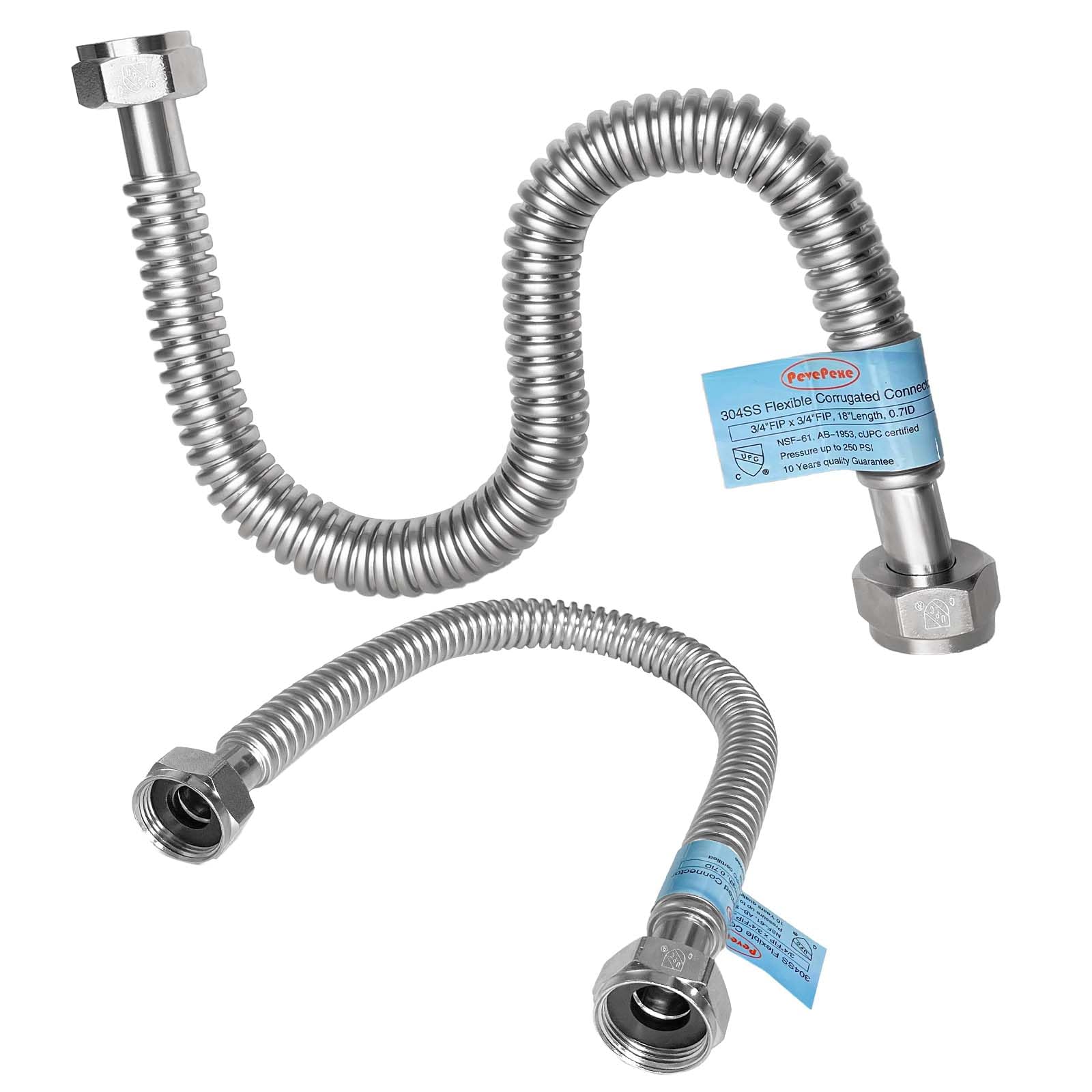
Two 24-inch hoses that shrug off 250 PSI without flinching.
If your setup involves a high-pressure booster pump or a tankless water heater that sees regular pressure swings, this PevePexe pair is the strongest stainless line here. It is rated at 250 PSI — a leap above the 180 PSI of the Eastman and the 160 PSI of the Supply Giant PEX. Each hose is 24 inches long with 1-inch FIP threads on both ends, and the inner diameter measures 0.95 inches, so flow is barely restricted. The 304 stainless steel corrugation resists corrosion and kinking better than zinc-plated alternatives.
Owners highlight the quality and fit — one called it “perfect fit” and another found it “easy to bend and sturdy.” The two-pack means you get both hot and cold sides in one order. The honest trade-off is that some buyers do not recommend these for long-term permanent installs; a few see it as a quick, cheap connection for a UV filter or a temporary line. The included gaskets and nuts seal well when you use Teflon tape, consistent with the general advice on stainless connectors.
Pressure king: At 250 PSI, this handles the most aggressive residential pressure environments — think well pump outputs or tankless expansion. The 24-inch length is useful when your ports are farther apart than the standard 12- or 18-inchers.
Best for: high-pressure water softener or tankless hookups where you want a dual-pack spare. Think twice if you need a permanent buried line — go with PEX for that job.
5. DAVCO 1″ ID Clear Vinyl Tubing, 50 ft

The see-through hose that keeps an eye on flow — at low pressure.
This is not a line for your main water supply. The DAVCO clear vinyl tubing is rated for only 30 PSI, making it a poor fit for direct connection to a household pressurised system. But for aquarium pumps, drip irrigation, condensate drains, or any low-pressure gravity-fed transfer, its transparency is a real advantage — you can see sediment, air bubbles, or flow blockages instantly. The inner diameter is exactly 1 inch, and the wall thickness is 3.2 millimeters with an outside diameter of 31.8 millimeters.
Owners call it “high quality” and “safe for aquarium usage” because it is BPA-free (bisphenol A-free, meaning no hormone-disrupting chemical) and non-toxic. The tubing works well for fish tank pumps and Oase filters, and it does not give off that sharp chemical smell. About 12 owners flagged a smell from the start, though it typically rinses out. It comes with two stainless clamps, though some buyers received the tubing without them, so check your package.
Low-pressure specialist: Excellent for aquarium supply lines, pond filters, and small-scale drip systems. Not suitable for any connection that sees household mains pressure — that 30 PSI rating is a strict limit.
Best fit: hobbyists and gardeners moving water at low pressure who need to see what is flowing. Keep it out of any pressurized plumbing system.
6. Happybuy Non-Barrier PEX Tubing 1 Inch X 300 Feet

Three hundred feet of PEX with a pipe cutter and clamps thrown in.
Radiant floor heating systems eat up a lot of tubing, and buying a 300-foot coil means fewer splices under the subfloor. This Happybuy PEX-B tubing has a minimum bending radius of 5 feet, which is enough for most staple-up and slab installations. The pressure capacity is 188 to 217 PSI at 20°C and holds temperatures from -47°F up to 230°F, so it handles both hot water heating loops and supply-line use. The wall thickness is 0.15 inches, slightly thicker than the Supply Giant’s 0.131 inches.
Owners rate the value for money as the top reason to buy — one called it “great PEX for the cost.” The kit includes a pipe cutter and 10 steel clamps, though no connectors or crimp fittings. The tubing is a bit stiff straight out of the coil; several reviewers point out you need to pin it down and let the sun warm it to straighten it. At 52.8 pounds for the full coil, it is heavy — not a one-hand carry item.
Big-project buy: Laying radiant heat across a whole floor or running a long supply line across acreage? This single 300-foot roll saves the hassle of joining multiple shorter coils like the Supply Giant. The included cutter is a nice bonus, but budget separately for fittings.
Meant for: large-scale radiant floor heating or commercial snow-melt systems. If you only need 50 feet for a small re-pipe, the 100-foot Supply Giant coil is a more practical choice.
Understanding the Specs
PSI — Pounds per Square Inch
PSI tells you how much pressure the pipe can take before bursting. Standard home water pressure is 40–80 PSI. A clear vinyl tube rated at 30 PSI will fail if connected to a main line; PEX at 160 PSI or stainless at 180-250 PSI is safe. For water heater connections, thermal expansion spikes can exceed 150 PSI, so a 180 PSI minimum is a good safety margin.
PEX-B vs PEX-A
Both are cross-linked polyethylene (a durable plastic), but PEX-A uses the Engel method and is more flexible, making it easier to bend around tight corners. PEX-B is stiffer and usually cheaper, and it is the type used in both the Supply Giant and Happybuy coils here. The real-world difference: PEX-B is fine for long straight runs but can be frustrating in tight 90-degree turns where PEX-A would bend by hand.
FIP and NPT threads
FIP stands for female iron pipe — threads on the inside of a nut. NPT is National Pipe Thread, the standard threading pattern used on North American plumbing fittings. When a product says “1 Inch FIP,” it means a female nut that fits a 1-inch male NPT nipple. The connector also uses a rubber gasket to seal without relying solely on the threads.
Working temperature range
Every water line has a temperature limit before the material degrades. PEX typically handles up to 200°F, stainless steel connectors up to 180°F, and PVC tubing much lower. For a water heater connector, a 180°F rating means it can touch the hot outlet without softening or leaking.
FAQ
Can I use a 1-inch flexible water line for a water heater?
What is the difference between PEX-B and PEX-A for a 1-inch water line?
Will a 1-inch FIP connector fit my standard shut-off valve?
How long does a stainless steel water line last?
Can I bury 1-inch PEX tubing underground?
What pressure rating do I need for a 1-inch water line?
Is clear vinyl tubing safe for drinking water?
Do I need a special tool to install PEX tubing?
Can I connect a 1-inch flexible line to a 3/4-inch pipe?
What does “non-barrier” mean in PEX tubing?
How do I prevent leaks at the threaded connection on a stainless steel connector?
Final Thoughts: The Verdict
Across the board, the 1 inch water line winner is the Supply Giant PEX-B 100-foot coil because it gives you a long continuous run at a strong pressure rating of 160 PSI, with the flexibility to handle whole-house re-pipes and well pump connections. If you need a short, high-pressure link for a water heater or softener, the Eastman 12-inch WaterFlex handles 180 PSI without any crimping or soldering. And for a massive radiant floor or snow-melt project, the Happybuy 300-foot PEX-B coil includes a cutter and clamps to get you started fast.
How We Picked
We do not accept paid placement. Every pick is matched to a real buyer and a real use-case; we do not hands-on test units.
Sources & Methodology
Specifications: manufacturer listings and product documentation. Review insights: verified customer reviews, as of July 2026. Pricing: not shown on this page (it changes often); check the current price via the retailer link.
As an Amazon Associate, Gadgets Feed earns from qualifying purchases. This does not affect which products we feature.