
Our readers keep the lights on and my morning glass full of iced black tea. As an Amazon Associate, I earn from qualifying purchases.
Specs are compiled from manufacturer listings and verified buyer reviews and can change over time — please confirm the key details on the product page before buying.
Bleeding brakes usually means one person pumping the pedal and another yelling “hold it!” from under the car. A 1 person brake bleeder kit removes that dance entirely by either pushing fluid in from the master cylinder or pulling it out at the caliper, so you can do the whole job alone in under an hour. This guide breaks down the top picks by their defining specs — vacuum versus pressure, tank size, and adapter coverage — so you can match a kit to your specific garage setup and vehicle.
I’m Min — the founder and writer behind Gadgets Feed. This guide is built by comparing the manufacturers’ published specifications and the patterns across verified customer reviews, so you get each pick’s real strengths and trade-offs instead of marketing spin.
From pneumatic vacuum extractors to manual pressure pumps, we’ve matched each model to the household or pro garage it actually suits. This is your straightforward read on the best 1 person brake bleeder kit options for a clean, solo fluid flush.
Our Picks at a Glance

How To Choose The Best 1 Person Brake Bleeder Kit
Before you buy, know which of the two main systems you actually want. Vacuum bleeders pull old fluid out at the wheel, while pressure bleeders push fresh fluid down from the master cylinder. Each has a different power source and a different feel in the driveway.
Vacuum vs. Pressure: Which Engine Fits Your Shop?
Vacuum kits like the FOUR UNCLES run off a pneumatic air compressor, so they are fast but demand an air source like a 6-gallon tank. Pressure bleeders are mostly manual — you pump a handle to build pressure in a sealed tank — so they work with zero air tools, but you are doing the pumping. A pressure system also tends to clear ABS and traction-control passages more reliably, which matters on modern cars.
Master Cylinder Adapter: The Fit That Makes or Breaks the Job
This is the part buyers get wrong. The pump can be brilliant, but if the cap on your master cylinder reservoir does not seal, you get leaks instead of bleeding. Kits ship with either a wide spread of adapters (16 pieces) or a single size like 45mm or 49.5mm. Measure your reservoir before ordering, and check whether the kit sells additional caps separately if yours is unusual.
Tank Capacity and Refills
A 2L tank covers most cars in one fill, while a 3L tank handles trucks or repeated flushes without stopping. The waste bottle size matters too — a 1L catch bottle is standard, but if you are flushing a big system you may empty it before the fluid runs clear.
Quick Comparison
| Model | Best For | System Type | Tank Capacity | Weight | Amazon |
|---|---|---|---|---|---|
| FOUR UNCLES 2L★ Best Overall | Air-powered fast flushes | Pneumatic Vacuum | 2L | 4.09 lbs | Amazon |
| 3L YEYETUOBudget Champion | Budget vacuum with big tank | Pneumatic Vacuum | 2L reservoir | 3.87 lbs | Amazon |
| Langawaser 3L | DIY at-home pressure bleeding | Manual Pressure | 3L | 3.81 lbs | Amazon |
| FAITIO 3L | Quick, clean single-person flushes | Manual Pressure | 3L | 3.89 lbs | Amazon |
| SMOTIVEPRO 3L | European car owners, notably BMW | Manual Pressure | 3L | 3.78 lbs | Amazon |
| OMT 2.5L | Classic GM and Chrysler vehicles | Manual Pressure | 2.5L | 3.1 lbs | Amazon |
| AGM 3L | ABS and modern brake systems | Compressor Pressure | 3L | 3.52 lbs | Amazon |
In‑Depth Reviews
1. FOUR UNCLES 2L Vacuum Brake Bleeder Pump Kit
Our pick — over 4★ from 500+ verified ratings; the strongest balance of quality and price.
The air-powered sprinter that turns a two-person brake job into a solo pit stop in record time.
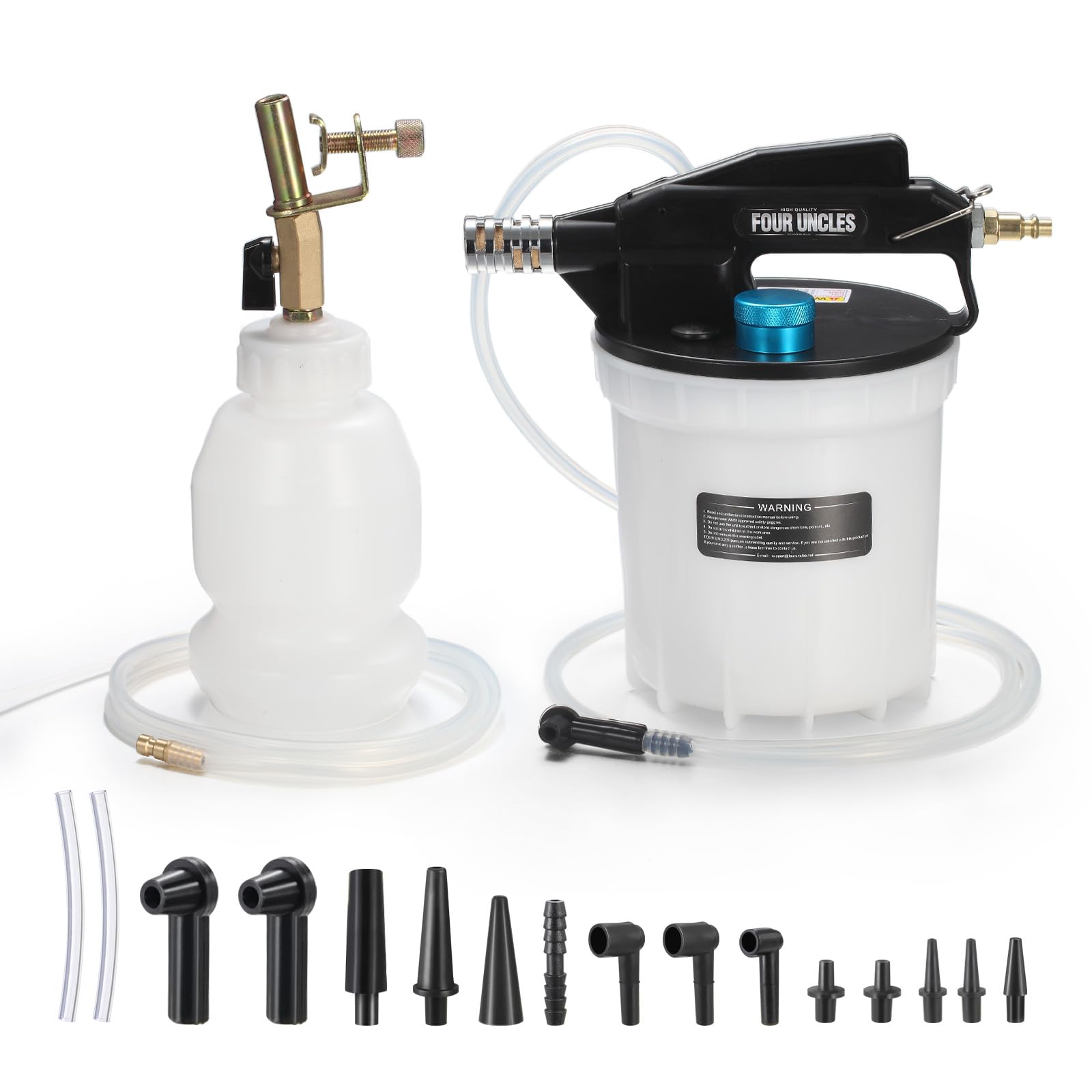
If you already own an air compressor, this pneumatic vacuum kit is the fastest route to a one-person bleed. Buyers report it can knock out all four corners in under 30 minutes per vehicle, thanks to a strong vacuum system that does the pulling while you work the bleeder screws. It comes with a 2L tank for old fluid, a 1L refill bottle, and two 60-inch silicone hoses that let you reach awkward calipers without contorting.
What wins people over is the sheer completeness and quality — the kit ships with 16 brake bleeder adapters covering cars, trucks, motorcycles, UTVs, ATVs, and hydraulic brake systems. The integrated silencer keeps the noise down in the garage, and the adjustable thumb throttle gives you fine control over the suction so you do not overshoot and suck air. A few owners note the fluid flow is a mixed bag depending on reservoir setup, and one reported a brass line connection failing after four uses — in that case support shipped a replacement immediately.
This kit asks for one thing in return: a compressor. An owner doing a solo flush on a BMW 540 confirmed it works great with a 6-gallon tank kept dry, bleeding one liter of DOT4 consistently, if a bit slowly with the jar markings being imprecise. As owners put it: “Strong vacuum, pneumatic, bleeds 4 corners <30 min/vehicle,” which captures the efficiency this tool delivers once the air is hooked up.
What Makes It The Crowd Favorite
- 16 adapters in the box cover nearly any street vehicle, from a BMW to a UTV
- Pneumatic suction with a thumb throttle gives precise, consistent bleeding
- 60-inch silicone hoses reach far calipers solo
- Known for responsive support when a fitting fails
What To Know Before Buying
- Requires an air compressor, ideally a 6-gallon tank, so it is not truly portable
- Fluid flow from some reservoirs is inconsistent and takes fiddling
- Jar markings are imprecise, so track levels with your own tape
The Fast Lane Pick: If your garage has an air line and you want the shortest possible bleed time, this is the kit to beat.
Look Elsewhere If: You have no air compressor and want a hand-powered tool that works anywhere.
2. 3L Brake Bleeder Kit by YEYETUO
A budget vacuum kit with a big 2L reservoir that survived four rough hours of daily abuse and kept running.
This value-oriented pneumatic kit pairs a 2L fluid reservoir with a 1L refill bottle and 16 bleed screw adapters for most models. At 3.87 pounds versus the FOUR UNCLES’ 4.09 pounds, the 2L tank cuts refill stops on big flushes. Inlet air pressure of 40-170 PSI gives you a wide window to match your compressor’s output.
Owners mention it handled a totally dry brake system without complaint, got dropped multiple times during roughly four hours of use, and still ran well — durability that punches above its price tier. One owner replaced an old Vacula brand kit and called it “the same thing but without the inflated price tag,” which sums up the value equation here. The kit even includes a 45-inch master cylinder evacuation hose specifically for bleeding at the master cylinder itself.
The honest catch is in the details. Container threads are stiff, and one owner had the fill bottle fail twice, letting air back into the system — frustrating if you rely on the bottle as shipped. Owners also note air bubbles around the bleeder screw are normal; the correct rhythm is open the bleeder, vacuum on, close the bleeder, vacuum off. It works daily as long as you respect that sequence and keep the compressor pressure up.
Value Verdict: It works on most vehicles, including an FJ Cruiser and a Tundra, at a price that undercuts the big names.
A Caveat: The fill bottle is the weak link; plan to replace it if you use this kit weekly.
3. Langawaser 3L Pressure Brake Bleeder Kit

A manual pressure tank that pushes fluid from above, ideal for the home mechanic with no air tools.
You can bleed your brakes alone without ever touching the pedal or plugging in a compressor. This kit uses positive pressure: you fill the 3L tank with fresh fluid, pump the handle to pressurize, and let the fluid’s weight push old brake fluid out at the calipers. The kit includes four precisely engineered master cylinder adapters: 43.5mm for Chrysler and Dodge, 45mm for most European vehicles, 49.5mm for GM and Mazda, and 50.7mm for late-model Ford and Nissan, plus a wrench for mess-free refills.
The easy-to-read pressure gauge and hanging chain let you work hands-free, a real win when you are alone under the car. One owner called it “a standout for brake bleeding” after it handled a dry system, survived multiple drops, and ran well for four hours. It also proved itself on a Honda manual hydraulic clutch with no soft pedal after a master and slave replacement — a demanding test the kit passed.
Pressure retention is where opinions split sharply. Some units refuse to hold pressure and leak at the cap fittings, with one buyer reporting fluid everywhere overnight and another noting the pressure vessel seals failed outright. A Mini Cooper owner found 29 PSI perfect but needed sealant on the rotating piece for a Mazda. Functionality earns the most praise here, so treat the adapters as the variable to verify against your own reservoir before the job.
The Right Fit: A dependable option for average garage DIY mechanics with a common domestic or European reservoir size.
Not For: Anyone whose master cylinder cap is an oddball size, since leakage at the cap is the recurring weak point.
4. FAITIO 3L Pressure Brake Bleeder Kit
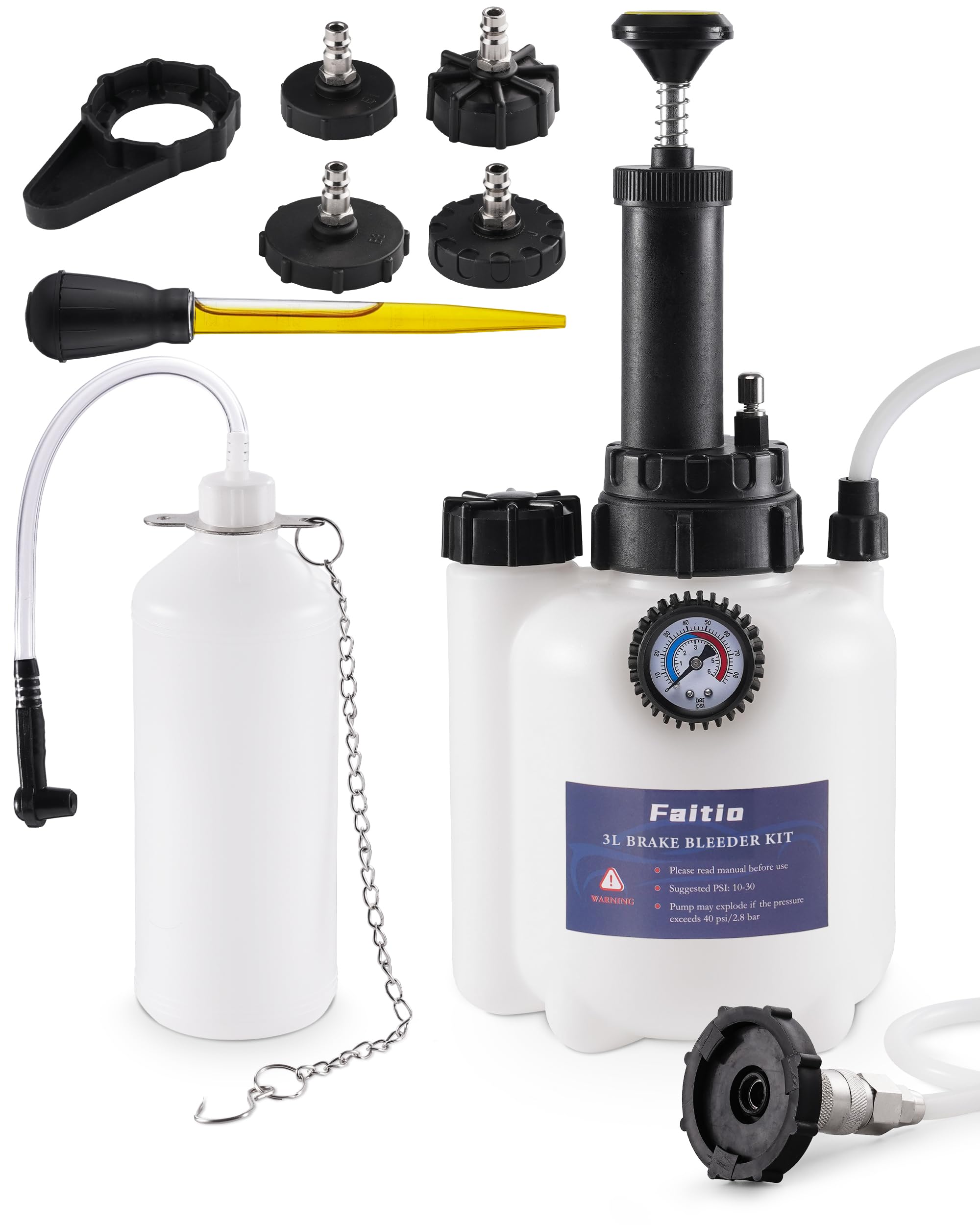
The translucent tank lets you watch fluid flow, turning a nerve-wracking flush into a visible, controlled process.
This 3L pressure bleeder stands out for its semi-transparent body, which lets you monitor the fluid level during the bleed so you know exactly how much has discharged at a glance. That simple design choice removes a lot of guesswork for a first-timer. It ships with upgraded adapter caps for 43.5mm, 45mm, 49.5mm, and 50.7mm reservoirs, and an ultra-thick, corrosion-resistant plastic bottle to cut down spill risk.
Owners describe it as solidly built and easy. One van owner praised it as the “easiest and cleanest brake flush ever” on a Chevy Express and GMC Savana — a two-person job turned solo by pumping roughly 40 times and opening the valve once until clean fluid ran. A 2017 BMW 430i owner finished a solo fluid exchange in about an hour, calling the build top-notch and the value excellent versus dealer pricing.
The recurring gripe is pressure maintenance. Several customers note the manual pump can’t hold steady pressure, and a second-use failure saw rubber fill gaskets leak severely in the engine bay, with the included fluid removal baster melting when exposed to DOT4 fluid. One owner converted to a vacuum system afterward. The usage guide says to pump to 10 PSI and press the brake pedal to flush, so factor in that the pressurization is the part that needs the most care.
Why It Wins Owners Over
- Semi-transparent tank makes fluid levels visible in real time
- Converts a two-person job into a clean solo operation
- Genuinely solid build for the price point
- Quick results, with a BMW flush done in about an hour
The Catch To Plan For
- Manual pump struggles to hold steady pressure for some owners
- Replacement gaskets and the baster can fail in real-world use
- Fit is not universal; measure your reservoir first
Pick This If: You want a clear view of the flush as it happens and own a common GM or BMW reservoir size.
Pass It Over: If you prefer a system that holds steady pressure without babysitting the pump handle.
5. SMOTIVEPRO 3L Manual Brake Bleeder Kit

Built specifically for European reservoirs with a 45mm E20 cap, this is the BMW owner’s shortcut to a firm pedal.
If you drive a European model, adapter fit is half the battle, and this kit attacks it directly with an E20 (45mm) master cylinder adapter made for most European vehicles. The 3L tank holds three liters of fluid, so a full system flush happens in one charge without refilling. A 60cm transparent hose gives you a clear view of the fluid as it moves.
The design refinements show a manufacturer paying attention: a shut-off valve with a 90-degree on/off rotation for quick flow control, a threaded pressure relief valve for more stable air pressure, and an aluminum alloy press part for stronger sealing against oil leaks. The heavy-duty, corrosion-resistant plastic is easy to clean and stable for home use. An owner bled two liters of fluid through a 2004 BMW M3 and 2013 X5 with minimal loss and flawless results.
No kit is perfect, and the pressure feedback here is genuinely mixed — some units build just enough, others report no pressure buildup at all. There’s a known issue where the waste bottle arrives airtight and needs a vent hole drilled, and the quick-disconnect o-ring wears out, causing leaks. Leakage is the most-discussed negative, so check the seals before a big job. An owner’s fix list was simple: drill the vent, swap the stiff extraction tube, and the value becomes unbeatable.
Best For: The DIYer with a BMW, Mercedes, or other European car who wants a matched 45mm cap and a big 3L tank.
Heads Up: Buyers whose reservoir is not 45mm will need a separate cap — it is not included, and support asks you to request it.
6. OMT 2.5L Pressure Brake Bleeder Kit
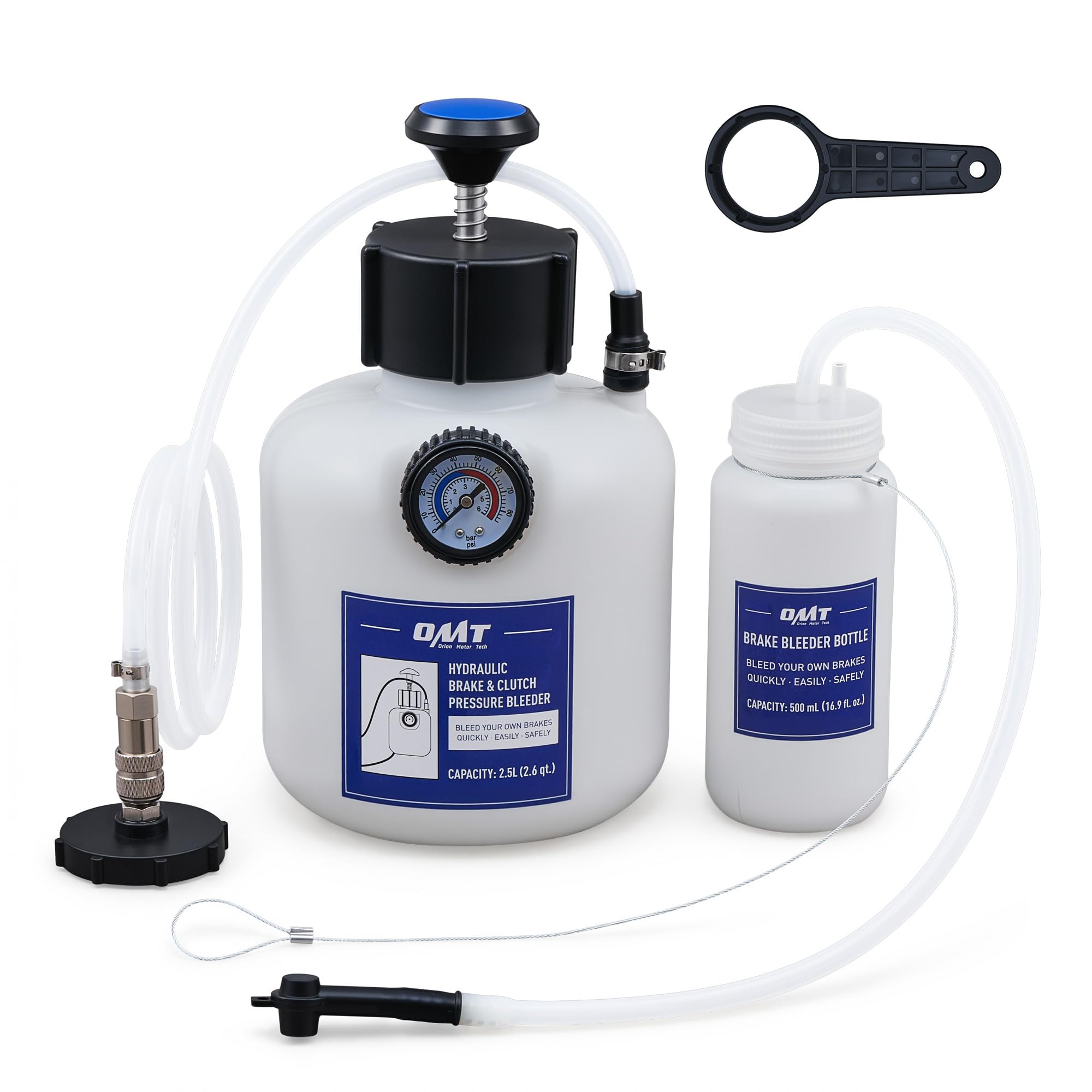
The lean pick for classic GM and Chrysler iron, pairing a 2.5L tank with a matched 49.5mm cap.
Orion Motor Tech built this one for the American garage, with a 49.5mm (1.9″) adapter that fits most GM models from 1992 onward, plus Saturn, Buick, Cadillac, Chevrolet, GMC, Chrysler Concorde LX, Oldsmobile, and Pontiacs. At 3.1 pounds versus the SMOTIVEPRO’s 3.78 pounds, it is noticeably easier to hoist and position, while still offering a 2.5L reservoir and a 500mL catch bottle.
The chemical-resistant polyethylene tank and silicone hoses are built to shrug off heat, wear, and corrosion, which is exactly what you want for a tool that lives near brake fluid. An owner running a 1975 Chevy K5 Blazer reported it held pressure, gave an accurate gauge reading, and delivered a firm pedal solo — exactly the result a classic-car owner is chasing after. Another bled all four wheels in about 20 minutes on a 1991 Ford Explorer once they worked out the cap quirk.
Pressure retention gets the most discussion here, and it is a mixed story rather than pure praise. Some owners hit leaks at 10 psi, and one had the master cylinder cap blow off and spray fluid when there was no vent valve. The fix is often mechanical: add washers to the wingnuts for a better seal, and clamp the adapter if it leaks initially. The universal adapter is tricky, but it does seal once you commit to tightening it properly.
Who It Is For: The GM or Chrysler owner who wants a lightweight, correctly-capped pressure bleeder for classic iron.
The Fit Note: Plan for some initial fiddling with the adapter seal — most owners solve it with washers and a clamp, not a return.
7. AGM Pressure Brake Bleeder 3L

The regulated compressor-driven system that clears ABS passages a vacuum pump simply cannot reach.
This is the system for modern cars. It connects to a standard air compressor and maintains steady pressure through the whole bleed, with an adjustable regulator and built-in gauge so you dial in exactly what your vehicle needs. The constant positive pressure pushes fluid and trapped air through the extra passages found in many ABS and traction-control systems — the very places a vacuum bleeder struggles. It out-performed a pneumatic vacuum bleeder that failed on a Baer Big Brake Kit, pushing out “tons of bubbles and old fluid” the vacuum could not.
The 3L reservoir handles most brake services without refilling, and the kit includes a catch bottle, syringe, and filler-cap wrench. Reviewers point out it has bled seven vehicles and completed four flushes over two years of service, keeping DOT4 fluid in the tank the whole time. The 15-30 minute time for four brakes, with endless pressure at the bleeders, is the consistent experience — one owner set the regulator around 15 PSI and opened the ball valve slightly to minimize relief valve leak.
The big (and intentional) catch: the master cylinder adapter is sold separately. The maker is upfront that reservoir designs vary so widely that paying for fittings you never use is wasteful — but you will need to budget for a vehicle-specific adapter or the Universal Adapter Kit. Also note that the plastic filler cap should be tightened by hand only. One owner who ignored the pressure limits had fluid rush into the engine bay, so respect the maximum pressure and always use a specific reservoir cap.
The Pro-Grade Case
- Regulated compressor pressure clears ABS and traction-control passages vacuum can’t reach
- 3L tank completes most services without a refill stop
- Endless steady pressure at the bleeders for a clean, firm pedal
- Built to last, with owners reporting years of reliable service
Plan For These
- Adapter sold separately, so budget for a vehicle-specific cap
- Needs an air compressor with a regulator; not hand-powered
- Overtightening the filler cap or exceeding pressure limits causes fluid spill
Choose This For: The modern garage tackling ABS-equipped vehicles or big brake kits that frustrate vacuum bleeding.
Reach Elsewhere If: You want one box with every adapter included and no air compressor on hand.
Understanding the Specs
PSI and Pressure Ratings
The pressure rating tells you how hard the system pushes fluid. A pneumatic kit like the YEYETUO operates in the 40-170 PSI range, while manual pressure kits work best at a modest 10-15 PSI. More PSI is not always better — too much pressure can blow a cap off and spray fluid, as some owners found. Match the pressure to your vehicle’s spec and watch the gauge.
Tank and Catch Bottle Capacity
The reservoir holds the fresh fluid that gets pushed or pulled through your lines, and the catch bottle collects the old stuff. A 2L reservoir covers most passenger cars in one fill, while a 3L tank handles trucks or multiple flushes. The catch bottle is usually 500mL-1L; if yours is 500mL, expect to empty it during a big flush.
Master Cylinder Adapter Fit
The adapter cap seals onto your master cylinder reservoir, and it must match your vehicle’s opening. Kits ship with a spread of sizes (like 43.5mm, 45mm, 49.5mm, and 50.7mm) or a single size. Measure your reservoir before buying, and check whether the kit sells extra caps separately, since fit is the most common source of leaks and frustration.
Silicone Hoses Length
Longer hoses let you reach calipers farther from the reservoir without wedging the tool awkwardly. A 60-inch hose is the comfortable standard for a vacuum kit, giving you slack to work around the wheel well. Shorter master-cylinder evacuation hoses serve a different job: pulling fluid directly from the reservoir itself.
FAQ
Can I really bleed brakes alone with these kits?
Do I need an air compressor for a vacuum brake bleeder?
How do I know which master cylinder adapter size I need?
What PSI should I set a pressure bleeder to?
Why do I see air bubbles when bleeding even with a new kit?
Will a pressure bleeder work on ABS and traction control systems?
How long does a brake bleed take with a one-person kit?
Is a vacuum bleeder better than a pressure bleeder?
Final Thoughts: The Verdict
For most buyers, the strongest 1 person brake bleeder kit to start with is the FOUR UNCLES 2L because it pairs a 16-adapter spread with fast pneumatic suction and a proven record of finishing all four corners in under 30 minutes. If you own an air compressor, this is the one that pays for itself in time saved. If you drive a European car and want a matched 45mm cap with a big 3L tank, grab the SMOTIVEPRO. And for the modern garage with ABS-equipped vehicles, the compressor-driven AGM 3L is the system that clears passages a vacuum pump simply cannot reach.
How We Picked
We do not accept paid placement. Every pick is matched to a real buyer and a real use-case; we do not hands-on test units.
Sources & Methodology
Specifications: manufacturer listings and product documentation. Review insights: verified customer reviews, as of August 2026. Pricing: not shown on this page (it changes often); check the current price via the retailer link.
As an Amazon Associate, Gadgets Feed earns from qualifying purchases. This does not affect which products we feature.