
Our readers keep the lights on and my morning glass full of iced black tea. As an Amazon Associate, I earn from qualifying purchases.
Specs are compiled from manufacturer listings and verified buyer reviews and can change over time — please confirm the key details on the product page before buying.
Plumbing a 1-inch line usually ends in one frustrating moment: you glue a valve in, and later realize you need to swap it out — but it’s permanently fused to the pipe. A threaded union solves that by letting you unscrew the joint cleanly, and a slip wye or tee lets you branch water or conduit without wrestling with bulky metal boxes.
I’m Min — the founder and writer behind Gadgets Feed. This guide is built by comparing the manufacturers’ published specifications and the patterns across verified customer reviews, so you get each pick’s real strengths and trade-offs instead of marketing spin.
Every fitting here is rated for potable water service and built to handle real pressure, which is exactly what you should demand from any 1 pvc fittings purchase for a permanent install.
Our Picks at a Glance

How To Choose The Best 1 PVC Fittings
Before you order, you need to know whether the pipe you are connecting is schedule 40 or schedule 80 — the wall thickness differs, and mixing them carelessly can create a weak joint under pressure. You also need to decide if you want a slip (socket) fitting that glues over the outside of the pipe, or a threaded one that screws onto a male thread.
Socket vs. Threaded Connections
A socket fitting slides over the end of the pipe and is secured with PVC cement — this is a permanent, leak-proof joint that you cannot take apart later. A threaded fitting screws onto a male-threaded pipe or adapter, which makes it removable but requires thread sealant tape or paste to guarantee a watertight seal. If you are installing a ball valve that may need replacing, a threaded union is the smarter choice because you can unscrew it instead of cutting the pipe.
Schedule 40 vs. Schedule 80
Schedule 80 has a thicker wall than schedule 40, so it handles higher pressure and resists impact better — that is why it is often specified for industrial and commercial lines. Schedule 40 is lighter, cheaper, and perfectly fine for most residential drainage and low-pressure water work. Both can handle a maximum operating temperature of 140 degrees F, which matters if the line carries hot water.
Quick Comparison
In‑Depth Reviews
1. NDS U-1000-T PVC Pipe Fitting, 1-Inch Threaded Union, Schedule 80
Our pick — over 4.5★ from 100+ verified ratings; the strongest balance of quality and price.
The unscrewable link that saves you from destroying a glued valve later
This gray union is the fitting you reach for when you know a valve or pipe section will need service someday. It screws together so you can separate the line cleanly, which beats a coupling when maintenance is a priority — the whole point is easy removal without cutting PVC. It is built from schedule 80 PVC, so it is rated for high-pressure residential and commercial water flow management, and it works with schedule 40 pipe too if that is what your run uses.
The o-ring is what makes the seal trustworthy: a black EPDM ring sits in the joint to stop leaks at the connection point. Because it is NSF certified and low-lead approved, it is safe for drinking water lines — not just drainage. Owners describe the build as well-made and heavy duty, and the installs go quickly, with the most common praise being that it is exactly what was ordered and fast to fit.
The one honest catch here is branding: it is a quality NDS part, but some buyers expected a King Brothers Industries union based on the listing photos, and it did not thread together with their existing KBI piece. If you are matching an old union from another brand, check the threads before committing — otherwise it is a solid, leak-free component.
Why it earns the top spot
- EPDM o-ring forms a positive seal against leaks at the joint
- Schedule 80 construction holds up in high-pressure water lines
- NSF certified for potable water with low-lead approval
Who should think twice
- Brand mismatch risk if you need to join an existing KBI union
- Threaded install needs sealant tape for a guaranteed watertight fit
Best for: anyone installing a valve or pump they will need to remove again — this is the maintenance-friendly pick.
Look elsewhere if: you are trying to extend an existing union from another manufacturer and cannot verify thread compatibility.
2. Spears 475 Series PVC Pipe Fitting, Wye, Schedule 40, 1″ Socket
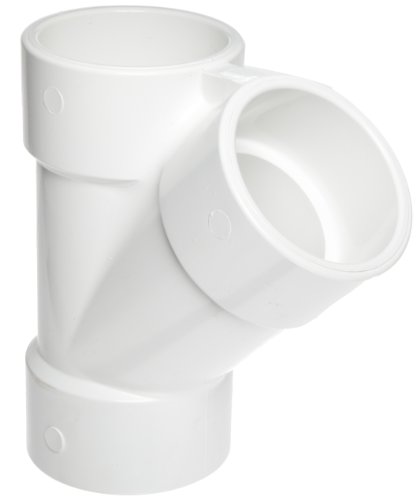
The three-way splitter that keeps flow moving at a gentle angle, not a sharp turn
This white wye gives you three socket openings so you can glue in three male pipes and branch a line without choking the flow the way a hard 90-degree tee can. The gentler angle matters for drainage and for anything carrying solids, since water keeps momentum instead of slamming into a wall. Each end is a socket, meaning you slide the pipe in and solvent-weld it for a permanent, leak-free joint — and buyers confirm it fits standard 1-inch PVC pipe snugly with no leaks once installed.
It is schedule 40, the lightweight workhorse grade that resists chemicals and corrosion while weighing less than metal fittings, and it carries the same 140 degrees F maximum operating temperature as heavier options. Because it is NSF certified for potable water service and meets ASTM D1784 and D2466 standards, you can trust it in a drinking-water line. It measures 6 x 4 x 6 inches, giving you room to work a gloved hand around the joint during assembly.
Buyers report it “fits perfectly 1″ pvc pipe, already installed in not leaks at all,” so you can trust it to seal a 1-inch wye branch without fuss. The only grumbles are about price — some owners call it overpriced for a simple fitting — but if your local plumbing store has no 1-inch wye in stock, this part rescues a stalled project, whether that is a 125-gallon fish tank setup or a home drain line.
Flow-friendly design: the wye angle keeps water moving smoothly through the branch, unlike a restrictive square tee.
The catch: it is a glue-in socket only — once cemented, there is no unscrewing it without cutting the pipe.
3. Spears 801 Series PVC Pipe Fitting, Tee, Schedule 80, 1″ Socket

The compact schedule 80 tee that cleans up conduit runs where boxy fittings look awful
This gray tee is the heaviest-duty of the three picks, built from schedule 80 PVC with thicker walls than the schedule 40 wye above, so it shrugs off higher pressure and rougher handling. At just 4.16 ounces and 4 x 3 x 1.75 inches, it is noticeably smaller and lighter than you might expect for a fitting this strong — which is exactly why it shines in tight spaces. It gives you three socket openings to glue three male pipes into a clean T-branch.
Beyond water lines, this slip tee earns its keep in electrical work: owners use it to build far cleaner EMT conduit runs than the boxy metal tees at hardware stores, like on a boat lift where a low-profile plastic branch keeps the install tidy. It is NSF certified for potable water service (safe for drinking-water lines) and meets ASTM D1784 and D2467 standards (material and dimensional quality benchmarks), and the 140 degrees F maximum operating temperature matches the wye above, so it handles hot-water lines up to that heat.
Reviewers repeatedly call it good quality at a fair price, with several noting they could not find a 1-inch slip tee at any local big-box or hardware store — this was the part that finished their job. If your project calls for schedule 80 thickness (a thicker, stronger wall than schedule 40) or you want a fitting that disappears neatly into a conduit layout, this tee is the one to grab.
Reach for this if: you need schedule 80 wall strength in a compact slip tee that also handles conduit and electrical runs neatly.
A fair warning: like any socket fitting, the glue joint is permanent — plan the layout before you cement it.
Understanding the Specs
Slot vs. Threaded: Permanent or Removable
A socket, or slip, fitting slides over the outside of the pipe and is fixed with PVC cement — this creates a permanent bond that will not leak but cannot be disassembled. A threaded fitting screws onto a male thread, so you can take the joint apart later, but it needs thread sealant tape or paste to guarantee a watertight seal. Choose slip for a finished, never-touch-again install and threaded when you know a valve will need future service.
Schedule 40 and Schedule 80 Wall Thickness
The schedule number tells you the wall thickness of the fitting: schedule 80 is thicker and stronger than schedule 40, so it handles higher pressure and more impact, while schedule 40 is lighter and cheaper for routine residential drainage and low-pressure water. Both types shown here carry a 140 degrees F maximum operating temperature and NSF certification for potable water, so either is safe for drinking-water lines.
FAQ
Can I use a schedule 80 fitting with schedule 40 pipe?
What is the difference between a wye and a tee fitting?
Why would I choose a threaded union over a glued coupling?
Are these fittings safe for drinking water?
What does socket mean on a PVC fitting?
Can I use these fittings for hot water lines?
Will a 1-inch slip tee work for electrical conduit?
How do I make a threaded union leak-proof?
Final Thoughts: The Verdict
For the majority of shoppers, the 1 pvc fittings winner is the NDS Threaded Union because its EPDM o-ring (a rubber seal that resists water and wear) and schedule 80 build make it the fitting you can rely on in a high-pressure line — and unscrew when maintenance calls. If you need to branch a drainage or water line at a smooth angle, grab the Spears Wye. And for a compact schedule 80 tee that cleans up conduit runs and tight spaces, the Spears 801 Tee is the one to reach for.
How We Picked
We do not accept paid placement. Every pick is matched to a real buyer and a real use-case; we do not hands-on test units.
Sources & Methodology
Specifications: manufacturer listings and product documentation. Review insights: verified customer reviews, as of September 2026. Pricing: not shown on this page (it changes often); check the current price via the retailer link.
As an Amazon Associate, Gadgets Feed earns from qualifying purchases. This does not affect which products we feature.