
Our readers keep the lights on and my morning glass full of iced black tea. As an Amazon Associate, I earn from qualifying purchases.
Specs are compiled from manufacturer listings and verified buyer reviews and can change over time — please confirm the key details on the product page before buying.
If your driveway has a hairline crack running through it, the right 1-quart bottle will seal it in a single afternoon — and the wrong one will leave you with a runny gray mess that never hardens. The picks below fall into two honest groups: pourable liquids that flow into narrow cracks and pre-mixed pastes that you trowel into holes and surface chips. Match the form to the damage — liquid for narrow cracks, paste for holes and vertical faces — and the rest of the spec sheet matters far less.
I’m Min — the founder and writer behind Gadgets Feed. This guide is built by comparing the manufacturers’ published specifications and the patterns across verified customer reviews, so you get each pick’s real strengths and trade-offs instead of marketing spin.
Before you scroll, know how this list is built: it uses flexible matching on the 1-quart container size, so a listing that offers 1 qt as a selectable option counts — not every pick is the exact number you typed. A few of these are pourable fillers rather than trowel-on patch (the kind you spread with a flat tool), and one is sold at a bulk price. Every entry below still does the same core job on the same kind of damage, so check the form and the crack width before you commit. These are the strongest 1 qt concrete patching compound options you can buy without overthinking it.
Our Picks at a Glance


How To Choose The Best 1 Qt Concrete Patching Compound
Buying the wrong bottle usually means grabbing a liquid for a hole or a paste for a hairline crack. Concrete repair splits into two jobs — narrow cracks and holes or surface defects — and each wants a different product form. Get that one call right — liquid for narrow cracks, paste for holes and vertical faces — and the rest of the spec sheet matters far less.
Liquid or paste — match the form to the damage
A pourable liquid is built for narrow cracks. It flows down into the gap and fills from the bottom up, which is what you want on a hairline split in a sidewalk or a driveway joint. A pre-mixed paste is built for holes, chips, and surface defects, where you need something that stays where you trowel it. Using a paste on a narrow crack means it bridges the top and leaves a void underneath. Using a liquid on a wide hole means it drains away before it sets.
Crack width is the number that decides it
Check the width of your damage before you buy anything. Some pourable fillers are rated for cracks up to 1/4 inch deep and 1/4 inch wide, which covers most driveway and patio splitting. Anything wider than that wants a patching paste you can pack in. Measure the gap with a tape or compare it to a coin — a crack you can slide a dime into is usually still liquid-filler territory.
Drying time and cure time are not the same thing
A bottle that says it dries in 1 hour is telling you when you can walk near it. It is not telling you when you can drive on it or paint it. Several products here list a full cure time measured in hours or days, and that is the number that governs when the repair is truly finished. Plan your job around the cure time, not the dry-to-touch time, especially if rain is coming.
Color and blend matter more than you think
Grey varies from slab to slab, so a sealer that cures lighter or darker leaves a visible scar. A sealer that cures lighter or darker than the slab leaves a visible scar, and that is the complaint that shows up most in the color feedback on these bottles. On a driveway you see every day, that mismatch is the difference between a repair you forget about and one you notice every morning.
Quick Comparison
| Model | Best For | Form | Rated Crack Size | Cure / Dry Time | Amazon |
|---|---|---|---|---|---|
| Quikrete 946mL Grey Concrete Crack Seal★ Best Overall | Sidewalk and patio cracks | Liquid | — | — | Amazon |
| Drylok 4311-4719 Pourable Masonry Crack FillerGreat All-Rounder | Driveways and sidewalks | Paste (pourable) | — | 24 hours full cure | Amazon |
| Akona Pre-Mixed Concrete and Stucco Patch | Holes and surface defects | Putty | — | 7 days full cure | Amazon |
| Akona Gray Pourable Concrete Crack Filler | Narrow cracks up to 1/4 inch | Liquid | 1/4 in deep, 1/4 in wide | 1 hour dry | Amazon |
| DAP 1 qt. Gray Pre-Mixed Concrete Patch | Vertical and overhead repairs | Paste | — | — | Amazon |
In‑Depth Reviews
1. Quikrete 946mL Grey Concrete Crack Seal
Our pick — 4.0+★ from 600+ verified ratings; the strongest balance of quality and price.
The bottle you can pour straight into the crack and walk away from.
Quikrete solves the laziest possible version of this job, and that is exactly why it wins. There is no mixing, no trowel, and no bucket to clean — you tip the bottle and the sealer runs down into the gap on its own. It is made for cracks in concrete sidewalks, patios, and driveways, which covers the overwhelming majority of what a homeowner actually needs to fix. The rubber-based mix cures grey to blend with the slab rather than sitting on top as a bright stripe.
What keeps people coming back is simply that it works as described. That is the top thing buyers respond to in the feedback on this bottle, comfortably ahead of every other theme — it flows where it should, and it seals. Quick drying lands second, and it matters: you pour in the morning and by afternoon you are not worrying about a rain cloud. At 3.6 pounds for the bottle, it is easy to carry around the yard while you hunt down cracks.
Here is the honest catch, and it is worth reading twice. This stuff is genuinely runny. The feedback on consistency, spreadability, and texture all lean mixed, and one shopper memorably described the result as “gray water” — meaning on a sloped surface it will keep moving instead of sitting still. Pour in thin passes and let each one set rather than flooding the crack. The nozzle is also the weak point in the durability feedback, with breakage showing up often enough that you should treat the cap gently and store the bottle upright between jobs.
Where this bottle earns its keep
- Zero mixing — pour straight from the bottle into the crack
- Grey finish that blends with the natural color of concrete
- Quick-drying formula so the repair is set the same day
- Light 3.6-pound bottle that is easy to carry around the property
Where it fights back
- Very liquid and runny — it will drift on any slope
- The nozzle is the fragile part; breakage shows up in the feedback
- Color consistency draws complaints on some slabs
Grab this one for: sidewalk, patio, and driveway cracks where you want to pour and be done, no tools involved.
Think twice for: a sloped surface or a wide gap — the thin mix will run before it sets.
2. Drylok 4311-4719 Pourable Masonry Crack Filler
A pourable filler that behaves more like a paste — and that is both the point and the problem.
Drylok takes a different route than the Quikrete bottle. It is labeled pourable, but it lists its item form as paste, which means it has more body and does not run away from you the instant it leaves the container. If you have ever watched a thin sealer slide down a sloped driveway, that extra thickness is the feature you are paying for. Coverage extends to driveways and sidewalks, and the whole quart is designed to be poured rather than troweled.
The standout spec is the 24-hour full cure time. That is a real, checkable number — you pour it, and inside a day the repair is fully set rather than merely dry to the touch. Faster than that, the feedback on drying puts the working time at about half an hour, which lines up with what a quick-setting masonry filler should do. Effectiveness is the theme buyers return to most in the reviews here, and it makes sense: on driveways and sidewalks the filler does what it was bought to do, without ceremony.
The part nobody mentions on the label is sagging. During curing, the filler can slump within the crack instead of holding a flush surface, so on a deep gap expect to top it up after the first pass rather than filling it once and forgetting it. The broader quality and durability feedback splits in two directions — plenty of people are happy, and some are much less so — so this is the pick for a straightforward pour, not a precision finish job.
The trade-off in one line: you get a thicker, more controllable pour and a full cure inside 24 hours, but you trade a perfectly flush top for the ability to keep the material where you put it.
Who it quietly suits: someone filling a run of sidewalk or driveway seams who wants body in the mix and does not need a showroom surface.
Right pick when: you want a pourable filler with more grip on a slope and a clear one-day cure to plan around.
Skip if: the crack is deep and you want a single-pass flush fill — plan on a second top-up.
3. Akona Pre-Mixed Concrete and Stucco Patch
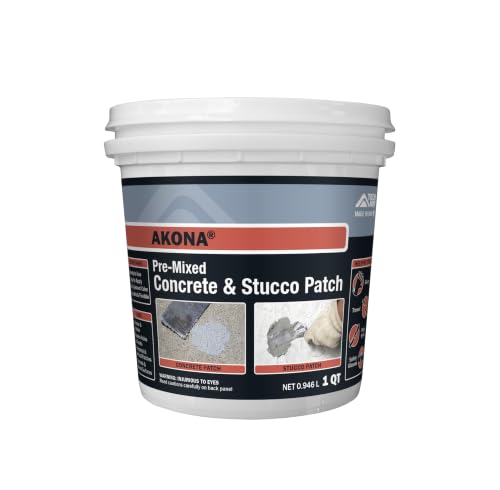
The one that stays put on a wall instead of draining out of the hole.
Everything above this point pours. This Akona does not — it is a putty, and that single fact changes which jobs it can take. It is built for minor cracks, holes, and surface defects in concrete or masonry, and the spec sheet promises superior adhesion indoors or outdoors and on vertical or horizontal surfaces. A vertical repair is the acid test here: a liquid filler simply runs out of a wall or a foundation crack, while this paste stays where you press it. The 1-quart pail yields approximately 3 square feet at 1/8 inch thickness, so you can estimate coverage before you open it.
Effectiveness is the quality buyers talk about most with this patch, with ease of use close behind. That combination tracks the product’s pitch — it is ready to apply straight from the pail with no mixing, so the barrier to entry is low. On cement block walls specifically, the patch does the job without a fuss.
The number that will surprise you is the cure time: a full 7 days before it is done, and paintable only after that full cure. Plan a week of patience into any repair you intend to paint or seal. And note that this listing tends to arrive at a higher price than the liquid fillers, so you are paying for the vertical-capable form, not for more volume. If your damage is a flat crack in a sidewalk, the cheaper pourables do the same work.
Why it lands here: vertical and overhead repairs are where a putty beats every liquid on this list, and this one is pre-mixed and ready to press in.
The patience tax: 7 days to full cure is the longest wait on this list, so do not schedule a paint coat for the same weekend.
Reach for this if: the damage is a hole, a chip, or a crack in a wall or foundation face where a pourable would slide right out.
Look elsewhere if: you are patching a flat sidewalk crack and want a same-day finish.
4. Akona Gray Pourable Concrete Crack Filler
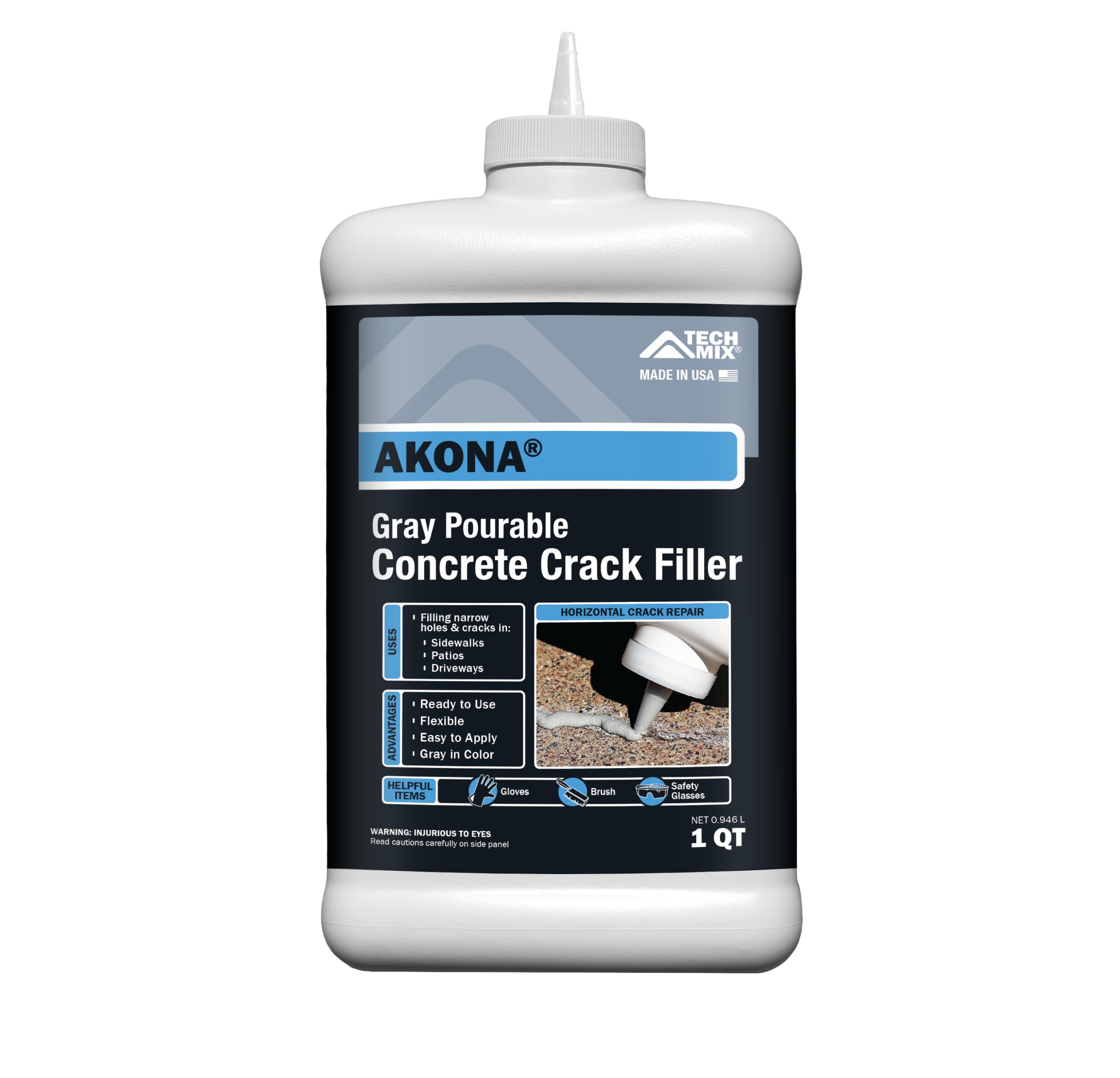
One hour to dry, and a rated limit of a quarter inch in both directions.
If speed is your whole reason for buying, this is the bottle to look at. It dries in 1 hour — the shortest dry time on this list by a wide margin — so a morning repair can be walked on before lunch. It is also the only pick that states its working limit plainly: ideal for cracks up to 1/4 inch deep and 1/4 inch wide. That number is genuinely useful, because it tells you up front whether your crack is in scope or if you need a paste instead. Shake gently, clip the tip, and go — no prep required.
On size and weight, this is the lightest serious option here. It measures 2.25 x 4.75 x 9.5 inches and weighs 3 pounds, against the DAP paste at 15.3 x 5.1 x 4.9 inches and 10.8 pounds — a far smaller, far lighter bottle to carry around the property. Synthetic rubber construction with an ASTM standard listed rounds out the spec sheet, and it is rated for driveways, sidewalks, patios, steps, garage floors, and above-ground foundations.
Now the part that keeps this off the top spot. The feedback on this bottle is genuinely split, and the value question is where it bites hardest — a meaningful share of buyers feel the bottle does not deliver enough for what it asks. Crack absorption and ease of use both draw mixed reactions rather than consistent praise. It is the right tool for a narrow, shallow crack where the one-hour dry is a real advantage. Treat it as a quick fix for a specific job, not as the one bottle for everything.
The fast-dry advantage
- Dries in 1 hour — walk on it the same morning
- Clearly rated for cracks up to 1/4 inch deep and 1/4 inch wide
- Only 3 pounds and compact — easy to handle on a ladder or a step
- No prep: shake, clip the tip, pour
The honest hesitation
- Split feedback on overall quality and on value
- Crack absorption draws mixed reactions, not consistent praise
- The 1/4 inch limit rules out wider damage outright
Best fit: a narrow, shallow crack in a step, patio, or garage floor where you need it dry today.
Not the pick for: wide or deep damage — the quarter-inch limit is a hard ceiling, not a suggestion.
5. DAP 1 qt. Gray Pre-Mixed Concrete Patch
A dense, water-resistant paste with real weight behind the trowel.
The first thing you notice about this DAP tub is the heft. It weighs 10.8 pounds and measures 15.3 x 5.1 x 4.9 inches, against the Akona pourable at 3 pounds and 2.25 x 4.75 x 9.5 inches — so this is a genuinely different animal, a thick paste rather than a pour. That weight is the mix talking: it is dense enough to press into a repair and hold its shape. It is pre-mixed, it lists water resistance, and it is aimed at making a repair look like new rather than merely sealing it.
Ease of use is the theme that comes through loudest in the feedback on this tub, and it lines up with the design — scoop it out and work it in, no bucket or mixing paddle involved. Appearance draws praise too, which is the point of a patching paste: on a visible slab, the repair should blend rather than announce itself.
Be realistic about two things before you buy. First, drying is the mixed one: some repairs set quickly, others take a long time to fully dry, so do not schedule anything around a fixed guess. Second, the consistency sits closer to putty than to concrete, and it can stay on the soft side. That softer body is actually helpful on a vertical patch where you need it to cling, and less helpful if you expected a rock-hard finish. This is a bulk-priced listing, so it makes the most sense for someone with several patches to fill rather than a single hairline crack.
Where it shines: a dense, water-resistant paste that spreads easily and blends visually — the pick for making a repair disappear.
What to expect: a putty-like consistency that can stay soft longer than you would guess, and a drying time that varies from batch to batch.
Worth it for: a batch of visible surface patches where blending and water resistance matter more than a rock-hard set.
Pass on it for: a single narrow crack — the pourables above handle that with less material and less waiting.
Understanding the Specs
Form: Liquid vs Paste vs Putty
The form tells you what the product can physically do. A liquid flows down into a narrow crack and fills from the bottom, which is what a sealer is for. A paste or putty stays where you press it, so it handles holes, chips, and vertical faces. Buying a liquid for a wall repair means it drains out; buying a paste for a hairline crack means it caps the top and leaves a gap underneath. Match the form to the shape of the damage and the rest of the spec sheet matters far less.
Cure Time vs Dry Time
Dry time is when the surface stops being wet. Cure time is when the material has fully set and can take paint, traffic, or weather. They can be very different — one filler here dries in 1 hour, another lists a 24-hour full cure, and a third needs a full 7 days before it is done. Read both numbers and plan the job around the longer one, especially if rain is in the forecast or you intend to paint over the repair.
Coverage and Weight
Two bottles can both hold 1 quart and weigh wildly different amounts. That gap tells you how dense the mix is. A 10.8-pound tub is a thick paste you scoop and trowel; a 3-pound bottle is a thin pourable you tip and pour. Neither is better in the abstract — heavier means more body and better vertical hold, lighter means easier handling and better flow into a narrow gap. Check the yield figure too, which tells you roughly how much surface a quart will cover at a given thickness.
Crack Width Ratings
A stated crack rating is the most useful number on any of these labels, because it draws a hard line around what the product will do. One filler here is rated for cracks up to 1/4 inch deep and 1/4 inch wide — beyond that, the material cannot bridge or fill properly and you need a paste you can pack in. If a label does not state a width, measure your crack and lean toward a paste for anything wider than a quarter inch.
FAQ
Can I use a pourable crack filler on a wall instead of a flat slab?
How wide a crack can a 1 quart concrete patching compound fill?
What is the difference between dry time and full cure time on these products?
Will the patch match the color of my existing concrete driveway?
Can I paint over a concrete patch and how soon?
Why does one 1 quart bottle weigh 3 pounds and another weigh 10.8 pounds?
Do I need to prep or clean the crack before pouring?
Is a pre-mixed patch as strong as mixing concrete from powder?
Will a 1 quart bottle be enough for my whole driveway?
Can I use a concrete patch on brick or stucco?
Final Thoughts: The Verdict
For most people fixing a crack in a sidewalk, patio, or driveway, the Quikrete 946mL Grey Concrete Crack Seal is the one to buy — it pours straight from the bottle, needs no tools, and dries quickly enough to finish the job in a day. It is the crowd favorite of this group because it pours straight from the bottle, needs no tools, and dries fast enough to finish in a day. If you want more body in the mix and a clear 24-hour cure to plan around, the Drylok Pourable Masonry Crack Filler is the next step up. And if your damage is a hole or a crack on a vertical face, skip the liquids entirely and grab the Akona Pre-Mixed Concrete and Stucco Patch, which is the only pick here built to stay put on a wall.
How We Picked
We do not accept paid placement. Every pick is matched to a real buyer and a real use-case; we do not hands-on test units.
Sources & Methodology
Specifications: manufacturer listings and product documentation. Review insights: verified customer reviews, as of November 2026. Pricing: not shown on this page (it changes often); check the current price via the retailer link.
As an Amazon Associate, Gadgets Feed earns from qualifying purchases. This does not affect which products we feature.