
Our readers keep the lights on and my morning glass full of iced black tea. As an Amazon Associate, I earn from qualifying purchases.
Specs are compiled from manufacturer listings and verified buyer reviews and can change over time — please confirm the key details on the product page before buying.
A 1 ton arbor press solves one very specific problem: getting smooth, controlled downward force onto small parts without a hammer. That matters most for bearing seats, fret jobs, leather punches, rivets, and stamping — anywhere a hammer smears the edge or sends a part skittering across the bench. The seven picks below split between budget-friendly, mid-range, and premium tiers, and each one is judged on the two things that actually decide a purchase here: usable height under the ram, and the weight and steadiness of the frame once it is bolted down.
I’m Min — the founder and writer behind Gadgets Feed. This guide is built by comparing the manufacturers’ published specifications and the patterns across verified customer reviews, so you get each pick’s real strengths and trade-offs instead of marketing spin.
Capacities in this class all read 1 ton on paper, yet the real differences hide in shorter working strokes, ratcheting versus plain levers, and how much cleaning a fresh unit demands before first use. This breakdown of the 1 ton arbor press covers every finalist, its honest trade-offs, and who each one suits.
Our Picks at a Glance

How To Choose The Best 1 Ton Arbor Press
An arbor press turns a long handle into slow, straight-line force — a gear rack and pinion converts your arm swing into a downward push on the ram (the sliding shaft that actually touches your work). That basic mechanism is identical across every press here, so the real differences come down to working height, handle type, and frame weight.
Start with the height under the ram, not the tonnage
The number that decides most jobs is the maximum height — the clear space between the ram tip and the anvil plate where your workpiece sits. Bearing drivers, fret cauls, and stacked stamping plates all need room. A press with a taller opening swallows bulkier assemblies; a short one forces you to build spacers. This single figure separates several of the picks below more than capacity ever does.
Plain lever or ratcheting handle
A standard lever gives you one continuous squeeze and the most direct feel for the work. A ratcheting handle lets you pump the ram down in short strokes, which helps when you cannot reach the end of a long swing in a tight spot. Both approaches work; the trade-off is feel versus convenience, and you should confirm the mechanism actually matches the listing before you commit.
Weight is a feature, not a flaw
A heavier frame sits still when you lean into the handle. Lighter units slide, twist, or lift at the back unless they are clamped or bolted down. Every press here benefits from being fixed to a bench or a thick board — factor that mounting step into your setup, because it is the difference between a controlled press and a wrestling match.
Quick Comparison
| Model | Best For | Max Height | Frame Weight | Anvil / Base | Amazon |
|---|---|---|---|---|---|
| VEVOR Arbor Press, 1 Ton Manual★ Best Overall | All-round workshop pressing | 5.9″ working stroke | 23 pounds | 3.5″ four-hole steel anvil plate | Amazon |
| PNBO 1 Ton Manual Arbor PressBest Value | Fret and mosaic work on a budget | 5.5in / 140mm | 10.94 kg | Slotted movable steel anvil | Amazon |
| PNBO Ratchet Leverage Arbor Press | Two-handle alignment jobs | 5.5in / 140mm | 11.73 kg | Slotted movable anvil plate | Amazon |
| NOOBECR Central Machinery Arbor Press | High-leverage metal bending | 5-1/2″ | — | 1″ ram square, 20:1 leverage | Amazon |
| KAKA INDUSTRIAL Arbor Press AP-1 | Portable bench-to-garage use | 4-inch under ram | 33 lbs | Adjustable 4-position plate | Amazon |
| HHIP ABS Import 8600-0032 | Everyday pressing and metal bending | 5.63″ max | 24 pounds | 4-position steel anvil | Amazon |
| PALMGREN 9661101 Arbor Press | Fret, pin, and precision shop work | 1 ton rated | — | Side handle with depth stop | Amazon |
In‑Depth Reviews
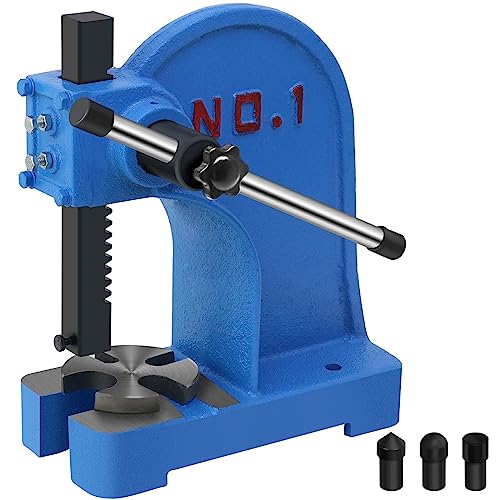
1. VEVOR Arbor Press, 1 Ton Manual Arbor Press, 5.9″ Maximum Height
Our pick — over 4★ from 350+ verified ratings; the strongest balance of quality and price.
The taller-mouthed workhorse that swallows awkward parts other 1 ton presses turn away.
For leathercraft, jewelry stamping, and pickup-bobbin work, the clear winner is this VEVOR — and not because of the 1 ton rating shared by every press here. Its working stroke reaches 5.9 inches, the most open throat of any pick in this lineup. Compared with the PNBO 1 Ton Manual Arbor Press on its 5.5 inch opening, that extra reach is real room for stacked plates, chunky cauls, and small assemblies that would otherwise need spacers under the anvil.
What wins people over is pure function: this is the most-praised single trait in its reviews by a wide margin — functionality earns well over 60 call-outs — and the durability note follows behind it. Owners describe a compact bench tool that handles everything from guitar pickup bobbins to leather punches. Buyers report: “I use this primarily to install pole pieces in electric guitar pickup bobbins, and it works great for that.” A separate owner puts it more bluntly — “quality built, good and heavy so no movement when using” — which tracks with the 23 pound cast iron frame. The 23 pound cast iron frame stays put while you lean on the lengthening lever, and the lever position locks so it will not slide mid-press.
Reach for it knowing two setup chores come standard. The unit ships heavily coated in protective grease — even over painted areas — so budget a disassembly, wipe-down, and re-oil before first use. The other recurring gripe is fit and finish: some frames arrive better machined than others, and a few units have shown up with parts missing, so keep the box until every piece is accounted for. Also plan to bolt it down — the back wants to lift as you press, and clamping solves it instantly. That setup ritual is the price of the deepest opening in this group.
What Earns It The Top Slot
- 5.9 inch working stroke — the tallest opening among the picks here — plus a 3.5″ four-hole steel anvil plate that pins down odd-shaped parts
- Three included molds (flat, pointed, and round drift) mean riveting, cutting, and carving work straight from the start
- Lengthening lever with an anti-slip rubber sleeve and a lockable position that kills the slip that plagues short handles
- High-strength cast iron body with an anti-rust coating and a polished, edge-free anvil plate
What To Know Before Buying
- Arrives packed in protective grease; you will disassemble, clean, and re-lubricate before the first press
- Machining consistency varies unit to unit, and a few shipments have reached buyers short on parts
- Must be bolted or clamped down — the back lifts under load otherwise
Buy it for: anyone who needs maximum clearance under the ram for leather, jewelry, or bobbin work and does not mind a cleaning ritual first.
Think twice if: a four-inch opening covers everything you press and you would rather skip the deep-clean setup.
2. PNBO 1 Ton Manual Arbor Press, 5.5″ Maximum Height Heavy Duty Cast Iron
The fret-press conversion kit: a compact cast iron press the guitar crowd keeps repurposing.
Guitar techs and mosaic artists get the most out of this one — it is the lighter of the two cast iron PNBO presses here, at 10.94 kg versus the 11.73 kg ratcheting model, and it presses up to 1 ton across a 5.5in/140mm maximum working height. The movable machined steel anvil slots into four positions, so bearing work, riveting, punching, and bending all get proper support. Four fixing holes in the base let you lock it to a bench in minutes.
Owners treat this as a foundation they tune rather than a finished appliance. One owner deepened the hole in the arbor shaft to accept a fret press caul and reported it “works very well.” Another notes it “fits Jiayouy Fret press caul perfectly (caul needs trimming)” after that modification, and recommends it as a budget alternative to a big-name fret press when you already own neck support. Tile-breaking for mosaics shows up too, with the press taking the strain off tired hands. The lever arm is the recurring grumble — the throw is shorter than some want, so you need a firm pull for the top end of the pressure range.
What to plan around: this is the fussier of the two PNBO units for quality control. Most arrive fine, but the loud minority reports rust, chipped paint on an assembled-looking unit, or a lever that will not cinch down when tightened, and at least one buyer could not get metal stamps to bite. The honest read is that this press rewards a buyer willing to inspect, clean, and adjust on arrival — get past that and it delivers a ton of pressure for very little outlay.
The fret crowd’s favorite: a 10.94 kg cast iron frame with a movable four-position steel anvil and 5.5in/140mm of opening — light enough to move, heavy enough to stay planted once bolted.
The wobbly bits: the lever throw and inconsistent arrival condition are the two things that split buyers, so open the box with patience and a wrench in hand.
Right for you if: you want a low-cost, adaptable press for frets, mosaics, or light punching and are happy to tweak it into shape.
Pass if: you need a press that arrives ready to work without a single adjustment.
3. PNBO Arbor Press 1 Ton, Ratchet Leverage Press with Handwheel, 5.5″ Maximum Height

Two handles, one handwheel, and a ratchet that some owners swear is not there at all.
For work where you need to line a tool up with both hands before committing pressure, this is the one to study. It presses up to 1 ton through a 5.5in/140mm working height like its sibling, but adds a second handle and an included handwheel for controlled positioning. It is also the heaviest of the PNBO pair on paper at 11.73 kg against the 10.94 kg manual model, so once it is bolted to a stout bench it moves less when you push. Four fixing holes anchor the base, and the slotted anvil plate shifts to support different workpiece shapes.
Leatherworkers are the core audience — stamping, riveting, and general bench pressing all show up in the feedback. One owner replaced the handle with a longer breaker bar for extra leverage and still called the stock handle fine. Mounting is the shared headache: getting it set up is fiddly, and the workaround is clamping it down with C-clamps instead of drilling the bench. The caution is the naming. Since this is sold as a “Ratchet Leverage Press,” buyers rightly expect a ratchet mechanism, and one owner’s strongest complaint was that it does not ratchet at all, calling it the same press as the cheaper model in the same maker’s range. It is one person’s read against a press that otherwise earns praise, but it is worth verifying before you buy.
If your setup benefits from a handwheel for creeping the ram down to contact and two handles for pre-loading a tool, this earns its place. If you just want a plain leverage press, the manual PNBO model does exactly that for less messing about.
Where This Press Shines
- Second handle plus included handwheel let you align and pre-load tools before pressing
- Heavier cast iron body at 11.73 kg leans into the bench rather than away from it
- Slotted movable anvil plate and four fixing holes adapt to riveting, punching, and bending
What You Are Buying Into
- Sold as a ratchet press, yet the mechanism has been questioned — confirm before ordering
- Mounting is awkward; expect to clamp it down as a workaround
- Same 1 ton capacity and 5.5in/140mm height as the cheaper PNBO model, so premium rests on the extra handle and handwheel
Choose this if: dual-handle alignment and a handwheel earn their keep in your workflow.
Reconsider if: the ratchet promise was the whole reason you were looking — the mechanism is the contested point.
4. NOOBECR Central Machinery 1 Ton Arbor Press
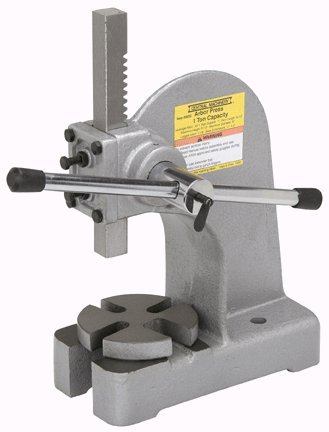
Metal-bending muscle with a 20:1 lever ratio and the widest arbor bore of the bunch.
Jewelry makers and small-parts fabricators get the most from this press, and the spec that does the talking is its 20:1 leverage ratio — every pound on the handle loads up twentyfold on the ram. Combined with a 1-1/8″ largest arbor and a 1″ ram square, it has the widest bore in this lineup, so thicker tooling and punches drop in without an adapter. The 2000 pound tensile strength matches the 1 ton class, and the 5-1/2″ maximum height clears most routine fittings.
Its value is simplicity: no ratchet, no depth stop, just a 20:1 lever and a ram. It bends silverware for jewelry and presses parts with nothing fancy in the way — press, release, done. One buyer had to pay a little above a discounter’s price but went ahead anyway because the cheaper source never kept stock, and reports it “works just as I need it to to bend silverware for jewelry.” Another sums the whole machine up: it is an arbor press, it uses mechanical leverage, and it needs to be securely bolted down.
The catch is weight-related shipping — heavy cast iron does not move cheaply, and the freight is the notable downside for many buyers. The other point worth weighing is sourcing: at least one owner noted they simply bought the same press at a big-box discount store instead, and it is the same Central Machinery brand. Consider both outlets before committing. Nothing here is defective — just be clear this is a plain leverage press, not a precision instrument, and bolt it to a bench so the frame has something to push against.
Pure leverage, no frills: a 20:1 ratio, 1-1/8″ arbor bore, 1″ ram square, and 5-1/2″ max height — the spec sheet of a press that just presses.
Mind the freight and the aisle: the same press can turn up at a cheaper counter, so compare before you click, and never press it loose on a bench.
Best for you when: wide-bore tooling and strong leverage matter more than included extras or brand polish.
Skip if: the wide bore is not something you will actually use — a lower-tier press handles the same bending jobs.
5. KAKA INDUSTRIAL Arbor Press, 1-Ton Capacity Manual Arbor Press AP-1

The small-footprint bench press built to slot into a garage corner and still push 2,200 pounds.
Small-shop and garage users get the point of this KAKA INDUSTRIAL — the base measures just 10-1/2″x7-1/2″ with a net weight of 33 lbs, so it lives on a crowded workbench without hogging space. It earns its force rating honestly: 2,200 pounds of pressing force tops the plain 1 ton figure, and an adjustable 4-position plate plus a 4-inch maximum height under the ram let it grip varied workpiece shapes. For pressing bearings, riveting, stamping, and bending small metal parts, the 4-inch height is the working limit to remember.
Where it delights is niche assembly. Pressing cap screws into plastic thumb screws is a citation-worthy use — the machine does it cleanly once secured to a base. Set the frame up right and the steel body with its protective paint finish holds its alignment through repeated cycles. The friction point is the plastic thumb screw itself: its flat bottom cannot grip a round shaft, so it loosens after each press. The fix owners reach for is drilling an indent into the shaft and adding thread locker, which turns a loose press into a reliable one. That is a modification, not a factory feature.
Be aware that condition on arrival divides strongly. The majority of feedback is positive, but the strongest complaints come from units that arrived rusty, scratched, or apparently used, and a few had missing or bent bolts. This press also runs a 4-inch working height rather than the 5.5 inch class of the mid-range picks, so taller assemblies will not fit. Buy from a seller with a stiff return policy and check every component before the window closes.
Portable and punchy: 2,200 pounds of force from a 33 lb frame that fits a small bench — you get real pressing power without a fixed shop footprint.
Verify on arrival: a 4-inch height limit and variable condition mean the sensible move is to inspect the unit and its fasteners the day it lands.
Great match for: a tight garage or tackle-box bench where a compact press that still hits 2,200 pounds is what you need.
Not for you if: you need a taller throat to clear chunky assemblies, or you want assembly to be zero-effort.
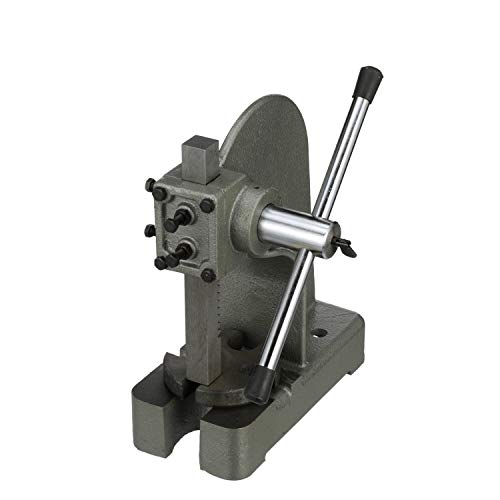
6. HHIP ABS Import 8600-0032 Heavy Duty Arbor Press, 1 Ton Capacity, 5.63″ Max Height
The metal bender that rides in a work truck and never needs a second thought.
Mobile mechanics and hobbyists who press away from the shop will like this HHIP ABS Import — the 24 pound cast iron frame is portable enough to fit in a work vehicle, and the 5.63″ maximum height clears most small bearing and bushing jobs, with steel pinions driving a 4-position steel anvil. Bending metal, seating bearings, and pressing small components all sit inside its 1 ton envelope. The deep throat-to-anvil geometry makes it convenient for quick jig work.
What people keep coming back to is that it simply does the job. One owner is happy enough to say it bakes bending metal for them and loves it; another reports it “works great” and fits their work truck. Metal fabricating, bearing pressing, and general stamping are the recurring uses. The pressing action is smooth and the steel pinions hold their alignment with minimal slop. This is a workhorse: bolt it down, lean on it, and it keeps pressing.
Two practical limits are worth knowing up front. The manufacturer plainly warns that adding a cheater bar — a longer arm on the handle — can exceed the press’s intended load and bend or break the components, so resist that temptation and step up in class if you need more force. Separately, quality control has slipped on some units: mounting holes have arrived misdrilled, and the tonnage markings can be absent from the casting (though the box label confirms the 1 ton rating). Most presses ship clean, but this is another one to check carefully on arrival.
Why It Earns The Nod
- 24 pound cast iron body with steel pinions and a 4-position steel anvil — sturdy enough to stay planted and compact enough to travel
- 5.63″ maximum height accommodates bearing work and small pressing jobs without crowding
- Solid all-round pressing, metal bending, and even floppy-disk destruction — genuinely versatile for the price tier
What To Watch For
- Do not add a cheater bar — the maker warns it can exceed load capacity and damage the press
- Misdrilled mounting holes and missing tonnage markings on some units
- No manual included with some shipments, and safety instructions are minimal
Worth grabbing if: you want a portable, dependable press for bending and bearing work that can travel.
Look elsewhere if: you plan to push past 1 ton — upgrade rather than adding a cheater bar.
7. PALMGREN 9661101-1 Ton Arbor Press w/Depth Stop

The guitar-fret favorite with a depth stop, a side handle, and a smooth, slop-free press cycle.
Anyone pressing guitar frets, removing rifle pins, or chasing repeatable depth will see the point of this PALMGREN fast. It presses up to 1 ton through a ram described as very smooth with zero slop during the press cycle, and a dedicated depth stop lets you set how far the ram travels. A side handle — a feature the mid-range picks do not list — adds a second grip point for control. The most-praised single quality in owner feedback is functionality, and value for money runs a close second, which is the unusual combination of a premium-tier press that still earns its keep.
Owners mention the cast iron frame feels built to last, and one uses the full 1 ton to press out stuck antique rifle pins that a hammer would have damaged. Fret pressing with a custom caul is the other job this press wins — the ram performs well once the caul is set. Part of the value equation is the 3-year warranty, which one owner registered to receive free curved jaw pliers. The depth stop, side handle, and the fact that the whole unit feels deliberately assembled rather than thrown together are why this earns the premium label.
Two setup quirks catch people off guard. The ram ships intentionally upside down — the flat end faces down for tool-shop use — and several tasks want it flipped, which takes minutes with a screwdriver. Second, it arrives very oily, so plan on hand washes and old clothes during the initial clean and re-grease. A couple of owners also noted bolts loosening over time and the side handle working loose, so a torque check after the first few press cycles is smart. Added support under the frame cutout and mounting on a thick board (a 2×12 with a 5-inch overhang is a popular solution) keeps the whole press tipping. None of these are defects — they are the maintenance that a serious press asks for.
The precision favorite: a depth stop and a side handle along with a 1 ton, slop-free ram — the tool a fret job wants.
The break-in ritual: expect a flipped ram, greasy arrival, and a moment on a torque wrench — the press rewards owners who do the small upkeep.
Pick it if: you want a serious fretting or precision-press tool and value the depth stop, side handle, and warranty coverage.
Not the one for you if: you only need occasional light pressing where a mid-range press feels adequate.
Understanding the Specs
Working Height (The Spec That Decides The Job)
Maximum working height is the clear distance between the ram tip and the anvil plate where your workpiece sits. It is the number most people ignore until a part will not fit — so check it before anything else. The VEVOR opens the deepest at 5.9 inches, while the PNBO presses and the HHIP sit around 5.5 to 5.63 inches, and the KAKA AP-1 tops out at 4 inches under the ram. If you press frets, bearings, or stacked plates, choose the tallest throat that fits your biggest part.
Leverage Ratio And Handle Length
Leverage ratio describes how the handle multiplies your swing into ram pressure — a 20:1 ratio, like the NOOBECR Central Machinery press lists, means each pound you apply at the handle pushes a much larger load at the ram. A longer handle or a ratcheting action trades feel for reach. Presses with a short handle throw need a firmer pull, and it is worth remembering the maker’s warning that adding your own longer bar can stress the frame past its rating.
Anvil Plate And Ram Bore
The anvil plate supports your workpiece at the base, while the ram bore determines how thick a tool or punch your ram accepts. A four-position movable steel anvil — as on the VEVOR and KAKA — lets you shift the support point, and the bore size (like the 1-1/8″ largest arbor on the NOOBECR) decides whether your tools fit without an adapter. Match both to the work you actually press.
Frame Weight And Mounting
Frame weight is a real feature. A heavier press — the KAKA at 33 lbs, the VEVOR at 23, the HHIP at 24 — stays put when you lean in. Lighter units want clamping or bolting. Almost every press in this class arrives covered in grease and requires cleaning, re-lubrication, and a firm mount before its first press, so treat setup as part of the tool, not a delay.
FAQ
Will a 1 ton arbor press press a wheel bearing?
What is the difference between a ratcheting and a plain arbor press?
How do I mount my arbor press so it does not lift?
Why does my new arbor press arrive covered in grease?
Can I press guitar frets with a 1 ton arbor press?
What is the maximum height and why does it matter?
How much pressure does a 1 ton arbor press apply?
Are arbor presses hard to assemble and clean?
Can a 1 ton arbor press handle leather and metalwork?
Should I buy an arbor press with a depth stop?
Final Thoughts: The Verdict
For most buyers, the 1 ton arbor press winner is the VEVOR Arbor Press because it pairs the deepest 5.9 inch working stroke of the group with a 3.5″ four-hole anvil plate and three included molds — enough clearance for leather, jewelry, and bobbin work that shorter-throat presses cannot fit. If you want the ratcheting option with a handwheel for two-hand alignment, grab the PNBO Ratchet Leverage Press. And for precision fret or pin work with a set depth, the PALMGREN 9661101 is the one to reach for. Whichever you choose, do the one thing every one of these presses asks of you before the first job: bolt it down, wipe off the shipping grease, and re-lubricate it — then it will press cleanly for years.
How We Picked
We do not accept paid placement. Every pick is matched to a real buyer and a real use-case; we do not hands-on test units.
Sources & Methodology
Specifications: manufacturer listings and product documentation. Review insights: verified customer reviews, as of September 2026. Pricing: not shown on this page (it changes often); check the current price via the retailer link.
As an Amazon Associate, Gadgets Feed earns from qualifying purchases. This does not affect which products we feature.