
Our readers keep the lights on and my morning glass full of iced black tea. As an Amazon Associate, I earn from qualifying purchases.
Specs are compiled from manufacturer listings and verified buyer reviews and can change over time — please confirm the key details on the product page before buying.
If you are trimming out a room, building a deck, or crafting furniture, the blade size is the first thing that matters. A 10-inch blade cuts deep enough for a 2×6 at 90 degrees and keeps the saw light enough to carry room to room. The real challenge is finding one that stays square, holds its settings, and doesn’t vibrate your workpiece loose. This guide breaks down the best 10-inch compound miter saws by what actually matters: motor power, cut accuracy, bevel range, and how easy they are to set up and use.
I’m Min — the founder and writer behind Gadgets Feed. This guide is built by comparing the manufacturers’ published specifications and the patterns across verified customer reviews, so you get each pick’s real strengths and trade-offs instead of marketing spin.
You need a saw that cuts crown molding, framing lumber, or metal without a blade swap. This guide uses the specs and real buyer feedback to match you with the right 10 compound miter saw for your projects and budget.
Quick Picks
- Metabo HPT C10FCG2 — Best Overall
- Bosch CM10GD — Premium Glide
- Makita LS1019L
- Evolution R255SMS-DB+ — Multi-Material
- Makita LS1040 — Top Performer
- Evolution R255SMS+ — Versatile Slider
- DOVAMAN DMS01A — Budget Slider
- MarvTool 10-inch Sliding — Entry Slider
- Genesis GMS1015LC — Budget Laser
How To Choose The Best 10 Compound Miter Saw
Picking a miter saw depends on three decisions: the widest board you cut, if you need a bevel in one or two directions, and how often you carry the saw. Here is what to look for.
Sliding vs. Non-Sliding
A sliding miter saw has rails that let you pull the blade through the workpiece. This lets you cut wider boards (up to about 12 inches) without stepping up to a 12-inch blade. A non-sliding saw is more compact, lighter, and typically has less play in the pivot, which matters for fine trim work. If you mainly cut 2x4s and baseboards, a non-slider is enough. For crown molding or wide shelving, get a slider.
Single Bevel vs. Dual Bevel
A single-bevel saw tilts left only (0-45 degrees). A dual-bevel saw tilts both left and right, which saves you from flipping the workpiece over when cutting compound angles for crown molding. If you do a lot of crown or complex angle work, dual bevel is a major time saver.
Motor Power and RPM
Almost all 10-inch saws have a 15-amp motor. The no-load RPM (typically 4,000 to 5,000) tells you how fast the blade spins. Higher RPM gives cleaner cuts in hardwood. For cutting metal or plastics, a saw with two speed settings (like 3,200 and 5,000 RPM) gives you more control.
Accuracy and Adjustability
Look for positive miter stops (commonly at 15°, 22.5°, 30°, and 45°) so you can lock in common angles without a protractor. The best saws are square from the start and have adjustments for fence and bevel. A laser guide or shadow line helps you see exactly where the blade will cut.
Quick Comparison
| Model | Best For | Motor / RPM | Bevel Range | Weight (lbs) | Amazon |
|---|---|---|---|---|---|
| Metabo HPT C10FCG2 | Lightweight all-around use | 15A / 5,000 RPM | 0–45° Left (Single) | 24.2 | Amazon |
| Genesis GMS1015LC | Budget-friendly with laser | 15A / — | 0–45° Left (Single) | — | Amazon |
| MarvTool 10-inch Sliding | Affordable sliding saw | 15A / 5,000 RPM | 0–45° Left (Single) | 25.6 | Amazon |
| DOVAMAN DMS01A | Multi-material with 3 blades | 15A / 3,200 & 5,000 RPM | 0–45° Left (Single) | 37.4 (17 kg) | Amazon |
| Evolution R255SMS+ | Multi-material sliding saw | 15A / — | 0–45° Left (Single) | 41.8 | Amazon |
| Evolution R255SMS-DB+ | Dual-bevel multi-material | 15A / — | 45° L/R (Dual) | 44.8 | Amazon |
| Makita LS1040 | Portable trim work | 15A / 4,600 RPM | 0–45° Left (Single) | 27 | Amazon |
| Bosch CM10GD | Compact dual-bevel precision | 15A / — | 45° L/R (Dual) | 64 | Amazon |
| Makita LS1019L | Pro-level sliding precision | 15A / — | 45° L/R (Dual) | 72.77 | Amazon |
In‑Depth Reviews
1. Metabo HPT C10FCG2
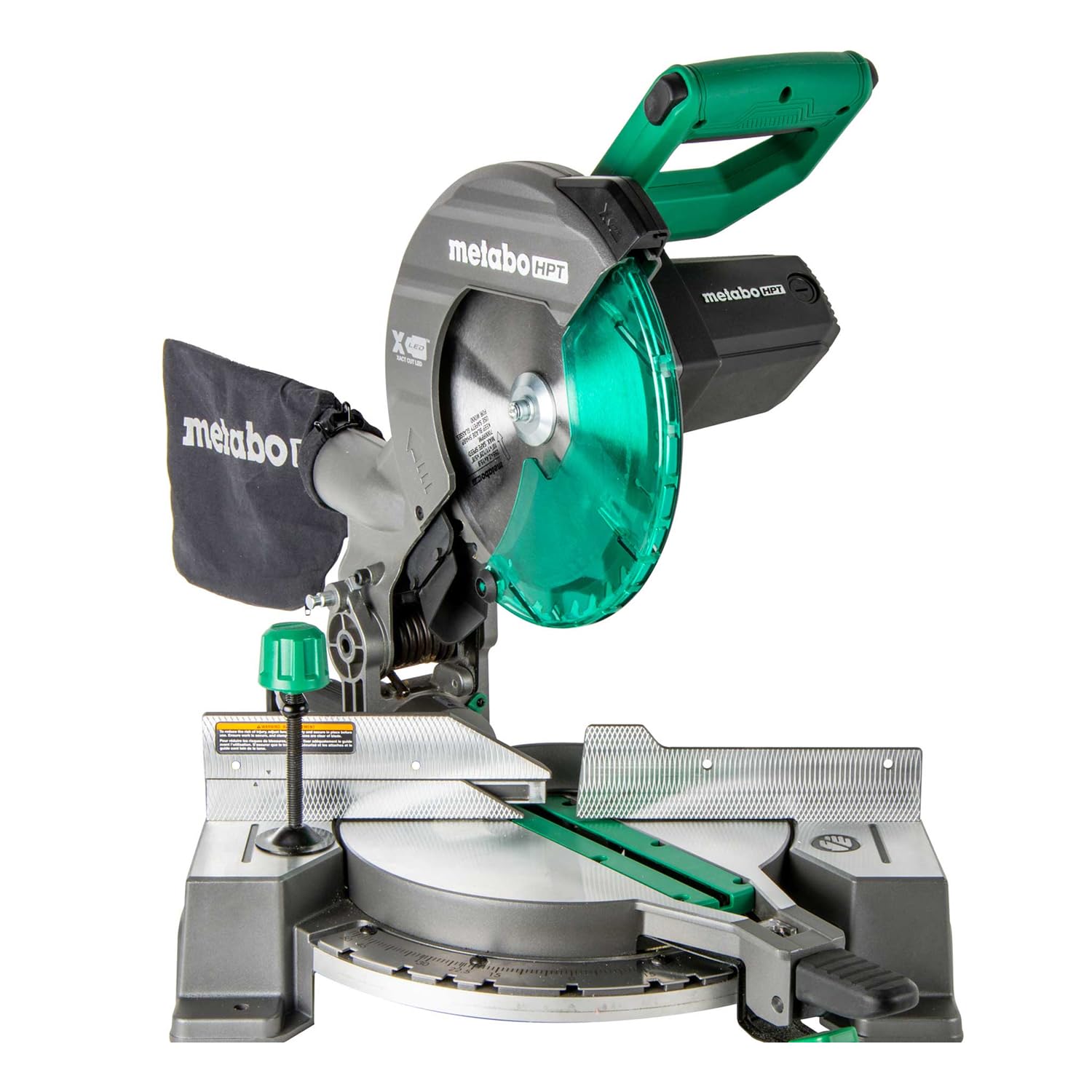
A featherweight saw that arrives square and stays there, cutting through a whole trim job in one afternoon.
The first thing you notice is the weight — 24.2 lbs makes this the lightest saw in the lineup, at 24.2 pounds versus the MarvTool slider below at 25.6 pounds. That matters when you are lugging it up stairs or between rooms. But it is not just light; buyers report the saw was “perfectly square from the start, miter, bevel, table and fence all square,” so you skip the tedious alignment dance. The 15-amp motor spins at 5,000 RPM and the Xact Cut Shadow Line projects a sharp shadow of the blade right where it will cut, replacing a laser guide for under.
It is a single-bevel saw (0-45° left) with a miter range of 0-52° left and right, which covers crown molding nested flat. The included 40-tooth TCT blade gets you started on pine or oak. One trade-off: the dust collector is small and does an adequate job but fills quickly. If you cut mostly trim and baseboards and want something easy to transport, this is the one.
What Shines
- Very light at 24.2 lbs.
- Square from the start per multiple buyers.
- 5,000 RPM for clean cuts.
- 5-year tool body warranty.
What Holds It Back
- Single bevel only.
- Dust collector is small.
- Not a sliding saw for wide boards.
Reach for this if: You need a lightweight, accurate non-sliding saw for trim and baseboards and want to avoid alignment hassles.
The trade-off: You give up dual bevel and sliding capacity, so it is not ideal for wide crown or shelving.
2. Bosch CM10GD

A dual-bevel miter saw that slides on arms instead of rails to fit on a workbench where no other compact saw can.
Bosch replaces the sliding rails with an Axial-Glide system — arms that swing instead of sliding. That means the saw needs up to 10 inches less rear clearance than a traditional slider, so you can mount it flush against a wall or in a tight corner. It is still a full-capacity saw: dual bevel (45° left and right), 90-degree miter cuts, and a 60-tooth carbide blade included. Owners mention the cuts are “laser-accurate for baseboards and crown molding.”
The upfront metal bevel controls and SquareLock precision fences make adjustments quick without reaching around the back. At 64 lbs it is heavy, but the compact form factor saves more bench space than any other slider here. One caveat: it has no soft start and customers note it “jumps on startup.” If you need a pro-grade saw that fits a tight workspace and bevels both ways, this is your pick.
The Big Win
- Axial-Glide needs minimal rear clearance.
- Dual bevel (45° L/R).
- Upfront controls for bevel and miter.
- 60-tooth carbide blade included.
One Thing
- Heavy at 64 lbs.
- No soft start; can jump at trigger pull.
- Dust collection nozzle is weak.
Who should buy it: Anyone who works in a small shop or needs dual bevel for crown molding without the depth of a rail slider.
skip it if: You need a lightweight saw for on-site carry — 64 lbs is a two-person lift.
3. Makita LS1019L

A 10-inch slider that cuts crown nested up to 6-5/8 inches, which is more than most 12-inch saws manage.
The LS1019L uses a 2-steel rail system that slides on linear ball bearings for “dead-on” accuracy, as Makita puts it. Its vertical cutting capacity is 5-1/4 inches, and nested crown capacity is 6-5/8 inches, which rivals 12-inch saws. The direct drive gearbox is powerful and reviewers point out dust collection hits over 80% with a shop vac. It is dual bevel (45° left and right) and has a laser guide for alignment.
At 72.77 lbs this is the heaviest saw in the guide, but the slide glide operation is smooth with minimal play. The included 60-tooth micro-polished blade is excellent from the start. Shoppers say the laser is dim and barely visible with work lights, and the work clamp requires many turns. If you cut a lot of wide crown molding and want to avoid stepping up to a 12-inch saw, this is the tool.
Key Strength
- 6-5/8″ nested crown capacity matches 12″ saws.
- Smooth rail slide with linear bearings.
- Dual bevel 45° left/right.
- Excellent dust collection with vac.
Consider This
- Very heavy at 72.77 lbs.
- Laser is dim and shows multiple lines.
- Work clamp is slow (many turns).
Who it fits: Pros who need the capacity of a 12-inch saw in a 10-inch package for heavy crown molding work.
The catch: The weight and dim laser are real frustrations, and the clamp is slow for production work.
4. Evolution R255SMS-DB+

A dual-bevel saw that cuts wood, steel, and plastic with the same blade and stays cool to the touch.
This is the dual-bevel version of Evolution’s multi-material saw. You bevel 45° left and right without flipping the workpiece. The included TCT (tungsten carbide tipped) blade cuts wood, wood with embedded nails, composite decking, mild steel, and plastic with virtually no sparks. The metal stays cool to the touch with a finish you can work on immediately. Buyers report it “cuts metal like butter” and the build is sturdy.
The saw has a soft-start motor that takes about 2 seconds to spin up, which reduces the startup jolt. The bevel and miter adjustments cover 50° left and right. It weighs 44.8 lbs, right in the middle of the pack. One reviewer noted the included blade dulled quickly on mild steel tubing; they recommend a dedicated steel blade for heavy metal work. If you jump between framing lumber and steel studs on the same job, this saw saves you from buying two tools.
Standout Feature
- Cuts wood, steel, and plastic with one blade.
- Dual bevel 45° left and right.
- Virtually no sparks when cutting steel.
- 3-year warranty.
Downside
- Included steel blade dulls on heavy use.
- Heavy at 44.8 lbs.
- Front clamp sold separately in US.
Best for: DIYers and pros who cut both wood and metal regularly and want one saw that handles both.
Not for: Heavy production cutting of steel — you will want a dedicated metal blade.
5. Makita LS1040

A rock-solid non-sliding saw that trim carpenters love for its small footprint and zero side-to-side play.
At 27 lbs the LS1040 is only a few pounds heavier than the Metabo HPT, but professional carpenters favor it for trim work because the single pivot point is more rigid than any sliding mechanism. Owners mention it handles “about 90-95 percent of the trim that will be installed in a typical middle class home.” The 15-amp motor runs at 4,600 RPM and the saw has 9 positive miter stops at common angles. It cuts 52° right and 47° left with bevel up to 45° left.
The included 40-tooth micro-polished blade, vertical vise, and triangular rule are ready from the start. One catch customers note: the saw “starts with a bang” and is not quiet. The direct drive motor is loud, but reliable. If you mainly do trim and want a saw you can carry room to room without worrying about alignment drift, this Makita is worth the jump.
Why Pros Like It
- Rigid single-pivot design for precise cuts.
- Light at 27 lbs for on-site work.
- 9 positive miter stops.
- Makita build quality and reliability.
One Drawback
- Loud start-up.
- Not a sliding saw — limited crosscut width.
- Made in China (not USA).
Pick this if: You are a trim carpenter or serious DIYer who wants a portable, rigid non-slider that cuts true.
Look elsewhere if: You need to cut wide shelving or crown molding nested — you will want a slider.
6. Evolution R255SMS+

A single-bevel slider that cuts through wood, metal, and plastic with one blade and includes dual quick-release clamps.
The R255SMS+ Plus version adds taller fences, a slide rail protector, and a 3m long cable for reach. It is a single-bevel saw (0-45° left) with miter angles of 50° left and right. The multi-material blade cuts wood, wood with embedded nails, composite decking, and mild steel with virtually no sparks. Reviewers point out it “cuts wood, aluminum, steel accurately after squaring fence/blade” and is a good homeowner saw for the price.
At 41.8 lbs it is not light, but the integrated carry handles help. The laser aligns only at the start of the cut, not continuously. Clamp quality is described as mediocre by some users. Unlike the dual-bevel Evolution above, you have to flip the workpiece for compound left and right angles. If you want the multi-material flexibility but do not need dual bevel, this saves you cash versus the DB+.
Strong Points
- Cuts wood, metal, and plastic with one blade.
- Taller fences and slide rail protector.
- 3m power cable for reach.
- 3-year warranty.
Weak Points
- Single bevel only.
- Clamp is mediocre.
- Laser aligns only at start of cut.
Who it suits: Homeowners and DIYers who cut wood and occasional metal and want a single-bevel slider with a long cord.
Not for: Production work or complex crown molding that needs dual bevel.
7. DOVAMAN DMS01A

A dual-speed sliding saw that ships with three TCT blades so you can cut wood, PVC, and soft metal starting day one.
The DOVAMAN gives you two speed settings: 5,000 RPM for wood and 3,200 RPM for soft metals and PVC, which helps prevent blade burn on plastics. It includes two 40-tooth and one 48-tooth TCT blades, plus two extra carbon brushes. The sliding rail extends the cut up to 4×13 inches, and the ambidextrous trigger handles work for left- and right-handed operators. Shoppers say it is “solid, well made, and functional” and the laser guide is a helpful addition.
It weighs 37.4 lbs (17 kg), which is manageable for a slider, and the cutting capacity is generous at 3.5×13.4 inches. One buyer had the saw arrive damaged but reported the seller quickly resolved it. Some note it is loud and takes time to get going. If you want a slider that handles multiple materials from the start without spending for the Evolution, this is a strong mid-range alternative.
What Impresses
- Dual-speed motor (3,200/5,000 RPM).
- Three TCT blades included.
- Ambidextrous design for lefties.
- Large cutting capacity up to 4×13″.
What to Know
- Loud operation.
- Some units arrived damaged.
- Heavier than basic saws at 37.4 lbs.
Choose this if: You need a versatile slider that cuts wood, PVC, and soft metal without buying extra blades.
Be aware: Inspect the packaging carefully on arrival and test the laser alignment before first use.
8. MarvTool 10-inch Sliding
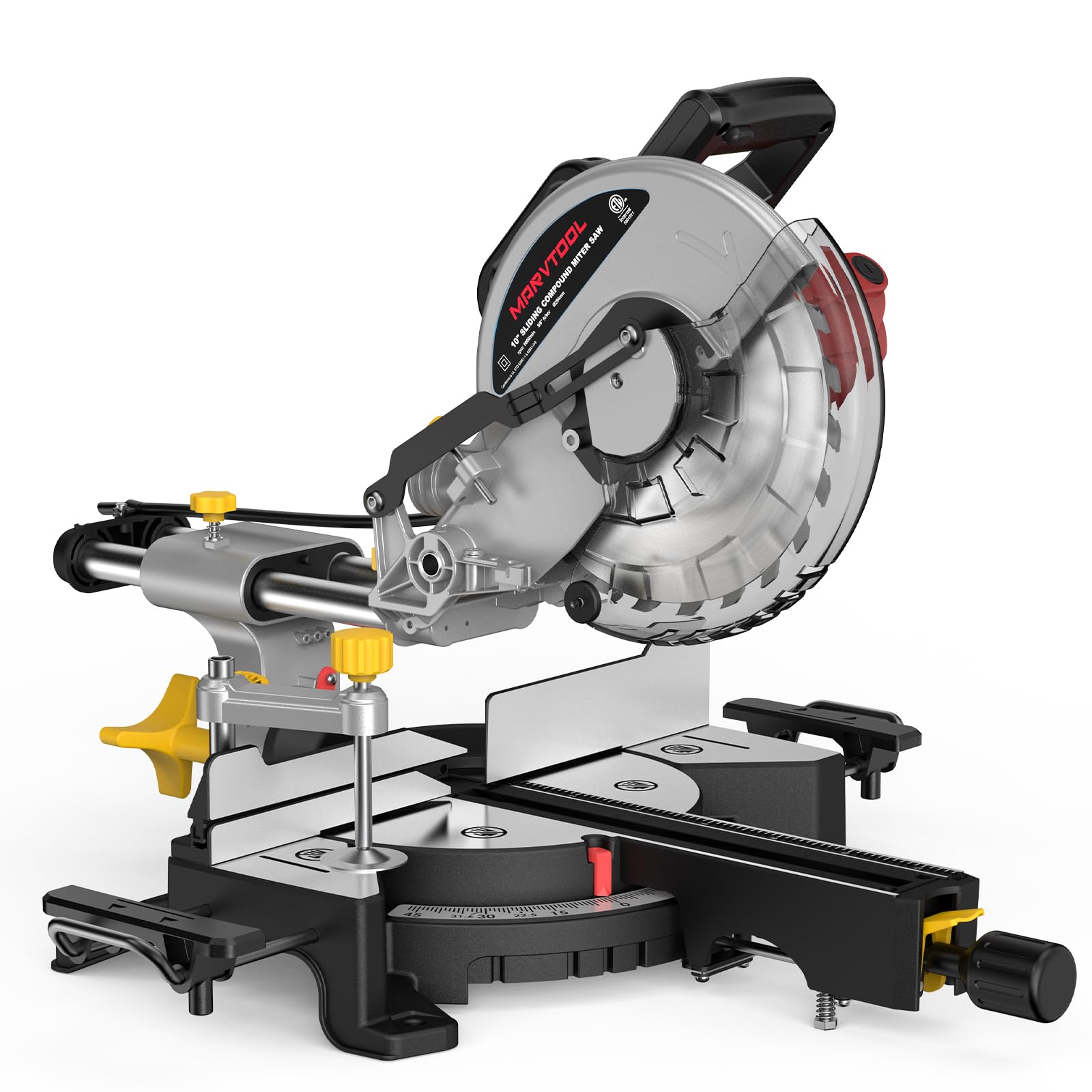
An affordable sliding saw that diyers praise for being “lightweight, easy setup, perfect cuts for trim work.”
This MarvTool sliding saw brings the sliding function under, which is rare. It has a 15-amp motor spinning at 5,000 RPM, single bevel from 0-45° left, and includes two extension tables and a 36-tooth blade. At 25.6 lbs it is lighter than the DOVAMAN slider above (37.4 lbs), making it one of the lightest sliding saws you can buy. Buyers report it is “great for the DIY that don’t need to break the bank” and feels sturdy.
The dust collection bag keeps the workspace cleaner than a bare saw. There is no laser guide, so you rely on your eye at the blade. The material supports could be longer per one reviewer. If you want the extra crosscut capacity of a sliding saw without spending mid-range money, this is the value entry point.
Why It Stands Out
- Sliding function at a budget price.
- Light at 25.6 lbs for a slider.
- Two extension tables included.
- 2-year warranty and 24/7 support.
Limitations
- No laser guide.
- Material supports are short.
- Single bevel only.
For the right buyer: DIYers who need occasional sliding capacity and want to keep costs low.
Pass on this if: You need a laser guide or dual bevel for frequent crown molding work.
9. Genesis GMS1015LC

A laser-guided entry-level saw that one buyer warned “had a small piece of quarter round trim kick out” during use.
The Genesis GMS1015LC is a single-bevel saw with a laser guide powered by two AAA batteries. It has 9 positive detent miter stops at common angles and cuts 45° left and right. The 15-amp motor has an electric brake that stops the blade in seconds. It includes a 60-tooth carbide blade, hold-down clamp, dust bag, and two extension wings. Owners mention it is “easy to use” and “cuts fantastic” for trim and baseboards.
At the entry-level price, there are compromises. One buyer experienced a kick-out where vibration loosened a small piece from the clamp. The die-cast aluminum base is portable but the saw does not feel as solid as mid-range options. If you are on a tight budget and primarily cutting softwood trim, this saw will get the job done, but you will want to double-clamp small pieces for safety.
What Works
- Laser guide for cut alignment.
- 9 positive miter stops.
- 60-tooth carbide blade included.
- Electric brake for safety.
What Concerns
- Vibration can loosen small workpieces.
- Build feels less solid than premium saws.
- Single bevel only.
Use it for: Light DIY cutting of softwood trim, baseboards, and picture frames on a strict budget.
Think twice if: You cut heavy hardwood or small workpieces — vibration and kick-out are real risks.
Understanding the Specs
Bevel vs. Miter
A miter cut is the blade tilting left or right across the width of the board — like cutting a picture frame corner. A bevel cut is the blade tilting forward or backward through the thickness of the board — like cutting an angled edge on a shelf. A compound miter saw lets you do both at the same time, which is necessary for crown molding. Single-bevel saws tilt left only. Dual-bevel saws tilt left and right, saving you from flipping the workpiece.
Sliding vs. Non-Sliding
A sliding miter saw has rails that let you push the blade forward through the material, increasing the width of board you can cut. A 10-inch non-slider typically cuts a 2×6 at 90 degrees (about 5.5 inches wide). A 10-inch slider can cut a 2×12 (about 11.5 inches wide) without moving the board. Sliders are heavier and have more moving parts that can develop play over time. Non-sliders are lighter, more rigid, and better for portable trim work.
FAQ
What is the difference between a compound miter saw and a standard miter saw?
Can a 10-inch sliding miter saw cut a 4×4?
What is a positive miter stop and why does it matter?
Is a dual-bevel saw worth the extra money?
What does the amp rating mean on a miter saw motor?
How important is the blade that comes with the saw?
Can I cut metal with a 10-inch compound miter saw?
Why are some miter saws so heavy?
What does the shadow line do on a miter saw?
How often should I replace the blade on my miter saw?
Final Thoughts: The Verdict
If you want one dependable pick, the best 10 compound miter saw winner is the Metabo HPT C10FCG2 because it weighs only 24.2 pounds, arrives square from the box, and has a 5,000 RPM motor with a clear shadow line (a laser-free cut indicator) at a budget-friendly price. If you want the tightest compact slider with dual bevel, grab the Bosch CM10GD. And for cutting both wood and metal without swapping blades, the Evolution R255SMS-DB+ is the one to pick.
How We Picked
We do not accept paid placement. Every pick is matched to a real buyer and a real use-case; we do not hands-on test units.
Sources & Methodology
Specifications: manufacturer listings and product documentation. Review insights: verified customer reviews, as of July 2026. Pricing: not shown on this page (it changes often); check the current price via the retailer link.
As an Amazon Associate, Gadgets Feed earns from qualifying purchases. This does not affect which products we feature.