
Our readers keep the lights on and my morning glass full of iced black tea. As an Amazon Associate, I earn from qualifying purchases.
Specs are compiled from manufacturer listings and verified buyer reviews and can change over time — please confirm the key details on the product page before buying.
Clamp jumper cables onto the wrong terminal and you can fry a car’s electronics in a second. Here is the short answer: if you want one set to keep in the trunk and never think about again, buy the set with reverse-polarity protection — it buzzes and cuts the current if you clamp the wrong terminal, and that is the single most common way a jump-start goes wrong. If you drive a diesel or a big truck, the thicker-gauge copper sets further down this list carry more current and crank a stubborn engine on the first try. One honest note before we start: not every pick here is a literal ten-foot cable. Some listings offer ten feet as a selectable length option, and a couple of this category’s best-built sets are longer, because on this shelf the nearest same-type size does the same job better. Read the cable length on each pick before you buy.
I’m Min — the founder and writer behind Gadgets Feed. This guide is built by comparing the manufacturers’ published specifications and the patterns across verified customer reviews, so you get each pick’s real strengths and trade-offs instead of marketing spin.
What separates a set that fires a dead diesel in seconds from one that just gets warm and clicks is the metal inside the jacket, and that is exactly what this guide breaks down. Every pick below is a real ten-foot-class booster cable worth keeping, so here is the honest ranking of the 10 ft jumper cables worth your trunk space.
Our Picks at a Glance

How To Choose The Best 10 Ft Jumper Cables
A ten-foot booster cable is a compromise you make on purpose: it is short enough to coil up and store in a small trunk, but long enough to reach from one battery to another when two cars sit nose to nose. Gauge, metal type, clamp construction, and polarity safety are the four things that decide whether a set works. Here is each one, in plain terms.
Gauge: the thickness that decides how much current reaches the dead battery
Gauge is a thickness rating, and a lower number means a thicker cable that carries more current with less resistance. That thicker copper is what lets you crank a big engine instead of waiting and hoping. Length quietly costs you power too: the longer the run, the more current the wire sheds on the way to the battery. On a small car you can afford a longer set; on a cold diesel you want the metal to do the heavy lifting.
Copper core versus CCA: the metal inside changes everything
Pure copper is the better conductor and moves more current without heating up. CCA, or copper-clad aluminum, wraps a thin layer of copper around an aluminum core — cheaper to make, and it needs a thicker gauge to match pure copper’s performance. If you jump-start in the cold often, or you own a truck, the pure-copper sets in this guide are the ones worth the extra. If you drive a compact and jump rarely, a heavy CCA set gets the job done.
Clamps and safety: the parts that actually touch your battery
The clamps are the first thing to fail and the easiest thing to overlook. Look for jagged teeth and strong springs so the jaws bite a terminal and stay put without you holding them. Fully insulated jaws are the ones that block a spark if you are clumsy in the dark. The better sets also build in a polarity check — a small circuit that senses a reversed connection, sounds a buzzer, and cuts the current before anything is damaged. For a first-timer, that feature alone is worth choosing.
Quick Comparison
| Model | Best For | Cable Length | Gauge | Conductor | Amazon |
|---|---|---|---|---|---|
| NOONE 2 Gauge Jumper Cables★ Best Overall | First-timers and daily drivers | 20 ft | 2 AWG | CCA | Amazon |
| Spartan Power 10 ft 4 AWGBest Value | Cars and light trucks | 10 ft | 4 AWG | Copper | Amazon |
| XINCOL A5 100% Copper | Trucks, SUVs, cold weather | 10 ft / 20 ft option | 2 AWG | Pure copper | Amazon |
| Spartan Power 2 AWG 10 ft | Heavy-duty trucks and diesel | 10 ft | 2 AWG | Pure copper | Amazon |
| Spartan Power 1/0 AWG 10 ft | Big diesels and fleets | 10 ft | 1/0 AWG | Pure copper | Amazon |
In‑Depth Reviews
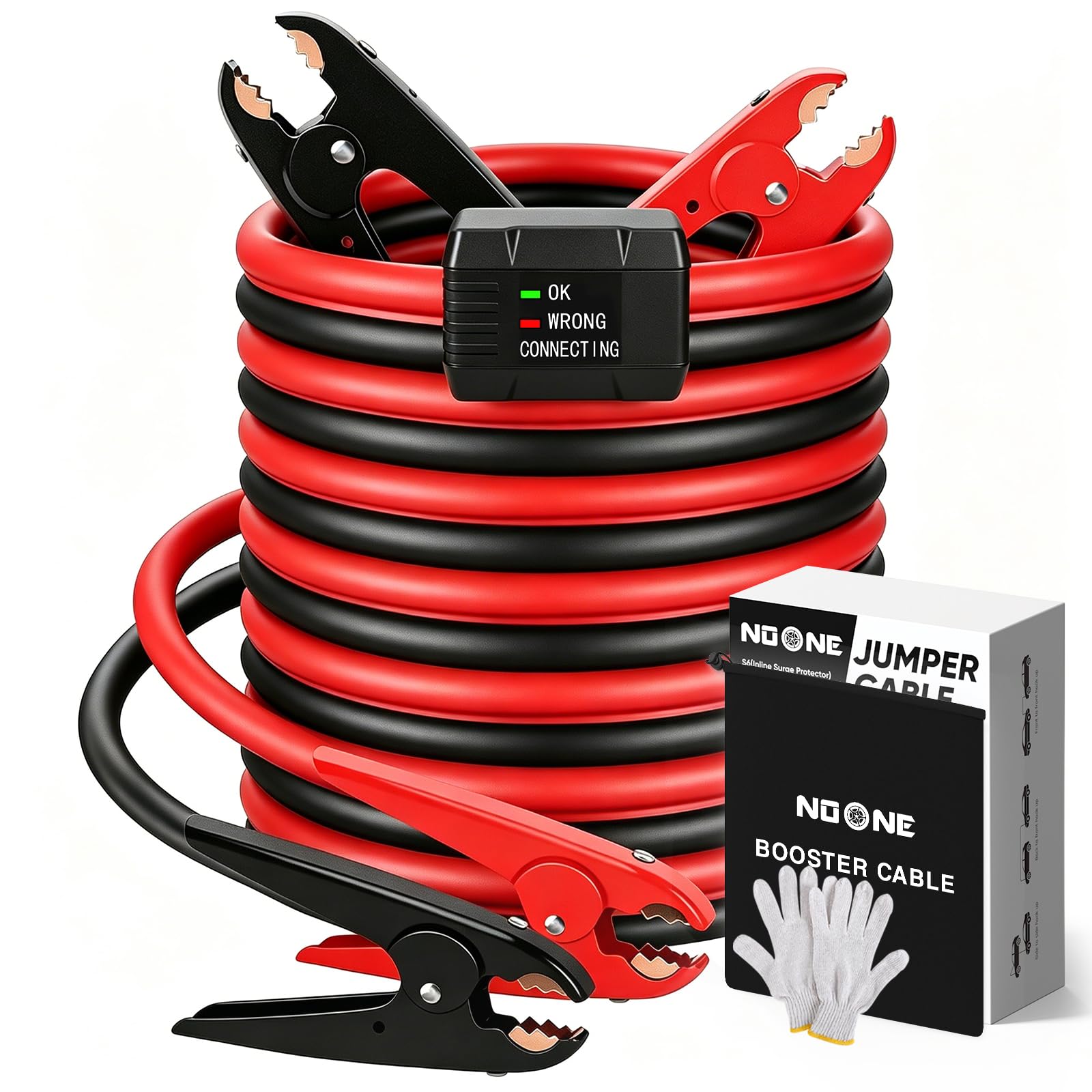
1. NOONE 2 Gauge 20 Ft Heavy Duty Jumper Cables with Reverse Polarity Protection
Our pick — over 4.5★ from 250+ verified ratings; the strongest balance of quality and price.
The one cable that tells you when you have clamped it wrong — before your electronics pay for it.
This earns the top spot because its 800A peak current (the burst of power that wakes a dead battery) covers nearly any car you will pull alongside. It handles engines up to 7.0L gas and 5.0L diesel, so it fits essentially every sedan, van, and SUV. If you have never jumped a car before, this is the set to keep.
The clamps are what win people over. Hook the cable up backwards and a red light kicks on, a buzzer sounds, and the current is cut before anything is damaged; a green light tells you the hookup is correct. The clamps have jagged teeth and strong springs, and the jaws are wrapped in non-conductive rubber to stop sparks. The core is copper-clad aluminum (CCA, a copper skin over an aluminum middle) and the build is UL1839-rated, with a thick double-layer rubber jacket rated for use from -40°F to 140°F, so it lives in your trunk year-round without cracking.
Here is the honest catch: the metal core is CCA, not pure copper. It conducts fine and hits that 800A peak. But pure copper moves current with less effort over a long crank, which matters on a frozen morning with a stubborn diesel — the Spartan 2 AWG below handles that better. At 20 feet, this set is also the longest here, and a genuine 10 ft run loses less current along the way. Buyers report the build feels heavy-duty and worth the money. Reviewers call the clamps quality pieces and the length convenient. This is your set if you jump-start rarely and want a safe, forgiving kit stashed in any trunk.
Where this cable earns its keep
- Reversed hookup triggers a light, a buzzer, and an automatic cutoff — the rare mistake-proof booster kit
- 800 amps of peak current and support for 7.0L gas / 5.0L diesel engines covers nearly every daily driver
- Rubber-shrouded, non-conductive jaws that keep sparks off your fingers in the dark
- Double-layer rubber jacket rated from -40°F to 140°F, so it stores in the trunk year-round without cracking
What to know before you buy
- Uses CCA rather than pure copper — fine for cars, less ideal for heavy diesels on cold starts
- At 20 ft it is the longest pick here, so it sheds more current over the run than a tight 10 ft set
Buy it if: you jump-start rarely, want a coil you can stash anywhere, and value the reverse-polarity safeguard so a first attempt never damages a car.
Look past it if: you regularly crank a diesel or a piece of heavy equipment and want pure copper moving the current.
2. Spartan Power 10 Foot 4 AWG Gauge Heavy Duty Jumper Cables Booster Set
A true ten-foot trunk cable with a copper spine and clamps built to feed both jaws.
A compact grab-and-go package sets this apart: it weighs 5.76 pounds, roughly the heft of a hardcover book, and ships in a storage bag that opens into a carry pack with a roadside safety stripe. That is the spec that matters if your trunk space is tight.
It is built from 4 AWG alligator-clamp copper cable, rated UL listed, and assembled in the United States. The signature detail is in the jaws: Spartan’s clamps have a copper ribbon linking both sides of each clamp, so both jaws feed power into the terminal instead of just one. That dual-jaw feed is why this set cranks a cold diesel truck where a thinner cable would struggle. The kit also carries a Lifetime Crimp Warranty (Spartan Power replaces or fixes the cable for as long as you own it if a crimp ever gives out), which makes this ten-foot set a buy-once purchase.
Consider the trade-off plainly: at 4 AWG, this is a mid-thickness copper cable, so it is a notch lighter-duty than the 2 AWG and 1/0 AWG sets further down for the biggest engines. For cars, light trucks, and the occasional cold morning, the pure-copper build gives you more current per thickness than the CCA starter kit above. The shorter ten-foot run loses less along the way too. Buyers rate the build high and describe it as strong, durable, and exactly as expected.
The value play: pure copper, a swappable carry pack, a ten-foot run, and a lifetime crimp warranty for a mid-range outlay — the cleanest value ladder on this shelf.
One thing to size up first: 4 AWG is a step below the 2 AWG sets here, so a hard-starting big-block or a cold diesel is better served by the thicker copper picks.
Reach for this if: you drive a gas car or light truck and want a genuine ten-foot, all-copper set that stores small and is backed by a lifetime crimp warranty.
Step up if: your vehicle is a heavy diesel or fleet machine that needs the extra current of 2 AWG or 1/0 AWG copper.
3. XINCOL A5 100% Copper Jumper Cables 10FT — Heavy-Duty for Trucks & SUVs
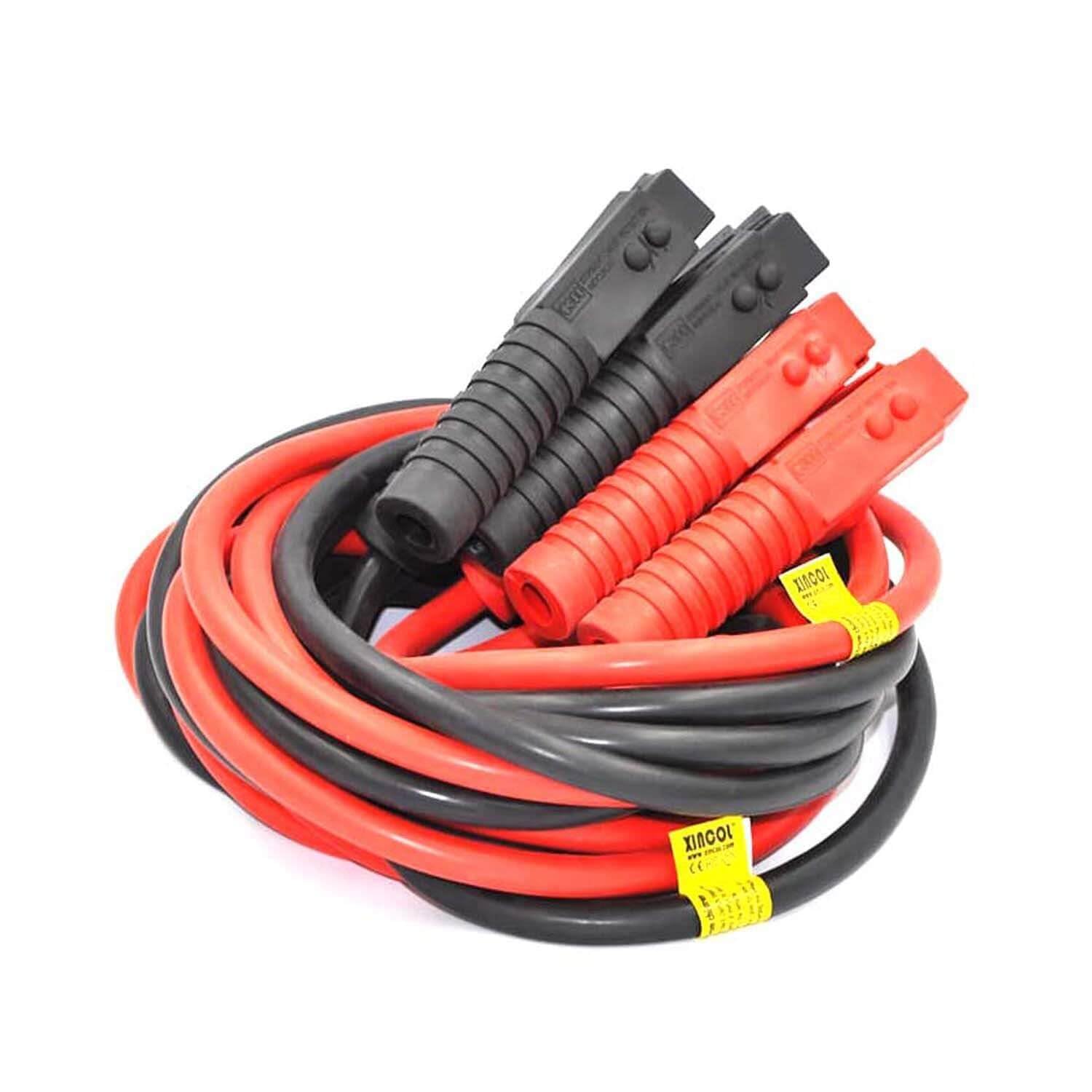
The set built for a -60°F morning, when other cables go stiff and useless.
Park outside in a real winter and the jacket decides whether you can jump your car at all. The XINCOL A5 is wrapped in industrial PVC (a plastic jacket) that stays flexible and crack-resistant from -60°F to 160°F. A cable that stiffens in the cold is a cable you cannot properly clamp, and this one does not. Those cords also stay pliable and non-freezing, so you can bend them around an awkward engine bay without fighting them.
The core is the real story: 100% pure copper at 2 AWG, which the maker positions above copper-clad aluminum for conductivity and lower heat. It is rated for 12V and 24V systems and supports engines up to 8.0L gas and 16L diesel — genuinely heavy vehicles. A complete kit ships with a drawstring storage bag and a pair of cotton work gloves with a dotted grip. The clamps use serrated teeth and high-tension springs for a firm, non-slip bite on most terminals. There is also a length choice: this listing offers the ten-foot run as a selectable option, while some buyers take the longer version for a semi.
Reviewers praise the cable quality and flexibility endlessly, and the 20-foot version’s reach draws frequent compliments. But the clamps divide opinion, and a few owners felt the value did not match the premium positioning. If pure copper and stiffness-proof cords matter more to you than clamp hardware, this is the pick for a Northern driveway.
The cold-weather case
- 100% pure copper, 2 AWG core that stays pliable and non-freezing in subzero temperatures
- PVC jacket rated from -60°F to 160°F, so winter does not turn it into a stiff rod
- Handles engines up to 8.0L gas and 16L diesel — trucks, SUVs, and diesels welcome
- Ships as a full kit with storage bag and dotted-grip cotton work gloves
Where the honest split sits
- The clamps draw the most divided feedback — some find them light for the price
- Value-for-money is the least settled part of the picture at this premium tier
The right call for: cold-climate owners and truck/SUV drivers who want pure copper and stiffness-proof cords above all.
Hold off if: clamp feel is your top priority — set aside some budget to swap them if the stock ones do not suit you.
4. Spartan Power Heavy Duty Jumper Cables with Alligator Clips, 100% Pure Copper, 2 AWG Gauge, 10 ft
Ten feet of 2 AWG copper with replaceable, bolted clamps — the set you buy once.
Bolted, replaceable clamps put this a step above crimped-and-disposable sets. The size is genuine: ten feet of 2 AWG pure copper cable, UL listed, assembled in Reno, Nevada. It weighs 7.33 pounds, which you feel when you lift the coil — and that weight is the point, because thicker copper carries more current to a stubborn battery. The kit arrives with a POS(+) and a NEG(-) cable as separate leads. Note the dimension difference against the XINCOL pick above: this Spartan unit measures 12 x 10 x 4 inches where the XINCOL measures 10.24 x 5.9 x 7.09 inches, and at 7.33 pounds this is the heavier, more substantial coil than the 5.76-pound 4 AWG set.
The clamps are the standout. They are fully insulated with a copper-braided lead feeding both sides, and they are bolted and replaceable rather than crimped and disposable. The handles are glass-fiber-reinforced plastic, a marked step up from the pressed sheet metal on bargain sets. The wire uses smooth tinned copper ring terminals and adhesive-lined heat shrink that resists water, fungus, and UV light, which is what keeps a copper cable alive through years of trunk storage. Pure copper beats CCA here too: a cheaper clad cable needs extra thickness to match this, and this build carries its current without the same heat penalty.
The one thing to know is the bag. It is a non-woven drawstring pack, generously sized, and a few owners found it too floppy and roomy for a ten-foot coil. The cables themselves are the part that lasts. Truck owners and tow drivers who are tired of replacing cheap cables every couple of years get the most from this pair.
Why it holds up: bolted, replaceable clamps, 2 AWG pure copper, and heat-shrink protection make this the set you can service instead of discard.
The small caveat: the included bag is floppy and oversized — stash the cable in your own case if tidy storage matters.
Best for: pickup owners, tow drivers, and anyone who wants replaceable clamps and thick pure copper they can trust for years.
Not the pick if: you need the absolute most current for a massive diesel — the 1/0 AWG set below goes thicker.
5. Spartan Power Heavy Duty Jumper Cables, 100% Pure Copper, 1/0 AWG Gauge, 10 ft
The thickest copper on this shelf, built to fire a big diesel that smaller cables cannot touch.
When a regular set just clicks and the truck will not turn over, the 1/0 AWG core here is what ends the argument. This is the heaviest-duty option in this guide: 1/0 AWG (the thickest gauge number here) pure copper, at 9.75 pounds. It makes the 7.33-pound 2 AWG set above and the 5.76-pound 4 AWG set feel light by comparison. That mass is the copper itself — more metal, more current, less resistance on a hard crank. It is made in the USA with the same UL-listed cable and smooth tinned copper ring terminals as its 2 AWG sibling.
The clamps are the differentiating feature: Spartan Power’s heavy-duty jaws carry a copper ribbon linking both sides of each clamp, so both jaws deliver power to the terminal — the “double your power” design. An owner running a 2,000W inverter off an electric car reported the clamps and bolted lugs handled the load without issues. An owner measured the 1/0 AWG set at 12V and 1000A: about 18% voltage drop at ten feet, roughly 46% at twenty-five feet. That short ten-foot length is working in your favor — half the run means roughly half the loss.
Be aware of the heft and stiffness, though. 1/0 copper is a stiff, heavy cable, and a few owners note it is not the easiest thing to coil and haul; one wished for a longer version but kept the shorter one because it was easier to carry. Choose the shortest practical length, because extra feet cost you current. If you own a compact car, this is more cable than you need — the 2 AWG or 4 AWG sets above do the same job with far less bulk. For a big-block, a box truck, or a working fleet, this is the set that says yes where lesser cables say nothing.
Who this heavy copper is for
- 1/0 AWG pure copper — the thickest core in this guide, for the hardest cranking jobs
- Double-jaw clamps with a copper ribbon feed power to both sides of the terminal
- Short ten-foot run minimizes the voltage loss a long cable bleeds away
- Made in the USA with UL-listed cable and serviceable, bolted lugs
The weight you take on
- At 9.75 pounds and stiff, it is a haul to coil and store compared with lighter sets
- Overkill for a compact car or light truck where the 2 AWG or 4 AWG sets come close to the same job for a fraction of the bulk
Choose this when: you run a big diesel, a commercial truck, or a fleet where a failed start costs you real time.
Wrong pick if: you drive a compact and want something light enough to tuck into a small trunk one-handed.
Understanding the Specs
AWG gauge and current-carrying capability
AWG stands for American Wire Gauge, the standard thickness rating for cable, and it runs backwards: the lower the number, the thicker the wire. A 2 AWG cable is thicker and carries more current than a 4 AWG one, and a 1/0 AWG cable is thicker still. That is why the bigger, heavier sets here (1/0 AWG and 2 AWG) are the ones aimed at diesels and trucks, while a 4 AWG copper set is ample for a car or light truck. Buyers check gauge first because it sets the ceiling on how much cranking power can reach a dead battery.
Length, voltage drop, and why ten feet is not a compromise
Shorter is stronger. The longer the cable run, the more of your battery’s current is lost as it travels, so a ten-foot set delivers more usable power to the dead vehicle than a much longer coil of the same gauge. That is exactly the case for a cable of this length: it reaches between two nose-to-nose cars without the extra feet bleeding power. Some sets here run twenty feet for flexibility when two vehicles cannot sit close, and the trade-off is honest — you gain reach and give up some current over the run.
Copper versus CCA metal cores
The core is either 100% pure copper or CCA — copper-clad aluminum, which is an aluminum core wrapped in a thin copper skin. Pure copper conducts better and needs less thickness to move the same current, while a CCA set has to go thicker to match it. If you jump-start rarely or drive a compact car, a heavy CCA set will serve you. If you crank diesels in the cold, or you want the cable that stays cooler under load, the pure-copper picks in this guide are the ones to compare.
Reverse-polarity protection and clamp build
Reverse-polarity protection is a small circuit inside (or on) the cable that detects a wrong-terminal connection, usually by lighting a warning and sounding a buzzer, then cutting the current before anything is harmed. On a basic set, connecting the clamps backwards can damage electronics, so this is the feature that makes a set beginner-friendly. The other part worth judging by hand is the clamp: serrated teeth and strong springs hold a terminal without slipping, and non-conductive or fully insulated jaws help prevent a spark at the battery post.
FAQ
Are 10 ft jumper cables long enough to jump a car?
What does reverse polarity protection actually do on jumper cables?
Is 2 gauge better than 4 gauge for jumper cables?
Copper vs copper-clad aluminum jumper cables — which should I buy?
Will these jumper cables work on a diesel truck?
How do I store 10 ft jumper cables so they stay in good shape?
Do alligator clamps wear out and can they be replaced?
Can I use 10 ft jumper cables to power an inverter or other gear?
Does a longer jumper cable hurt performance?
Final Thoughts: The Verdict
If you want the set that makes a jump-start nearly mistake-proof, the answer is the NOONE 2 Gauge Jumper Cables — its reverse-polarity cut-off and 800A peak cover the daily driver you own, and its 4.7-star rating across 290+ ratings backs that up. If you want a genuine ten-foot trunk cable in pure copper with replaceable clamps, the Spartan Power 4 AWG 10 ft is the value leader, and stepping up to the Spartan Power 2 AWG 10 ft adds thicker copper for bigger engines. And for a working truck or big diesel that laughs at thinner cables, the Spartan Power 1/0 AWG 10 ft is the one to hang in the fleet. Pick by your engine, not by the bag — and keep the coil coiled, because the shortest run that reaches is the strongest.
How We Picked
We do not accept paid placement. Every pick is matched to a real buyer and a real use-case; we do not hands-on test units.
Sources & Methodology
Specifications: manufacturer listings and product documentation. Review insights: verified customer reviews, as of September 2026. Pricing: not shown on this page (it changes often); check the current price via the retailer link.
As an Amazon Associate, Gadgets Feed earns from qualifying purchases. This does not affect which products we feature.