
Our readers keep the lights on and my morning glass full of iced black tea. As an Amazon Associate, I earn from qualifying purchases.
Specs are compiled from manufacturer listings and verified buyer reviews and can change over time — please confirm the key details on the product page before buying.
If you are adding a 10-gigabit connection to your home lab or office network, the SFP+ slot on your switch is the way in — but the little copper module you slide into it makes the difference between a stable upgrade and a frustrating headache. Copper SFP+ modules (transceivers that convert the SFP+ port on a switch or router into a standard RJ45 Ethernet port) let you use regular Cat6a cabling rather than fiber, which is far simpler for runs under 100 feet. Yet finding one that stays reliably cool, negotiates the right speed, and actually works with your specific hardware is the real quest.
I’m Min — the founder and writer behind Gadgets Feed. This guide is built by comparing the manufacturers’ published specifications and the patterns across verified customer reviews, so you get each pick’s real strengths and trade-offs instead of marketing spin.
Whether you run Ubiquiti, TP-Link Omada, Cisco, or Netgear gear, this roundup of the 10 gigabit sfp modules you can buy today shows which ones deliver stable multi-gigabit speeds without melting down.
Our Picks at a Glance

How To Choose The Best 10 Gigabit SFP+ Module
Picking the right SFP+ transceiver depends on three things: which switch or router you own, how fast your internet plan or local network needs to be, and whether you can keep the module cool enough to avoid dropped packets. Here is what to look for.
Compatibility — The First Filter
Not every SFP+ module works in every SFP+ port. Some switch brands (like Cisco Meraki, HP Aruba, or Fortinet) lock out third-party modules unless you change settings. Even open-brand switches can be picky — Ubiquiti UniFi, TP-Link Omada, and MikroTik each have their own quirks. Check the manufacturer’s listed compatibility and scan real customer reports for your exact device before ordering. Many modules on this list come with a compatibility-check offer if you contact customer service first.
Multi-Rate Support (1G / 2.5G / 5G / 10G)
A module that auto-negotiates down to lower speeds (called multi-rate or NBase-T support) lets you connect a 2.5-gigabit cable modem to a 10-gigabit switch port without buying a separate adapter. If your internet plan tops out at 1 or 2 gigs today, a multi-rate module future-proofs your setup for faster service later — and it lets the same module work across devices that run at different speeds.
Heat Management
Every copper 10-gigabit SFP+ module runs warmer than a fiber module because the electronics that push 10Gbps over copper cables generate more heat. Operating temperature ranges are typically 0 to 70°C (32 to 158°F), but many users report modules becoming too hot to touch. Running them in a well-ventilated switch, avoiding stacking modules next to each other, and adding a small stick-on heatsink can improve stability and lifespan. If your switch sits in an enclosed rack with no airflow, consider a fiber-based SFP+ instead.
Quick Comparison
| Model | Best For | Multi-Rate Support | Max Distance (Copper) | Power Draw | Amazon |
|---|---|---|---|---|---|
| ipolex SFP+ to RJ45 10Gb★ Best Overall | Budget-friendly 10G with broad brand support | 10G / 5G / 2.5G / 1.25G | 30m | <2.5W | Amazon |
| TP-Link Omada SM5310-TAlso Great | Long-term stability & broad compatibility | 10G / 2.5G / 1G / 100M | 30m (10G) / 100m (lower speeds) | — | Amazon |
| FTTPVIPS 10GBASE-T | Netgate 8200 and wider compatibility | 10G / 5G / 2.5G / 1.25G | 30m (Cat6a/Cat7) / 100m (Cat5e at lower speeds) | — | Amazon |
| QSFPTEK 10G SFP+ RJ45 | Ubiquiti UniFi setups with 3-year warranty | 10G / 5G / 2.5G | 30m | 2.5W | Amazon |
| 10Gtek 10GBase-T SFP+ | Cisco/Fortinet users wanting Marvell chip | 10G | 30m | — | Amazon |
| QINIYEK 1.25/2.5/5/10G-T SFP+ | Adventurous users with multi-switch labs | 10G / 5G / 2.5G / 1.25G | 30m | — | Amazon |
| NataLink 10G SFP+ to RJ45 | Ultra-light modules & absolute budget price | 10G / 5G / 2.5G / 1.25G | 30m | <2.5W | Amazon |
In‑Depth Reviews
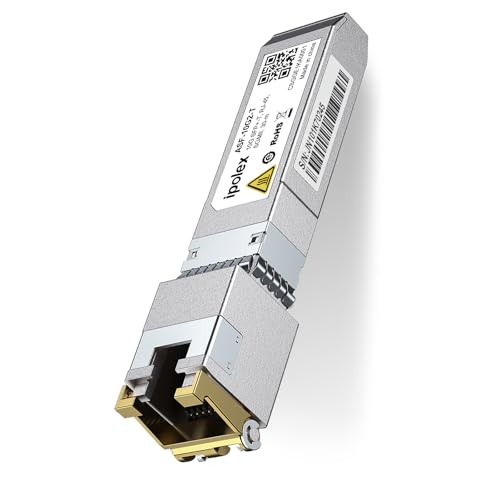
1. ipolex SFP+ to RJ45 10Gb Module
Our pick — over 4.5★ from 850+ verified ratings; the strongest balance of quality and price.
The best-selling budget module with nearly 900 reviews — but read the fine print on heat and compatibility.
At just 3.2 ounces and measuring a bulky 6.69 x 2.17 x 0.59 inches, this ipolex module is the heaviest and longest option here — at 6.69 x 2.17 x 0.59 inches versus the FTTPVIPS module’s 3.58 x 2.44 x 0.75 inches It supports the full multi-rate range (1.25G/2.5G/5G/10G) over Cat6a/Cat7 up to 30 meters and draws under 2.5W. The compatibility list is broad: Cisco, Ubiquiti UniFi, MikroTik, Netgear, D-Link, Qnap, and TP-Link are all listed, though the maker warns that compatibility can depend on IOS version and platform.
A buyer with Ubiquiti gear said the module “works fine with compatible hardware, but NOT compatible with Netgate XG-7100 SFP ports; caused overheating and instability.” Another reviewer noted it runs “hot-to-the-touch” after two weeks with a 5Gbps adapter. On the plus side, owners who paired it with UniFi USG Pro and USW Aggregation say it negotiates 10G with devices and enabled a 2Gbps Xfinity connection where a standard 2.5G module failed. It is the cheapest module in this lineup, but the heat and the large package size are the trade-offs that make the TP-Link or QSFPTEK worth the extra spend for critical links.
Budget benefits
- Strong multi-rate support at a budget price
- Works with Ubiquiti USW Aggregation and UniFi gear (verified by multiple buyers)
- 887 ratings with a 4.6-star average — proven by volume
Budget compromises
- At 3.2 oz and 6.69 inches long, it is the bulkiest module — may not fit tightly packed SFP+ banks
- Customers note overheating and instability with Netgate XG-7100 ports
Smart pick for: A secondary 10G link or home-lab experiment where the budget is tight and you can provide airflow; it has the highest review count here, so you are not flying blind.
Reconsider if: You run a Netgate XG-7100 or need the module to fit into a tight SFP+ slot array — the 6.69-inch length is a physical problem.
2. TP-Link Omada SM5310-T
The first-party module that just works without the usual compatibility guesswork.
TP-Link made this copper SFP+ module for its own Omada ecosystem, so if you run an Omada switch or router, this is the safest drop-in choice — but it works across many other brands too. It supports multi-rate auto-negotiation: full 10Gbps over runs up to 30 meters using Cat6a cable, and it drops down to 2.5G, 1G, or even 100Mbps when you connect slower gear. At only 1.06 ounces and with a compact metal casing measuring 2.65 x 0.54 x 0.54 inches, it is the lightest and most pocket-friendly module here — at 1.06 ounces versus the ipolex’s 3.2 ounces
Buyers report it works with Ubiquiti Dream Router 7 (the only module that worked after trying two others) and stays stable with Fortinet S648 SFP+ ports after a single setting tweak. One reviewer noted near-rated speeds for 30-68GB file transfers using NVMe SSDs and called it “barely warm.” The catch: the TP-Link SM5310-T lists for a premium price, and it won’t solve heat problems in a poorly ventilated rack, though most owners say it runs cooler than generic modules.
Why it earns the top spot
- First-party Omada support plus broad third-party compatibility (Ubiquiti, Fortinet, QNAP tested)
- Lightest module at 1.06 oz — very easy on the SFP+ slot
- Runs cooler than most copper SFP modules, per multiple user reports
The one honest trade-off
- Premium-priced compared to generic competitors
- May need a CLI tweak (set speed 10000cr) for some Fortinet switches to avoid packet loss
Best for: Anyone who wants the most reliable, cool-running module with tested compatibility across TP-Link, Ubiquiti, and Fortinet gear — and is willing to pay for first-party confidence.
Look elsewhere if: You need a sub- budget module or you run an HP/Aruba or Dell Force10 switch that is known to reject third-party optics.
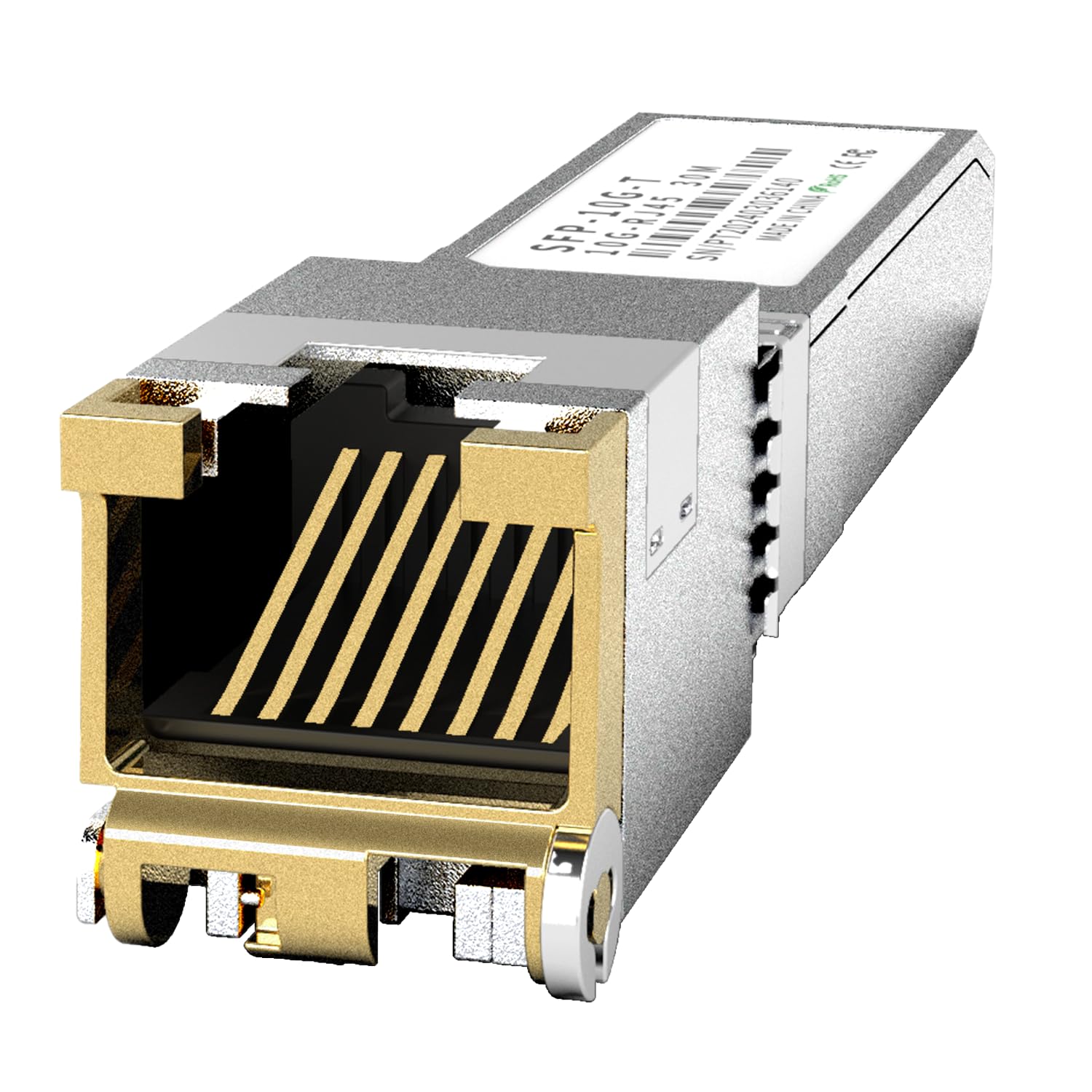
3. FTTPVIPS 10GBASE-T SFP+ RJ45 Copper Transceiver Module
The best-reviewed budget pick that actually works with the Netgate 8200.
That means you can plug it into a 2.5-gigabit cable modem today and upgrade to 10G later without swapping hardware. At 2.08 ounces, it is heavier than the TP-Link but still uses the standard compact SFP+ form factor (3.58 x 2.44 x 0.75 inches). One buyer confirmed it worked with the Netgate 8200 at 10G connection to a Quantum Fiber device.
Owners mention it runs hot — a shared trait across all copper 10G SFP+ modules — but they also highlight the 2-year warranty and 30-day free returns as safety nets. Another owner solved a 2.5G connection from an SFP+ port to wired Deco WAPs and saw real-world speeds jump to 1600-1700 Mbps down versus 900 Mbps over Gigabit Ethernet. The honest catch: while it passed integration tests with Cisco, Meraki, and MikroTik gear, the smaller seller has fewer verified long-term reviews than the established brands.
Best-value highlights
- Multi-rate support (1.25G/2.5G/5G/10G) for maximum flexibility
- Proven compatibility with Netgate 8200 and Ubiquiti gear
- 2-year warranty and lifetime technical support included
Value trade-offs
- Runs hot — a small fan or heatsink recommended for enclosed racks
- Fewer long-term reliability reports compared to the TP-Link or 10Gtek
Grab it if: You want a multi-rate module with a 2-year warranty at a mid-range price, especially if you own a Netgate 8200 or need to connect 2.5G cable modems to a 10G switch.
skip it if: You run a production environment where first-party vendor lock-in is required, or if you cannot provide airflow around the SFP+ slot.
4. QSFPTEK 10G SFP+ RJ45 Module

A dedicated Ubiquiti specialist with a 3-year warranty that outlasts the competition.
QSFPTEK built this module specifically for Ubiquiti UniFi gear — it is even labeled “for Ubiquiti” in the product color variant. The transceiver runs at 10GBase-T using an RJ45 interface and supports 10G, 5G, and 2.5G multi-rate adaptation over Cat6a or Cat7 cables up to 30 meters. It draws up to 2.5W of power, which is standard for this category but note if you fill multiple SFP+ slots. The package dimensions are identical to the QINIYEK module above (3.94 x 1.77 x 0.71 inches), but QSFPTEK adds a 3-year warranty and lifetime technical support — the strongest coverage here.
Buyers running Ubiquiti UDM Pro and US-8-150W switches report plug-and-play installation with zero configuration. One reviewer upgraded a home network and saw large file transfers become much faster with no stability issues. Another ran a stable 10 Gbps uplink between a main router and office hub for six months, noting the module “runs very hot” at around 127°F — but that is typical for copper 10G SFP+. The 3-year warranty is a tangible edge: if heat degrades the unit over time, the maker stands behind it.
What makes it a pro pick
- Specifically tested and tune for Ubiquiti UniFi switches and routers
- 3-year warranty and lifelong technical support — best coverage in this roundup
- Reliable 10Gbps uplink performance over months of 24/7 use
Reality check
- Runs very hot (127°F reported); a small heatsink is a smart addition
- Slightly more expensive than generic no-name modules
Who it serves: Ubiquiti UniFi owners who want a module with a warranty that lasts, not just the lowest upfront cost.
Who should pass: If you run Cisco Nexus or Meraki switches, check compatibility first — QSFPTEK lists Cisco SFP-10G-T-S support but not all Cisco series.
5. 10Gtek 10GBase-T SFP+ to RJ-45 Transceiver

The premium chipset choice if you need broad Cisco/Meraki support and can manage the heat.
10Gtek uses the Marvell AQR113C integrated circuit inside this transceiver — a widely respected chip that delivers consistent 10Gbps over Cat6a/Cat7 up to 30 meters. The module runs hot (the company itself warns about it and recommends keeping ambient temperature below 50°C), but the chipset is the same one found in many high-end enterprise modules. This is the only pick here that explicitly warns it is not compatible with HP ProCurve, HP Aruba, Intel, Arista, Mellanox, or Dell Force10 switches — so check compatibility before ordering.
One buyer tested it in a UniFi UDM Pro and said it was recognized as OEM and ran “warm, not hot,” achieving over 940Mbps on a 1Gbps connection. Another had an initial compatibility issue with an Intel SFP+ card, but after customer support sent a free replacement, it delivered a consistent 10Gbps over 50 feet of Ethernet. The after-sales story stands out: the seller replaced a non-working unit at no cost after the return window. The catch is the price — this is the most expensive mid-range option, and it runs hot enough that 10Gtek suggests a cool environment.
Premium strengths
- Marvell AQR113C chipset delivers reliable enterprise-grade performance
- Strong customer support that replaced a defective unit free of charge
- Works with Cisco, Fortinet, Netgear, D-Link, and Meraki (verified in reviews)
Premium drawbacks
- Higher price than generic modules — one reviewer called it “a little pricey”
- Explicitly incompatible with HP, Intel, Arista, Dell Force10, and Juniper switches
Choose this if: You need a quality chipset for a Cisco, Fortinet, or Meraki switch and value customer service that replaces defective units without hassle.
Not for you if: Your network includes HP, Intel, or Juniper SFP+ ports — this module will not link up.
6. QINIYEK 1.25/2.5/5/10G-T SFP+ to RJ45 Transceiver

A compact multi-rate module that worked in every brand one buyer tried — but reliability can be a gamble.
This 10G SFP+ to RJ45 copper module from QINIYEK measures just 3.94 x 1.77 x 0.71 inches and weighs 1.44 ounces — far smaller than the ipolex, similar to the QSFPTEK. It supports 10G/5G/2.5G/1.25G over Cat6a/Cat7 up to 30 meters, with plug-and-play hot-swappable installation. The maker lists compatibility with Cisco SFP-10G-T-S, Ubiquiti UF-RJ45-10G, Netgear AXM765, D-Link DEM-440XT, MikroTik S+RJ10, and Fortinet — though they explicitly warn it does not work with Cisco Nexus or Meraki series.
One buyer mentioned that one of two transceivers failed after 9 months in a climate-controlled UniFi setup, though the company provided excellent customer support. A third owner tested it in Mokerlink, Zyxel, and Netgear switches and saw transfer speeds jump from 60-90 MB/s to 200 MB/s versus 1Gig. The 3-year warranty and lifetime technical support offer a safety net, but the failure report is a reminder that budget-tier modules sometimes have a shorter lifespan.
Value pluses
- Compact size (3.94 x 1.77 x 0.71 in) fits tight port arrays well
- 3-year warranty and lifetime tech support included
- Works across Mokerlink, Zyxel, Netgear, MikroTik, Fortinet (verified in reviews)
Value minuses
- One owner reported a failure after 9 months in a UniFi setup; reliability is not guaranteed
- Not compatible with Cisco Nexus or Cisco Meraki switches
Reach for this if: You are building a multi-switch lab with Mokerlink, Zyxel, or Netgear gear and want a compact module with a 3-year warranty.
Look elsewhere if: You need guaranteed uptime for critical infrastructure and cannot risk a mid-life failure — consider the TP-Link SM5310-T instead.
7. NataLink 10G SFP+ to RJ45 Transceiver
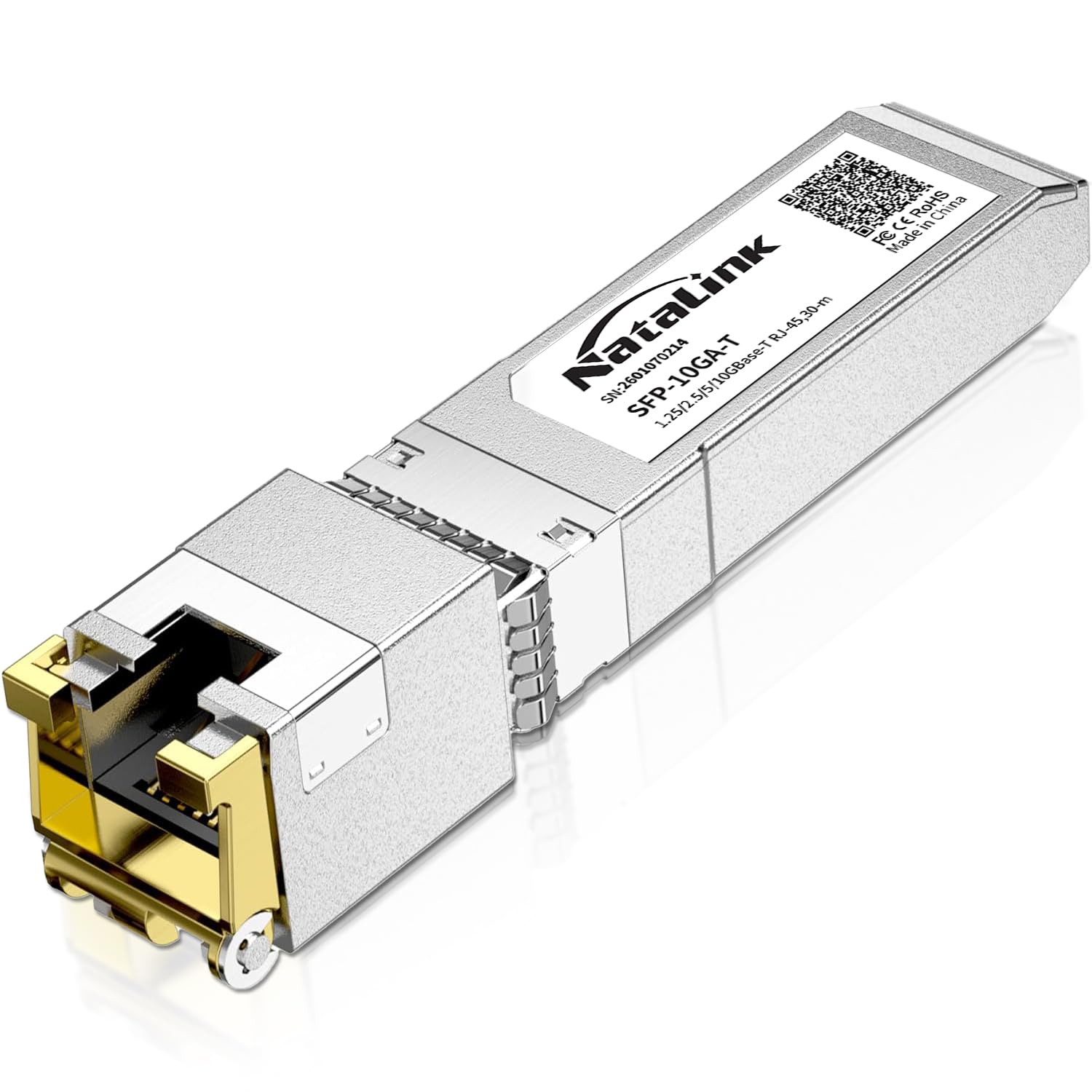
The lightest module in the lineup at 1.13 ounces — but reviewers point out major heat and packet-loss issues.
NataLink’s 10G SFP+ to RJ45 transceiver is the lightest module here at 1.13 ounces — at 1.13 ounces versus the ipolex’s 3.2 ounces It supports full multi-rate auto-negotiation (1.25G/2.5G/5G/10G) over Cat6a/Cat7 up to 30 meters, with a power draw under 2.5W. The compatibility list includes Cisco, Ubiquiti, Unifi, QNAP, ZyXEL, D-Link, Netgear, TP-Link, Brocade, Broadcom, and MikroTik. The date first available is listed as January 2026, which means it is a new, relatively unproven entrant compared to modules that have been on the market since 2016.
The customer reviews tell a mixed story. One buyer got it working with a MokerLink switch at all speeds (10G/5G/2.5G/1.25G). Another used it to connect a 2.5G cable modem to a 10G router port with success. But the most critical review warns: “Extremely hot, dropped packets, and showed dead on my Ubiquiti. Sham compatibility. Avoid.” A separate reviewer on a TP-Link router reported that the unit overheated, though they blamed the router rather than the module. With only 37 ratings and a 4.4 average, the sample size is too small to be confident — especially when one of those reviews describes a complete failure on a Ubiquiti network.
Budget-side strengths
- Lightest module at 1.13 oz — puts minimal stress on the SFP+ slot
- Full multi-rate support (1.25G/2.5G/5G/10G) at the lowest price
Budget-side risks
- Buyer reported extreme heat, dropped packets, and complete failure on Ubiquiti gear
- Only 37 reviews — insufficient data to judge long-term reliability
Only consider if: The budget is extremely tight, you are experimenting in a non-critical home lab, and you accept that the module may run too hot for some Ubiquiti switches.
Definitely skip if: You need a reliable primary link on Ubiquiti UniFi gear — the single review reporting “dead on my Ubiquiti” is a hard warning.
Understanding the Specs
Multi-Rate Auto-Negotiation
All the modules on this list support multiple speeds — from 1.25G or 1G all the way up to 10G — and they automatically negotiate the highest speed both ends can handle. That means you can plug a module into a 10G switch port today, connect it to a 2.5G cable modem, and it will run at 2.5G without any configuration. When you upgrade to a 10G modem or device, the same module speeds up automatically. If a module only lists 10G support without mentioning 2.5G or 5G, it will not work at those intermediate speeds.
Heat Management and Power Draw
Every copper 10G SFP+ module generates more heat than a fiber module because the chipset inside has to push a 10-gigabit signal through copper wiring. Most modules draw under 2.5W, but that still produces noticeable heat — many shoppers say modules become too hot to touch during heavy use. Operating temperatures are rated 0–70°C (32–158°F), but sustained operation at the high end can shorten lifespan. Solutions include leaving an empty SFP+ slot between modules for airflow, adding a small stick-on heatsink, or pointing a fan at the switch faceplate. If your switch sits in an enclosed, unventilated space, a fiber SFP+ module may be a better long-term choice.
FAQ
Will any 10G SFP+ module work in my switch or router?
What cable do I need for a 10G SFP+ copper module?
How hot is too hot for a 10GBASE-T SFP+ module?
Can I use a 10G SFP+ module in a 1G SFP+ slot?
What is the difference between SFP and SFP+?
How do I remove a copper SFP+ module from a switch?
Can I use a copper SFP+ module in a fiber-only SFP+ port?
How long does a 10G SFP+ copper module last?
Will a 10G SFP+ module work with a 2.5G-only switch port?
Should I buy a first-party module or a third-party one?
Final Thoughts: The Verdict
For most people, the 10 gigabit sfp module to buy is the TP-Link Omada SM5310-T because it combines first-party build quality, broad cross-brand compatibility, and cooler operation than almost any alternative. If you want the best value with a 2-year warranty and proven Netgate 8200 support, grab the FTTPVIPS 10GBASE-T module. And for a dedicated Ubiquiti UniFi network with long-term coverage you can trust, the standout is the QSFPTEK 10G SFP+ RJ45 module and its 3-year warranty.
How We Picked
We do not accept paid placement. Every pick is matched to a real buyer and a real use-case; we do not hands-on test units.
Sources & Methodology
Specifications: manufacturer listings and product documentation. Review insights: verified customer reviews, as of July 2026. Pricing: not shown on this page (it changes often); check the current price via the retailer link.
As an Amazon Associate, Gadgets Feed earns from qualifying purchases. This does not affect which products we feature.