
Our readers keep the lights on and my morning glass full of iced black tea. As an Amazon Associate, I earn from qualifying purchases.
Specs are compiled from manufacturer listings and verified buyer reviews and can change over time — please confirm the key details on the product page before buying.
Running out of hot water mid-shower is a daily frustration that a 10 GPM tankless water heater can end for good. These units heat water the moment you turn the tap, so a large family can run the laundry, dishwasher, and two showers at once without the tank running dry. This guide compares the top models built for that kind of whole-house demand, focusing on real specs and what owners actually experience after installation.
I’m Min — the founder and writer behind Gadgets Feed. This guide is built by comparing the manufacturers’ published specifications and the patterns across verified customer reviews, so you get each pick’s real strengths and trade-offs instead of marketing spin.
Read on to find the right 10 GPM tankless water heater for your home’s flow needs, venting setup, and fuel source before you commit to an installation.
Our Picks at a Glance
How To Choose The Best 10 GPM Tankless Water Heater
Before you buy a tankless water heater, check three things: your home’s gas line size, the venting setup, and how many fixtures you run at once. If the unit needs a bigger gas pipe than you have, or a vent type your wall can’t support, your project stalls. Get these three right first, and the rest is straightforward.
Flow Rate vs. Actual Demand
A 10 GPM unit delivers 10 gallons of hot water per minute, enough for several showers and appliances at once. But your real demand depends on fixture count and your incoming ground-water temperature in winter. In cold climates, a 10 GPM unit may only deliver 6-7 GPM at 120°F because colder inlet water needs more heating power. That’s why BTU input matters as much as the flow rate number.
Venting and Fuel Type
Indoor tankless heaters must vent exhaust outdoors. Concentric vent systems use a single pipe-within-a-pipe design (often 3″ x 5″) that pulls combustion air in and pushes exhaust out through one wall penetration. Standard PVC venting uses two separate pipes. Your home’s construction determines which is possible, so check the required vent type before buying. Also confirm whether you have natural gas or propane — some models can convert between the two, saving you a second unit if you ever switch.
Quick Comparison
| Model | Best For | Flow Rate | Max Temp | Venting | Amazon |
|---|---|---|---|---|---|
| MIZUDO NG★ Best Overall | Budget-minded large homes | 10.3 gpm | 149°F | 3″ x 5″ concentric | Amazon |
| Westinghouse HW199A0G | Smart home control | 10.3 gpm | 167°F | 3″ x 5″ concentric | Amazon |
| A. O. Smith ATI-510CX3 | DIY installers | 10 gpm | — | Direct vent concentric | Amazon |
| Rinnai RU180iP | Premium long-term value | 10 gpm | — | — | Amazon |
In‑Depth Reviews
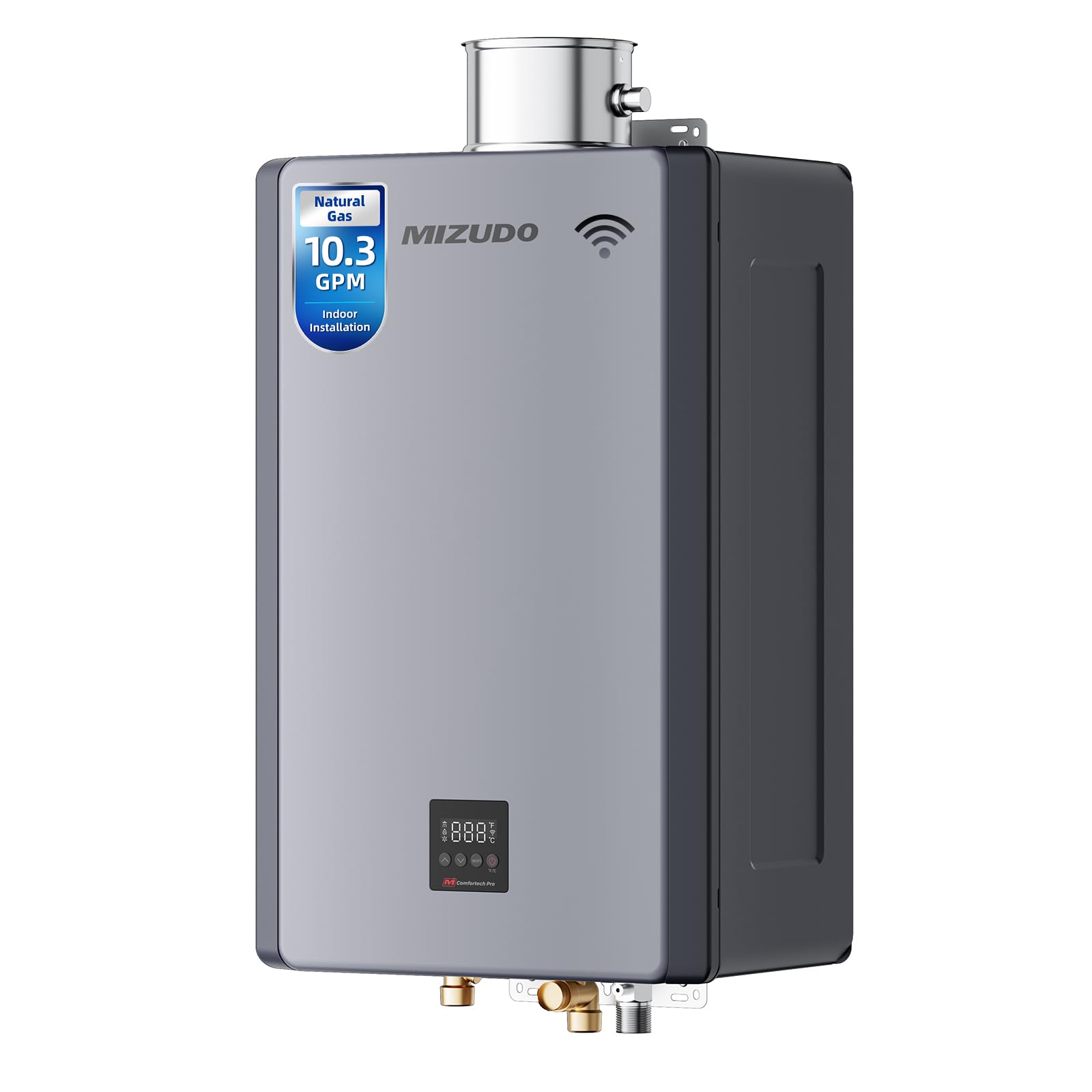
1. MIZUDO Natural Gas Tankless Water Heater
Our pick — over 4★ from 300+ verified ratings; the strongest balance of quality and price.
The compact whole-house performer that replaces a 50-gallon tank without the premium price tag.
The MIZUDO earns its spot here by delivering a 10.3 gpm flow from a 199,000 BTU burner — enough to feed 2–3 bathrooms, the kitchen, laundry, and dishwasher at the same time. Owners who made the switch from a traditional tank report hot water arriving in seconds, which makes the morning rush far less stressful.
A standout feature is its ±1°F temperature control, holding water within one degree of your setting to stop those sudden cold blasts mid-shower. You can dial it up to 149°F for deep soaking tubs or heavy-duty laundry, and the default 107°F daily setting is a comfortable starting point. It even activates at a low 0.53 GPM flow, so a single sink faucet gets hot without the unit idling.
The sealed concentric vent (3″ x 5″) draws outdoor air for combustion and pushes exhaust out with a forced-draft fan, keeping fumes away even in windy weather. At roughly the size of a carry-on suitcase (24.8″ x 15.9″ x 10.4″), it tucks into closets or basements, and the CSA certification confirms it’s built for indoor installation. Buyers report: “The hot water comes out in a few seconds.”
What Wins People Over
- Fast, consistent heating praised across owner experiences
- Compact footprint fits tight spaces
- App control with abnormal alerts and Alexa compatibility
Know Before Installing
- Some report heat output drops after 60–90 seconds in colder conditions
- Requires professional installation and a dedicated vent kit
- Not recommended above 3,000 feet elevation
The smart money choice: Best for a busy household that wants whole-home hot water and app control at a mid-range investment. A 2-year full unit warranty plus 5-year heat exchanger coverage backs it up.
The trade-off: In very cold climates, that 10.3 GPM flow may not stay at full strength, so think about your winter inlet temperature before relying on it for a huge home.
2. Westinghouse Tankless Water Heater Gas Indoor
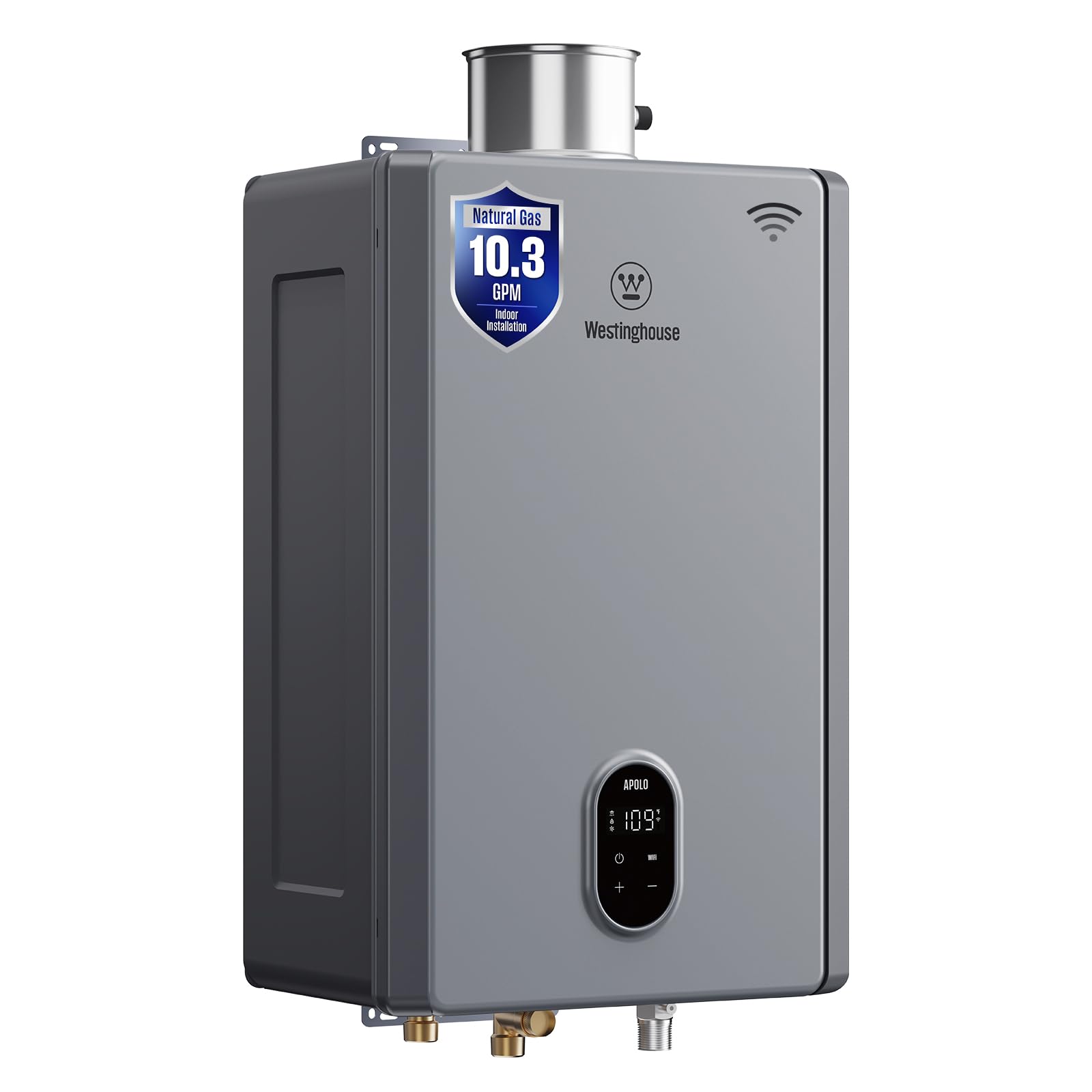
A high-temperature workhorse built for 4+ bathrooms with smart control and serious winter protection.
The Westinghouse pushes performance further than the MIZUDO with a max temperature of 167°F — a full 18°F hotter, which lets you set very high water temps for specialized use. That firepower pairs with 10.3 GPM and 199,000 BTU, sized for homes with 4+ bathrooms running showers, laundry, and appliances at the same time. Owners mention: “It has been working flawlessly for about 2 months now.”
Smart WiFi app control is the headline feature here. Set temperature, check operating status, and get fault alerts from anywhere, plus voice control for hands-free adjustments. Owners love that at 116°F they no longer mix hot and cold — the thermostat holds so steady that cold water only gets used when they specifically want it.
Winter performance sets this apart too, with integrated freeze protection down to -13°F and a phosphorus-deoxidized copper heat exchanger for faster heating. The 1:20 turndown ratio and 6-stage combustion system adjust energy use in real time, which helps cut gas consumption during lighter demand. It uses the same 3″ x 5″ concentric stainless steel vent pipe as the MIZUDO, so installation expectations are similar.
The Strong Suits
- Highest max temperature in this lineup at 167°F
- Freeze protection down to -13°F for colder regions
- Smart app tracks hot water usage as a bonus
Consider This
- Temperature control gets mixed feedback in owner reports
- Hiring a contractor who knows tankless units can be a hurdle
- It can take a minute or two to reach full heat at the tap
Built for bigger homes: Choose this if you have 4+ bathrooms and want the highest temp ceiling plus smart-home integration in one unit.
The ask: Its premium position means you’ll want an experienced installer — and you should budget for the separate concentric vent kit.
3. A. O. Smith ProLine XE ATI-510CX3
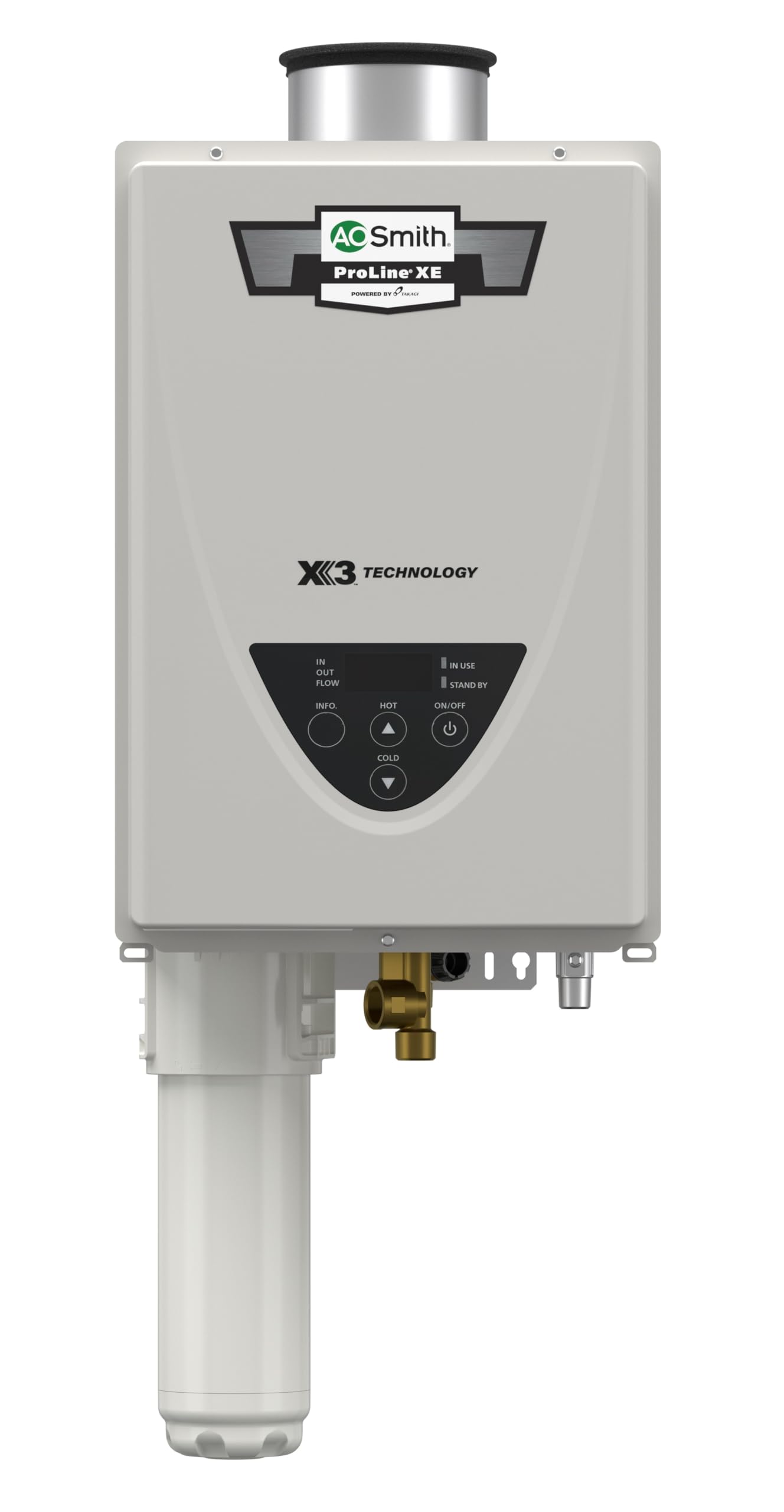
The DIY-friendly unit whose owner reports read like a 10-year reliability forecast.
The A. O. Smith’s commercial-grade copper heat exchanger transfers heat 25x faster than stainless steel, so water stabilizes to temperature quicker. At 10 gpm continuous flow and 199,000 BTU, it handles simultaneous showers, laundry, and dishes without pressure drop, as owners confirm on a condo setup running shower and washer at once.
Flexibility is its calling card. This unit converts easily from natural gas to propane, so it works whether your home is on a gas line or a tank. The built-in X3 Scale Prevention Technology reduces mineral buildup, and a built-in filter adds extra protection — though owners still recommend an annual vinegar flush to keep performance sharp.
It also carries a 15-year limited warranty on the heat exchanger for residential use, the longest in this lineup. A separate concentric flue is required for the direct vent system, which can be run vertically or horizontally. The brand’s integrated controls and advanced diagnostics help simplify troubleshooting, and multiple customers note completing the install themselves with basic DIY knowledge in about 25 minutes of plumbing work.
What Shines Here
- 15-year heat exchanger warranty in residential use
- Convertible between natural gas and propane
- Copper heat exchanger for faster temperature stability
What to Watch
- One owner notes it’s not recommended for midwestern winter regions
- Warranty voids without a professional installer
- Separate concentric flue costs extra and requires planning
The DIY pick: If you’re handy and want a convertible, long-warranty unit you can install yourself, this is the one to beat for value-per-feature.
Where it hesitates: Colder midwestern climates may need extra consideration for incoming water temp, so pair it with realistic expectations about winter flow.
4. Rinnai RU180iP Condensing Tankless Water Heater

The condensing premium pick that sips energy while serving up to six appliances at full flow.
The Rinnai RU180iP is the only condensing unit here, capturing extra heat from exhaust gases for higher efficiency. It’s ENERGY STAR qualified and, at 74.1 pounds, the heaviest here—a sturdy build owners say “goes right to work” after simple setup. Some installed it themselves without needing tech support.
Its Circ-Logic feature pairs with an external pump for scheduled or on-demand recirculation, cutting the wait for hot water at distant faucets. At up to 10 GPM it can accommodate up to 6 appliances at once, making it a serious contender for the largest households. Its warranty covers 15 years on the heat exchanger, 5 years on parts, and 1 year on labor for residential use.
WiFi monitoring is available with a separate Controlr module, which isn’t included — a nice upgrade path rather than a built-in standard feature. Professional installation is strongly recommended by the manufacturer, and they point buyers to their PRO locator to find a qualified technician. At this premium tier, the brand’s reputation for tankless reliability is what most owners cite as the reason they stayed loyal.
The Premium Payoff
- Condensing design qualifies for ENERGY STAR
- Handles up to 6 appliances at 10 GPM
- 15-year heat exchanger warranty
Before You Commit
- Holds temperature well but carries a higher upfront investment for pro install
- Controlr WiFi module sold separately
- Heavier build (74.1 lbs) needs a solid mounting surface
The long-game choice: For a household that will stay put for a decade or more and wants the most efficient hot water possible, this is the premium pick worth saving for.
The honest catch: Budget for a professional installer and the optional WiFi module if you want the fully connected experience.
Understanding the Specs
Flow Rate (GPM)
Gallons per minute tells you how much hot water the unit can deliver at once. A 10 GPM unit like these handles multiple showers plus appliances running simultaneously. Your real output depends on inlet water temperature — colder ground water in winter means less effective flow at your desired shower temp, so BTU input matters just as much.
BTU Input & Max Temperature
BTU (British Thermal Units) measures heating power — 199,000 BTU is the standard for 10 GPM whole-home units. Max temperature shows how hot the unit can go: the Westinghouse reaches 167°F while the MIZUDO tops out at 149°F. Higher max temps help with deep soaking tubs and sanitizing dishwasher cycles.
Venting System
Indoor tankless heaters must vent exhaust outdoors. Concentric venting uses one pipe-in-pipe (typically 3″ x 5″) that draws combustion air in and pushes exhaust out through a single wall penetration. Standard PVC uses two pipes. Your home’s construction and wall layout determine which type you can install — check before buying.
Warranty Coverage
Tankless warranties typically split into heat exchanger, parts, and labor coverage. The A. O. Smith and Rinnai both offer 15-year heat exchanger warranties, while the MIZUDO provides 5 years on the heat exchanger with 2 years on the full unit. These tiers tell you how long the manufacturer expects the core component to last.
FAQ
Is a 10 GPM tankless water heater enough for my whole house?
What is the difference between condensing and non-condensing tankless heaters?
Can I install a 10 GPM tankless water heater myself?
What venting do I need for an indoor tankless water heater?
Does a tankless water heater work during a power outage?
How often do I need to flush a tankless water heater?
What is a good maximum temperature for a 10 GPM tankless heater?
Does a 10 GPM tankless heater work in cold climates?
Final Thoughts: The Verdict
For the majority of shoppers, the clear winner for the best 10 gpm tankless water heater is the MIZUDO because it delivers the full 10.3 GPM flow, smart app control, and a compact build at a value price that undercuts the premium field. If you need the highest temperature ceiling and freeze protection for a 4+ bathroom home, grab the Westinghouse with its 167°F max. And for DIY installers who want a convertible gas/propane unit with a 15-year warranty, the A. O. Smith is the one to reach for. The Rinnai RU180iP remains the premium condensing choice for buyers who prioritize energy efficiency above all. Choose the MIZUDO for smart features, the A. O. Smith for DIY simplicity, or the Rinnai for maximum efficiency.
How We Picked
We do not accept paid placement. Every pick is matched to a real buyer and a real use-case; we do not hands-on test units.
Sources & Methodology
Specifications: manufacturer listings and product documentation. Review insights: verified customer reviews, as of August 2026. Pricing: not shown on this page (it changes often); check the current price via the retailer link.
As an Amazon Associate, Gadgets Feed earns from qualifying purchases. This does not affect which products we feature.