
The graphics card market is a battlefield of architecture generations, VRAM capacities, and overclocked factory bins — and making the wrong pick means leaving performance, dollars, and future-proofing on the table. Whether you’re targeting 1440p ultra with ray tracing or diving into 4K with DLSS, the gap between a smart buy and a regretful one comes down to understanding how core count, memory bandwidth, and thermal headroom translate into real frame rates in your actual games.
I’m Min — the co-founder and writer behind Gadgets Feed. I’ve spent hundreds of hours analyzing GPU spec sheets, real-world benchmarks, and user-verified performance data to cut through the marketing noise and identify which graphics cards deliver on their promises across every price tier.
After comparing 11 distinct models spanning Intel Arc, NVIDIA Ampere, and Blackwell architectures, this guide narrows the field to the best 10 graphics cards that balance raw compute, cooling efficiency, and feature support for today’s demanding gaming and creative workloads.
How To Choose The Best 10 Graphics Cards
Selecting the right GPU involves weighing architecture generation, memory subsystem, and cooling solution against your specific resolution targets. Focusing solely on core count or clock speed without considering memory bandwidth and thermal behavior leads to disappointing real-world results.
VRAM Capacity and Memory Bus Width
10GB on a 320-bit bus handles 1440p gaming comfortably today, but 16GB on a 256-bit GDDR7 bus offers higher bandwidth for 4K textures and future titles. Cards like the RTX 5080 with 16GB GDDR7 deliver 960 GB/s of memory bandwidth, which prevents stuttering in texture-heavy scenes. For creative workloads, insufficient VRAM forces the system to rely on system RAM, drastically reducing performance in video editing and 3D rendering.
Cooling Solutions and Thermal Design
Dual-fan designs with 0dB modes keep noise low at idle but can hit 80°C under sustained gaming loads. Premium cards with vapor chambers and triple fans maintain temperatures below 70°C while staying quieter. The ASUS TUF Gaming 3080, for instance, uses dual ball fan bearings for longevity and stays under 75°C in stress tests. Card length also matters — some premium coolers extend past 13 inches, requiring careful case compatibility checks.
Architecture and Feature Support
NVIDIA’s Ampere architecture (RTX 30 series) brings second-gen ray tracing cores and third-gen tensor cores for DLSS, while Intel’s Xe2-HPG architecture includes Xe Matrix Extensions for AI acceleration and XeSS upscaling. The newer Blackwell architecture (RTX 50 series) introduces DLSS 4 with frame generation improvements and PCIe 5.0 support. DX12 Ultimate support and AV1 encoding are essential features for modern games and content creation workflows.
Quick Comparison
On smaller screens, swipe sideways to see the full table.
| Model | Category | Best For | Key Spec | Amazon |
|---|---|---|---|---|
| ASUS TUF Gaming RTX 3080 V2 OC | Premium Mid-Range | 1440p Ultra / 4K Gaming | 1815 MHz Boost, 10GB GDDR6X | Amazon |
| GIGABYTE RTX 5080 Gaming OC | Premium High-End | 4K Ultra / Creator Workflows | 16GB GDDR7, Blackwell Arch | Amazon |
| MSI RTX 5080 Inspire 3X OC | Premium High-End | Compact 4K Builds | 16GB GDDR7, DisplayPort 2.1a | Amazon |
| ASUS ProArt RTX 5080 OC | Professional Workstation | Content Creation / 3D Rendering | 2730 MHz Boost, Vapor Chamber | Amazon |
| EVGA RTX 3080 FTW3 Ultra | Premium Mid-Range | High-Refresh 1440p | 1800 MHz Boost, iCX3 Cooling | Amazon |
| GIGABYTE RTX 3080 Gaming OC Rev2.0 | Mid-Range | 1440p Gaming / 4K Entry | 8704 CUDA Cores, 10GB GDDR6X | Amazon |
| MSI RTX 3080 Ventus 3X Plus OC LHR | Mid-Range | VR / High-End Gaming | 1740 MHz Boost, 10GB GDDR6X | Amazon |
| ZOTAC RTX 3080 Trinity OC White LHR | Mid-Range | Aesthetic Builds / 1440p | 1740 MHz Boost, White Edition | Amazon |
| NVIDIA RTX 3080 Founders Edition (Renewed) | Value Mid-Range | Budget High-End Gaming | 10GB GDDR6X, FE Design | Amazon |
| Sparkle Intel Arc B570 Guardian OC | Entry-Level | 1080p/1440p Budget Gaming | 2660 MHz Boost, 10GB GDDR6 | Amazon |
| ASRock Intel Arc B570 Challenger 10GB | Entry-Level | 1440p Gaming / Video Editing | 2600 MHz GPU, Xe2-HPG Arch | Amazon |
In‑Depth Reviews
1. ASUS TUF Gaming NVIDIA GeForce RTX 3080 V2 OC Edition

The ASUS TUF Gaming RTX 3080 V2 OC builds on the Ampere architecture with 8704 CUDA cores and a factory overclock reaching 1815 MHz in OC mode. Its military-grade certification and dual ball fan bearings set it apart from standard cards — the TUF lineup is engineered for sustained loads where lesser coolers throttle. Users report three years of heavy use without degradation, maintaining stable FPS in titles like Red Dead Redemption 2 at high frame rates while keeping thermals below 75°C under stress.
This card pairs exceptionally well with the RTX 3080’s 10GB GDDR6X memory on a 320-bit bus, delivering 760 GB/s of bandwidth that handles 1440p ultra settings with ray tracing effortlessly. The V2 revision refines the thermal paste application and fan curve, resulting in quieter operation than launch units. Owners note that in ITX builds like the NR200 Max, the card stays under 75°C even during prolonged sessions, with coil whine being luck-of-the-draw but generally considered minimal.
For content creators, the 2nd-gen RT cores and 3rd-gen tensor cores accelerate Blender renders and DaVinci Resolve timelines. The card requires a minimum 850W 80+ Gold PSU and two PCIe power cables, which is standard for this performance tier. The build quality is all-metal with no plastic shroud, adding structural rigidity that prevents PCB flex over time.
Why it’s great
- Military-grade build with dual ball bearing fans for long service life
- Excellent thermal performance — stays under 75°C in stress tests
- Factory overclocked with quiet operation in performance mode
Good to know
- Requires 850W PSU minimum with two PCIe power cables
- Large card — verify case clearance before purchase
2. GIGABYTE GeForce RTX 5080 Gaming OC 16G

The GIGABYTE RTX 5080 Gaming OC represents a generational leap with NVIDIA’s Blackwell architecture and DLSS 4. Its 16GB GDDR7 memory on a 256-bit bus delivers 960 GB/s bandwidth — a 26% improvement over GDDR6X solutions — which eliminates texture pop-in even at 4K with maximum settings. The WINDFORCE cooling system uses three fans with alternate spinning to reduce turbulence, keeping the card between 60-65°C under load in 85°F ambient rooms without AIO water cooling.
Users upgrading from RTX 3080 12GB models report dramatic improvements in 4K gaming, maintaining 60 FPS in demanding titles without relying on DLSS or frame generation. DLSS 4.5 support and frame gen 2x-3x modes further extend performance in ray-traced titles, while the 4x mode is best reserved for single-player experiences. The card overclocks effortlessly — owners achieve +350 core without voltage adjustment, hitting 3150 MHz GPU clocks.
The card measures 13.46 inches long, requiring spacious cases with proper front-to-back airflow. It includes a versatile VGA holder to prevent sag and a 12V-2×6 to 3x PCIe 8-pin adapter. While the MSRP positions it as a premium option, the combination of 16GB VRAM, PCIe 5.0 support, and next-gen encoding makes it a strong investment for 4K gaming and professional workloads.
Why it’s great
- 16GB GDDR7 memory with 960 GB/s bandwidth for 4K ultra textures
- Exceptional thermal performance — 60-65°C under sustained load
- DLSS 4.5 and frame generation for ray-traced titles
Good to know
- Very long card at 13.46 inches — verify case compatibility
- RGB lighting is understated compared to Aorus Master variants
3. MSI Gaming RTX 5080 16G Inspire 3X OC

The MSI RTX 5080 Inspire 3X OC brings Blackwell architecture into a more compact package than the GIGABYTE card, making it suitable for smaller form factor builds without sacrificing performance. Its 16GB GDDR7 memory and 256-bit interface handle 1440p ultra with ray tracing effortlessly — users report 200+ FPS with DLSS frame generation enabled and 120+ FPS without, even when paired with an AMD Ryzen 7 9800X3D processor. The Inspire 3X cooler is notably quiet, maintaining silence under load without aggressive fan profiles.
DisplayPort 2.1a outputs support high-refresh-rate monitors up to 8K resolution, future-proofing for the next generation of displays. The card’s compact design relative to other 5080 variants means it fits in mid-tower cases where longer cards cause clearance issues. Users transitioning from AMD 7800 XT setups note the driver stability advantage of NVIDIA’s software suite, with plug-and-play operation across DirectX 12 and Vulkan titles.
Power draw remains high at this tier — ensuring at least an 850W PSU with proper PCIe 5.0 connector support is critical. The card’s build quality is solid with a sleek, premium aesthetic that avoids excessive RGB. For buyers targeting 1440p 240Hz gaming or entry-level 4K, this card delivers the Blackwell feature set without the bulk of flagship coolers.
Why it’s great
- Compact form factor fits mid-tower cases comfortably
- DisplayPort 2.1a supports 8K high-refresh monitors
- Quiet operation — Inspire 3X cooler is silent under load
Good to know
- High power draw requires 850W PSU minimum
- Premium pricing tier reflects Blackwell launch positioning
4. ASUS ProArt NVIDIA GeForce RTX 5080 OC Edition
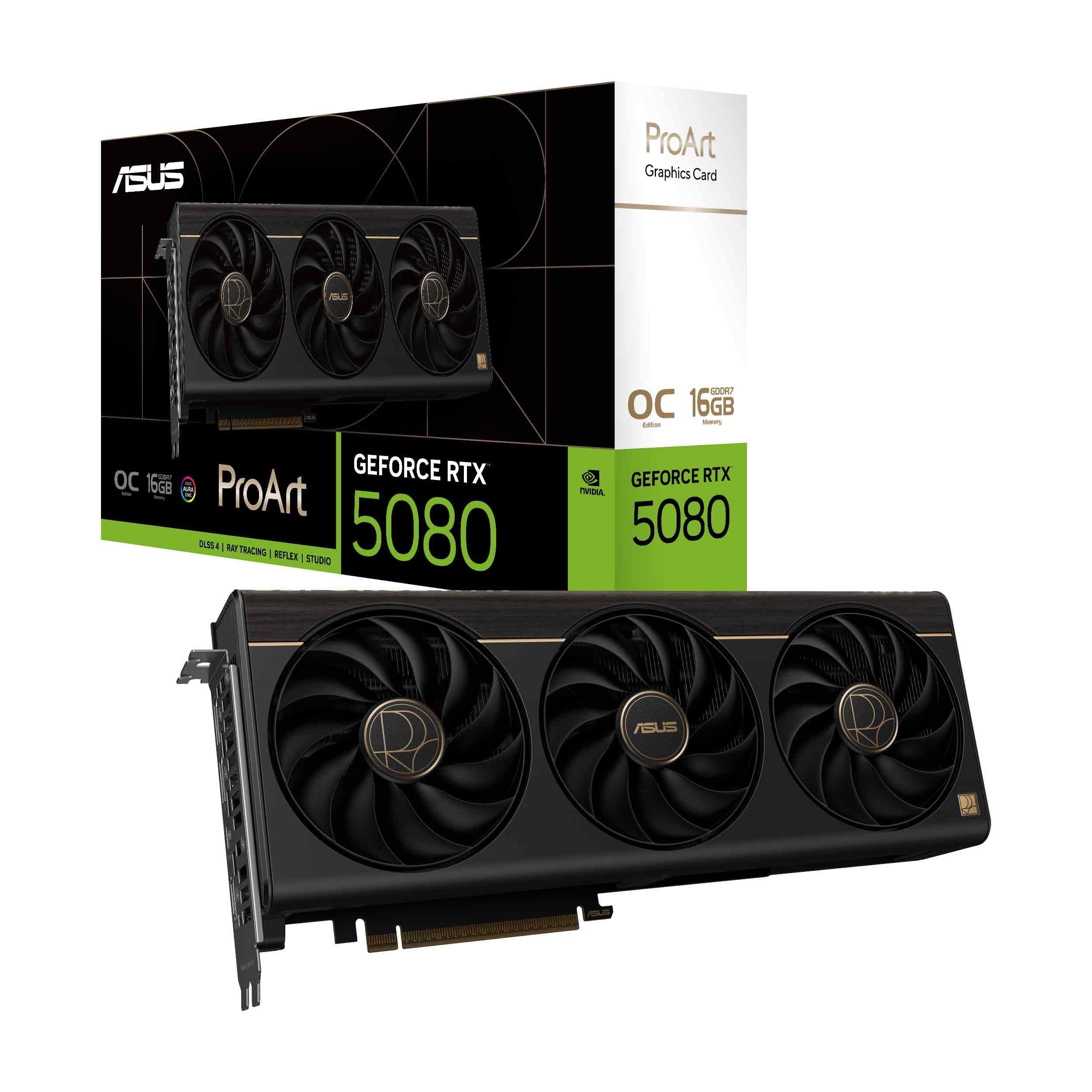
The ASUS ProArt RTX 5080 OC is built for content creators who need workstation-grade reliability with gaming-class performance. Its vapor chamber cooling and MaxContact heatsink design maintain 1858 AI TOPS of AI compute performance, accelerating renders in Blender, renders in Unreal Engine, and video exports in DaVinci Resolve. The integrated USB Type-C port on the card itself adds versatility for direct peripheral connections without routing cables through the motherboard.
At 2.5-slot thickness, the ProArt design prioritizes compatibility with SFF and workstation chassis while still housing the full Blackwell architecture with 16GB GDDR7 memory. Users report excellent thermals — the card runs cool even during prolonged rendering sessions, with no coil whine reported in verified reviews. The adjustable illuminated logo allows discreet branding for professional environments where RGB flash is unwanted.
Pricing reflects the premium materials and workstation-targeted features, but for creators who need CUDA acceleration alongside gaming capability, this card eliminates the need for separate Quadro and GeForce purchases. The 3-year warranty adds peace of mind. Ensure a Gen 4 BIOS setting if using non-Gen 5 riser cables, as the card defaults to PCIe 5.0 negotiation.
Why it’s great
- Vapor chamber cooling for sustained creator workloads
- Built-in USB Type-C port simplifies peripheral connections
- 2.5-slot design fits SFF and workstation cases
Good to know
- Premium price point reflects workstation-grade engineering
- May need BIOS adjustment for Gen 5 riser cables
5. EVGA GeForce RTX 3080 FTW3 Ultra Gaming

The EVGA RTX 3080 FTW3 Ultra represents the pinnacle of EVGA’s engineering before their exit from the GPU market, making it a sought-after card for enthusiasts. With a real boost clock of 1800 MHz and iCX3 technology that uses multiple thermal sensors across the card, the FTW3 maintains aggressive boost behavior under load. Users report hitting 165 FPS at 1440p in most titles with tweaked settings, and the card’s NVENC encoder makes it a strong choice for streamers recording at high bitrates.
The 10GB GDDR6X memory on a 320-bit bus provides the bandwidth needed for high-refresh 1440p gaming, but the card runs hot — owners note it raises room temperature by 5-10°F during extended sessions, and the triple 8-pin power requirement means verifying PSU cable availability before purchase. The card is also physically large at 11.81 inches, requiring a GPU support bracket to prevent sag in standard ATX cases.
EVGA’s Precision X1 software enables per-voltage curve tuning, allowing owners to achieve top-10% 3DMark scores with proper overclocking. The card’s build quality is excellent, with a metal backplate and ARGB lighting that complements custom loop builds — many users pair it with EK water blocks for silent operation. The LHR variant reduces ETH mining performance, but for gamers, this is irrelevant.
Why it’s great
- 1800 MHz boost clock with iCX3 multi-sensor thermal control
- Excellent overclocking headroom — top-10% 3DMark achievable
- Premium EVGA build quality with ARGB lighting
Good to know
- Runs hot — raises ambient room temperature noticeably
- Requires 3x 8-pin PCIe cables and sag support
6. GIGABYTE GeForce RTX 3080 Gaming OC 10G Rev2.0

The GIGABYTE RTX 3080 Gaming OC Rev2.0 is a well-balanced card that prioritizes quiet operation without sacrificing performance. Its 3X WINDFORCE fans feature alternate spinning to reduce turbulence, and the fans do not spin under 50°C load — a feature that surprises new owners but extends fan bearing life. Once gaming begins, the system maintains excellent thermals, staying under 80°C even in demanding titles like Cyberpunk 2077 with RT and DLSS enabled at 4K.
The 10GB GDDR6X memory on a 320-bit bus provides 760 GB/s bandwidth, which handles 1440p gaming with room to spare. Users pair this card with Intel 13900K processors to achieve 120+ FPS in Warzone at 1440p medium settings. The card is large at 2.5 slots, requiring a support bracket — the included GIGABYTE bracket works well for preventing sag. The 4-year warranty adds confidence for long-term ownership.
One quirk: the fans staying stationary at idle can cause initial concern, but this is intentional 0dB cooling behavior. The card idles at 40W and peaks at 370W under full load, making a 750W PSU the recommended minimum. The LHR variant is unlockable for those interested in mining, but gaming performance is the primary focus. The solid all-metal build and clean aesthetic make it a reliable workhorse.
Why it’s great
- 0dB fan mode — fans stay off below 50°C for silent idle
- Strong 1440p performance — 120+ FPS in competitive titles
- 4-year warranty for long-term reliability
Good to know
- Large 2.5-slot card needs case clearance checks
- Fans spinning only under load surprises new owners
7. MSI Gaming GeForce RTX 3080 LHR Ventus 3X Plus 10G OC
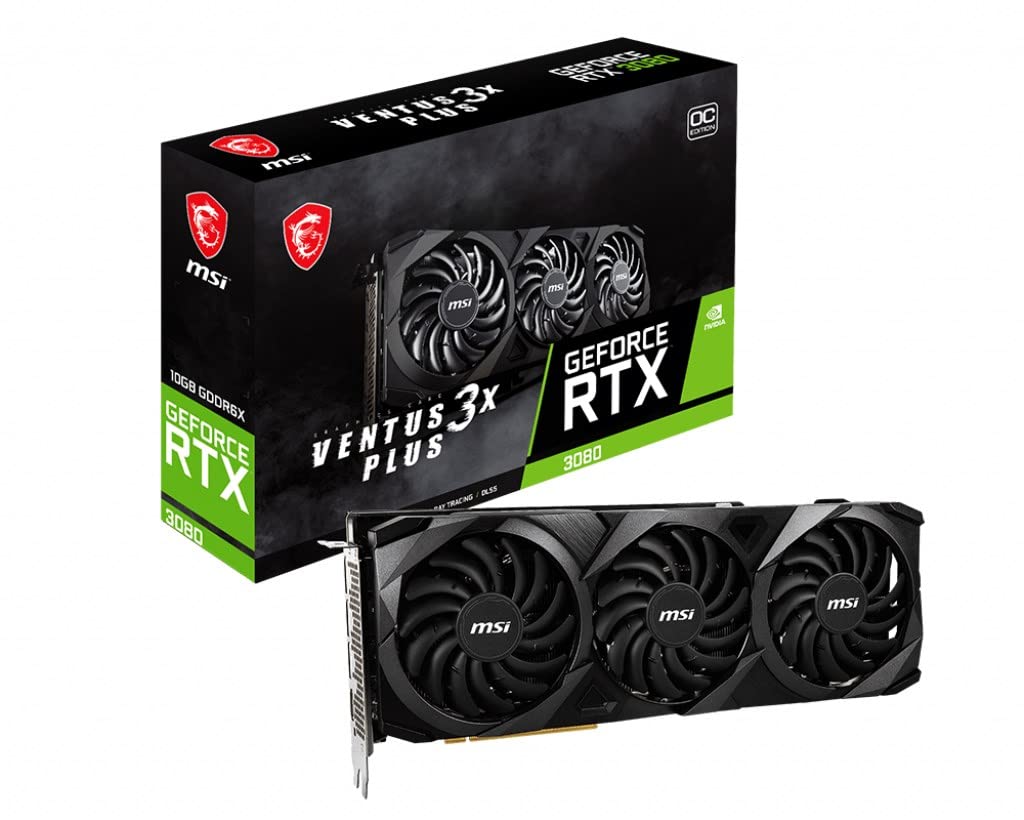
The MSI RTX 3080 Ventus 3X Plus OC LHR is a gamer’s card that excels in demanding VR titles and high-refresh 1440p gaming. Its 10GB GDDR6X memory handles VRAM-intensive scenes in Half-Life: Alyx at 120 FPS on Quest 2, and the card’s TORX 3.0 fans maintain stable performance in VR, where dropped frames cause nausea. Users report that after per-voltage curve tuning with a power limit of 85%, the card achieves top-10% 3DMark scores while running cooler and more efficiently than stock.
The dual-slot design is relatively compact for a 3080, making it easier to fit in standard ATX cases. The card pairs well with Ryzen 7 5800X3D processors for smooth gaming at 1440p with G-Sync, achieving 141 FPS in demanding titles. The Nvlink bridge support allows multi-GPU configurations for rendering workloads, though SLI is deprecated in modern games. Owners note the card runs hot — it significantly raises room temperature during summer months in unconditioned spaces.
Bought during GPU shortages, many owners report being satisfied with the price-to-performance ratio once prices normalized. The card handles Cyberpunk 2077 at 1440p near-max settings at 120 FPS with DLSS, making it a capable choice for modern AAA titles. The LHR label reduces mining efficiency to 43 MH/s ETH, but gaming performance remains identical to non-LHR variants.
Why it’s great
- Excellent VR performance — 120 FPS in Half-Life: Alyx
- Compact design fits most ATX cases
- Good overclocking headroom with voltage curve tuning
Good to know
- Runs warm — raises room temperature during gaming sessions
- Stock 3DMark scores are bottom-48% without manual tuning
8. ZOTAC Gaming GeForce RTX 3080 Trinity OC White Edition LHR

The ZOTAC RTX 3080 Trinity OC White Edition is the rare white graphics card that doesn’t compromise on performance. Its IceStorm 2.0 Advanced Cooling system uses a massive heatsink with dual fans that feature FREEZE Fan Stop — the fans stop completely below 50°C for silent idle operation. The Spectra 2.0 RGB lighting is fully customizable, and the LED backplate adds visual flair that white build enthusiasts will appreciate.
Performance matches the reference 3080 spec sheet — 8704 CUDA cores, 10GB GDDR6X on a 320-bit bus at 19 Gbps memory speed. Owners confirm the card runs at 77°C in negative pressure cases, averaging 95 FPS at 1440p ultra settings with ray tracing enabled. The white PCB and metal backplate create a clean aesthetic that pairs well with white-themed motherboards and cases.
One consideration: the card is standard length for a 3080 but still requires adequate case airflow. The LHR variant reduces ETH mining performance to 43 MH/s, which is standard for this generation. ZOTAC’s warranty support and build quality are solid, though some early owners reported thermal pad issues that later revisions resolved. For those building all-white gaming rigs, this is the most visually cohesive 3080 option without sacrificing performance.
Why it’s great
- Unique white aesthetic with RGB backlighting
- FREEZE fan stop for silent idle operation
- Full 3080 performance at 1440p ultra with ray tracing
Good to know
- Standard 3080 thermals — runs 77°C under load in some cases
- White color may limit case matching options
9. NVIDIA GeForce RTX 3080 Founders Edition (Renewed)

The NVIDIA RTX 3080 Founders Edition, renewed through Amazon’s inspection process, offers high-end Ampere performance at a fraction of the original cost. The FE design is iconic — with its unique dual-slot flow-through cooler that exhausts heat through the PCIe bracket, making it effective in cases with poor front airflow. The 10GB GDDR6X memory and 320-bit bus deliver the performance needed for 1440p ultra gaming and entry-level 4K.
Renewed cards from Amazon-qualified suppliers undergo professional inspection and testing, with the Amazon Renewed Guarantee providing returns and replacement options. Users report receiving cards in pristine condition that work immediately after installation — one reviewer noted the card functioned as expected and only returned it because their original GPU returned from repair earlier. Another user resolved initial display issues by updating motherboard drivers before reinstalling the GPU.
One practical consideration: the FE card requires a cable extender to reach the power supply in some cases, which isn’t included. The card supports 8K display output via HDMI 2.1 and DisplayPort 1.4a, making it suitable for high-resolution productivity monitors. For budget-conscious buyers who want 3080-class performance without paying premium markups, the renewed FE route is a compelling value — just ensure your PSU has the required power connectors.
Why it’s great
- Professional inspection ensures like-new condition
- Amazon Renewed Guarantee for returns and replacement
- Full 3080 performance at a reduced cost
Good to know
- May require a separate power cable extender
- No factory warranty — relies on Amazon Renewed coverage
10. Sparkle Intel Arc B570 Guardian OC 10GB
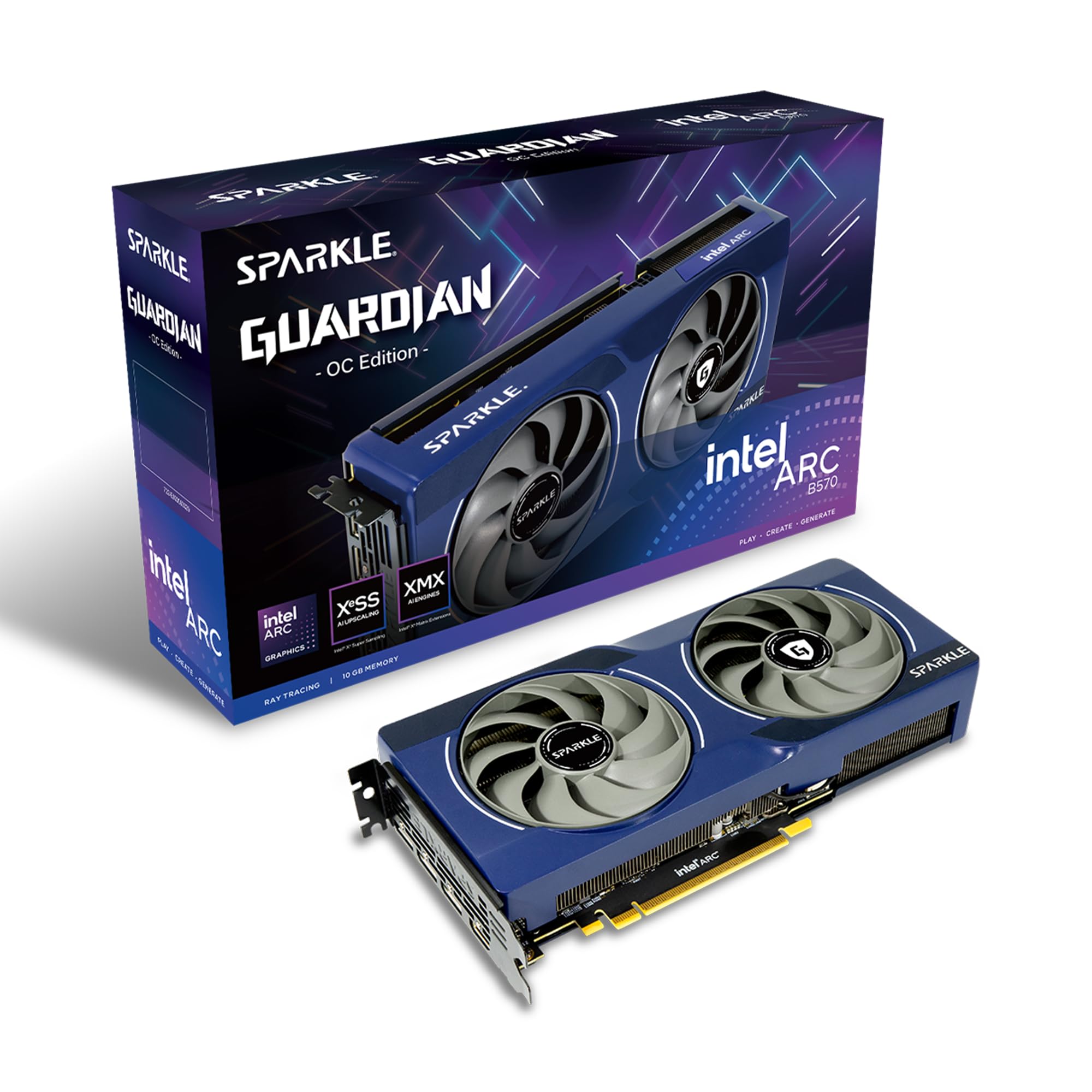
The Sparkle Intel Arc B570 Guardian OC brings Intel’s Xe2-HPG architecture to the budget segment with a 2660 MHz boost clock and 10GB GDDR6 memory. This card directly competes with NVIDIA’s RTX 3060-class offerings but brings superior VRAM capacity for texture-heavy titles. The TORN Cooling 2.0 system uses dual axial fans with 0dB mode for silent operation at idle — idle power consumption is just 25W at 180Hz refresh rate.
Performance at 1080p is strong — users report 200 FPS in Fortnite, 180 FPS in Battlefront 2, and 90 FPS in Forza Horizon 5. At 1440p, the card holds its own in lighter titles. The key requirement is Resizable BAR support — older motherboards without this feature will see significantly reduced performance. Users with Ryzen 5 5500 or better CPUs report the card performs identically to an RTX 2060 6GB, but with double the VRAM.
The build quality is excellent for the price tier — a full metal backplate prevents sag, and the matte blue breathing light adds subtle style. The single 8-pin PCIe power connector simplifies cable management. Some early users reported driver-related issues, but Intel’s driver updates have improved stability significantly. For budget builds where 10GB VRAM and modern architecture matter more than ray tracing performance, this card is a strong value.
Why it’s great
- 10GB VRAM at this price point is unmatched by competition
- Low power consumption — 25W idle, single 8-pin power
- Strong 1080p gaming performance with 200+ FPS in esports
Good to know
- Requires Resizable BAR support for full performance
- Ray tracing performance lags behind NVIDIA equivalents
11. ASRock Intel Arc B570 Challenger 10GB OC

The ASRock Intel Arc B570 Challenger is the entry-level card that surprises with its 1440p gaming capability and content creation features. Powered by Intel’s Xe2-HPG architecture with Xe Matrix Extensions for AI acceleration, this card supports Intel XeSS 2 upscaling technology for improved performance in supported titles. The 10GB GDDR6 memory on a 160-bit bus provides enough bandwidth for 1440p gaming, with users reporting smooth performance in VR titles like VRChat when connected wirelessly.
The dual striped axial fan design with 0dB silent cooling keeps noise minimal during light workloads. Owners report the card works well for video editing in CapCut and music production in FL Studio, leveraging the AV1 encoding engine for fast exports. One important note: the card requires Resizable BAR enabled in BIOS — users with older motherboards like the A320M-K need to enable 4G decoding and ReBAR settings, and some experience driver-related issues that require CMOS clearing to resolve.
For budget-minded buyers, this card offers the Intel driver ecosystem that has matured significantly since initial Arc launch. The metal backplate prevents sag and adds durability. Performance in Call of Duty benefits from enabling precompiled shaders in Intel graphics software. This card is best suited for builders who are comfortable with BIOS tweaking and want modern features like AV1 encoding without paying NVIDIA prices.
Why it’s great
- 10GB VRAM with AV1 encoding for content creation
- XeSS 2 upscaling improves performance in supported titles
- 0dB cooling keeps system silent during light use
Good to know
- Resizable BAR must be enabled in BIOS for full performance
- Some users report driver stability issues requiring troubleshooting
FAQ
Does 10GB VRAM limit 4K gaming on the RTX 3080?
Why must Intel Arc cards have Resizable BAR enabled?
What PSU wattage is needed for these graphics cards?
How do renewed RTX 3080 cards compare to new budget cards?
Final Thoughts: The Verdict
For most users, the best 10 graphics cards winner is the ASUS TUF Gaming RTX 3080 V2 OC because it combines military-grade build quality with robust cooling and all the 1440p ray tracing performance most gamers need. If you want the latest Blackwell architecture and 4K readiness, grab the GIGABYTE RTX 5080 Gaming OC. And for budget-friendly 1440p gaming with impressive VRAM, nothing beats the Sparkle Intel Arc B570 Guardian OC at its price tier.