
Our readers keep the lights on and my morning glass full of iced black tea. As an Amazon Associate, I earn from qualifying purchases.
Specs are compiled from manufacturer listings and verified buyer reviews and can change over time — please confirm the key details on the product page before buying.
You want to know which home security system is actually worth buying — and the honest answer is that the right one depends on if you want a loud local siren, a phone alert, or a real person calling the police. This list covers eleven systems, from DIY kits you install in about an hour to wired camera setups that record around the clock.
I’m Min — the founder and writer behind Gadgets Feed. This guide is built by comparing the manufacturers’ published specifications and the patterns across verified customer reviews, so you get each pick’s real strengths and trade-offs instead of marketing spin.
One thing to know before you start: this list uses flexible, human-like matching, so not every pick is the exact piece count you may have searched for — the nearest same-type size serves the same purpose. Every pick here is a real, currently sold kit, and each one solves a different version of the same problem: knowing what happened at your home while you were away. best 10 home security systems here means the ones that report fast, install without a contractor, and do not lock you into a contract.
Our Picks at a Glance

How To Choose The Best 10 Home Security Systems
Before you compare kits, decide what you want to happen in the first ten seconds after someone opens your back door. Sensor counts, cameras, and monitoring plans all follow from that one answer.
Decide where the alarm goes
A system can shout, text you, or hand the problem to a monitoring center that calls emergency services. A DIY kit with a loud siren handles the first job on its own. A system with 4G connectivity can reach you even if your internet is cut. Professional monitoring adds a real person making a call — usually as an opt-in subscription you can cancel, not a contract.
Count doors and windows before you count pieces
Contact sensors (the two-piece magnetic switches that know when a door or window opens) are the backbone of any kit, and most homes need more of them than the box provides. Motion sensors cover the open paths inside — hallways, landings, living rooms. If the kit includes more contact sensors than you have doors, you have room to cover a garage or a shed.
Check the wiring reality versus a camera setup
Sensor-first kits run on batteries and peel-and-stick adhesive, so they go up in about an hour. Camera-first systems — PoE, which stands for Power over Ethernet and means one cable carries both electricity and video — live in a different world. They need cable runs, and they record continuously instead of only chiming. Pick based on if you want a perimeter alert or a full record of the property.
Quick Comparison
| Model | Best For | Setup Style | Monitoring | Kit Contents | Amazon |
|---|---|---|---|---|---|
| Like-New Ring Alarm 8-Piece Kit★ Best Overall | 1-2 bedroom homes | Wireless, adhesive mounts | Optional Ring Protect, 24/7 pro monitoring | Base station, keypad, 4 contact sensors, motion detector, range extender | Amazon |
| PGST A107F Home Security SystemsBudget Champion | Renters and small apartments | Wireless, DIY | Smart Life/Tuya app alerts, 1-year warranty | 1 alarm system panel with motion and door sensors | Amazon |
| OSI Alarm System Gen 2 (4G)Top Performer | Rentals and small businesses | Wireless, 11pc DIY | Free self-monitoring or 24/7 pro monitoring, no long-term contract | 7″ touchscreen panel, 2 motion sensors, 5 contact sensors, strobe siren, 2 remotes | Amazon |
| eufy Security eufyCam C37 4-Cam Kit | Covering a whole property | Wireless with solar panels | No monthly fees, local storage | 4 cameras, HomeBase Mini, 4 solar panels, mounts | Amazon |
| Ring Alarm 14-Piece Kit | 2-4 bedroom homes | Wireless, DIY, no drilling | Optional Ring Protect, 24/7 pro monitoring | Base station, 2 keypads, 8 contact sensors, 2 motion detectors, range extender | Amazon |
| SimpliSafe 11 Piece Gen 3 | Owning your equipment outright | Wireless, self-adhesive | Optional 24/7 pro monitoring, no contract | Base station, indoor wireless camera, keypad, 2 motion sensors, 6 entry sensors | Amazon |
| aosu D1 Max 4-Cam Kit | Full-yard outdoor coverage | Wireless cameras with detached solar panels | No subscription required, local storage | 4 solar cameras, aosuBase, 4 solar panels, screw kit | Amazon |
| Hiseeu 4K PoE Security Camera System | Businesses and large properties | Wired PoE, plug and play | No subscription, local NVR recording | 8 PTZ cameras, 16-channel 4K NVR, 3TB HDD | Amazon |
| OOSSXX 4K POE Wired System | Always-on wired recording | Wired PoE, single cable per camera | Free app, no monthly fees | 8 x 4K cameras, 8-channel PoE NVR, 4TB HDD | Amazon |
| ANNKE 8CH 4K PoE System | Clear day and night detail | Wired PoE, minimal setup | No subscription, local NVR recording | 6 x 4K PoE cameras, 8-channel 12MP NVR, 2TB HDD | Amazon |
| REOLINK RLK16-1200D8-A | Max resolution and channel count | Wired PoE, 16-port NVR | No subscription, local 4TB recording | 8 x 12MP cameras, 16-channel NVR, 4TB HDD | Amazon |
In‑Depth Reviews
1. Like-New Ring Alarm 8-Piece Kit
Our pick — over 4.5★ from 850+ verified ratings; the strongest balance of quality and price.
The refurbished kit that walks you through setup in about 45 minutes flat
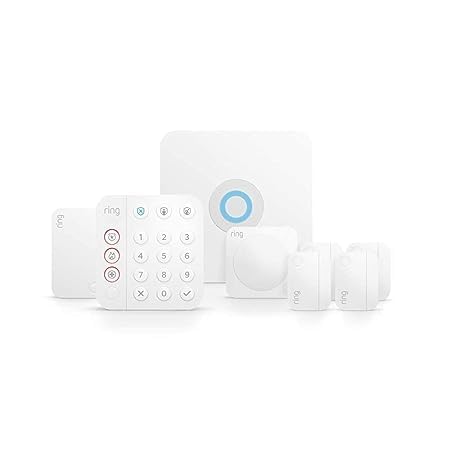
If you rent a one or two bedroom place and want a real alarm rather than a pile of camera apps, this is the one to start with. The box holds a base station, a keypad, four contact sensors for your doors and windows, one motion detector, and a range extender that stretches the signal into far corners. Setup runs through the Ring app, which talks you through each step. Buyers report the adhesive mounts are included, so no drilling — the whole job lands around 45 minutes. It is sold Like-New: refurbished, tested, certified to work like new, and backed by the same limited warranty as a new device, though it may arrive in plain Amazon packaging.
What wins people over is that it simply functions as one connected system rather than a pile of separate gadgets. Arming the alarm, checking sensors, and watching Ring cameras all happen in the same app, and you get a phone notification the moment something trips. There is no subscription needed for local use — the optional Ring Protect plan is what open up arming from anywhere, keeping the system online if your Wi-Fi drops, and 24/7 professional monitoring that dispatches police, fire, or medical help. Add an Echo and you can arm and disarm by voice.
The catch is the plan. Without it, you lose remote arming and cellular backup, so the system is local-only. And the sensors are a bit fussy to name and place inside the app, which is where most of that 45-minute setup time actually goes. It is the crowd favorite here — 4.7 stars across 850+ ratings — and the surrounding devices hold a few more ratings than this kit does, but neither of those tops the quality of information at work now: 91 people call out functionality and 70 point to build quality, both as praise.
Lands in your favor
- Full kit for a small home — base station, keypad, four contact sensors, motion detector, range extender
- Adhesive mounts mean no drilling and a roughly 45-minute install
- Refurbished certification keeps this the cheapest way into a real monitored alarm
- Alexa voice arming once you add a Ring Protect plan
Worth knowing first
- Remote arming and cellular backup need the paid Ring Protect plan
- Naming and placing each sensor in the app takes real patience
- Ships in generic Amazon packaging, not retail boxing
Reach for this if: you have a small apartment or starter home and want a genuine alarm without a contract.
Look elsewhere if: four contact sensors will not cover your doors and windows — the 14-piece Ring kit up next doubles that.
2. PGST A107F Home Security Systems
The cheap alarm that still rings your phone when a door opens
Here is the cheapest way to get an actual phone call, not just a chime, when someone walks in. The PGST A107F runs through the Smart Life or Tuya app (two names for the same control software) and pushes notifications or dials your phone directly when a motion or door sensor trips. Alerts do get through quickly — owners mention they arrive 4-6 seconds after the door opens. There is a one-click SOS button on the panel that immediately calls your pre-set contacts, whether that is family or a neighbor, and a loud external siren.
Setup is where this one asks for patience. Reviews describe a manual that skips steps, a firmware bug that fired the alarm even while the system was disarmed, and SMS arm-and-disarm failing on some carriers. The good news is that settings do exist to fix most of it — you can lock the keypad, disable open alerts, and reconfigure SMS — but you have to dig for them. One seller-side detail worth noting: shipping weight and box size are small, so it tucks onto a shelf or countertop without fuss.
Know what you are buying: this is a starter kit for a shed, a garage, or an apartment you want eyes on, not a whole-house perimeter. It is expandable if you add more sensors later, and there is a 1-year warranty. The trade-off is that you configure firmware bugs yourself as you find them. For the money, though, nothing else here dials your phone the same way.
The real upside: 4G calling, SOS panic button, and a loud external siren put this at the bottom of the price ladder without dropping the alert itself.
Where it asks work: firmware bugs and a thin manual mean you spend an evening in the settings menu. Budget an evening in the settings menu before it runs smoothly.
This pick is for: the buyer who wants SMS and phone-call alerts from a single panel and is happy to tinker.
skip it if: you want a setup that works flawlessly on the first try — the SimpliSafe or OSI kits below are friendlier from the start.
3. OSI Alarm System Gen 2 (4G), 11pc DIY
An 11-piece kit with a touchscreen panel that skips the monthly fee entirely
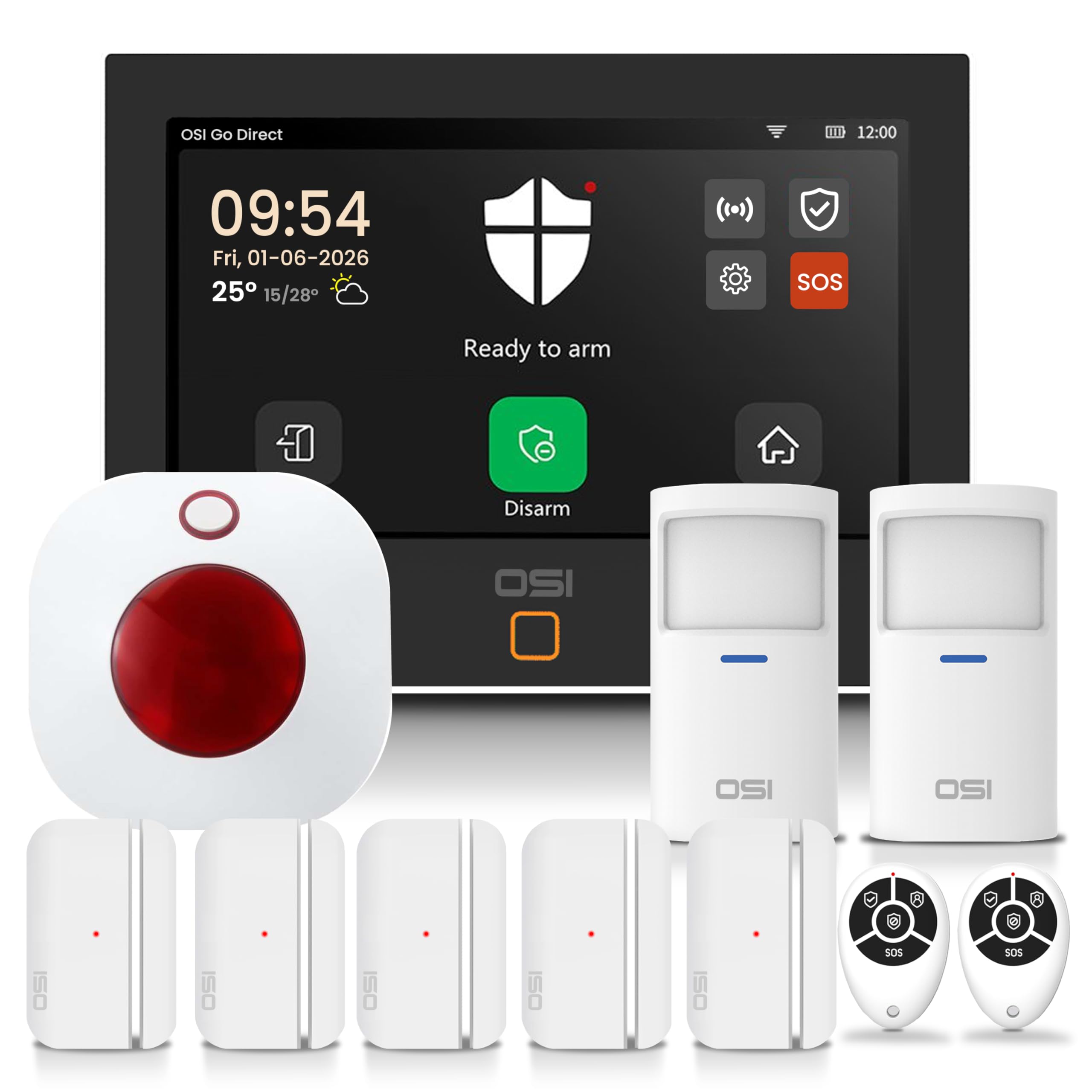
This is the pick for anyone who wants a full control panel on the wall rather than an app buried on their phone. The Gen 2 kit packs a 7″ touchscreen control panel, two motion sensors, five contact sensors, a wireless strobe siren, and two remote controls. The display is a 1024 x 600 touchscreen with an anti-fingerprint coating, so it reads clearly and does not smear under daily poking. You can choose free self-monitoring through the Smart Life app with zero monthly fees, or opt into 24/7 professional monitoring with emergency dispatch, SMS texts, and a phone-call confirmation from the station.
Set-up is one of the wins here. The interactive wizard walks you through configuration step by step, which is why so many people in the reviews call it easy. The panel also supports multiple user levels — one administrator account plus five limited accounts — which is genuinely useful if you run an Airbnb, have renters, or want to lock kids out of system settings. Sensors run on 433MHz radio, a low-frequency band that pushes through walls; reviewers with cement and rebar say signals respond immediately, though an extender helps on larger properties. You can scale up to 160 sensors, 6 controllers, 6 doorbells, and 6 keypads. A 24-hour backup battery keeps it alive through a power cut.
The one recurring complaint is the motion sensors, which get mixed feedback. Some users find them reliable, others hit enough trouble that it is worth watching your placement. There is also a set of small annoyances: the word “disarm” is used oddly on screen, the plug-in siren is bulky, and the Smart Life app has no history-delete option. None of that undermines the core trade-off — no locked-in contract, high-end panel, and a self-monitoring mode that never asks for a subscription.
Why it wins people over: the free self-monitoring mode and the 4G option keep you covered without a contract, and the digital wizard makes a large kit feel simple.
What to check first: motion sensor placement. Reviews are split, so test a spot before you mount permanently. Minor UI wording and a bulky siren are the trade-offs.
Buy it if: you want a touchscreen panel, expandability across a house or small business, and the option to add monitoring later.
Pass if: you want the cheapest possible path — this sits a tier above the PGST and Ring 8-piece kits on value.
4. eufy Security eufyCam C37 4-Cam Kit
Four cameras that pan, tilt, and follow — and charge themselves on sunlight
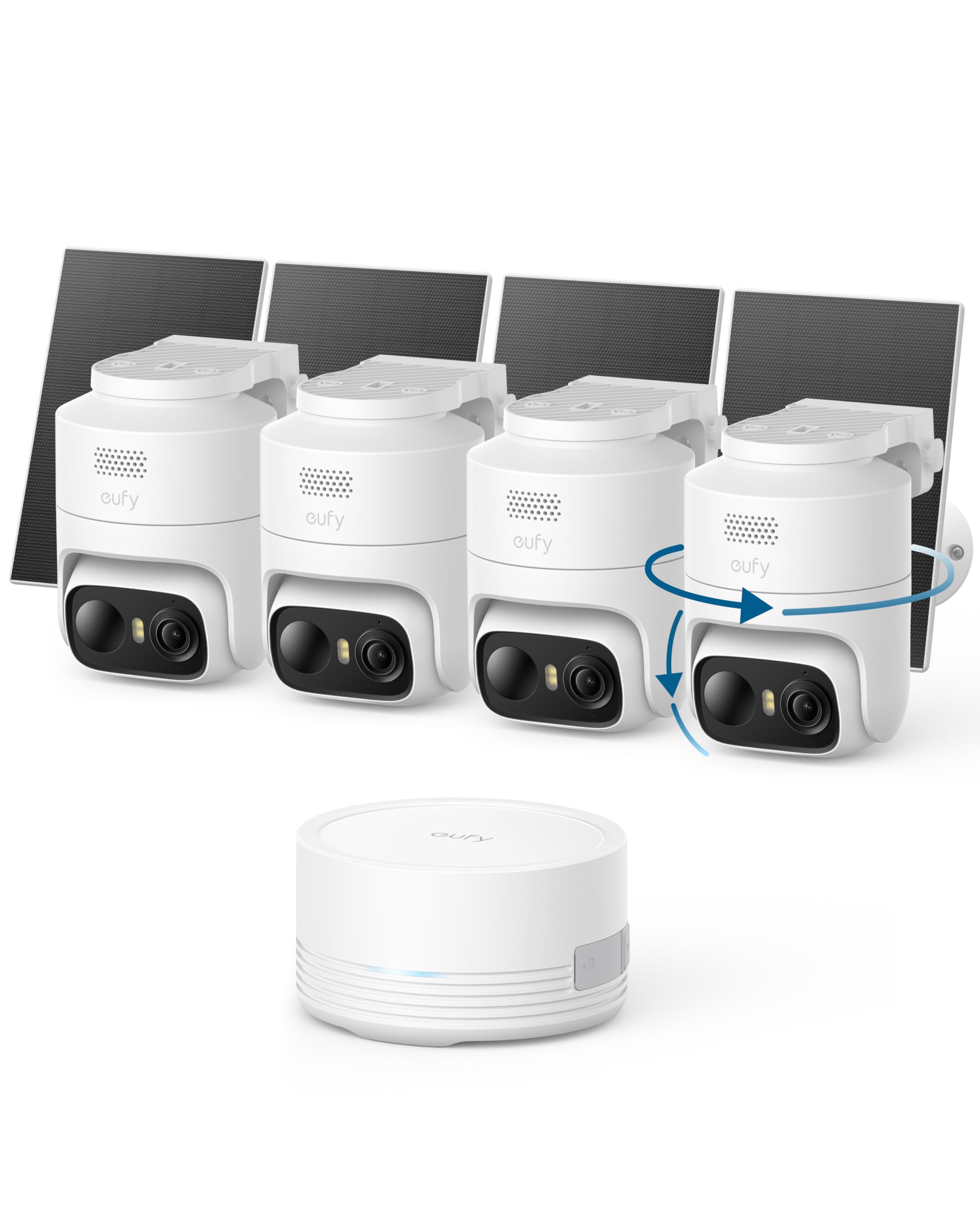
This is the jump from a sensor alarm to a full camera net, and the numbers matter. Each camera shoots 2K video with color night vision, and the built-in spotlight lights up faces, license plates, and clothing details in vivid color even in total darkness. eufy claims 2K delivers 77% more pixels than standard 1080p, which is the difference between a shape at the end of your drive and a face you can identify. The cameras pan and tilt through a full 360° with auto-tracking, so a single unit can watch an entire yard and keep a moving subject centered.
Power is the part that makes this livable. Detached solar panels charge each camera continuously, so you are not climbing a ladder to swap batteries. Each 3W panel aims at the sun independently from the camera angle, which means you never choose between the right view and enough charge. Footage lands on the HomeBase Mini with 64GB of built-in storage, expandable up to 1TB via microSD, and connects up to 10 cameras in one app with human, vehicle, pet, and facial recognition. No cloud subscription required. Renters tend to love this most — nothing is drilled into a landlord’s wall.
The honest downside: setup feedback is mixed, and the app is not the most intuitive for a first-timer. Connectivity and notifications also get mixed reviews, with slow Wi-Fi connection and delayed live-feed loading showing up more than once. There is also a real limit worth knowing — this kit is not compatible with HomeBase 2 or HomeKit. The clean story, though, is that the recording quality is what carries the kit: 30 people call it out as good quality, 11 flag the value, and 10 point to the video itself.
The clear win: 2K color night vision plus 360° auto-tracking on a single camera means one mount can watch a whole side of your property.
The honest friction: reviewers describe setup as mixed, connectivity as slow at times, and no HomeKit support at all. Budget an evening for the app.
Worth grabbing if: your goal is property-wide video coverage without trenching cable or paying a monthly fee.
Think twice if: you want an alarm with a siren and contact sensors — this is a camera system, not a perimeter alarm.
5. Ring Alarm 14-Piece Kit
The same Ring system grown up to cover eight doors and two hallways
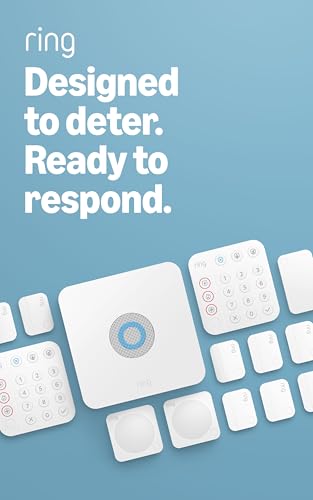
Take the 8-piece kit and double the coverage: this box holds a base station, two keypads, eight contact sensors, two motion detectors, and one range extender, sized for a two to four bedroom home. Installation stays DIY, with no drilling or wiring, and Ring’s app walks you through every sensor — most customers note it up and running in a single afternoon. Unlike the 8-piece above, you get enough contact sensors to cover back doors, garage entry, and every window you consider a real risk.
What makes Ring worth owning is that it works as one system. Adding a camera means grabbing a Ring camera, and it just appears in the same app with the same alerts. The base station carries a battery backup so a power cut does not kill the alarm, and the system connects over 2.4GHz Wi-Fi — one reviewer even noted it held signal through a brick wall and a floor without trouble. Voluntary monitoring is available if you want it, but you never have to sign a contract.
Two things to know before you order. The kit ships with two keypads, not a swappable sensor set, so if you would rather have a glass-break sensor than a second keypad, that is a bundle decision you cannot change at checkout. And the keypads do not display alarm status, which has tripped up at least one household into a false alarm. Those are small trade-offs against a system whose quality and easy setup dominate what buyers talk about — well over 270 people highlight the build, and a similar crowd call out how quickly it goes in.
Why households commit
- Enough sensors to actually cover a four-bedroom home — 8 contact sensors plus 2 motion detectors
- Battery backup in the base station keeps the alarm live through outages
- One app for Ring cameras, doorbells, and sensors, with 2.4GHz Wi-Fi reaching through walls
- DIY install with no drilling, and no contract for local use
Notes for the careful buyer
- Kit ships with two keypads rather than extra sensors or a glass-break unit
- Keypads do not show alarm status, which can hide a tripped state
- Adding each device to Wi-Fi one at a time makes expansion slow
This is the one for: a house with more than two bedrooms and a real perimeter to cover.
Not the right fit if: you are protecting a studio or one-bedroom — the 8-piece Ring kit covers that for far less.
6. SimpliSafe 11 Piece Gen 3 with Indoor HD Camera
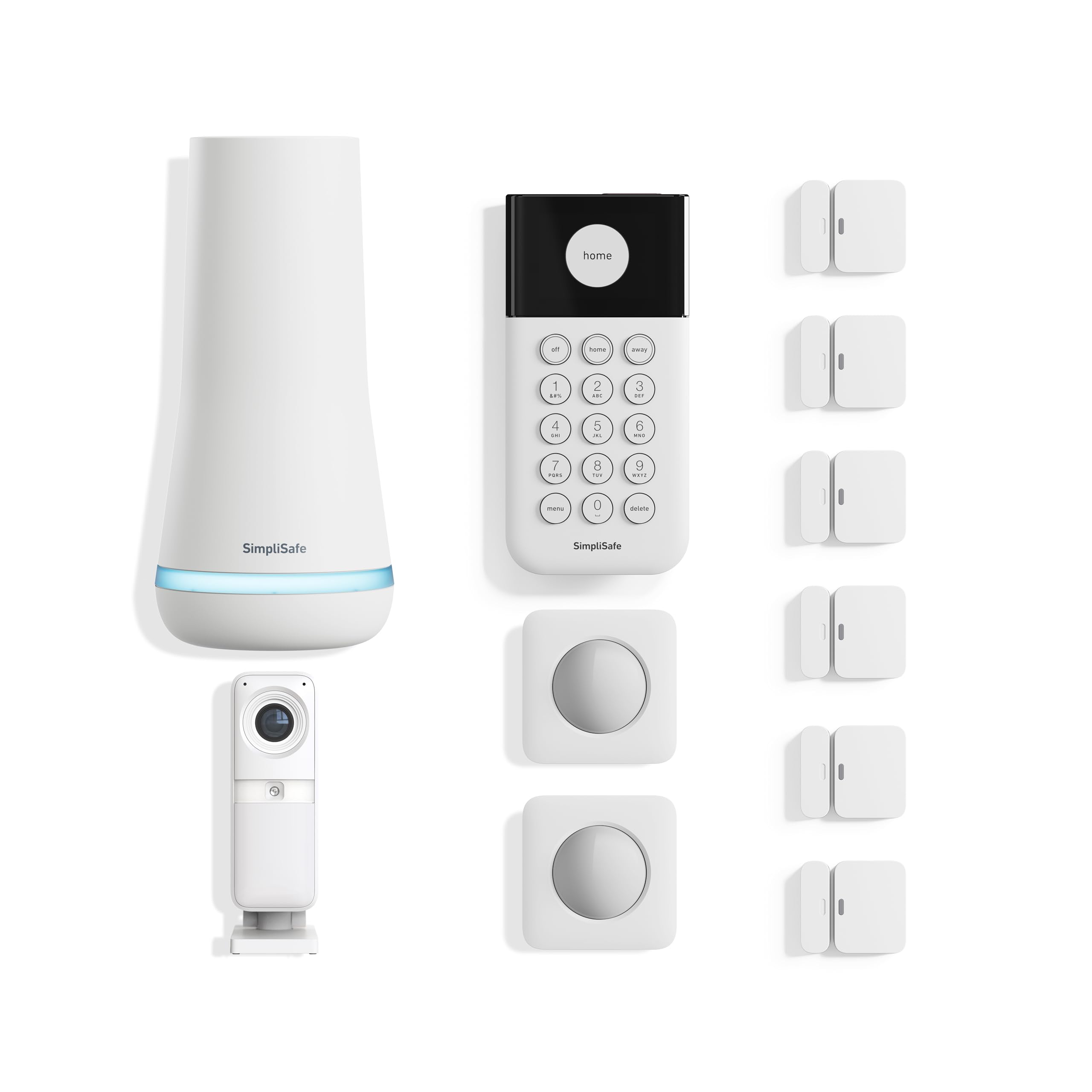
The kit you own outright, with a 95-decibel siren and a camera that talks back
SimpliSafe is aimed at buyers who never want to rent their security. You buy the hardware, you own it, and monitoring is an optional monthly add-on with no contract. The 11-piece kit includes a base station, an indoor wireless camera, a keypad, two motion sensors, and six entry sensors. Plug in the base, place the sensors, and you are protecting the home — no wiring, no drilling. The motion sensors detect movement up to 35 feet with a 90-degree field of view, and they are designed to ignore pets under 60 pounds so a wandering cat does not trip the alarm.
Two features set it above the DIY crowd. The siren hits 95 decibels — genuinely painful in a hallway and loud enough to be heard down the street. And with the Smart Alarm Wireless Indoor Camera paired to live guard monitoring, agents can see and speak to intruders through the camera’s two-way audio while the alarm is going off. The keypad is smash-safe, so an intruder cannot simply pull it off the wall and silence the system, and its backlit buttons light up when you reach for them and go dark when you don’t.
Where this can wobble is reliability. Reviews are mixed on how steady the connection stays — some owners note motion sensors dropping offline periodically and needing a physical reset, and cameras that occasionally blink out and recover. It rarely fails outright, but sensors and cameras occasionally drop offline and need a manual reset. The base station backups and the option to add extra sirens and glass-break sensors make it easy to extend, and the support line is responsive when you do need help. This is the one for someone who wants the hardware paid for once.
The strongest case: real ownership of the equipment, a 95 dB siren, and an indoor camera that lets monitoring agents speak to intruders live.
The realistic caveat: sensors and cameras occasionally drop offline and need a manual reset. Not a deal-breaker, just a system that wants a glance every few weeks.
Go here if: owning your equipment matters and you want optional monitoring rather than mandatory.
Consider the Ring 14 instead if: you already have Ring cameras and doorbells — keeping one ecosystem means one app for everything.
7. aosu D1 Max 4-Cam Kit 4K Solar
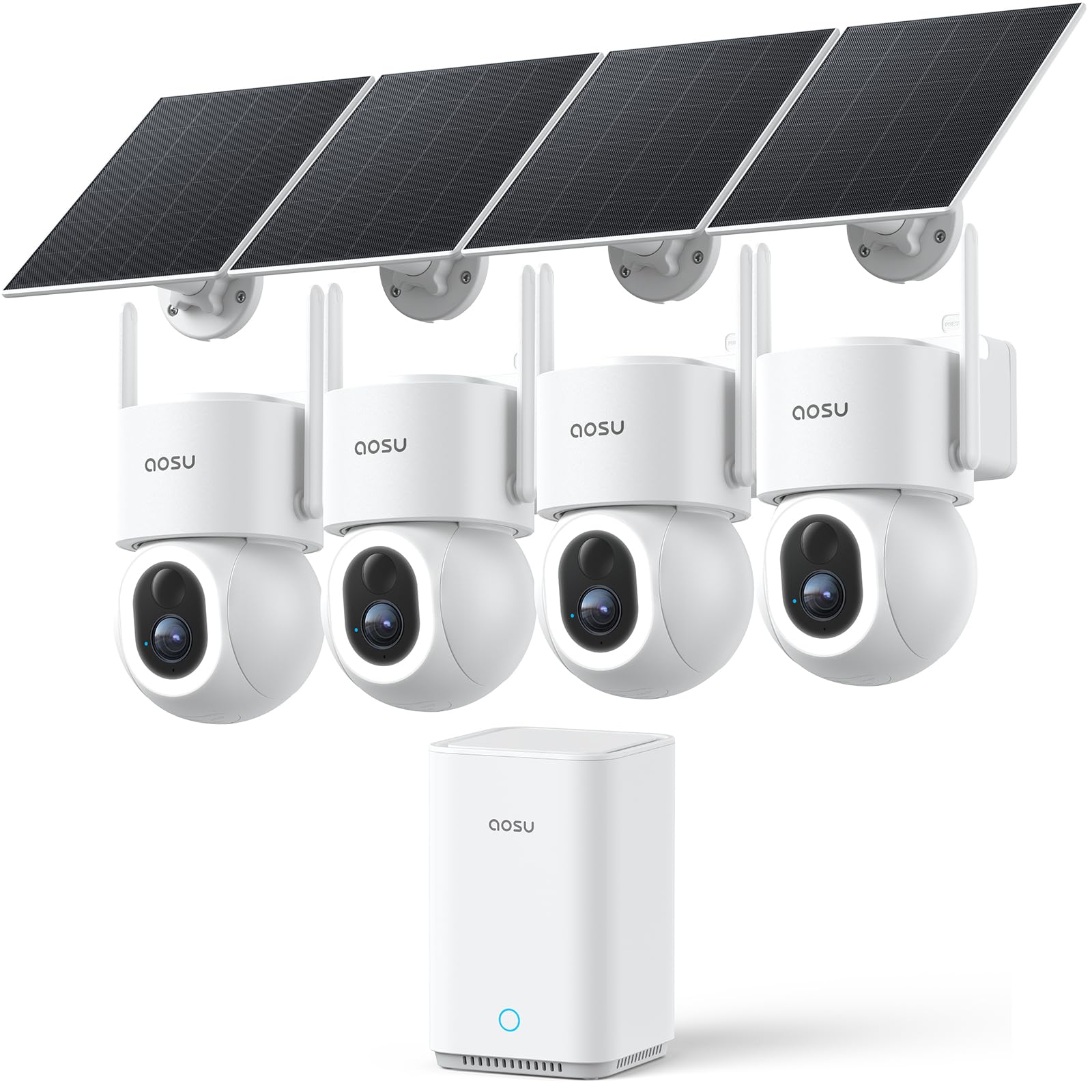
4K footage that reads a license plate 33 feet away, powered by the sun
If your property has a driveway, side yard, and back fence to cover, this kit handles the whole spread with four cameras. Each one shoots 4K Ultra HD from an 8MP sensor with 6x digital zoom, and the built-in spotlights swing the view into full color at night instead of the usual grainy black and white. aosu rates the visible detail up to 33 feet — close enough to read a plate and pick out a face. Recording happens on the aosuBase with 32GB included storage, expandable up to 1TB, so no cloud subscription is required.
The tracking is the feature most people notice. Each camera pans, tilts, and follows motion through a full 360° range, and multiple cameras can hand off tracking so footage stitches into one continuous timeline rather than four disconnected clips. On-device AI filters out irrelevant motion by detecting people and vehicles specifically, and a Smart Vehicle Guard watches parked cars and alerts when someone moves near them. Freeing you from cords, each camera runs on a 5200 milliamp-hour battery topped up by a detached solar panel that can be angled toward the sun separately from the camera’s aim.
There is one serious limitation worth flagging. The system is not fully off-grid. If your internet goes down, the app requires online password verification and you cannot reach the locally stored video — a real strike for anyone expecting a fully independent setup. Reliability and connectivity also get mixed reviews, and audio quality is weak in wind. It is a great system for a connected home, less so for a remote cabin.
What it does best
- 4K from an 8MP sensor, detail readable from up to 33 feet
- 360° pan, tilt, and tracking with cross-camera handoff for continuous coverage
- Detached solar panels keep charging even when the camera faces another way
- 32GB local storage, no monthly subscription required
The honest trade-offs
- Internet down means the app cannot verify you, and local footage is unreachable
- Audio picks up wind noise badly enough to make two-way talk difficult
- Reliability and Wi-Fi connectivity draw mixed feedback, especially at range
Reach for it if: you have a generous yard and want 4K coverage on four sides without cable runs or subscription fees.
Rule it out if: your connection is unreliable or you need a fully offline system — the system will not let you in without internet.
8. Hiseeu 4K PoE Security Camera System
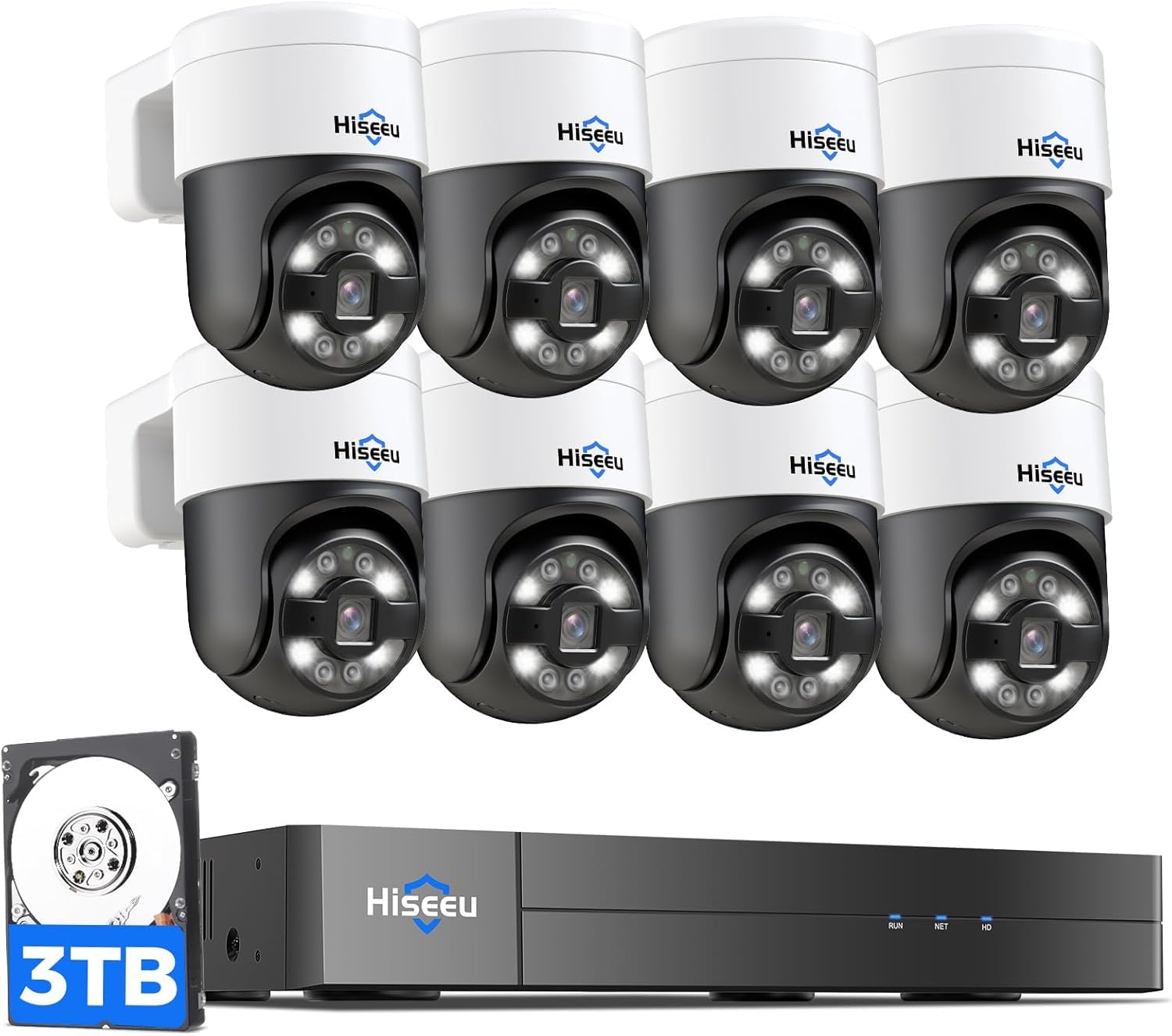
Eight tracking cameras on one cable each, recorded locally for weeks
This is where home security turns into property security. Eight 5MP PTZ cameras feed a 4K-compatible NVR (network video recorder, the box that stores and manages the footage), and the whole thing runs on PoE — meaning a single Ethernet cable per camera carries both power and video. That one-cable design is why installation stays approachable even at this scale. Each camera pans through 300° and tilts 90°, with human auto-tracking that follows a person walking across your lot instead of simply catching them in a fixed frame.
The NVR holds 8 built-in PoE ports and can expand up to 16 channels with an additional PoE switch, so you can grow the system well past the initial eight cameras. A pre-installed 3TB hard drive supports 24/7 continuous recording, and color night vision keeps the picture usable in low light instead of switching everything to grayscale. Human and vehicle detection cuts the false alerts you get from a passing cat, and instant push alerts hit your phone when something real moves. Two-way audio lets you talk to whoever is at the gate without opening it, and IP66 waterproofing means rain, snow, and cold are not a concern.
Two things to plan for. The NVR does make audible hard drive noise, so give it breathing room rather than walling it into a bedroom closet. And reliability shows up as a mixed theme in reviews — the system usually works flawlessly, but an occasional camera stops responding and needs attention. At this channel count and resolution there is no subscription to pay, no cloud dependency, and no per-camera fee.
The big advantage: 16-channel headroom with a 3TB drive means you can record continuously for weeks and still add cameras later.
Two practical notes: the NVR is audibly noisy, and an occasional camera requires a reboot. Give the recorder ventilated space and check the app every so often.
Best for: a business, a large lot, or anyone who wants wired reliability and no monthly fee.
Not for: a studio apartment — eight cameras is more system than a small flat needs.
9. OOSSXX 4K POE Wired Home Security Camera System

Two months of continuous 4K footage, stored on-site and never in the cloud
The headline here is storage. Eight 4K cameras at 8 megapixels each feed an 8-channel NVR with a pre-installed 4TB hard drive, and that drive holds up to 60 days of continuous recording. Sixty days is a real number — it means footage of a delivery, a break-in attempt, or a dispute from two months back is still there when you need it. Each camera shoots through a 130° wide-angle lens, so one unit covers a corner instead of one narrow sliver, and AI human detection paired with a PIR sensor (a passive infrared motion trigger) filters out tree branches and passing animals.
Wiring stays simple because of PoE: one cable per camera carries power and video together, plug-and-play with no separate power adapters. Each camera has a built-in microphone and speaker for two-way conversation, and the app gives you live view and playback remotely at no monthly cost. The enclosures are IP66 weatherproof, rated for rain and dust, and the whole system supports the ONVIF standard — the cross-brand compatibility protocol — so it can interoperate with other surveillance software if you need that.
Two honest limits. The cables that ship are 60 feet each, which is fine for most homes but short for a large property — one review mentions needing 100 to 150 foot runs for a church. And the system has documented weak spots: cameras keep default credentials, which is a real security gap you should change immediately, and the mobile app has not worked for every Apple device. For a wired system with 60-day local storage and no fees, it is still a lot of coverage for the money.
The standout number: 4TB of storage equals up to 60 days of continuous 4K recording — more history than most home systems offer.
Worth knowing: the included 60-foot cables limit placement, and default passwords need changing on day one. Plan cable runs before you mount.
Pick this if: you want the longest local recording history and prefer no subscription at all.
Look elsewhere if: you need longer cable runs or Apple-only phone access — the cable length and app support are genuine limits.
10. ANNKE 8CH 4K PoE Security Camera System
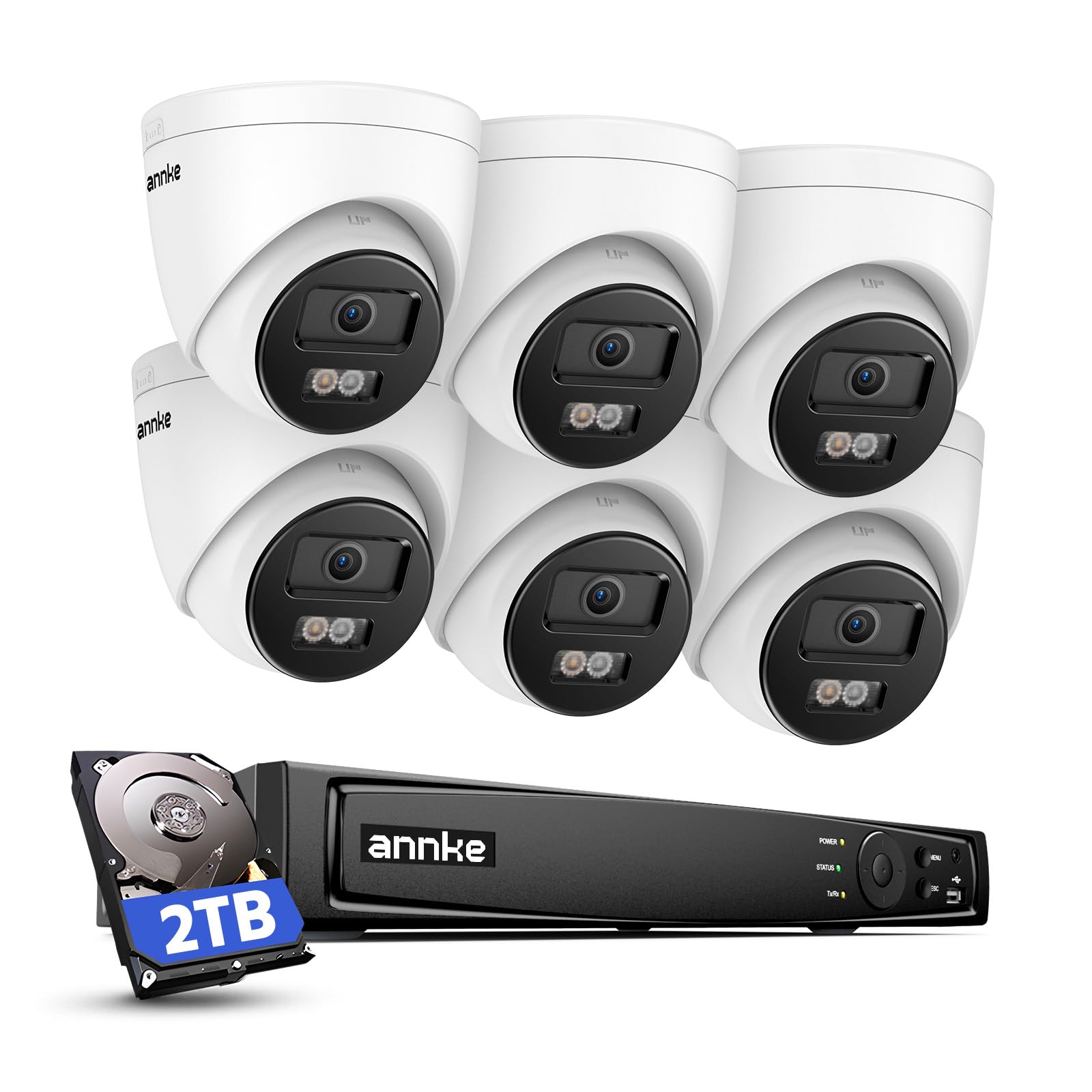
Six 4K turret cameras that switch to color the moment a person appears
ANNKE built this kit around seeing things clearly after dark, and it works differently from the pack. By default the cameras record in black and white using infrared light. The moment AI detects a person or vehicle, the IR light turns off and the white spotlight turns on, so that clip is captured in full color instead of washed-out gray. The sensor is a 1/2.4″ Progressive Scan CMOS delivering 4K at 8MP, which is what lets it hold that clarity in both modes. Six cameras feed an 8-channel NVR that is fully compatible with cameras up to 12MP.
The recording stays local on a built-in 2TB security-grade hard drive, running 24/7 without a subscription. Image processing has three specific names worth knowing: BLC (backlight compensation, which balances a bright doorway against a dim room), 3D DNR (digital noise reduction, which cleans up grain in low light), and HLC (highlight compensation, which stops headlights and porch lights from blowing out the image). AI human and vehicle detection keeps false alerts down. The outdoor cameras carry IP67 sealing, which is a step above IP66 for dust and water.
Setup is where the reviews are clearest: the NVR auto-detects each IP camera with minimal configuration, and one buyer wired all six cameras in about four hours. The friction shows up in the software. The app only rotates the image 90°, so fine-tuning angles is limited. It cannot be set to detect humans only or cars only, so that filtering depends on the AI doing the work automatically. And a stranded flaw appears in reviews — one unit shipped with a faulty LAN port and had to be returned. A working unit delivers straightforward 4K surveillance with color night vision.
Where it pulls ahead
- Dual-light system switches to full color the second a person or car is detected
- IP67 rating is tougher than the IP66 most kits claim
- 2TB of 24/7 recording with no monthly fees
- NVR auto-detects cameras for a fast wired install
The caveats
- App only rotates image 90° — angle tuning is limited
- Cannot filter for humans only or vehicles only at the app level
- Occasional units ship with a faulty LAN port and need returning
Go here if: the detail that matters to you happens at night, and color footage of a face beats grainy black and white.
Think twice if: you want granular control over detection rules — the app limits how specific you can get.
11. REOLINK 16CH 12MP PoE Security Camera System

The highest-resolution system on the list, with 16 channels of headroom
Twelve megapixels is the sharpest per-camera resolution in this guide, and it changes what you can actually identify after the fact. This kit pairs eight D1200 12MP cameras with an RLN16-410 NVR and a 4TB hard drive. Each camera records H.265 video (a compression format that stores the same picture in less space, so your drive lasts longer) and runs on PoE with one cable each. Full color night vision comes from built-in spotlights, which you can schedule to run during specific hours and switch to infrared LED mode the rest of the time; motion can also trigger the spotlight and siren together to warn an intruder off.
Detection here is the most granular on the list. The cameras identify people, vehicles, and pets separately by shape, which cuts unwanted alerts when the neighbor’s dog wanders past. Two-way talk is built into every camera, so you can answer a visitor or warn someone off from the app. The NVR offers 16 PoE ports and can theoretically reach 24 channels when you mix in Reolink’s plug-in Wi-Fi and specific battery-powered cameras, giving you room to grow well past the initial eight. Everything stores locally, and there is no monitoring fee.
The honest caveats are worth naming. Camera mounts screw on without locking set screws, so a determined thief could unscrew one. Vehicle detection is described as hit-or-miss compared to how well person detection works. And the stock NVR only holds roughly five days of 24/7 recording at this resolution — one owner added a 6TB drive to reach about twelve days. One review also reports an included hard drive failing within a year, which is worth watching if you run it around the clock. On the plus side, Reolink’s support sent a replacement within five business days after a power surge killed an NVR.
Why it leads on clarity
- 12MP per camera — the highest resolution here, so fine details stay readable
- Person, vehicle, and pet detection sorted by shape, not just motion
- 16 PoE ports with reach toward 24 channels for future growth
- Full color night vision with schedulable spotlights and motion-triggered siren
Plan around these
- Mounts have no locking set screws, so cameras can be unscrewed
- Stock 4TB drive holds only about five days of continuous 24/7 recording
- Vehicle detection is less reliable than person detection
Best for: a large property or business where maximum detail per camera justifies the highest price in the guide.
Only if you need it: if 4K detail is enough, the Hiseeu and OOSSXX systems deliver comparable recording for noticeably less.
Understanding the Specs
Resolution: 1080p, 2K, 4K, and 12MP
Resolution is simply how much detail each frame can hold. A 2K camera captures about 77% more pixels than 1080p, which is the difference between an outline and a face you can name. 4K at 8MP goes further, and 12MP goes furthest of all — but bigger files also fill a hard drive faster, so match resolution to what you actually need to identify. If your concern is a driveway plate, high resolution helps. If your concern is a door opening, a contact sensor does the job for far less.
Night Vision: Infrared and Color
An infrared (IR) mode uses light your eyes cannot see, so footage comes out in black and white but stays discreet and unlit. A color night-vision mode adds a built-in white spotlight so faces and cars appear in true color — the trade-off is obvious light that may draw attention. Some systems run IR by default and switch to color only when the AI detects a person or vehicle, which keeps the light off until it matters and saves power on battery cams.
FAQ
Do I need a monthly subscription for these home security systems?
How many door and window sensors do I actually need?
Will these systems work if my internet goes down?
PoE versus wireless cameras: which should I pick?
Can I arm and disarm these systems with my voice?
How much footage storage do I need for 24/7 recording?
Can these systems call police or emergency services on their own?
Do hardwired camera systems require a contractor?
What happens to a system if the power goes out?
Will a wireless camera system work in a large house?
Final Thoughts: The Verdict
For most homes, the winner is the Like-New Ring Alarm 8-Piece Kit because it pairs a genuine, professionally monitorable alarm with a roughly 45-minute adhesive install and no contract — and it still earns the highest rating in this guide at 4.7 stars. If you have more than two bedrooms to cover, grab the Ring Alarm 14-Piece Kit for its eight contact sensors and two motion detectors. And for anyone who wants to see the property rather than just hear it, the aosu D1 Max 4-Cam Kit delivers 4K tracking across four sides of the yard without a subscription. Decide what you want to happen in the first ten seconds after a door opens, and the rest of the choice follows.
How We Picked
We do not accept paid placement. Every pick is matched to a real buyer and a real use-case; we do not hands-on test units.
Sources & Methodology
Specifications: manufacturer listings and product documentation. Review insights: verified customer reviews, as of September 2026. Pricing: not shown on this page (it changes often); check the current price via the retailer link.
As an Amazon Associate, Gadgets Feed earns from qualifying purchases. This does not affect which products we feature.