
A 10-inch miter saw is the defining tool for finish carpentry, trim work, and precise crosscuts in lumber, molding, and even metal. The wrong choice means fighting blade wobble, inaccurate detents, and dust that coats your entire workspace, turning a simple project into an afternoon of frustration. Choosing the right one comes down to motor delivery, slide mechanism rigidity, and how well the saw maintains square cuts across hundreds of repetitive operations.
I’m Min — the co-founder and writer behind Gadgets Feed. This guide is the result of hours spent analyzing technical specifications, cross-referencing real user feedback, and comparing every measurable metric that separates a reliable cutting station from a frustrating one.
If you need a machine that handles baseboards, crown molding, decking, and even mild steel without swapping blades for each material, you need to find the most capable 10 inch miter saw for your specific mix of projects and workspace constraints.
How To Choose The Best 10 Inch Miter Saw
Selecting a 10-inch miter saw means balancing cut capacity, slide mechanism quality, motor power, and dust management. A saw that excels at trimming baseboard may struggle with a stack of 4×4 posts, so matching the tool to your material thickness and frequency of use is crucial.
Slide Mechanism vs. Fixed Arm
A sliding miter saw uses rails or a glide system to extend the blade forward, dramatically increasing the width of material you can crosscut. Traditional rail systems take up significant bench depth behind the saw, while axial-glide designs fold the mechanism into a smaller footprint. Non-sliding compound saws are lighter and more portable, but limit your cut to the blade’s diameter minus the arbor—typically around 5.5 inches on a 10-inch saw.
Motor Power and Speed Control
Most 10-inch saws use a 15-amp universal motor spinning at around 5000 RPM. Dual-speed models let you drop to 3200 RPM for cutting ferrous metal or aluminum without overheating the blade or creating dangerous burrs. Soft-start electronics gradually ramp up the motor, preventing the sudden torque that can trip breakers on job sites with limited power availability.
Blade Quality and Multi-Material Compatibility
The included blade often determines your first experience with the saw. Stock blades with 24 to 40 teeth are adequate for framing lumber, but a 60-tooth or TCT (Tungsten Carbide Tipped) blade designed for multi-material cutting handles steel, aluminum, wood with embedded nails, and PVC without chipping or burning. Pay attention to blade arbor size—most 10-inch saws use a 5/8-inch arbor, but some European models use a 20mm shaft.
Quick Comparison
On smaller screens, swipe sideways to see the full table.
| Model | Category | Best For | Key Spec | Amazon |
|---|---|---|---|---|
| Bosch CM10GD | Premium | Pro finish carpentry | Axial-Glide system | Amazon |
| DEWALT DCS714WW1 | Premium | Cordless job-site use | 20V MAX XR battery | Amazon |
| Makita LS1040 | Premium | Lightweight trim work | 27 lbs total weight | Amazon |
| Evolution R255SMS+ | Mid-Range | Multi-material steel cutting | 15-amp TCT blade | Amazon |
| Hoteche 10-Inch Sliding | Mid-Range | DIY woodworking | 5000 RPM no-load | Amazon |
| MarvTool JS-1013C3 | Mid-Range | Budget sliding saw | 25.6 lbs portable | Amazon |
| Evolution R185SMS+ | Mid-Range | Compact metal cutting | 1500W motor draw | Amazon |
| Genesis GMS1015LC | Budget | Entry-level trim work | 9 positive miter stops | Amazon |
| DOVAMAN DMS01A | Budget | Multi-speed value | 5000/3200 dual speed | Amazon |
In‑Depth Reviews
1. BOSCH CM10GD Compact Miter Saw

The Bosch CM10GD replaces traditional sliding rails with the Axial-Glide system, which uses articulated arms to move the motor and blade forward. This eliminates the rail friction and play that causes deflection on long cuts, while also reducing the rear clearance needed by roughly 10 inches compared to a conventional sliding saw. The result is a machine that fits flush against a wall stud yet still crosscuts a 12-inch board cleanly.
The dual-bevel control is placed entirely up front—no reaching around the back to loosen a bevel lock. The large metal controls feel positive, and the square-lock fence maintains a 90-degree relationship reliably. The included 60-tooth carbide blade delivers a glass-smooth finish on poplar and oak, though some users report the dust collection nozzle could be improved with a shop vac adapter. At 64 pounds, this is a stationary shop saw best mounted on a dedicated stand.
The CM10GD lacks a soft-start circuit, so the motor lurches on startup, but the overall build quality, zero-clearance fence design, and consistent detent engagement make it the choice for professionals cutting crown molding and baseboard all day. The clear lower guard provides near-unobstructed visibility of the cut line, and the ambidextrous trigger handle fits either hand comfortably.
Why it’s great
- Axial-Glide mechanism eliminates rail slop and saves bench depth
- Front-facing bevel and miter controls for quick adjustments without contorting
- 60-tooth carbide blade delivers finish-ready cuts out of the box
Good to know
- Heavy at 64 pounds; not designed for daily transport
- No soft-start motor; sudden startup torque can shift the saw on a lightweight stand
2. DEWALT 20V MAX XR 10 in. Double Bevel Fixed Miter Saw Kit (DCS714WW1)
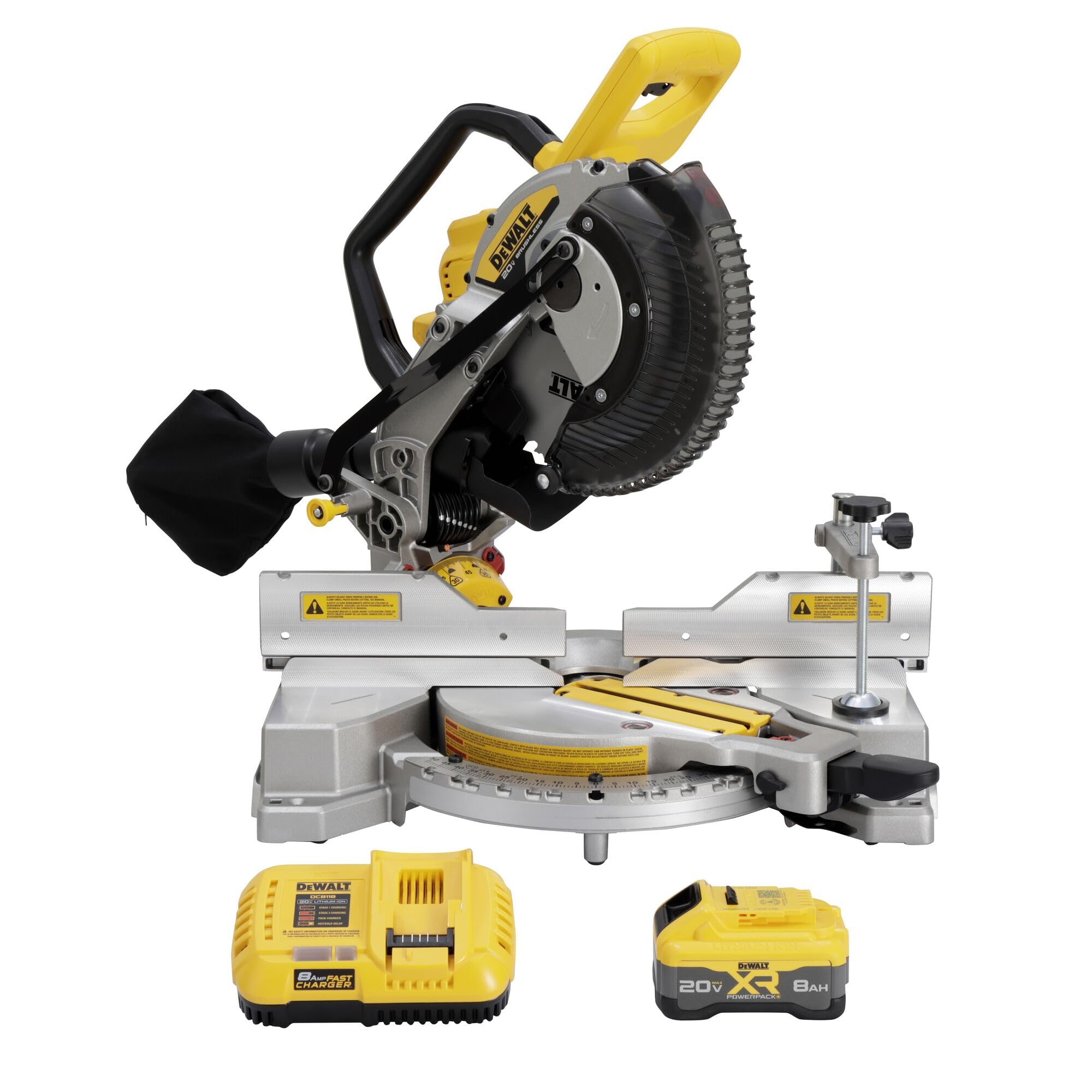
The DEWALT DCS714WW1 is the cordless answer for job sites where dragging a 15-amp extension cord across a wet floor is dangerous or impractical. The bevel-gear transmission maximizes runtime by minimizing drivetrain loss, delivering up to 434 cuts in 3-1/4-inch MDF base molding on a single 4Ah battery. This is a fixed (non-sliding) miter saw, so its crosscut capacity is limited to approximately 6 inches horizontally, but that covers the vast majority of trim and 2x lumber cuts.
At just under 27 pounds with the battery installed, this saw is genuinely portable. The double-bevel capability lets you tilt the blade left and right without flipping the workpiece, which speeds up crown molding nesting. Dust collection hits 97% capture per DEWALT’s testing, and the included non-airlock vacuum adapter connects directly to standard shop vac hoses. Some users found the original blade rough on finish work and swapped it for a 60-tooth Diablo, but the 40-tooth stock blade powers through pressure-treated lumber without bogging.
The clamp feels slightly flimsy compared to the rest of the saw’s build, and the base plate lacks pre-drilled holes for mounting to popular portable stands like the DWX726. The shadow cut line is clever—visible even in bright sunlight—and eliminates the need for a laser guide. This saw suits framers, finish carpenters, and anyone who needs a 10-inch saw in locations without reliable power.
Why it’s great
- Excellent battery runtime with bevel-gear transmission efficiency
- Lightweight 27 lbs with battery; ideal for multi-floor job sites
- Shadow cut line visibility in direct sunlight
Good to know
- Fixed slide limits crosscut to about 6 inches horizontally
- Requires 4Ah or larger battery; smaller packs underperform
3. Makita LS1040 10″ Compound Miter Saw

The Makita LS1040 is a non-sliding compound miter saw that prioritizes weight and precision over brute crosscut capacity. At 27 pounds, it is the lightest premium 10-inch saw on this list, making it the go-to for trim carpenters who work out of a truck bed and need to carry the saw up three flights of stairs. The direct-drive 15-amp motor delivers 4600 RPM, which is lower than the typical 5000 RPM figure, but the torque curve is flat enough to chew through stacked 2x material without noticeable speed drop.
The dual-post compound pivoting arm keeps the head rigid, and the machined aluminum base provides a flat reference surface that holds its calibration over years of use. Positive miter stops are at 15, 22.5, 30, and 45 degrees on both sides, plus 0 degrees, which covers common crown and baseboard angles. Bevel cuts up to 45 degrees left only—this is not a dual-bevel saw, so you must flip the workpiece for compound cuts requiring the opposite tilt.
The included 40-tooth micro-polished blade cuts cleanly on pine and poplar out of the box, though heavy users replace it with a 60-tooth blade for smoother MDF cuts. The startup is abrupt—users describe it as “starting with a bang”—and the base lacks pre-drilled holes for mounting to portable stands commonly used with other brands. For pure trim work where weight matters most, the LS1040 is a class leader.
Why it’s great
- Extremely portable at 27 pounds without sacrificing motor torque
- Machined aluminum base stays true over years of job-site abuse
- 9 positive miter stops with crisp detent engagement
Good to know
- Bevel only tilts left; no dual-bevel capability
- No pre-drilled mounting holes for aftermarket stands
4. Evolution Power Tools R255SMS+ PLUS 10-Inch Sliding Miter Saw

The Evolution R255SMS+ is engineered around the premise that you should be able to cut wood, steel, aluminum, plastic, and composite decking with a single blade swap. The included TCT blade cuts mild steel with virtually no sparks and minimal heat buildup, which is a significant safety upgrade over abrasive chop saws that rain orange sparks across the workspace. The 15-amp motor delivers consistent power through the extended duty gearbox, and the sliding mechanism provides a larger cut capacity than the fixed Evolution R185SMS+.
Bevel range spans 0 to 45 degrees, and miter range covers 50 degrees left and 50 degrees right, giving you 100 degrees of total miter travel for acute angle cuts on crown molding. The PLUS version includes dual quick-release clamps, taller fences, a slide rail protector, and a 3-meter cable for reaching distant outlets. Rubber grip handles reduce vibration transfer, and the integrated carry handle makes transport reasonable at 42 pounds.
Some users found the included blade drags fibers on soft woods, and the plastic fence components require careful assembly to ensure square alignment. Dust collection is adequate with a shop vac attached but the bag fills quickly during metal cutting. For anyone who regularly switches between wood trim and steel fabrication, the R255SMS+ eliminates the need for a second dedicated metal-cutting saw.
Why it’s great
- Single TCT blade cuts metal without sparks or heat buildup
- 100-degree miter range for acute angle compound cuts
- 3-year manufacturer warranty provides long-term coverage
Good to know
- Plastic fence requires careful alignment during setup
- Laser guide is helpful but not perfectly aligned out of the box
5. Hoteche 10-Inch Miter Saw 15A Sliding Compound Single Bevel

The Hoteche sliding compound miter saw targets the serious DIYer who needs a 15-amp motor and a laser guide without reaching into premium price territory. The 5000 RPM no-load speed is on par with industry standard, and the sliding rails extend to handle crosscuts up to 12 inches on dimensional lumber. The built-in laser guide projects a red line offset calibrated to the blade kerf, which improves accuracy for beginners and speeds up repetitive cuts for experienced users.
Maximum cutting capacity at 0 x 90 degrees is 315 x 90 mm (12.4 x 3.5 inches), which is tight for a full 4×4 post but sufficient for 2x lumber and baseboard. At 45 x 45 degrees, capacity drops to 215 x 40 mm, making this saw viable for crown molding in small to medium jobs. The included TCT blade and working clamp are functional, and the dust bag and wrench are standard inclusions. The motor includes spare carbon brushes for long-term maintenance.
The fence could sit further back for wider cuts, and the G-clamp mechanism, while effective, has a learning curve for smooth operation. At 42 pounds, it is heavy enough to stay planted on a stand but still manageable for occasional transport. For homeowners doing window casing, baseboards, and furniture projects, this saw provides the essential features of a sliding saw at a mid-range investment.
Why it’s great
- Laser guide improves cut line accuracy for trim work
- 15-amp motor delivers consistent power through sliding cuts
- Spare carbon brushes extend motor service life
Good to know
- Fence position limits width capability for larger stock
- Laser calibration may need adjustment after initial assembly
6. MarvTool 10-inch Sliding Compound Miter Saw (JS-1013C3)
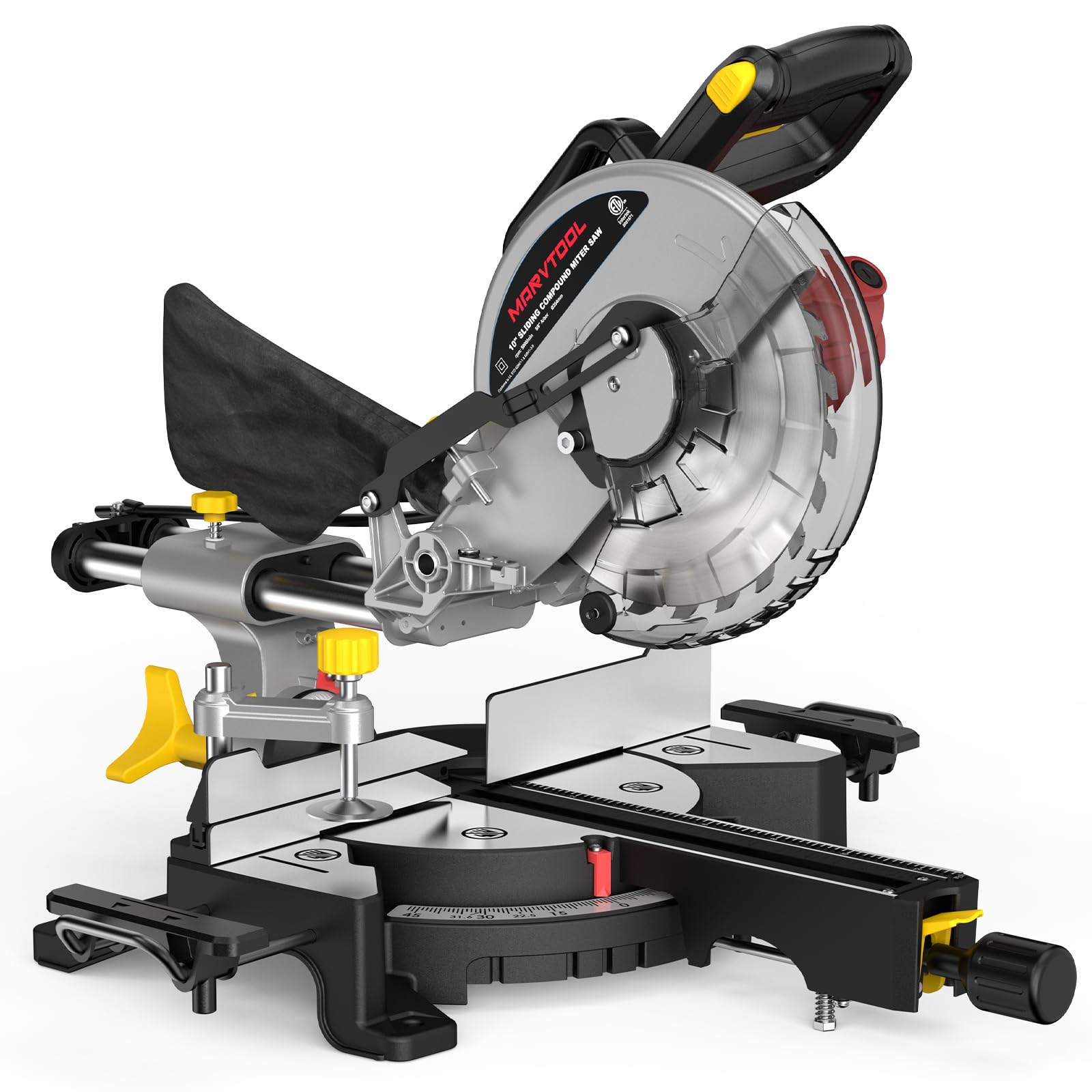
The MarvTool JS-1013C3 is a sliding compound miter saw that prioritizes portability and starter affordability. At 25.6 pounds, it is the lightest sliding 10-inch saw in this guide, making it realistic to carry between garage and driveway jobs. The 15-amp motor hits 5000 RPM, and the dual flexibility of left miter angles from 0 to 45 degrees with the base adjusting for bevel from 0 to 45 degrees covers most trim and baseboard cuts. The head locks into the base using a release knob, shrinking the footprint for shelf storage.
The included 36-tooth TCT blade is adequate for softwood and laminates, but buyers upgrading to a Diablo or Freud blade report significantly smoother cuts on hardwood and MDF. The transparent blade guard provides visibility, and the vise clamp holds material securely during bevel cuts. The dust collection bag captures the larger chips but fine dust escapes, so a shop vac connection is recommended for indoor work. Two extension tables are included to support longer workpieces, though users note they could be longer for stability on 8-foot boards.
There is no laser guide on this model, which means cutting accuracy depends entirely on your ability to track the blade kerf. Some users found the handle arrives inside the foam packaging and must be installed before first use, a simple but non-obvious step. For the occasional DIYer who wants a sliding saw without spending on premium features, the MarvTool represents a functional entry point.
Why it’s great
- Very lightweight at 25.6 lbs for a sliding saw; easy to move
- Head locks down for compact storage in tight garages
- Pre-installed blade and extension tables included
Good to know
- No laser guide; rely on visual alignment of the kerf
- Extension tables are short for supporting material over 6 feet
7. Evolution Power Tools R185SMS+ Sliding Miter Saw (7-1/4″)

The Evolution R185SMS+ uses a 7-1/4-inch blade rather than the 10-inch standard, which is a critical distinction for buyers who assume all miter saws in this category share the same blade diameter. The smaller blade reduces cutting depth to roughly 2.5 inches at 90 degrees, but the trade-off is a saw that excels at cutting steel, aluminum, and plastic with the same TCT blade used for wood. The patented multi-material cutting technology produces virtually no sparks when cutting mild steel, making it safer for indoor and garage use than abrasive saws.
Bevel capacity spans 0 to 45 degrees, and the miter range covers 50 degrees left and right. The sliding mechanism uses ball-bearing rails for smooth motion, and the laser cutting guide aids alignment on the narrower blade. At 1500W of measured draw, the motor is less raw than a 15-amp saw, but the optimized gearbox keeps the blade speed steady through material transitions. The PLUS features include a premium clamp and dust bag, though serious dust management requires a shop vac.
This saw is best suited for metal fabricators, handymen cutting aluminum extrusions, or anyone who needs a single saw for thin steel and wood trim. The 3-year warranty reflects Evolution’s confidence in the gearbox and motor. It is not a framing saw, but for the niche of multi-material cutting in a compact package, the R185SMS+ is a specialized tool that performs its role with minimal cleanup.
Why it’s great
- Cuts mild steel without sparks or harmful debris
- Ball-bearing slide rails reduce vibration during cuts
- Compact footprint fits small workbenches
Good to know
- 7-1/4 inch blade limits cut depth to 2.5 inches at 90 degrees
- Not suitable for framing lumber or thick hardwoods
8. Genesis GMS1015LC 15-Amp 10-Inch Compound Miter Saw

The Genesis GMS1015LC is a non-sliding compound miter saw designed for homeowners and DIYers taking on their first trim project. The 15-amp motor is strong enough for pressure-treated 2x4s and 4x4s, and the 60-tooth carbide blade cleans up the cut edge without splintering on pine. The laser guide, powered by two AAA batteries, projects a red line that helps beginners visualize the cut path before engaging the blade. The electric brake stops the blade in seconds, reducing the wait time between repetitive cuts.
Miter adjustments span 45 degrees left and right with nine positive detent stops at common angles. The die-cast aluminum base keeps the saw stable and improves accuracy over stamped steel alternatives. Bevel cuts up to 45 degrees left only, which is standard for this price tier. The included dust bag is almost useless—it fills quickly and the angle of the exhaust port prevents effective capture—so a shop vac connected to the port is essential for maintaining a clean workspace.
This saw is not designed for metal cutting; the plastic base components and blade guard can melt under the heat generated by cutting steel. The fence calibration held true out of the box for most users, which is surprising at this tier. For baseboards, window casing, and small furniture projects where precision matters more than cut width, the GMS1015LC provides a capable starting point without over-investing.
Why it’s great
- 60-tooth carbide blade delivers clean cuts on trim and softwood
- Laser guide and electric brake included at entry-level price
- Die-cast aluminum base stays flat and true
Good to know
- Not rated for metal cutting; plastic parts may melt from heat
- Dust bag is ineffective; shop vac connection is necessary
9. DOVAMAN Updated 10-Inch Sliding Miter Saw (DMS01A)

The DOVAMAN DMS01A stands out in the budget tier for its dual-speed motor that switches between 5000 RPM and 3200 RPM, enabling cleaner cuts on plastic and soft metals without the blade overheating. It ships with three TCT blades—two 40-tooth and one 48-tooth—which is an unusual level of inclusion at this price point. The sliding rail extends the cutting range to roughly 4 x 13 inches, handling baseboard and shelving stock without repositioning. The 15-amp pure copper motor pulls consistent current through the cut without sagging on thicker material.
The ambidextrous design features dual lock switches for left- and right-handed operators, and the laser guide is bright enough to be visible in moderate daylight. The extendable side tables help support longer workpieces, though they are not as robust as the cast-aluminum wings on premium models. The included support clamp holds material securely, and the user manual covers the setup steps clearly. At 37 pounds (17 kg), it is mid-weight among sliding saws—heavier than the MarvTool but lighter than the Evolution R255SMS+.
The stock blades, while generous, are not Diablo-level in cut quality. Users report better results upgrading to a dedicated carbide blade for hardwoods. One unit arrived with a damaged rail, but the seller resolved it quickly, and the replacement saw performed well. For the DIYer who wants multi-material capability and a laser guide without stretching into mid-range pricing, the DOVAMAN offers the best bundled value in this category.
Why it’s great
- Dual-speed motor (5000/3200 RPM) for versatile material cutting
- Three included TCT blades provide multi-material readiness immediately
- Ambidextrous controls and laser guide included
Good to know
- Stock blades benefit from upgrading for hardwood cuts
- Extension tables are functional but less rigid than premium models
FAQ
Can a 10-inch miter saw cut a 4×4 post in one pass?
Why does my miter saw produce burning marks on the cut edge?
Is a sliding miter saw worth the extra cost for trim work?
Final Thoughts: The Verdict
For most users, the 10 inch miter saw winner is the Bosch CM10GD because the Axial-Glide system combines precision with a compact footprint that fits tight workshops. If you want cordless freedom for job-site mobility, grab the DEWALT DCS714WW1. And for multi-material cutting that handles steel and wood without sparks or heat, nothing beats the Evolution R255SMS+.