
Our readers keep the lights on and my morning glass full of iced black tea. As an Amazon Associate, I earn from qualifying purchases.
Specs are compiled from manufacturer listings and verified buyer reviews and can change over time — please confirm the key details on the product page before buying.
If you have ever fought with a handheld circular saw trying to cut crown molding or baseboards, a 10-inch sliding compound miter saw makes that job simple. The real challenge is picking one that cuts square straight from the box, does not lose alignment after a dozen pulls, and can handle metal without slowing down — all without paying a premium for a brand name. This guide covers the models that deliver repeatable accuracy for weekend trim work and daily job-site use.
I’m Min — the founder and writer behind Gadgets Feed. This guide is built by comparing the manufacturers’ published specifications and the patterns across verified customer reviews, so you get each pick’s real strengths and trade-offs instead of marketing spin.
Whether you are cutting picture frames or steel studs, the right 10 inch sliding compound miter saw balances power, portability, and precision without guesswork.
Quick Picks
- MarvTool JS-1013C3 10-inch Sliding Compound Miter Saw — Value King
- DOVAMAN DMS01A Updated 10-Inch Sliding Miter Saw — Dual-Speed Versatility
- NOVORIK 1009xqj00101 Single Bevel Compound Sliding Miter Saw — Best Overall
- Evolution Power Tools R255SMS+ PLUS 10-Inch Sliding Miter Saw — Multi-Material Beast
- VEVOR J1G-ZP33-K255D 10-Inch Sliding Miter Saw — Dual Bevel Value
- Bosch CM10GD Compact Miter Saw — Wall-Hugging Glide
- Makita LS1019L 10″ Dual-Bevel Sliding Compound Miter Saw — Crown Molding Master
How To Choose The Best 10 Inch Sliding Compound Miter Saw
Choosing a 10-inch sliding compound miter saw depends on three factors: the materials you cut most, how often you move the saw, and if you need dual bevel (tilt both directions) or single bevel. Here is what to check on the spec sheet.
Motor Power and Speed
Every saw here runs on a 15-amp motor, but the no-load speed varies. A higher RPM, like 5000, makes quicker work of softwood, while a lower speed option (3200 RPM) helps when cutting soft metals so the blade does not overheat. Some saws offer a single fixed speed; others give you a switch to choose between two speeds depending on the material.
Sliding Mechanism and Capacity
A sliding saw extends the crosscut capacity beyond the blade diameter. The longer the slide — up to 13 inches on some models — the wider the board you can cut in one pass. But traditional rails need clearance behind the saw. Newer designs like Bosch’s Axial-Glide replace the rails with a pivoting arm, letting you mount the saw flush against a wall and saving roughly 10 inches of bench space.
Bevel Type: Single vs. Dual
A single-bevel saw tilts the blade left (or right) for angled cuts. A dual-bevel saw tilts both directions without flipping the workpiece — a real time-saver for crown molding and compound angles. Dual bevel normally costs more and adds weight, so think about your typical project before paying extra for it.
Cut-Line Visibility: Laser Guide vs. LED Shadow
A laser guide projects a line on the workpiece so you see exactly where the blade lands. An LED shadow line works similarly by casting a dark shadow on the cut line — it never needs battery changes because it runs off the saw’s power. Both get the job done, though some users find the LED shadow line easier to see under bright workshop lights.
Portability and Weight
If you carry your saw between jobs or store it on a shelf, weight matters. Models range from roughly 25 pounds (very light for a miter saw) up to more than 70 pounds for heavy-duty dual-bevel units. A lighter saw is easier to lift onto a workstand but may feel less stable during long cuts. Check the packed dimensions too — a compact footprint means you can tuck it into a corner when not in use.
Quick Comparison
On smaller screens, swipe sideways to see the full table.
| Model | Best For | Motor (Amps / RPM) | Bevel Type | Weight | Amazon |
|---|---|---|---|---|---|
| MarvTool JS-1013C3 | Budget-friendly DIY trim work | 15A / 5000 RPM | Single Bevel 0–45° | 25.6 lbs | $175.99$189.99PrimeAmazon |
| DOVAMAN DMS01A | Multi-material versatility | 15A / 3200–5000 RPM | Single Bevel 0–45° | 17 kg (37.5 lbs) | $189.97$219.97PrimeAmazon |
| NOVORIK 1009xqj00101 | Affordable accuracy with laser guide | 15A / 4000 RPM | Single Bevel 0–45° | 33.9 lbs | Amazon |
| Evolution R255SMS+ PLUS | Metal cutting and job-site toughness | 15A | Single Bevel 0–45° | 41.8 lbs | Amazon |
| VEVOR J1G-ZP33-K255D | Dual bevel on a mid-range budget | 15A | Dual Bevel 0–45° | 39.68 lbs | Amazon |
| Bosch CM10GD | Compact shop with zero-clearance against a wall | 15A | Dual Bevel | 64 lbs | Amazon |
| Makita LS1019L | Pro-level crown molding and precision | 15A | Dual Bevel | 72.8 lbs | Amazon |
In‑Depth Reviews
1. MarvTool JS-1013C3 10-inch Sliding Compound Miter Saw
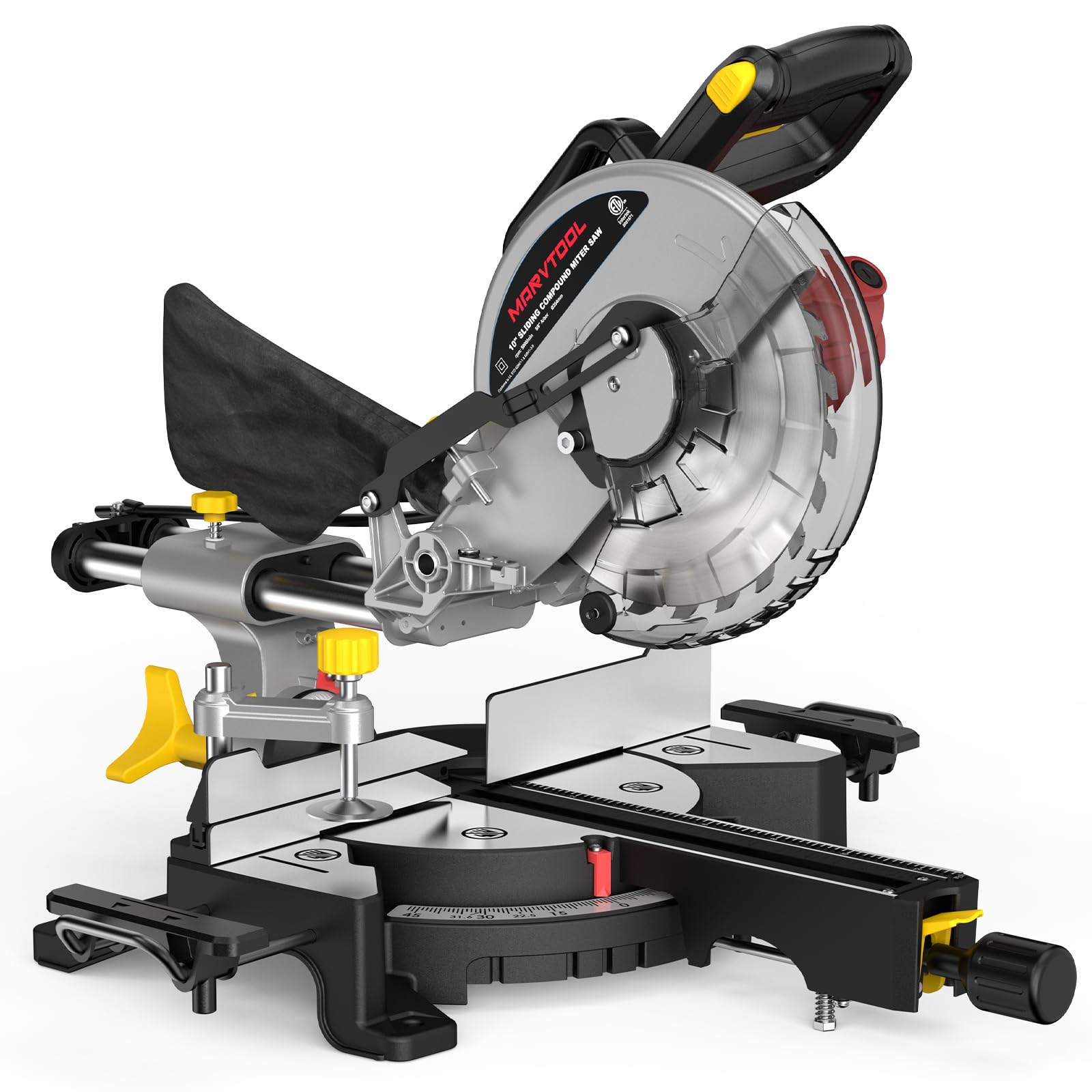
A lightweight trim saw that keeps your wallet happy without skimping on cut quality.
This saw gives you a 15-amp motor that spins up to 5000 RPM — enough to push through hardwood and soft metals without bogging down. At 25.6 pounds, it is significantly lighter than many competitors; the NOVORIK, for example, comes in at 33.9 pounds, making the MarvTool easier to carry up a ladder or stow on a shelf between weekend jobs.
Buyers report it is “affordable, easy setup, lightweight, accurate cuts, pre-installed blade, well-built for trim work.” The single-bevel range goes from 0 to 45 degrees, and the included 36-tooth blade gets you started right away. There is no laser guide, so you will need to rely on the line-of-cut marks — a trade-off some users note is manageable after a few practice cuts.
Solid starter package: The guard is transparent for good blade visibility, and a dust bag keeps chips off the floor. A two-year warranty backs the tool, and the extension tables help support longer boards.
One shortcoming: The material support wings are on the shorter side — a couple of buyers wished they extended further for long trim pieces. The 36-tooth blade is fine for framing but you will likely upgrade to a finer blade for finish work.
Grab this if: you are a DIYer who needs a functional, accurate miter saw for occasional trim and furniture projects and wants to keep the investment low.
Look elsewhere if: you cut metal regularly or need a laser guide for quick alignment — you will find those features on the DOVAMAN or NOVORIK picks below.
2. DOVAMAN DMS01A Updated 10-Inch Sliding Miter Saw

Two speeds and three included blades mean you switch from wood to metal without missing a beat.
This saw stands out because you can pick your speed — 5000 RPM for fast wood cuts or 3200 RPM for soft metals and plastics. It comes with a total of three TCT blades: two 40-tooth and one 48-tooth, so you have specialized blades for different materials without buying extras. The 13-inch sliding rail gives you a cutting range up to 4 by 13 inches.
Buyers mention the laser guide is “a huge bonus” and helps with precise lines. One noted the saw arrived damaged but the seller “quickly resolved” it. The ambidextrous trigger handle works for both left and right-handed operators — a detail the Evolution and MarvTool saws do not match. At 17 kilograms (about 37.5 pounds), it is heavier than the MarvTool but still manageable for one-person setup.
What works well
- Dual-speed motor handles wood, PVC, and soft metals with one switch.
- Laser guide projects the cut line — helpful for angled cuts.
- Two extra carbon brushes included for motor maintenance.
Where it slips
- Some buyers replace the included TCT blades with a premium Diablo for smoother cuts.
- Packaging did not prevent all shipping damage in a few cases.
Who it fits: the home hobbyist who cuts a mix of materials and wants dual-speed flexibility plus a laser guide for accuracy, all without leaving the mid-range tier.
Who should pass: if you need a single-bevel saw with the smallest possible footprint, the Bosch or Makita are more compact despite costing more.
3. NOVORIK 1009xqj00101 Single Bevel Compound Sliding Miter Saw

Hefty build, accurate positive stops, and a laser guide that takes the guesswork out of angled cuts.
The NOVORIK runs a 15-amp motor at 4000 RPM — a good middle speed for both wood and softer metals. The miter table has positive stops at 0, 15, 22.5, 30, and 45 degrees in both directions, so you feel a click when you hit those common angles.
Owners mention it is “good tool…even better customer service” and “sturdy, well-built, accurate.” The laser guide projects the cut path, and the included clamping device holds the workpiece tight. A dust extraction port lets you hook up a vacuum hose to keep the area clean.
Smart details: The degree dial is a sticker rather than engraved metal, which a few reviewers flagged as a long-term durability concern. The design uses a blade guard for safety and side supports for longer boards.
Honest catch: The dust bag fills quickly and a fair amount of dust still escapes into the air — you will want a shop-vac adapter for serious cleanup. The blade is pre-installed, so you can start cutting wood right from the start.
Best for: the serious DIYer or apprentice who wants a solid, accurate saw with a laser guide and a 2-year manufacturer warranty at a reasonable mid-range price.
skip it if: you need dual-bevel capability (left and right tilt) — the VEVOR or Bosch are better matches.
4. Evolution Power Tools R255SMS+ PLUS 10-Inch Sliding Miter Saw

One blade cuts wood, nails, steel, and plastic — and it stays cool enough to touch right after.
That weight comes from a sturdy build intended for multi-material cutting: the included TCT blade chews through wood, wood with embedded nails, composite decking, mild steel, and plastic with “virtually no sparks” and stays “cool to the touch” when cutting mild steel. Buyers confirm it “works well with wood and 1/8″ metal” and note it “cut like butter on the thinner metal.”
It offers a 0 to 45-degree bevel and a wide 50-degree left and right miter range. The plus model adds dual quick-release clamps, a dust bag, taller fences, a slide rail protector, and a 3-meter long cable. The soft-start motor prevents the breaker from tripping on startup — a complaint some Bosch users have about their saw.
Reasons to buy
- Cuts mild steel without needing a separate metal-cutting blade or a grinder.
- Soft-start reduces the jolt when you pull the trigger.
- 3-year warranty beats the industry standard.
Limitations
- Laser guide is only accurate for the first few inches of the cut.
- Stock blade drags fibers on wood finishing cuts — you may want a fine-tooth blade for trim work.
- Clamp is described as mediocre compared to dedicated work clamps.
Who needs this: the remodeler or property-maintenance user who cuts metal studs, rebar, or deck lumber regularly and wants one saw that does it all safely.
Who walks away: anyone who needs a compact saw — at 41.8 pounds and with traditional sliding rails, it takes up significant bench space.
5. VEVOR J1G-ZP33-K255D 10-Inch Sliding Miter Saw
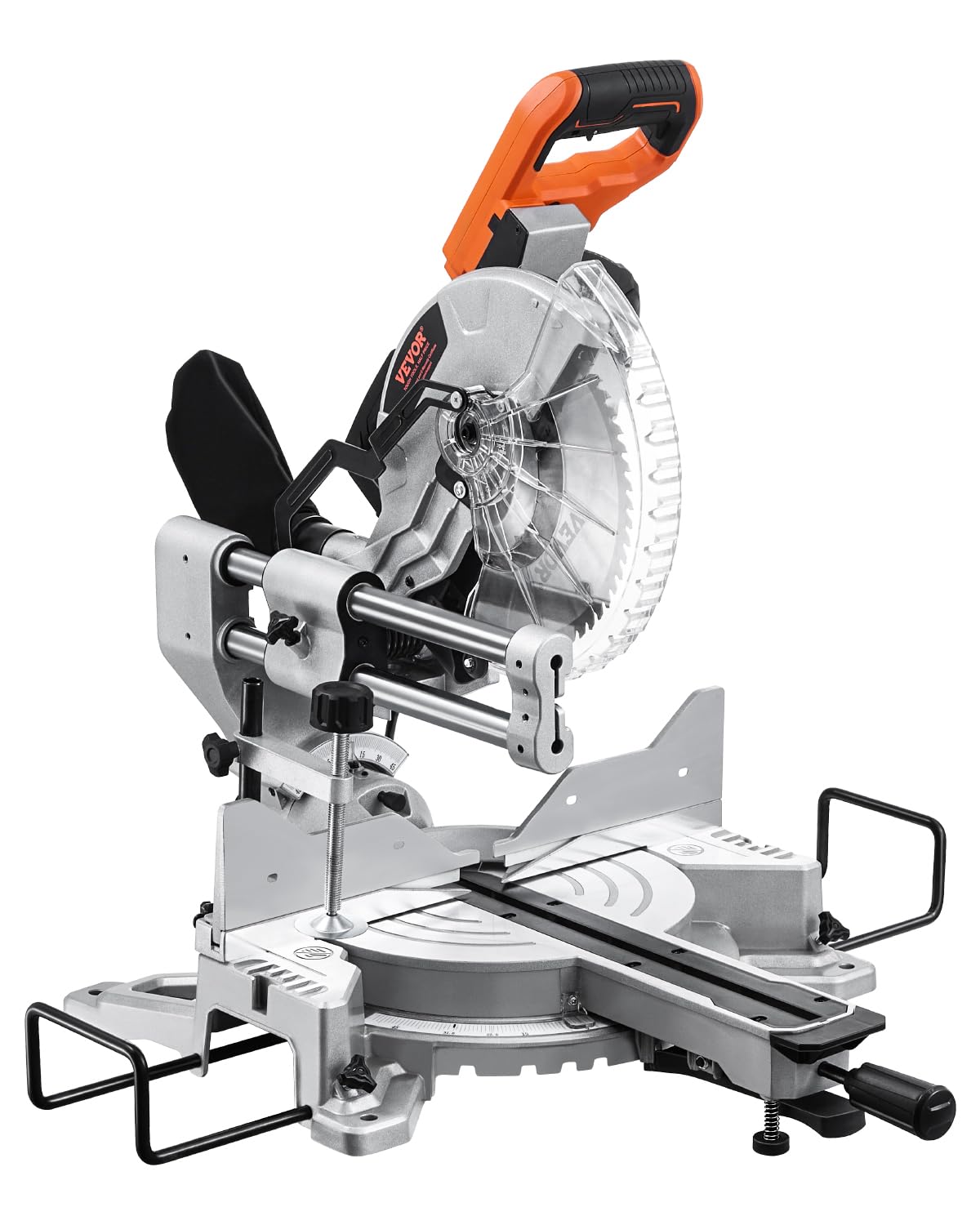
Dual bevel at a mid-range price — tilt both ways without flipping the workpiece.
The VEVOR brings dual-bevel capability (0 to 45 degrees both left and right) to a price point that is typically occupied by single-bevel saws. It runs on a 15-amp motor with an axial-slide system — similar in concept to the Bosch, though the VEVOR uses an aluminum base instead of a cast iron one, keeping weight at 39.68 pounds. The included 60-tooth blade is a finer cut than the 36- or 40-tooth blades on lower-priced models.
Instead of a laser, it uses an LED shadow line that projects a dark line onto the cut path — customers note it is “a great LED Shadow line for cutting” and it never needs battery changes. The saw measures 30.31 by 20.87 by 27.56 inches, making it one of the bulkier units here. Reviewers point out it is “impressive accuracy at 90°” and the “smooth sliding action” is a highlight.
Solid dual bevel for the money: A 3-year warranty is not included here, but the LED guide and axial sliding system make this a smart pick for crown molding and compound angles without spending Bosch-level cash.
Watch out for: Some buyers received their unit missing the blade and hex tool, and customer service was difficult to reach for a refund. Check the box contents as soon as it arrives.
Reach for this if: you need dual bevel for picture frames or complex miters but want to stay in the mid-range budget — it delivers a feature normally reserved for saws costing twice as much.
Hold back if: reliability from the start is your top concern — the Bosch and Makita have far fewer packaging and missing-parts complaints in their reviews.
6. Bosch CM10GD Compact Miter Saw

No sliding rails means you can push this saw flat against a wall and still get a wide crosscut.
The Bosch CM10GD replaces traditional sliding rails with an Axial-Glide system — the head glides on pivoting arms instead of rails. That saves up to 10 inches of rear clearance, so you can mount it flush against a wall, perfect for a small workshop. The saw weighs 64 pounds and sits on a 2-inch by 26.5-inch footprint.
All the controls — bevel lock, miter detents, and crown stop — are up front, so you never reach around the back. The dual bevel tilts both directions, and the included 60-tooth carbide blade delivers smooth cuts. The clear lower guard keeps the blade visible while protecting your hands. One reviewer noted the saw has “no soft start” and “jumps on startup,” which is a difference from the Evolution saw above that has a soft-start motor.
Why it stands out
- Axial-Glide is the most space-efficient sliding system on the market — no rails to clear.
- Up-front metal bevel controls and Square Lock precision fences make adjustments quick.
- Ergonomic ambidextrous handle with soft grip reduces fatigue on long jobs.
Watch for
- Dust collection with the included bag is mediocre — a shop vac adapter improves it significantly.
- No soft-start feature — the saw jerks briefly when you pull the trigger.
- At 64 pounds, it is not a carry-around saw for job-site hopping.
Best space-saver: If your workshop is tight and you need a full sliding crosscut capacity without the rear clearance, this is the best in class — no other 10-inch saw packs this capacity into such a small footprint.
Not for: the mobile contractor who lifts the saw onto a truck bed every morning — the Makita is slightly lighter but still heavy, and the MarvTool at 25.6 pounds is a better portable option.
7. Makita LS1019L 10″ Dual-Bevel Sliding Compound Miter Saw

A 10-inch saw that cuts nested crown molding as tall as most 12-inch saws — without the bulk.
The Makita LS1019L uses a direct-drive gearbox and guard system that gives you a vertical cutting capacity of 5.25 inches. That means it handles 6.625-inch nested crown molding — a size normally reserved for 12-inch saws. The dual bevel tilts both directions without rotating the workpiece, and the two-steel rail sliding system with a single slide-glide operation reduces the saw’s footprint while keeping cuts smooth and accurate.
Buyers with decades of woodworking experience call it the “best Makita 10″ slider” and note the dust collection captures 80% or more when connected to a vacuum. The soft start motor eliminates the startup jerk that the Bosch saw has. Some users did find the laser “too dim” and “misaligned until the blade is lowered,” especially under bright shop lights, so you may rely more on the cut-line marks.
Production-ready precision: The linear ball bearing system is engineered for dead-on cuts, and the two-piece fence supports long workpieces. One buyer mentioned the initial 1/32-inch error on a 12-inch cut was simply due to a loose miter table lock — tightening it fixed the issue completely.
Heads-up: The included side extensions are adjustable. At 72.8 pounds, this is the heaviest saw here — plan for a stationary setup or a rolling stand. The arbor tilt knob is also less ergonomic than the front controls on the Bosch.
Who it fits: the finish carpenter or serious woodworker who cuts crown molding daily and wants a 10-inch saw that delivers 12-inch-level capacity with excellent dust collection and smooth, repeatable accuracy.
Who should pass: the occasional DIYer — the 72.8-pound weight and premium cost are overkill if you only cut baseboards a few times a year.
Understanding the Specs
Blade Size and Tooth Count
The “10-inch” refers to the diameter of the blade. A 10-inch blade is lighter and cheaper than a 12-inch, yet still cuts through 4×4 lumber in one pass. Tooth count affects finish: a 36-tooth blade cuts fast but leaves a rougher edge, while a 60-tooth blade takes slower passes but leaves a finish that often needs little sanding.
Bevel and Miter Ranges
The bevel is the tilt of the blade left or right for angled cuts through the thickness of the board. The miter is the rotation of the table left or right for angled cuts across the width. Dual bevel tilts both directions without flipping the board — a big time-saver for crown molding. Positive stops are preset detents at common angles (22.5°, 30°, 45°) that click into place so you do not have to read a scale every time.
Motor Amperage and Speed
A 15-amp motor is standard for this class. Higher RPM (5000 vs. 4000) means faster cuts in softwood, but lower RPM (3200) is safer for soft metals because the blade generates less heat. Dual-speed saws let you pick the right speed for the material, which extends blade life.
Sliding Mechanism and Compactness
Traditional sliding rails extend backward and need clearance behind the saw — about 10 to 15 inches. Axial-Glide (Bosch) and linear ball-bearing systems (Makita) replace those rails with pivoting arms or dual-rail designs that allow the saw to sit closer to a wall. If your shop space is tight, that rear-clearance number matters more than the table dimensions.
FAQ
Can a 10-inch sliding compound miter saw cut a 4×4 in one pass?
What is the difference between single bevel and dual bevel?
Do I need a laser guide or an LED shadow line?
Can I cut metal with a 10-inch miter saw?
How much space do I need behind a sliding miter saw?
How do I maintain a sliding compound miter saw?
What does the tooth count on a miter saw blade mean?
Is a heavier miter saw always better?
Can I mount any of these saws to a miter saw stand?
How long does a 10-inch miter saw blade last?
Final Thoughts: The Verdict
For the majority of shoppers, the best 10 inch sliding compound miter saw overall is the NOVORIK because it combines a sturdy 15-amp motor, a useful laser guide, and solid build quality at a price that will not scare off a serious DIYer. If you cut metal regularly, the Evolution R255SMS+ is the smartest pick — it handles steel with no sparks and stays cool to the touch. For a compact workshop, the Bosch CM10GD saves you the most bench space thanks to its Axial-Glide system.
How We Picked
We do not accept paid placement, and we did not hands-on test every unit. Instead, we match each pick to a real buyer and use-case by comparing the manufacturers’ published specifications against the patterns in verified customer reviews — so you get each pick’s real strengths and trade-offs instead of marketing copy.
Sources & Methodology
Specifications: manufacturer listings and product documentation. Review insights: verified customer reviews, as of July 2026. Pricing: not shown on this page (it changes often); check the current price via the retailer link.
As an Amazon Associate, Gadgets Feed earns from qualifying purchases. This does not affect which products we feature.
Product prices and availability are accurate as of the date/time indicated and are subject to change. Any price and availability information displayed on Amazon at the time of purchase will apply to the purchase of this product. As an Amazon Associate I earn from qualifying purchases.
CERTAIN CONTENT THAT APPEARS ON THIS SITE COMES FROM AMAZON. THIS CONTENT IS PROVIDED "AS IS" AND IS SUBJECT TO CHANGE OR REMOVAL AT ANY TIME.
Amazon and the Amazon logo are trademarks of Amazon.com, Inc. or its affiliates.