
Our readers keep the lights on and my morning glass full of iced black tea. As an Amazon Associate, I earn from qualifying purchases.
Specs are compiled from manufacturer listings and verified buyer reviews and can change over time — please confirm the key details on the product page before buying.
Buying a 10 inch speaker box is mostly about two things nobody puts on the box: does it physically fit where you plan to put it, and does the internal air volume match the subwoofer you already own. Get those two wrong and you will hear it immediately as thin, flabby bass. The list below separates the picks by what they actually do well — a rear-angle box that tucks against a seat, a ported cabinet tuned for output, a sealed dual-box that stays balanced and tight.
I’m Min — the founder and writer behind Gadgets Feed. This guide is built by comparing the manufacturers’ published specifications and the patterns across verified customer reviews, so you get each pick’s real strengths and trade-offs instead of marketing spin.
Every enclosure here genuinely houses a 10-inch driver, so your real decision is shape, airspace, and mounting depth. Below you will find the 10 inch speaker box that matches your sub, your trunk, and the sound you actually want to hear.
Our Picks at a Glance


How To Choose The Best 10 Inch Speaker Box
An empty box looks simple, but it is an acoustic part with a job: hold air, hold your sub rigidly, and stay quiet. Four numbers decide whether it does that job in your vehicle — sealed or ported, airspace, mounting depth, and wall thickness. Check them in that order before you buy.
Sealed or ported — which bass do you want?
A sealed box traps air behind the driver, so the cone snaps back fast and the low end stays tight and accurate. A vented box — also called ported — lets that air escape through a tuned opening, which typically trades a little precision for louder, deeper output on the notes you feel. If you want punchy rock and clean kick drums, go sealed. If you want a hip-hop shelf you can hear down the block, a ported cabinet is usually the move.
Airspace in cubic feet
Airspace is the internal volume of the box, measured in cubic feet, and your subwoofer’s manual will list a recommended figure. A box that is too small will sound thin and chuffing at the port. One that is too large can let the cone flop past its limits at high volume. Read the driver’s spec sheet, then match the enclosure’s listed airspace to it.
Mounting depth and cutout diameter
Mounting depth is how much room the box gives the magnet behind the mounting surface, and cutout diameter is the size of the round hole the cone drops through. A 10-inch subwoofer needs both figures checked separately — the driver size alone does not guarantee the hole or the cavity is deep enough. Look for a cutout near 9.125 inches and confirm the depth clears your magnet.
Wall thickness and the seal
Boxes here are built from 5/8-inch or 3/4-inch MDF, a dense board that resists flex under bass pressure. Walls that flex lose energy and add buzz. The invisible spec is the seal: an air-tight cabinet with glued and nailed joints stops the small leaks that turn clean bass into a rattle.
Quick Comparison
| Model | Best For | Design | Airspace | Mounting Depth | Amazon |
|---|---|---|---|---|---|
| QPower Pack of 2 Single 10-Inch Sealed Subwoofer Boxes★ Best Overall | Symmetrical dual-sub builds | Sealed, pair | 0.9 cu. ft. each | — | Amazon |
| New Single Car Black Subwoofer Box 10SBest Value | Small-space sealed installs | Sealed, single | 0.85 cu. ft. | 9.625 in | Amazon |
| ASC 10″ Inch Truck Sub Box Regular CabBest for Trucks | Behind-seat truck fit | Sealed, single | 0.80 cu. ft. | 5 3/4 in | Amazon |
| ASC 10 Inch Subwoofer Box Sealed Rear-Angle | Trunk-corner angle fit | Sealed, single | — | — | Amazon |
| ASC Single 10 Inch Vented Subwoofer Box | Loud output on a budget | Vented, single | 1.14 cu. ft. | 14 in | Amazon |
| QPower QBOMB Single 10″ Vented Ported Box | Deep bass in tight cabins | Vented, single | 1.4 cu. ft. | — | Amazon |
| Atrend Bbox 10″ Single Vented Enclosure | Pro-tuned low-profile subs | Vented, single | — | 11.5 in | Amazon |
| BELVA Dual 10-inch Sealed Box | Two subs, separate chambers | Sealed, dual | Two separate chambers | — | Amazon |
| CT Sounds CT1X10 Single 10” Kerf Port Box | Tuned 37 Hz output | Ported, single | — | — | Amazon |
In‑Depth Reviews
1. QPower Pack of 2 Single 10-Inch Sealed Subwoofer Boxes, 0.9 Cubic Feet of Airspace Per Box
Our pick — 4.5+★ from 600+ verified ratings; the strongest balance of quality and price.
Two matched sealed cabinets in one order, so your left and right subs behave exactly alike.
If you are building a dual-sub system and want both sides to sound identical, this pair solves the hard part before you start. Each cabinet gives a 10-inch driver 0.9 cubic feet of airspace, sealed so the cone stays controlled and the bass lands punchy instead of booming. The 7.5-inch depth on each box means it tucks deeper into tighter spaces than a bulkier cabinet might — the ASC 10S, for reference, measures 13 inches deep.
The build is where this pick earns its keep. Solid 5/8-inch MDF with a charcoal carpet finish resists the flex that turns heavy bass into a buzz. Each box ships with terminal cup connectors, so wiring is a screwdriver job rather than a soldering project. Owners consistently single out the overall quality of these boxes above everything else, and the construction and carpet finish get steady praise alongside it. Buyers report the cabinets handle subwoofers up to 500W RMS, and reviews consistently describe deep low-end extension for a sealed 0.9-cubic-foot box.
The honest catch is the wire connectors — a small handful of people find the terminal cups fiddly and prefer to rewire them. It is a minor annoyance, not a reason to walk away, and the fix costs a few minutes. On size, some find the interior generous and others call it a touch small, which is really a reminder to check your sub’s recommended airspace before you commit.
What earns the top spot
- Two matched 0.9 cu. ft. sealed cabinets in one order — no mismatched bass between sides.
- 5/8-inch MDF with charcoal carpet keeps the walls stiff and the finish tidy.
- Terminal cups included on each box for quick, secure hookup.
- 7.5-inch depth is genuinely compact for a sealed cabinet.
Where it asks a little patience
- The wire connectors draw the only real gripes — some swap them out.
- Interior volume reads mixed: plenty of room for some subs, tight for others.
Made for dual builds: you are running two 10-inch subs and want them sealed, matched, and wired without fabrication.
Hold off: you only need one box, since this is sold strictly as a pair.
2. New Single Car Black Subwoofer Box Sealed Automotive Enclosure for 10″ Woofer 10S
A sealed single-10 cabinet that arrives ready to load, with a slanted back built to hug a seat or trunk wall.
This is the pick for someone who wants a sealed box, no assembly, and nothing fancy. The 10S gives your driver 0.85 cubic feet of internal volume, and the flat front with a slanted back means it sits flush against a rear seat or cargo wall instead of leaving a wedge of dead space. Its mounting depth of 9.625 inches is generous for a compact cabinet — the ASC vented box above goes considerably deeper at 14 inches.
The cabinet is CARB-compliant MDF with a 0.75-inch face, wrapped in black aviation-grade carpet and finished with gold binding posts for positive and negative wire. It ships fully assembled. Value is the thread running through owner feedback — the general read is that you get a solid box and clean sound for modest money, and owners repeatedly flag how well it fits into small spaces. The appearance gets its own nods too, which is rare for something that mostly hides in a trunk.
One thing to measure twice: the cutout. The woofer hole measures 9.125 inches across, and a few owners found it tighter than they expected for their particular sub. Check your driver’s cutout requirement against that figure before you order and this box is a quiet little bargain.
The real verdict: a no-drama sealed cabinet that fits small spaces and needs nothing but wire and a woofer. It is the smartest entry point here if you want accuracy over volume.
Check before you commit: the 9.125-inch cutout is the one measurement that matters most, and it has caught a few buyers out.
Right call for: a first sealed install in a small trunk or SUV cargo corner.
Think twice: your subwoofer’s cutout requirement runs larger than 9.125 inches.
3. 10″ Inch Truck Sub Box Single Subwoofer Enclosure Regular Cab 5/8″ MDF ASC
Built for the sliver of space behind a regular-cab bench, where a normal box simply will not go.
Regular-cab pickups punish subwoofer owners: there is almost no room behind the seat. This ASC enclosure is shaped for exactly that gap, with a 20-inch width, 15-inch height, a 5-inch top depth and a 7.5-inch bottom depth that follows the lean of the cab wall. Its 5 3/4-inch mounting depth is the real story — shallow enough to clear a slim truck sub, while the ASC vented box needs a full 14 inches.
It uses 5/8-inch MDF and includes subwoofer grilles plus spring-loaded terminal cups, so the driver is protected and the wiring is quick. The airspace is 0.80 cubic feet, the tightest figure on this list and a natural fit for a truck sub asking for a small sealed volume. Owners describe the fit as dead-on behind a regular-cab seat, and reviews repeatedly note deeper bass than the 0.80-cubic-foot sealed volume would suggest.
Worth knowing: the shallow mounting depth that makes it fit a truck is also its limit. If your subwoofer has a deep magnet, it will not seat here — check the 5 3/4-inch figure against your driver’s spec before buying.
Why it wins truck owners: the shallow 5 3/4-inch depth plus a shape that follows the cab wall is the whole point, and it delivers at a budget-friendly tier.
The one trade-off: tight 0.80 cubic feet and shallow depth mean it only suits subs specced for a small sealed box.
Pick it if: you drive a regular-cab truck and need bass behind the bench.
Look elsewhere if: your sub wants a big sealed volume or has a deep magnet assembly.
4. 10 Inch Subwoofer Box Sealed Rear-Angle Single 10″ Sub Box 5/8″ MDF – ASC

The angled-back cabinet that fills a trunk corner instead of wasting it.
Trunks are not rectangles, and this sealed box leans back to match. The rear-angle profile lets it sit neatly against the back of a seat or a cargo wall, so you keep more usable floor space than a square cabinet leaves behind. It measures 15-1/2 inches wide, 14.3 inches tall, with a 9-inch front depth stepping out to 11-1/2 inches at the base.
Construction is 5/8-inch MDF with a high-grade spring-loaded terminal cup included for the wiring. The sealed alignment gives you the balanced, controlled bass that suits a broad range of music — kick drums and bass guitar land tight rather than loose. Its job is narrow and it does it: a sealed 10-inch cabinet that turns a trunk corner into a usable sub location.
The trade-off is information: this listing does not publish airspace or mounting depth figures, so you cannot verify the internal volume against your sub’s recommendation without checking with the maker. If your sub is flexible on enclosure size, the angle design makes it an easy fit. If your driver demands a precise volume, confirm the numbers first.
Best for: a trunk where a standard square box steals too much floor space.
Confirm first: airspace and mounting depth are not listed, so verify them against your subwoofer’s spec.
5. Single 10 Inch Vented Car Subwoofer Box Ported Enclosure 5/8″ MDF – ASC

A ported cabinet with room for a big-magnet sub — 14 inches of mounting depth is the headline.
Most 10-inch boxes here bottom out around 9 or 10 inches of mounting depth. This ASC vented box goes to 14 inches, which means deep-magnet subwoofers that choke in shallow cabinets will actually seat. Airspace is 1.14 cubic feet, and the vented design lets the driver move air more efficiently for louder, more effective low end. The ASC truck box above, by contrast, sits at 0.80 cubic feet — a big shift in how much air the sub has to work with.
The enclosure is 5/8-inch MDF, measures 16-1/2 inches wide by 12-1/4 inches tall by 14-1/2 inches deep, and weighs 15.95 pounds. Quality is the common thread in owner feedback, with sound quality right behind it — the sense you get is that people are surprised by how much more bass comes out of a single 10 compared with their old setup.
Fair warning on the port: a vented box produces more output but less of the razor-tight accuracy a sealed cabinet gives. If you prize precision over volume, the sealed picks above will suit you better. But if your sub has a deep magnet and you want to feel your music, this is the one.
The case for it: 14 inches of mounting depth and 1.14 cubic feet of airspace open up subs that would not fit a shallow cabinet, and the vented design turns that room into real output.
Who should pass: listeners who want tight, accurate bass over raw volume.
Go this route if: you own a deep-magnet sub and want maximum low-end from a single 10.
Reconsider if: accuracy matters more to you than output.
6. QPower QBOMB Single 10″ Tough Vented Shallow Ported Subwoofer Box, Black
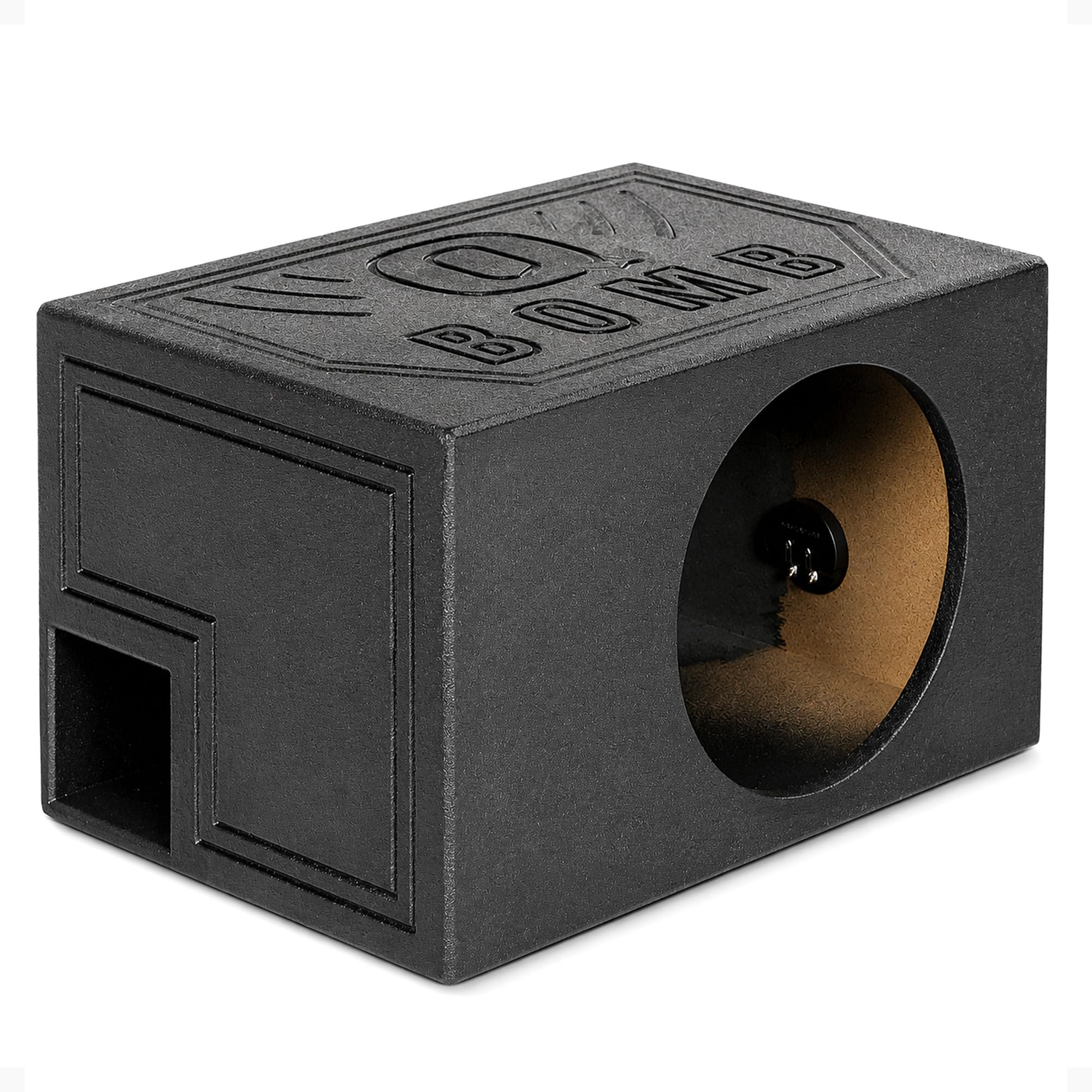
A ported box with 1.4 cubic feet of airspace, sprayed in bedliner so it survives whatever the trunk throws at it.
Here is the biggest airspace on the list for a ported single-10: 1.4 cubic feet. More air lets the subwoofer dig deeper, and combined with the vented design that is why owners describe low notes in terms that sound like a genuine system upgrade. The cabinet suits shallow-mount 10-inch subs as well as standard ones, so it stays flexible on the driver side.
Durability is where it stands apart. The finish is a black bedliner spray — the same rugged coating you find on truck beds — so scrapes and daily wear barely register. The build quality and the money-to-output ratio both come up regularly in owner feedback, and the appearance earns its own share of compliments for something that lives in a trunk. It also turns up in installs well beyond cars, fitting neatly under boat seats as well, which tells you how compact the footprint stays despite that internal volume.
The caveat is size perception: some find the cabinet smaller in person than the listing photos suggest, and a ported box this deep wants a sub that matches its tuning. Check your driver’s recommended vented airspace and you will get the output this box is clearly capable of.
Why bass fans like it
- 1.4 cu. ft. of airspace — the most ported volume on this list.
- Bedliner-spray finish resists everyday wear and tear.
- Fits shallow-mount and standard 10-inch subs alike.
- Compact footprint works in cars, trucks, even under boat seats.
Before you order
- Some find it smaller in person than the photos imply.
- Vented output favors depth over pinpoint accuracy.
Ideal for: anyone chasing deep, loud bass from one 10 and wanting a finish that shrugs off abuse.
Check the photos aren’t misleading you: measure your space and confirm your sub likes 1.4 cubic feet ported.
7. Atrend Bbox Car Pro Audio Speaker Enclosures 10” Single Vented Subwoofer Enclosure

The airtight build is the sell here — aliphatic wood glue and a second glue pass around every internal joint.
Most listings tell you the box is tough. This one tells you how it is sealed: aliphatic wood glue on all MDF parts, brad nails from a pneumatic gun holding the joints during drying, then a second glue application around every internal seam after assembly. That is the difference between a cabinet that stays quiet at volume and one that buzzes. It is built for optimum bass response and low-frequency reproduction, aimed squarely at lower-profile subs.
The MDF is thick and high-grade, and the recessed side panels create an airtight, no-leak air chamber, which is exactly why the sound stays rattle- and noise-free as you turn it up. Dimensions are practical: a 9.125-inch sub cutout, 11.5-inch mounting depth, 11.75-inch height, 16.25-inch width and 15.25-inch depth. Sound quality and build quality dominate how owners describe it, and there is a running theme of it amplifying the low end of music effectively without adding noise of its own.
The recurring snag is the cutout hole — it runs small for some drivers, so check your exact cutout requirement against 9.125 inches. A few also describe the box as smaller than expected. Neither is a build problem; both are reasons to measure before you buy.
Where it shines brightest: the glued, nailed, double-sealed MDF construction is the most thoroughly described seal on this list, and it shows up in how clean the bass stays.
The measurement that matters: the 9.125-inch cutout and 11.5-inch depth will not suit every 10-inch sub — verify both.
Worth grabbing if: you want a pro-tuned vented cabinet and value an airtight build over a big exterior footprint.
Measure before ordering: your driver’s cutout has to clear 9.125 inches.
8. BELVA Dual 10-inch Car Subwoofer Box Sealed 3/4-inch MDF Prelined Polyfil

Two subs, two separate chambers — so one driver can never rob air from the other.
A dual box with one big shared cavity lets the two subs interfere with each other. This BELVA enclosure splits into two separate chambers, giving each 10-inch driver its own air space, which keeps both behaving predictably and preserves stereo imaging. It is built from 3/4-inch MDF — thicker than the 5/8-inch walls on several picks here — for better density and more consistent sound, and it comes pre-lined with polyfill to tame internal reflections.
Gold post terminals make the wiring clean and easy to reach, and black carpeting protects the finish against trunk scrapes. At 25 inches long, 12-1/2 deep and 12-1/2 tall it stays compact for a dual cabinet. Build quality is what climbs to the top of owner feedback, with the box drawing the same praise, and the sound itself lands hard — the kind of description that has people talking about two big subs in the trunk rather than the pair of 10s actually installed.
It is a sealed design, so expect tight, accurate bass rather than the deepest ported rumble. If you want maximum low-end extension, the QPower QBOMB’s 1.4 cubic feet of vented volume will go deeper.
What you are buying: a genuinely well-built dual cabinet with separate chambers, 3/4-inch MDF walls and pre-installed polyfill — a lot of enclosure for a mid-range outlay.
The design limit: sealed means accuracy over boom, so it will not match a big ported box for sheer depth.
Reach for this if: you are running two 10s and want each in its own sealed chamber.
Skip if: you only have one sub, or your heart is set on ported output.
9. CT Sounds CT1X10 Single 10” Kerf Port Universal-Fit Car Subwoofer Box
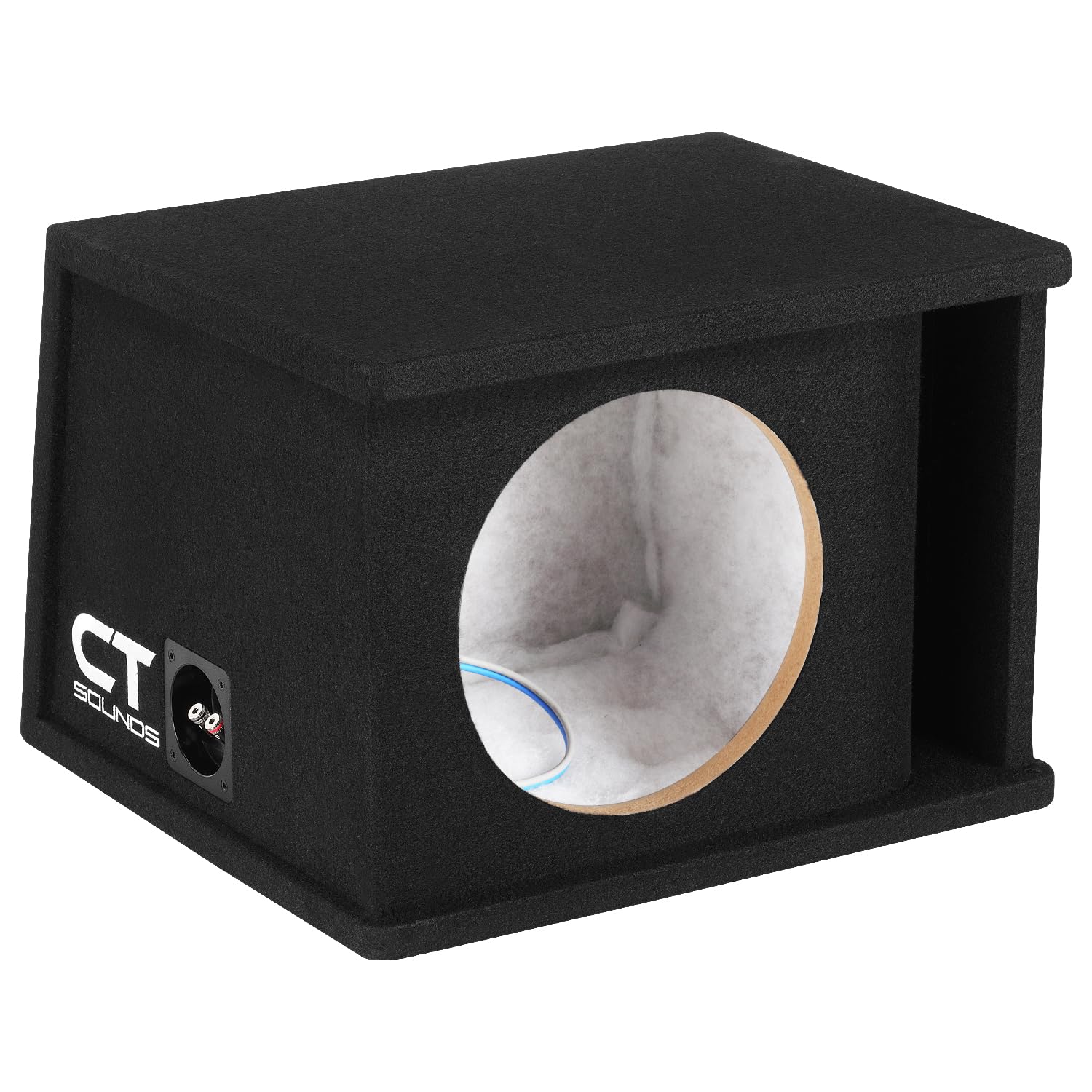
The only box here that publishes its port tuning — 37 Hz — and a kerf-style port to hit it.
Tuning frequency is the spec most listings leave out, and it decides which notes get the boost. This CT Sounds cabinet is tuned to 37 Hz, low enough to give kick drums and bass lines real weight, and its kerf-style port is a smoothly curved opening rather than a sharp-edged slot. That curve is designed to play deeper and more accurately, without the chuffing noise a rough port can add at high volume.
The construction is serious for the tier: 3/4-inch MDF, dado and miter joints for an air-tight, vibration-free cabinet, poly-filled internal walls to damp reflections, and pre-soldered 12 gauge speaker wire already in place. The cutout is 9.45 inches, slightly larger than the 9.125-inch hole on several other picks, so check your driver clears it. Build quality and sound quality lead owner feedback in equal measure, with a running theme of it hitting hard and clean with no fuss.
The one recurring question is size — some find the footprint decent, others call it too large for their space. Measure your trunk before you commit, because the ported performance justifies the room it takes.
Choose it for: a purpose-tuned ported box with pre-wired internals and a smoother port design.
skip it if: space is tight — confirm the footprint suits your trunk first.
Understanding the Specs
Sealed vs Ported (Vented)
A sealed box traps the air behind the subwoofer, which makes the cone spring back fast for tight, accurate bass — good for rock, jazz, and clean kick drums. A ported or vented box lets that air escape through a tuned opening, trading some precision for louder, deeper output. Sealed suits tight, accurate bass; ported suits louder, deeper output — pick the one your driver is built for. Check your subwoofer’s manual for the recommended enclosure type and volume before buying.
Airspace in Cubic Feet
Airspace is the internal volume of the cabinet, and it has to be close to what your subwoofer is designed for. Too little air and the bass sounds thin and strained. Too much and the driver can flop past its limits at high volume. When a listing publishes a figure like 0.9 or 1.4 cubic feet, that is your number to check against the driver’s spec sheet.
Mounting Depth and Cutout Diameter
Mounting depth is how far the box lets the magnet sit behind the mounting surface — deep-magnet subs need more of it. Cutout diameter is the size of the round hole the cone drops into. A 10-inch sub does not guarantee a particular hole size; boxes here range from 9.125 to 9.45 inches. Measure both against your driver before ordering.
MDF Thickness and the Seal
MDF is a dense engineered wood board used to build cabinets that resist flex under bass pressure. Walls that flex waste energy and add buzz. Thickness here runs 5/8 inch to 3/4 inch, with the thicker board offering more rigidity. Just as important is the seal — glued and nailed joints keep the cabinet airtight so bass stays clean instead of rattling.
FAQ
Will a 10-inch subwoofer fit any 10-inch speaker box?
How do I know if my sub needs a sealed or ported box?
Does more airspace in cubic feet mean louder bass?
Can I put a deep-magnet sub in a shallow truck box?
Will a 5/8-inch MDF box rattle less than a 3/4-inch one?
Do I need two subwoofer boxes or just one?
What does port tuning frequency like 37 Hz actually mean?
Do I need to add polyfill or wire to a subwoofer box?
Can a subwoofer box improve the bass without a new amplifier?
Will a vented box sound muddy compared to a sealed box?
Final Thoughts: The Verdict
For most people building around a 10-inch sub, the QPower dual sealed pair makes the strongest case — two matched 0.9-cubic-foot cabinets, a 5/8-inch MDF build, and terminal cups ready to wire. If you want one box and value accuracy, the New Single Car Black 10S delivers sealed sound that fits small spaces. And if the sub lives behind a regular-cab truck bench, grab the ASC truck box — the 5 3/4-inch mounting depth is the detail that makes it work where bigger boxes cannot go.
How We Picked
We do not accept paid placement. Every pick is matched to a real buyer and a real use-case; we do not hands-on test units.
Sources & Methodology
Specifications: manufacturer listings and product documentation. Review insights: verified customer reviews, as of November 2026. Pricing: not shown on this page (it changes often); check the current price via the retailer link.
As an Amazon Associate, Gadgets Feed earns from qualifying purchases. This does not affect which products we feature.