
Our readers keep the lights on and my morning glass full of iced black tea. As an Amazon Associate, I earn from qualifying purchases.
Specs are compiled from manufacturer listings and verified buyer reviews and can change over time — please confirm the key details on the product page before buying.
If you want bass that you feel in your chest, not just a hum you barely hear, the size and power of the subwoofer you pick is everything. A 10-inch subwoofer is the balance — small enough to fit in tight spots yet large enough to produce deep, chest-thumping low-end that transforms how your music sounds in the car. The hard part is cutting through the marketing hype to find which one actually delivers on its promises without blowing your budget or your trunk space.
I’m Min — the founder and writer behind Gadgets Feed. This guide is built by comparing the manufacturers’ published specifications and the patterns across verified customer reviews, so you get each pick’s real strengths and trade-offs instead of marketing spin.
After digging into the specs and real owner experiences, here is the straight story on choosing the best 10 inch subwoofer for deep bass and which models genuinely deliver on their promises.
Quick Picks
- Rockville Punisher 10D2 10″ Dual 2-Ohm — Best Overall
- Pioneer A-Series TS-A250D4 10″ 400W nominal — Top Performer
- Pioneer A-Series TS-A2500LS4 10″ 300W RMS — Space Saver
- Rockville W10K6D4 V2 10″ 500W RMS Dual 4-Ohm — Best Value
- KICKER Comp 10C4 10″ 4-Ohm Subwoofer — Reliable Classic
- Alpine SWT-S10 1200W Max (250W RMS) Single 10″ — Premium Balanced
How To Choose The Best 10 Inch Subwoofer For Deep Bass
Picking a 10-inch sub is about matching your amplifier’s power and your space constraints with the sub’s physical specs. Get these three things right and you will hear the difference.
RMS Power vs Peak Power
The RMS rating is the number you live with — it is the continuous power the sub can handle without distorting or overheating. Peak power is a marketing number that only lasts an instant. A sub rated for 500W RMS will outperform one rated for 2000W peak but only 300W RMS, because the RMS tells you what it can sustain all day. Match the sub’s RMS to about 75-100% of your amp’s RMS output for clean, reliable bass without clipping.
Voice Coil Configuration (Dual 2-ohm vs Dual 4-ohm)
The voice coil wiring matters because it determines the final impedance your amplifier “sees.” A dual 2-ohm sub can be wired to 1 ohm (for a powerful mono amp) or 4 ohms. A dual 4-ohm sub can be wired to 2 ohms or 8 ohms. Choose the configuration that lets your amp push its full rated power at the impedance you plan to use.
Mounting Depth and Enclosure Fit
The physical depth of the sub — from the mounting surface to the bottom of the magnet — decides what box it fits in. Standard subs need around 6 to 7 inches of depth, which works in most trunk-sized sealed or ported boxes. Shallow-mount subs need only 3 to 4 inches, which opens up under-seat spaces in trucks and small cars. Measure your available space before buying, or you risk buying a sub that simply will not fit.
Quick Comparison
| Model | Best For | RMS Power | Impedance | Mounting Depth | Amazon |
|---|---|---|---|---|---|
| Rockville Punisher 10D2 | Competition SPL | 1250W | Dual 2-ohm | 6.69 in | $149.95Amazon |
| Pioneer A-Series TS-A250D4 | Factory Upgrade | 400W | Dual 4-ohm | 5.875 in | $98.99Amazon |
| Pioneer A-Series TS-A2500LS4 | Tight Spaces | 300W | Single 4-ohm | Shallow | $112.98$169.99Amazon |
| Rockville W10K6D4 V2 | Value Bass | 500W | Dual 4-ohm | Moderate | $89.95Amazon |
| KICKER Comp 10C4 | Reliable Upgrade | 300W peak | 4-ohm | Standard | Amazon |
| Alpine SWT-S10 | Sealed Bass | 250W | Single 4-ohm | Standard | $229.95Amazon |
In‑Depth Reviews
1. Rockville Punisher 10D2 10″ Dual 2-Ohm Competition Subwoofer

A 1250-watt RMS beast built for ground-shaking SPL with a colossal 246 oz magnet.
Your ears and chest will tell you this sub means business. The Punisher packs a staggering 1250W RMS (5000W peak) — a full 2.5 times the continuous power of the Rockville W10K6D4 V2’s 500W RMS — making it the clear choice for serious bass output. The enormous magnet (246 oz) and a 3-inch 4-layer voice coil designed to handle up to 250 degrees C mean it can take punishment all day without losing composure.
One buyer put a single Punisher in a ported box tuned to 35 Hz on a 3000W amp and reported it “slaps hard.” The dual 2-ohm voice coils give you wiring flexibility (1 ohm, 2 ohms, or 4 ohms) to match nearly any competition-grade amplifier. The catch is the 6.69-inch mounting depth, which is noticeably deeper than the Pioneer TS-A250D4’s 5.875-inch depth, so you need a larger box — some buyers had to cut their enclosure to make it fit. If you have the space and a powerful amp, this is the sub that delivers genuinely chest-compressing low-end.
What makes it a monster
- Massive 1250W RMS handles huge amplifier power without distress
- Dual 2-ohm coils allow 1-ohm wiring for maximum amp output
- Buyers report it hits harder than some larger 12-inch subs
What to watch for
- Deep 6.69″ mounting depth requires a large enclosure
- One reviewer noted a burning smell on arrival (unit may have been defective)
- Overkill for factory amps — you need a serious external amplifier
Reach for this: If you are building a competition-level system or want the deepest, loudest possible bass from a 10-inch sub and have the amp and box space to support it.
Look elsewhere if: You need a shallow sub for under a seat or only have a modest 300-400W amp — this sub will demand far more power than it will ever give back.
2. Pioneer A-Series TS-A250D4 10″ 400W nominal Subwoofer

A factory-friendly upgrade delivering 400W of clean, tight bass — especially in Mustangs.
Ford Mustang owners with the B&O system know the stock sub leaves bass on the table. Multiple reviewers confirmed this Pioneer sub is a direct-fit upgrade for 2019 to 2024 Mustangs, calling it “100% better than stock” with notably tighter, louder bass and far less distortion. At 400W nominal power, it delivers 33% more continuous power than the shallow-mount TS-A2500LS4’s 300W rating, but with a moderate 5.875-inch depth that fits many standard boxes.
The dual 4-ohm voice coils give you wiring options (2 ohm, 4 ohm, or 8 ohm) to match most car amplifiers. The 74 dB sensitivity rating is modest — it will take more amplifier power to reach the same volume as a higher-sensitivity sub, so pair it with an amp that pushes at least 300-400W cleanly. Buyers consistently highlight the clean, punchy bass and easy installation. The glass-fiber and mica-reinforced cone keeps the sound detailed, not muddy.
Where it shines
- Proven drop-in upgrade for Ford Mustang B&O systems per multiple owners
- 400W RMS gives solid output without needing competition-level amps
- Flexible dual 4-ohm coils work with nearly any monoblock amp
Keep in mind
- 74 dB sensitivity means it needs more power to get loud vs higher-sensitivity subs
- Mounting depth (5.875 in) still needs a standard box, not under-seat
- Requires external amp — no passive bass boost included
Best suited for: Anyone upgrading a factory sub in a Mustang, truck, or sedan who wants tighter, louder bass without major fabrication or a huge amplifier.
Skip this if: You need max SPL for competitions or have very limited depth space — look at the shallow-mount Pioneer or the high-RMS Rockville Punisher instead.
3. Pioneer A-Series TS-A2500LS4 10″ 300W RMS Shallow-Mount Subwoofer

A shallow-mount sub that fits tight spots without sacrificing deep, punchy bass.
You do not have to sacrifice solid low-end just because your space is tight. This shallow-mount Pioneer delivers 300W RMS with a slim profile designed to fit behind or under seats, making it a rare find for truck owners and small-car builders. The single 4-ohm voice coil keeps wiring simple — just connect it directly to a compatible amplifier and go. At 85 dB sensitivity, it is notably more efficient than the standard TS-A250D4’s 74 dB, meaning it gets louder on less amplifier power, which is a real advantage with a smaller amp.
The catch, as owners mention, is that while it thumps well inside the car and handles 20 Hz playback without a problem, it lacks the external output to rattle walls. One reviewer described it as giving “nice deep bass” with a 1000W Memphis amp but noted it “won’t burst your windows out.” The foam surround feels durable according to owners, and multiple people confirm it handles sub-25 Hz content cleanly. It is the best choice if you absolutely need shallow depth but still want genuine bass extension.
Why it stands out
- Shallow depth fits in tight under-seat or behind-seat enclosures
- 85 dB sensitivity means louder bass with less amplifier power
- Customers note clean 20 Hz playback without distortion
Its compromise
- External output is mild — not for street bass competitions
- Single 4-ohm coil gives just one wiring option (no impedance flexibility)
- At 300W RMS, it will not keep up with a high-power competition system
Grab this if: You drive a truck, coupe, or any car where trunk space is precious and you still want real, deep bass you can feel inside the cabin.
Pass on this if: You want to win SPL shows or need maximum volume — the standard-depth Pioneer TS-A250D4 or Rockville Punisher will hit harder.
4. Rockville W10K6D4 V2 10″ 500W RMS Dual 4-Ohm Subwoofer

500W RMS bass that “shakes everything” at an entry-level price that punches way above its class.
If you want deep, chesty bass without emptying your wallet, this Rockville delivers. With a 500W RMS rating (2000W peak) and a fiber-reinforced non-pressed paper cone, it produces clean, low bass that reviewers point out “shakes everything” when crossed at 80 Hz. The dual 4-ohm coils give you wiring options (2 ohms or 8 ohms) to match budget mono amps. The vented pole piece helps keep it cool during long sessions, preventing power compression that would muddy the sound.
One owner upgraded from Kicker Comp Slims and reported this sub “hits very hard, low, and deep” in a 0.6 cubic foot sealed box on just 335 watts RMS — well under its full rating, meaning it still has headroom. The catch is the physical size: the large basket and moderate depth may require box modification and a spacer for cooling clearance, as one buyer mentioned. It has survived winters in a work truck according to another long-term owner, speaking to its durability. At this price, it is tough to top the low-end authority.
What makes it a steal
- 500W RMS delivers deep bass that shakes the vehicle on modest amp power
- Fiber-reinforced cone resists flex and distortion over time
- Shoppers say it survived years of rough use without failing
What to plan for
- Large basket may need box modification and a spacer for cooling
- Not competition-level — won’t win SPL battles against high-end subs
- Moderate depth limits thin under-seat enclosures
Best for: Budget-minded builders who want a sub that delivers deep, reliable bass without spending premium money — pair it with a 500-700W mono amp and you get a system that satisfies.
Not for: Anyone needing competition-level SPL or a shallow sub for a tight enclosure — step up to the Rockville Punisher or down to the Pioneer shallow-mount.
5. KICKER Comp 10C4 10″ 4-Ohm Subwoofer
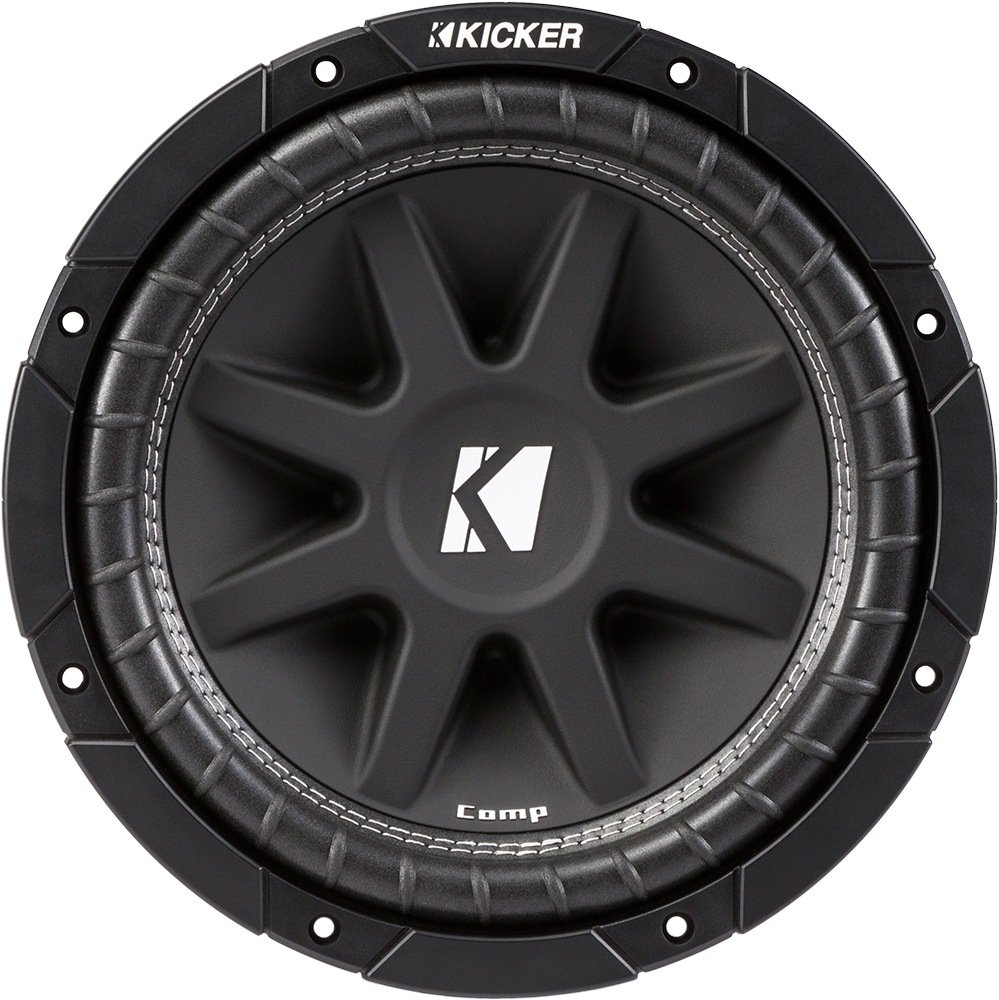
A legendary 10-inch that has earned its place as the go-to “thump” upgrade for a decade.
KICKER’s Comp series has been a staple in car audio for a reason. This 10-inch 4-ohm sub delivers a frequency response of 30-500 Hz and a sensitivity of 86.2 dB — meaning it gets loud easily with a modest amp. One owner reported they finally replaced their old KICKER Comps after about eight years and found the new ones “sound amazing, I mean they THUMP!” That kind of long-term loyalty is rare. The single 4-ohm voice coil keeps wiring simple: you connect it to a mono amp and just go.
The trade-off is the power handling: 300 watts peak, with no RMS rating listed, suggests you are looking at roughly 75-100W RMS of continuous power. That will not shake your rear-view mirror off, but it will fill your car with satisfying, clean bass that moves things around. One owner noted in a review the sub “won’t rattle the car but will move some things” and recommended a break-in period of about a week. It works great in truck boxes and pairs smoothly with a Class D Fosgate amp and a Kenwood head unit, as another buyer confirmed. If all you need is a reliable, classic bass upgrade, the Comp delivers.
Why people keep buying it
- Proven long-term durability — multiple buyers report 8+ years of service
- 86.2 dB sensitivity means it plays loud on a small, cheap amp
- Simple 4-ohm SVC wiring is plug-and-play for beginners
Where it falls short
- 300W peak = roughly 75-100W RMS, which is entry-level power
- No deep sub-30 Hz extension compared to the Rockville or Alpine options
- Not designed for serious SPL or competition use
Choose this when: You want a no-fuss, proven upgrade for a basic system — it pairs perfectly with a 100-200W amp in a sealed truck box for daily driving.
Look past it if: You need genuine deep, sub-30 Hz rumble or plan to run a 500W+ amp — the Rockville W10K6D4 V2 or Pioneer TS-A250D4 will give you the low-end extension you want.
6. Alpine SWT-S10 1200W Max (250W RMS) Single 10″ Subwoofer

A clean, balanced sub that fills a Tacoma or sedan with smooth bass — no rattle, no distortion.
If your goal is musical, non-fatiguing bass rather than maximum SPL, Alpine brings refinement. At 250W RMS (1200W Max), this sub is designed for modest amps and sealed enclosures, producing what buyers describe as “smooth, loud bass” that is plenty for inside the car without rattling the neighborhood. One Tacoma owner paired it with Rockford Fosgate door speakers and Kicker tweeters, calling the overall sound “great now.” The built-in grille adds a nice touch of protection without looking aftermarket.
The main catch: this is not a sealed subwoofer despite the product title. A buyer noted there is a vent hole, so it is a ported design — and plugging it did not sound good. The bass is deep and loud but “lacks deep kick drum” according to one review, with rap fans likely preferring a 12-inch. It excels with techno and country music where balanced, controlled low-end matters more than gut-punching subsonic pressure. Pair it with a Kicker 400W mono amp and set the gain correctly, as one owner advised, and you get a clean, long-lasting system.
What makes it classy
- Clean, balanced sound that does not overpower the rest of the system
- Built-in grille protects the cone from cargo and debris
- Buyers praise it as a great upgrade for Tacomas and small trucks
Where it disappoints
- Not a sealed sub — has a vent port, which some buyers found misleading
- 250W RMS limits output compared to the Rockville or Pioneer options
- Rap fans may want a 12-inch for deeper kick drum extension
Ideal for: Audiophiles who want smooth, clean bass that blends with factory speakers and stays inside the car — not for flexing at stoplights.
Skip this if: You demand competition-level SPL or need deep, window-rattling sub-30 Hz extension — go for the Rockville Punisher or a 12-inch option instead.
Understanding the Specs
RMS Power — The Number That Matters
RMS (Root Mean Square) tells you the continuous power a subwoofer can handle without overheating or distorting. A sub rated at 500W RMS will play cleanly at that level all day. Peak power (like 2000W) is a momentary burst rating — it sounds impressive but you never actually run a sub at peak. Always match the RMS of your amplifier to the RMS of the sub. A good rule is to give the sub 75-100% of its RMS rating from the amp for the cleanest, loudest bass.
Voice Coils and Wiring
The voice coil is the electromagnet inside the sub that moves the cone. Dual voice coil (DVC) subs give you wiring flexibility: you can wire them in series (higher impedance) or parallel (lower impedance) to match your amplifier’s stable load range. Dual 2-ohm coils can be wired to 1 ohm or 4 ohms; dual 4-ohm coils can be wired to 2 ohms or 8 ohms. Single voice coil (SVC) subs offer only one impedance. Lower impedance (1 or 2 ohms) lets your amplifier deliver more power, but your amp must be rated stable at that load.
Mounting Depth and Enclosure Fit
Mounting depth is the distance from the mounting surface (the top of the box where the sub bolts in) to the bottom of the magnet. Standard 10-inch subs usually need 5 to 7 inches of depth. Shallow-mount subs need only 3 to 4 inches, making them ideal for under-seat enclosures in trucks and small cars. Always measure your available box depth before buying — a sub that does not physically fit is a waste of money regardless of how powerful it is on paper.
Sensitivity (dB) — How Efficiently It Gets Loud
Sensitivity measures how much sound a subwoofer produces from a given amount of power, measured in decibels (dB). A sub with 86 dB sensitivity will be noticeably louder than one with 74 dB when both receive the same 100W from the amp. Higher sensitivity (85 dB or above) means you can use a smaller, cheaper amp and still get satisfying volume. Lower sensitivity (below 80 dB) demands a more powerful amplifier to reach the same loudness, but can often handle higher power without distortion.
FAQ
What is the difference between RMS and peak power on a 10-inch subwoofer?
Will a 10-inch subwoofer fit under the seat of my truck?
What size amplifier do I need for a 10-inch subwoofer?
Should I use a sealed or ported enclosure for deep bass?
Can I replace my factory subwoofer with any 10-inch aftermarket sub?
What does dual 2-ohm vs dual 4-ohm mean for my setup?
How long does a 10-inch car subwoofer typically last?
Is a higher sensitivity rating always better for a subwoofer?
Will a 10-inch subwoofer give me the same deep bass as a 12-inch?
Do I need to break in a new subwoofer?
Final Thoughts: The Verdict
For most people, the winner for a 10 inch subwoofer for deep bass is the Rockville Punisher 10D2 because its 1250W RMS rating is in a different league, delivering competition-level SPL with a monster magnet and bulletproof build. If you want an easy factory upgrade in a Mustang or sedan, grab the Pioneer A-Series TS-A250D4. And for tight spaces like under a truck seat, the shallow-mount Pioneer TS-A2500LS4 delivers deep bass you can actually feel without eating up your cabin.
How We Picked
We do not accept paid placement. Every pick is matched to a real buyer and a real use-case; we do not hands-on test units.
Sources & Methodology
Specifications: manufacturer listings and product documentation. Review insights: verified customer reviews, as of July 2026. Pricing: not shown on this page (it changes often); check the current price via the retailer link.
As an Amazon Associate, Gadgets Feed earns from qualifying purchases. This does not affect which products we feature.
Related Guides
Product prices and availability are accurate as of the date/time indicated and are subject to change. Any price and availability information displayed on Amazon at the time of purchase will apply to the purchase of this product. As an Amazon Associate I earn from qualifying purchases.
CERTAIN CONTENT THAT APPEARS ON THIS SITE COMES FROM AMAZON. THIS CONTENT IS PROVIDED "AS IS" AND IS SUBJECT TO CHANGE OR REMOVAL AT ANY TIME.
Amazon and the Amazon logo are trademarks of Amazon.com, Inc. or its affiliates.