
Our readers keep the lights on and my morning glass full of iced black tea. As an Amazon Associate, I earn from qualifying purchases.
Specs are compiled from manufacturer listings and verified buyer reviews and can change over time — please confirm the key details on the product page before buying.
A 10-meter radio helps you reach farther than a standard CB, but you have to choose between modes like AM, FM, and SSB (Single Sideband—a mode that concentrates power into one signal for double the range), and power levels from 40W to 80W PEP (Peak Envelope Power—the maximum power your voice hits during speech). The real question is which one gives you the clearest receive, the most versatile modes, and the power you actually need without paying for features you will never use.
I’m Min — the founder and writer behind Gadgets Feed. This guide is built by comparing the manufacturers’ published specifications and the patterns across verified customer reviews, so you get each pick’s real strengths and trade-offs instead of marketing spin.
You may be a trucker needing reliable highway chatter, a base station operator chasing DX (long-distance) contacts, or just starting out. This breakdown of the best 10 meter cb radio options on the market gives you a clear path to the right purchase.
Quick Picks
- Stryker SR-447HPC2 — Heavy-Duty Performer
- Radioddity QT80 — Maximum Power
- AnyTone AT-5555N II — Versatile SSB Choice
- Anytone AT-6666PRO — High Power SSB Rig
- Radioddity QT60 Pro — Quietest Receiver
- Stryker SR-94HPC — Ultra-Compact Mobile
- Retevis Ailunce HS4 — Feature-Rich SSB Base
- Radioddity QT40 — Best Value SSB
How To Choose The Best 10 Meter CB Radio
A 10 meter radio operates in the 28.000 to 29.700 MHz range. It is a step up from a standard CB radio, offering more power and the ability to use Single Sideband (SSB) for much longer range. Here is what matters most when picking one.
Power Output (Watts PEP)
Power is measured in watts PEP (Peak Envelope Power). This is the real measure of your radio’s “swing” when you talk. A radio with 40W PEP is fine for local chats and moderate skip, while an 80W PEP model can push a signal much farther during good propagation conditions. Do not confuse this with “dead key” watts, which is the constant carrier power when you are not speaking.
Modes: AM, FM, and SSB
AM is the standard mode used by most CB radios — it is simple but noisy. FM offers clearer audio but is less common on 10 meters. SSB (Single Sideband) concentrates all power into one signal, roughly doubling the effective range of AM at the same wattage for long-distance (DX) contacts. If you want to talk across the country, get an SSB radio.
Number of Channels and Programmable Bands
Standard 10 meter radios come with 40 channels, but many modern units can be programmed or modified to cover 200, 360, or even more channels. This allows you to access the 11-meter CB band, 12 meters, or 10-meter repeater frequencies. Some models let you switch bands with a few button presses, which adds a lot of flexibility.
Noise Reduction and Filters
If you are installing the radio in a truck or vehicle, engine noise and alternator whine can ruin your receive audio. Look for features like NRC (Noise Reduction Control), ANL (Automatic Noise Limiter), and NB (Noise Blanker). These circuits filter out background hiss and engine noise, letting you hear weak signals clearly. DSP (Digital Signal Processing) is even better if you can get it.
Quick Comparison
| Model | Best For | Power (PEP) | Channels | Weight | Amazon |
|---|---|---|---|---|---|
| Stryker SR-447HPC2 | Heavy-Duty Truck Use | 55+ Watts | 40 | 4.4 lbs | $297.79Amazon |
| Radioddity QT80 | Maximum Power | 80W | 23 | 2.8 lbs | $299.99Amazon |
| AnyTone AT-5555N II | Versatile SSB | 60W | 40 | 3.3 lbs | $246.05Amazon |
| Anytone AT-6666PRO | High Power SSB | 80W (PEP) | 40 | 2.8 lbs | $299.00Amazon |
| Radioddity QT60 Pro | Quiet Receiver | 60W | 200 | 3.3 lbs | $239.99$259.00PrimeAmazon |
| Stryker SR-94HPC | Ultra-Compact Mobile | 45+ Watts | 40 | 2.5 lbs | $146.70Amazon |
| Retevis Ailunce HS4 | Feature-Rich SSB Base | 38-40W | 360 | 3.3 lbs | $199.99$229.99Amazon |
| Radioddity QT40 | Best Value SSB | 40W | 40 | 3.3 lbs | $169.99$199.99PrimeAmazon |
In‑Depth Reviews
1. Stryker SR-447HPC2

The tank of the trucker world, built to outlast the competition for years of daily abuse.
This radio is designed to survive the punishing environment of a semi-truck. It puts out 55+ watts PEP using heavy-duty MOSFET finals — a lot of punch for such a compact chassis that fits into a standard DIN slot. The “up-armored” receiver and advanced adjacent channel rejection keep your audio clear even when the driver next to you is blasting a loud signal. Buyers report that after three years of hard use, one owner reports, “Sounds good going out and the receiving sound is great too,” adding that it still works like new.
It lacks SSB, so if you are chasing DX contacts, look elsewhere. But for pure AM/FM highway work with a loud, clear receiver, this is as good as it gets. The 7-color LED faceplate and dimmer let you match the look of your cab, and the variable talkback and digital echo controls give you fine control over your audio.
What Makes It a Workhorse
- 55+ watts PEP from a durable chassis that outlasts other brands in trucks
- Compact size fits a standard radio slot without modification
- Outstanding receive quality — one reviewer says it beats a Galaxy 88
The Only Real Trade-Offs
- No SSB mode, so long-range skip is limited compared to SSB radios
- May need a shop tune-out-of-the-box for peak performance
Ideal for the long-haul driver: If you live in a truck and need a radio that literally fits in the factory slot and just works, this is the one.
A caveat for the DX enthusiast: If you want SSB for global contacts, you will need to pick a different model.
2. Radioddity QT80

The power king that pushes 80 watts, giving you a serious edge on long-range contacts.
If raw power is your priority, the QT80 delivers the highest peak wattage in this roundup at 80W PEP. That extra headroom over the typical 40W or 60W radios means your signal gets out with more authority, especially during weak propagation. It supports SSB (USB/LSB), AM, FM, and PA modes, and comes with adjustable TX & RX noise reduction so you can tailor the audio to your environment — a real benefit in a noisy vehicle.
A neat trick is that you can modify it for 12 and 15 meters in about five minutes. “Easy open up for 10-15m,” one reviewer confirms. The 7-color LCD display lets you pick a hue that matches your setup, and the automatic squelch control (ASQ) filters out background chatter. A key limitation: it only has 23 channels from the start, so you might need the software to expand coverage.
Why It Stands Out
- Highest power output at 80W PEP for top-tier signal reach
- Easy frequency expansion to 12m and 15m bands
- Excellent noise reduction on both transmit and receive
What to Consider
- Limited to 23 channels stock (programming required for more)
- Programming software not natively available for Linux users
Perfect for the power-hungry operator: If you want every watt you can get for DX and are comfortable with some programming, this is your pick.
Not the simplest setup: If you want a turnkey radio, the limited stock channels might frustrate you.
3. AnyTone AT-5555N II

The modern classic that combines incredible receive sensitivity with a quiet, stable SSB signal.
This is an upgraded version of the popular AT-5555N, adding CTCSS/DCS tone encoding and NRC (Noise Reduction Control) on both TX and RX. It delivers 60W PEP on AM and SSB, and 45W on FM, all in a solid, familiar chassis that many say feels like the legendary President HR-2510. The receive is notably quiet and sensitive — one reviewer says it is “the best radio since the President HR-2510,” praising its precise S-meter and superb audio.
The noise blanker on this unit reportedly outperforms even a Yaesu FT1200, which is impressive for a radio in this price range. It includes 40 channels, 7 weather channels, HI-CUT, dual-watch, and SWR protection. A minor weak point noted by reviewers is the RJ-45 mic jack, which can be a bit cheap, but overall the build quality is excellent. It uses a similar board to the Stryker 955, so performance is top-tier.
Strength at the Core
- Outstanding receive sensitivity with a very quiet noise floor on SSB
- Noise blanker that beats much more expensive ham rigs
- Excellent transmit audio with the stock microphone
Small Quirks
- RJ-45 mic jack feels fragile; amplified mics need an adapter
- Expanding to 10-12m band voids the warranty
The clear winner for the SSB enthusiast: If you prize a quiet receiver and clean audio for long listening sessions, this is your radio.
A minor caution: The mic jack is the only thing that feels less premium — treat it gently.
4. Anytone AT-6666PRO

A feature-packed powerhouse that even bested a President McKinley in an owner’s shack.
This updated version of the popular AT-6666 cranks out 80W PEP on AM and SSB, and 50W on FM, making it among the most powerful compact radios you can buy. It supports CW, FM, AM, USB, LSB, and PA modes, and includes NRC, ANL, NB, HI-Cut, RF Gain, and squelch controls to help you dial in the perfect receive audio. One reviewer was so impressed they said, “Got rid of my President McKinley and will buy Anytone from now on!”
The radio is very stable on sideband, with great frequency stability, and the power output exceeds its advertised specs according to some owners. A data cable can also open up 15, 12, and 11-meter bands, making it incredibly flexible. It has 40 channels per band, a generous LCD with 7-color options, and an EMG call function.
Why It Shines
- 80W PEP output that actually exceeds its own specs
- Versatile coverage: open up 15, 12, and 11-meter bands
- Stable SSB with great audio reports from contacts
One Thing to Note
- The CW mode is accessed via the mic PTT — not a dedicated keyer jack
- Requires a power supply that supports over 15A drain
Top choice for the multi-band operator: If you want the most flexible band coverage and top-shelf power in a small package, buy this.
Not for CW purists: If you need a dedicated key input, you will have to do some wiring.
5. Radioddity QT60 Pro

The quietest receiver in the class, letting faint signals cut through the static like a whisper.
If you are tired of background hiss and loud squelch crashes, the QT60 Pro is designed to fix that. Its adjustable digital noise reduction (with five levels) is so effective that one reviewer calls it “the quietest receiver of all exports,” noting it outperforms older radios like the Cobra 148 and Uniden Grant XL on both AM and SSB. It delivers 60W high power and covers 200 channels, giving you plenty of room for 10m, 11m, and 12m operation.
It includes CTCSS/DCS, ASQ (Automatic Squelch Control), NOA weather alert, and a large LCD screen that is easy to read while driving. Reviewers report “clean, punchy audio” and praise the noise blanker. One noted a loose channel selector knob, but otherwise, the build quality is solid. It uses the same board as the Anytone Quad5N2, so you are getting proven internals.
Quiet, Calm, Effective
- Industry-leading noise reduction makes weak signals audible
- 200 channels offer massive flexibility across multiple bands
- Excellent audio clarity on both transmit and receive
Minor Gripes
- Channel selector knob can feel a bit loose
- Some users wish for a different default LCD color
Made for the listener: If scanning for weak, distant signals is your thing, this radio’s receiver is your best friend.
One small annoyance: The loose knob might bother you, but it doesn’t affect performance.
6. Stryker SR-94HPC
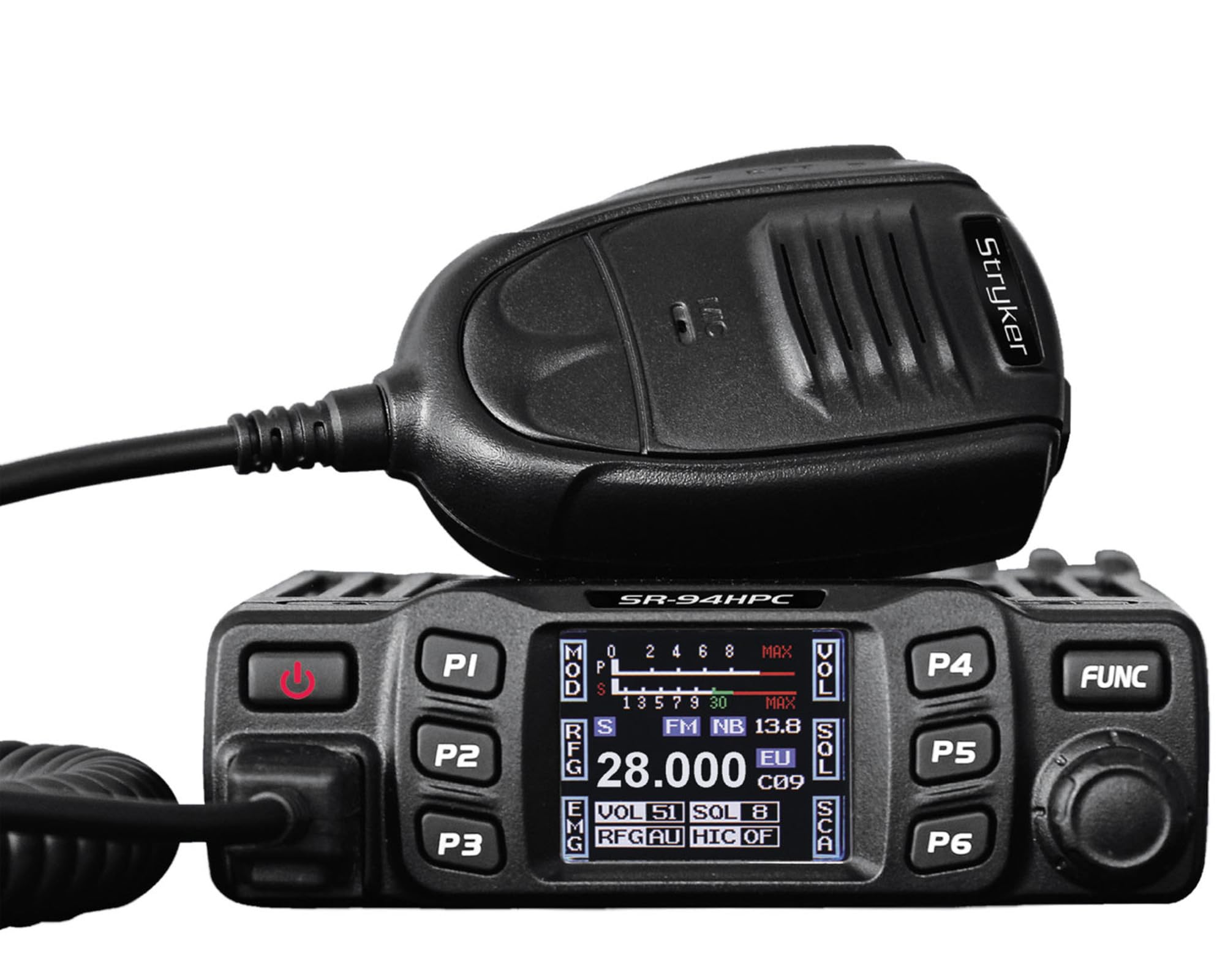
The smallest powerhouse that squeezes big DX punch into the tightest dashboard spots.
Measuring only 5.8 inches long by 1.4 inches tall, the SR-94HPC is the slimmest full-powered radio here. Despite its tiny size, it uses three FQP13N10 final transistors to generate 45+ watts PEP — the kind of power usually reserved for full-size DX chassis. It even has a wrap-around cast aluminum heat sink to keep it cool when you are transmitting at those power levels for extended periods.
One reviewer noted, “I just talked over 2125km’s on CB 11m AM,” which is extraordinary for a radio this compact. It features a crisp full-color TFT display that you can customize to show frequency, voltage, S-units, and more. That screen is “sharper and easier to read while driving,” according to the manufacturer. It lacks SSB, so it is purely AM/FM, but for a mobile radio that disappears into the center console, it is tough to top.
What Makes It Tiny but Mighty
- Ultra-slim design (1.4″ tall) fits anywhere in the vehicle
- 45+ watts PEP from a chassis that usually offers much less
- Excellent heat management for long transmissions
What It Sacrifices
- No SSB mode — AM/FM only
- Display can occasionally glitch to white, requiring a power cycle
The ultimate space-saver: If your dashboard has zero room but you refuse to compromise on power, this is your only choice.
SSB seekers look away: If you need sideband for long-range contacts, this AM/FM radio won’t cut it.
7. Retevis Ailunce HS4
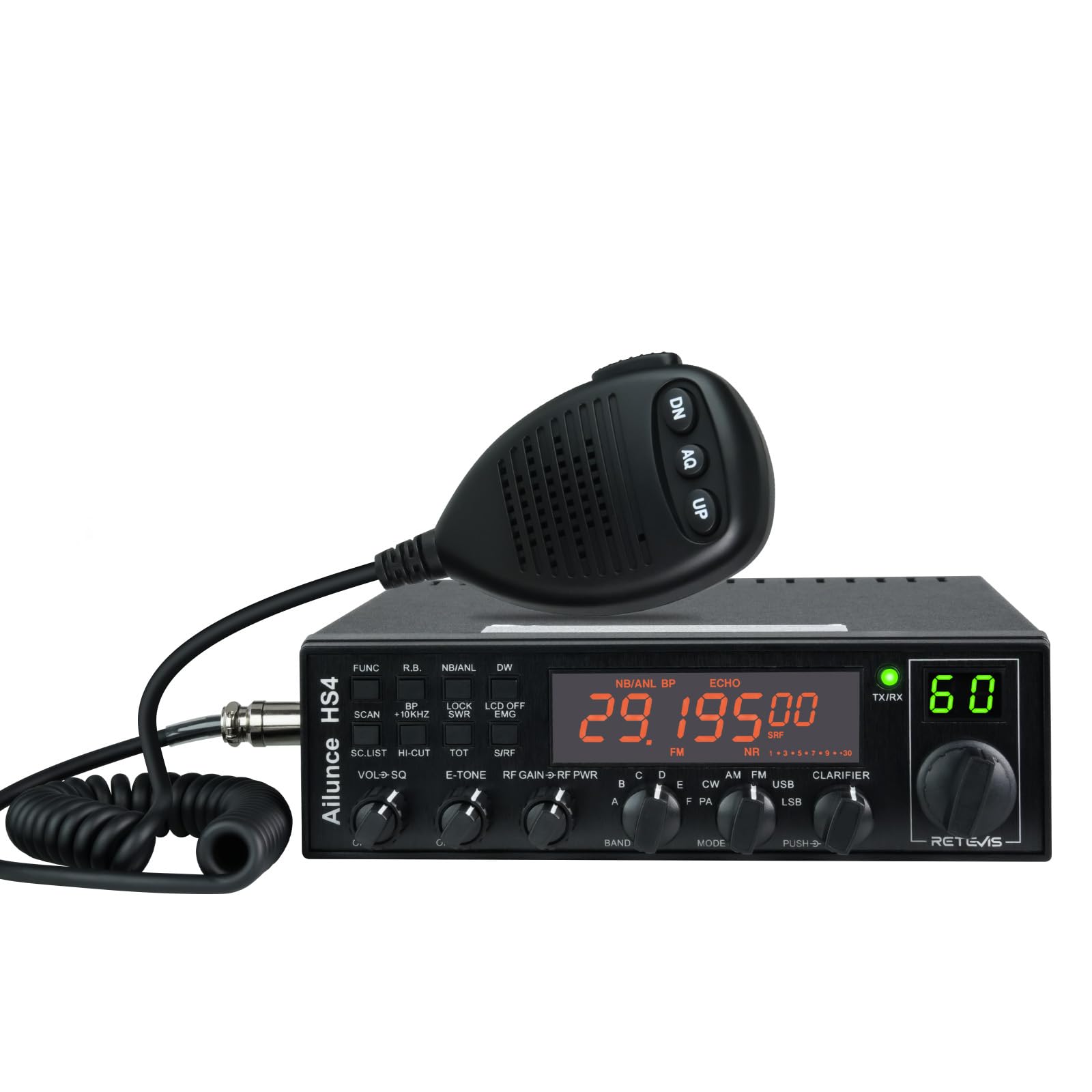
The feature beast that offers 360 channels and six modes for the ultimate shack operator.
With 360 channels and six modes (PA/AM/FM/USB/LSB/CW), the HS4 is the most feature-dense radio in this lineup at its price point. It supports CW (for those who connect an external Morse code key), SSB for DX work, and even a PA mode for public address. A large, backlit LCD display shows you all the information clearly, and the radio supports dual-watch (monitoring two frequencies simultaneously), which is handy for base station contesting.
Owners mention it is “identical to Anytone 5555plus/LT-5558A at a lower price,” adding that “stock output 38-40W with stable 13.8-14.5V.” The DSP filters keep the receiver cleaner than the classic Cobra 148GTL. It includes a built-in cooling fan, SWR and voltage protection, and VOX hands-free operation. The only trade-off is its larger size — at 11 inches deep, it needs a fair bit of table space for a mobile radio.
Why the Shack Loves It
- 360 channels and six modes give you maximum operating flexibility
- Includes CW mode, a rarity for radios at this level
- Clean, stable receiver with effective DSP noise filtering
The Space Factor
- Larger chassis (11″ deep) is less ideal for cramped vehicles
- Stock microphone is okay but benefits from an upgrade for better audio
A dream for the home station: If you want a Swiss Army knife of modes and channels for your desk, the HS4 is class-leading at this price.
Consider the footprint: If you are mounting this in a compact car, measure twice; it is a big radio.
8. Radioddity QT40

The retro-styled bargain that packs SSB, noise reduction, and surprising range into one tidy box.
If you want SSB capability without spending a fortune, the QT40 is the strongest contender. It delivers 40W PEP, includes TX and RX digital noise reduction, and supports AM, FM, SSB, and PA modes. The classic retro design (silver & black) looks sharp on any dashboard or desk. One reviewer achieved “20-mile AM and 38-mile SSB range” with a proper install, which is a massive gap in performance — 38 miles on SSB versus 20 on AM.
It comes with a USB programming cable, supports CTCSS/DCS for secure channels, and has a useful NOAA weather alert feature. The receiver is very sensitive and the stock microphone sounds great. The 40-channel count is standard, but an easy modification open up the 11-meter CB band in seconds. At its price point, you are getting a feature set normally found on radios costing significantly more.
High-Value Features
- SSB, AM, and FM in one retro-styled package at a budget-friendly price
- Excellent range: 38-mile SSB capability with a good antenna setup
- Includes USB programming cable and full noise reduction suite
The Fine Print
- Not recommended for pure HAM use (no frequency readout)
- Some users find the up/down channel buttons on the mic easy to bump
Perfect entry for the new enthusiast: If you want SSB and solid features without a steep investment, start here.
A minor annoyance: The mic buttons can accidentally change channels if you are not careful.
Understanding the Specs
PEP vs Dead Key Power
When you see “60W PEP” (Peak Envelope Power), that is the maximum power the radio swings to when you talk — it is not a constant output. The “dead key” is the carrier wave it sends when you key the mic but don’t speak. A radio with a 0.5W dead key that swings to 40W is typically better than one with a 10W dead key. The PEP number is what matters for actual communication range.
SSB (Single Sideband) and You
SSB is what separates a good 10 meter radio from a great one. Standard AM mode wastes half its power on a carrier wave and the other half on a duplicate sideband. SSB cuts out both, focusing all 40 or 60 watts into one slim signal. This gives you about double the effective range and makes weak, distant stations sound clearer. If you want to talk 20+ miles on a regular basis, SSB is not optional — it is essential.
What “Channels” Actually Means
Most 10 meter export radios come with 40 channels on the 10-meter band (28.000-29.700 MHz). But many are designed with multiple bands (A/B/C/D/etc.) that let you switch to the 11-meter CB band, 12 meters, or even 15 meters. A radio with “200 channels” may be covering three or four bands. The key is to check if the radio can be easily modified to your preferred band (like 11m CB) or if it requires a programming cable and software.
Noise Reduction (NRC, ANL, NB)
These three acronyms describe different noise-canceling tools. ANL (Automatic Noise Limiter) knocks down steady background hiss like alternator whine. NB (Noise Blanker) targets sharp impulse noise like ignition spikes from spark plugs. NRC (Noise Reduction Control) is a digital filter that you can usually set to a level (1-5). In a truck, the NB and ANL are almost mandatory. At a base station with a quiet power supply, NRC is the most useful.
FAQ
Do I need an FCC license to use a 10 meter CB radio?
What is the difference between AM, FM, and SSB on a 10 meter radio?
Will a 10 meter radio fit in my truck’s dashboard slot?
How do I modify a 10 meter radio to work on CB (11 meter) frequencies?
What is a good antenna setup for a 10 meter mobile radio?
How far can I talk on a 10 meter radio without an amplifier?
What is SWR and why does my radio need SWR protection?
Can I use a 10 meter radio as a base station at home?
What does CT CSS/DCS mean on a 10 meter radio?
Final Thoughts: The Verdict
The best 10 meter cb radio for most buyers is the AnyTone AT-5555N II because it offers a quiet, sensitive receiver, clean SSB audio, and a sturdy 60W PEP output without the bulk of larger radios. If you want raw 80W PEP power for maximum reach, grab the Radioddity QT80. And for the trucker who needs a radio that survives the road, the Stryker SR-447HPC2 delivers class-leading durability and receive clarity at 55+ watts PEP.
How We Picked
We do not accept paid placement. Every pick is matched to a real buyer and a real use-case; we do not hands-on test units.
Sources & Methodology
Specifications: manufacturer listings and product documentation. Review insights: verified customer reviews, as of July 2026. Pricing: not shown on this page (it changes often); check the current price via the retailer link.
As an Amazon Associate, Gadgets Feed earns from qualifying purchases. This does not affect which products we feature.
Product prices and availability are accurate as of the date/time indicated and are subject to change. Any price and availability information displayed on Amazon at the time of purchase will apply to the purchase of this product. As an Amazon Associate I earn from qualifying purchases.
CERTAIN CONTENT THAT APPEARS ON THIS SITE COMES FROM AMAZON. THIS CONTENT IS PROVIDED "AS IS" AND IS SUBJECT TO CHANGE OR REMOVAL AT ANY TIME.
Amazon and the Amazon logo are trademarks of Amazon.com, Inc. or its affiliates.