
Our readers keep the lights on and my morning glass full of iced black tea. As an Amazon Associate, I earn from qualifying purchases.
Specs are compiled from manufacturer listings and verified buyer reviews and can change over time — please confirm the key details on the product page before buying.
You want accurate cuts without surrendering your whole garage, and a 10-inch miter saw delivers that. The biggest myth is that you need a massive 12-inch slider for serious trim, crown molding, or framing. A good 10-inch saw handles 90% of that work, takes up far less room, and costs less. Here are the best models across every price tier, from a budget-friendly first saw to a pro-grade machine, so you can match the tool to the work you actually do.
I’m Min — the founder and writer behind Gadgets Feed. This guide is built by comparing the manufacturers’ published specifications and the patterns across verified customer reviews, so you get each pick’s real strengths and trade-offs instead of marketing spin.
To narrow the field, we focused on models that deliver real cutting power, smooth operation, and honest value for your shop. Keep reading to find the 10 miter saws worth your money this year.
Our Picks at a Glance

How To Choose The Best 10 Miter Saws
Picking the right miter saw depends on three things: what you will cut, where you will store it, and how often you will move it. A trim carpenter needs a different machine than a weekend DIYer, and the specs that matter to one are irrelevant to the other. Here is what to actually look for.
Sliding vs. Non-Sliding: The Space vs. Width Trade
The biggest decision you will make is if you need the sliding arm. A non-sliding saw is lighter, cheaper, and more accurate for small pieces, but it limits how wide a board you can cut. A sliding saw uses rails to pull the blade through the wood, letting you cut wider boards without a bigger blade. The trade-off is that sliding saws take up more depth in your shop — unless you get one with an articulating arm, which folds the rails to save space.
Power and Speed: Amps and No-Load RPM
Nearly every serious 10-inch saw on the market runs a 15-amp motor, so that number alone will not separate the good from the great. What matters more is the no-load speed, measured in RPM. A higher RPM means the blade spins faster, which generally means smoother cuts through hardwoods and less tear-out. You will see numbers between 4,600 and 5,500 RPM in this category, and the difference is felt most when cutting dense oak or hickory.
Bevel and Miter: Understanding the Range
The miter angle is the left-to-right swing of the blade for angled cuts like picture frames. The bevel is the tilt of the blade for angled cuts like baseboards. A single-bevel saw tilts only one way, usually left, which is fine for most work. A dual-bevel saw tilts both ways, which is a huge time-saver when cutting crown molding because you do not have to flip the board. If you only cut trim occasionally, single bevel is plenty; if you cut crown regularly, dual bevel is worth the upgrade.
Quick Comparison
| Model | Best For | Motor Power | No-Load Speed | Weight | Amazon |
|---|---|---|---|---|---|
| BOSCH CM10GD★ Best Overall | Pro-level precision in small shops | 15 Amp | 4,800 RPM | 64 lbs | Amazon |
| Metabo HPT C10FCG2Best Value | First-time buyers and light DIY | 15 Amp | 5,000 RPM | 24.2 lbs | Amazon |
| Genesis GMS1015LCBudget Champion | Home projects on a budget | 15 Amp | — | 16 oz | Amazon |
| DOVAMAN DMS01A | Multi-material cutting versatility | 15 Amp | 5,000 RPM | 17 kg | Amazon |
| MarvTool JS-1013C4 | Portable jobsite work | 15 Amp | 5,000 RPM | 25.6 lbs | Amazon |
| Evolution R255SMS+ | Cutting steel and metal | 15 Amp | — | 41.8 lbs | Amazon |
| Delta S26-263L | Mid-range trusted-brand value | 15 Amp | 5,500 RPM | 29.5 lbs | Amazon |
| Makita LS1040 | Accurate trim work on the go | 15 Amp | 4,600 RPM | 27 lbs | Amazon |
| Makita LS1019L | The best overall premium performer | 15 Amp | — | 57.9 lbs | Amazon |
In‑Depth Reviews
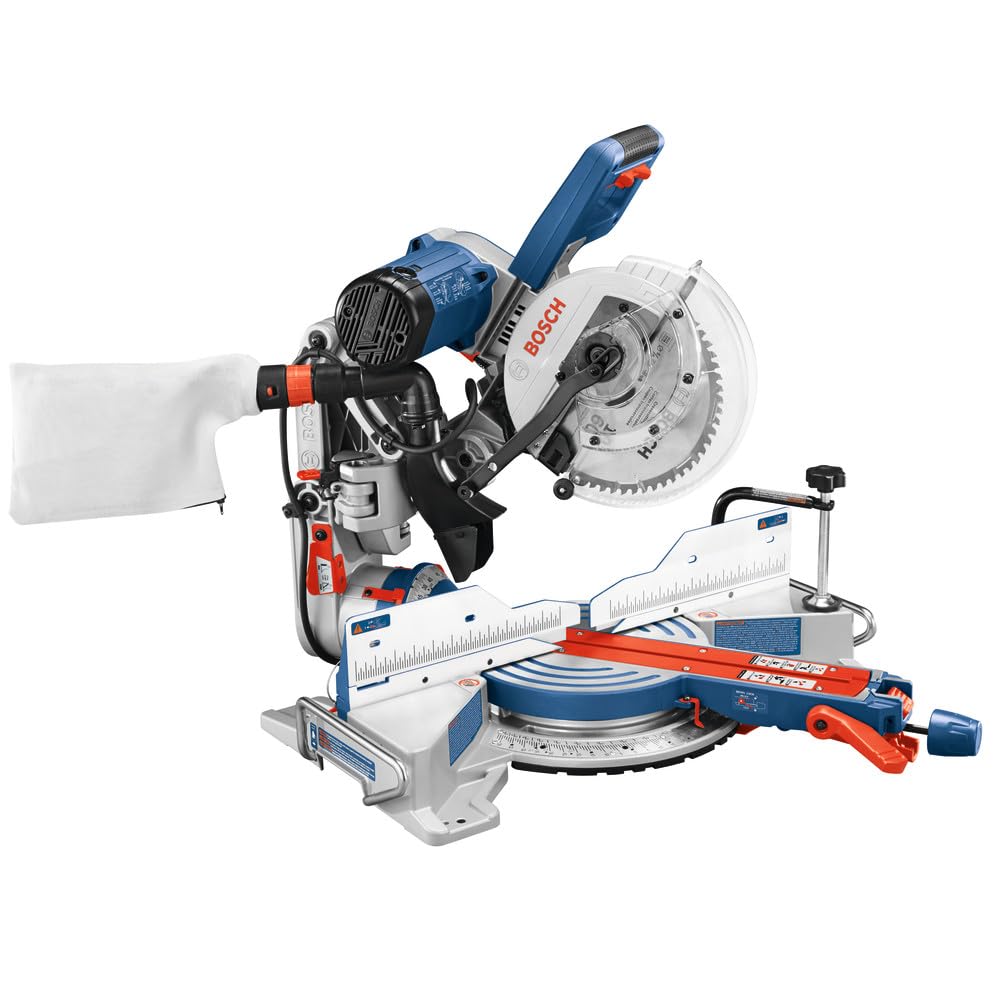
1. BOSCH 15.0 Amp CM10GD 10 In. Dual-Bevel Glide Miter Saw for Woodworking
Our pick — over 4.5★ from 650+ verified ratings; the strongest balance of quality and price.
The big-saw champion that folds its rails to fit your small shop.
You get the wide cutting range of a sliding saw without needing deep bench space, thanks to the Axial-Glide System (articulated hinge arms that cut the saw’s front-to-back footprint by up to 10 inches compared to slide saws with similar capacity). That is why this tool wins over owners with tight garages. Despite the compact footprint, the 15 Amp motor spins at 4,800 no-load RPM (revolutions per minute, how fast the blade turns), and buyers who install flooring for a living describe excellent precision and clean cuts on dense oak and hickory.
This saw cuts a 12-inch wide board horizontally, a 5-1/2 inch vertical baseboard against the fence, and a 6-inch crown cut nested at 45 degrees. The dual bevel tilts 47 degrees left and right with detents at 0, 33.9, and 45 degrees for the most common angles, so you rarely have to flip your workpiece for crown molding. The tall sliding fences stand 4-1/4 inches high, which gives you real support on tall baseboard and increases the crown capacity you can attempt. All the bevel and miter adjustments sit up front, so you never have to reach around behind the saw to change a setting.
The catch is an honest one: at 64 pounds, this is a heavy machine, and it has no carry handles, which makes moving it awkward between job sites. The stock dust bag is described as mediocre, and there is no laser guide built in — buyers who want one add an aftermarket laser. That said, Owners consistently praise the smooth, precise sliding mechanism.. For a professional finish carpenter who lives on trim and crown work in a small shop, this is the one to beat.
What Wins Owners Over
- Axial-Glide saves up to 10 inches of bench depth
- Dual bevel handles crown molding without flipping the board
- 15 Amp motor with 4,800 no-load RPM for hardwoods
- All adjustments are up front and easy to reach
The Trade-Offs
- 64 lbs is heavy and there are no carry handles
- No built-in laser guide
- Stock dust collection is weak on its own
Reach for this if: you do high-volume trim, baseboard, or crown work and want dual-bevel convenience in a compact footprint.
Look elsewhere if: you move your saw constantly — 64 lbs without carry handles makes portability a chore.
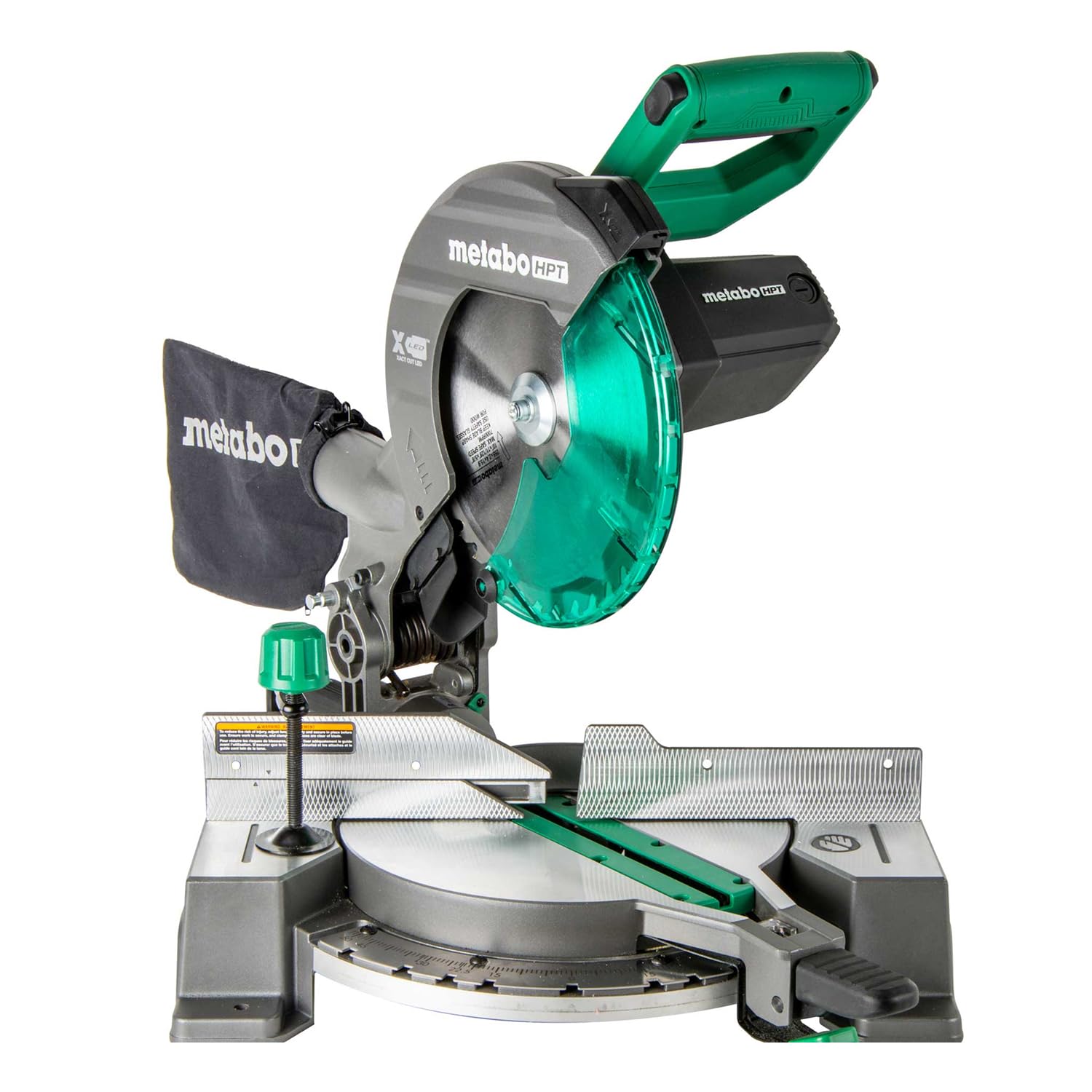
2. Metabo HPT 10-Inch Single Bevel Compound Miter Saw, 15-Amp Power Saw C10FCG2
A featherweight 24.2 lbs that spins at 5,000 RPM for easy first-timer cuts.
If you are new to miter saws, this is the one that makes the learning curve painless. It weighs just 24.2 pounds, which is a 2.6x gap compared to the 64-pound BOSCH above, and that lightness is exactly what owners appreciate most when hauling it to a job site. The 15 Amp motor spins at 5,000 no-load RPM, which buyers report handles 2x4s, 2x6s, and trim with clean results straight from the start.
The design is built around simplicity: an improved miter scale and easy-to-read controls, a large table for supporting your material, and a vice clamping system that holds the workpiece firmly for safety. The compound miter gives you a 0-52° miter range left and right plus an adjustable bevel range of 0-45° left, which covers most baseboard and trim work a homeowner will ever face. It includes a 40T TCT blade, an electric brake to stop the blade fast, and a 5-year warranty on the tool body, which is a strong promise for a tool in this price class.
What buyers describe is a saw that performs “like a high-dollar brand name” for a budget-friendly price, particularly for trim and flooring work. The honest caveats are that dust collection is weak — you will want a shop vac — and the instructions for the 3-piece assembly and handle lock are not great. But the consensus is powerful: owners mention it is “great for first timers and small to medium DIY projects,” with a sharp blade, stable build, and a welcome LED light. This saw offers the best price-to-performance ratio in its class..
The value take: this is This saw delivers premium performance at an entry-level price. — the lighting and sharp factory blade are the details that win people over.
The honest limit: dust collection needs a shop vac, and the assembly instructions will test your patience once.
3. Genesis GMS1015LC 15-Amp 10-Inch Compound Miter Saw with Laser Guide
A laser-guided budget pick that cuts trim cleanly while staying affordable.
You see exactly where the blade will land before you pull the trigger, thanks to the integrated laser guide that buyers describe as an effective aid for accurate cuts. The 15 Amp motor handles everyday stuff — customers note it cuts 2x4s and even 4x4s easily. At 19.5″ L x 16.25″ W x 15″ H, it takes up a fraction of the bench space of the big BOSCH (a 64% larger footprint by comparison), so it suits a home DIYer with limited room.
It makes bevel cuts up to 45 degrees left and miter cuts up to 45 degrees left and right, with 9 positive detent stops at the most common angles. That makes compound cuts for crown molding, shadow boxes, and picture frames straightforward. The package includes a 60T carbide blade, a hold-down clamp, a dust bag, two extension wings, a blade wrench, and two AAA batteries for the laser — everything you need to get started is in the box. The electric brake stops the blade in seconds, and the arbor lock makes blade changes quick.
The honest notes here are about expectations. This saw is loud — ear protection is a must — and while the dust bag helps, a shop vac is far more effective. The supports will not hold lumber longer than 8 feet without sagging. And as one buyer put it verbatim: “Used this for cutting trim over the weekend and it’s easy to use and cuts fantastic! So glad I chose this one!” The one firm warning is that this is a wood saw — cutting metal can melt the plastic parts, so keep it to wood and trim work. For the price, the laser guide and 9 miter stops make this a strong budget entry.
Built for home projects: the laser and positive detents make this the easiest budget saw to set up and cut accurately on day one.
The fair warning: this is a woodworking tool only — keep metal away from the blade and plastic parts.
4. DOVAMAN 10-Inch Sliding Miter Saw, Multi-Material, 2-Speed, 15A

Two-speed power that lets one saw cut wood, PVC, and soft metals.
You switch materials without buying extras, thanks to the dual-speed motor that delivers 5,000 RPM for wood and 3,200 RPM for softer materials, plus three TCT blades (tungsten carbide-tipped, for durability) — two 40-tooth and one 48-tooth. The 13-inch sliding rail and extendable side tables give you a cutting range up to 4 x 13 inches, so you handle wide stock like 2x12s and 4x4s without a second saw. Reviewers point out it cuts treated and untreated lumber and composite fascia well, with one noting it outperforms a non-sliding saw.
The ambidextrous design makes it comfortable for both left- and right-handed operators, and the built-in laser guide helps with detailed cuts. The 15 Amp pure copper motor is engineered for durability., and the included spare carbon brushes are a nice touch for long-term maintenance. For a sliding saw, the footprint is manageable, and the overall build is described as heavy and well-made, which translates to stability during cuts.
The honest concerns are real, though. The most-discussed negative is blade durability — there are reports of the blade struggling or wearing quickly after multiple cuts, and a few owners note it struggles with thicker hardwood. The spin-up time is also a mixed point: it takes a while to reach full speed. But the overwhelming consensus is positive: shoppers say it is “a better saw than the one I bought at home depot,” and the customer support gets high marks, with one owner receiving an entire replacement saw after a laser was damaged. If you need one machine that handles wood, PVC, and light metal, this is the one.
Why It Stands Out
- Two speeds (5,000/3,200 RPM) for multi-material cutting
- Three TCT blades included in the box
- 13-inch slide rail cuts up to 4 x 13 inches
- Ambidextrous design works for lefties and righties
The Known Gripes
- Blade durability is questionable on heavy use
- Slow to spin up to full speed
- Struggles with thicker hardwood
5. MarvTool 10-inch Sliding Compound Miter Saw, 5000RPM, 15 Amp, Single Bevel 0-45°
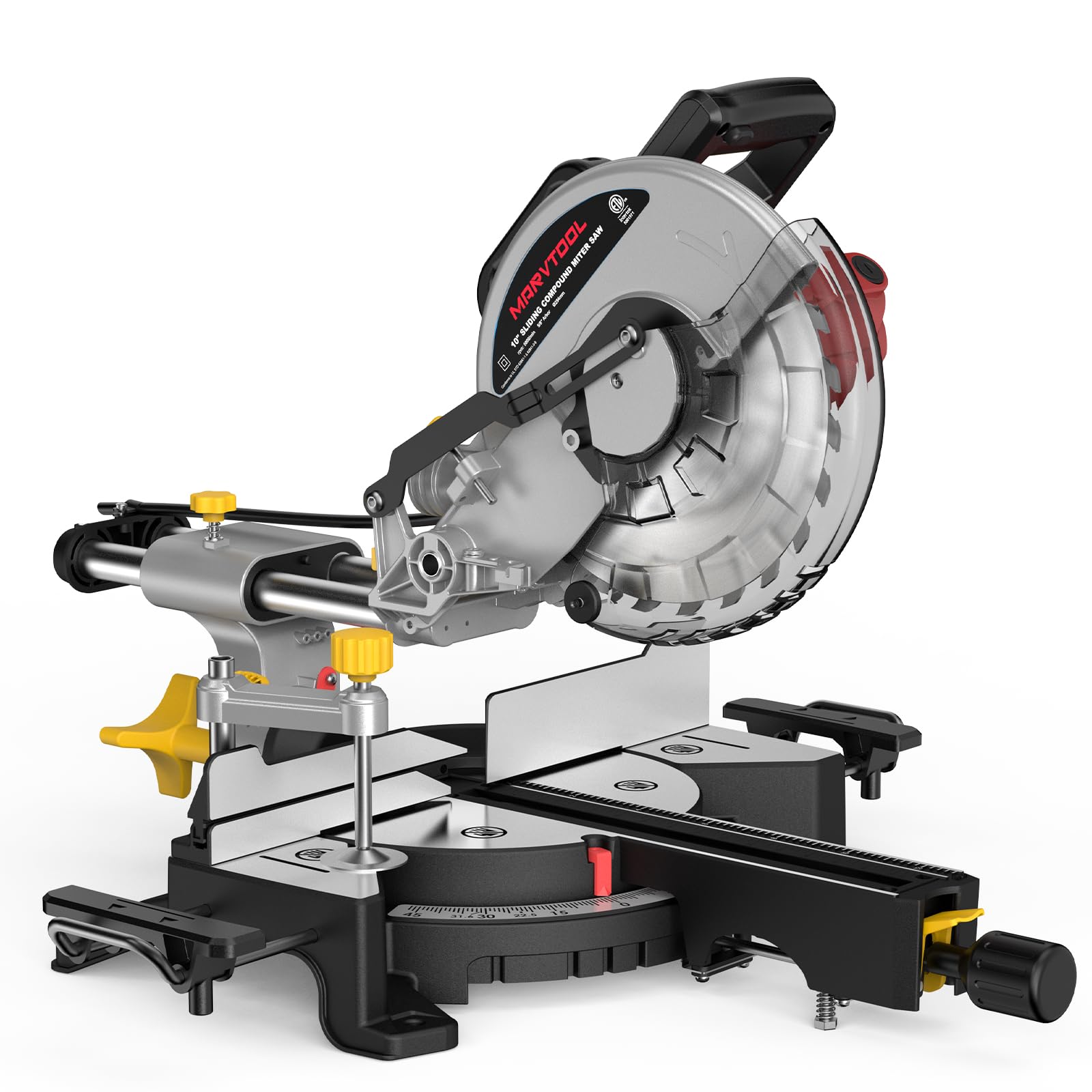
A 25.6-lb slider that locks its head down for easy, compact storage.
What makes this saw stand out is how it handles the two biggest complaints about sliding miter saws: weight and storage space. At just 25.6 lbs, it is light enough to carry to a job site by hand, and the head locks securely into the base using the Release Knob, which shrinks its footprint dramatically for storage or transport. The 15 Amp motor spins at 5,000 RPM, and the 36T blade included cuts through wood, metal, plastic, and laminates, so it is a true multi-material tool for versatility.
The miter angles go from 0° to 45° left, and the base adjusts on both sides for bevel cuts from 0° to 45°, giving you a wide range of compound angle cuts for diverse projects. It comes with two extension tables and an Allen key, plus a transparent blade guard for clear visibility and a vise clamp to secure materials. The dust collection bag keeps your workspace tidy, though a shop vac is always better. A 2-year warranty and 24/7 customer support back it up, which is a solid promise for a portable saw in this class.
Buyers consistently describe it as a “great value” that feels sturdy and cuts accurately. One owner framed a whole basement with it and reported clean cuts after swapping to a finish blade. Another noted it will easily cut a 6-inch board, which is impressive for a 10-inch saw. The honest caveats are that there is no laser guide — you will align by eye — and the handle arrives detached in the box for shipping safety, so you need to install it before first use. This portable, multi-material saw stores compactly, making it a smart choice..
The portability win: the locking head and 25.6-lb frame make this the easiest slider to move and store.
The trade-off: no laser means you line up cuts by eye, and the handle needs a quick install from the start.
6. Evolution Power Tools R255SMS+ PLUS 10-Inch Sliding Miter Saw

The steel-eating slider that cuts wood and metal with one blade.
The defining capability here is multi-material cutting: with a single TCT blade, this saw cuts through wood, wood with embedded nails, composite decking, mild steel, and plastic. Owners describe it as a “steel cutting monster,” reporting it handles 50 miter cuts on 3/16-inch angle iron without issue, and it is remarkably quiet doing it. The 0° to 45° bevel and 50° to 50° miter angles give you the range to handle most framing, trim, and metal projects.
The +PLUS features make it job-ready from the start: dual quick-release clamps to hold your work, a dust bag, taller fences, a slide rail protector, a generous 3-meter cable, and integrated carry handles. At 41.8 lbs, it is not light, but the carry handles make moving it manageable. The 3-year warranty is a strong commitment, and buyers report it cuts “like butter” on thinner metal with virtually no sparks and stays cool to the touch when cutting mild steel, which is a real safety win.
The honest trade-offs are about finish quality, not function. The plastic parts are not pro-grade, and the clamp is described as mediocre. The laser needs adjustment — it is off at full width — and chips fly rearward, so eye and long-sleeve protection is advised. Buyers also note that clamping material firmly is essential because the saw is powerful enough to throw a loose piece. If you need one saw that goes from framing lumber to steel angle without switching blades, this is the most capable multi-material option in the list.
The multi-material flex: wood, embedded-nail lumber, composite, and mild steel all fall to one blade, virtually spark-free.
The honest warning: clamp your work firmly — this saw has the power to throw a loose piece, and the laser needs a tune-up.
7. Delta 10 in. Compound Sliding Miter Saw S26-263L

A trusted brand slider that spins fastest in class at 5,500 RPM.
You get smooth cuts through hardwoods and less tear-out on the face of your work, because this Delta spins at 5,500 RPM — the fastest in this lineup. It is a sliding saw with a bevel that tilts left from 0° to 45°, and it cuts a nominal 2 x 12-inch board at full bevel, which is real capacity for a 10-inch machine. At 29.5 pounds, it hits a balance between the 64-lb BOSCH and the 24-lb Metabo — light enough to move room to room, stable enough for serious cuts.
Buyers describe it as a good quality, reliable saw with a smooth slider and a functional clamp. The stock 24T blade is decent for rough framing, but owners upgrade to a 60T blade for cleaner finish cuts on oak. The cord exits out the rear of the slide bar, which keeps it protected from the blade — a thoughtful detail. The spindle lock holds the blade securely while you loosen the nut for quick blade changes.
The honest feedback is that this is a mid-level saw, not a pro machine, and the negatives reflect that positioning. The laser is weak and only useful indoors, the dust bag is not effective enough on its own — you will want a shop vac — and one owner found it louder than most. But the value story is strong for a trusted brand at this price. As buyers put it, it is a “solid, good value miter saw” that embiggens your toolbox without the pro-level price tag. For the weekend warrior who wants a dependable brand and speed, this delivers.
The speed edge: 5,500 RPM is the fastest no-load speed here, and it shows in smoother hardwood cuts.
The honest caveats: the laser is indoor-only strength and the dust bag needs a shop vac partner.
8. Makita LS1040 10″ Compound Miter Saw

The 27-lb trim saw that makes picture-frame corners like a dream.
You get accurate corners on trim and portrait-format framing, because the single pivot arm has no slider play — buyers who frame artwork report it “makes corners like a dream.” At 27 lbs, it is genuinely portable — owners say a carpenter can handle 90-95% of home trim with this one saw and move it easily. The 15 Amp direct-drive motor spins at 4,600 RPM, which is enough for clean cuts on baseboard and casing.
The miter range is wide: 0°-45° left and 0°-52° right, with 9 positive miter stops at 15°, 22.5°, 30°, 45°, and 0° (90° cuts). That gives you precise, repeatable angles without fiddling. Bevel cuts go up to 45° to the left. The build is all-metal with a machined aluminum base and dual slide rails, which owners mention feels solid and lasts for years. It includes a vertical vise, a 40T micro-polished blade, a socket wrench, and a triangular rule, so it is ready to work from the start.
The honest notes are about adjustability and noise. Some customers note limited angle adjustment capability beyond the detents, and the saw is loud — described as starting “with a bang.” The included blade is praised for cutting clean and smooth, and the all-metal construction means no plastic parts to worry about. One buyer found the blade change bolt very hard to remove and needed a rubber mallet on the wrench, so a little patience is required there. This lightweight, accurate trim saw from a trusted brand is tough to top..
The trim advantage: zero slider play means precise corners for picture frames and fine finish work.
The honest limits: it is loud, and angle adjustment beyond the detents is limited — this is a trim specialist, not a slider.
9. Makita LS1019L 10″ Dual-Bevel Sliding Compound Miter Saw with Laser

10-inch cutting capacity with 12-inch crown reach, dead-on laser accuracy.
This is the premium overachiever: it delivers the crown molding cutting capacity of a 12-inch miter saw — 6-5/8 inches nested — from a 10-inch blade platform. The linear ball bearing system is engineered for dead-on accurate cuts, and buyers confirm the laser line is accurate for precision work. The innovative direct-drive gearbox adds vertical cutting capacity to 5-1/4 inches, so you can stand taller baseboard up against the fence. The unique 2-steel rail sliding system folds in on itself, which shrinks the footprint and lets the saw operate flush against a wall.
The dual bevel is the star for crown molding work: it tilts both directions, so you never flip your workpiece, and reviewers point out the dust collection is excellent — which is the rare exception in this category. Buyers describe it as “precise,” “quiet running,” and note that settings hold their position cut after cut. It includes a 60T micro-polished blade, a bag, a hex wrench, a triangular rule, and a vertical vise, so it is complete from the start.
The honest caveats are about quality control and portability. At 57.9 lbs, it is heavy for jobsite work, and there are reports of a batch of defective units where the blade carriage and rails arrived misaligned — though Makita replaced them, and the replacement saws were perfect. The two-piece fence’s work clamp works well but is slow, requiring many knob turns. Buyers who compared it directly to the BOSCH CM10GD chose this one for its superior dust collection and accurate laser. For a 50-year carpenter, it is the best miter saw they have used — a strong endorsement for a serious investment..
The Premium Wins
- Crown cutting capacity of a 12-inch saw from a 10-inch frame
- Dual bevel for crown without flipping the board
- Excellent dust collection with the supplied shroud
- Accurate laser for precision cuts
The Premium Costs
- Heavy at 57.9 lbs for portability
- Quality control issues reported on some units — check alignment on arrival
- Work clamp is functional but slow to operate
Choose this for: serious crown molding and finish work where accuracy and dust collection are non-negotiable.
Think twice if: you need a light jobsite saw — 57.9 lbs plus a metal frame is a workout to move daily.
Understanding the Specs
No-Load Speed (RPM)
This is how fast the blade spins when it is not cutting anything. Higher RPM, like 5,500, generally means smoother cuts and less tear-out on hardwoods. Lower RPM, like 4,600, uses more torque for tougher materials. A 15 Amp motor is the standard across this category — the difference you feel is in the RPM and the blade quality.
Bevel vs. Miter
The miter angle is the left-to-right swing of the blade for flat angled cuts like picture frames. The bevel is the tilt of the blade for angled cuts like baseboards. A single-bevel saw tilts only left, which covers most work; a dual-bevel saw tilts both ways, saving you from flipping the board when cutting crown molding.
Sliding vs. Non-Sliding
A sliding saw uses rails to pull the blade through the workpiece, allowing wider cuts without a bigger blade. The trade-off is depth — sliding saws take up more bench space. Some, like the BOSCH Axial-Glide, use articulated arms to fold that rail space away, giving you the reach without the footprint.
Weight and Portability
Weight ranges from 16 oz for a compact budget model to 72.8 lbs for a full-size slider. If you move your saw to job sites, look for 30 lbs or less. If it lives in one spot in your shop, weight is less of a concern — but the BOSCH at 64 lbs has no carry handles, so plan how you will move it.
FAQ
Can a 10-inch miter saw cut a 2×12 board?
What is the difference between single bevel and dual bevel?
Is a sliding miter saw better than a non-sliding one?
How loud are these miter saws?
Do I need a laser guide on my miter saw?
Which saw is best for cutting metal?
How much bench space does a sliding miter saw need?
What blades come with these saws?
Which saw is best for a beginner?
Final Thoughts: The Verdict
Across the board, the 10 miter saws winner is the BOSCH CM10GD because the Axial-Glide system gives pro-level dual-bevel cutting in a footprint small enough for a home garage, and the quality and accuracy dominate its review history. If you are a first-timer who values low weight, the Metabo HPT C10FCG2 is your best entry point at just over 24 lbs. And for the serious crown-molding work, the Makita LS1019L delivers 12-inch cutting reach from a 10-inch blade — the one to reach for if dust collection and dead-on laser accuracy are worth the premium.
How We Picked
We do not accept paid placement. Every pick is matched to a real buyer and a real use-case; we do not hands-on test units.
Sources & Methodology
Specifications: manufacturer listings and product documentation. Review insights: verified customer reviews, as of August 2026. Pricing: not shown on this page (it changes often); check the current price via the retailer link.
As an Amazon Associate, Gadgets Feed earns from qualifying purchases. This does not affect which products we feature.