
You are looking for a 10-inch speaker to fill a room — maybe a rehearsal space, a small venue, your living room, or an outdoor ceremony — with clear, powerful sound that does not break up when you turn it up. The tricky part is that powered PA speakers (for live vocals and DJ work) and powered subwoofers (for home theater bass) serve totally different jobs. The right pick for you depends on whether you need to project your voice across a crowded bar or feel movie rumble in your chest.
The short answer: for live performances where reliability and clarity matter most, the premium ALTO TS410 gives you the most headroom and pro-grade features. If your budget is tight but you still want a solid PA speaker, the Rockville BPA10 packs a huge number of inputs and decent sound for the money. This guide shows you the top 10 speakers and what each one actually does best, so you can pick the right one.
How To Choose The Best 10 Speakers
When you start looking at 10-inch speakers, you will find two very different types: powered PA speakers (made for live vocals, instruments, and DJ work) and powered subwoofers (made to add deep bass to a home stereo or home theater system). Knowing which type you need is the single most important decision you will make.
Power: Peak vs. RMS (the real number that matters)
The most common beginner mistake is comparing peak wattage numbers. Peak power is the absolute maximum the speaker can handle in a millisecond burst before it blows. RMS (root mean square) power is the continuous power the speaker can deliver cleanly, song after song. A speaker rated at 400W peak might only deliver 100W RMS, which is the number you should actually use for comparison. For a small to medium room, 50W to 100W RMS is usually enough; for a live band or DJ set, you will want at least 200W RMS per speaker.
Inputs and Connectivity: What do you need to plug in?
A PA speaker needs XLR and ¼-inch combo jacks for microphones, instruments, and mixers, plus Bluetooth streaming if you want to play break music from a phone. A home theater subwoofer needs RCA line-level inputs to connect to your AV receiver. Many PA speakers also include an XLR output (“link” or “daisy-chain” output) so you can send the signal to a second speaker for a stereo pair — a critical feature if you ever plan to expand your setup.
Quick Comparison
On smaller screens, swipe sideways to see the full table.
| Model | Category | Best For | Key Spec | Amazon |
|---|---|---|---|---|
| ALTO TS410 | Premium PA | Live bands, mobile DJs, large venues | 2000W peak / 3-channel mixer / DSP app control | Amazon |
| Mackie Thump210 | Premium PA | DJs, bars, venues needing feedback control | 1400W peak / Feedback Eliminator / Music Ducking | Amazon |
| ALTO TX410 | Mid-Range PA | Rehearsals, ceremonies, small gigs | 350W peak / TWS Bluetooth / 2-channel mixer | Amazon |
| Polk Audio PSW10 | Home Subwoofer | Home theater, music listening in small rooms | 50W RMS amp / 10-inch driver / 80-160Hz crossover | Amazon |
| Rockville BPA10 | Budget PA | Budget-conscious DJs, karaoke, small events | 400W peak / multi-input / USB/SD/FM | Amazon |
In‑Depth Reviews
1. ALTO TS410 2000W 10″ Powered PA Speaker
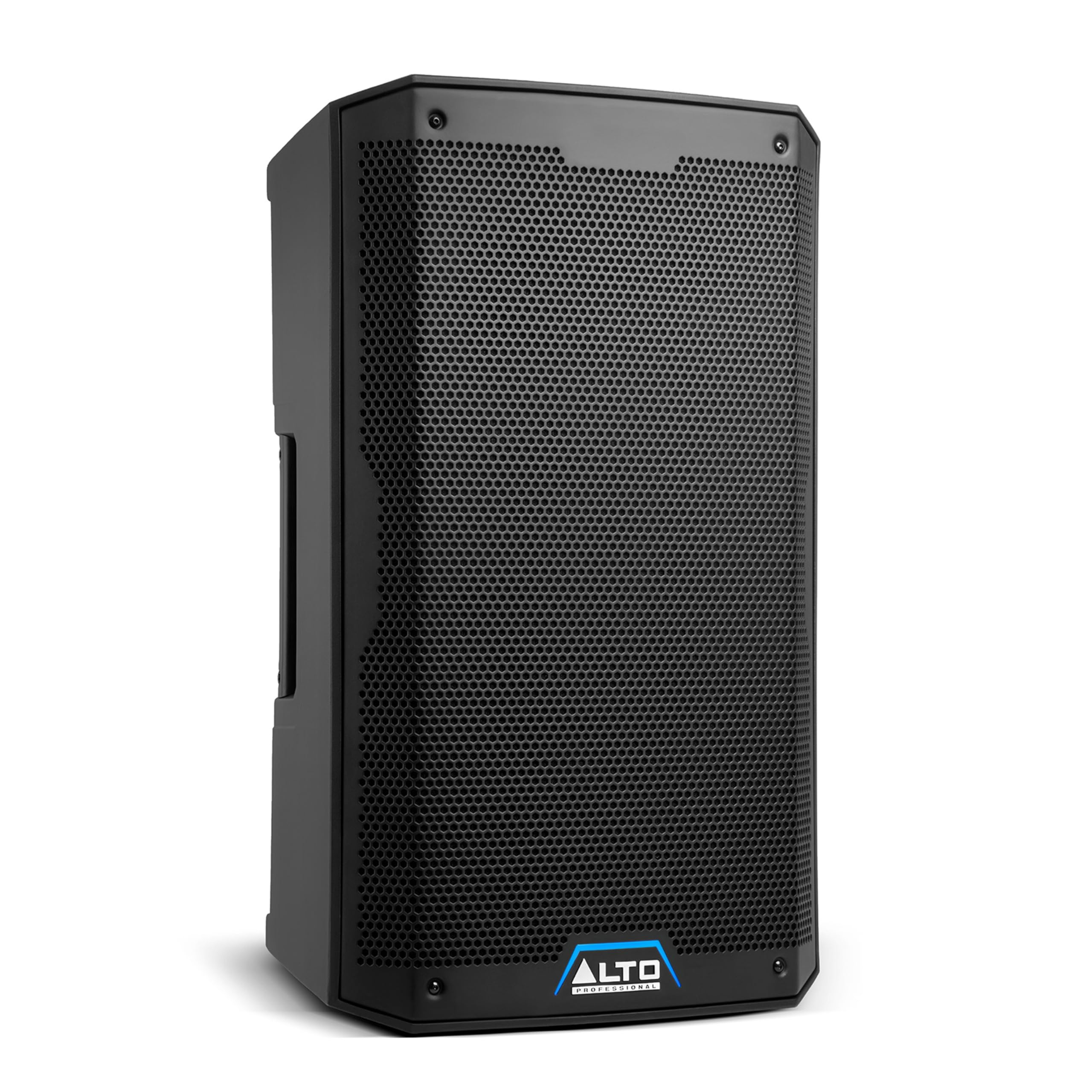
2000W peak power makes the ALTO TS410 the top pick for musicians and DJs who need loud, clean sound that stays controlled even when pushed. That rating is 5.7 times larger than the 350W peak of the ALTO TX410, meaning the speaker won’t distort or break up when your band hits the chorus or your DJ mix peaks. Buyers report it handles rock bands and saxophone backing tracks cleanly in medium-sized venues.
What really sets this apart is the DSP app control: you can download an app on your iOS or Android phone to adjust Bluetooth levels, pick a speaker mode (like wedge monitor or pole-mounted), set a subwoofer size, and fine-tune a custom EQ to stop feedback. The built-in 3-channel mixer lets you plug in two microphones and a backing track all at once without an external mixer, using dual XLR/¼-inch combo inputs with independent level controls.
One design quirk: when you use the TS410 as a floor wedge monitor, the handle sits on the wrong side and can smash cables when you pick it up. Still, buyers who compare it to pricier units like the EV ZLX 15 say the TS410 gets you about 90% of the performance for less money. The ALTO TS410 is the clear choice for live sound where you cannot afford a hiccup.
Why it’s great
- 2000W peak power provides enormous headroom for clean sound at high volume
- DSP app control lets you tweak EQ and feedback settings from your phone
- Built-in 3-channel mixer with combo XLR/¼-inch inputs handles mics and line sources
- Four use modes (pole, wedge, suspended, freestanding) offer versatile placement
Good to know
- Handle placement is awkward when using as a floor monitor — can pinch cables
- Rated peak power is not continuous RMS wattage; real-world output is lower
- Bluetooth can sometimes have a delay that makes it less ideal for video work
2. Mackie Thump210 10″ 1400W Powered Loudspeaker

While the ALTO TS410 leads on raw power and phone-based control, the Mackie Thump210 fights back with two smart features that fix real performance headaches. First, the Feedback Eliminator — a circuit that automatically detects and stops that ear-piercing microphone squeal before it ruins your set. Second, Music Ducking mode: when you speak into the microphone on channel 1, the audio on channel 2 (your DJ mix or backing track) turns down automatically, so your voice cuts through without you touching a fader.
Inside is a 1400W peak Class-D amplifier (a highly efficient amp that stays cool), a 1-inch compression driver (the part that handles high treble), and a 10-inch woofer. Owners mention it gets “real loud but sound good” with “powerful bass for an unbelievable price.” At 35 pounds, one person can lift it. The Thump210 is the choice if you act as your own sound engineer — karaoke hosts, bar performers, wedding MCs who need to make announcements over music.
Where it falls behind the TS410 is flexibility: the Thump210 has no DSP app for custom EQ on the fly, and its Bluetooth is just a convenience, not a core feature. It also lacks a dedicated XLR link output for daisy-chaining multiple speakers. Choose this over the top pick if you need automatic feedback killing and music ducking to handle live vocals without a dedicated sound engineer.
Where it shines
- Feedback Eliminator stops microphone squeal automatically during performances
- Music Ducking mode lowers background music when you speak into the mic
- 1400W peak Class-D amplifier delivers powerful, room-filling bass
- Lightweight design at 35 pounds is easy for one person to transport
Worth noting
- No DSP app for remote EQ or feedback fine-tuning from a phone
- Sound quality at low to medium volume can be less refined unless gain is carefully set
- Lacks a dedicated XLR link output for daisy-chaining multiple speakers
3. ALTO TX410 350W 10″ Powered PA Speaker
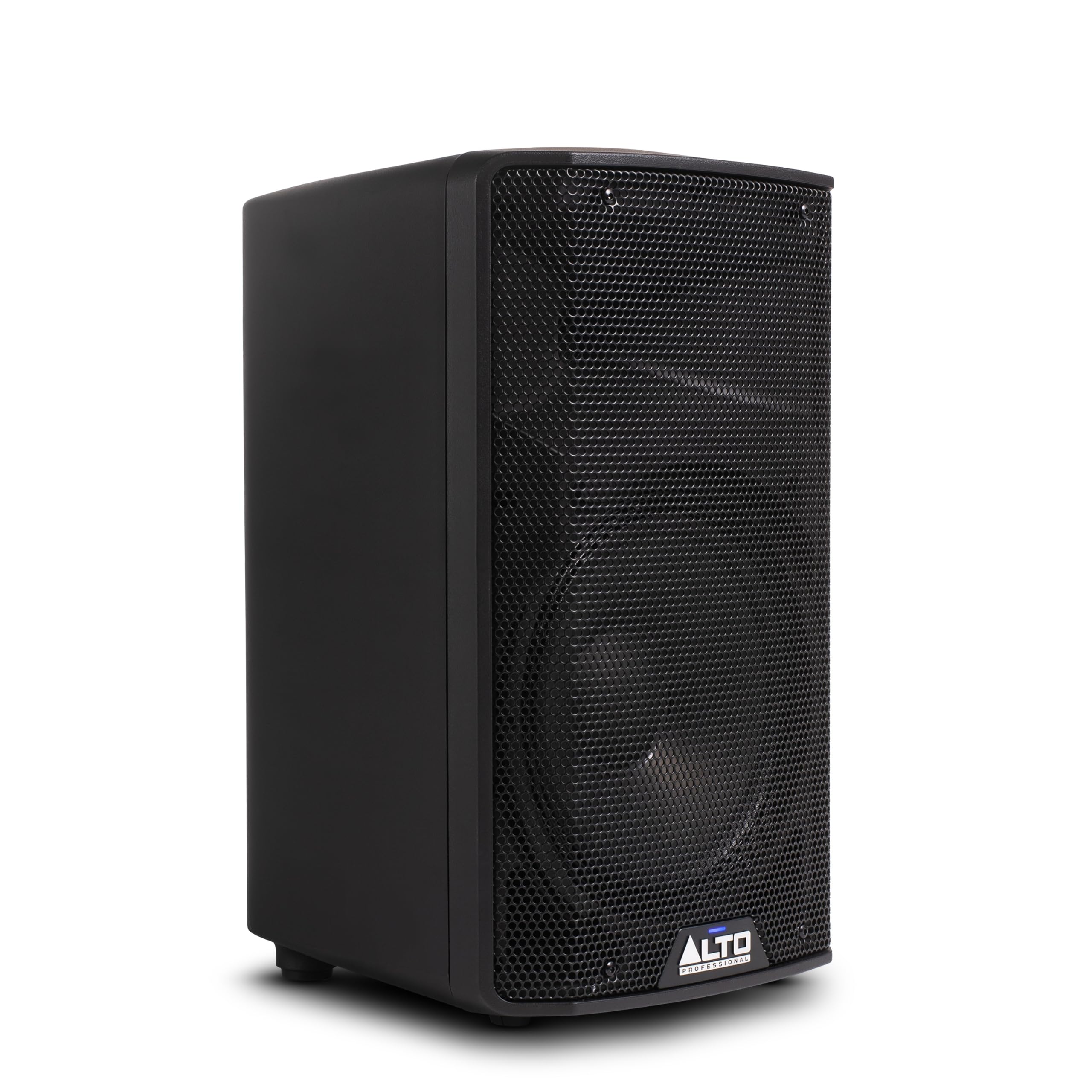
You do not need the full pro headroom of the TS410, but you want a step above basic budget gear. The ALTO TX410 hits that sweet spot with 350W of bi-amplified power — 250W just for the low-frequency woofer and 100W just for the high-frequency driver — so vocals stay crisp and instruments sound separate even when you push the volume. Customers note it gives “clear voice” and works well for “small band practice (vocals, keyboards).”
A rare feature at this price is True Wireless Stereo (TWS) Bluetooth, which lets you pair two TX410 speakers wirelessly for a stereo pair without running audio cables between them. You also get a built-in 2-channel mixer with separate level controls for mic and line sources, an XLR output for daisy-chaining more speakers, and a contour EQ tuned for music playback. The rugged metal grille and lightweight enclosure make it easy to haul to gigs — pole-mount or as a floor monitor.
The one specific catch: the TX410 uses a 36mm pole mount socket, not the standard 35mm. Some buyers fix it with tape around the pole, but it is an annoyance. The TX410 is for you if you host ceremonies, run exercise classes, or need a reliable monitor for DJ gear without spending premium money. skip it if a full-band main PA without a subwoofer is your goal — you will want the TS410’s power instead.
What stands out
- 350W bi-amplified power keeps vocals clear and instruments punchy together
- True Wireless Stereo Bluetooth lets you pair two speakers without audio cables
- Compact and lightweight design with a rugged metal grille for easy transport to gigs
- Built-in 2-channel mixer with separate level controls and XLR daisy-chain output
The trade-offs
- Pole mount is 36mm instead of the standard 35mm — may require a small fix
- Not ideal as the main PA for a full band without a larger 12-inch speaker or subwoofer
- Some reviewers point out it feels slightly light or flimsy compared to more expensive models
4. Polk Audio PSW10 10″ Powered Subwoofer

The single number that matters most in this category is 50W RMS — its continuous power rating, which drives a 10-inch Dynamic Balance woofer through a front-firing port for smooth, musical bass that a reviewer called “musically accurate” and “not boomy,” filling a small to medium room (up to about 160 square feet per buyers’ reports) without rattling walls.
The catch is simplicity: this subwoofer is wired only, with no Bluetooth, XLR inputs, or mixer; you connect it to your AV receiver via RCA line-level or speaker-level inputs, and dial in the crossover frequency between 80 Hz and 160 Hz to blend with main speakers, while buyers with older stereo amps appreciate the high-level inputs for compatibility with vintage gear lacking a dedicated LFE output.
At this price, no other major brand gives you this kind of clean, integrated bass for home listening — it won’t shake foundations for action movies like a 200W+ subwoofer would, but for music lovers with small to medium rooms, the Polk PSW10 delivers an honest low end, making its price-to-value read as a budget-friendly choice for accurate, not extreme, bass.
The upsides
- 50W RMS continuous power provides clean, non-distorted bass for music and movies
- Includes high-level (speaker wire) inputs for compatibility with older stereo amps
- Continuously variable 80-160 Hz crossover blends smoothly with your main speakers
- Compact footprint fits easily into small to medium living room setups
Keep in mind
- No Bluetooth or wireless connectivity — requires wired connection only
- Front grille may rattle at higher output levels if pushed very hard
- 50W RMS is modest power; it won’t deliver chest-thumping bass for large rooms
5. Rockville BPA10 10″ 400W Powered PA Speaker

What you actually get at this lower price is a speaker packed with playback options: Bluetooth streaming (shoppers say it is “reliable”), a USB and SD card slot for playing MP3s directly, an FM radio with 10 presets and a remote control, plus XLR, ¼-inch, RCA, and aux inputs — all in one box. The 400W peak power drives a 10-inch long-throw woofer and a 1-inch titanium compression driver, which buyers report delivers “clean, punchy sound across highs, mids, lows” that is “twice as good as rival” speakers at this level.
What you give up is real-world continuous output. A reviewer measured the actual RMS (root mean square) output at only about 35W RMS (not the claimed 100W RMS), with a maximum of 110db. That works fine for small venues, basement band practice, karaoke night, or music classes. As one verified buyer says, it is a “very enjoyable PA for the price.” The enclosure is high-impact ABS (a tough plastic), which keeps weight down to 18.5 pounds, but some owners mention the box “resonates and flexes” at higher volumes and lacks true sub-bass for electronic music or heavy rock.
The Rockville BPA10 is for you if you are a budget-conscious musician, DJ, or event host who needs a very versatile speaker with tons of inputs. It also makes a great second speaker for a stereo pair when you expand on a budget. pass on it if you need enough clean power for a live band with a loud drummer — look at the TS410 or TX410 instead. It is the exact budget buyer it is perfect for.
Why we’d pick it
- Huge range of inputs including Bluetooth, USB, SD card, FM radio, XLR, and RCA
- Weighs only 18.5 pounds with ergonomic handles for easy one-person transport
- Includes a wireless remote control for playback and settings from a distance
- Long-throw 10-inch woofer and 1-inch titanium compression driver for clear highs
A few caveats
- Real-world RMS output is measured at only about 35W — not the 100W claimed
- ABS plastic enclosure can resonate and flex at higher volume levels
- Bluetooth does not automatically power on when the speaker is turned on
Understanding the Specs
Peak Power vs. RMS Power
The most important spec to understand is the difference between peak power (the maximum wattage a speaker can handle in a split-second burst) and RMS power (the continuous wattage it can deliver cleanly, minute after minute). Many PA speakers advertise a large peak number, like 400W or 2000W, but the real-world continuous output might be a fraction of that — sometimes as low as 35W. When comparing speakers, look for the RMS number or read independent real-world measurements from buyers; that is the number that tells you how loud the speaker can actually play without distorting.
Bi-Amplified vs. Single Amplifier
A bi-amplified (or bi-amp) speaker uses separate amplifier channels for the low-frequency woofer and the high-frequency compression driver. This allows the speaker to produce cleaner, more controlled sound because each driver gets power tailored specifically to its needs. Single-amplifier speakers use one amp for everything, which can lead to muddy sound at high volumes. If you prioritize vocal clarity and instrument separation, a bi-amplified speaker is worth the extra money.
FAQ
Can I use a PA speaker as a home theater subwoofer?
How many watts do I need for a small venue or bar gig?
Final Thoughts: The Verdict
Across the board, the 10 speakers winner is the ALTO TS410 because it delivers pro-grade power, DSP app control, and a 3-channel mixer in one lightweight, versatile package — perfect for live sound where quality and reliability matter most. If you want wireless stereo pairing without running cables, grab the ALTO TX410. And for budget-conscious buyers who need tons of inputs without spending a lot, the standout is the Rockville BPA10.