
Our readers keep the lights on and my morning glass full of iced black tea. As an Amazon Associate, I earn from qualifying purchases.
You are shooting a bird that is barely a speck in the viewfinder. A 100-400mm lens turns that speck into a frame-filling portrait without you needing to swap lenses or carry a heavy prime. The Canon RF 100-400mm F5.6-8 IS USM weighs just 750 grams, while the Nikon NIKKOR Z 100-400mm VR S weighs 3.2 lbs — the difference between a lightweight hike and a sore shoulder.
I’m Min — the founder and writer behind Gadgets Feed. This guide is built by comparing the manufacturers’ published specifications and the patterns across verified customer reviews, so you get each pick’s real strengths and trade-offs instead of marketing spin.
If you shoot Canon RF, Nikon Z, Sony E, or Fuji X, these are your best 100-400 lens options ranked by the real-world experience of the people who use them.
Quick Picks
- Canon RF 100-400mm F5.6-8 IS USM – Lens for Canon R System Cameras — Best Overall
- Canon RF100-400mm F5.6-8 IS USM Telephoto Lens, Black, Compatible with EOS R Series — Best Value
- Fujinon XF100-400mmF4.5-5.6 R LM OIS WR — Fuji Shooters
- Nikon NIKKOR Z 100-400mm VR S — Premium Nikon
- Sony FE 100-400mm F4.5–5.6 GM OSS White — Sony Pro
How To Choose The Best 100-400 Lens
A 100-400mm is a go-to lens for wildlife, sports, and aviation photography. It gives you long reach without the bulk of a 600mm prime (a lens with a fixed focal length). The difference between a good day in the field and a frustrating one depends on three things: maximum aperture, image stabilization, and your camera’s mount.
Maximum Aperture and Low-Light Performance
The widest aperture at 400mm — whether it is f/5.6 or f/8 — controls how much light reaches your sensor. A lens that opens to f/5.6 at the long end helps you shoot in overcast conditions or near dusk. You can use a faster shutter speed without raising the ISO (your camera’s light sensitivity). Lenses that only open to f/8 need good sunlight or a tripod to avoid blurry photos.
Image Stabilization for Handheld Sharpness
At 400mm, any small hand movement shakes the image a lot. Built-in optical image stabilization (often called OIS or VR — a system that moves lens elements to counter your hand motion) is critical. Look for a lens that offers at least 5 stops of shake correction. The Canon RF 100-400mm delivers 5.5 stops, so you can shoot at 1/30s instead of 1/500s and still get a sharp image. Some lenses combine with your camera’s in-body stabilization for even more correction.
Weather Sealing for Outdoor Reliability
If you shoot in rain, snow, dust, or coastal spray, a lens with weather-resistant seals is worth the extra money. The Fuji XF100-400mm and Nikon Z 100-400mm VR S both feature weather-resistant construction. Many budget-friendly options leave the barrel unsealed, so moisture or dust can get inside the moving parts. The Nikon Z and Fuji X premium options include weather sealing as part of their design.
Quick Comparison
On smaller screens, swipe sideways to see the full table.
| Model | Best For | Max Aperture at 400mm | Image Stabilization | Weight | Amazon |
|---|---|---|---|---|---|
| Canon RF 100-400mm F5.6-8 IS USM | Best Overall | f/8 | 5.5 stops | 750 g / 1.65 lbs | Amazon |
| Canon RF100-400mm F5.6-8 IS USM (Retail) | Best Value | f/8 | 5.5 stops | ~750 g / 1.65 lbs | $749.00Amazon |
| Fujinon XF100-400mmF4.5-5.6 R LM OIS WR | Fuji Shooters | f/5.6 | 5 stops | 3.03 lbs | Amazon |
| Nikon NIKKOR Z 100-400mm VR S | Premium Nikon | f/5.6 | 5.5 stops | 3.2 lbs | Amazon |
| Sony FE 100-400mm F4.5–5.6 GM OSS | Sony Pro | f/5.6 | Optical SteadyShot | 49.3 oz / 3.08 lbs | Amazon |
In‑Depth Reviews
1. Canon RF 100-400mm F5.6-8 IS USM – Lens for Canon R System Cameras

Weighs just 750 grams so you can hike all day and still get sharp 400mm shots.
At only 750 grams — about as heavy as a bag of sugar — this is the lightest full-frame 100-400mm you can buy. That low weight makes it ideal for long hikes or all-day wildlife shoots. It also has optical image stabilization (a system that counteracts hand shake) that delivers up to 5.5 stops of correction. This means you can shoot at slower shutter speeds handheld and still get sharp photos, so you avoid blur in dusky light. The Nano USM autofocus motor (a quiet, fast focusing system from Canon) is nearly silent and quick. That matters when you track moving subjects like birds or sports players.
The catch is the variable aperture: at 400mm, the lens stops down to f/8. This means you need decent light or a higher ISO (sensor sensitivity) to avoid motion blur. It also lacks the weather sealing found on more expensive RF lenses. Buyers report that the “lightweight and still has a great quality when zoomed in for action sports” and that it is a solid value that “doesn’t break the bank.”
The case for it: It offers an unbeatable combination of light weight, effective stabilization, and affordable entry into 400mm reach for Canon R series shooters.
The downside: The f/8 maximum aperture at 400mm struggles in low light, and the barrel has no weather seals, so you will want to be careful in wet conditions.
Best for: Traveling and hiking wildlife photographers who prioritize portability over low-light max aperture.
Skip if: You regularly shoot at dawn/dusk or in rain without protection — the f/8 aperture and lack of weather sealing will limit you.
2. Canon RF100-400mm F5.6-8 IS USM Telephoto Lens, Black, Compatible with EOS R Series

Same core optics as our top pick, but you get a retail box and a boost from in-body stabilization.
This is essentially the same lens as product #1 — same 100-400mm range, same f/5.6-8 aperture, same 5.5-stop optical image stabilizer (a system that steadies your viewfinder image and reduces blur). It ships in a standard retail package with a lens cap and dust cap. The key advantage is pairing it with an EOS R series camera that has in-body image stabilization (IBIS — a system inside the camera body itself that moves the sensor to cancel shake). You then get up to 6 stops of total shake correction. That is enough to shoot at very slow shutter speeds like 1/30s at 400mm handheld. The minimum focus distance is just 2.89 feet at 200mm, with a maximum magnification of 0.41x at 400mm. This lets you get very close to small subjects like flowers or insects.
Owners mention it is a “lightweight 400mm for hiking/birding with R7,” and that the zoom ring rotates opposite to the usual direction, which takes some getting used to. They also mention the lens has no weather sealing, so it is best kept dry. The autofocus is fast and quiet, making it a strong choice for shooting birds in flight.
Why it’s great
- Maximum 6-stop correction when paired with IBIS-equipped Canon R bodies
- Very close minimum focus distance of 2.89 feet for near-macro shots
- Quiet and responsive Nano USM autofocus
Good to know
- No weather sealing — not for use in rain or dusty conditions
- Zoom ring rotation is opposite to the usual Canon direction, takes practice
Best for: Canon R-series owners who want the best stabilization possible on a tight budget with good close-focus ability.
Skip if: You need to shoot in bad weather or you absolutely require a constant f/5.6 aperture throughout the range.
3. Fujinon XF100-400mmF4.5-5.6 R LM OIS WR
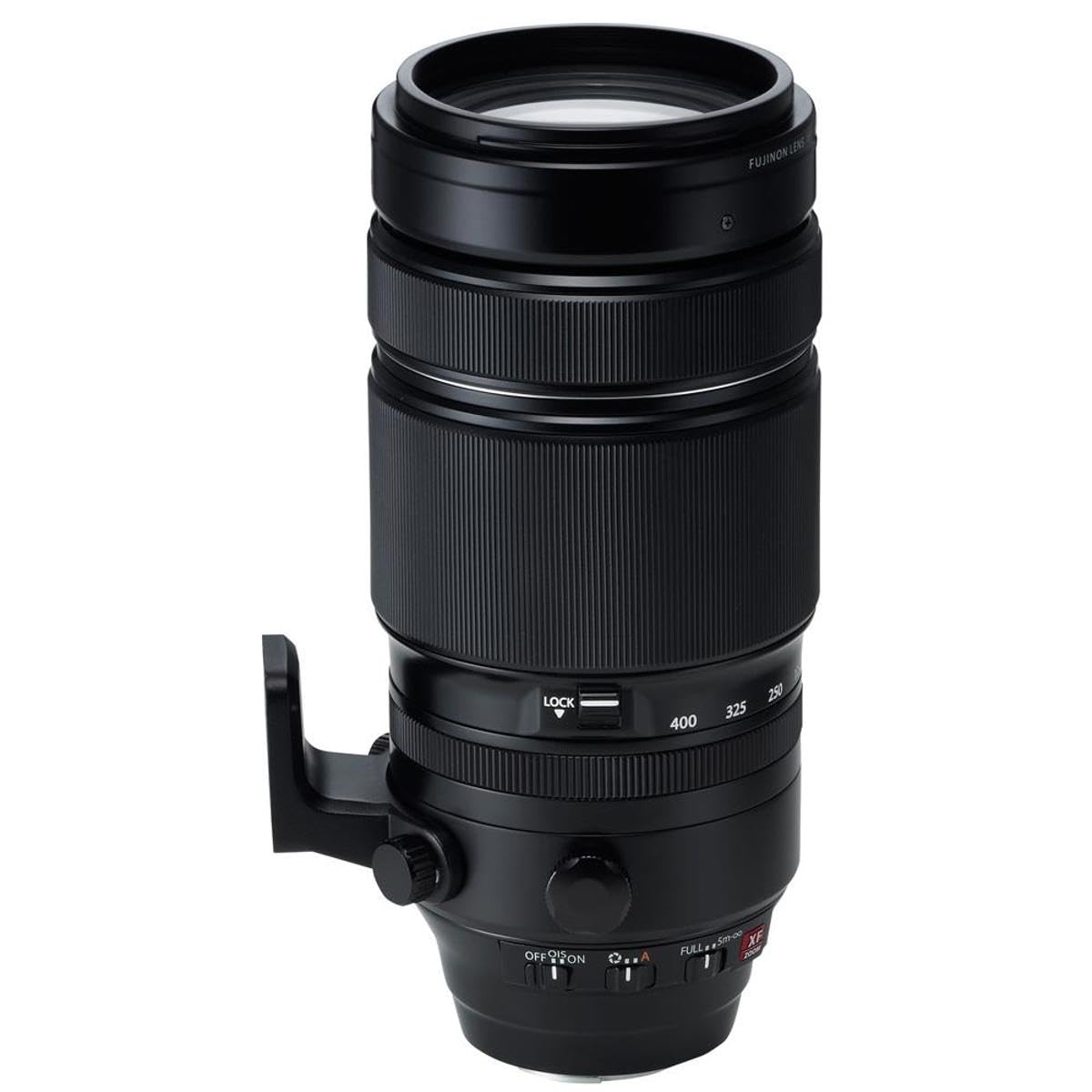
Gives you a 152-609mm equivalent reach on APS-C with weather sealing that handles rain and snow.
Fuji’s native 100-400mm gives you an equivalent reach of 152-609mm on APS-C (a smaller sensor size that crops the image, magnifying the view). It has 21 elements in 14 groups, including five extra-low dispersion (ED) elements and one super ED element. These special glass pieces reduce chromatic aberration (color fringing around edges) and keep images razor-sharp. The lens is also weather and dust resistant, and it can operate in temperatures as low as 14°F (-10°C). So you can shoot in the snow without worrying about internal fogging. The 5-stop optical image stabilization (OIS — a system that moves lens elements to counter hand shake) helps keep things steady. The removable tripod mount includes an Arca Swiss-compatible foot (a standard type of tripod quick-release plate).
Customers note that it is “size/weight similar to Canon 100-400 L v.1 but lighter (3.03 lbs),” and that it delivers “stunning images” that balance well on X-T1 and X-Pro 2 bodies. The trade-off, as some reviews note, is “zoom creep” — the lens extends slowly under its own weight when pointed downward — and the lock only works at 100mm. The minimum focus of 1.75m (about 5.75 ft) is decent for its class but not as close as the Canon RF 100-400mm’s 2.89 feet.
The case for it: Fuji’s finest telephoto zoom with pro-grade weather sealing, outstanding color and contrast, and an Arca Swiss tripod foot right out of the box.
One limitation: The lens is prone to zoom creep (it extends when pointed down), and the tripod collar is reported by some owners as “awful” and not fully Arca Swiss-compatible despite the foot design.
Best for: Dedicated Fuji X-series photographers shooting in challenging weather — rain, snow, or cold — who want maximum reach without switching systems.
Skip if: You depend on a rock-solid zoom lock at all focal lengths, or you want the closest possible minimum focus distance for near-macro work.
4. Nikon NIKKOR Z 100-400mm VR S

Survived polar expeditions and gives you edge-to-edge sharpness plus teleconverter reach up to 800mm.
The Nikon NIKKOR Z 100-400mm VR S is built for serious photographers. It has two high-speed STM stepping motors (a type of autofocus motor that moves in very small, precise steps) that work together for near-silent autofocus and virtually no focus breathing. Focus breathing is when the lens’s angle of view changes as you focus, which can ruin a video composition. This lens keeps your composition stable while you track a moving subject. It achieves up to 5.5 stops of vibration reduction (VR — Nikon’s name for its image stabilization system). It works with both FX (full-frame) and DX (APS-C) Z cameras — on a Z50 or Z fc you get a 150-600mm equivalent reach. It is also teleconverter-compatible: add the 1.4x for 560mm or the 2x for 800mm, with almost no loss in sharpness according to buyer reports.
Reviewers point out that “the lens was used on two separate trips to polar regions and performed extremely well in cold and wet conditions,” confirming its weather-sealed build. The fluorine coating on the front element repels water and dust. However, some note that the f/4.5-5.6 aperture is “slow” and “requires tripod at longer focal lengths” in lower light — this is not a lens for dusk shooting without support. It weighs 3.2 pounds, which is heavier than the Canon RF 100-400mm at 1.65 lbs, but the image quality matches the price tag.
Why it’s great
- 1.4x and 2x teleconverter compatible for up to 800mm reach
- Near-silent autofocus and virtually no focus breathing for video
- Fluorine coating and proven weather resistance in extreme cold/wet conditions
Good to know
- f/4.5-5.6 aperture requires good light or tripod for sharp results at 400mm
- At 3.2 lbs, it is heavier than some other 100-400mm options in this guide
Best for: Nikon Z-series owners who want a rugged, weather-sealed lens that can handle extreme environments and pair with teleconverters for extra reach.
Skip if: You mostly shoot handheld in low light without a tripod, or you need a lightweight option for long backpacking trips.
5. Sony FE 100-400mm F4.5–5.6 GM OSS White

Gives you sharp handheld shots at 1/80s at 400mm — the gold standard for Sony full-frame.
Sony’s G Master 100-400mm uses a double linear motor and a Direct Drive SSM (a type of autofocus motor that uses ultrasonic waves for fast, quiet focusing). The 9-blade circular aperture produces creamy, natural bokeh (the smooth blur behind your subject). The optical SteadyShot (OSS — Sony’s name for image stabilization) lets you handhold at surprisingly slow speeds. One reviewer noted they got “sharp at all focal lengths; hand-held sharp at 1/80s at 400mm.” The minimum focus distance is just 3.22 feet with a 0.35x maximum magnification, making it versatile enough for close-up nature shots. Three assignable focus hold buttons on the barrel let you customize the lens for your shooting style.
The compromise is that at 49.3 ounces (just over 3 pounds), it is one of the heavier lenses in this comparison. It is heavier than the Canon RF 100-400mm at 1.65 lbs, for example. The f/4.5-5.6 aperture means it is best suited for daylight shooting. Buyers agree it is “the best lens in bag, even among GM lenses,” and that it delivers “exceptional AF, clarity, stabilization” for professional action and sports work. It pairs well with a 1.4x teleconverter for up to 560mm, but some find the autofocus slightly slower with the extender attached.
The case for it: It delivers class-leading sharpness across the entire zoom range, fantastic handheld stabilization down to 1/80s, and professional-grade build quality with three customizable buttons.
The drawback: At over 3 pounds, it is heavy for all-day hiking, and the maximum aperture requires good light or a tripod for consistent results in dim conditions.
Best for: Professional Sony E-mount photographers who demand the sharpest possible 100-400mm lens for sports, wildlife, and fashion portraits in good light.
Skip if: You travel light or shoot — the weight and premium price point make it overkill for casual use or backpacking trips.
Understanding the Specs
Image Stabilization (OIS / VR)
This is a lens feature that counters small hand movements to keep your photo sharp, especially at long focal lengths. It is measured in “stops” of correction. A 5-stop system lets you shoot at a shutter speed 32x slower than you could without stabilization (for example, 1/15s instead of 1/500s). All five lenses here have built-in optical stabilization, with most offering 5 to 5.5 stops of correction.
Teleconverter Compatibility
A teleconverter is a small optical accessory that fits between the lens and the camera body to multiply the focal length. A 1.4x teleconverter turns a 400mm lens into 560mm, while a 2x makes it 800mm. The Nikon Z 100-400mm VR S supports both, while the Sony FE 100-400mm GM is compatible with Sony’s 1.4x and 2x teleconverters. The Canon RF and Fuji X lenses do not officially support teleconverters.
FAQ
What does 100-400mm mean on a lens?
Is a 100-400mm lens good for wildlife photography?
Can I use a 100-400mm lens on a crop-sensor camera?
What is the difference between f/5.6 and f/8 at 400mm?
Does the Canon RF 100-400mm have weather sealing?
Will a 100-400mm lens work with a teleconverter?
How heavy is a 100-400mm lens for hiking?
Is the Sony FE 100-400mm GM compatible with the Sony A7 IV and A7R V?
What does “Nano USM” mean on the Canon RF 100-400mm?
How close can you focus with a 100-400mm lens?
Final Thoughts: The Verdict
If you want one dependable pick, the 100-400 lens winner is the Canon RF 100-400mm F5.6-8 IS USM because it hits the balance of light weight at 750 grams, effective 5.5-stop stabilization, and an approachable price for Canon R-series shooters who want real telephoto reach. If you need a weather-sealed pro lens for Nikon Z cameras, grab the Nikon NIKKOR Z 100-400mm VR S. And for the sharpest possible optics on Sony full-frame, the Sony FE 100-400mm F4.5–5.6 GM OSS gives you handheld sharpness at 1/80s at 400mm that rivals the best in class.
How We Picked
We do not accept paid placement, and we did not hands-on test every unit. Instead, we match each pick to a real buyer and use-case by comparing the manufacturers’ published specifications against the patterns in verified customer reviews — so you get each pick’s real strengths and trade-offs instead of marketing copy.
Sources & Methodology
Specifications: manufacturer listings and product documentation. Review insights: verified customer reviews, as of July 2026. Pricing: not shown on this page (it changes often); check the current price via the retailer link.
As an Amazon Associate, Gadgets Feed earns from qualifying purchases. This does not affect which products we feature.
Product prices and availability are accurate as of the date/time indicated and are subject to change. Any price and availability information displayed on Amazon at the time of purchase will apply to the purchase of this product. As an Amazon Associate I earn from qualifying purchases.
CERTAIN CONTENT THAT APPEARS ON THIS SITE COMES FROM AMAZON. THIS CONTENT IS PROVIDED "AS IS" AND IS SUBJECT TO CHANGE OR REMOVAL AT ANY TIME.
Amazon and the Amazon logo are trademarks of Amazon.com, Inc. or its affiliates.