
Our readers keep the lights on and my morning glass full of iced black tea. As an Amazon Associate, I earn from qualifying purchases.
Specs are compiled from manufacturer listings and verified buyer reviews and can change over time — please confirm the key details on the product page before buying.
Buying a 100Ah lithium battery is about freeing yourself from lead-acid’s weight and limits. The goal is doubling usable capacity, cutting weight by two-thirds, and extending service life from seasons to years. The real differentiators are the BMS quality, low-temperature charging cutoff, and verified cycle count.
I’m Min — the founder and writer behind Gadgets Feed. This guide is built by comparing the manufacturers’ published specifications and the patterns across verified customer reviews, so you get each pick’s real strengths and trade-offs instead of marketing spin.
This guide matches the right 100Ah cell to your RV, trolling motor, or solar setup and budget.
Our Picks at a Glance
How To Choose The Best 100 Amp Hour Lithium Battery
All 100Ah lithium batteries claim the same capacity, but build quality and BMS differ significantly. Service life hinges on the BMS electronics and case dimensions, not the advertised capacity.
Match the Physical Size to Your Tray
Measure your battery tray before ordering to avoid a Group 31 not fitting a Group 24 box. A BCI Group 24 battery measures about 10.24 inches long, while a Group 31 is closer to 13 inches. If your RV or boat has a fixed battery box, a Group 31 will not fit where a Group 24 lived, so check your tray dimensions first.
Check the Battery Management System (BMS)
Your battery’s BMS (a built-in computer that guards the cells against overcharging, draining too low, and short circuits) keeps it safe. A 100A BMS lets you draw high current for trolling motors or inverters without tripping protection. Choose one that also handles cold weather, so charging pauses automatically in freezing conditions to avoid permanent cell damage.
Quick Comparison
| Model | Best For | Size Group | Weight | Cold Cutoff | Amazon |
|---|---|---|---|---|---|
| Litime 12V 100Ah★ Best Overall | RV & Off-Grid Power | Group 31 | 22.2 lbs | Yes | Amazon |
| SUPER EMPOWER 12V 100AhBest Value | Drop-in Value | Group 24 | 21.6 lbs | Yes | Amazon |
| DJLBERMPW 12V 100AhTop Performer | Golf Cart & Trolling | Group 31 | 23 lbs | Yes | Amazon |
| Dyness 12V 100Ah | Solar & Off-Grid | Group 31 | 25.3 lbs | Yes | Amazon |
| HumsiENK 12V 100Ah | Portable & Fast Charge | Group 24 | 19.73 lbs | Yes | Amazon |
| DC HOUSE 12V 100Ah | Trolling Motor & Bluetooth | Group 24 | 23.8 lbs | Yes | Amazon |
| WattCycle 12V 100Ah | High-Cycle Performance | Group 24 | 23.2 lbs | Yes | Amazon |
| ECO-WORTHY 12V 100Ah | Bluetooth Monitoring | Group 24 | 23.15 lbs | Yes | Amazon |
| Power Queen 12V 100Ah | Marine & Trolling | Group 31 | 24.3 lbs | No | Amazon |
| Redodo 12V 100Ah | Proven Long-Term Use | Group 31 | 22.04 lbs | No | Amazon |
In‑Depth Reviews
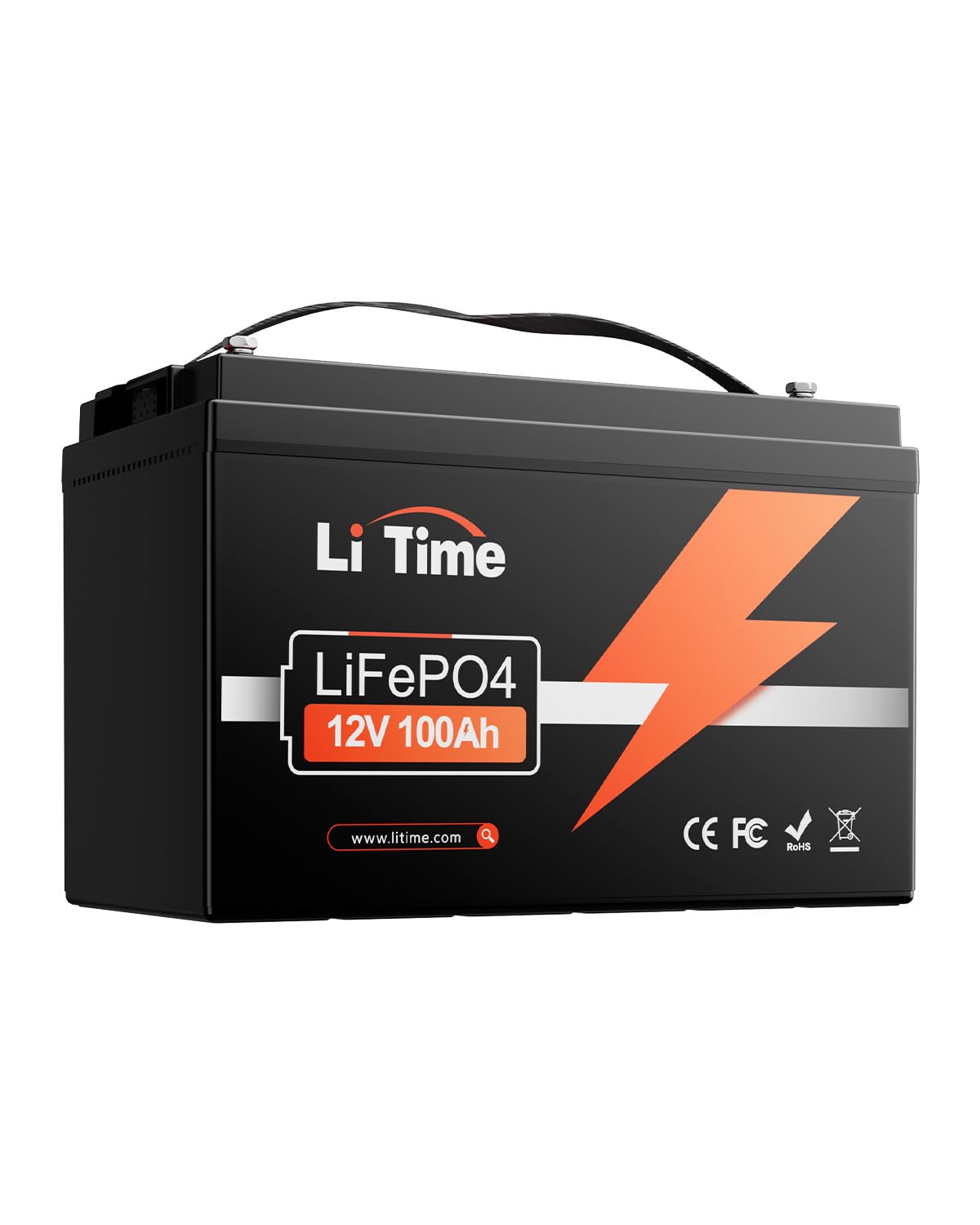
1. Litime 12V 100Ah LiFePO4 Battery
Our pick — over 4.5★ from 700+ verified ratings; the strongest balance of quality and price.
The RV crowd’s favorite, blending Bluetooth monitoring with a 10-year design life.
Owners consistently praise the Litime’s build quality and its delivery of the promised 100Ah capacity. At 22.2 pounds, it’s about one-third the weight of a lead-acid equivalent, so you can lift it in and out of a truck bed without a second thought. At 22.2 pounds, it’s roughly one-third the weight of a lead-acid equivalent, making it easy to lift.
Bluetooth (a wireless link to your phone) keeps you informed: you can see live charge and discharge rates from up to 50 feet away. The app sometimes needs a disconnect and reconnect during charging, but that’s a small hassle compared to knowing your state of charge. One owner reports: “Durable, affordable LFP battery; 2 yrs in truck bed, 34 cycles, powers fridge/30A compressor.”
The 4000+ cycle rating at 100% depth of discharge (meaning you can fully drain it every time without damage) is what justifies the premium price. That translates to roughly a decade of daily use before you notice degradation. It’s expandable to a 20.48kWh bank, so it grows with your power needs instead of becoming obsolete.
What Wins People Over
- Bluetooth app shows real-time charge and discharge rates, praised by nearly every owner
- Fully usable 100Ah capacity, unlike lead-acid’s 50% limit
- Group 31 size fits standard double battery boxes
The Trade-Offs
- Not heated — you’ll need the heated version for extreme cold
- App can glitch during charging, requiring a reconnect
- Holds at 100% for some, but others report overnight drain
Reach for this if: you want a smart, Bluetooth-equipped workhorse that balances premium features with a realistic price for RV and solar duty.
Look elsewhere if: you camp in sub-freezing temperatures often and need built-in self-heating, which this model lacks.
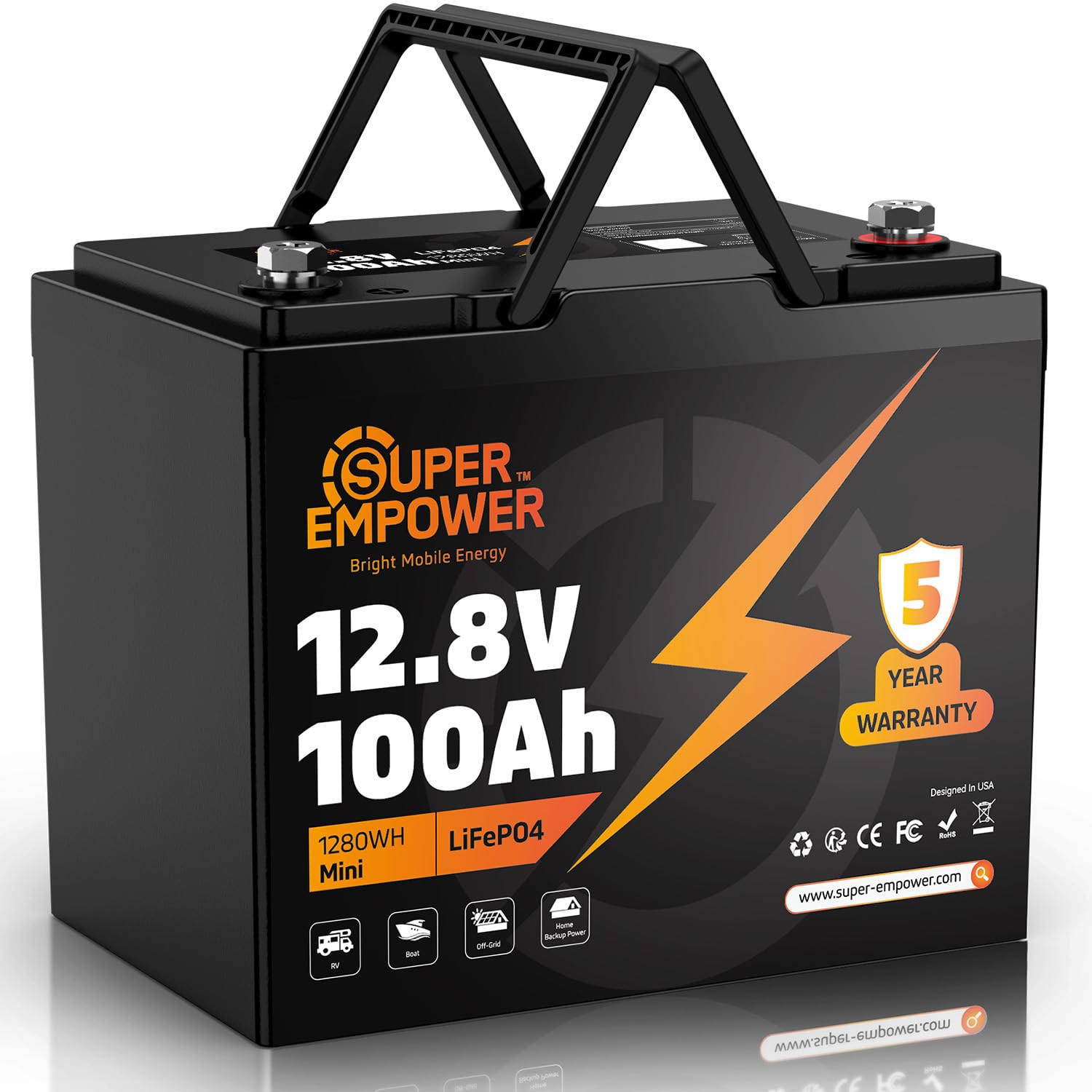
2. SUPER EMPOWER 12V 100Ah LiFePO4 Battery
A featherweight drop-in replacement that punches far above its price tag.
Battery life is the most-cited strength here, and it shows in the real-world results. A pair of these running a 24V trolling motor gives you hours on the water, and the 21.6-pound weight makes them genuinely easy to haul around. It’s a solid 3% lighter than the Litime Group 31 above, which matters when you’re loading a kayak or small boat.
Charging is where this budget pick impresses. Buyers report it charged from a factory 50% state to full in six to seven hours using a 20A charger, which is a quick turnaround for a 100Ah pack. The built-in 100A BMS handles overcharge, over-discharge, and short circuits, so you don’t need to babysit it. The physical size fits most standard Group 24 boxes without any modification.
There’s no Bluetooth readout or battery percentage display, so you’ll need to track voltage yourself. But for a pure drop-in replacement that just works, the simplicity is part of the appeal.
Smart, Simple Swap: A no-frills Group 24 that gives you the core lithium benefits — weight, capacity, and cycle life — without paying for app connectivity you might not use.
Best for: boaters and RV owners who want a true 100Ah upgrade from lead-acid at the lowest entry cost, with a 5-year warranty as backup.
Consider otherwise if: live battery monitoring from your phone is a must-have feature for your setup.
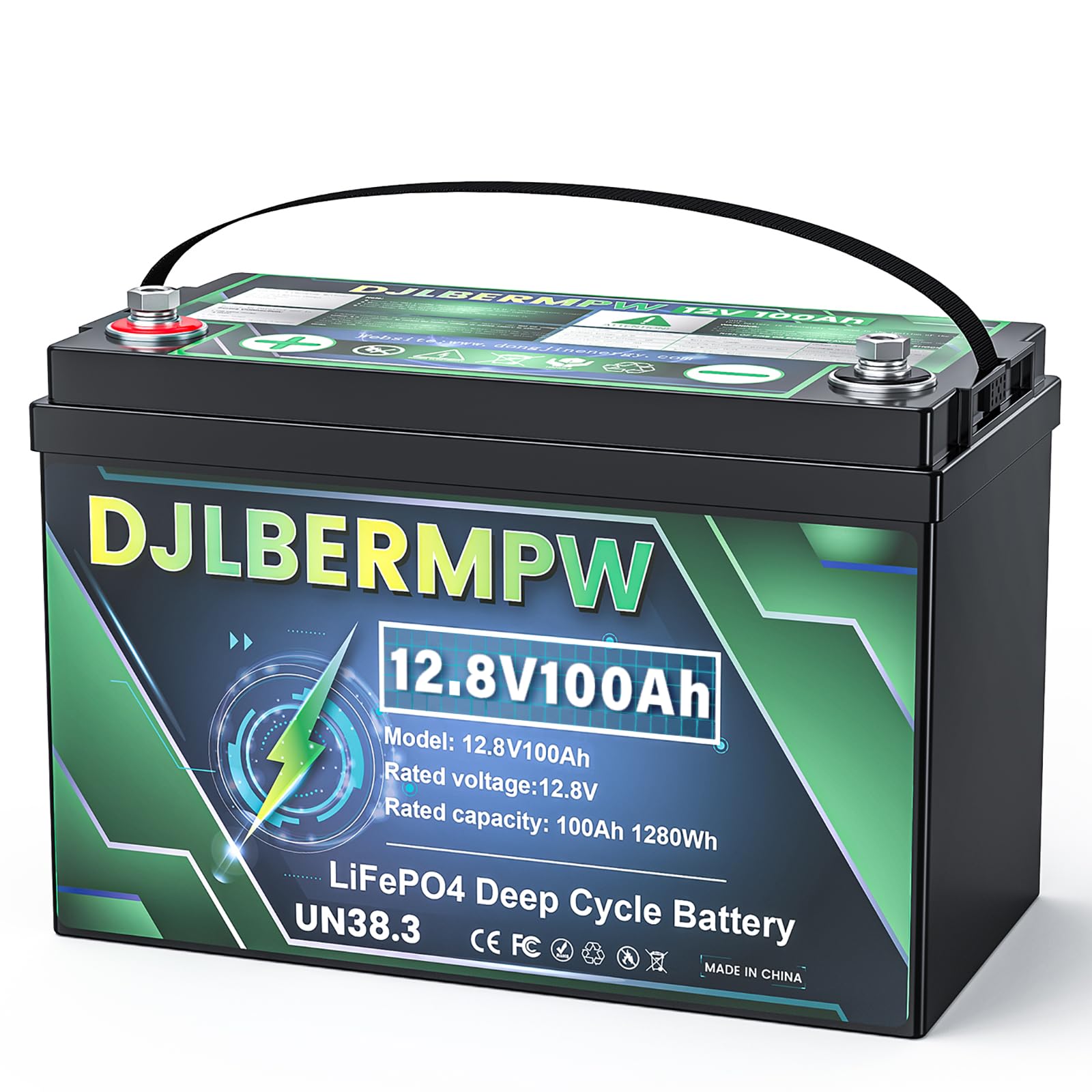
3. DJLBERMPW 12V 100Ah LiFePO4 Battery
The golf cart upgrade king, shedding 264 pounds of lead-acid weight in one swap.
The crowd favorite here is the battery quality, and the reviews back it with real-world math. Golf cart owners swap three of these 23-pound units for six 55-pound lead-acid batteries, dropping 264 pounds off the cart while gaining voltage stability. That weight loss translates directly to more speed and range on the course.
With 15,000 deep cycles at 60% depth of discharge, this is one of the highest cycle ratings in this lineup. The low-temperature cutoff prevents charging below freezing, and the IP66 waterproofing means it shrugs off spray in a boat or damp compartment. It’s rated for a 100A continuous discharge with a 200A surge for 3-5 seconds, so it handles a 30-70lb trolling motor without breaking a sweat.
The honest caveat is the battery life feedback is mixed — some units have stopped charging after about 8 months of use, and there’s a report of corrosion on the control board. However, the 5-year after-sales service and responsive seller replace problematic units quickly.
Powerhouse for Heavy Rigs: The IP66 waterproofing and high surge rating make it the pick for serious marine and golf cart use, where exposure to water and high draw are the norm.
It beats: the lighter-duty Group 24 options on surge current and waterproofing for wet environments.
It does not beat: the reliability record of the top pick — treat the occasional 8-month failure as a risk the warranty covers.
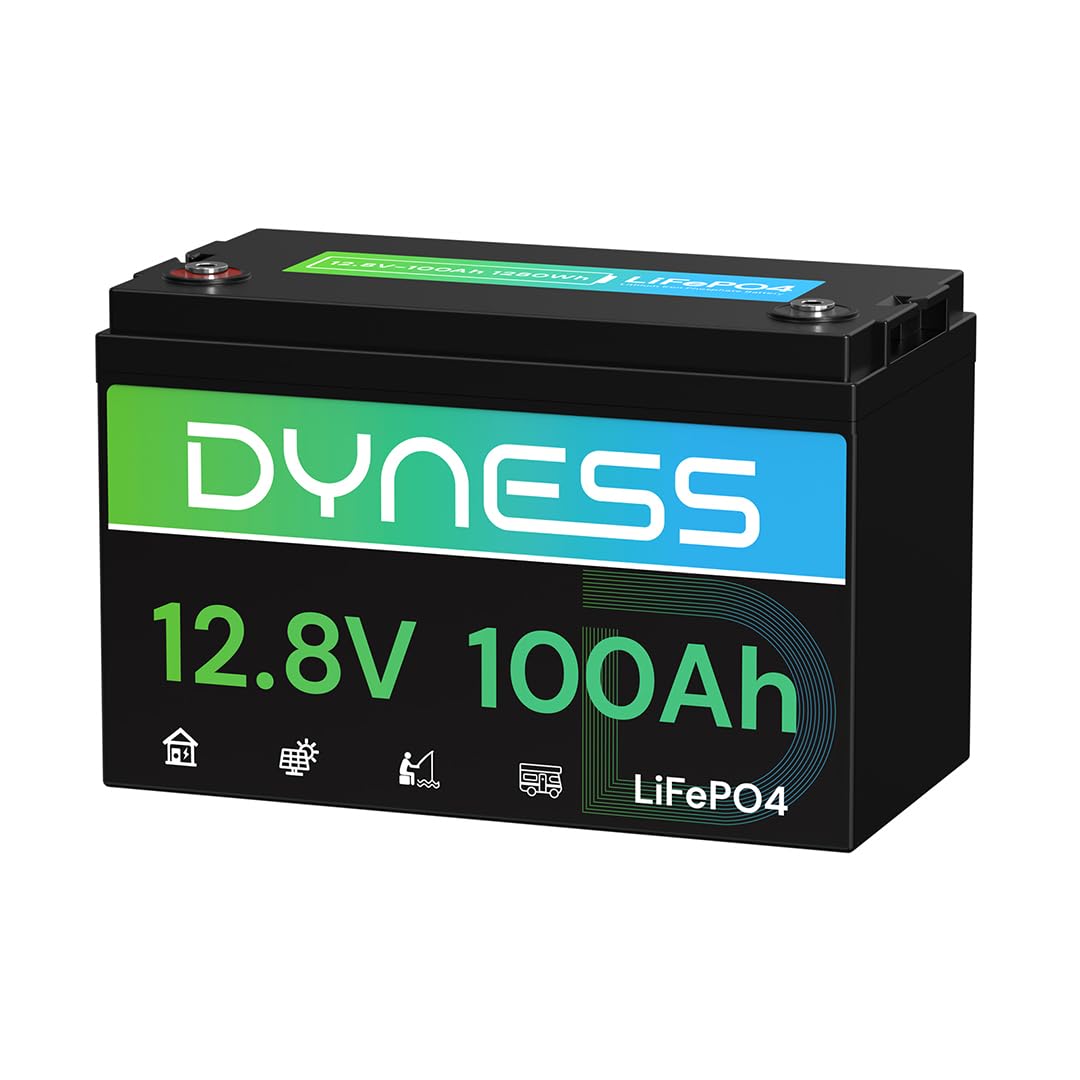
4. Dyness 12V 100Ah LiFePO4 Battery
A security-system hero that runs a 4-channel NVR setup 24/7 without complaint.
This battery’s real-world proof is in the numbers owners mention. A buyer tested the 100Ah capacity and found it measured slightly over 100Ah, which is rare in this category. Running a full living room entertainment setup on two in parallel, it holds up under sustained load that would flatten a lead-acid pack in hours.
Rated at 25.3 lbs and nearly 50% smaller than equivalent lead-acid, it’s a space-saver for tight installs. The IP65 waterproofing and salt-spray resistance make it suitable for marine environments where corrosion is a constant threat. It’s certified to FCC, CE, RoHS, and UN38.3 standards, which is a solid safety baseline for a battery that lives inside your living space.
There’s a fit warning here: the case runs just over 13 inches long, so it won’t drop into every Group 31 cradle without checking dimensions first. Battery life feedback is mixed, with some owners reporting it won’t hold a charge, so verify your charging setup is LiFePO4-compatible.
Reliable, Certified Power: The FCC and UN38.3 certifications plus the A+ grade cells make this a safe, traceable choice for home backup and always-on security systems.
Reach for this if: you need a certified, compact 100Ah for home energy storage or security systems that run continuously.
Measure first if: you’re replacing an existing Group 31 — the 13-inch length might not fit your cradle.
5. HumsiENK 12V 100Ah LiFePO4 Battery
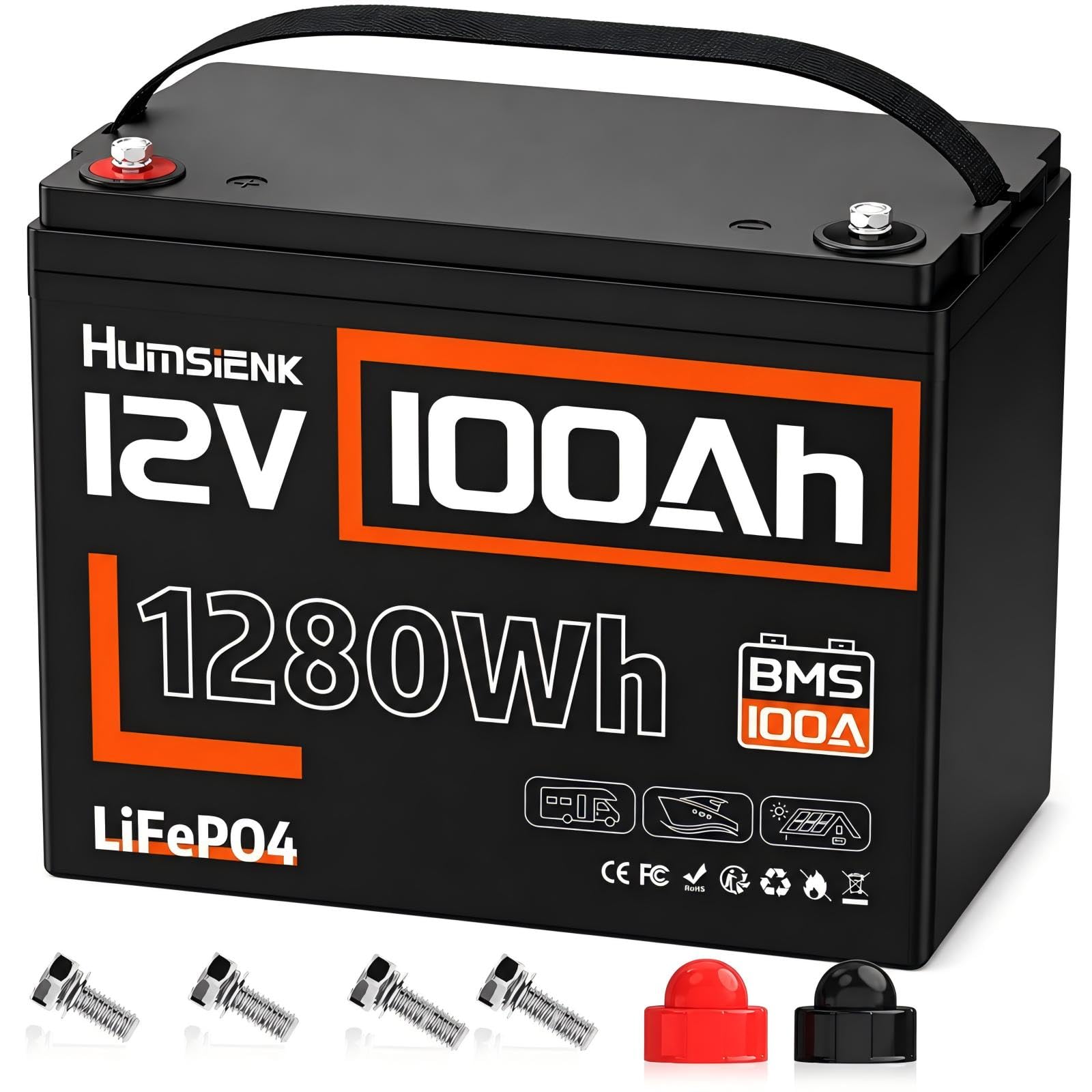
The lightest full-fat 100Ah here, slipping into a Group 24 box at under 20 pounds.
At 19.73 pounds, this is the lightest 100Ah battery in this lineup — a noticeable difference when you’re hauling it to a campsite or lifting it into a kayak. The compact 8.4 x 6.6 x 10.2-inch footprint fits BCI Group 24-31 standards, so it works in most standard trays. The nylon handle makes it genuinely easy to grab one-handed.
Fast charging is the headline feature: the maker claims a full recharge in just 2 hours, which is six times faster than the 14 hours a lead-acid equivalent takes. In real use, it powered a major kitchen appliance through a 2000W inverter, and ran an 8000 BTU air conditioner for 11 hours in Eco mode before draining to 50%. The Bluetooth app delivers per-cell data and dozens of alarm types, updating several times per second.
The battery life feedback is mixed — some report it holds charge perfectly, while others say it refuses a full charge. The terminal bolts are also short, and one owner saw a terminal overheat at a 780W draw before the bolt was swapped. The IP67 waterproofing is the highest rating in this list, so water exposure is less of a concern.
Best for Quick Turnarounds: The 2-hour full charge claim is the standout here — if you need your battery refilled between trips, this is the one.
Standout spec: IP67 waterproofing at a 19.73-pound weight — the lightest, wettest-friendly option in the lineup.
The caveat: verify your charger delivers a true LiFePO4 profile to avoid the full-charge issue some owners hit.
6. DC HOUSE 12V 100Ah Bluetooth LiFePO4 Battery
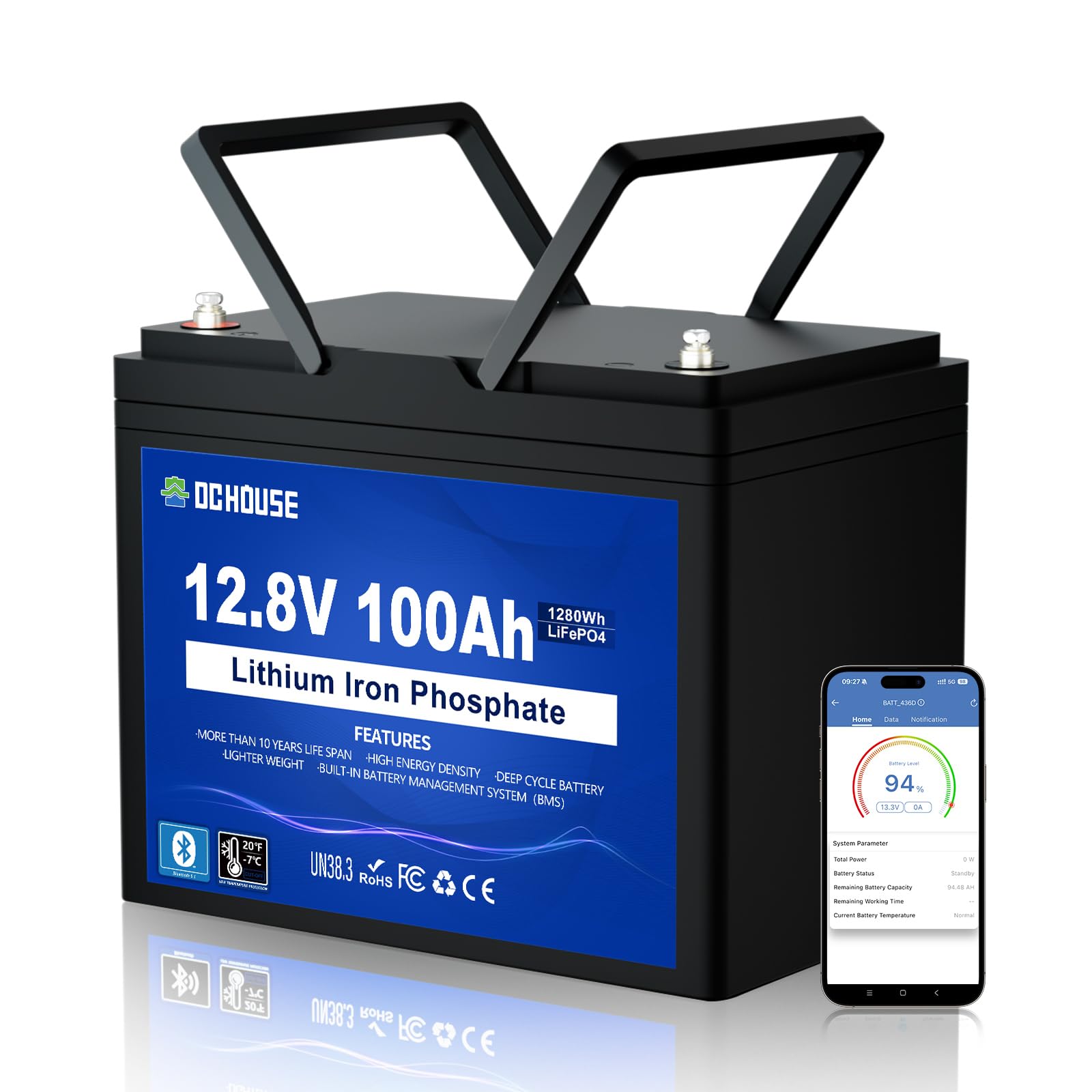
A trolling motor specialist that held 89% charge after six hours of fishing.
The battery life is the most-praised aspect here, with a 55lb thrust trolling motor running for six hours and never dropping below 89% charge. That’s the kind of real-world endurance that keeps you on the water all day without range anxiety. The Bluetooth 5.1 connection is accurate to the specific cell, and it has a fault display page for troubleshooting.
Weighing 23.8 pounds, it’s remarkably light for a full 100Ah pack, which makes it ideal for small boats and kayaks where every pound counts. The low-temperature cutoff stops charging below 19.4°F and cuts discharge below -4°F, automatically recovering above 32°F. There’s a 3-year service commitment backing the 15,000-cycle rating.
It’s dimensionally close to a Group 24 but runs about 0.32 inches taller than the standard spec, so check your box height. It also supports up to 8 batteries total in a 4-series/4-parallel configuration, though it does not allow the 4P4S combination.
Built for the Water: The combination of a precise Bluetooth readout and proven trolling motor endurance makes this the go-to for dedicated anglers.
Best for: fishermen running 55lb thrust motors who want live battery stats on their phone while out on the lake.
Check the fit: the 0.32-inch extra height over standard Group 24 could matter in a tight enclosed box.
7. WattCycle 12V 100Ah LiFePO4 Battery
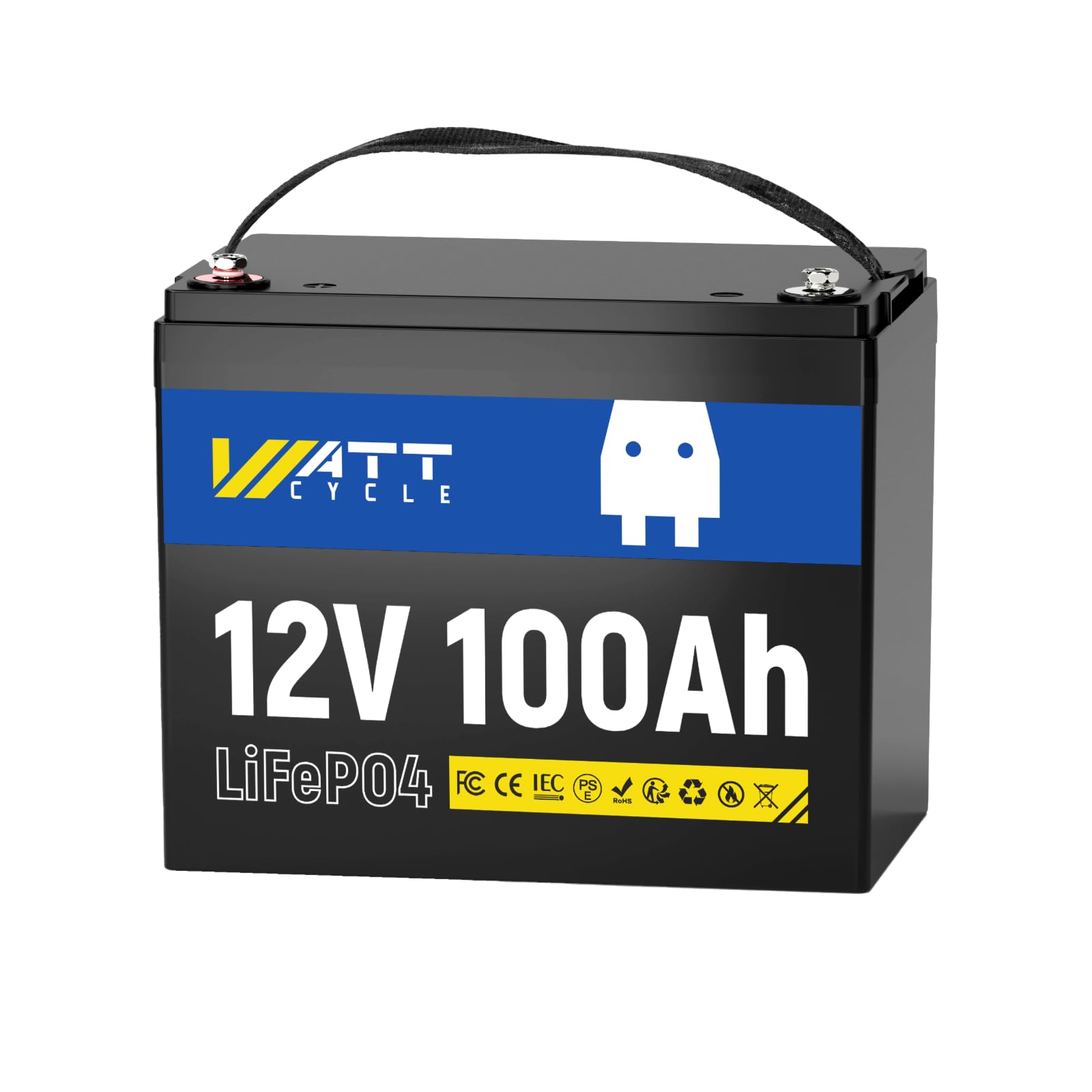
A telescope-toting premium cell that ran two observatories for a week without a recharge.
The quality here is what wins people over — owners praise the build and the consistent 12.8V output under load. One owner measured the charge at 46-47Ah in about 3 hours and 40 minutes, confirming the 100Ah rating is genuine. It powered two telescopes for a full week without needing a recharge, which is the kind of sustained, low-draw performance that matters for night-sky observation.
At 10.2 x 6.6 x 8.2 inches and 23.2 pounds, it fits snugly into a Group 24 box. The 100A BMS disconnects the battery if discharge current exceeds 300±50A, which is a generous safety margin for surge loads. It operates from -4°F to 158°F, so it handles both deep winter and summer heat without complaint.
The trade-off is a lack of built-in Bluetooth — owners add a third-party monitor to track state of charge. There’s also a note about a single battery in a series bank discharging about 0.15V faster than its siblings, which is a balancing quirk to watch in multi-battery setups.
No App, All Substance: For buyers who don’t care about phone connectivity and just want a dense, reliable power source, this delivers on the core promise without gimmicks.
Reach for this if: you run high-draw trolling motors or sensitive equipment like telescopes and want a proven 15,000-cycle cell.
Look elsewhere if: you want phone-based monitoring — this one has no Bluetooth, so you’ll add your own monitor.
8. ECO-WORTHY 12V 100Ah LiFePO4 Battery

The Bluetooth workhorse that ran a portable AC for ten hours on two packs in series.
The charging performance is the standout here, with owners praising how well it takes and holds a charge. A 12V 100Ah pair in series powered a portable air conditioner for over 10 hours, and a single unit ran diesel heaters for days on end. The Bluetooth 5.1 app shows voltage, current, and remaining capacity, plus estimates of working time left.
At 23.15 pounds and 10.23 x 6.6 x 8.43 inches, it’s a true Group 24 drop-in replacement. The built-in 100A BMS handles the standard protections, and the low-temperature cutoff stops charging below 19.4°F. Owners note the Bluetooth’s power drain is negligible, and the battery holds a 100% charge for weeks when not in use.
There is a catch: delivery can take up to three weeks, so it’s not the choice for an urgent install. The battery life feedback is also mixed, with some owners reporting it stops holding a charge over time, though the 3-year warranty backs it up.
Built for Audiovisual Rigs: The negligible Bluetooth drain and stable voltage make it a favorite for field audio, running a 300-watt guitar amp and 85-watt PA for hours.
Best for: RV and off-grid users who want app-based monitoring and a battery that holds its charge through long storage periods.
Plan ahead: the 3-week delivery window means this isn’t a same-week installation battery.
9. Power Queen 12V 100Ah LiFePO4 Battery
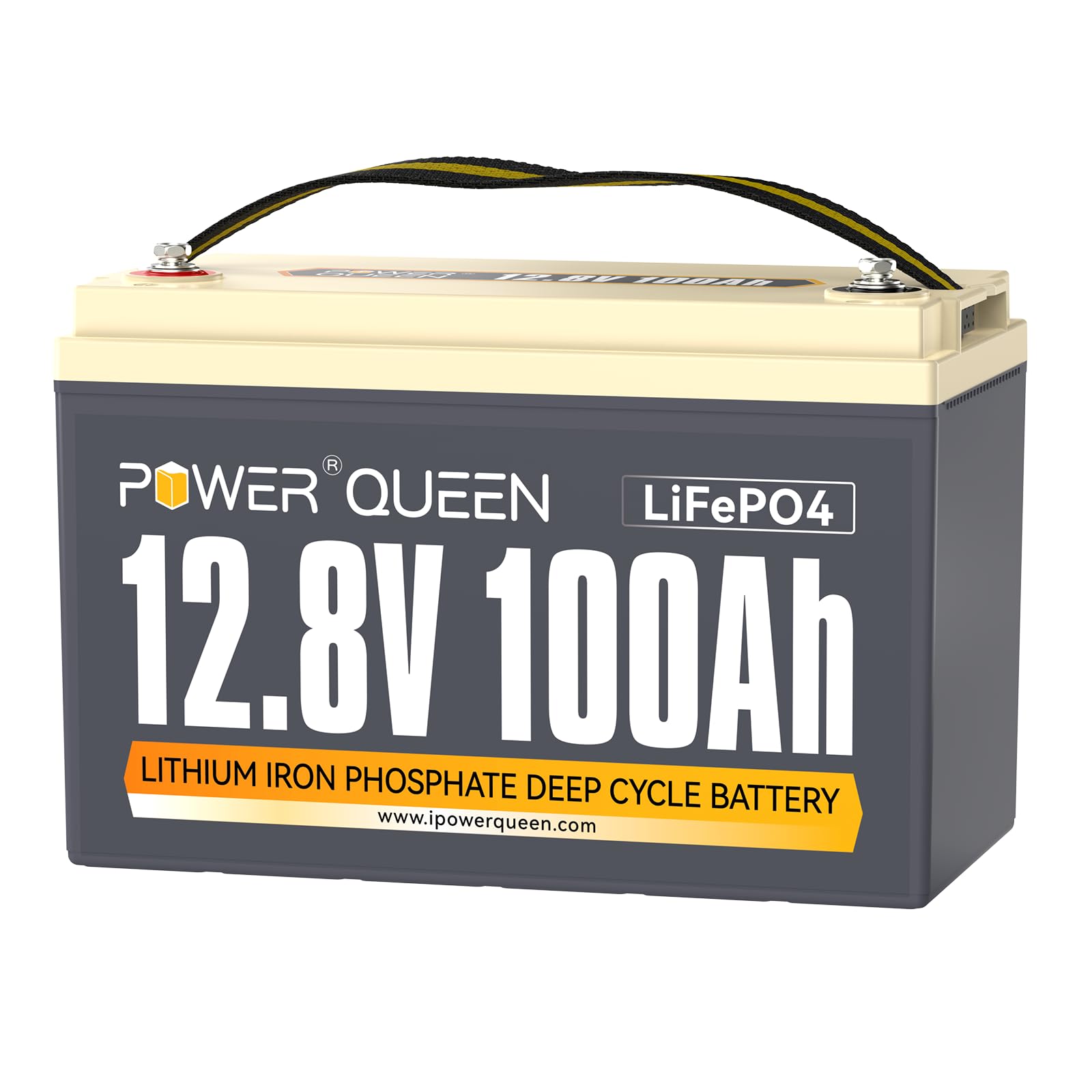
A marine veteran that powered 12 miles of trolling on a single charge across three trips.
The reliability is what this brand is known for — with the quality and reliability aspects getting nearly equal praise. A 100Ah Class 31 battery powered a trolling motor for roughly 12 miles across three separate trips, with capacity still in reserve. One owner described it like having a power plant for their shed, running a 300-watt guitar and 85-watt PA system for 6 hours straight.
At 24.3 pounds and a 12.99-inch length, it’s a true Group 31 fit. The 100A BMS offers the standard protections, and it’s rated for 15,000 deep cycles. It charges from empty in about 3 hours, which is competitive for the category.
The honest limitation is the lack of low-temperature charging cutoff — it’s not built for freezing winter charging like some rivals. There’s also a minor hardware gripe about the 6mm bolts being prone to cross-threading, so use care when tightening terminals. A single unit in a 36V golf cart setup did die after 4 days, though the seller’s support was responsive.
Best for Warm Climates: A reliable, high-capacity Group 31 for trolling and marine use where cold-weather charging isn’t a factor.
Reach for this if: you’re replacing lead-acid in a boat or golf cart in a mild climate and want a proven, trusted brand with strong reliability.
Pass if: you need to charge in freezing conditions — there’s no low-temp cutoff on this model.
10. Redodo 12V 100Ah LiFePO4 Battery
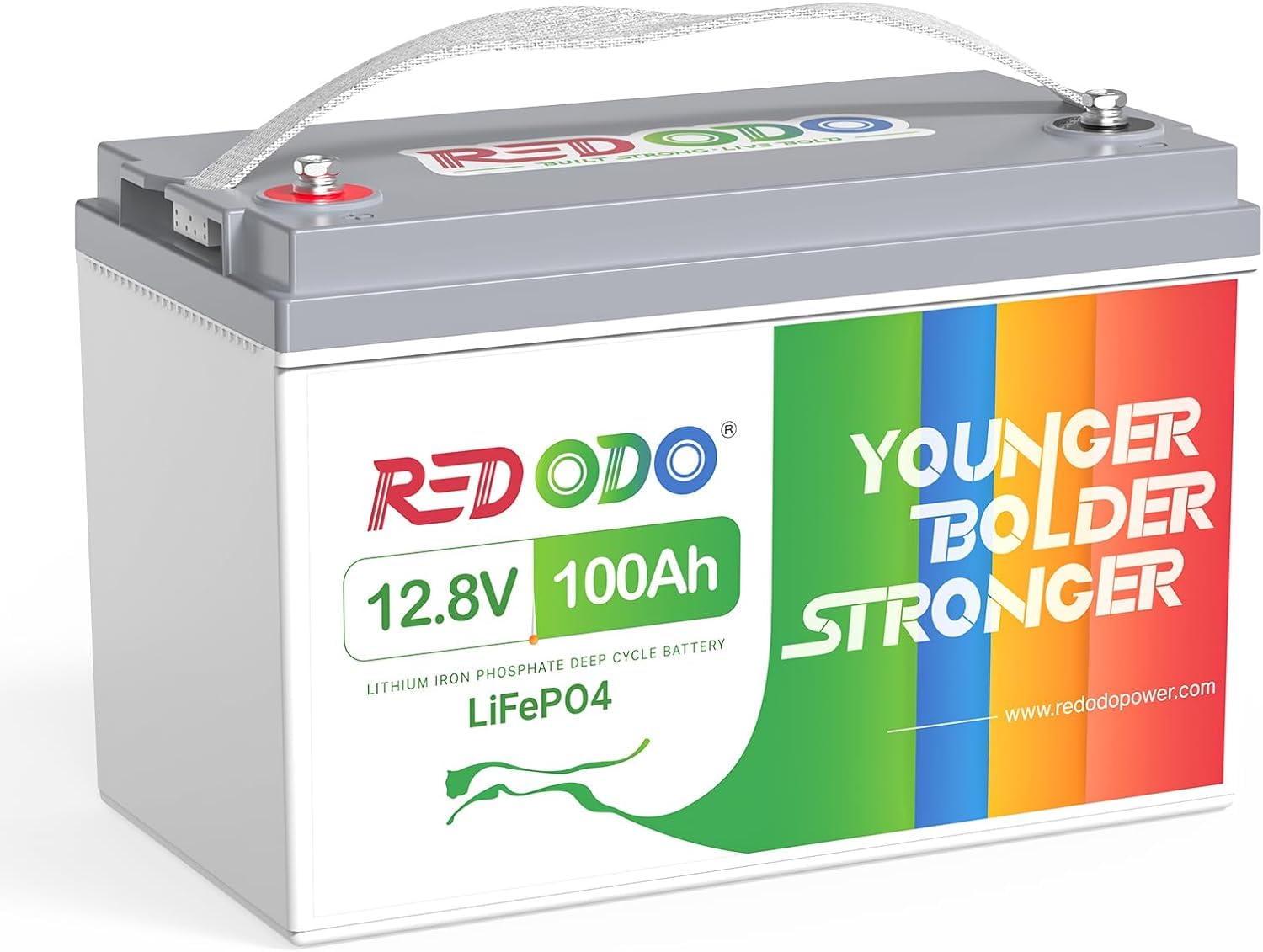
The long-haul champ, with owners running it for years in vans and boats.
The battery quality earns the most praise by a wide margin, and the long-term reviews back it up. One owner ran this battery in a van for a full year with 200W solar and a 1000W inverter, using 40-60Ah overnight and recharging in about 5 hours of sun. A pool cleaning company replaced lead-acid batteries that failed every 3-4 months with these and now runs all day without slowdown.
At 22.04 pounds and 13 x 6.77 x 8.43 inches, it’s a true Group 31 fit that’s 60% lighter than the lead-acid equivalent. The 100A BMS provides the standard protections, and the maker specifies a low self-discharge rate of just 3%. It’s rated for 4000 cycles at 100% depth of discharge, extending to 15,000 cycles at 60%.
The warranty support is a real strength — a battery that failed to charge after three years was replaced within days. The caveat is the battery life feedback is mixed, with a kayak trolling motor user seeing a failure after 4 years, though that was also covered under warranty.
Endurance Proven: With a track record of multi-year service in vans, boats, and commercial use, this is the pick for buyers who want a battery that simply keeps working.
Best for: off-grid vans and solar systems that need a dependable, high-cycle-count workhorse with proven long-term ownership support.
The trade-off: no low-temperature charging cutoff, so it’s not ideal for sub-freezing winter charging conditions.
Understanding the Specs
Depth of Discharge (DoD)
This tells you how much of the battery’s capacity you can safely use before recharging. A battery rated for 100% DoD, like the Litime, lets you drain it fully. Lead-acid batteries typically only allow 50% DoD, which means a 100Ah lithium gives you effectively double the usable power of a 100Ah lead-acid.
Battery Management System (BMS)
The BMS is the internal safety computer that protects the cells from overcharge, over-discharge, and short circuits. A 100A BMS rating means it can safely deliver up to 100 amps of continuous current — enough for most trolling motors and inverters. Low-temperature cutoff is a BMS feature to prioritize if you charge in cold weather, as charging below freezing can permanently damage lithium cells.
FAQ
What is the difference between Group 24 and Group 31 battery sizes?
Can I use my existing lead-acid charger on a LiFePO4 battery?
How long will a 100Ah lithium battery power my trolling motor?
Can I connect multiple 100Ah batteries in series or parallel?
What does low-temperature charging protection do?
Is a 100Ah lithium battery good for a golf cart?
How fast can a 100Ah lithium battery be charged?
What is the lifespan of a 100Ah lithium battery compared to lead-acid?
Do I need a battery with Bluetooth monitoring?
Can a 100Ah lithium battery start an engine?
Final Thoughts: The Verdict
The 100 amp hour lithium battery winner is the Litime 12V 100Ah because it pairs a top-tier 4.6-star reputation with Bluetooth monitoring and a 10-year design life that suits most RV and solar setups. If you want a featherweight budget drop-in with a 5-year warranty, grab the SUPER EMPOWER. And for a proven long-haul workhorse with outstanding owner support, the Redodo is the one to reach for — its quality is the most-praised aspect in the entire lineup.
How We Picked
We do not accept paid placement. Every pick is matched to a real buyer and a real use-case; we do not hands-on test units.
Sources & Methodology
Specifications: manufacturer listings and product documentation. Review insights: verified customer reviews, as of August 2026. Pricing: not shown on this page (it changes often); check the current price via the retailer link.
As an Amazon Associate, Gadgets Feed earns from qualifying purchases. This does not affect which products we feature.