
Hooking up a reliable off-grid power system starts with the right panel, and a 100-watt module hits the sweet spot for RVs, camping, emergency backup, and small cabin setups. The challenge is cutting through the noise of efficiency claims, connector types, and build quality to find a panel that delivers its rated wattage day after day without disintegrating in the sun or rain.
I’m Min — the co-founder and writer behind Gadgets Feed. I’ve spent hundreds of hours cross-referencing manufacturer spec sheets, customer performance reports, and real-world output tests to separate the genuine high-performers from the overhyped knockoffs in this crowded solar panel market.
After comparing cell efficiency, connector compatibility, portability, and weather sealing across nine different models, this guide builds a clear picture of what truly makes the best 100 amp solar panel for your specific power needs and budget tier.
How To Choose The Best 100 Amp Solar Panel
Not all 100W panels are created equal. The difference between a panel that consistently pumps out 95W and one that struggles to hit 70W comes down to cell quality, bypass diodes, and the type of charge controller included. You need to match the panel’s electrical characteristics — specifically its open-circuit voltage and maximum power current — to your battery bank and power station’s input limits.
Cell Technology and Efficiency Percentage
Monocrystalline silicon cells dominate the 100W category for a reason: they convert sunlight more efficiently than polycrystalline panels, especially in low-light or partial-shade conditions. Look for panels using A+ grade cells with at least 22% efficiency. N-type cells and PERC (Passivated Emitter and Rear Cell) technology push that number past 24%, meaning more wattage per square foot and better performance when the sun isn’t directly overhead.
Portable vs Rigid Form Factor
Your mounting scenario dictates the panel’s physical design. Foldable suitcases with kickstands weigh between four and ten pounds and are ideal for camping, car travel, and temporary setups — they sacrifice some peak efficiency for convenience. Rigid aluminum-framed panels with tempered glass are heavier (fifteen pounds or more) but offer higher real-world output, better heat dissipation, and the ability to bolt permanently to a roof or ground mount. If you need to move the panel daily, go portable. If you want a fixed station that stays in one spot for years, go rigid.
Output Connectors and Voltage Matching
A 100W panel typically outputs between 18V and 24V open-circuit, which is sufficient to charge a 12V battery through an MPPT or PWM controller. But the physical connector — MC4, XT60, Anderson, DC8020, or DC5521 — must match your power station or charge controller. Panels that include multiple adapter cables or a true 5-in-1 cable eliminate the frustration of buying separate adapters. Also verify the panel’s maximum amperage (around 5 to 5.5 amps for most 100W panels) to ensure your charge controller can handle the input.
Quick Comparison
On smaller screens, swipe sideways to see the full table.
| Model | Category | Best For | Key Spec | Amazon |
|---|---|---|---|---|
| Renogy E.Flex 100W | Portable | Ultra-light camping & power station charging | 25% N-Type cell efficiency, 7.3 lbs | Amazon |
| SOLPERK 100W Kit | Complete Kit | Permanent battery maintenance with MPPT | 10A MPPT controller, 30% cell efficiency | Amazon |
| ECO-WORTHY 2-Pack | Rigid | Fixed roof or ground-mount off-grid systems | 25% PERC cells, 5400Pa snow load | Amazon |
| Renogy Flexible 100W | Flexible | Curved RV roofs and uneven surfaces | 0.08in thin, 4 lbs, 22% efficiency | Amazon |
| ZOUPW 100W | Portable | Universal power station compatibility | True 5-in-1 cable, IP67, 23.5% efficiency | Amazon |
| Topsolar 100W Kit | Complete Kit | DIY off-grid battery charging with brackets | 30A PWM controller, V-mount bracket | Amazon |
| FlexSolar 100W | Ultra-Portable | Backpacking and airline-friendly travel | 4.1 lbs, folds to laptop size | Amazon |
| DOKIO 100W Suitcase | Suitcase | RV supplemental power with LCD controller | Built-in 10A PWM, N-type cells | Amazon |
| EBL 100W | Portable | Expandable system with series/parallel | 23.5% efficiency, IP65, expandable | Amazon |
In‑Depth Reviews
1. Renogy 100 Watt Solar Panel (E.Flex)

The Renogy E.Flex uses 16BB N-Type cells to hit 25% efficiency, which is the highest rating among portable 100W panels in this roundup. In real-world tests, owners report consistent 87-100W output in full sun, and the magnetic closure and quad-fold design make deployment trivial compared to Velcro or snap-style competitors. The 7.3-pound weight undercuts most comparable models by nearly two pounds, and the 0.08-inch thin cells allow it to pack down to a 23-inch square that slides easily behind a car seat.
Output versatility is strong: the panel provides a USB-C PD port delivering up to 45W, two USB-A ports (18W and 15W), and MC4 output for connecting to power stations or 12V battery systems. The three-position kickstand (40°, 50°, 60°) gives good sun-angle flexibility, and the IP65 rating handles rain and dust without issue. The included MC4 cable is only 3 feet long, so you will need an extension for most power station setups, and the USB-C maxes out at 40W rather than the advertised 45W according to some users.
UL 61730 certification adds a layer of safety verification that budget panels often skip. Owners running two units in series report 195W net output after heating losses, confirming the panel’s electrical stability. The storage pocket is tight for longer cables, and the panel needs stakes or weights in windy conditions, but the performance-to-weight ratio is the best in class for portable use.
Why it’s great
- Industry-leading 25% efficiency from N-Type cells
- Lightest portable 100W panel at 7.3 pounds
- Magnetic closure and 3-angle kickstand for quick setup
- UL 61730 certified for electrical safety
Good to know
- MC4 cable is only 3 feet long — extension needed for most setups
- USB-C PD output caps at 40W in testing, not 45W
- Needs staking in moderate wind due to lightweight design
2. SOLPERK 100W Solar Battery Charger Kit

The SOLPERK 100W kit stands apart because it bundles a fully waterproof 10A MPPT charge controller right in the box — a controller that, by the manufacturer’s claim, harvests over 30% more power than a standard PWM unit. The A+ monocrystalline cells are rated at 30% efficiency (a peak lab figure), and the panel itself is a rigid tempered-glass design with an aluminum frame and pre-drilled holes for permanent mounting. Daily energy generation sits around 400 watt-hours in four hours of peak sun.
The MPPT controller provides comprehensive protection against overcharging, deep discharge, reverse polarity, and short circuits, and its waterproof housing can be fully submerged — a rare feature for a charge controller in this price tier. The kit includes Z-mounting brackets, alligator clips, and O-ring connectors, making it a turnkey solution for attaching to a 12V battery bank in an RV, shed, or boat. Owners report that the panel reliably delivers its rated wattage even after consecutive cloudy days.
The trade-off is that the controller lacks a digital display showing wattage or amp-hours, which some users find inconvenient for monitoring system performance. The panel itself weighs around 12 pounds and measures 35 inches long — it is not designed for frequent portability but rather for semi-permanent or permanent installation. The MPPT’s efficiency gain is meaningful: users upgrading from PWM controllers notice faster battery recovery, especially during winter months with limited sunlight.
Why it’s great
- Includes a fully waterproof 10A MPPT controller
- 30% peak cell efficiency for maximum daily harvest
- Complete kit with mounting brackets and alligator clips
- Comprehensive battery protection features
Good to know
- Charge controller has no digital wattage display
- Heavier rigid design limits portability
- Panel dimensions too large for compact roof spaces
3. ECO-WORTHY 2pcs 100 Watt Solar Panels
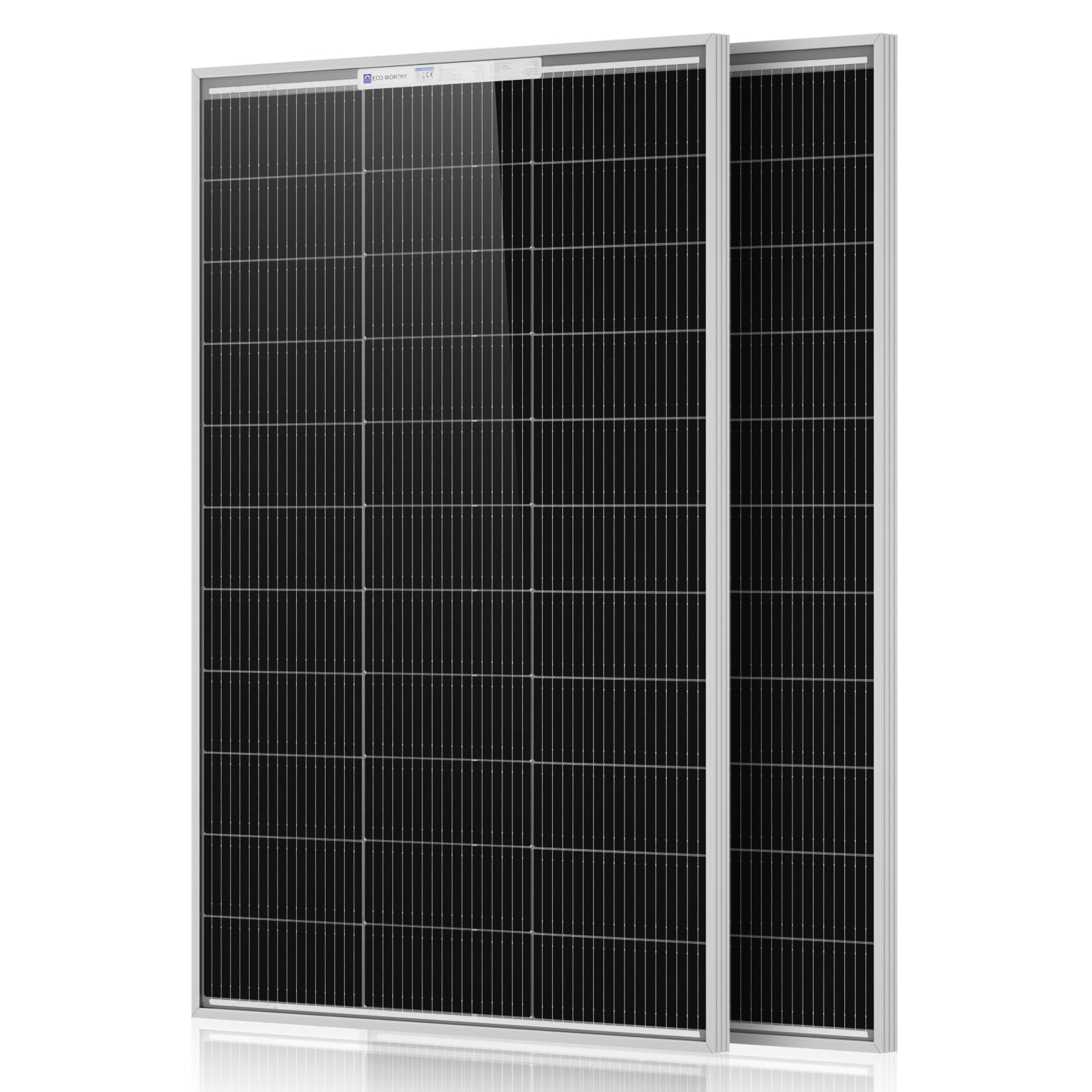
The ECO-WORTHY 2-Pack delivers two rigid 100W panels with PERC technology pushing cell efficiency to 25%, which translates to a combined daily output of approximately 800 watt-hours under four hours of peak sun. Each panel measures 35.6 inches by 23 inches with a 1.18-inch thick frame that provides rapid heat dissipation and structural rigidity. The 5400Pa snow load and 2400Pa wind load ratings mean these panels can survive heavy winter weather on a roof or ground mount.
The panels come with pre-installed 35-inch MC4 cables and an IP68-rated junction box with bypass diodes to minimize power loss from partial shading. Owners consistently report real-world output of 95-105W per panel in clear winter conditions, and the aluminum frame with pre-drilled holes makes installation straightforward even for first-time DIYers. Weighing 11.46 pounds each, they are lighter than many competing rigid panels, which simplifies rooftop handling.
The primary consideration is packaging: some units arrive with cracked glass due to insufficient corner protection during shipping, though Amazon and ECO-WORTHY handle replacements. The panels are sold as a pair only, so if you need an odd number, this configuration won’t work. The 25-year lifespan estimate is supported by the corrosion-resistant frame and tempered glass build, and users running four panels in series report stable performance over multiple years of continuous use.
Why it’s great
- 25% PERC efficiency with 800Wh daily output per pair
- IP68 junction box and bypass diodes for shade tolerance
- 5400Pa snow load and 2400Pa wind load ratings
- Lightweight rigid design at 11.46 lbs each
Good to know
- Packaging may not prevent shipping damage to glass
- Sold only as a 2-pack, not individually
- No charge controller included in the box
4. Renogy Flexible Solar Panel 100 Watt

The Renogy Flexible 100W panel is purpose-built for curved surfaces where rigid glass panels cannot mount — think Airstream roofs, van tops, boat decks, and camper shells. At just 0.08 inches thick and weighing 4 pounds, it is 70% lighter and 95% thinner than a standard rigid panel. The polymer and aluminum alloy construction allows it to conform to a radius of curvature without cracking, and the 22% monocrystalline efficiency is respectable for a flexible panel.
Durability testing shows the panel withstands 2400Pa wind loads and 5400Pa snow loads, matching the specs of many rigid competitors. Users report successful installations on minivan roofs using RV mounting tape, and the panel’s low profile makes it nearly invisible once mounted. The 5-year warranty from Renogy is longer than most portable panels offer. Owners running two panels in parallel on a van setup report peak combined output of 175W over three years of daily use.
The trade-off is that flexible panels inherently run hotter than their rigid counterparts because they lack an air gap for heat dissipation, which can reduce efficiency in extreme heat. The panel is also more susceptible to micro-cracks from repeated flexing or improper installation, so it must be mounted on a smooth, clean surface without sharp pressure points. The 4-pound weight makes it easy to handle, but the semi-flexible design means it cannot be folded like a suitcase panel — it rolls for storage.
Why it’s great
- Extremely thin and light at 4 pounds
- Conforms to curved surfaces for flexible mounting
- 5-year warranty for long-term reliability
- Withstands 5400Pa snow load despite thin profile
Good to know
- Runs hotter than rigid glass panels, reducing efficiency
- Susceptible to micro-cracks if over-flexed during installation
- Requires perfectly clean and smooth mounting surface
5. ZOUPW 100W Portable Solar Panel

The ZOUPW 100W panel’s defining strength is its true 5-in-1 solar cable, which includes DC8020 (for Jackery Explorer 1000V2 and up), XT60 (EcoFlow DELTA/RIVER, Anker C300), Anderson (Jackery 1000 original), DC7909/8mm (Jackery 240/300/500, Bluetti EB3A/EB70), and DC5521 for generic lithium batteries. This eliminates the need for separate dongles and adapters, making it the most plug-and-play portable panel for multi-brand power station owners. The 23.5% efficiency from A+ monocrystalline cells is competitive, and the 45° adjustable kickstands capture up to 25% more sunlight than flat-laying panels.
The IP67 waterproof rating with ETFE lamination means the panel itself can withstand rain, splashes, and even brief submersion, while the zippered pocket keeps the built-in controller and cables dry. Owners consistently report strong performance with Jackery and EcoFlow units, with one user noting the panel charged a Jackery Explorer 300 from 84% to 100% in 20 minutes on a cloudy day. The 10-foot cable length provides flexible positioning, and the magnetic handle makes carrying the 9.48-pound unit less awkward.
The USB-C PD port outputs 45W, and the two USB-A ports include QC3.0 for direct device charging without a power station. The kickstands are not angle-adjustable in fine increments — only the fixed 45° position — which limits optimization during early morning or late afternoon. Some users note the panel runs slightly heavier than expected for longer backpacking trips, but for car camping and RV use, the universal connector set outweighs the weight penalty.
Why it’s great
- True 5-in-1 cable fits Jackery, EcoFlow, Anker, Bluetti and more
- IP67 waterproof with ETFE lamination for wet conditions
- 10-foot cable for flexible sun positioning
- USB-C PD 45W and QC3.0 for direct device charging
Good to know
- Kickstands only offer a single fixed angle
- Heavier than ultra-portable competitors at 9.48 lbs
- USB-C capped at 45W, not suitable for larger laptops
6. Topsolar 100W 12V Solar Panel Kit

The Topsolar kit bundles a rigid 100W monocrystalline panel with a 30A PWM charge controller and a V-shape tilt rack bracket, creating a complete self-contained charging station for 12V battery systems. The 30A controller is oversized for a single 100W panel (which typically outputs around 5.5 amps), but it leaves headroom for expanding the array with additional panels in parallel. The kit also includes two 16-foot MC4 cables and two 5-foot O-ring cables, giving you 42 feet of wiring total for flexible placement between panel and battery.
The panel itself measures 46.5 inches by 21.8 inches with a 1.37-inch thick aluminum frame and tempered glass coating. The V-mount bracket adjusts the tilt angle for seasonal sun optimization, and the pre-drilled holes allow mounting on wood, walls, or the ground. Owners report solid performance charging tractor batteries, RV banks, and gate opener systems, with one user running two panels in parallel for a multi-vehicle battery maintenance setup over three years without issues.
The PWM controller lacks the efficiency gains of an MPPT unit, which matters if you frequently charge in partial shade or during winter. Some users found the controller’s voltage selection (12V/24V) difficult to switch without disconnecting the battery and panel in a specific sequence. The panel weighs 15.84 pounds, making it one of the heavier single-panel kits in this roundup, but the included bracket and cables reduce the need for additional purchases.
Why it’s great
- Complete kit with 30A PWM controller and V-mount bracket
- 42 feet of total cable length included for flexible routing
- Sturdy tempered glass panel with aluminum frame
- Adjustable tilt bracket for seasonal sun angle optimization
Good to know
- PWM controller is less efficient than MPPT alternatives
- Heavy at 15.84 pounds — not for portable use
- Controller voltage switching can be tricky
7. FlexSolar 100W Portable Solar Panel
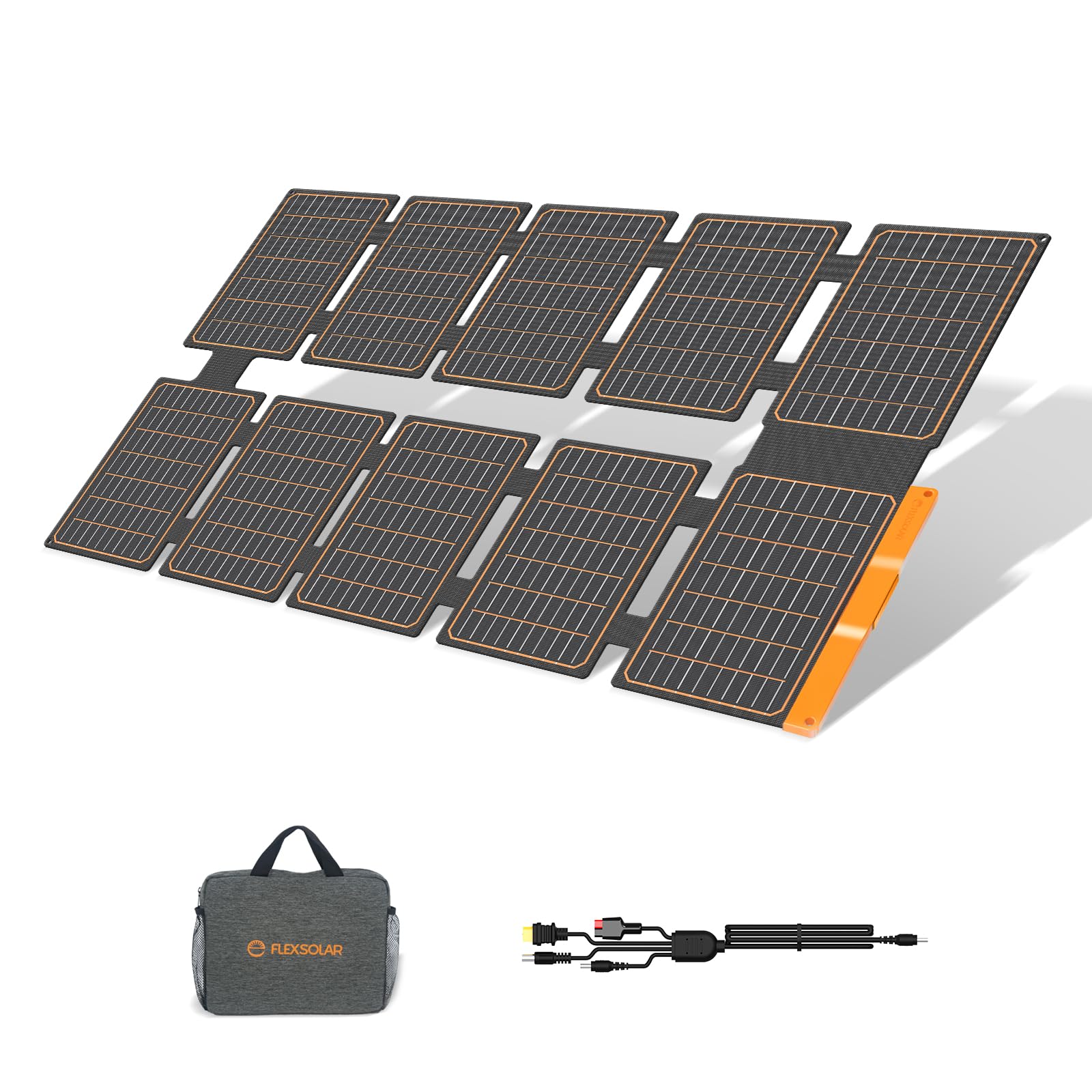
At 4.1 pounds with a folded size of 13 inches by 10.4 inches — roughly the footprint of a 13-inch laptop — the FlexSolar 100W panel is the most travel-friendly option in this review. The IP67 waterproof rating and military-grade ETFE lamination provide genuine submersion protection, which is unusual for a panel this light. The 24% monocrystalline cell efficiency is competitive with heavier premium panels, and users report real-world output of 88W in December winter conditions when angled correctly.
The 4-in-1 cable (XT60, Anderson, DC5521, DC8MM) covers compatibility with Jackery, EcoFlow, Bluetti, Anker, and most power stations. Built-in USB-C PD at 45W and QC3.0 USB-A at 18W allow direct device charging without an intermediate power station. Owners consistently praise the fold-and-go design, noting it fits easily into a standard backpack alongside camping gear, and the included carabiners allow hanging from a backpack while hiking to charge on the move.
The panel’s blanket-style construction means it lacks rigid kickstands — you need a flat surface, a hanging point, or a propped angle to achieve peak output. Some users report a slight electrical burning smell during initial use, which typically dissipates after a break-in period. The 1-year warranty is shorter than Renogy’s 5-year or ECO-WORTHY’s implied long-term durability, but the extreme weight savings make this the go-to choice for backcountry hikers and minimalist travelers.
Why it’s great
- Ultra-light at 4.1 pounds with laptop-sized folded footprint
- IP67 waterproof with ETFE lamination for rugged weather use
- 24% efficiency with 88W real-world winter output
- 4-in-1 cable covers major power station brands
Good to know
- No rigid kickstands — needs flat surface or hanging point
- Some users report initial electrical burning smell
- 1-year warranty is shorter than competitors
8. DOKIO 100W Portable Solar Panel Suitcase
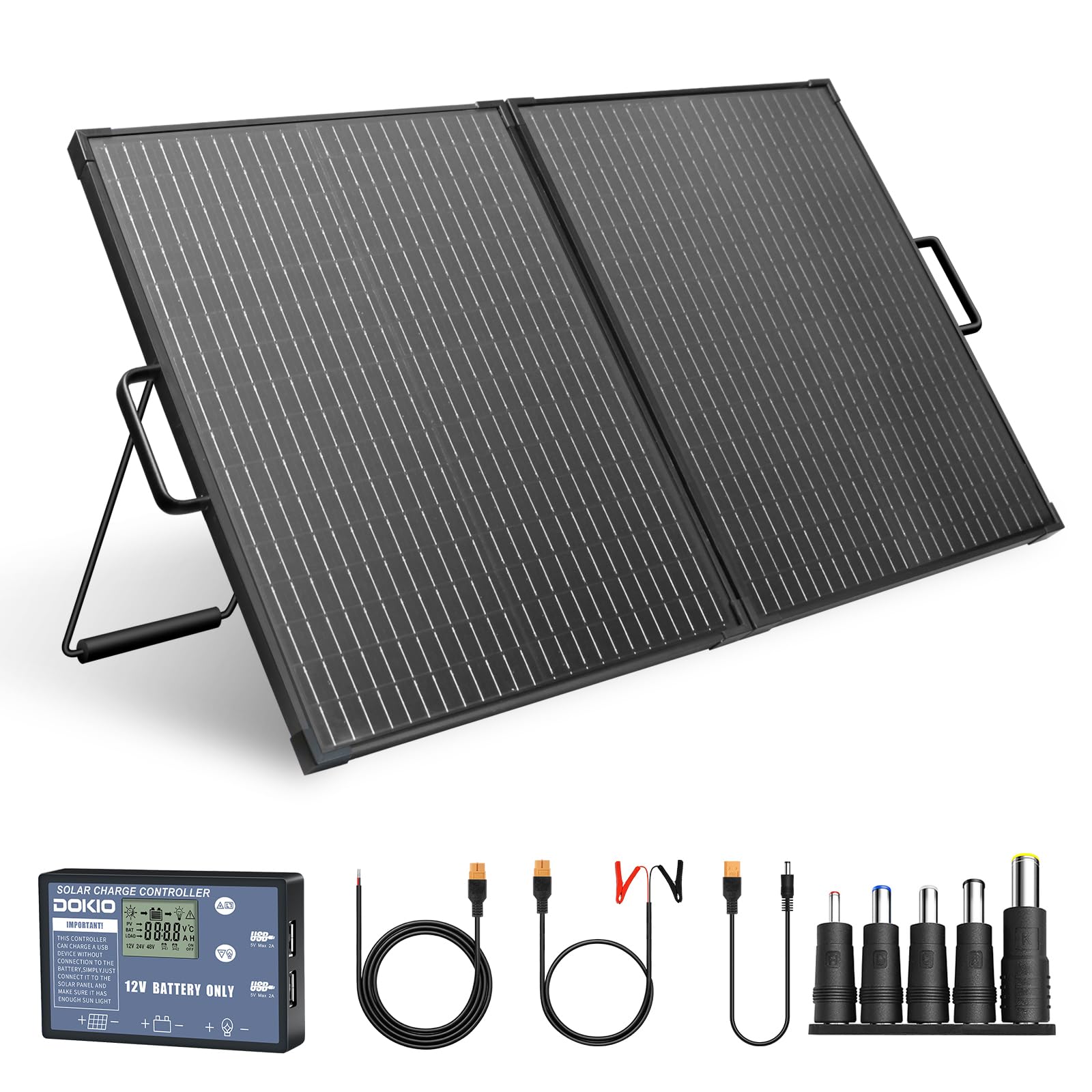
The DOKIO 100W suitcase integrates a detachable LCD charge controller directly into the panel frame, giving you real-time readouts of charging voltage, current, and battery status without needing an external monitor. The N-type monocrystalline cells and 30° adjustable bracket allow for reasonable sun tracking, and the 9.8-foot extended cable provides flexibility to position the panel in sunlight while the controller stays near the battery. The corrosion-resistant aluminum frame and reinforced corner guards are designed for all-weather durability from -40°F to 185°F.
Built-in protections include reverse polarity, overcharge, short circuit, and reverse current, and the 5V 2A USB port can charge phones directly. The kit includes five DC adapter plugs (DC35135, DC5521, DC5525, DC6440, DC80) for broad compatibility with power stations and battery systems. Owners report strong performance during week-long beach camping, powering smartphones, a fan, and a mini-fridge simultaneously, with decent output even on cloudy days.
Quality control is inconsistent: some units arrive with shattered glass panels, chipped cells, or failing bag handles. The kickstand legs are wobbly and may damage the panel if folded carelessly. The 10.14-pound weight is manageable but not backpack-friendly, and the glass panel design requires careful handling during transport. The 10-year power output warranty is generous, but customers note that initial product condition varies significantly between units.
Why it’s great
- Integrated LCD charge controller for real-time system monitoring
- N-type cells and 30° adjustable bracket for good sun tracking
- 10-year power output warranty for long-term confidence
- Five DC adapter plugs for broad compatibility
Good to know
- Quality control varies — some units arrive with damage
- Wobbly kickstand legs may fold unexpectedly
- Glass panel construction requires careful transport
9. EBL 100W Solar Panel
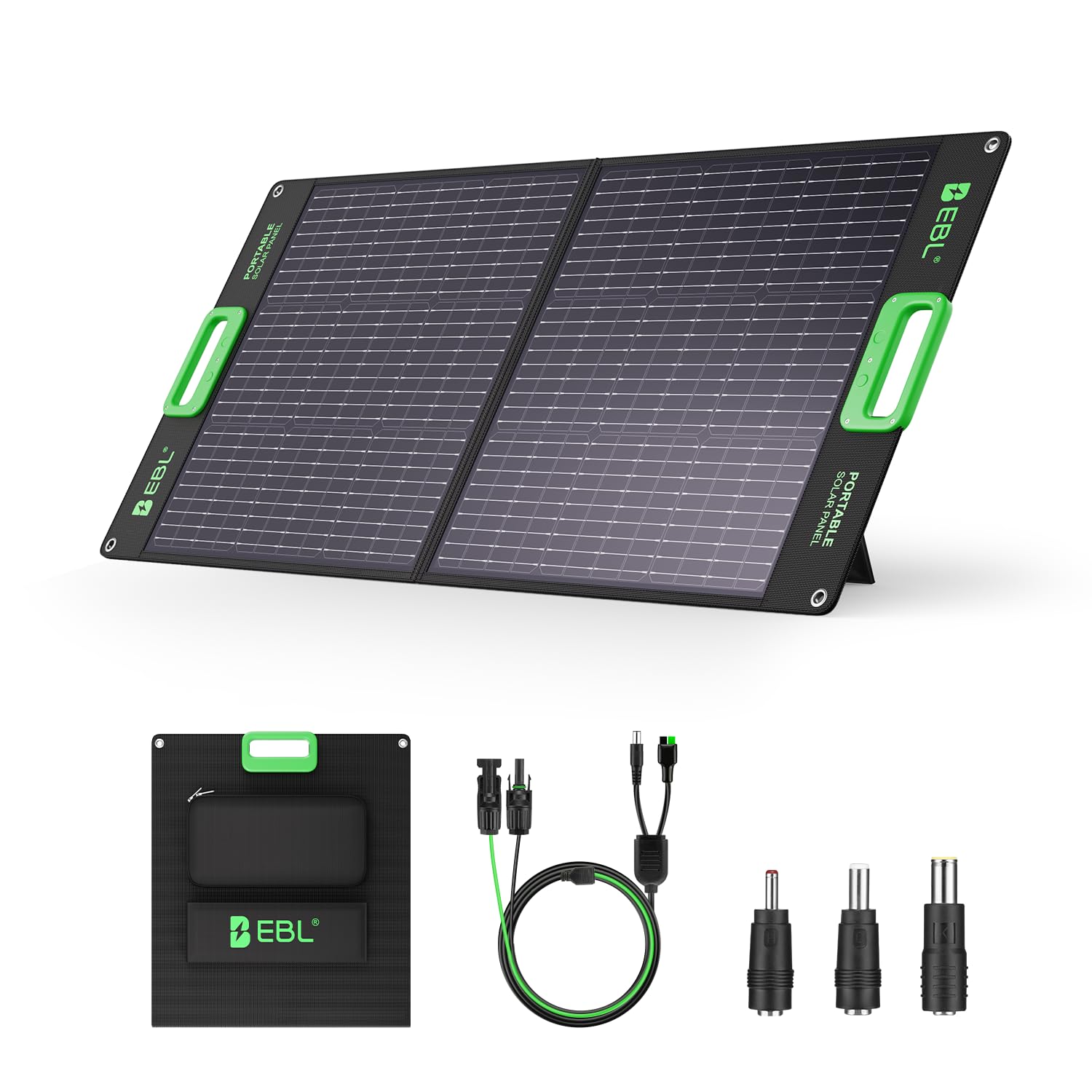
The EBL 100W panel is designed with scalability in mind, supporting both series and parallel connections so you can pair it with a second panel to double voltage or current output. The 23.5% monocrystalline efficiency is solid, and the smart IC chip automatically adjusts charging speed to match the connected device while protecting against overcharging. The kit includes multiple DC adapters (7.9mm, 5.5×2.5mm, 3.5×1.35mm, 5.5×2.1mm) and an Anderson cable, making it optimized for EBL solar generators but broadly compatible with other brands.
The ETFE lamination and IP65 rating provide splash and dust resistance, though the panel should avoid extended rain exposure or submersion. The foldable briefcase design includes integrated kickstands, reinforced grommets for mounting, and a zippered pouch for storing cables and adapters. Owners report stable, efficient power delivery even on cloudy days, with one user noting their EcoFlow Delta 2 stayed fully charged throughout a day of use. Weighing approximately 8 pounds, it splits the difference between ultra-portable and mid-range models.
The IP65 rating is less robust than the IP67 found on the FlexSolar or ZOUPW panels, so it is not ideal for marine or heavy-rain environments. Some users found the included cables shorter than expected for positioning the panel away from the power station in full sun. The 2-year warranty is fair but shorter than the 5-year or 10-year terms offered by Renogy and DOKIO. For users planning to build an expandable array over time, the series/parallel flexibility justifies the slightly lower waterproof rating.
Why it’s great
- Supports series and parallel connections for system expansion
- Smart IC chip for automatic speed adjustment and overcharge protection
- ETFE lamination and IP65 for outdoor durability
- Multiple DC adapters for broad power station compatibility
Good to know
- IP65 rating is less waterproof than IP67 alternatives
- Cables may be too short for distant panel placement
- 2-year warranty is shorter than some competitors
FAQ
Can a 100W solar panel run a refrigerator?
What is the difference between IP65 and IP67 waterproof ratings for solar panels?
How many amp hours will a 100W solar panel produce in a day?
Do I need a charge controller between a 100W solar panel and a battery?
Final Thoughts: The Verdict
For most users, the best 100 amp solar panel winner is the Renogy 100W E.Flex because it delivers the best combination of 25% cell efficiency, 7.3-pound portability, and USB-C output in a UL-certified package. If you want a complete turnkey kit with a waterproof MPPT controller, grab the SOLPERK 100W Kit. And for a permanent off-grid installation where panel pairs make sense, nothing beats the value and durability of the ECO-WORTHY 2-Pack.