
Adding a workshop, a newly finished basement, or a detached garage almost always comes down to one decision: how do you feed power from the main panel without risking voltage drop, tripping the feeder breaker, or running out of spaces for future circuits? A dedicated subpanel rated for 100 amps solves that problem by distributing power close to where you actually need it, but choosing the wrong enclosure — too few spaces, incompatible breakers, or a bus bar that can’t handle the load — turns a straightforward project into a costly rework.
I’m Rikta — the co-founder and writer behind Gadgets Feed. I spend my time comparing bus bar materials, breaker compatibility charts, and knock-out patterns so you don’t have to sort through a dozen product manuals just to find a panel that fits your feeder cable and local code. (And Homer 🐱 inspected each box for the ideal cardboard fort potential before I could get a tape measure near them).
Whether you’re feeding a home workshop, a rental unit, or an EV charger station, the right enclosure balances circuit count, wire bending space, and neutral-ground separation. This guide breaks down the best options to help you match the panel to the job — a reliable 100 amp sub panel starts with knowing what your installation actually demands.
How To Choose The Best 100 Amp Sub Panel
Picking a subpanel isn’t just about matching the amperage rating on the label. You need to consider the physical enclosure size, the bus bar material, the number of breaker spaces, and whether the panel supports plug-on neutral for modern arc-fault breakers. A few extra minutes comparing these details saves hours of retrofit work later.
Spaces vs. Circuits — Read the Fine Print
A panel listed as “20-space, 40-circuit” means it holds 20 full-size breakers but accepts tandem breakers to double the circuit count. If you only need 12 circuits now, buy a 20-space panel so you have room to expand without cramming tandems into every slot.
Bus Bar Material — Aluminum vs. Copper
Tin-plated aluminum busses are standard in most budget and mid-range panels; they handle 100 amps fine when connections are torqued correctly. Copper busses offer marginally lower resistance and are preferred in high-moisture environments or by electricians who value long-term corrosion resistance, but they raise the price considerably.
Neutral and Ground Configuration
In a subpanel, the neutral and ground buses must be isolated from each other — the bonding screw or strap is removed during installation. Some panels ship with a single ground bar; others include two. If your panel has many circuits, having extra ground bars on both sides keeps wiring organized and code-compliant.
Quick Comparison
On smaller screens, swipe sideways to see the full table.
| Model | Category | Best For | Key Spec | Amazon |
|---|---|---|---|---|
| Siemens PN3030B1100C | Premium | Maximum expansion & copper bus | 30-space, 30-circuit, copper main bus | Amazon |
| Leviton LP210-BPD | Premium | Innovative wiring & clean aesthetic | 20-space, 20-circuit, tin-plated copper bus | Amazon |
| Square D HOM1224M100PC | Mid-Range | Plug-on neutral & tandem compatibility | 12-space, 24-circuit, plug-on neutral | Amazon |
| Siemens SN2040B1100 | Mid-Range | Best value for 40 circuits | 20-space, 40-circuit, plug-on neutral | Amazon |
| Siemens E0816ML1125S | Mid-Range | Compact 8-space for tight spaces | 8-space, 16-circuit, 125A rated | Amazon |
| Siemens W0202MB1100CU | Premium | Outdoor 2-space service disconnect | 2-space, 4-circuit, outdoor NEMA 3R | Amazon |
| Square D HOM2100 | Budget | Replacement 100A double-pole breaker | 2-pole, 100A, 120/240V | Amazon |
In‑Depth Reviews
1. Siemens PN3030B1100C

The Siemens PN Series PN3030B1100C is the most future-proof indoor subpanel in this lineup. It delivers 30 full-size spaces, a copper main bus bar for superior conductivity, and two factory-installed ground bars that make separating neutral from ground simple — no extra components to buy. The plug-on neutral design accommodates Siemens arc-fault and ground-fault breakers without pigtails, keeping the interior tidy.
With a 22 kA interrupting rating and a 120/240 V single-phase configuration, this panel handles heavy shop equipment or multiple 240 V circuits comfortably. The 4-inch wire bending space exceeds code requirements, making it easier to land 2/0 AWG feeder cables without fighting the enclosure. Owners who installed it upside down (main breaker at the bottom) report clean wire routing and no functional issues.
This panel hits a premium price point, but the cost reflects genuine upgrades: copper bussing, a 30-space capacity that outgrows any residential expansion, and dual ground bars that save an hour of installation time. If your project demands high current draw and you want room to double circuits later, this is the one to buy.
Why it’s great
- 30 full-size spaces — rarely run out of room for new breakers
- Copper bus bar offers lower resistance than standard aluminum
- Two factory-installed ground bars simplify subpanel wiring
Good to know
- Premium cost may be overkill for a small 4-6 circuit garage
- Cover fit sometimes requires minor adjustment out of the box
2. Leviton LP210-BPD

The Leviton LP210-BPD breaks the mold with a white powder-coated finish and a radical wiring approach: you wire the entire enclosure at rough-in without any breakers installed, then snap breakers in later. The tin-plated copper bussing provides excellent conductivity, and the plug-on neutral system eliminates the pigtail mess you get with older panel designs. Every circuit position accepts Leviton’s smart breakers for remote monitoring.
At 20 spaces and 20 circuits, it’s not the largest panel here, but the interior layout is exceptionally uncluttered. The knockout for the main breaker can be stubborn to remove — you’ll likely need a hammer and screwdriver — and the cover and door are sold separately, which adds to the overall cost. Once installed, though, the sleek white face blends into a finished wall far better than a standard grey enclosure.
This panel is a strong choice for homeowners who want a modern, serviceable subpanel and plan to use Leviton breakers throughout. It costs a premium compared to basic panels, but the ease of wiring and the ability to add GFCI/AFCI or WiFi breakers without rewiring make it worth considering for a main living area or home office subfeed.
Why it’s great
- Wire the entire box at rough-in before breakers arrive on site
- Tin-plated copper bus outperforms standard aluminum
- Compatible with Leviton smart breakers for remote control
Good to know
- Cover and door are sold separately — factor that into your budget
- Main breaker knockout is very tight and requires force to remove
3. Square D HOM1224M100PC
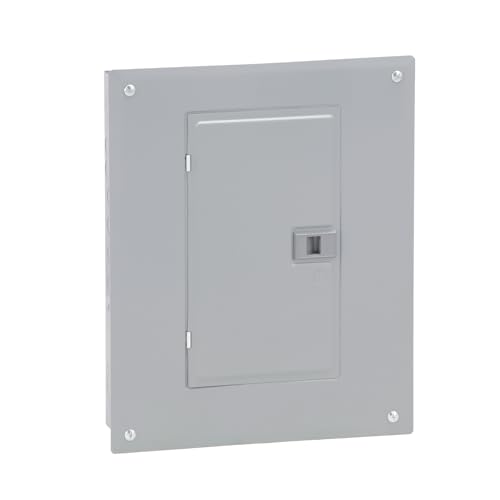
The Square D Homeline HOM1224M100PC is the sweet spot for most residential subpanel projects. It offers 12 spaces and supports up to 24 circuits when you use tandem breakers, all within a compact 14.25-inch wide enclosure that fits between standard studs. The plug-on neutral design is fully distributed — every space accepts Homeline combination arc-fault breakers without pigtails, saving time and keeping the box clean.
Breaking capacity is rated at 22 kA, and the tin-plated aluminum bus bar handles the full 100 A feed reliably. The combo cover supports both flush and surface mounting, so you don’t need to decide before purchase. Some units ship with a door that doesn’t latch perfectly out of the box; a few minutes of gentle filing on the latch tab usually solves the issue without compromising the UL listing.
This panel hits a mid-range price that undercuts many 20-space units while still delivering modern plug-on neutral convenience. If you’re feeding a basement, home office, or light workshop with 8-12 planned circuits, this is probably the panel you should install. Just confirm you have room for the physical height (21 inches) in your planned location before ordering.
Why it’s great
- Fully distributed plug-on neutral works with any space
- Compact 12-space footprint fits tight wall cavities
- Combo flush/surface cover adds installation flexibility
Good to know
- 12 spaces fill quickly if you need many 240 V circuits
- A small percentage of units need door latch adjustment
4. Siemens SN2040B1100

The Siemens SN Series SN2040B1100 packs 20 spaces with the ability to reach 40 circuits using tandem breakers, all at a price that often beats smaller panels. It features plug-on neutral technology for fast AFCI/GFCI breaker installation, a 22 kA interrupting rating, and a NEMA 1 enclosure that ships with one factory-installed ground bar. The 4-inch wire bending space is generous enough to land 2/0 AWG feeder wire without cramping.
Electricians familiar with Siemens equipment consistently praise this panel for its build quality and ease of installation. Users report that it arrives well-packaged and is noticeably sturdier than some competing panels at a similar price point. Since it ships in the manufacturer’s box without additional padding, a few units show minor cosmetic scuffs on the outer enclosure — the interior components remain unaffected.
The main limitation is that you need to purchase a separate ground bar if you want a second one for symmetry, which is common practice for subpanels with many circuits. If you’re wiring a large workshop or rental unit and need inexpensive expansion capacity without paying for copper bussing, this Siemens panel delivers the best cost-per-space ratio in the group.
Why it’s great
- 20 spaces for the price of many 12-space panels
- Plug-on neutral works with Siemens AFCI/GFCI breakers
- Ample 4-inch wire bending space for heavy feeder cable
Good to know
- Only one ground bar is included — buy a second for large installs
- Cardboard-only shipping can leave scuffs on the enclosure
5. Siemens E0816ML1125S

The Siemens E0816ML1125S is physically one of the smallest load centers in this comparison, but it’s rated for 125 amps despite being fed by a 100-amp breaker. The main-lug design (breaker not included) makes it a true subpanel, and the aluminum bus bar and galvanized steel construction hold up well in indoor environments. The 8-space, 16-circuit capacity fits neatly inside a food truck cabinet, a small workshop corner, or a tight wall cavity.
Owners specifically note that this panel accepts ITE breakers and has ample interior space despite its compact size. The knockouts are well-placed, and the enclosure can be mounted upside down to route feeder cable from the top — just be prepared for the door labels to read upside down as well. You will need to buy a separate ground bar and a main lug kit if they aren’t included in your shipment.
The mid-range price reflects the smaller space count and the fact that the main breaker is sold separately. If you only need 4-6 circuits for a welder, lighting, and a few receptacles, this compact unit saves wall space and provides a clean installation. For larger expansions, you’ll outgrow it quickly — match the panel size to your actual circuit count, not the 125-amp rating.
Why it’s great
- Small footprint fits tight enclosures like food trucks or cabinets
- Rated for 125A even with a 100A feeder — headroom built in
- Galvanized carbon steel resists corrosion indoors
Good to know
- Main breaker and ground bar are not included — buy separately
- 8 spaces limit future expansion to about 6-8 full-size circuits
6. Siemens W0202MB1100CU

The Siemens W0202MB1100CU is a purpose-built outdoor main breaker enclosure rated for 100 amps with a NEMA 3R rating, meaning it shrugs off rain and snow. It includes a copper bus bar and a factory-installed main breaker, making it suitable as a service disconnect or an outdoor subpanel for a shed, barn, or detached garage. The enclosure measures roughly 8 x 5 x 18 inches and provides 2 spaces expandable to 4 circuits.
Owners who installed it as a service entrance report excellent build quality and a tight seal on the weatherproof door. The enclosure does not include a ground bar — you must purchase and mount one separately, and the mounting holes need to be drilled. This is a known frustration that isn’t always disclosed in the product description, so budget for that extra part and a few minutes of drilling.
This is not a general-purpose subpanel for running 20 circuits in a basement. It’s a compact outdoor disconnect or a minimal subfeed for an outbuilding with only a few loads. If you need an inexpensive, weather-resistant enclosure that lets you shut off power to a remote structure, this unit delivers genuine value. For more than 2 circuits, look at larger outdoor-rated panels instead.
Why it’s great
- NEMA 3R weatherproof rating for outdoor mounting
- Copper bus bar and included main breaker
- Compact size works well as a service disconnect
Good to know
- No ground bar included — must purchase and drill mounting holes
- Only 2 spaces — too small for multi-circuit subpanels
7. Square D HOM2100

The Square D HOM2100 is a 100-amp, 2-pole, 120/240-volt circuit breaker — not a full load center. It’s the feeder breaker you install in the main panel to protect the cable running to a subpanel, or it serves as a replacement breaker for an existing Homeline panel. The plug-on design fits Homeline load centers without needing additional hardware, and the compact 3-inch width saves space in the main panel.
Customers consistently confirm that it fits perfectly, installs in seconds, and provides reliable overload and short-circuit protection. The UL listing ensures it meets code anywhere in North America. Because it’s a standard thermal-magnetic breaker, it doesn’t include GFCI or AFCI protection — you’ll add those at the subpanel for downstream circuits. The lightweight 8-ounce construction reflects the simple job this device performs.
If you are building a new subpanel from scratch, you will need both a load center and a feeder breaker. This Square D breaker pairs naturally with the Homeline HOM1224M100PC reviewed above. For users who already own a Homeline main panel and need to feed a secondary panel, the HOM2100 is the exact component you need at a budget-friendly price. Just confirm your main panel accepts Homeline breakers before ordering.
Why it’s great
- Plug-on design installs quickly into any Homeline panel
- UL listed for code-compliant installations
- Proven reliability with thousands of positive reviews
Good to know
- This is a breaker, not a load center — it feeds the subpanel
- No built-in GFCI or AFCI protection
FAQ
Do I need to remove the bonding screw in a 100 amp subpanel?
Can I feed a 100 amp subpanel with a 60 amp breaker?
What size wire do I need for a 100 amp subpanel?
Final Thoughts: The Verdict
For most users, the 100 amp sub panel winner is the Square D HOM1224M100PC because it combines plug-on neutral convenience, a compact 12-space footprint, and reliable build quality at a mid-range price that leaves room in the budget for breakers. If you want maximum future expansion and a copper bus bar, grab the Siemens PN3030B1100C. And for a tight installation like a food truck or a tiny workshop where every inch of wall space counts, nothing beats the Siemens E0816ML1125S.