
Our readers keep the lights on and my morning glass full of iced black tea. As an Amazon Associate, I earn from qualifying purchases.
Specs are compiled from manufacturer listings and verified buyer reviews and can change over time — please confirm the key details on the product page before buying.
A 100-foot air hose is a promise of reach that usually dies in a tangle of stiff, coiled plastic in your garage. The real question is whether the hose stays flexible in the cold, resists kinking, and seals at the fittings. This guide cuts through the material marketing to help you pick the one that actually works for your compressor and your projects.
I’m Min — the founder and writer behind Gadgets Feed. This guide is built by comparing the manufacturers’ published specifications and the patterns across verified customer reviews, so you get each pick’s real strengths and trade-offs instead of marketing spin.
Weighing 3/8-inch airflow against 1/4-inch portability matters, and cold-weather flexibility decides winter usability. After comparing these factors, the best 100 ft air hose balances pressure rating, weight, and temperature tolerance for your specific tools and workspace.
Our Picks at a Glance

How To Choose The Best 100 Ft Air Hose
You need a 100-foot air hose that matches your compressor’s pressure and your local weather. Get these right and the hose works quietly; get them wrong and you’ll fight it every time.
Inner Diameter: The Airflow Decision
The inner diameter, marked as 1/4-inch or 3/8-inch, is the single biggest factor in how your tools perform. A 3/8-inch hose carries more air volume to high-consumption tools like impact wrenches or spray guns. A 1/4-inch hose is lighter and easier to maneuver, which suits nailers, tire inflation, and blow guns. Match the hose diameter to your most demanding tool, not your compressor’s outlet size.
Pressure Ratings: Working vs. Burst
Every hose lists a maximum working pressure — the pressure it handles continuously, like 300 PSI. The burst pressure, often 1200 PSI, is the point where the hose would fail. Most home compressors run at 90-150 PSI, so a 300 PSI working rating gives a huge safety margin. Just avoid the cheap hoses that only list one number.
Material and Temperature Tolerance
The material determines the hose’s weight, flexibility, and cold-weather behavior. Rubber is heavy but tough and stays flexible in extreme cold. Hybrid blends of rubber and PVC are lighter and resist kinking but can stiffen in winter. Polyurethane is the lightest and coils up smallest, but it can feel stiff and can be damaged by dragging. Check the temperature range — a hose rated to -40°F will stay flexible in a freezing garage, while a PVC-only hose turns into a rigid pipe.
Quick Comparison
| Model | Best For | Max Working Pressure | Inner Diameter | Material | Amazon |
|---|---|---|---|---|---|
| SYXQT Hybrid 3/8″★ Best Overall | High-flow tools & cold weather | 300 PSI | 3/8-inch | Rubber-PVC Hybrid | Amazon |
| Furesn Hybrid 1/4″Best Value | Budget-friendly versatility | 400 PSI | 1/4-inch | Rubber-PVC Blend | Amazon |
| SANFU PU ReinforcedFinish-Safe Pick | Zero-scuff indoor finishing | 300 PSI | 1/4-inch | Polyurethane | Amazon |
| DeWalt Braided PU | Nailers & trim work | 300 PSI | 3/8-inch | Braided Polyurethane | Amazon |
| Flexzilla Hybrid 1/4″ | All-day professional use | 300 PSI | 1/4-inch | Hybrid Polymer | Amazon |
| Flexzilla Pro 1/4″ | Repairable premium fittings | 300 PSI | 1/4-inch | Hybrid Polymer + Aluminum | Amazon |
| Metabo HPT Poly | Heavy dragging & durability | 300 PSI | 1/4-inch | Polyurethane Blend | Amazon |
| DeWalt Premium Rubber | Cold-weather rubber toughness | 300 PSI | 3/8-inch | Rubber | Amazon |
| BLUBIRD 100% Rubber | Extreme cold & heavy duty | 300 PSI | 3/8-inch | 100% Rubber | Amazon |
In‑Depth Reviews
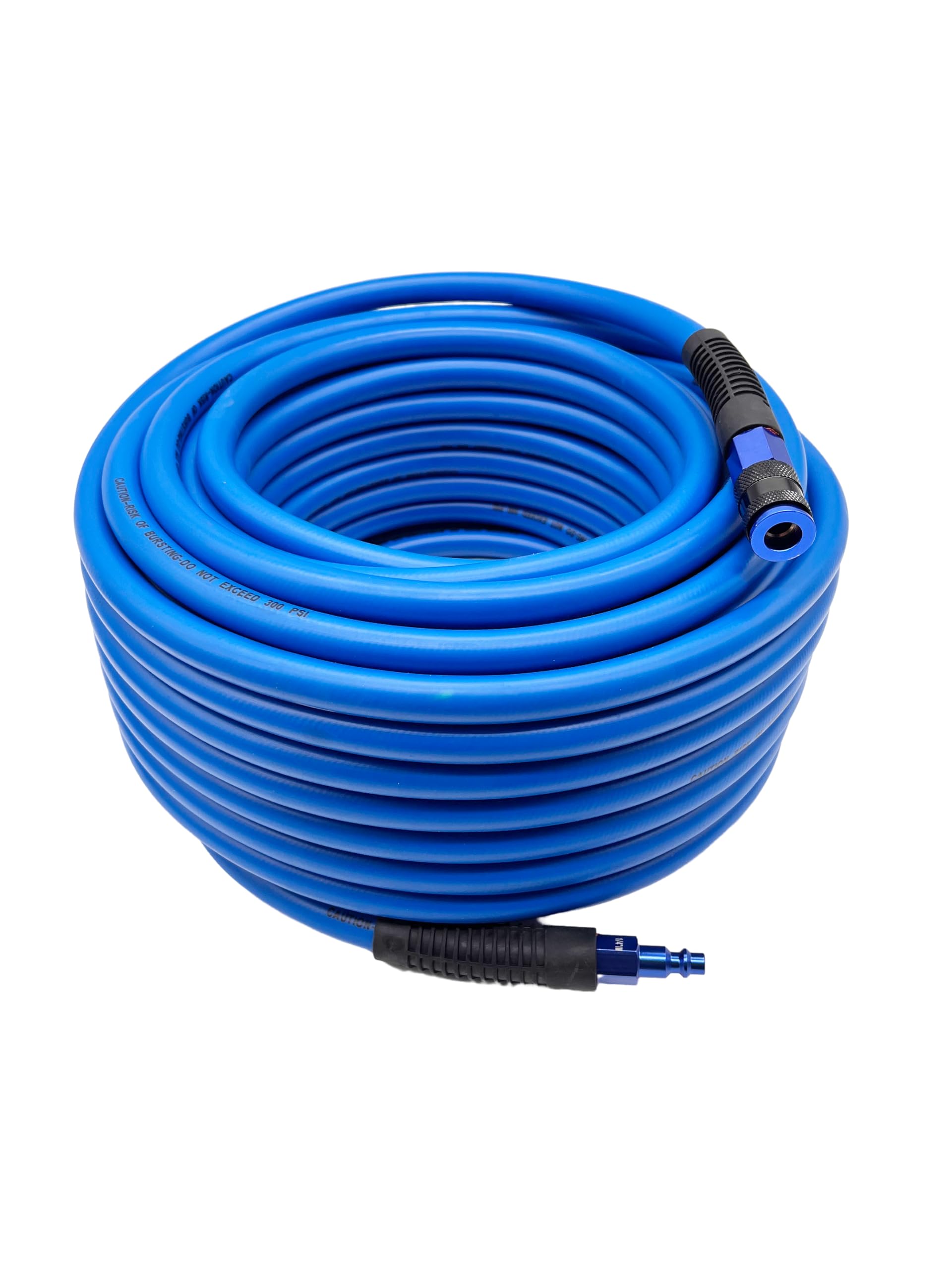
1. SYXQT Hybrid Air Hose 3/8-Inch x 100FT
Our pick — over 4.5★ from 350+ verified ratings; the strongest balance of quality and price.
The 3/8-inch workhorse that stays soft when your unheated shop drops below freezing.
You get real airflow with this one because its 3/8-inch inner diameter moves more volume than a 1/4-inch line, so spray guns and impact wrenches keep their punch at the far end of 100 feet. It carries a 300 PSI working pressure with a 1200 PSI burst rating, which means your 150 PSI compressor is nowhere near the hose’s limits. The hybrid rubber-PVC construction gives you the abrasion resistance you want when dragging across a shop floor without the weight penalty of a pure rubber hose.
Its -40°F rating keeps it flexible in freezing garages. The hose is rated from -40°F to 150°F, which buyers confirm — they report it works well in cold weather where other hoses turn into rigid pipes. It arrives ready to work with a 1/4-inch aluminum quick coupler and plug pre-installed, so there are no extra trips to the hardware store. A built-in bend restrictor at each end protects the connection points, the most common failure spot on any long hose.
Owners most often praise its overall quality, with functionality close behind. Owners describe it as rugged yet easy to move around, and the dark blue color makes it easy to spot on a cluttered workbench. It leads the pack by balancing heavy-duty flow, winter flexibility, and leak-free fittings.
What Makes It a Winner
- 3/8-inch diameter delivers strong airflow for high-consumption tools
- Rated to -40°F, so it stays flexible in freezing garages
- Pre-installed aluminum coupler and plug save setup time
- Backed by a 3-year limited warranty
Fair Caveats
- The 3/8-inch bore and hybrid build make it less pocketable than slim 1/4-inch poly lines
- Leakage is a minor mixed point in the reviews, so check fittings on arrival
Reach for this if: you run air-hungry tools and work in a space that gets genuinely cold in winter.
Look elsewhere if: you only drive a brad nailer and want the absolute lightest line to haul around.
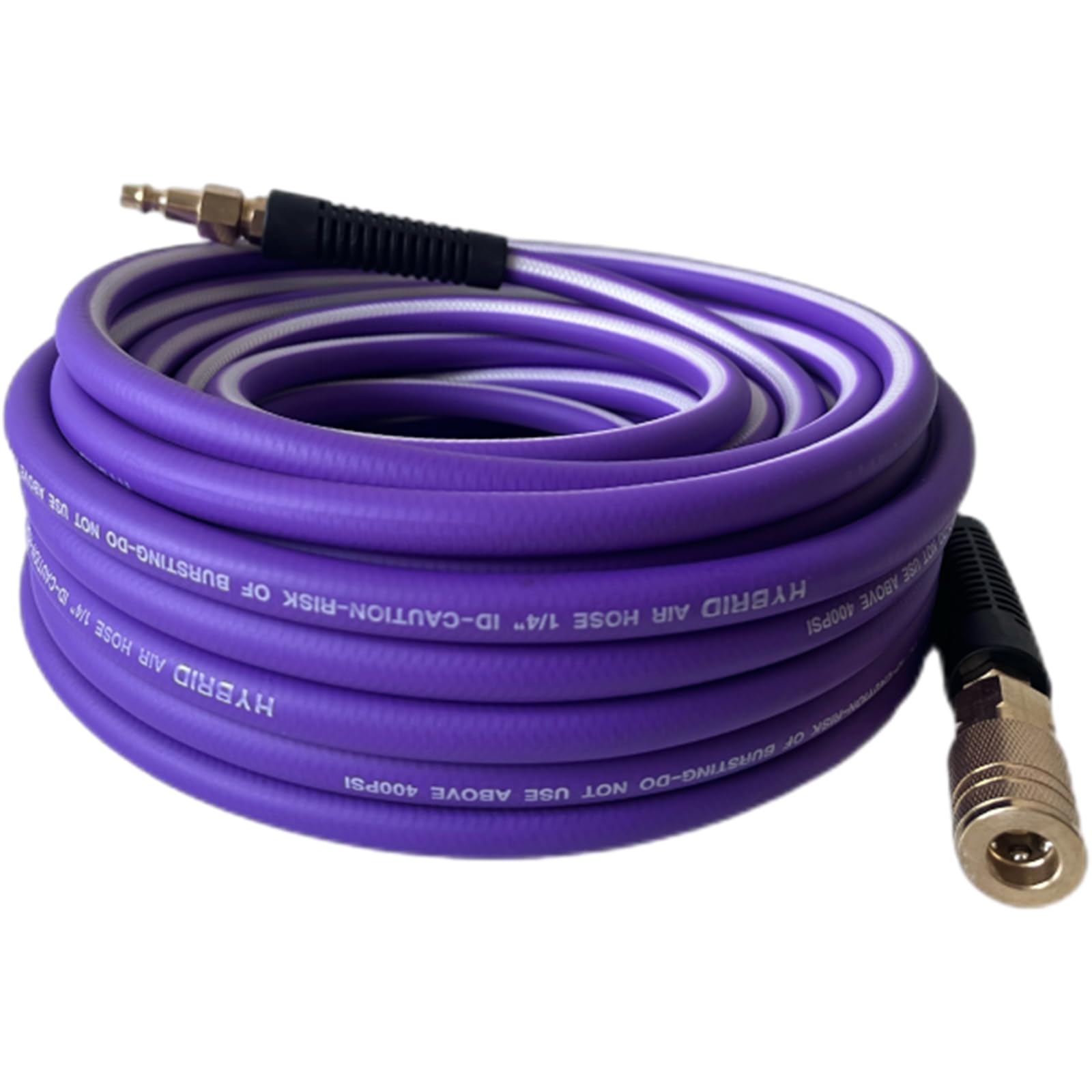
2. Furesn Hybrid Air Hose 1/4 in x 100 ft
A 400 PSI hybrid that out-specs the field while staying light enough for daily garage duty.
This Furesn hose earns the top spot because it handles 400 PSI (pounds per square inch, a measure of air pressure) — a full 100 PSI more than the other 300 PSI hoses here, so you have extra headroom for high-pressure tools. Its woven hybrid middle layer resists snags, abrasions, punctures, chemicals, oil, and grease, which matters when you drag a 100-foot line across concrete all day. At 3.34 kg, it stays manageable when you haul and coil it.
Owners call out quality above everything else, with durability and flexibility following close behind. Buyers report the connection to an air compressor is easy, and the hose is lightweight with great length — the value for money is a consistent theme. Both ends carry 1/4-inch NPT industrial fittings and a universal quick-connect coupler, all in brass to resist rust and corrosion. The temperature range of -40°F to 150°F means winter flexibility is covered, and the bend restrictors at both ends reduce kinking at the connection points.
A few owners note it tangles more than they’d like when coiling. The brass fittings and the highest pressure rating in the lineup make this the smart-money pick, and the two-year limited warranty adds a layer of security for a budget-friendly price.
Smart money pick: the highest working pressure (400 PSI) and rust-resistant brass fittings make it a standout value.
Minor coiling note: plan to roll it carefully, as some owners mention it tangles more than premium hybrids.
3. SANFU Polyurethane Reinforced 1/4” ID x 100ft
The scuff-free polyurethane line built for trim work where painted walls and wood floors matter.
This SANFU hose is made from pure polyurethane, which gives it a smooth surface that won’t damage painted surfaces, wood flooring, or trim — a critical feature if you do interior finishing. The wide temperature range of -65°F to 250°F is the broadest of any hose on this list, so it stays workable in extreme conditions on both ends of the thermometer. Reinforcement makes it durable enough to withstand the kinks and twists that come with a 100-foot hose, and it resists abrasion, corrosion, and grease.
The people who love this hose most are working pros — roofline and siding work appears in the reviews, along with interior trim crews. One trim contractor running work on multimillion-dollar homes was surprised by the quality at the price point. The installed professional brass coupler and plug are a real plus because air hoses get dropped, kicked, and stepped on, and the swivel brass fittings hold up to that impact. At 4.4 pounds, it is very lightweight compared to rubber, making it easy to carry in your hand across a job site.
The catch is that flexibility gets mixed feedback. Some owners find it flexible, while others describe it as stiff — a common trait of polyurethane. If you need an ultra-flexible line for constant movement, a hybrid will serve you better. But for finish work where scuff protection matters most, this is the specialist pick.
Specialist choice: the smooth PU surface protects delicate surfaces that rubber and PVC would scuff.
Flexibility check: owners are split — some say it is flexible, some call it stiff, so it suits careful use better than aggressive dragging.
4. DeWalt Braided Polyurethane Air Hose 3/8″ x 100′
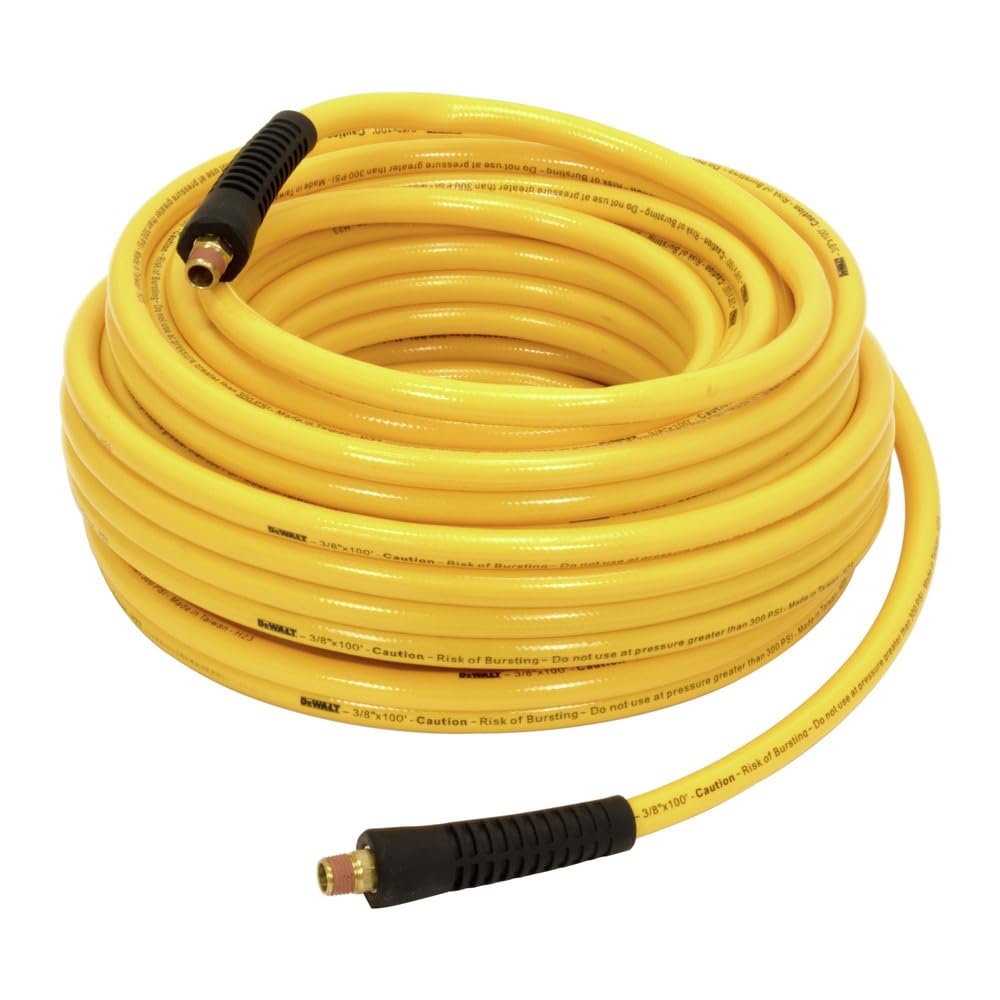
A 3/8-inch braided line that powers a framing nailer with a 165 PSI pancake compressor and still rolls up by hand.
This DeWalt hose pairs the 3/8-inch diameter with a braided polyurethane material that gives it greater durability than a standard PU line while handling up to 300 PSI of working pressure. The braiding within the hose is the structural secret — it adds strength without the weight of rubber. At 7.7 pounds, it is the heavier end of the polyurethane options, but that weight translates directly into toughness you can feel. It is oil and kink resistant, and it comes with 1/4-inch NPT male fittings on both ends with bend restrictors.
Owners use this hose for real framing and trim jobs. They run it from a 6-gallon, 165 PSI DeWalt pancake compressor to drive a 21-gauge framing nailer, a 16-gauge, and an 18-gauge trim nailer — all without issues. One buyer reports it coils back up on its own and is “kink free and very reliable.” Another notes it is lightweight, highly flexible, and easy to carry and roll back up by hand.
The one thing to know before you buy: this hose does not come with fittings pre-installed, so you need to purchase your own ends. One owner rates it 95% satisfaction for that exact reason. If you already have the couplers and plugs, this is a high-performance 3/8-inch option that will not let you down on a busy job site.
Nailer-ready build: the 3/8-inch bore keeps volume high for framing nailers at full 100-foot extension.
Bring your own fittings: the ends are bare 1/4-inch NPT, so factor in the cost and trip for couplers.
5. Flexzilla HFZ14100YW2-D Air Hose with ColorConnex
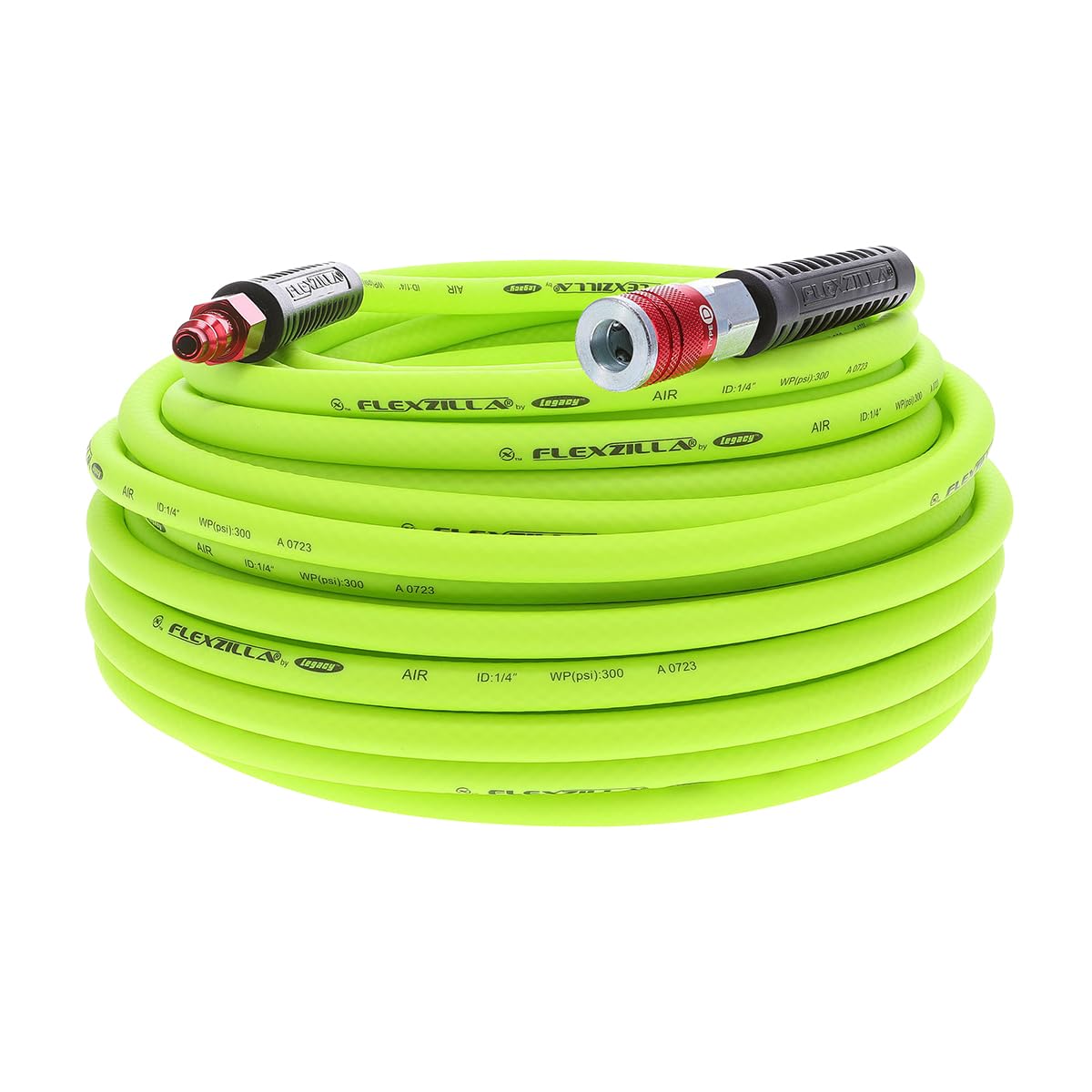
The legendary hybrid polymer that lays flat and never fights back, even after a full day of use.
Flexzilla built its reputation on one feature: zero shape memory. That means the hose never kinks when used and has no memory of being coiled, so it lays perfectly flat the moment you roll it out. Made from a flexible hybrid polymer, this 1/4-inch hose handles 300 PSI while staying unbelievably light — so light that it does not pull on your air tool as you work, a detail that matters during long sessions. It coils up easily at the end of the day and lays flat when rolled out, as owners in demanding fields like aircraft structural work confirm.
The kit arrives ready to go with a Red Industrial (Type D) 1/4-inch body ColorConnex coupler and plug, one of each, already fitted with thread sealer on the threads. That pre-sealed setup saves you a trip to the hardware store and removes the most common source of leaks. Owners mention it stays pliable in cold weather and that the fittings seal properly — one tested it by filling the tank to 140 PSI and watching it hold, where a previous hose would lose air overnight. The fit of the connectors is the most-discussed positive point among owners, with flexibility second.
The value for money gets mixed reactions, mainly because this is not the cheapest 1/4-inch hose you can buy. But you are paying for the working experience — a hose that never tangles, never kinks, and stays flexible. If you spend your day moving around a shop with a nailer or spray gun, that convenience is worth the premium.
easy to Work With
- Zero shape memory means it never kinks and lays flat on its own
- Light enough that it does not tug on your air tool
- Comes with pre-sealed, color-coded industrial coupler and plug
- Owners confirm it stays pliable in cold weather
Before You Commit
- Value for money draws mixed feedback — you pay a premium for the convenience
- The light hybrid polymer feel is less rugged than a pure rubber line
Reach for this if: you value a tangle-free, tool-friendly line for daily professional or heavy garage use.
Look elsewhere if: you need maximum abrasion toughness for dragging across rough concrete constantly.
6. Flexzilla Pro Air Hose with ColorConnex, 1/4 in. x 100 ft

A field-repairable workhorse with aircraft aluminum fittings that survive impacts a brass end would crush.
The headline feature here is the field-repairable design with reusable anodized aircraft aluminum fittings. If a fitting gets damaged on a job site, you can service it yourself rather than replacing the entire 100-foot hose — a major cost saver on a premium line. The aluminum construction is crush-resistant, and the ZillaGreen color makes it highly visible on any jobsite, a feature owners specifically praise. All-weather flexibility spans -40°F to 140°F, so it stays workable through winter seasons too.
This Flexzilla hose handles 300 PSI and won’t kink under pressure, coiling easily and laying flat with zero memory (meaning it doesn’t hold a coil shape). It shares Flexzilla’s design DNA but adds more sturdy fittings. Owners say it is flexible, strong, and high-visibility, with quality connectors that survive cold and rugged weather. The kit includes the Flexzilla Pro hose with the ColorConnex Red Industrial (Type D) coupler and plug.
Durability opinions are mixed, with some owners disappointed. A couple of customers note a kink can appear from the start despite the kink-resistant claim. The 10-year limited warranty is a strong vote of confidence from the manufacturer, which helps offset those concerns. If you want the repairability and the toughest fittings Flexzilla makes, this is the pick.
Reach for this if: you want a premium hose whose aluminum fittings you can repair on-site instead of replacing the line.
Look elsewhere if: you demand absolute kink-proof behavior — even this one can show a kink occasionally from the start.
7. Metabo HPT Air Hose 1/4-Inch x 100 Ft

A 40%-lighter-than-PVC poly hose that a roofer dragged around a whole house and roof for over a month.
This Metabo HPT hose is marketed as 40% lighter than PVC, which makes it a compact, portable option for moving around a job site or dragging up a ladder. It is spiral reinforced for durability, and the brass couplers feature a standard 6-ball bearing design that provides longer coupler life and stronger connections. At 3.4 pounds for 100 feet, it is one of the lighter options here, and owners describe it as much more compact than standard garage hoses.
The real-world abuse story in the reviews is strong. The consensus is that it is a durable, high-quality compression hose that works very well as expected, with owners calling it better than rubber. It handles pressures at or below 300 PSI, which covers home and most professional compressor setups.
The trade-off is flexibility, which receives mixed feedback. Several owners find it too rigid, and one notes it occasionally re-coils with the pressure of the air even after stretching it out. If you need a line that stays perfectly limp in the cold, a hybrid will beat it. But if you want a lightweight, compact hose that survives heavy dragging, this is a solid, value-conscious choice.
Built to drag: spiral reinforcement and a compact 3.4-pound build survive month-long abuse on roofs and job sites.
Stiffness warning: flexibility is the recurring mixed point, so it suits rugged work more than fine, constant-flexing tasks.
8. DEWALT DXCM012-0202 3/8″ x 100′ Premium Rubber Hose
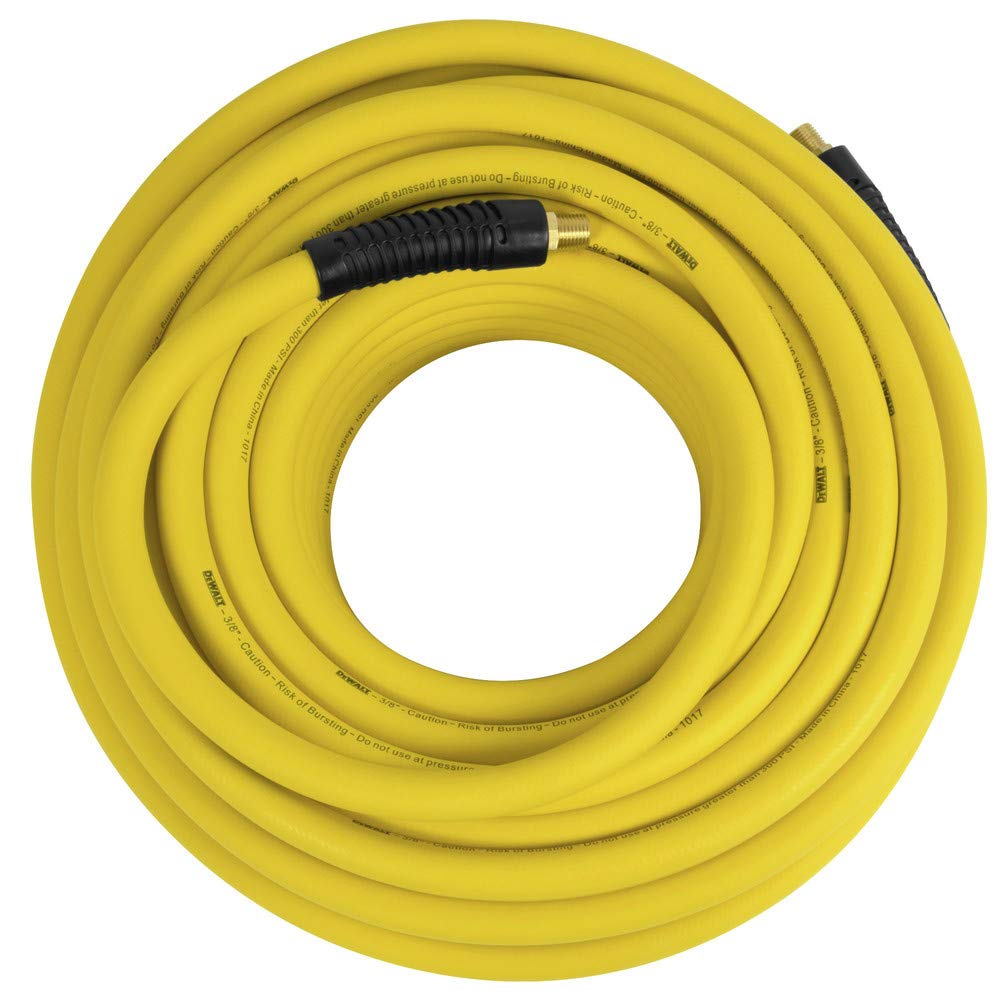
A 3/8-inch premium rubber line with a 4:1 safety factor that one owner ran through an entire house without a single kink.
This DeWalt rubber hose is flexible in cold weather across a temperature range of -40°F to 150°F, and it is oil and kink resistant. The 4:1 safety factor is a standout specification — the burst pressure is four times the 300 PSI working pressure, giving you a huge margin of safety when a compressor’s regulator fails. It uses 1/4-inch NPT solid brass male fittings on both ends with bend restrictors to protect the connection points. At 3/8-inch diameter, it delivers the strong airflow you want for air-hungry tools.
Seasoned owners swear by quality rubber hoses. One long-time buyer notes learning years ago to only buy good quality rubber air hoses, and this one meets that standard. Another ran it through an entire house with no kinking or knotting, calling it extremely well made. The brass ends come with protective covers on both ends, a small detail that protects the threads during storage and transport. The tip from one owner: lay it in the warm sun as you unroll it so it is very easy to work with after it warms up.
The honest note here is that one owner found it kinks very easily when rolled up — rubber hoses have memory. This is the trade-off of choosing rubber over a hybrid polymer. If you want cold-weather toughness and a long service life, this DeWalt delivers premium build quality from a trusted brand.
Safety-first build: the 4:1 burst-to-working safety factor and solid brass fittings make it a confidence-inspiring line.
Rubber memory: one owner notes it kinks easily when rolled, so store it neatly to keep it coiled cleanly.
9. BLUBIRD BB38100 3/8″ x 100′ Rubber Air Hose
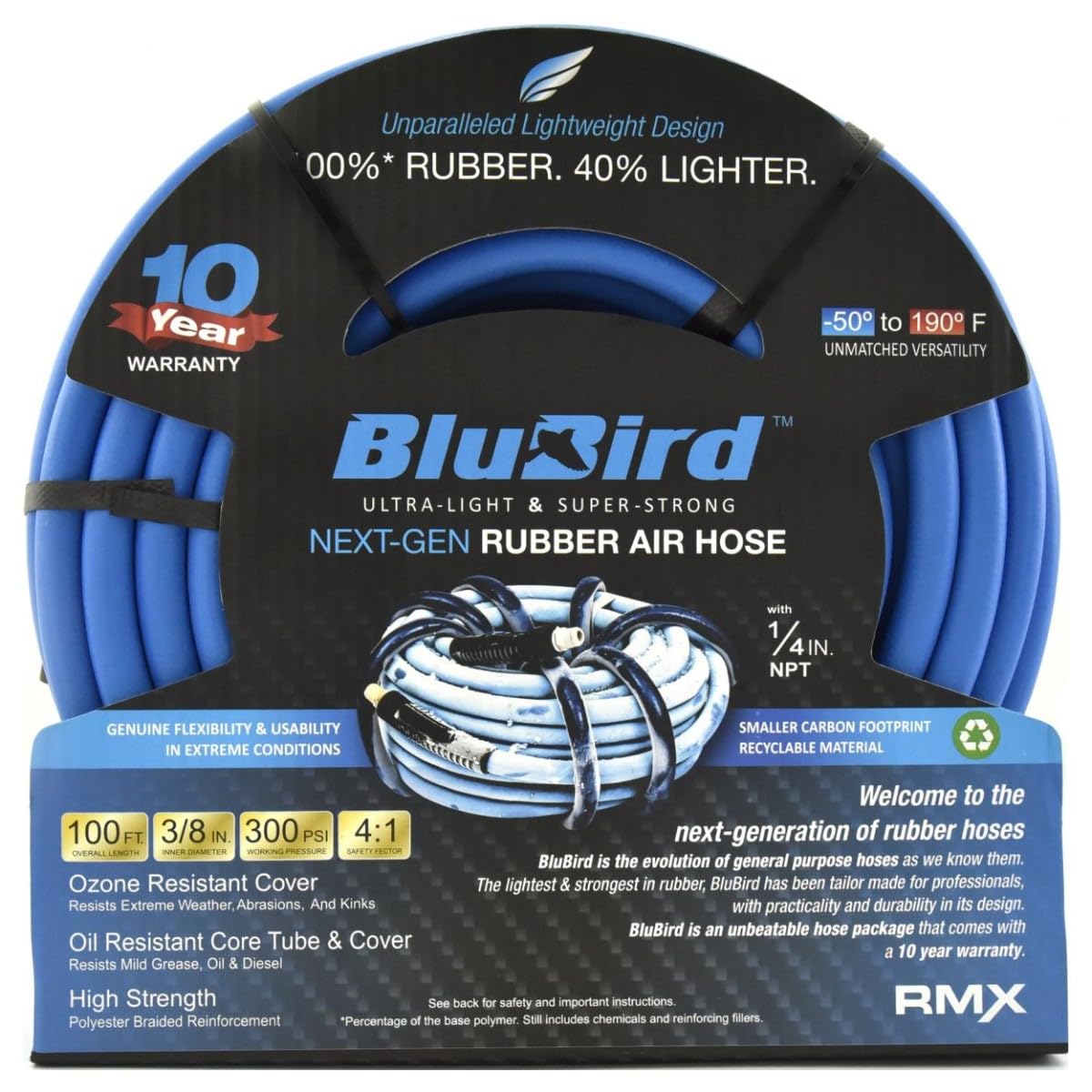
The 100% rubber specialist that stays flexible at -50°F when hybrid hoses have already turned to noodles.
This BLUBIRD is built for extreme cold, with the maker claiming it stays as flexible at -50°F as the best hybrids at 0°F. Its 100% rubber construction is 40% lighter than standard industry hoses, so you don’t get the usual heavy rubber feel. It works at 300 PSI across the full -50°F to 190°F range, with a burst pressure of 1200 PSI — a figure the maker says is higher than most ‘300 PSI’ hybrids, which often burst at 900 PSI. The high-strength polyester braid provides that pressure capacity and keeps the hose from going limp until 190°F.
Flexibility and functionality are the two most-discussed positives, with owners praising that it lays flat, does not kink under pressure, and stays flexible in cold temperatures. One owner notes it runs up to 200 PSI with no problems, above its rated 300 PSI. The brass end fittings resist rust better than steel and are stronger than aluminum, and the visible blue color is easy to spot. It is also easy to roll up and unroll, staying supple and kink-free.
Durability receives mixed feedback, so it is not invincible. Some owners wish it were more flexible, finding it a little hard to work with sometimes, though it has held up well for them so far. This is a premium-priced, specialist tool for people who work in genuinely cold environments and need rubber’s toughness with real flexibility.
Arctic-grade performer: the -50°F flexibility claim and 1200 PSI burst make it the cold-weather specialist of the group.
Flexibility caveat: some owners still find it a little stiff, and durability opinions vary, so treat it well.
Understanding the Specs
Working Pressure vs. Burst Pressure
The working pressure, such as 300 PSI, is the pressure the hose handles continuously in normal use. The burst pressure, often listed as 1200 PSI, is the point where the hose would physically fail. A 4:1 safety factor, meaning burst is four times working pressure, gives you a comfortable margin even if a compressor regulator sticks. Your home compressor typically runs at 90-150 PSI, so a 300 PSI working rating is more than enough headroom.
Inner Diameter and Airflow
The inner diameter (1/4-inch vs. 3/8-inch) controls how much air volume reaches your tool. A 3/8-inch hose moves more air, which keeps high-consumption tools like impact wrenches and spray guns performing at full strength over 100 feet. A 1/4-inch hose is lighter and easier to maneuver, which suits nailers, tire inflation, and blow guns. Match the diameter to your most demanding tool, not the outlet on your compressor.
Material and Temperature Range
Rubber is heavy but tough, stays flexible in extreme cold down to -50°F or -40°F, and resists oil and abrasion. Hybrid blends of rubber and PVC are lighter and resist kinking, but they can stiffen in winter. Polyurethane is the lightest and coils up smallest, but it can feel stiff and can be damaged by rough dragging. Check the temperature range — a hose rated to -40°F will stay workable in a freezing garage, while a PVC-only line turns rigid.
Fittings and Bend Restrictors
Brass fittings resist rust and corrosion better than steel, while aluminum is lighter and crush-resistant. Bend restrictors are the collars at each end that stop the hose from kinking right at the connection point — the most common failure spot on any air hose. A pre-installed quick coupler and plug save you a trip to the hardware store, while bare 1/4-inch NPT threads mean you supply your own fittings.
FAQ
Is a 3/8-inch air hose better than a 1/4-inch hose for a 100-foot run?
Will a 300 PSI hose handle my home air compressor?
Why does my air hose get stiff in the winter?
What is the difference between working pressure and burst pressure?
Do I need to buy fittings separately for a 100-foot air hose?
Which air hose material lasts the longest?
Will a 100-foot 1/4-inch hose power a framing nailer?
What does “kink resistant” actually mean for an air hose?
How much does a 100-foot air hose weigh?
Is rubber better than a hybrid hose for cold weather?
Final Thoughts: The Verdict
For most buyers, the best overall 100 ft air hose is the SYXQT Hybrid 3/8-Inch because it pairs 3/8-inch airflow with a -40°F to 150°F range and pre-installed aluminum fittings, at a price that undercuts premium brands while matching their quality. If you want the lightest, most maneuverable line for daily nailer work, the Flexzilla Hybrid 1/4-Inch with its zero-shape-memory polymer is the one to grab. And if you work in genuinely brutal cold, the BLUBIRD 100% Rubber stays flexible down to -50°F, making it the specialist pick for winter job sites.
How We Picked
We do not accept paid placement. Every pick is matched to a real buyer and a real use-case; we do not hands-on test units.
Sources & Methodology
Specifications: manufacturer listings and product documentation. Review insights: verified customer reviews, as of August 2026. Pricing: not shown on this page (it changes often); check the current price via the retailer link.
As an Amazon Associate, Gadgets Feed earns from qualifying purchases. This does not affect which products we feature.