
Our readers keep the lights on and my morning glass full of iced black tea. As an Amazon Associate, I earn from qualifying purchases.
Specs are compiled from manufacturer listings and verified buyer reviews and can change over time — please confirm the key details on the product page before buying.
Choosing a filter for a 100-gallon tank is the single decision that decides whether you spend your evenings watching fish glide through crystal water or scrubbing green glass. The right one quietly cycles every drop through biological, chemical, and mechanical media, while the wrong one leaves you with cloudy water, noise, or a puddle on the floor. This guide cuts through the clutter to the seven filters that actually handle the volume.
I’m Min — the founder and writer behind Gadgets Feed. This guide is built by comparing the manufacturers’ published specifications and the patterns across verified customer reviews, so you get each pick’s real strengths and trade-offs instead of marketing spin.
Here is what the owner experience across thousands of freshwater tanks, turtle habitats, and even outdoor ponds teaches us about the 100 gallon fish tank filter that earns its place under your cabinet.
Our Picks at a Glance

How To Choose The Best 100 Gallon Fish Tank Filter
Three specs separate a filter that handles a stocked 100-gallon tank from one that constantly struggles: flow rate, media volume, and pump quality. Here is the plain-English breakdown of what each means for your fish and your schedule.
Flow Rate — The Water-Turnover Rule
Your filter should move the full volume of the tank through itself at least four times every hour. For a 100-gallon tank, that means a minimum of 400 gallons per hour (GPH). A higher rate gives you a safety margin if you keep heavy waste producers like goldfish or cichlids.
Filtration Stages — Mechanical, Chemical, Biological
Mechanical media trap visible debris like uneaten food. Chemical media (usually activated carbon) pull out dissolved pollutants and odors. Biological media hosts the beneficial bacteria that break down ammonia and nitrite. A good filter for this tank size gives you dedicated space for all three stages, not just a single foam pad.
Canister vs. Hang-On-Back vs. Internal
Canister filters sit below the tank, hidden inside the cabinet, and provide the largest media volume and quietest operation. Hang-on-back (HOB) units clip onto the rim and are easier to reach but hold much less media. Internal submersible pumps take up space inside the tank. For a 100-gallon aquarium, a canister filter is the standard choice for good reason: it keeps the tank clean and the living room quiet.
Quick Comparison
| Model | Best For | Flow Rate | Filtration Stages | Media Capacity | Amazon |
|---|---|---|---|---|---|
| Fluval 407★ Best Overall | Best Overall — Quiet, Proven Canister | 383 GPH | Multi-stage | 3 EZ-Lift Baskets | Amazon |
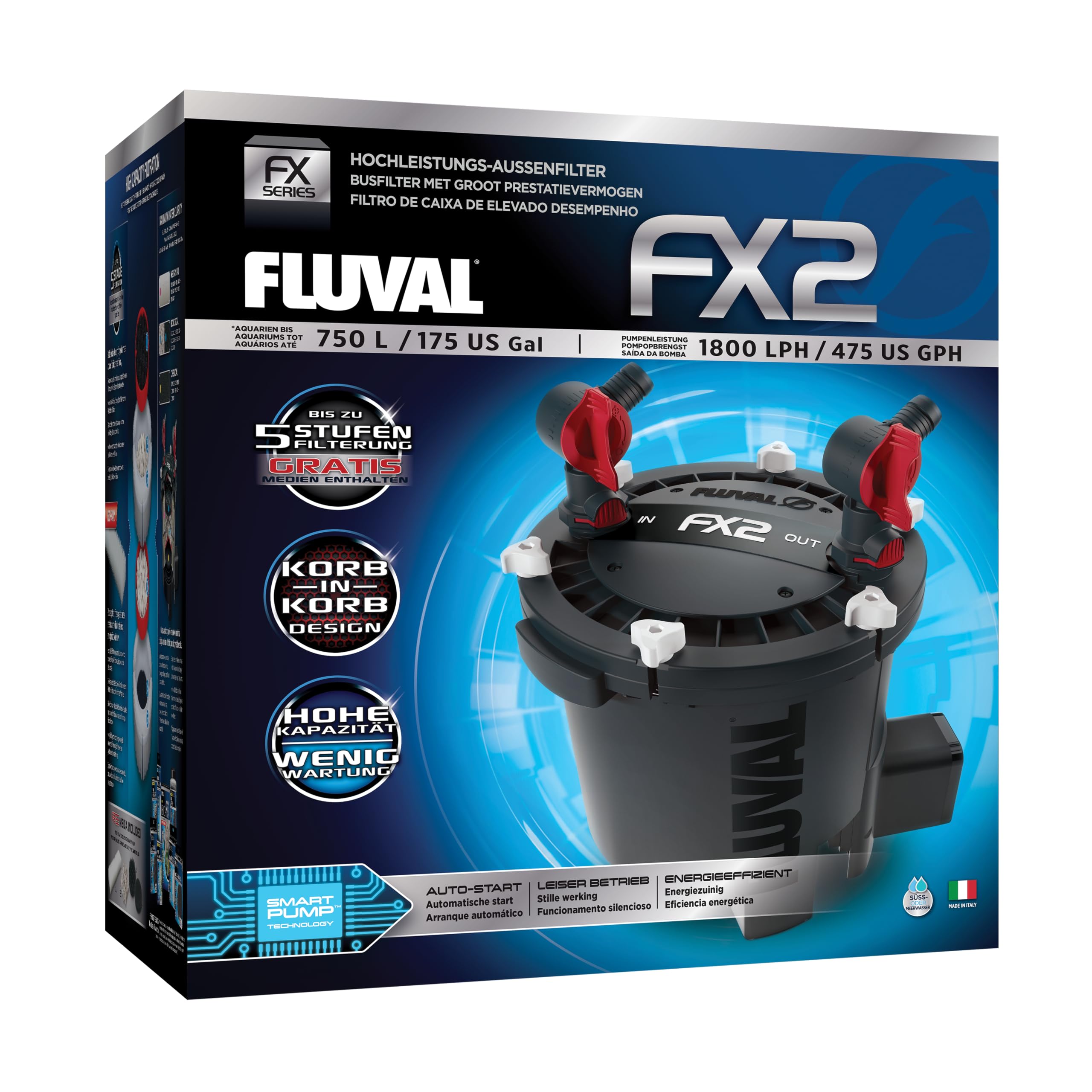
| Fluval FX2High-Flow Powerhouse | High-Flow Powerhouse | 475 GPH | 4-Stage | 4 Baskets (1 Gal) | Amazon |
| Aqueon QuietFlow 155/400 | HOB Convenience + Large Tank | 400 GPH | Multi-stage | Pre-loaded Media Set | Amazon |
| Penn-Plax Cascade 1000 Elite | All-Inclusive Value Kit | 265 GPH | Multi-stage | 3 Media Trays | Amazon |
| TARARIUM HB-1200 | HOB with UV Light | 344 GPH | 5-Stage w/ UV | Large Canister | Amazon |
| VEVOR 317GPH | Budget Canister w/ UV Timer | 317 GPH | 4-Stage w/ UV | 3 Media Layers | Amazon |
| COOSPIDER JUP-04 | Budget Submersible w/ UV | 600 GPH | Dual w/ UV | Sponge Only | Amazon |
In‑Depth Reviews
1. Fluval 407 Performance Canister Filter
Our pick — 4.5★ from 9,500+ verified ratings; the strongest balance of quality and price.
The canister nearly ten thousand owners trust to run silent and never skip a beat.
The first thing you notice about the Fluval 407 is the sound — or rather, the total absence of it. Its eTEC pump runs up to 25% quieter than the previous generation while drawing the same energy as an LED light bulb. For a filter that sits in your living room, that silence is the difference between a peaceful space and a constant hum. The 383 GPH (1,450 liters per hour) flow rate means a 100-gallon tank gets nearly four full turnovers every hour, which keeps waste from settling before the media can catch it.
The EZ-Lift media baskets are a genuine time-saver. A single center handle lets you lift the entire media stack out with one finger, so swapping a sponge or adding carbon takes seconds, not a wrestling match. The crowd favorite features are filter quality and noise level — more than 600 owners specifically praise how well it scrubs the water and how little it intrudes on their home.
This is a premium tool — built for the aquarist who prioritizes quiet, clear water and easy maintenance above a bargain price.
silent powerhouse: You get near-silent operation and proven reliability — across nearly 10,000 units sold, buyers report the 407 is quieter and more dependable than the VEVOR and Penn-Plax. One buyer says it cleared about 90% of the waste from a 30-gallon turtle tank in under 24 hours, and that same filtration power handles a 100-gallon tank just as well.
quiet performance: you want a canister that disappears into the cabinet acoustically and makes media swaps genuinely easy.
space constraints: your budget is limited or you need a built-in UV light — the 407 has no UV option from the factory.
2. Fluval FX2 High Performance Canister Filter
475 gallons per hour is not a suggestion — it is the guarantee your heavy stock stays oxygenated.
The FX2 pumps out 475 GPH (1,800 liters per hour), which is nearly five full turnovers of a 100-gallon tank every sixty minutes. That kind of flow is overkill for a lightly stocked community tank, but it is exactly what you need for discus, large cichlids, or a turtle that produces waste like a small mammal. The patented Smart Pump microchip continuously monitors performance and auto-evacuates trapped air every 12 hours, so you never have to worry about losing prime or flow dropping off overnight.
You can customize your filtration because four removable baskets hold up to 1 US gallon (3.9 liters) of media — mechanical, chemical, and biological — and you stack them in any order your bioload needs. At 16.4 inches tall, the FX2 slides easily under a standard aquarium cabinet. Reviewers call it “easy setup and maintenance, no priming or air bubble issues, plug-and-play, class-leading filtration.” One owner runs it on a 75-gallon tank, cleans it every three months, and reports it is “running strong.”
The caveat? Reliability is the most-discussed aspect, though sentiment is mixed — a vocal minority report that the unit stopped working or the flow halved over time. This is a high-performance machine that demands occasional attention to its hose connections and impeller.
high flow beast
- Massive flow rate easily handles 100-gallon tanks with heavy waste
- Smart Pump self-primes and auto-evacuates air for consistent performance
- Four removable baskets give immense media flexibility
pricey media
- Mixed reports on long-term reliability — some units develop flow issues
- Thin plastic hose connections feel less premium for the price point
heavy duty: a heavily stocked 100-gallon tank or a messy turtle setup where flow volume is critical.
budget pick: you have a lightly stocked community tank — the massive flow may be unnecessary, and the filtration media on the Fluval 407 will likely suffice.
3. Aqueon QuietFlow 155/400 Canister Filter

A canister that hangs a polishing unit on the back — maintenance without crawling under the cabinet.
The Aqueon QuietFlow 155/400 is rated for aquariums up to 155 gallons and pumps at 400 GPH, which puts it squarely in the right zone for a 100-gallon tank. Its defining trick is the hang-on-back water polishing unit — a secondary cartridge that clips onto the tank rim and polishes the water without needing to open the canister every time. That means you handle daily clarity maintenance in seconds, while the main canister handles the heavy biological and mechanical work. It comes pre-loaded with activated carbon, coarse foam, bio balls, and bio-ceramic rings.
Owners who run it on 120 and 125-gallon tanks call the water clarity “excellent” and note that their fish became more active once the water cleared. Aqueon’s customer service gets pointed praise — one owner’s pump failed after a year, and Aqueon sent a free replacement in two days, no questions asked. The big recurring complaint is the priming process: after cleaning, refilling and restarting the filter takes some trial-and-error, unlike competitors with simpler push-button priming.
Noise level is the aspect owners discuss most, and opinions split about evenly — some call it super quiet, others find it noisy.
value choice: you want a canister with a convenient hang-on polisher for quick touch-ups and value responsive customer support.
advanced needs: a straightforward, single-lid priming system is a priority for you — the Aqueon can be fussy to restart after cleaning.
4. Penn-Plax Cascade Canister Aquarium Filter (1000 Elite)

Comes with everything including an algae magnet — truly ready to run from the start.
The Cascade 1000 Elite arrives with a Bio-Sponge, six Bio-Floss pads, two packs of Pro-Carb carbon, a 10-ounce bag of Bio Rings, and even a large Magna Sweep algae magnet. You need to buy nothing else — just set it up and turn it on. Its 265 GPH flow rate is the lowest on this list, which works fine for a lightly to moderately stocked 100-gallon freshwater tank but may fall short if you keep messy fish or heavy bioloads. The quick push-button self-primer makes initial setup simple, and the flow-rate cut-off valves give you precise control over turnover.
Owners highlight easy setup and quiet operation — “comparable to an HOB filter” for sound — and note the filter fits under standard cabinets. The most common negative is durability: a number of owners mention leaks or cracked hose fittings after about three months.
big tanks: the first-time canister buyer who wants one box with all the media and extras included, no second trip.
easy setup: you need to push 400+ GPH or plan to keep heavy waste-producers — the 265 GPH rate is the constraint here.
5. TARARIUM Large Hang on Back Aquarium Filter (HB-1200)
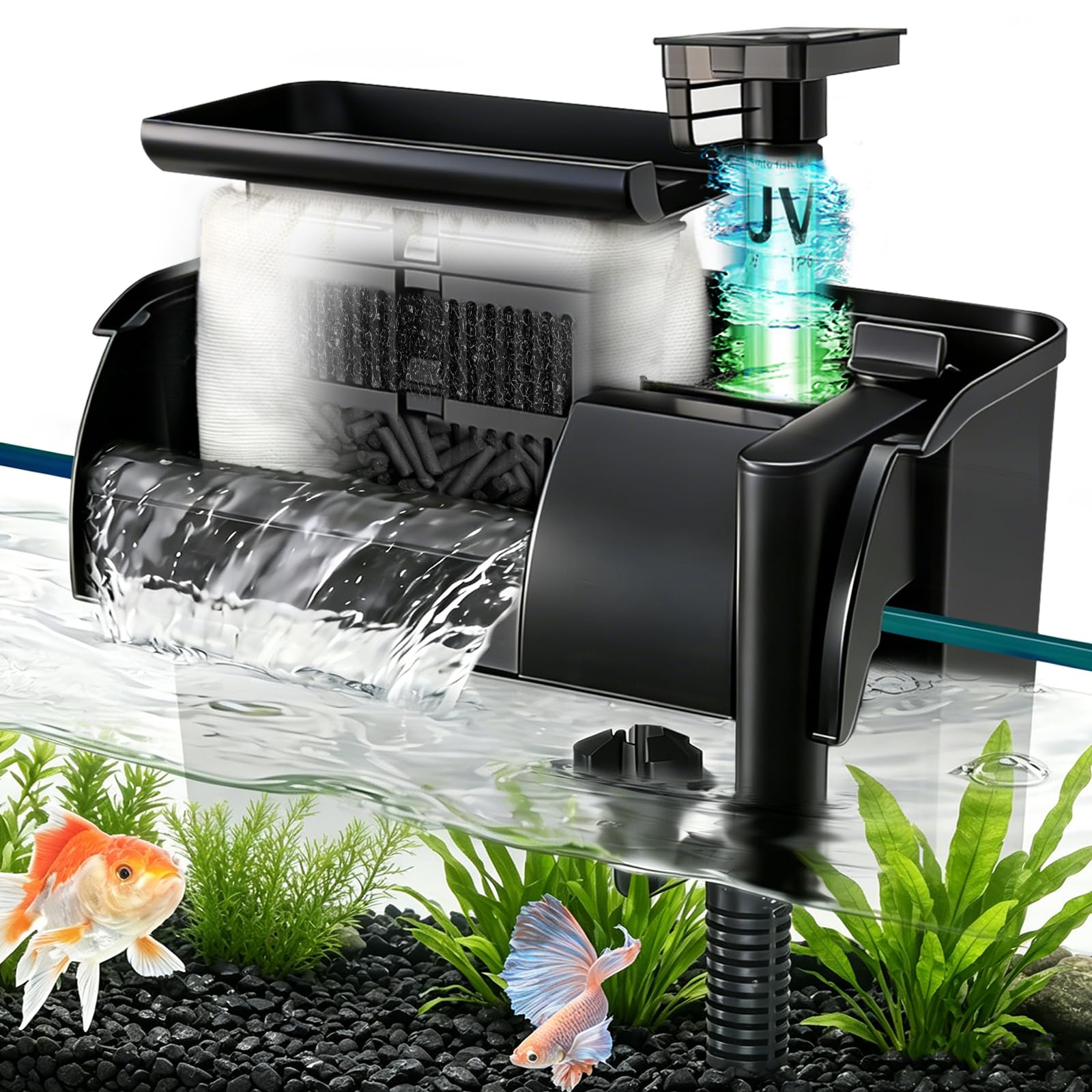
A hang-on-back that pulls 344 GPH and packs a UV light for green-water knockout power.
Effectiveness and noise level get the most positive owner feedback. The trade-off is the 6-month warranty — short compared to canister competitors — and the 344 GPH flow is adequate but not generous for a fully stocked 100-gallon tank.
smart uv design: The isolated UV chamber keeps the sterilizing light separate from the bio-media, solving the classic problem of UV filters killing both algae and good bacteria.
uv included: you want UV sterilization in a simple HOB design and you have a moderately stocked tank that gets afternoon sun.
quiet seekers: you need the large media capacity of a canister for heavy bioloads.
6. VEVOR Aquarium Filter 317GPH (AQ-905F-UV 12W)
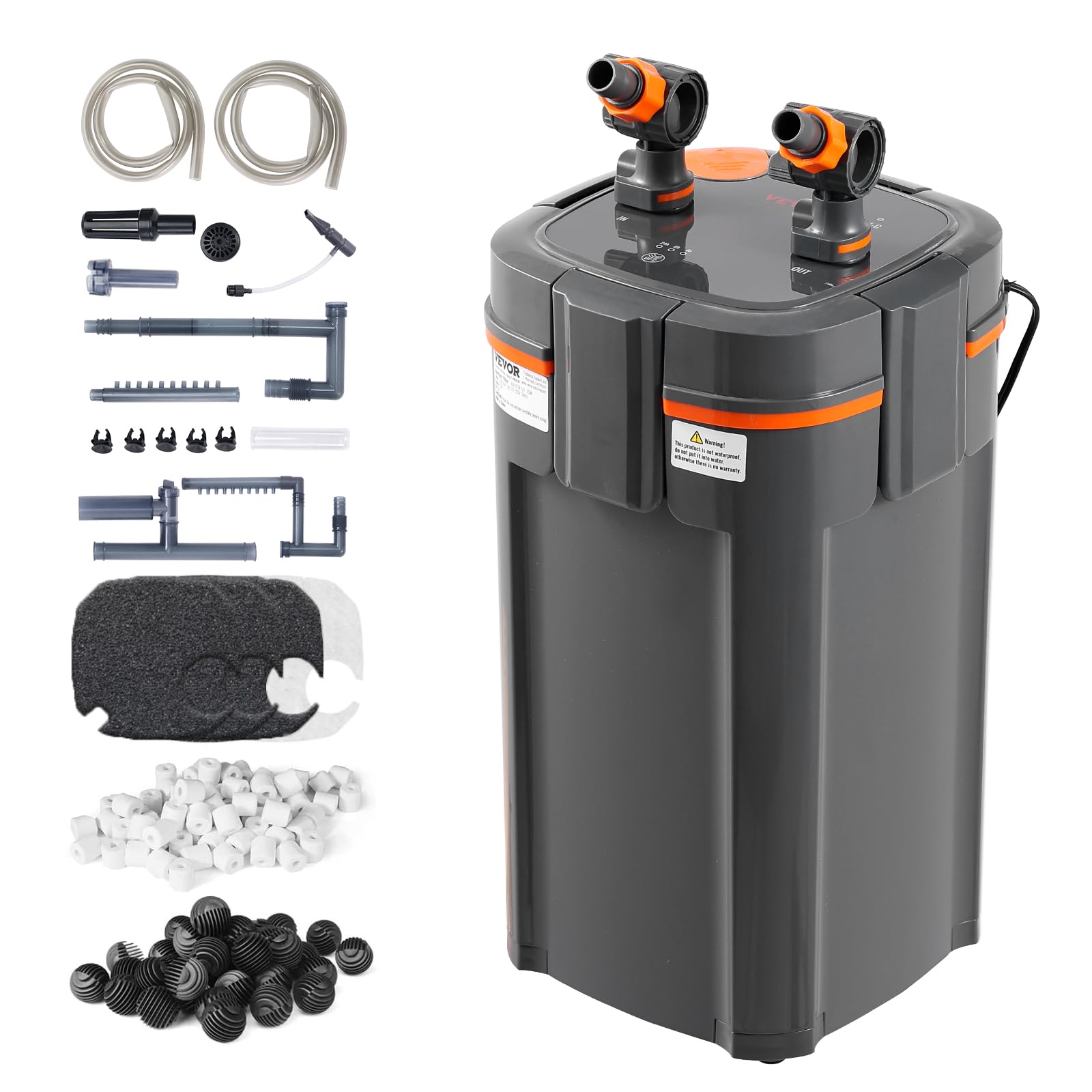
A 4-stage canister with a UV lamp timer that auto-schedules itself to dodge algae.
The VEVOR 317 GPH is a 4-stage canister for 75-100 gallon tanks that packs a 12W UV lamp. The standout feature is the timer upgrade — you can set the UV lamp to run in 4, 8, or 24-hour intervals automatically, so you are not forgetting to turn it off and roasting your bacteria. The internal pure copper brushless motor keeps noise under 50 decibels, and the dual quick-release head design makes disassembly straightforward. It ships with ceramic rings and bio-balls in the media layers.
Owners praise the easy setup and quiet operation — one called it “amazing alternative to the big name brands” — and note zero leaks after the first month. The pain point is filter performance, which owners rate as mixed: a few units arrive with weak flow or break down after the impeller clogs. The recurring advice is to buy activated carbon separately, as VEVOR does not include it in the box.
small tanks: you want UV sterilization and a canister form factor at a mid-range price, and you are comfortable with occasional maintenance.
high volume: you cannot tolerate the risk of a unit that may need impeller cleaning every few weeks to maintain full flow.
7. COOSPIDER Aquarium Filter JUP-04
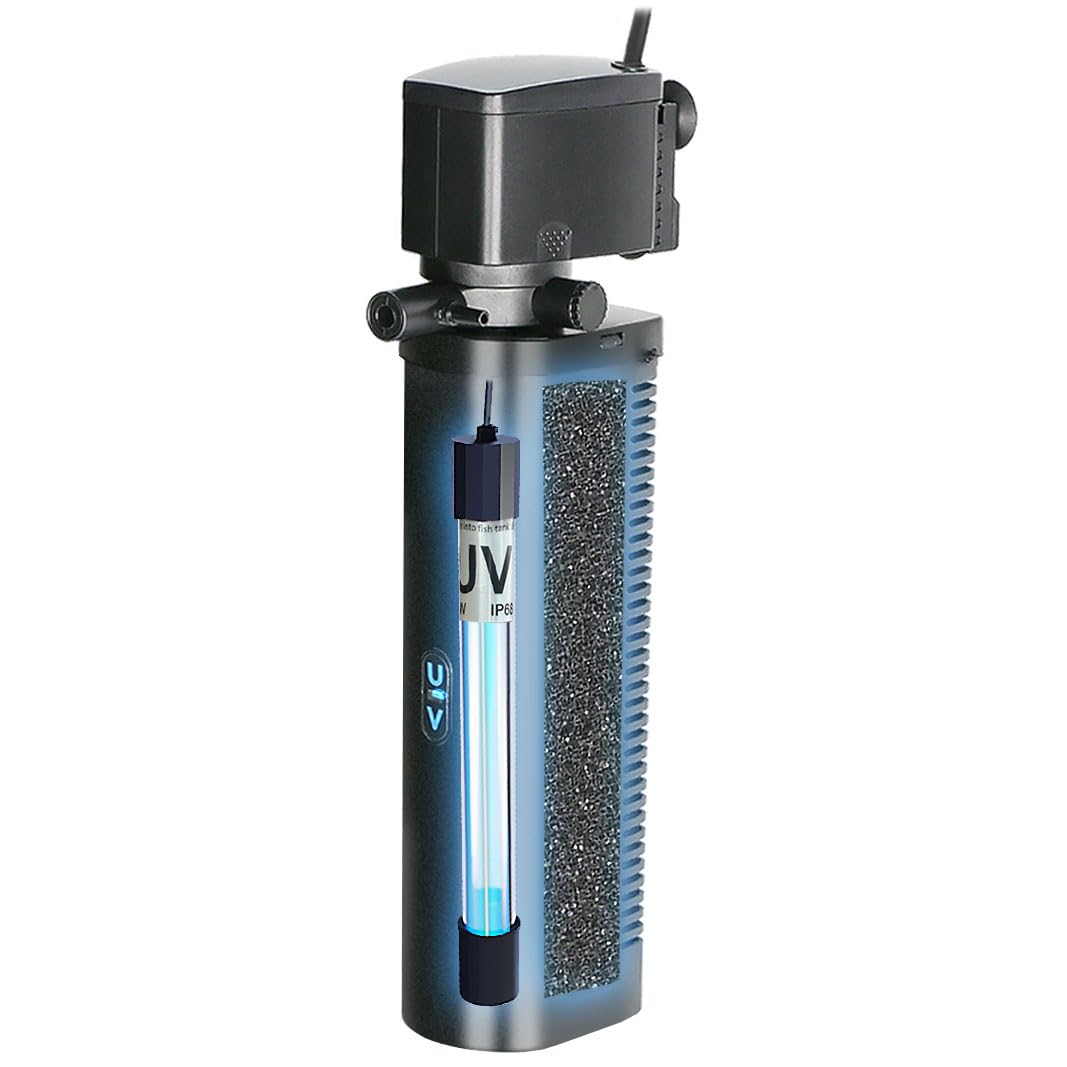
A submersible that pumps 600 GPH and a 9W UV lamp into one watertight package.
The COOSPIDER JUP-04 is an internal submersible filter that delivers 600 GPH via a 35W pump and pairs it with a 9W, 254nm UV light. It is rated for 100 to 500-gallon tanks, making it the most powerful budget option here by raw flow. The UV light and pump have independent switches so you run the sterilizer only when needed — recommended at 1-2 hours a day. The dual physical filtration stages (a replaceable sponge followed by the UV chamber) are simple to pull apart and clean, and the sponge is reusable. For a turtle tank, it works as a wet-dry cycle: reviewers point out an “incredible improvement” in clarity in just 6 days on an 800-gallon stock tank pond. Setup is drop-in — immerse it completely and plug it in.
The catch is the thin media: just a sponge and a UV light, no dedicated biological media chamber. For a tank with heavy bioload, you would want a canister as the primary filter and use this as a high-flow polishing/UV unit. The 35 review base is small, but the performance satisfaction is strong.
affordable all-in-one
- Massive 600 GPH flow for the price — clears murky water fast
- Independent pump/UV switches give precise control over sterilization
- Drop-in submersible design needs no hoses or cabinet space
flimsy build
- Single sponge media with no dedicated biological chamber for heavy waste
- Takes up room inside the tank compared to a canister
budget friendly: you need a powerful, secondary UV polisher for green water or you have a pond/stock tank that needs high flow on a budget.
durable build: you want a standalone filter for a heavily stocked 100-gallon tank — this works best as a booster alongside a canister.
Understanding the Specs
Gallons Per Hour (GPH)
This measures how much water the pump moves through the filter media in one hour. The general rule for freshwater tanks is to turn over the full tank volume four to five times per hour. For a 100-gallon tank, that means a filter rated for at least 400 GPH. Higher GPH means more oxygen exchange and faster waste removal, but it can also create a strong current that some fish, like bettas or angelfish, find stressful. Look for filters with an adjustable flow valve so you can dial the flow up or down.
UV Light / Sterilization
Filtration Stages (Mechanical, Chemical, Biological)
Mechanical media — sponge pads, filter floss — trap visible particles like uneaten food. Chemical media — activated carbon, Purigen — adsorb dissolved pollutants, medications, and odors. Biological media — ceramic rings, bio-balls, Bio-Foam — provides surface area for beneficial bacteria that convert toxic ammonia and nitrite into much less toxic nitrate. A filter with separate chambers for each stage lets you service one without disturbing the others. For a 100-gallon tank, look for at least three distinct media layers.
Canister vs. HOB vs. Submersible
Canister filters sit below the aquarium, connect via intake and return hoses, and offer the largest media volume and quietest operation. Hang-on-back (HOB) filters clip onto the rim and are easier to reach for media changes but hold less media. Submersible internal filters drop directly into the tank, take up interior space, and are typically used as supplementary circulation or polishing units. For the primary filter on a 100-gallon tank, a canister is the most common and capable choice.
FAQ
Is 400 GPH enough for a 100 gallon fish tank?
What is the difference between a canister filter and a hang-on-back filter for a 100 gallon tank?
Do I need a UV light on my 100 gallon fish tank filter?
How often should I clean a canister filter on a 100 gallon tank?
Can a filter rated for 75 gallons work on a 100 gallon tank?
Will a 100 gallon fish tank filter work for a turtle tank?
Do I need to replace the media in my canister filter, or just rinse it?
What does “self-priming” mean in a fish tank filter?
How do I know if my filter is too strong for my fish?
Can a UV light kill beneficial bacteria in my tank?
Final Thoughts: The Verdict
For most people, the 100 gallon fish tank filter winner is the Fluval 407 because it combines near-silent operation, easy media access via the EZ-Lift baskets, and a proven track record across nearly 10,000 owners. If you need massive flow for heavy waste-producers, grab the Fluval FX2 at 475 GPH. And for a budget-friendly canister with a UV light timer, the VEVOR 317GPH is the one to reach for.
How We Picked
We do not accept paid placement. Every pick is matched to a real buyer and a real use-case; we do not hands-on test units.
Sources & Methodology
Specifications: manufacturer listings and product documentation. Review insights: verified customer reviews, as of July 2026. Pricing: not shown on this page (it changes often); check the current price via the retailer link.
As an Amazon Associate, Gadgets Feed earns from qualifying purchases. This does not affect which products we feature.