
The original Zip drive was a lifeline for backups in the dial-up era, but its 100 MB ceiling and the infamous “Click of Death” left a generation of users paranoid about data loss. Today, extracting legacy files or finding reliable high-density removable storage requires navigating a minefield of outdated hardware, counterfeit chips, and format incompatibilities.
I’m Min — the co-founder and writer behind Gadgets Feed. I’ve spent countless hours digging through technical specifications and customer failure reports to separate the functional drives from the risky dead ends in this forgotten corner of data storage.
Modern storage options have far outpaced those old blue disks, and this roundup focuses on genuine solutions for transporting, archiving, and recovering data at the 100 GB scale without sacrificing reliability. Finding a truly dependable 100 gb zip drive means knowing which media type and interface actually work with today’s operating systems.
How To Choose The Best 100 GB Zip Drive
Choosing a 100 GB drive today means deciding whether you need to read magnetic Zip-100 disks, burn archival-grade Blu-ray media, or simply carry large files on flash storage. Each path has very different hardware requirements and failure risks.
Interface & OS Compatibility
The biggest hurdle for legacy Iomega drives is getting them recognized by Windows 10, 11, or modern Linux distros. The original ATAPI internal drives require old drivers and won’t work past Windows 7 without a SATA/IDE adapter. The USB-powered Iomega 100MB drive is the only official external option that retains plug-and-play support, though it feels flimsy compared to the old internal units. For Blu-ray burners, you need a USB 3.0 BDXL-compatible optical drive; many older burners default to 25 GB instead of the full 100 GB capacity of these discs.
Media Authenticity & Reliability
Magnetic Zip disks, especially the 750 MB variants, have a notorious failure rate — several user reports confirm unrecoverable corruption within minutes of first use. For flash drives, the single largest pitfall is fake capacity: cheap bulk drives often report 4 GB while only physically containing 111 MB of real NAND, corrupting files without warning when that tiny true capacity is exceeded. Optical M-DISC BD-R media from Verbatim, by contrast, is physically engraved, passed US Department of Defense durability tests, and carries a 10-year warranty. If cold storage longevity is your priority, optical is the only reliable path.
Quick Comparison
On smaller screens, swipe sideways to see the full table.
| Model | Category | Best For | Key Spec | Amazon |
|---|---|---|---|---|
| Iomega 100MB USB-Powered Drive Zip | Legacy Reader | Reading old Zip disks on modern OS | Data transfer rate 0.9 MB/sec | Amazon |
| Verbatim M DISC BD-R 100GB 4X | Optical Archive | Long-term archival cold storage | 100 GB per disc, 25-pack spindle | Amazon |
| Sandisk 128GB Ultra USB 3.0 | Flash Storage | Fast, reliable file transfers | Up to 100 MB/s read speed | Amazon |
| Iomega 32328 Zip 750 MB ATAPI | Internal Legacy | Replacing a dead internal Zip drive | Reads/writes 750 MB and 250 MB disks | Amazon |
| Aiibe 128GB USB 3.1 Flash Drive | Budget Storage | Daily file backup and transport | 128 GB, USB 3.2 Gen 1 | Amazon |
| Kanayu 4GB 100 Pack USB 2.0 | Bulk Distribution | Mass-distribution of small files | 4 GB per drive, 100-pack | Amazon |
| EASTBULL 1GB USB Flash Drive 100 Pack | Bulk Distribution | Handing out files at conferences | 1 GB per drive with lanyards | Amazon |
In‑Depth Reviews
1. Iomega 100MB USB-Powered Drive Zip

This is the only USB-powered Iomega drive that modern operating systems actually recognize without hunting down legacy drivers. Real user reports confirm it works on Windows 10 (64-bit), Windows XP, Vista, and even Ubuntu 24.04.3 — the right-click eject function works natively. One reviewer successfully extracted files from disks written in the late 1990s using a USB 3.1 port, all without re-plugging the drive.
The plastic casing feels significantly cheaper than the old internal drives, and multiple user reports mention that after a single successful session, the drive can fail to accept or release disks entirely. At 0.9 MB/sec transfer speed, moving a full 100 MB disk takes roughly two minutes — manageable for occasional data recovery but impractical as a daily driver.
If your primary goal is reading legacy Zip-100 disks on a modern computer, this is the only ready-made solution. Just be prepared for the possibility that the drive may become a one-time-use tool, and have a backup retrieval path ready. It is strictly for data recovery, not for new backups.
Why it’s great
- USB-powered, recognized instantly by Windows 10 and Linux without extra software
- Reads, writes, and erases legacy Zip disks from the 1990s
Good to know
- Feels flimsy; some units fail after a single use
- Transfer rate of 0.9 MB/sec is very slow
2. Verbatim M DISC BD-R 100GB 4X White Inkjet Hub Printable Blank Blu-Ray Recordable Media – 25pk Spindle

If your definition of a “100 GB Zip Drive” is a medium that reliably stores 100 GB of data for decades without corruption, this is the clear winner. The M-DISC technology physically engraves data into a rock-like layer, making it impervious to light, temperature swings, and humidity — it passed US Department of Defense durability testing. Real users report 100% success rates across multiple burns with no disc errors.
The main catch is that you need a BDXL-compatible burner. Many standard Blu-ray burners default to reading these discs as 25 GB, so you must manually select the 100 GB capacity in your burning software. One user broke a disc in half to examine the build quality and confirmed the M-DISC layer is far more substantial than standard dye-based media. Verbatim backs this with a 10-year limited warranty and technical support.
These discs are non-rewritable, so this is a write-once, read-forever solution. The 4X write speed means burning a full 100 GB takes approximately 30 to 40 minutes. For archival photo libraries, video masters, or legal document backups where longevity matters more than speed, this is the most trustworthy option available.
Why it’s great
- M-DISC engraving resists environmental damage — rated for archival longevity
- 25-disc spindle gives 2.5 TB of total cold storage capacity
Good to know
- Requires a BDXL-compatible burner; standard drives may see only 25 GB
- 4X write speed is slow — up to 40 minutes per disc at full capacity
3. SANDISK 128GB Ultra USB 3.0 Flash Drive – SDCZ48-128G-U46

When you need fast, reliable flash storage that actually delivers its advertised capacity, the Sandisk Ultra is the benchmark. It reads at up to 100 MB/sec — more than 100 times faster than the old Iomega USB drive. Real-world user feedback confirms it works perfectly for recording TV programs via a Fire Stick, storing large file archives, and as a general-purpose backup drive. Data integrity is consistently reported as excellent.
The write speed is noticeably slower than the read speed, hovering around 15 MB/sec according to multiple verified purchasers. This is a common limitation in this price tier, and it means transferring large video files onto the drive takes several minutes. The compact red-and-black housing is sturdy and lightweight at 0.1 pounds, making it pocket-friendly. Sandisk includes a one-year subscription to Rescue PRO Deluxe file recovery software, adding a layer of data safety that most budget drives skip entirely.
A few users noted that while read speeds meet expectations, write speeds can feel sluggish for their use case. If your workflow involves frequent large-file writes, consider a higher-end USB 3.2 Gen 2 drive. For general storage, transport, and emergency backups, this is the most reliable flash-based option in the roundup.
Why it’s great
- Read speed up to 100 MB/sec — handles large files quickly
- Includes Rescue PRO Deluxe data recovery software subscription
Good to know
- Write speed is slow — around 15 MB/sec in real-world use
- USB 3.0 interface, not as fast as newer USB 3.2 Gen 2 drives
4. Iomega 32328 Zip 750 MB ATAPI Drive

This internal ATAPI drive is a direct replacement for a dead 250 MB or 750 MB drive in an old PC. It reads and writes 750 MB and 250 MB Zip disks, and reads 100 MB disks (but does not write them). Real users have successfully connected it to modern systems using a SATA/IDE to USB adapter, allowing data retrieval without installing it inside a desktop. One reviewer was able to recover lost files from old Zip disks this way.
The critical limitation is driver support: the drive will not work on Windows 10 natively. It requires Windows 7 or older to function without a workaround. The Iomega Solutions Suite software that ships with the drive is also decades out of date. Additionally, the 750 MB Zip disks themselves have a well-documented reliability problem — one verified buyer reported a brand-new disk dying within minutes of first use, corrupting all data beyond recovery.
If you already own a collection of 750 MB Zip disks and need a drive to read them, this is one of the few remaining options. Just be aware that the disks themselves are fragile, and you should expect a high failure rate. For most users, digitizing those disks to a modern flash drive is the safer long-term strategy.
Why it’s great
- Ideal replacement for a dead internal 250 MB or 750 MB Zip drive
- Can be used with a SATA/IDE to USB adapter for data recovery
Good to know
- Does not work on Windows 10 or 11 without legacy OS
- 750 MB disks are notoriously unreliable — high risk of data loss
5. Aiibe 128GB USB Flash Drive USB Drive 128GB USB 3.1 Thumb Drive

The Aiibe 128GB drive offers a massive capacity at a remarkably low entry point, making it a strong contender for those who need bulk storage on a tight budget. Real-world testing shows it can successfully back up years of files from a failing laptop — one verified reviewer recovered seven years of data during a critical system failure where the source machine took 30 minutes to boot and crashed repeatedly. The green retractable housing keeps the USB plug protected when not in use.
The most notable issue is that one buyer reported receiving a pre-owned unit containing explicit content, which raises concerns about quality control and factory reset procedures. Additionally, while the packaging lists USB 3.2 Gen 1, some users describe the speed as adequate for documents but not for frequent large-file transfers — one review explicitly calls it a “USB 2.0 drive” in terms of perceived performance. The default exFAT format works well for cross-platform use between Windows and Mac.
For emergency backups where capacity matters more than speed, and where you can verify the drive is genuinely blank before inserting sensitive data, this represents solid value. The 1-year warranty provides a basic safety net, but the variability in reported real-world speeds makes it a gamble for performance-sensitive users.
Why it’s great
- 128 GB capacity at an entry-level price point
- Retractable USB plug design protects the connector
Good to know
- Quality control issues — one unit arrived with pre-existing user data
- Real-world write speeds are significantly slower than the USB 3.2 Gen 1 label suggests
6. EASTBULL 1GB USB Flash Drive Bulk Thumb Drives 100 Pack with Lanyards USB 2.0 Memory Sticks Zip Drive Pen Drive for Storage and Backup Gold 100PCS 1GB
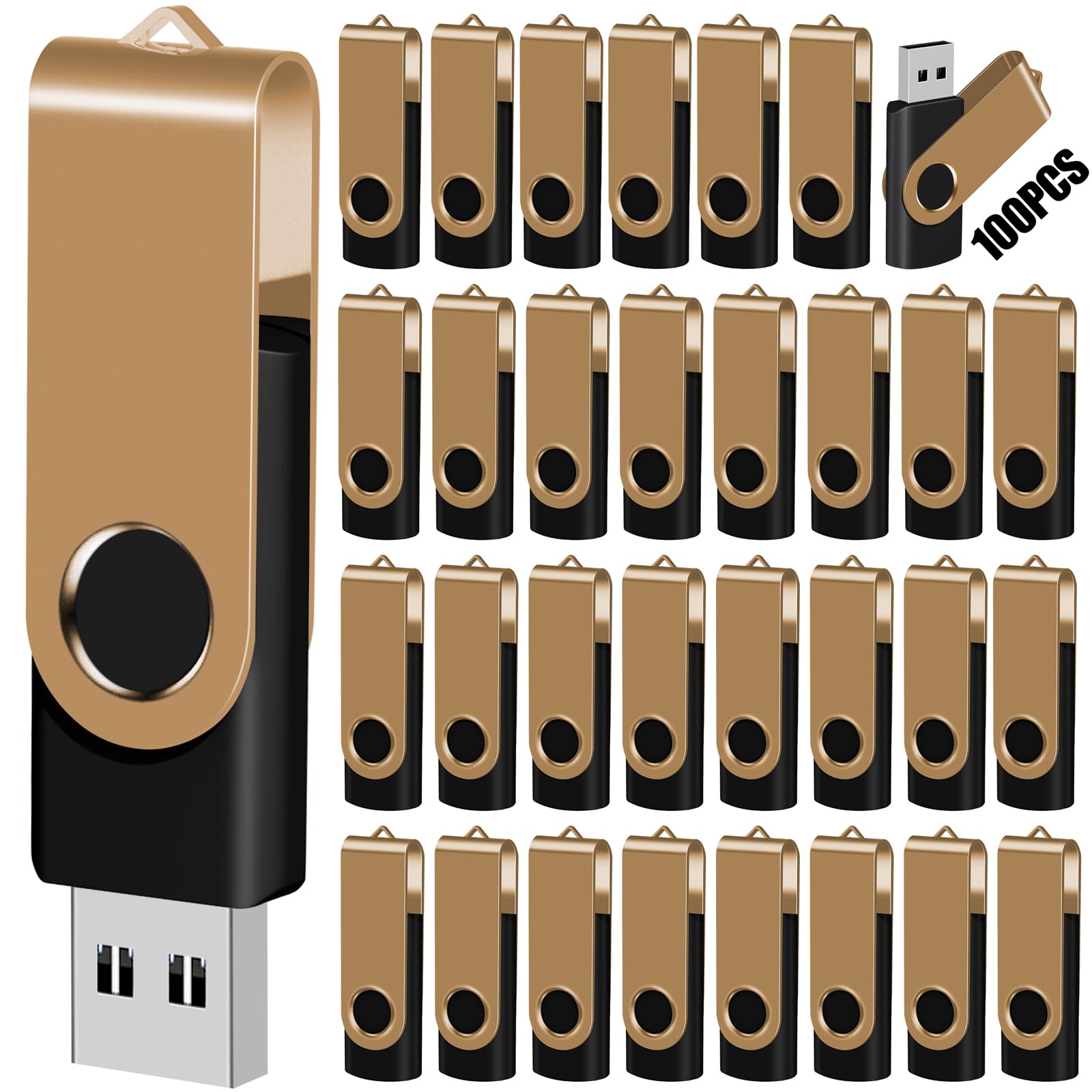
This 100-pack of 1 GB USB 2.0 drives is designed for mass distribution — handing out conference materials, seminar recordings, or school assignments. Each drive comes with a detachable lanyard, and the gold metallic body resists fingerprints. Real user reports indicate that the drives work reliably for their intended purpose, with one reviewer successfully distributing 7 GB of seminar content across multiple drives without a single failure across 20 units.
The drives ship formatted in FAT32, which means any single file larger than 4 GB cannot be stored without reformatting to exFAT. One buyer noted they had to manually reformat all 20 drives in their pack to accommodate a 9 GB video file. At USB 2.0 speeds (read around 15-25 MB/s, write around 6-12 MB/s), copying files is slow, but for small document distribution this is acceptable. A handful of long-term users are on their second or third purchase.
These are not suitable for critical data backups due to the low write speed and small per-drive capacity. They excel in scenarios where you need to hand out pre-loaded content to many people at a low per-unit cost. The included lanyards are a genuinely useful bonus for event usage.
Why it’s great
- 100 drives with lanyards for event distribution at a low per-unit cost
- User reports confirm reliable operation for file sharing
Good to know
- FAT32 format prevents storing files larger than 4 GB
- USB 2.0 speeds are slow — write speeds average 6-12 MB/s
7. Kanayu 4GB 100 Pack USB Flash Drives Bulk 2.0 USB Thumb Drives Memory Drive with LED Light Portable Keychain Flash Drive for Data Storage Pc Computer Laptop Office School(Black)
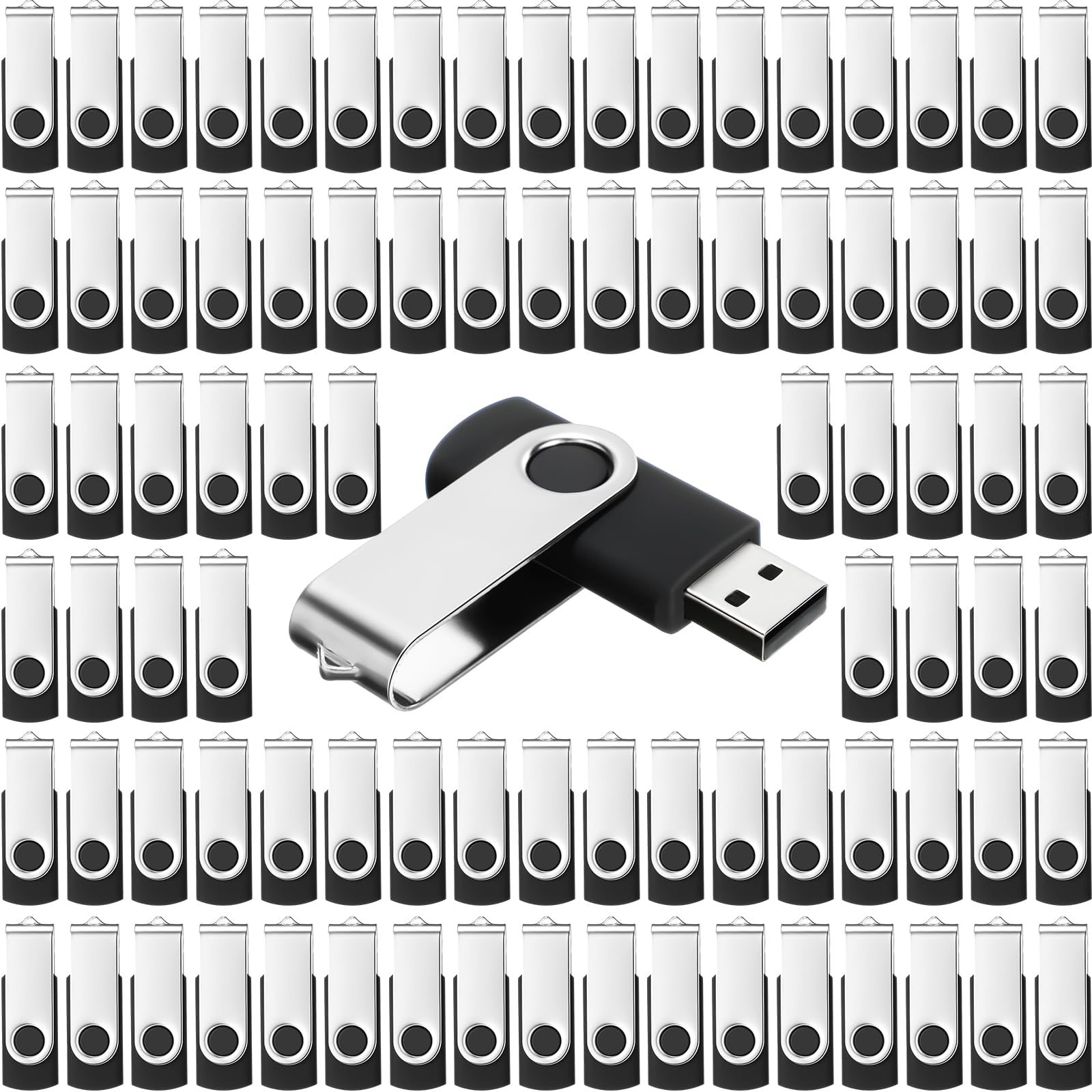
At face value, this 100-pack of 4 GB drives offers a massive amount of storage for a low total price. However, the real user feedback paints a grim picture. Multiple verified buyers report that the drives are fake capacity units — they report 4 GB in Windows but physically contain only 111 MB of real NAND. Storing even a few files beyond that tiny threshold corrupts the data irrecoverably. One buyer who purchased 400 of these drives described the experience as a “big waste of money” after realizing the files were corrupting silently.
A handful of users reported that the drives function adequately for playing music on car stereos, but this appears to be within the limited real capacity. The swivel aluminum cover and keychain hole are nice physical touches, but they cannot compensate for fundamentally fraudulent flash controllers. The product listing claims compatibility with USB 2.0 and 1.1, but write speeds are inconsistent across units.
We strongly advise against purchasing these for any scenario where data integrity matters. If you need bulk USB drives for distributing files, the EASTBULL 100-pack with verified real 1 GB capacity is a safer choice, and for data-heavy distribution, a smaller pack of verified-capacity Sandisk drives is worth the premium.
Why it’s great
- Keychain hole and swivel cover for easy carrying
- LED indicator light confirms when the drive is connected
Good to know
- Multiple users confirmed fake capacity — real storage is only 111 MB per drive
- Files corrupt silently when true capacity is exceeded; high risk of data loss
FAQ
Will the Iomega 100MB USB drive work on Windows 10 or 11?
What is the Click of Death and does it affect modern Zip drives?
Can I use Verbatim BD-R 100GB discs in a standard Blu-ray burner?
How can I test if a bulk USB flash drive has fake capacity?
Final Thoughts: The Verdict
For most users, the 100 gb zip drive winner is the Verbatim M DISC BD-R 100GB 25-pack because it is the only medium in this roundup that actually stores 100 GB per unit with archival-grade durability and a manufacturer warranty. If you need to recover data from legacy Zip disks, grab the Iomega 100MB USB-Powered Drive. And for fast, reliable everyday storage of 100 GB or more, nothing beats the Sandisk 128GB Ultra USB 3.0.