
Our readers keep the lights on and my morning glass full of iced black tea. As an Amazon Associate, I earn from qualifying purchases.
Specs are compiled from manufacturer listings and verified buyer reviews and can change over time — please confirm the key details on the product page before buying.
If you want a giant 100-inch picture but your living room is not a cavernous home theater, a short throw projector is the answer. It sits a few feet from the wall, not across the room, so you get a huge image without walk-in-front shadows or ceiling-mount hassle. This guide covers the best models that can fill a 100-inch screen from close range, explaining what really matters before you spend.
I’m Min — the founder and writer behind Gadgets Feed. This guide is built by comparing the manufacturers’ published specifications and the patterns across verified customer reviews, so you get each pick’s real strengths and trade-offs instead of marketing spin.
You want a 100 inch short throw projector that fits your room and your budget, so focus on three things: brightness, contrast, and how close it can sit to the wall. Here are nine models, each matched to a specific need, so you can pick the one that works for you.
Our Picks at a Glance


How To Choose The Best 100 Inch Short Throw Projector
Short throw projectors solve a real room problem, but picking one still takes some homework. You need to balance brightness for your lighting, contrast for dark scenes, and the throw ratio that fits your furniture layout. Here is the plain-English breakdown of what actually moves the needle.
Brightness and Your Room Lighting
Brightness is measured in lumens, and it decides whether you can watch with the lights on. For a 100-inch image, look for at least 2,000 lumens if you plan to use it mostly in a dark room. If you want to watch during the day or with lamps on, you want something closer to 3,000 lumens or more, so the picture does not wash out.
Contrast Ratio for Deep Blacks
Contrast ratio tells you how much difference there is between the brightest white and the darkest black a projector can show. A higher number means richer, more cinematic dark scenes instead of a grayish haze. Laser projectors typically beat lamp models here, which is why many premium picks lean on laser light sources.
Throw Ratio and Room Layout
Throw ratio is the distance from the lens to the screen divided by the image width. A smaller throw ratio means the projector can sit closer to the wall. Standard projectors need 8 to 10 feet for 100 inches, but a short throw model often needs only 3 to 5 feet. Ultra short throw units can sit just inches away, so measure your furniture depth before you choose.
Laser vs Lamp Light Source
Lamp projectors are cheaper but the bulb dims over time and eventually needs replacing. Laser light sources last much longer with consistent brightness, often rated for 30,000 hours or more. If you plan to keep the projector for years, the higher upfront cost of a laser model often pays off in fewer replacements and steady picture quality.
Quick Comparison
| Model | Best For | Brightness | Contrast Ratio | Resolution | Amazon |
|---|---|---|---|---|---|
| BenQ TH671ST★ Best Overall | Gaming & budget cinema | 3000 lm | 10000:1 | 1080p | Amazon |
| Optoma GT1090HDRLaser Pick | Laser reliability & day viewing | 4,200 lm | 300,000:1 | 1080p (4K input) | Amazon |
| BenQ X500iGaming 4K | Competitive 4K gaming | 2200 lm | 3000:1 | 4K UHD | Amazon |
| Hisense PL2 | Smart TV replacement | 2700 lm | 3000:1 | 4K UHD | Amazon |
| WEMAX Nova Pro | Built-in streaming & value | 2100 lm | 3000:1 | 4K UHD | Amazon |
| AWOL VISION LTV-3000 Pro | Built-in center channel audio | 2000 lm | 2500:1 | 4K UHD | Amazon |
| NexiGo Aurora Pro | Dolby Vision & deep blacks | 2400 lm | 3000:1 | 4K UHD | Amazon |
| NexiGo Aurora Pro MKII | Ultra-low latency gaming | 2400 lm | 30000:1 | 4K UHD | Amazon |
| Epson Lifestudio Grand Plus | Brightest premium image | 4000 lm | 5,000,000:1 | 4K UHD | Amazon |
In‑Depth Reviews
1. BenQ TH671ST
Our pick — 4.5★ from 650+ verified ratings; the strongest balance of quality and price.
Projects a crisp 100-inch 1080p image from just 5 feet away.
You get a true 1080p picture with 92% Rec. 709 color accuracy, so skin tones look natural and game worlds feel vivid. The 3000-lumen lamp is bright enough that buyers report it stays visible even in daytime with lights on — a rare feat at this level. It projects a 100-inch screen from just 5 feet away, which makes it a fit for apartments where a standard throw would never work.
Gamers, this one is for you. The low input lag (the delay between your controller action and the screen response) and refresh rate are matched to the max output of Xbox One X and PS4 Pro, so fast titles stay sharp without motion blur. High Ground Gaming named it Best Projector for Gaming in 2019. The contrast ratio of 10000:1 is lower than the laser models further down this list, but it still gives you deep enough blacks for movie nights when the room goes dark.
Owners call the onboard speakers impressive for a projector, noting 40-60% volume is plenty, and the quiet operation means the fan does not interrupt dialogue. The biggest caution is the rainbow effect, which a few buyers see on large images, and the lamp eventually dims after years of use. The 3-year limited parts and labor coverage from a US-based team softens that long-term worry.
What wins people over
- Bright 3000-lumen image that handles ambient light
- Ultra-low input lag for smooth console gaming
- 100-inch screen from just 5 feet away
- Strong 3-year warranty with US support
The fair trade-offs
- Contrast trails laser models at 10000:1
- Lamp needs eventual replacement unlike laser units
- Rainbow effect visible to some on large screens
Reach for this if: you want a bright, lag-free 1080p picture for gaming and movies without paying laser prices.
Look elsewhere if: you need the deepest blacks of a laser light source or plan to run it for years without maintenance.
2. Optoma GT1090HDR
Laser-powered, 4,200-lumen bright, and built to run for 30,000 hours
This Optoma blows past the BenQ above in raw output, delivering 4,200 lumens versus 3000 lumens, which is a 40% brighter picture for rooms where light is hard to control. The laser light source also eliminates lamp and filter replacements for up to 30,000 hours of operation, so you are not budgeting for bulbs down the road. It throws a large 120-inch image from 4 feet 4 inches away, giving you flexible placement in tighter spaces.
The contrast ratio here is the headline number: 300,000:1 versus the BenQ TH671ST’s 10000:1, a 30x gap that shows up in noticeably deeper blacks and richer shadow detail. It accepts 4K HDR input through HDR10 and HLG, though the native panel is 1080p — so it upscales your 4K sources rather than displaying true 4K. Owners who use it for golf simulators rave about the picture quality, calling it whisper quiet and easy to set up.
Owners mention the picture is “great and very durable after 2 years of use. No issues” — a strong sign for the laser reliability. The trade-offs are a small menu that is hard to navigate and a digital zoom with big jumps instead of fine control. Color quality gets mixed feedback, with some finding a red tint strong enough that they adjusted it down several points. It also supports full 3D with 120Hz rapid refresh for flicker-free content, though glasses sell separately.
The standout strengths
- 4,200-lumen brightness that shrugs off daylight
- 300,000:1 contrast for cinematic blacks
- 30,000-hour laser with no lamp swaps
- Full 3D support at 120Hz refresh
What to know before buying
- Native 1080p panel upscales 4K, not true 4K
- Small menu and coarse digital zoom
- Some owners adjust a strong red tint
Confident verdict: the brightness and laser longevity make this the pick for bright rooms and long-term owners who want zero lamp maintenance.
Single caveat: if you insist on true 4K pixels, this 1080p panel will disappoint you.
3. BenQ X500i
A true 4K gaming projector with 4.2 ms latency for competitive play.
Delivers a 4.2 ms response time at 1080p@240Hz for instant shot registration. The 4LED engine produces a true 4K HDR picture with 2200 lumens of brightness, and owners describe gaming as “buttery smooth” with bright colors and deep blacks. It casts a 100-inch screen from about 6.5 feet, which is slightly farther back than the top pick but still well within short throw territory. Unlike the Optoma above, this is a native 4K panel, so every pixel is real.
Google-Certified Android TV is built in, letting you stream Netflix, Prime, and YouTube right from the start, plus cast from iPhone, iPad, Mac, Android, and PC via AirPlay and Chromecast. BenQ’s TreVolo audio adds 7.1-channel and Dolby Atmos support with tuned sound modes for FPS, RPG, and cinematic content, though owners say the built-in speakers are just okay and recommend external audio. Customers note that for the price, some competitors offer 120Hz, ethernet, and HDMI 2.1 that this unit lacks — it sticks with HDMI 2.0 and no ethernet port.
The image quality is the story that wins people over, with owners blown away by the clarity and calling it an amazing home theater projector for games and movies with family. It is extra quiet, which matters during long sessions. The catch is the 3000:1 contrast ratio, which is modest for the premium tier and means it performs best in a darker room. If you want the fastest response plus true 4K, this is your machine.
Built for the win
- 4.2 ms low latency with 240 Hz refresh
- True 4K panel, not upscaled
- Android TV with AirPlay and Chromecast built in
- Dolby Atmos audio with game sound modes
Honest limitations
- HDMI 2.0 lacks the newest 2.1 standard
- No ethernet port for wired connection
- Contrast ratio of 3000:1 needs a dark room
Who it beats: any lamp projector on responsiveness, and it outshines the Optoma GT1090HDR for gamers who want native 4K.
Who it does not: if your room stays bright or you need HDMI 2.1 for the newest consoles, look at the premium models below.
4. Hisense PL2

A wall-hugging laser TV with 1.07 billion colors and built-in streaming
This ultra short throw unit sits in front of the wall, not a few feet back, and casts images from 80 inches up to 150 inches using X-Fusion laser technology rated for 25,000+ hours. The 4K AI upscaler takes lower-resolution content and sharpens it, while the 1.07 billion color palette makes grass the right green and skin tones full of nuance. Owners say the image quality is TV-like on a plain off-white wall, with colors so vivid they look like they are coming out of the screen.
At 2700 lumens with Dolby Vision and multiple HDR standards supported, it handles daytime viewing better than the dimmer UST options. Google TV is built in with Wi-Fi 6E, and the sound quality gets genuine praise — owners call the built-in speakers great and find it quieter than expected. It is not heavy and is easy to adjust, which makes setup less intimidating than the bigger premium units.
The honest catch is the setup logistics: to reach maximum size you place it on the floor, and the levelers feel awkward, with some calling it a toddler hazard. Auto keystone draws complaints for being inefficient, requiring a phone photo upload to a device-hosted website. A few owners note a slight rainbow effect, though others report none at all. Buyers sum it up as one of the best value laser TVs around, with a couple calculating the cost at roughly two dollars a day spread over a decade.
Why it impresses
- 1.07 billion colors for lifelike accuracy
- 25,000+ hour X-Fusion laser light source
- Google TV and Wi-Fi 6E built in
- Bright 2700-lumen image with Dolby Vision
Setup realities
- Floor placement needed for maximum size
- Auto keystone is clunky to use
- Minor rainbow effect reported by some
Best for: families who want a true TV replacement with zero lamp maintenance and strong built-in sound.
Think twice if: you want a simple to use keystone setup (the adjustment that squares the image) or have curious toddlers who might touch low furniture.
5. WEMAX Nova Pro
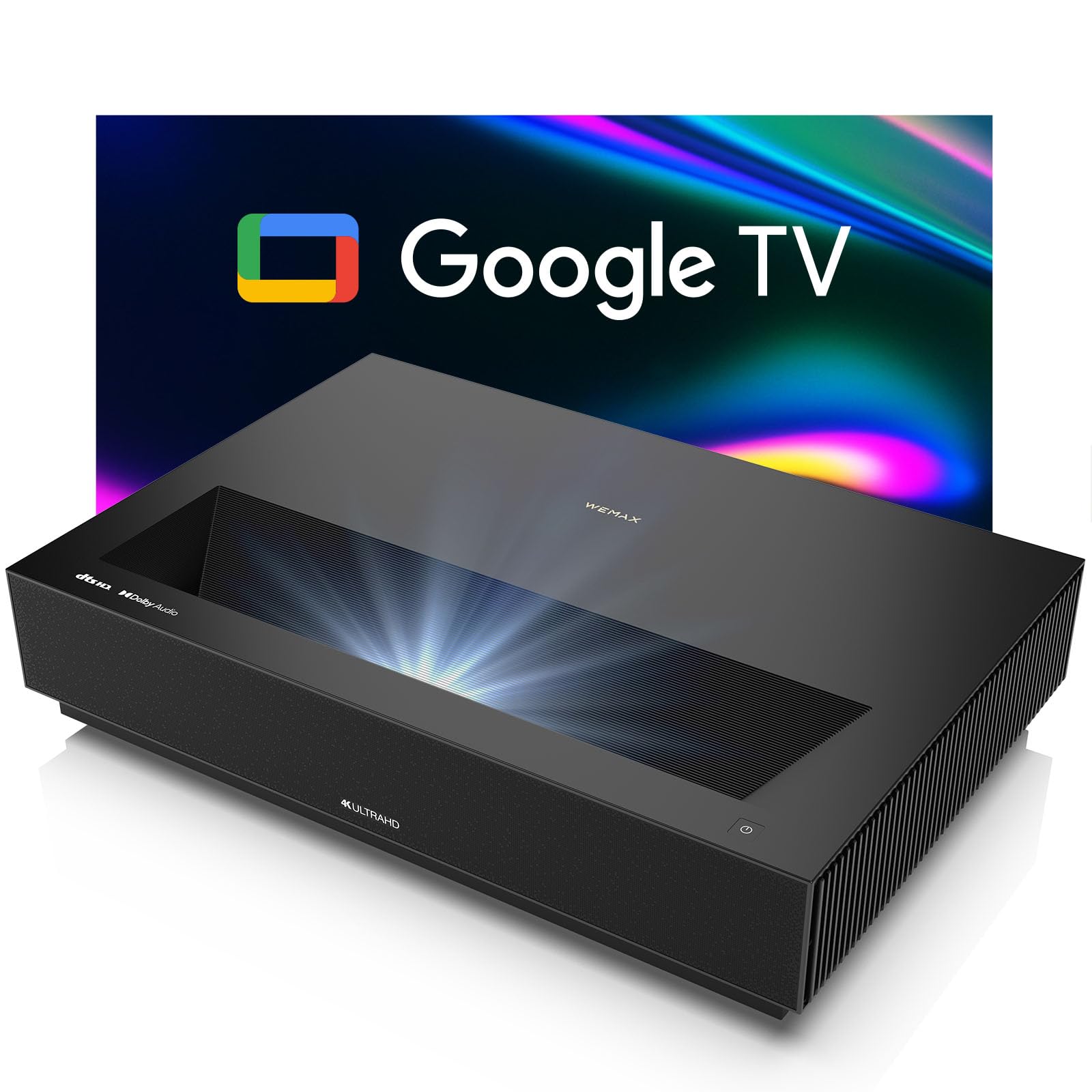
Throws a 150-inch image from 19 inches away with Netflix built in.
With a 0.23:1 ultra short throw ratio, this projector throws a massive 150-inch image from just 49cm (19 inches) off the wall, which is the tightest placement in this lineup. ALPD laser technology delivers true 4K UHD with 110% Rec.709 color gamut and 1.07 billion colors, and owners call it the best value UST on the market with a premium build. The built-in Google TV includes official Netflix, so you skip the streaming stick entirely, plus Google Assistant voice control and multi-user profiles.
Audio is a real strength here, with dual 15W speakers delivering Dolby Audio and DTS-HD for theater-like surround sound. Owners describe the soundbar as great and the fans as quiet, making long movie sessions comfortable. The 2100 ISO lumens perform well in moderate ambient light, though a darker room or an ALR screen gives the optimal picture. Setup is genuinely easy, with buyers finishing in 15-20 minutes and praising the keystone correction.
Reliability gets mixed feedback: some owners run it for years with zero issues, but a few report it stopping unexpectedly or developing dead pixels after a couple of years. Owners recommend buying an extended warranty for confidence. The remote lacks a source button and offers limited picture settings, and there is no built-in iPhone mirroring. For the price, buyers consistently say it beats the Optoma and the pricier VAVA on value, with one noting it falls cheaper than the VAVA.
Why it stands out
- 150-inch image from just 19 inches away
- Official Netflix and Google TV built in
- 30W speaker system with DTS-HD
- 1.07 billion colors on true 4K
Know the risks
- Mixed long-term reliability reports
- No iPhone mirroring built in
- Remote lacks a dedicated source button
Reach for this if: you want the tightest throw distance possible and hate the idea of a separate streaming stick.
Look elsewhere if: long-term reliability is your top fear — spring for extra coverage if you choose this one.
6. AWOL VISION LTV-3000 Pro
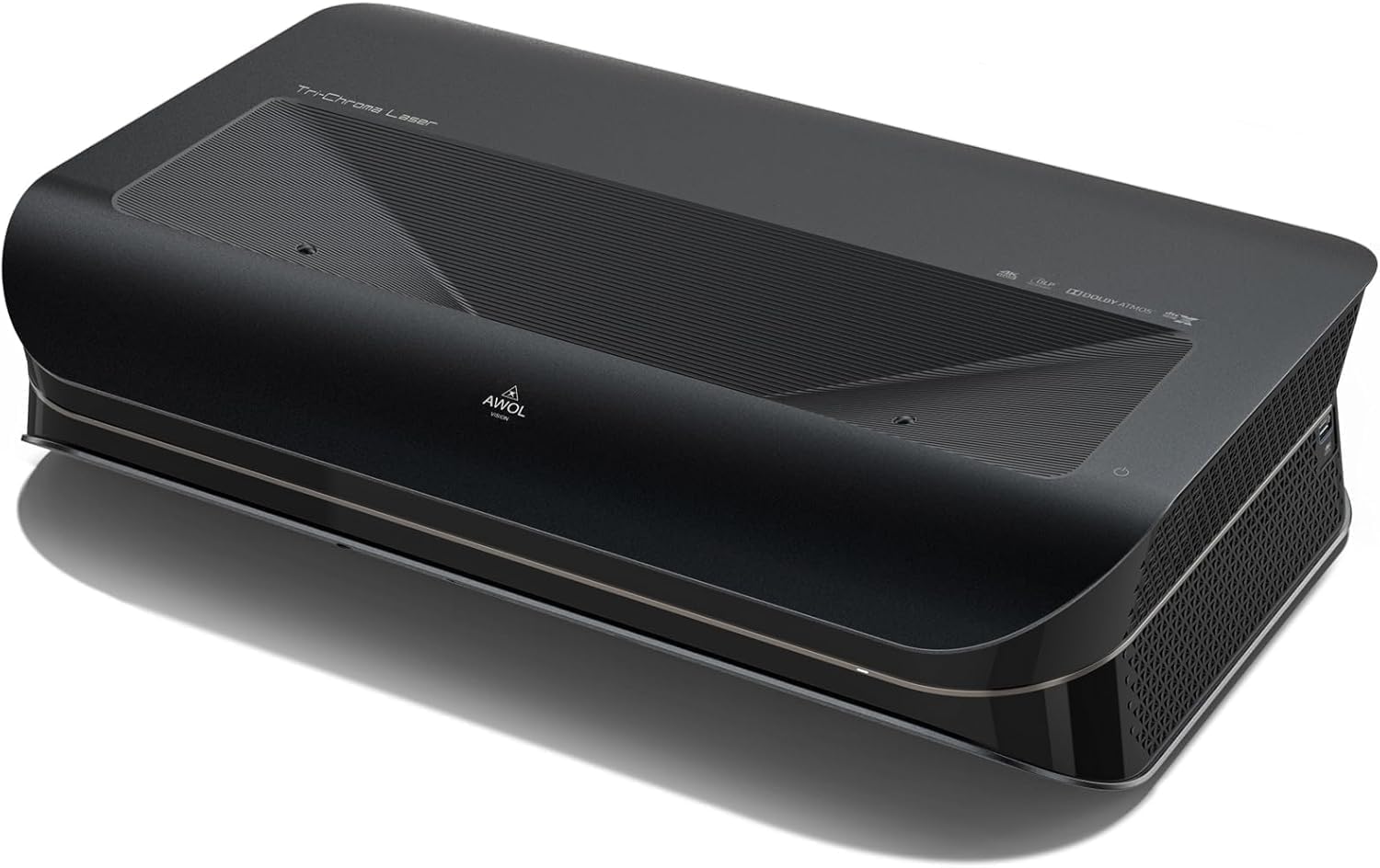
The first UST projector with a built-in center channel speaker for direct dialogue.
This AWOL is the first ultra short throw projector with a built-in center channel speaker, so dialogue comes straight from the screen without extra speakers. The triple laser engine (which uses no color wheel) combines 4K UHD, Dolby Vision, HDR10+, and 3D support for sharp images day or night. It covers 107% BT.2020 and 147% DCI-P3 color standards, giving you cinema-grade accuracy comparable to digital cinemas.
Owners are consistently impressed, calling it the best replacement for a TV they have ever owned, with a super sharp 4K picture that works even during the day. The setup is intuitive and the built-in smart TV interface means many do not need a soundbar at all. The fixed throw ratio of 0.25:1 means about 8.54 inches from the wall for a 100-inch image, so it hugs the wall tighter than nearly everything here.
The honest downsides are the internal speakers, which one owner calls dreadful until an EQ fix, and the 60Hz maximum refresh rate that causes some blur in fast motion and gaming. A few report the fan getting loud after 1.5 hours of 4K content and primitive menus with a poor manual. Owners note the price rivals two high-end 75-inch TVs, so it is a serious investment. The energy saving is real though, using just 1/10 the energy of conventional LED TVs.
What makes it special
- Built-in center channel speaker for clear dialogue
- Triple laser with no color wheel
- 147% DCI-P3 color coverage
- Uses 1/10 the energy of LED TVs
The real trade-offs
- 60Hz max refresh limits gaming smoothness
- Internal speakers disappoint until EQ adjustments
- Fan gets loud during long 4K sessions
Confident verdict: for movie lovers who want dialogue clarity and cinema color without a separate receiver, this is the standout.
Single caveat: gamers chasing high refresh rates should look at the NexiGo MKII below instead.
7. NexiGo Aurora Pro

The only UST projector combining Dolby Vision with a native 3000:1 contrast ratio.
This is the spec monster of the list — the only ultra short throw projector combining Dolby Vision, HDR10+, a native contrast ratio above 3000:1, and dynamic laser dimming all in one body. The ALPD 4.0 RGB+ technology and dynamic laser dimming reduce the black level by more than 60% while providing over 30% energy savings. Reviewers point out stunning clarity, vibrant colors, and good black levels that outperform expectations, with brightness that still works during the day.
Audio is a headline feature with built-in 60W stereo speakers consisting of two 15W woofers and two 15W tweeters, plus Dolby Atmos with eARC. Owners call it a flawless home theater experience and would rebuy it, noting the sound is genuinely good for built-in units. The 4K@120Hz input with the lowest tested input lag of 8ms among UST projectors makes it a strong gaming choice too, with responsive 120Hz MEMC reducing ghosting.
The main criticism is that Dolby Vision needs tuning from the start, though owners note that after calibration it is stunning with rich colors. Focus requires manual re-adjustment at each startup, which is an annoyance for daily use. Value gets mixed verdicts — some call it worth the price while others find it overpriced for the image quality. The mount holes are aluminum and risk stripping, and the remote battery lasts 4-6 months with reduced range when low.
The premium wins
- Dolby Vision, HDR10+, and 3000:1 contrast together
- 60W speaker system with Dolby Atmos
- 4K@120Hz with 8ms lowest tested input lag
- Dynamic laser dimming cuts black level 60%+
Where it stumbles
- Dolby Vision needs manual calibration
- Focus resets and needs re-adjusting each startup
- Mixed opinions on value for the price
Best for: enthusiasts who love calibrating and want the rare combo of Dolby Vision plus deep dynamic blacks.
Think twice if: you want a pick-up-and-play unit with zero daily adjustments — look at the Epson below instead.
8. NexiGo Aurora Pro MKII

Boasts a 30,000:1 contrast ratio and 4.2 ms latency for serious gamers.
This second-generation NexiGo jumps the contrast ratio by a factor of ten over its sibling above, hitting an impressive 30000:1 through the Scene Adapt Engine that adjusts laser output in real time. The dynamic iris and laser dimming produce deeper blacks and brighter highlights, and the engine lowers energy consumption by about 70%. The ALPD 5.0 laser engine boosts color accuracy to ΔE≈1 with 107% BT.2020 gamut, and the 30,000-hour lifespan translates to 18+ years for the average viewer.
Gamers get the headline treatment with 4K gaming at 120Hz and an ultra-low latency between 4.2ms and 8ms in Gaming Mode. The 0.21:1 throw ratio creates a large projection with less space than the older model, so you can enjoy up to 150 inches in a home cinema of any size. Owners call it the best projector they have ever owned, with sharp corner-to-corner focus even at angles, excellent color, and a quiet fan with no filter maintenance. The built-in streaming stick compartment hides a Chromecast or Fire Stick for a clean look.
Sound comes from 60W speakers with Dolby Atmos, and owners praise the speakers alongside the S/PDIF out (a digital audio output) for external setups. A few note the oddly shaped pixels cause slightly soft focus, and the fan speed fluctuates at times. Some owners call the touch buttons on top funky. With autofocus and auto-calibration working perfectly per the reviews, this is among the most polished units in the lineup for daily use.
The headliners
- 30000:1 contrast with dynamic iris dimming
- 4.2ms to 8ms ultra-low gaming latency
- 30,000-hour lifespan equals 18+ years
- Auto-focus and auto-calibration work perfectly
Minor quirks
- Oddly shaped pixels cause slightly soft focus
- Fan speed fluctuates at times
- Touch buttons on top feel unusual
Reach for this if: you want the fastest UST response times combined with a contrast ratio that rivals home cinema projectors.
Look elsewhere if: the price stings — the WEMAX Nova Pro delivers 80% of the experience for a significantly lower cost.
9. Epson Lifestudio Grand Plus
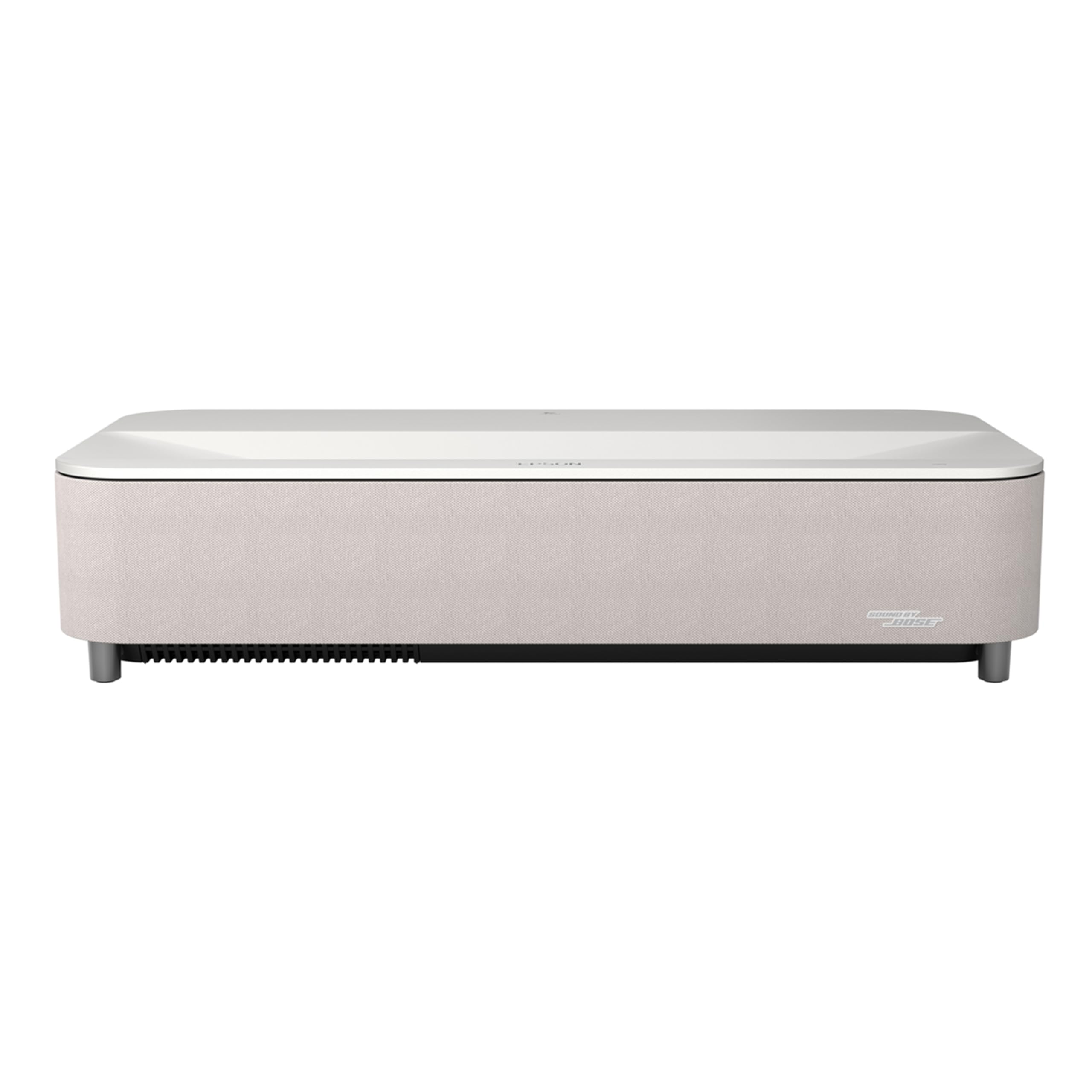
Delivers 4,000 lumens, Bose audio, and a 5,000,000:1 contrast ratio.
This Epson tops the brightness chart at 4,000 lumens of both color and white brightness, and the 3-chip 3LCD technology produces a full 8.29 million pixels on-screen with 4K HDR10 color. The contrast ratio is the highest on this list at 5,000,000:1, which delivers the deepest blacks and richest shadow detail of any pick here. Owners who stepped up from a 2600-lumen UST call it a day-and-night difference, noting it works in daytime pretty well — though they stress it needs a proper screen, not a bare wall.
Audio comes from Bose technology, and owners praise the loud output with four modes including a bass-heavy cinema setting. Google TV is built in and runs fast, with three HDMI ports, ALLM, and high-frame-rate support for smooth gaming on the latest consoles. Owners describe it as a beautiful 4K experience on a 120-inch ALR screen, with fluid Android and good built-in sound. The ultra short throw placement puts it close to the wall for a theater-like picture up to 150 inches.
The honest reality is that this is a huge, heavy unit at 27.6 pounds, and there is no autofocus, so you will adjust focus manually. Owners warn that you must budget for an expensive UST-specific ALR screen, because standard long-throw screens reflect the light to the ceiling and ruin the image. It lacks Dolby Vision support, and text is described as less crisp than some rivals. If you want the absolute brightest, most contrast-rich image and have the room and screen budget, this earns its premium price tag.
Why it leads
- 4,000 lumens for the brightest daytime picture
- 5,000,000:1 contrast for deep blacks
- Bose audio with four sound modes
- 8.29 million pixels with 4K HDR10
What it demands
- Heavy at 27.6 pounds with no autofocus
- Requires a costly UST-specific ALR screen
- No Dolby Vision support
Best for: dedicated home theater owners who want maximum brightness and contrast and are ready to invest in a matching ALR screen.
Think twice if: you want a lightweight portable unit or cannot budget the extra money for the proper screen.
Understanding the Specs
Throw Ratio
This is the distance from the lens to the screen divided by the image width, and it decides where the projector can sit. A smaller throw ratio means it can be closer to the wall. Standard projectors often need 8-10 feet for a 100-inch image, while short throw units need only 3-5 feet, and ultra short throw models sit just inches away. Measure your furniture depth before choosing so you know which type actually fits your room.
Lumens and Brightness
Lumens measure how much light the projector throws out, and more lumens means a brighter, more daylight-friendly picture. For a 100-inch image, 2,000 lumens works well in a dark room, but you want 3,000 or more if you plan to watch with lights on. Pay attention to whether the number is a standard lumen rating or a stricter measurement like ISO lumens, which can make a unit seem brighter than it really is.
Contrast Ratio
Contrast ratio shows the difference between the brightest white and the darkest black a projector can display. A higher ratio means deeper blacks and more detail in dark scenes, which is the difference between a washed-out haze and a cinematic image. Lamp projectors typically sit around 10,000:1, while premium laser models can reach 300,000:1 or even millions to one with dynamic dimming technology.
Native Resolution vs 4K Input
Native resolution is what the projector actually displays, while 4K input means it can accept a 4K signal and upscale it to its own panel. A true 4K projector has a native 4K panel, while a 1080p projector with 4K input will still show a 1080p picture. If you want every pixel of your 4K content, check the native resolution carefully instead of just the input support.
FAQ
How close does a short throw projector need to be to get a 100 inch screen?
Can I use a standard projector screen with an ultra short throw projector?
Is a laser projector really better than a lamp projector?
What does 4K input mean if the projector is not true 4K?
Do I need a special screen or can I project onto a wall?
What input lag do I need for gaming on a projector?
Can a short throw projector work in a bright room?
What is the rainbow effect on laser and DLP projectors?
Final Thoughts: The Verdict
For the majority of shoppers, the 100 inch short throw projector winner is the BenQ TH671ST because it balances 3000 lum
of brightness, a true 1080p picture, and gaming-grade low input lag at a price that does not require a second mortgage. If you want the brilliance of a laser light source with 300,000:1 contrast and zero lamp swaps, grab the Optoma GT1090HDR. And if you are a competitive gamer chasing the fastest response times with true 4K pixels, the NexiGo Aurora Pro MKII at 4.2ms latency is the one to reach for. Whichever you choose, measure your room and check the throw ratio first — the right fit makes all the difference.
How We Picked
We do not accept paid placement. Every pick is matched to a real buyer and a real use-case; we do not hands-on test units.
Sources & Methodology
Specifications: manufacturer listings and product documentation. Review insights: verified customer reviews, as of August 2026. Pricing: not shown on this page (it changes often); check the current price via the retailer link.
As an Amazon Associate, Gadgets Feed earns from qualifying purchases. This does not affect which products we feature.