
The “100-mile” claim on a walkie-talkie box is the most misunderstood spec in two-way radio. Physics, not marketing, governs radio wave propagation — UHF signals follow line-of-sight, and terrain, weather, and your own body block them long before you hit triple-digit miles. Real-world range for handheld FRS and GMRS radios typically lands between one and eight miles under heavy tree cover or inside buildings, and maybe 35 miles across open water or flat desert. The real decision you face is not about a phantom 100-mile number; it is about which unit delivers the most consistent signal, the longest battery life, and the toughest chassis for where you actually take it.
I’m Min — the co-founder and writer behind Gadgets Feed. I’ve spent hundreds of hours analyzing FCC part 95 rules, power output limits, antenna gain patterns, and battery chemistry across every major two-way radio brand to separate the performance you can actually rely on from the marketing copy you should ignore.
This guide cuts through the noise to deliver the best 100 mile long range walkie talkies that money can buy — ranked by real-world durability, battery endurance, audio clarity, and usable range under the conditions that matter to you.
How To Choose The Best 100 Mile Long Range Walkie Talkies
The best choice for you depends entirely on your environment and your license status. A radio that thrives on a flat jobsite will struggle in a mountain forest, and a premium outdoor unit may have features you never use indoors.
FRS vs GMRS: License Rules Everything
FRS (Family Radio Service) radios are capped at 2 watts and require no license. They are fine for casual family trips, light hiking, and short-range communication within a mile or two under cover. GMRS (General Mobile Radio Service) radios can transmit up to 5 watts, often have removable antennas for higher gain, and support repeater channels that can extend your range significantly — but you need a FCC license (no test required) to operate them legally. If you plan to regularly communicate beyond 2 miles in wooded or hilly terrain, the GMRS path with a 5-watt radio like the Rocky Talkie Expedition is the only realistic route.
Battery Chemistry and Capacity
Not all rechargeable batteries perform the same in cold weather. NiMH packs (common in budget-tier units like the Motorola T475) lose capacity faster as temperatures drop and typically deliver 8 to 12 hours of use. Lithium-ion batteries, found in mid-range and premium models, hold voltage longer in freezing conditions and often achieve 24 to 120 hours of standby. Look at the mAh rating: 800 mAh is enough for a full day of light use, but 2000 mAh or higher is what you want for multi-day backcountry trips or all-day construction shifts.
Durability and Environmental Sealing
IPx4 rating means splash resistance — fine for light rain. IP67 means the radio can survive submersion in one meter of water for 30 minutes, and units like the Retevis RB48 even carry MIL-STD-810H certification for shock, vibration, dust, and extreme temperature. If your walkie talkies will be dropped on concrete, exposed to mud, or used in a downpour, prioritize a unit with a reinforced internal chassis and a rubberized over-mold rather than a bare plastic shell.
Audio Output and Squelch Control
Speaker output power, measured in milliwatts (mW), determines how loud your radio gets in a noisy environment. Units with a 500 mW speaker (like the Retevis RT68) are significantly louder than those with 300 mW speakers. Adjustable squelch levels (0-9) let you filter out background hiss — critical for job sites with machinery or outdoor settings with wind. Some radios offer VibraCall alerts, which let you feel incoming calls without relying on audio.
Quick Comparison
On smaller screens, swipe sideways to see the full table.
| Model | Category | Best For | Key Spec | Amazon |
|---|---|---|---|---|
| Rocky Talkie Expedition 5W | GMRS | Backcountry durability | 5W / 1800mAh / IP67 | Amazon |
| Rocky Talkie Mountain Radio | FRS | Ultralight outdoor trips | 2W / 1550mAh / IP56 | Amazon |
| globalptt G0 | PoC | Unlimited cellular range | 4G LTE / 7-day battery | Amazon |
| Retevis RB48 | FRS | Jobsite ruggedness | 2000mAh / MIL-STD-810H | Amazon |
| SAMCOM FPCN30A | UHF | Team group call | 5W / 1500mAh / Group Call | Amazon |
| Retevis RT68 | FRS | Budget business bulk buy | 500 mW speaker / 10-pack | Amazon |
| Motorola T475 | FRS | Budget entry-level | 800mAh / NOAA alerts | Amazon |
In‑Depth Reviews
1. Rocky Talkie Expedition 5 Watt Radio
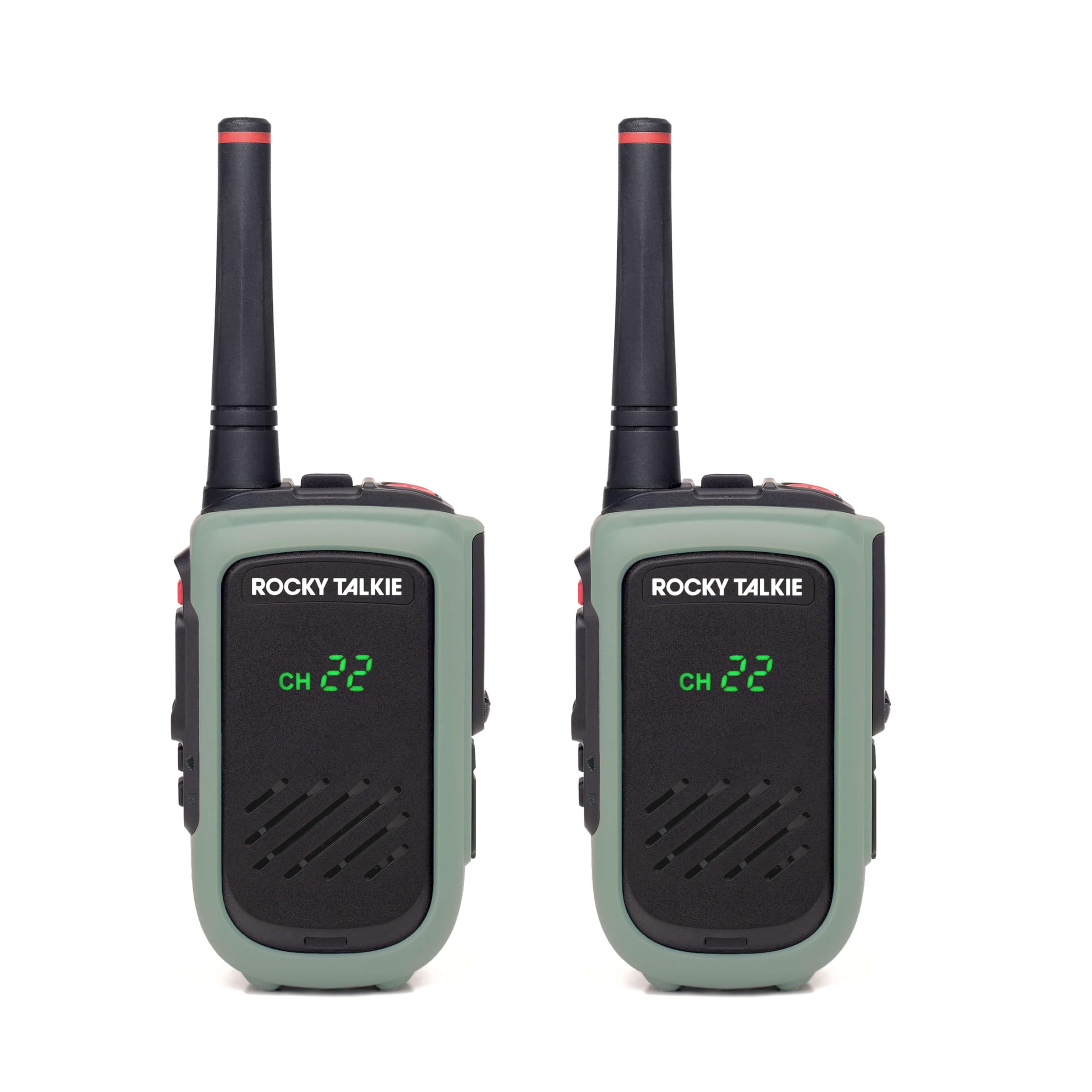
The Rocky Talkie Expedition is, without question, the most capable handheld two-way radio on this list — and the only one that genuinely delivers on its durability and range promises. Its 5-watt GMRS transmitter operates at the legal maximum for handheld use, and paired with a removable antenna and repeater channel support, real-world backcountry range of 2 to 8 miles is entirely realistic. The 1800 mAh lithium-ion battery consistently achieves five full days of use on a single charge, even in sub-freezing temperatures where lesser NiMH packs would die within hours.
The IP67 rating means you can drop this radio in a creek, let it get caked in mud, or use it in a driving rainstorm without a second thought. The Steel Gator Clip and metal-reinforced backup leash attach securely to backpack straps or climbing harnesses, and the shatterproof display eliminates the worry of a cracked screen on a rock fall. NOAA weather alerts with dual-channel monitoring keep you informed of changing conditions without interrupting your primary channel.
Yes, you will need a FCC GMRS license — that is a trivial cost for the performance leap over any FRS radio. For anyone who relies on communication during off-road trips, backcountry hunting, or remote expedition work, the Expedition is the only radio you should consider.
Why it’s great
- Maximum legal 5W power with repeater support for extended range
- Five-day battery life in a user-replaceable Li-ion pack
- IP67 waterproof and built with industrial-grade materials
Good to know
- Requires a separate FCC GMRS license ()
- Bulkier than ultralight FRS models
2. Rocky Talkie Mountain Radio
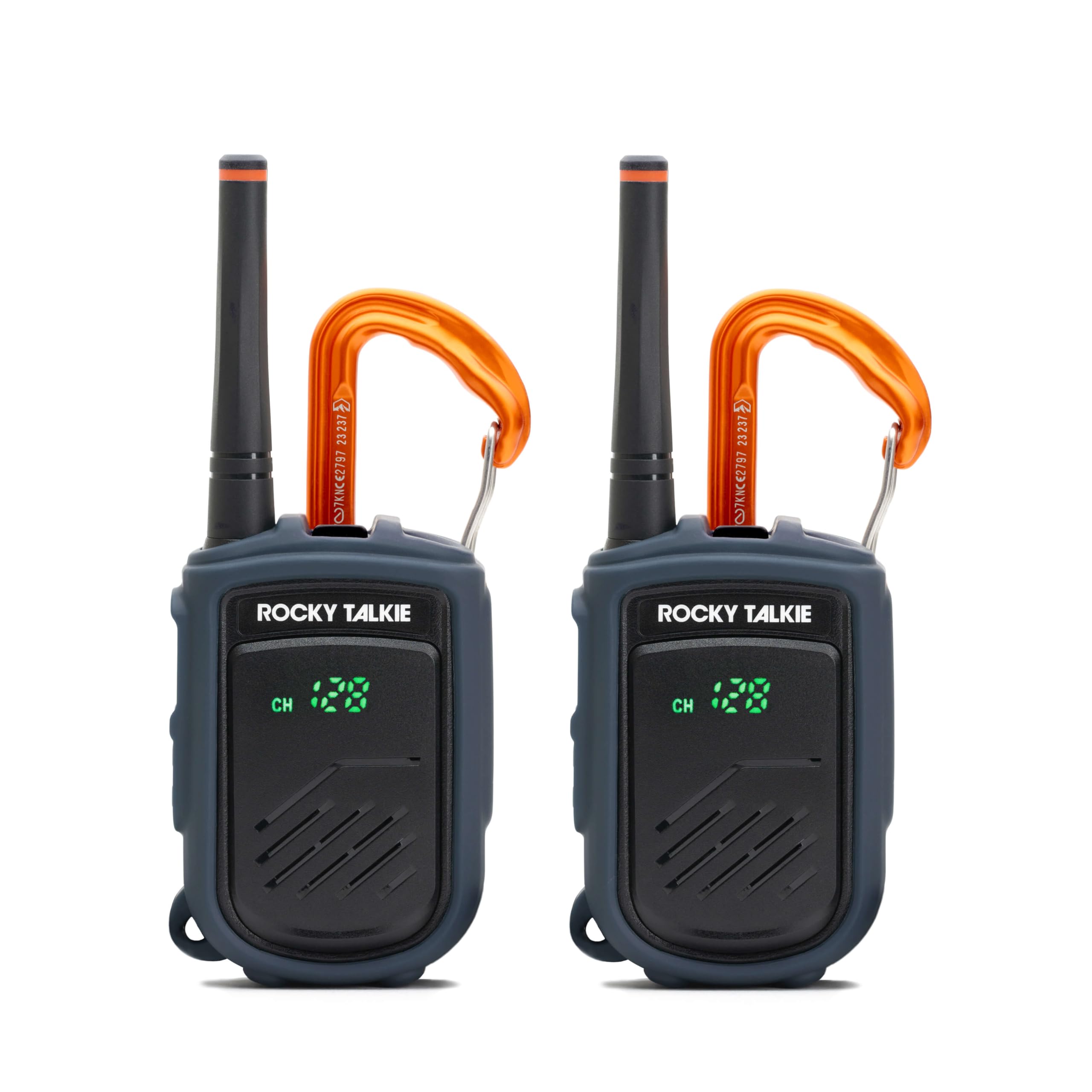
The Mountain Radio takes everything great about the Expedition and scales it down to a license-free FRS package for those who prioritize weight and simplicity. At 2 watts, it cannot match the penetration of the 5-watt Expedition, but its audio clarity is exceptional, and the 1550 mAh battery delivers over four days of use in cold conditions. The shatterproof LCD screen and thermoplastic rubber armor make this radio noticeably tougher than any similarly-priced competitor.
Rocky Talkie replaced fragile plastic belt clips with a climbing-rated carabiner and a metal-reinforced backup leash — a small design change that eliminates the single most common failure point on outdoor radios. The five-button interface requires zero configuration, and the radio ships ready to use out of the box. Users report reliable communication across 3 to 5 miles over open water and 1 to 2 miles in dense forest, which is impressive for a 2-watt FRS unit.
If you are a climber, skier, or hiker who wants a radio that survives drops and weather without needing a license, the Mountain Radio is the best balance of weight, durability, and usable range you can buy.
Why it’s great
- Ultralight with climbing-rated carabiner attachment
- Four-day battery life even in freezing temps
- No license required — FRS ready out of the box
Good to know
- Range is limited by 2W FRS maximum
- No NOAA weather alerts on this model
3. globalptt G0 PoC Radio

The globalptt G0 is not a traditional two-way radio — it is a Push-to-Talk over Cellular (PoC) device that uses 4G LTE networks to achieve effectively unlimited range. If your team needs to communicate across different states, between offices in separate cities, or across a sprawling industrial complex with dead zones, the G0 bypasses the line-of-sight limits that constrain every FRS and GMRS radio on this list. The included SIM card comes with 365 days of data service, and the device supports both 4G and 3G fallback.
Battery life is exceptional for a PoC unit — users consistently report two to three days of active use and up to seven days of standby. The display is bright and readable in direct sunlight, and the button layout is intuitive enough for quick operation without training. Audio clarity over LTE is noticeably better than analog radio, with no static or squelch artifacts. The rugged build is weather-resistant and designed to survive daily drops.
The limitation is obvious: if you are in an area without cellular coverage, the G0 is a brick. It is not a substitute for a GMRS radio in the backcountry. But for logistics teams, security personnel, or event organizers who need wide-area coverage, the G0 delivers a capability that no traditional radio can touch.
Why it’s great
- Unlimited range over 4G LTE cellular network
- One year of data service included with no monthly fees
- Crystal-clear digital audio, no static
Good to know
- Requires cellular signal to function
- Not compatible with analog FRS/GMRS radios
4. Retevis RB48 IP67 Waterproof Walkie Talkies

The Retevis RB48 is the most rugged radio on this list by certification standards — it passed 19 separate tests under MIL-STD-810H, including temperature shock, rain, salt fog, humidity, sand and dust, vibration, shock, and immersion. The reinforced internal structure and thick rubber exterior mean it survives repeated drops onto concrete and operates reliably in environments where cheaper radios would fail within weeks. The large front PTT button is designed for gloved hands, a detail that matters on construction sites or cold-weather job sites.
The 2000 mAh lithium-ion battery delivers up to 20 hours of use, easily covering a full work week of daily shifts. NOAA weather alerts with seven channels keep outdoor teams informed of approaching storms. The IP67 rating means you can rinse mud off the radio under a tap without worrying about water ingress. Users consistently report clear communication across 40 to 60 acres of farmland with tree coverage, and reliable performance within a mile in suburban neighborhoods.
If you manage a construction crew, a farm, or an industrial site and you cannot afford radios that break, the RB48 four-pack is a smart investment. The 5-year warranty adds confidence that Retevis stands behind the durability claim.
Why it’s great
- MIL-STD-810H certified for extreme conditions
- 2000mAh battery runs 20 hours per charge
- Glove-friendly oversized PTT button
Good to know
- Heavier than standard FRS radios at 730g per unit
- Real-world range is 1 mile or less in dense cities
5. SAMCOM FPCN30A 5W UHF Radio

The SAMCOM FPCN30A stands out for a specific feature that matters in professional settings: Instant Group Call. This allows you to broadcast a message to all radios simultaneously, even if they are on different channels. On a construction site or in a warehouse, this capability eliminates the need to switch channels to deliver a site-wide announcement or safety alert. The radio operates at 5 watts on UHF frequencies (406.1-470 MHz) and includes a high-gain antenna that improves penetration through concrete and steel.
The 1500 mAh battery delivers 8+ hours of continuous use and 12+ hours of standby, enough for a full shift plus overtime. The LCD display is larger than average and shows channel number, battery level, and signal strength clearly. The programmable settings allow customization for specific job site needs, and the included K-type earpiece keeps communications private in noisy environments. Users report reliable performance across 300,000+ square feet inside buildings, and 3 to 5 miles in open terrain.
Note that the FPCN30A requires an FCC license for commercial use (it is not a license-free FRS radio). It also ships without pre-programmed standard channels — you will need a programming cable and PC software to set it up properly. For teams that need a coordinated multi-channel system with broadcast capability, this radio is worth the extra setup effort.
Why it’s great
- Instant Group Call broadcasts to all channels at once
- 5W UHF power with high-gain antenna
- Large LCD display with clear info
Good to know
- Requires programming cable for channel setup
- Needs an FCC license for business use
6. Retevis RT68 Walkie Talkies 10-Pack
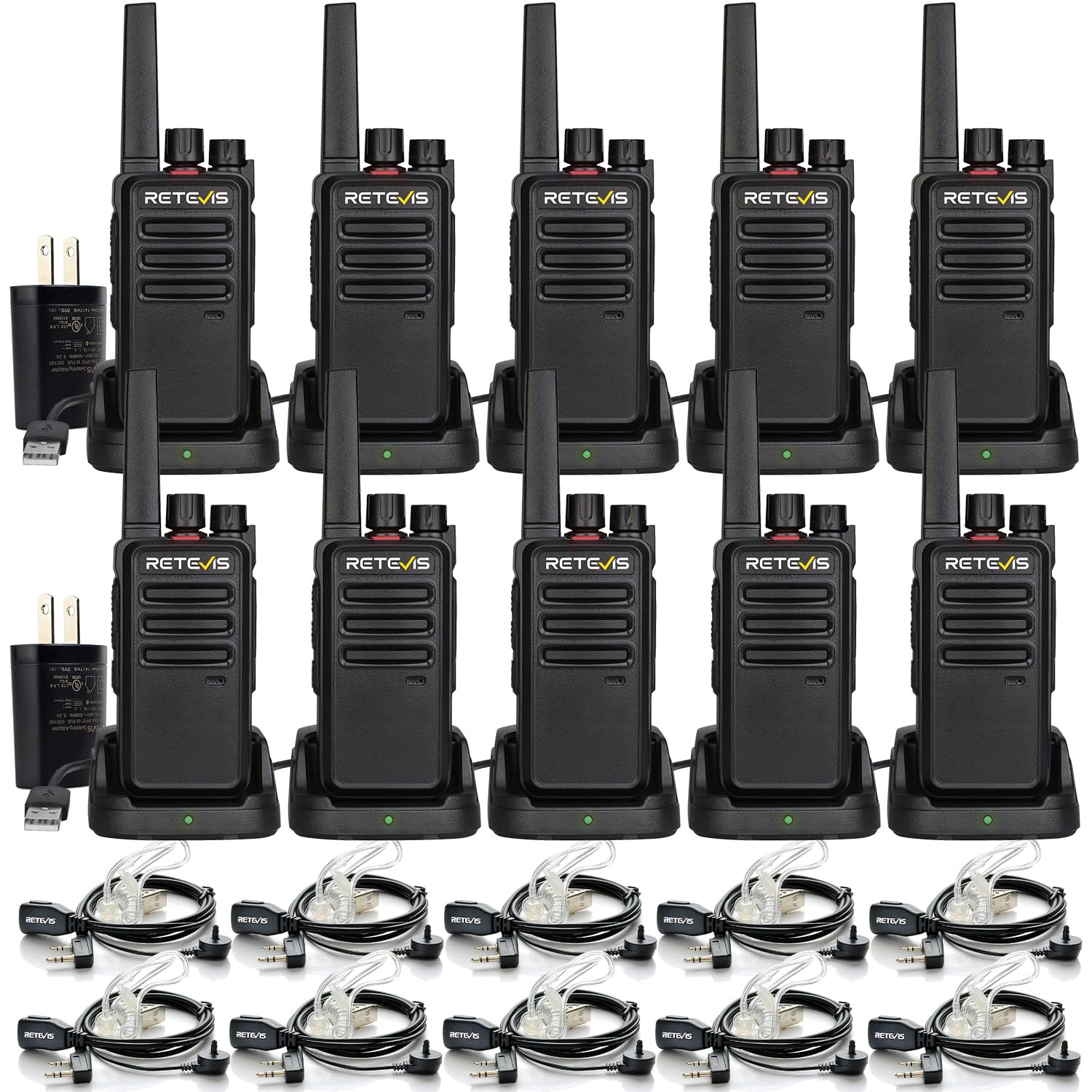
The Retevis RT68 is built for one job: equipping a team of 10 with reliable, affordable, and easy-to-use FRS radios. At this pack size, the per-unit cost is extremely low, and the radios perform well for their price tier. Each unit features a 500 mW speaker, which is noticeably louder than the 300 mW speakers found on similarly priced models — a critical advantage in noisy environments like manufacturing floors or restaurant kitchens. The 0-9 level adjustable squelch lets you fine-tune background noise rejection.
The radios are palm-sized and weigh very little, making them comfortable for employees who wear them all shift. The VOX function enables hands-free operation — speaking activates the transmission without pressing the PTT button. Each unit comes with a charging base, earpiece, and belt clip, so the kit is ready to deploy immediately. Users consistently report reliable communication within retail stores, school buildings, and warehouse facilities.
Do not expect long-range performance from the RT68 — it is an FRS radio with a fixed antenna, and real-world range inside buildings is typically 100,000 to 200,000 square feet. This is a business tool for facility-wide communication, not a backcountry expedition radio.
Why it’s great
- 10-pack provides excellent value for team deployment
- 500 mW speaker cuts through noise
- VOX hands-free operation for busy staff
Good to know
- Limited range — not suitable for outdoor backcountry use
- Earpiece volume is quiet for some users
7. Motorola Solutions T475 Extreme Two-Way Radio
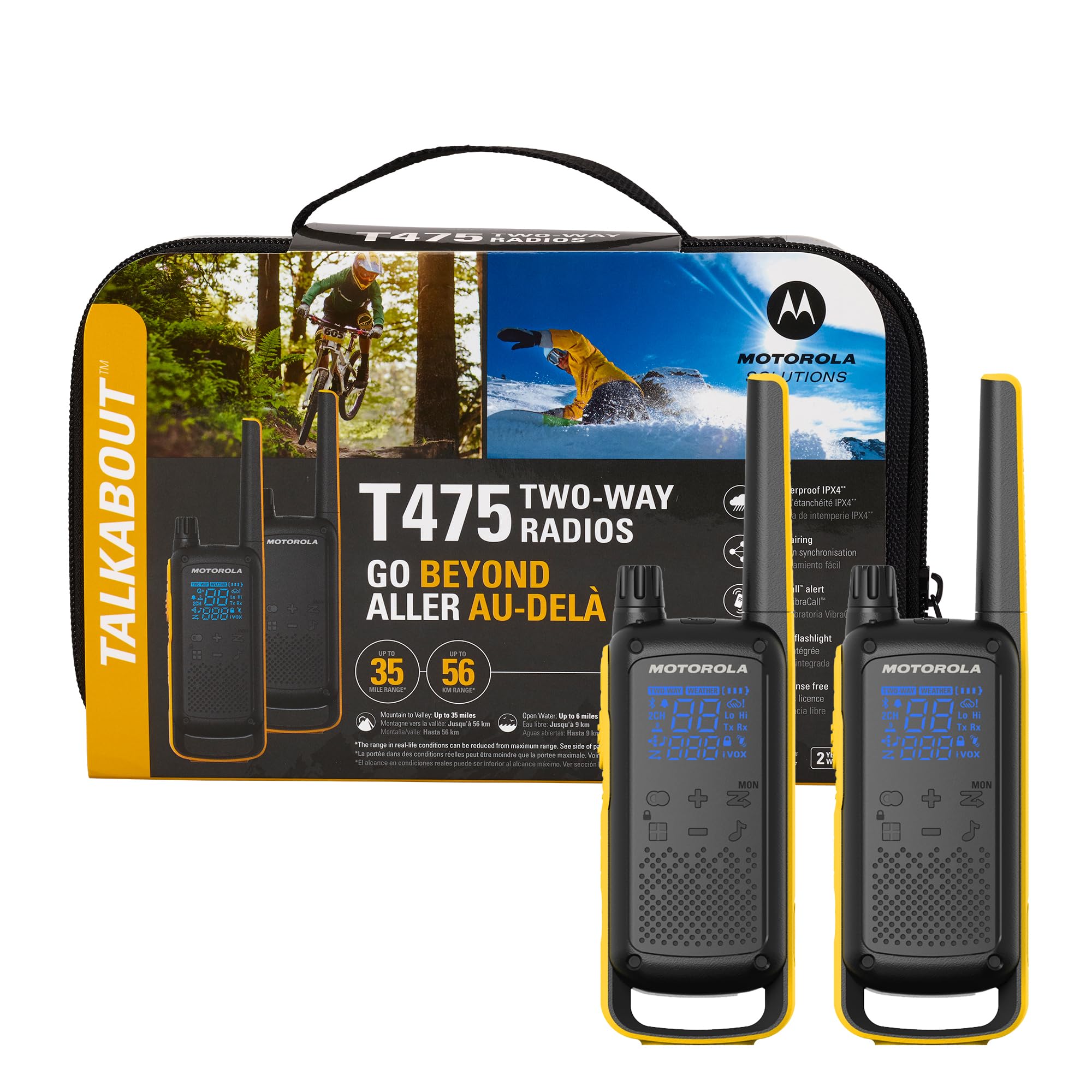
The Motorola T475 is the most affordable option in this guide, and it serves a clear purpose: a simple, license-free FRS radio for families and casual outdoor users who do not need extreme range or military-grade durability. It runs on the 462-467 MHz FRS band with 22 channels and 121 privacy codes — 2,662 total combinations to find a clear channel. The 800 mAh NiMH battery lasts up to 12 hours on a full charge, which is adequate for a day hike or a day at the beach.
The T475 includes a built-in flashlight, VibraCall silent vibration alerts, and a NOAA weather radio with alerts that automatically warns you of severe weather in your area. The IPx4 rating protects against splashes, so light rain is fine, but do not submerge it. Users consistently report clear communication across 3 to 5 miles in open areas and about half a mile to a mile in hilly or wooded terrain — competitive performance for a budget-tier FRS radio.
The main compromise is build quality. The plastic chassis is not reinforced and will not survive repeated drops onto hard surfaces like construction-grade radios would. The NiMH batteries also lose capacity faster in cold weather compared to the Li-ion packs in pricier models. If your need is simple — occasional family camping trips or communication between cars on a road trip — the T475 gets the job done at a very low cost.
Why it’s great
- Lowest entry price for reliable FRS communication
- NOAA weather alerts with automatic severe weather warnings
- Built-in flashlight and VibraCall alerts
Good to know
- Plastic build is not drop-rated
- NiMH battery life drops significantly in cold temps
FAQ
What does “100 mile range” actually mean on a walkie talkie?
Do I need a license to use GMRS walkie talkies?
Can I use PoC radios like the globalptt G0 without cellular service?
Final Thoughts: The Verdict
For most users, the best 100 mile long range walkie talkies winner is the Rocky Talkie Expedition because its 5-watt GMRS output, five-day battery life, and IP67 build deliver the highest usable range and durability money can buy. If you want a license-free radio for lightweight outdoor trips, grab the Rocky Talkie Mountain Radio. And for unlimited range across cellular networks, nothing beats the globalptt G0 PoC Radio.