
Our readers keep the lights on and my morning glass full of iced black tea. As an Amazon Associate, I earn from qualifying purchases.
Specs are compiled from manufacturer listings and verified buyer reviews and can change over time — please confirm the key details on the product page before buying.
When two dead RC packs or a drained laptop stall your plans, a 100W charger turns a long wait into a quick top-up. It cuts charge time from hours to minutes. This guide separates genuine 100W-plus chargers from lookalikes to match your battery types and voltage.
I’m Min — the founder and writer behind Gadgets Feed. This guide is built by comparing the manufacturers’ published specifications and the patterns across verified customer reviews, so you get each pick’s real strengths and trade-offs instead of marketing spin.
Whether you’re topping off LiPo packs or a 12V deep-cycle battery, the right 100 watt battery charger cuts charge time dramatically and protects your cells from overcharging damage.
Our Picks at a Glance


How To Choose The Best 100 Watt Battery Charger
A 100W charger is a power delivery promise, not a universal fit. Before you click buy, you need to match three things: the battery’s chemistry, its voltage, and the connector it uses. Matching chemistry, voltage, and connector makes charging a set-and-forget routine.
Chemistry and voltage compatibility come first
Your battery’s chemistry dictates the charging algorithm. A LiPo pack needs a balance charge that keeps all cells equal, while a lead-acid battery wants a desulfation mode and a float charge to maintain it. Confirm the charger explicitly lists your battery type — LiPo, LiFe, NiMH, or lead-acid — before you buy. Feeding the wrong chemistry can damage the pack.
Balance charging is non-negotiable for multi-cell packs
If you run 2S, 3S, or 6S LiPo batteries, balance charging is what keeps every cell in the pack at the same voltage. Skip it and one weaker cell gets overworked, which shortens pack life and risks swelling. Look for a charger that balances automatically through the balance lead or a smart connector that handles it internally.
AC/DC input decides where you can charge
A charger that runs on AC input alone needs a wall outlet. An AC/DC model also draws from a 12V car socket or a bench power supply, so you can top up packs at the field or in the driveway. If you charge on the go, the DC input flexibility is worth the extra few dollars.
Quick Comparison
| Model | Best For | Channels | Max Output | Chemistries | Amazon |
|---|---|---|---|---|---|
| Spektrum S2100 G2★ Best Overall | Spektrum Smart battery owners | 2 | 100W per port | Smart, LiPo, LiFe | Amazon |
| Fepprry 100W USB-C Car ChargerBest Value | Road-warrior laptop users | 2 | 100W + 18W | USB-C PD laptops | Amazon |
| Huiaipaic 20-Amp Charger | 12V & 24V vehicle batteries | 1 | 300W | Lead-Acid, LiFePO4 | Amazon |
| Common Sense RC ACDC-10A | Budget-friendly hobby charging | 1 | 100W | LiPo, LiFe, LiHV, NiMH | Amazon |
| Hiyiton C6X2 Dual | Two different packs at once | 2 | 240W DC | LiPo, Li-ion, NiMH, PB | Amazon |
| Topsolar 100W Solar Kit | Off-grid 12V maintenance | 1 | 100W panel | 12V Lead-Acid | Amazon |
| Venom Pro Quad | High-volume RC racing pits | 4 | 100W per port | LiPo, LiHV, NiMH, Pb | Amazon |
In‑Depth Reviews
1. Spektrum S2100 G2 2x100W AC Smart Charger
Our pick — over 4.5★ from 200+ verified ratings; the strongest balance of quality and price.
Auto-balances Spektrum Smart packs with zero guesswork.
If you run Spektrum Smart batteries, this is the charger that removes every manual step. A single IC3 or IC5 connection handles both charging and balancing — there’s no separate balance lead to fuss with. The charger reads the battery’s own parameters and starts a safe, accurate charge automatically the moment you plug it in.
At 100W per channel — or 200W when you pour everything into one port — it finishes a pair of 3S or 4S packs at 5A in roughly 20 to 30 minutes. Owners who fly Spektrum gear call it essential, and the dual-port layout means two batteries top up simultaneously without you standing guard. The bright display and power switch keep daily operation simple.
No adapters ship in the box, which is a small annoyance you can fix cheaply. The bigger caveat is durability: a handful of units have come apart during use, and the brand pricing sits at the premium end. Some owners also found it won’t recognize certain common non-Spektrum packs, so this is really for the Smart ecosystem faithful.
Why owners love it
- Auto-balancing on Smart packs — no separate lead required
- Fast 3S/4S top-ups at 5A in 20-30 minutes
- IC3 and IC5 output ports built in, no adapter needed
Where it stumbles
- Premium price for what’s essentially an ecosystem charger
- Occasional reports of units falling apart during use
- Some common non-Spektrum batteries not recognized
Reach for this if: you’re already invested in Spektrum Smart batteries and want a truly hands-off charging routine.
Look elsewhere if: you fly mixed-brand packs — you’ll be paying for convenience you can’t fully use.
2. Fepprry 100W USB-C Laptop Car Charger
Keeps a laptop charged throughout a road trip.
Working from your car used to mean a bulky AC inverter that quit mid-call. This charger sidesteps that entirely: plug into the 12V socket and the USB-C port delivers 5V-20V at up to 5A for a full 100W to your laptop, while a second USB-A port adds 5V/3A for your phone. Owners who tried a 150W inverter that kept failing found this one never dropped power once.
Compatibility is the real story here. It covers Dell Latitude and XPS, Lenovo ThinkPad and Yoga, MacBook Pro and Air, HP Spectre, LG Gram, and Chromebooks — plus a string of model numbers that reads like a decoder ring. The rectifier technology smooths voltage fluctuations from your car’s electrical system, which is what makes the charge stable instead of stuttering.
The catch is build quality, which earns mixed marks — a few units have arrived broken or failed quickly. But the overwhelming pattern is reliability you can lean on, and buyers report it actually charges a ThinkPad E14 Gen 2 faster than the home wall adapter. For anyone who lives on the road, that trade-off is easy to accept.
Bottom line: a dependable, fast way to keep your laptop alive through the longest drive — just handle it with care.
Pick this if: you need a compact, cheap fix for charging laptops and a phone from the car.
Think twice if: you want something that will survive years of daily abuse — treat this as a great value, not an indestructible tool.
3. Huiaipaic 20-Amp 12V/24V Car Battery Charger
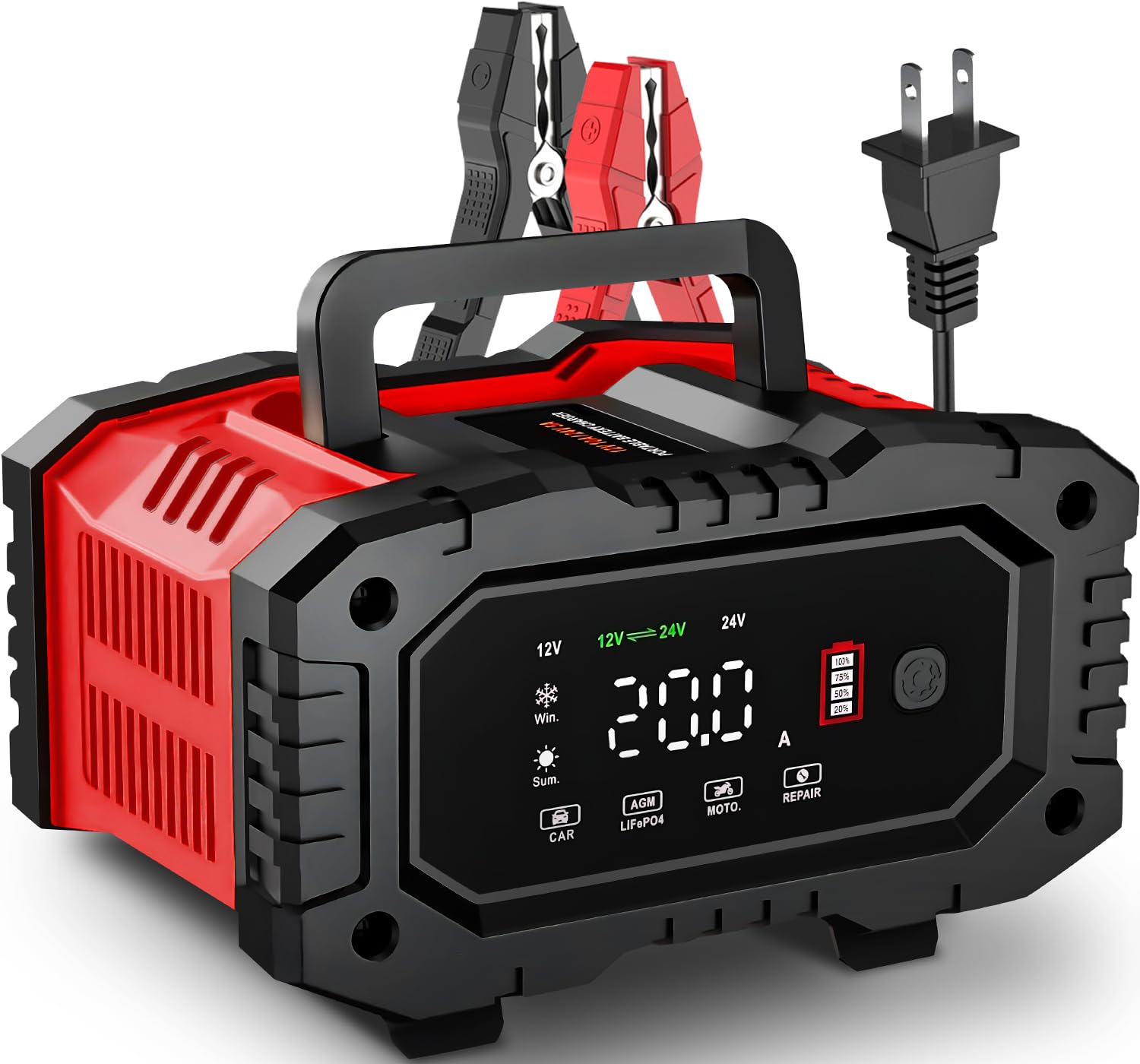
A 300W all-in-one that charges, maintains, and revives 12V and 24V batteries.
This isn’t just a charger — it’s a charger, maintainer, and desulfator in one box. The 12V/20A and 24V/10A output is a real step up from the 10A or 15A chargers most garages hold, and the 300W internal transformer pushes the job faster. Owners mention reviving a dead battery in about 5 hours, and the pulse repair mode can coax an old, idle pack back to life.
The chemistry list is broad: AGM, GEL, SLA, VRLA, flooded, and LiFePO4 all get proper charge profiles. A built-in MCU controller watches for over-charge, over-voltage, over-temperature, sparks, short circuits, and reverse polarity. The large LCD shows voltage, current, power percentage, and even summer vs. winter mode, so you always know what the battery is doing.
Despite the heavy-duty copper alligator clips and heat-resistant cabling, opinions split on value and long-term battery life. Some owners warn it could damage LiFePO4 packs if you pick the wrong profile, so read the chemistry settings carefully. For a bench charger that handles cars, trucks, boats, and mowers, though, the quality consensus is strong.
Real-world verdict: a compact, easy-to-use bench charger that quickly handles most 12V and 24V lead-acid needs — just match the chemistry.
Grab it for: the mixed fleet — car, camper, boat, and mower — that needs one charger to rule them all.
Be careful if: you rely heavily on LiFePO4; double-check the mode before connecting.
4. Common Sense RC ACDC-10A 100W Balancing Charger

The compact multi-chemistry workhorse that saves hours versus budget chargers.
For the price, this 100W, 10A charger covers an enormous range of packs — LiPo, LiFe, LiHV, and NiMH from 1S up to 6S. Owners who paid triple at hobby shops for chargers that never worked found this one functions flawlessly right from the start. A crowd favorite for its speed, it routinely finishes charges in a fraction of the time cheaper units need.
It’s also a proven long-hauler. Multiple customers note hundreds of charge cycles across LiPo and NiMH packs of every size with zero issues, which is the kind of reliability you can build a charging routine around. The compact footprint means it fits easily on a bench or in a field kit without hogging space.
The included connectors are limited, so expect to buy a few cheap adapters. But that’s a minor cost on top of a genuinely budget-friendly price. For the balance between speed, chemistry support, and durability at this wattage, it’s hard to argue with the value.
Price-to-value read: you get hobby-shop performance at a fraction of the cost — the adapters are the only real extra spend.
Choose this if: you want one reliable charger that handles most RC chemistries without emptying your wallet.
skip it if: you need to charge two different packs simultaneously — this is a single-channel unit.
5. Hiyiton C6X2 Dual LiPo Battery Charger
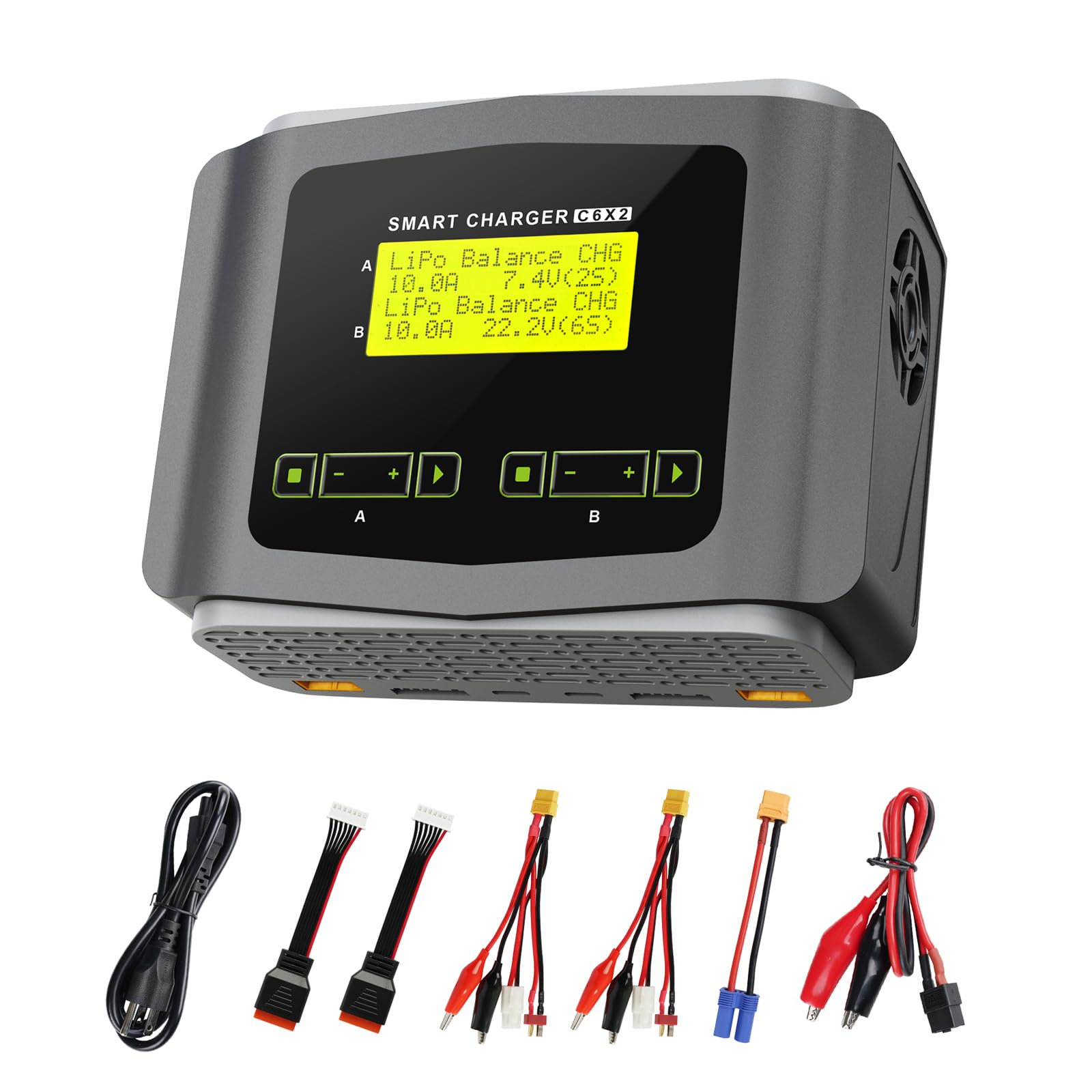
The dual-channel brain that juggles two different packs without slowing down.
This charger’s two independent channels let you charge two different LiPo batteries at the same time — like a 2S and a 3S pack side by side, each with its own settings and 20 saved memory slots. The chemistry support spans LiPo, LiFe, Li-ion, LiHV, NiMH, NiCd, and PB, from a 1S all the way to a 15S NiMH pack. Owners who picked it up as an iMax B6 replacement found it clones that classic functionality and works just as well.
Power delivery is split intelligently: up to 150W total on AC input (divisible between channels, like 50W on one and 100W on the other), or a full 240W on DC input for faster charging from a field battery. The clear LCD screen gives real-time status, and the safety suite covers over-voltage, over-temperature, over-current, short-circuit, and over-charge protection.
Charging speed earns mixed feedback — some find it quick, others wish it pushed harder. A few owners also mention a minor power supply whine and some heat during operation. But the ease of use and automatic cell-count detection for LiPo and NiMH win most people over quickly.
The honest take: a safe, budget-friendly dual-channel option that auto-detects your pack and keeps multiple batteries flight-ready.
Ideal for: RC enthusiasts juggling multiple pack sizes who want independent, simultaneous charging.
Not for: speed demons chasing the absolute fastest charge times.
6. Topsolar 100W 12V Solar Panel Kit

The sun-powered solution that keeps 12V batteries topped up anywhere off the grid.
This kit is for the off-grid crowd: it charges 12V batteries in RVs, cabins, boats, sheds, and gate openers without ever touching a wall outlet. The 100W monocrystalline panel pairs with a 12V/24V intelligent charge controller, which prevents overcharge, over-discharge, and short circuits. Owners wired two panels in parallel to keep tractor and buggy batteries alive, and one reported charging a Class A motorhome’s engine battery in just 4 hours.
Setup is genuinely easy — owners describe hooking up the battery, then the panel, and it simply starts working with no programming required. The kit includes a V-shape mounting tilt rack, two 16-foot MC4 cables, and two 5-foot O-ring cables for the battery connection. The panel itself is built with an anodized aluminum frame and tempered glass to shrug off weather, and it weighs in at 15.84 pounds for easy carrying.
The mixed feedback centers on the mounting brackets — some kits arrived missing pieces, and the roof-mount holes don’t always line up. One owner solved that by drilling through the aluminum frame directly. It’s also worth knowing the controller can be tricky to switch between voltage modes. But for pure off-grid battery maintenance, the functionality is exactly what people need.
What wins people over: a genuinely simple install that keeps batteries charged even on cloudy days, with real power output when the sun cooperates.
Best for: RV owners and cabin dwellers who want self-sufficient battery maintenance.
Reconsider if: you expect precise mounting hardware from the start — you may need to improvise.
7. Venom Power Pro Quad 4-Port Charger

The four-port pit boss that charges a full race fleet at once.
When you’ve got a stack of packs to prep before a race day, this charger’s four dedicated 100W, 7A circuits handle four batteries simultaneously. Owners who charge 11.1V 5000mAh packs note they finish in about 50-55 minutes at 7A — slower than the promised 25-30, but with noticeably better cell balance and cooler running electronics. The multi-chemistry support covers LiPo, LiHV, Li-ion, LiFe, NiMH, NiCd, and lead-acid from 1S to 6S.
It’s a true all-in-one: charger, balancer, and discharger, plus a storage charge mode that keeps packs healthy between sessions. Two USB 2.3A ports on the back power your phone or tablet while you work. For AC/DC flexibility, the included AC adapter handles home charging while a DC adapter keeps you charging at the track. Owners even report reviving dead power tool batteries with custom adapters.
The gripes are practical: only two XT60 plugs ship for a four-channel charger, and the storage discharge is slow. There’s no power switch either, and the single display won’t show a percentage meter. But the raw charging quality — for 400W of simultaneous output — has owners calling it the best charger they’ve used.
What makes it a pro pick
- Four independent 100W channels charge batteries simultaneously
- Full balance, fast charge, storage, and discharge modes
- USB ports on the back for charging a phone while you work
What you trade off
- Only two XT60 plugs included for a 4-port charger
- Storage discharge is slow — hours for a large pack
- No power switch and a basic single display
For the serious racer: you can charge four devices at once with a total output of 400W (watts, the measure of charging speed), so your pit crew can top up a laptop, two phones, and a camera battery simultaneously without slowing down.
Consider the cost: you’re paying a premium, and you’ll want extra charge leads to use all four ports well.
Understanding the Specs
Wattage and charge current
Wattage (W) is the total power the charger can push, calculated by multiplying voltage by current. A 100W charger at 12V can deliver roughly 8A, while at 24V it tops out near 4A. Higher wattage means faster charging for large packs, but the charger’s amperage rating (like 7A or 10A) also caps how quickly it can fill a battery. Match both to your battery’s size for the best speed.
Balance charging
Balance charging is the process of keeping every cell in a multi-cell battery pack at the same voltage. A 3S pack has three cells, a 6S has six, and they can drift apart over time. A balance charger monitors each cell through a balance lead and equalizes them during charging, which prevents one weak cell from being overworked and extends the pack’s lifespan.
FAQ
Can a 100W charger handle a 6S LiPo battery?
What is the difference between AC and DC input on a charger?
Will a 100W USB-C car charger work with my MacBook?
How long does it take to charge a car battery with a 20A charger?
Can I charge a LiFePO4 battery with a standard 100W LiPo charger?
What does the desulfation mode on a battery charger do?
Is it safe to charge two different batteries at the same time on a dual-port charger?
How many watts do I need to charge RC car batteries quickly?
Final Thoughts: The Verdict
If you’re deep in the Spektrum Smart ecosystem, the Spektrum S2100 G2 is the easy top pick — it auto-balances and finishes 3S/4S packs in about 20-30 minutes. For the road warrior charging a laptop from the car, the Fepprry 100W USB-C charger is the value play that just works. And for the RC racer juggling a whole fleet of packs, the Venom Pro Quad with its four 100W ports is the throughput king. Match the charger to your battery chemistry and voltage to avoid dead-pack delays.
How We Picked
We do not accept paid placement. Every pick is matched to a real buyer and a real use-case; we do not hands-on test units.
Sources & Methodology
Specifications: manufacturer listings and product documentation. Review insights: verified customer reviews, as of August 2026. Pricing: not shown on this page (it changes often); check the current price via the retailer link.
As an Amazon Associate, Gadgets Feed earns from qualifying purchases. This does not affect which products we feature.