
Our readers keep the lights on and my morning glass full of iced black tea. As an Amazon Associate, I earn from qualifying purchases.
Specs are compiled from manufacturer listings and verified buyer reviews and can change over time — please confirm the key details on the product page before buying.
You need a 100-watt heat bulb for your reptile, chicken coop, or seedlings, but the wrong one can cost you more in replacements than the bulb itself. Ceramic emitters can run for years, while basking bulbs often burn out in months. The real difference is not wattage — it is how the heat reaches your animal, if you need visible light or total darkness, and which bulb’s build survives daily use without cracking or dying early.
I’m Min — the founder and writer behind Gadgets Feed. This guide is built by comparing the manufacturers’ published specifications and the patterns across verified customer reviews, so you get each pick’s real strengths and trade-offs instead of marketing spin.
What follows cuts through the shelf confusion to identify the 100 watt heat bulb that matches your specific animal, enclosure size, and budget without burning through replacements every few weeks.
Our Picks at a Glance
How To Choose The Best 100 Watt Heat Bulb
Heat bulbs in this category split into two very different camps — basking spot lamps that produce visible light and UVA (a type of ultraviolet radiation that helps reptiles synthesize vitamin D3), and ceramic heat emitters that produce infrared warmth without any glow. Your choice depends entirely on if you need daytime heat and light or 24-hour heat that won’t disturb nocturnal animals or sleeping pets. The wrong pick either disrupts your animal’s sleep cycle or leaves a cold spot in the enclosure at night.
Light vs No Light: The Day/Night Decision
Basking bulbs create a warm, bright spot that mimics the sun, which many reptiles need for thermoregulation during the day. Ceramic emitters screw into the same E26 socket but produce zero light, making them the only safe option for nighttime heating. Some keepers run a basking bulb during the day and switch to a ceramic emitter at night, requiring two separate fixtures. If you need a single bulb for around-the-clock use, a ceramic emitter is your only choice — your pet gets warmth in total darkness.
Lifespan and Build Quality: What the Hours Mean
The claimed lifespan of these bulbs varies dramatically — some basking bulbs are rated for 2,000 hours, while premium ceramic emitters boast up to 10,000 hours. In real-world use, that 2,000-hour rating often means replacing the bulb every 6 to 9 months if run daily, while a 10,000-hour emitter can last several years. But lifespan is only half the story; the socket connection, ceramic body quality, and resistance to thermal shock determine whether your bulb survives humidity, accidental bumps, or sudden temperature swings in a glass terrarium.
Matching Wattage to Enclosure Size
A 100-watt bulb is the standard for medium enclosures, but “medium” covers a wide range. A 75-gallon tank owner found a 100W ceramic emitter insufficient, while an 18x18x18 tree frog tank heats comfortably with the same wattage via thermostat and dimmer. A good rule of thumb: larger tanks (55 gallons and up) or uninsulated coops may require 150W, while anything smaller than a 20-gallon long tank can overheat quickly with 100W. Always use a thermostat to dial in the exact temperature your species needs.
Quick Comparison
| Model | Best For | Heat Type | Lifespan | Dimensions (W x H) | Amazon |
|---|---|---|---|---|---|
| Fluker’s Ceramic Heat Emitter★ Best Overall | Long-term, 24-hour nocturnal heat | Infrared ceramic (no light) | 2–3 years typical | — | Amazon |
| Zoo Med Repticare Ceramic Infrared Heat EmitterPremium Pick | Flat-face efficient heating | Infrared ceramic (no light) | — | — | Amazon |
| REPTI ZOO Ceramic Heat Emitter 2-Pack | Dual-tank humid setups | Infrared ceramic (no light) | 10,000 hours | 2.9″ x 3.9″ | Amazon |
| ReptiKing Basking Light 2-Pack | High-density daytime basking spot | Basking spot (UVA + light) | 2,000 hours | 3.2″ x 4.8″ | Amazon |
| Briignite Ceramic Heat Emitter 2-Pack | Budget 2-pack for background warmth | Infrared ceramic (no light) | 10,000 hours claimed | — | Amazon |
| REPTI HOME Ceramic Heat Emitter 2-Pack | Coop and large tank winter heat | Infrared ceramic (no light) | 10,000 hours | 3″ x 3″ | Amazon |
| REPTI HOME Red Infrared Basking Spot 2-Pack | Dim-light daytime basking | Infrared basking spot (red light, 13.75 lm/W) | 2,000–3,000 hours | — | Amazon |
In‑Depth Reviews
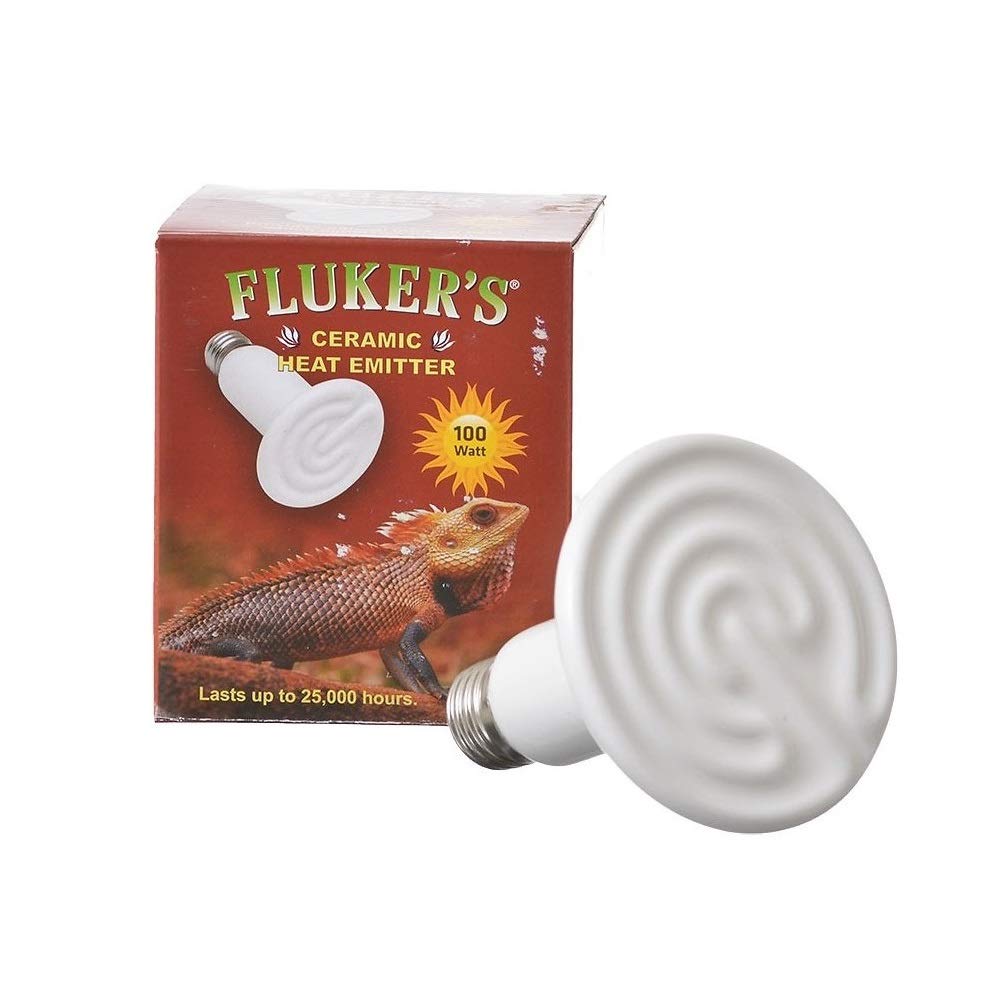
1. Fluker’s Ceramic Heat Emitter, 100 Watt
Our pick — over 4.5★ from 900+ verified ratings; the strongest balance of quality and price.
The ceramic workhorse that outlasts competitors by years, not months.
Fluker’s 100-watt emitter delivers infrared heat without a single photon of visible light, so your nocturnal reptile or amphibian gets consistent warmth without having its sleep cycle disrupted. One buyer reports a single unit lasting eight years of 24-hour heat, far exceeding typical bulb lifespans. Owners of tree frogs, bearded dragons, and even breeders raising newborn puppies all cite the same result: safe, steady heat with zero light emission, making it ideal for a 24-hour heat source.
At 100 watts, this emitter works well in medium enclosures such as an 18x18x18 tree frog tank when paired with a thermostat and dimmer. The A15 bulb shape fits standard lamp domes, and buyers report it runs cooler on the socket than competing models, which helps prevent the meltdown issues some other ceramic emitters cause over time. The only catch is that you get no light at all — not even a faint glow — so you need a separate basking bulb if your daytime setup requires visible light.
Owners mention that the Fluker’s consistently lasts 2 to 3 years, while Zoo Med units typically last 1 year. When the emitter eventually fails, it can crack or melt the lamp socket, so a quality ceramic lamp holder is a wise precaution.
Why keepers stick with it
- Proven lifespan — one reviewer noted 8 years of continuous use in a tree frog enclosure
- No light output means completely dark nights, safe for nocturnal and light-sensitive animals
- Compatible with standard E26 lamp sockets and most thermostat/dimmer setups
The honest trade-offs
- Produces no visible light, so it cannot double as a daytime basking lamp
- Some units may crack the lamp socket upon failure if not used with a quality ceramic holder
Your best bet if: you need a single, around-the-clock ceramic emitter that delivers years of heat without any light disruption in a medium enclosure.
Reconsider if: your setup demands daytime basking light within the same bulb — you will need a separate lamp for that.
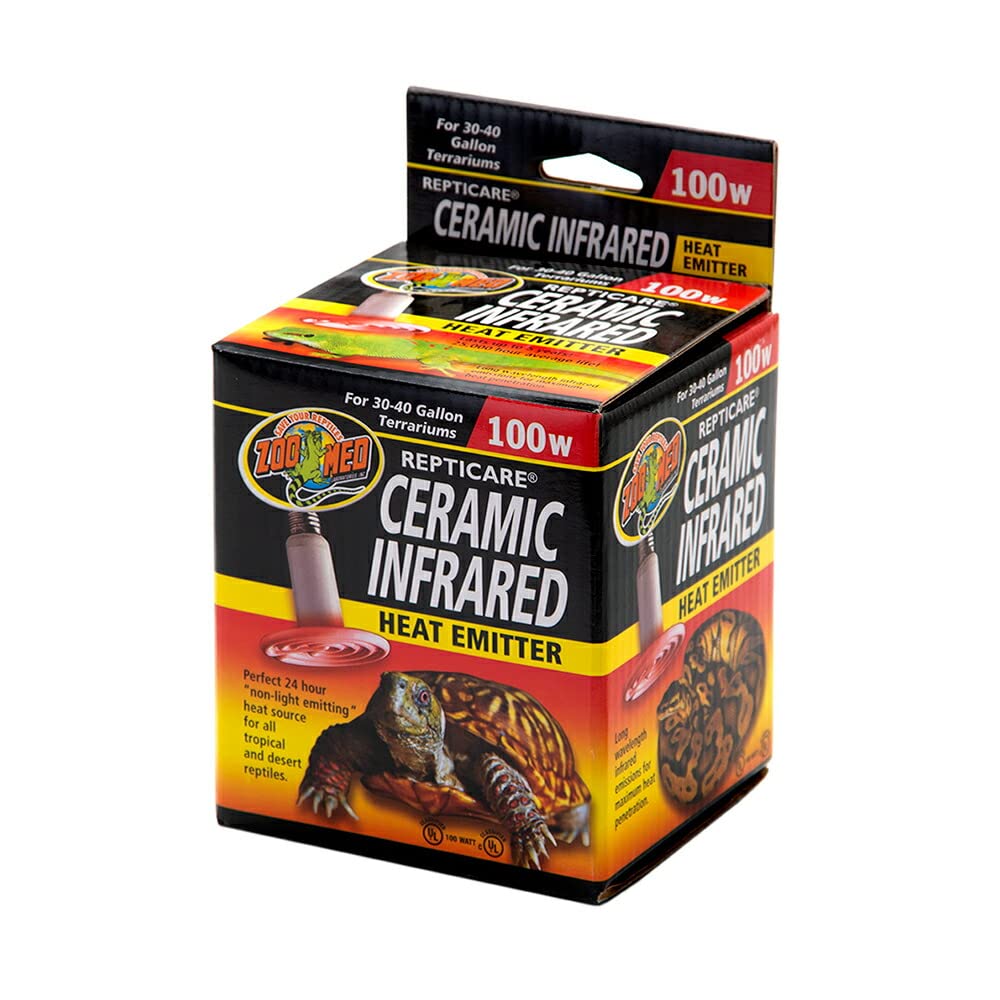
2. Zoo Med Repticare 100 Watt Ceramic Infrared Heat Emitter
The flat-faced ceramic that pushes radiant heat downward, not sideways.
Zoo Med’s Repticare stands apart from the crowd with its flat face design, which the maker claims directs heat more efficiently than typical conical ceramic emitters. The practical benefit is straightforward: more of the 100 watts lands on the basking spot rather than heating the air around the fixture. A reviewer measured a surface temperature of 449°F on the emitter, which can raise a glass terrarium’s air temperature 10–20°F above room temperature.
Chicken coop customers note success using this emitter in a 5’x8’x8′ coop, where multiple 100W and 150W units kept interior roosting area temperatures at 44°F while outside temperatures dropped to 21°F, with the heaters surviving -18°F mornings. Reviewers also note that chickens clearly prefer the ceramic emitter’s invisible heat over traditional red light bulbs. Because the emitter gets extremely hot on the surface, buyers consistently recommend using a wire-cage holder and a cord switch for safety.
One caveat: several owners mention a strong burning odor during the first hour of use — this is typical for new ceramic emitters as manufacturing residues burn off. The bulb runs smaller than many expect, so it may look undersized in a large dome fixture. Reviewers point out that pairing it with a reflective bowl fixture boosts its effective heating range significantly.
What makes it worth the premium
- Flat-face design focuses heat downward more efficiently than conical emitters
- Proven performance in uninsulated chicken coops during sub-freezing winters
- Made in America with 100-120V / 60Hz compatibility
A few things to know
- Emits a noticeable burning smell during the first hour of use
- Smaller physical size than typical ceramic emitters — may look undersized in large fixtures
Reach for this if: you need a focused, directional heat beam for a large enclosure or an uninsulated coop and you are willing to tolerate the initial burn-off odor.
Consider another option if: you want a larger bulb that fills the dome completely, or if a quiet, odor-free first use is important to you.
3. REPTI ZOO 100W Ceramic Heat Emitter 2-Pack

A crack-resistant, high-humidity ceramic designed to survive misty terrariums.
REPTI ZOO’s 2-pack of 100W ceramic emitters is built around a simple insight: glass terrariums are humid environments, and ceramic that can’t handle moisture will fail. These emitters are crafted from high-purity ceramic material that resists cracking in high-humidity setups like chameleon or tree frog enclosures. The G40 bulb shape measures 2.9 inches wide by 3.9 inches high — slightly more compact than the ReptiKing basking bulb — which makes it a good fit in smaller dome fixtures. Shoppers say warming up quickly and holding a consistent temperature when paired with a thermostat.
The maker claims a 10,000-hour lifespan, which is three times longer than standard heat lamps. Owners with multiple tanks note they keep several units stockpiled because the emitters reliably heat 10-gallon gecko tanks and larger enclosures alike. Using gloves during installation prevents oil transfer from skin, which can cause hot spots on the ceramic. The first unit in one user’s set died after 9 to 10 months, but they still rated the overall value as good given the 2-pack price.
REPTI ZOO is also CE-certified and RoHS-compliant, meaning it meets European safety and environmental standards. The E26 base is standard for domestic lamp sockets, and the emitters work with any compatible dome or clamp lamp.
Why this 2-pack stands out
- High-purity ceramic resists cracking in humid glass terrariums
- CE-certified and RoHS-compliant for safety and environmental standards
- Compact 2.9″ x 3.9″ size fits smaller dome fixtures
Watch out for
- Individual bulb lifespan varies — one user’s unit died after 9-10 months
- Requires careful handling (use gloves) to avoid oil contamination that can cause hot spots
Smart choice for: keepers running multiple tanks in humid conditions who want a spare bulb ready without a second trip to the store.
Not the pick if: you need a single, ultra-long-life emitter and are not comfortable with possible lifespan variance between units.
4. Briignite Ceramic Heat Emitter 2-Pack

The budget 2-pack that warms a tortoise without any distracting light.
Briignite’s entry is a straightforward ceramic emitter 2-pack that focuses on the core job: invisible infrared heat at 100 watts. The brand emphasizes a thicker ceramic shell that retains heat better and a NiCrAl alloy heating element for rapid temperature rise. A tortoise owner reports their pet “prefers this over heat lamp bulb; basks well without light,” highlighting why keepers choose ceramic emitters for nocturnal or light-sensitive species. Another owner is using it to keep a potted palm tree warm during winter, showing the emitter’s usefulness beyond reptile keeping.
At 0.33 kilograms (about 0.73 lbs) each, these are lighter than some competitors, and the review feedback suggests they work quietly without issues for months at a time. The maker claims a 10,000-hour lifespan, plus the E26 screw base makes installation a simple turn into any standard domestic socket. The black ceramic body means no light escapes at all, preserving complete darkness for your animal’s natural sleep-wake cycle.
The main trade-off is the price-point anonymity — at this level, you are buying on spec sheets and reviews rather than brand reputation. A few buyers mention the lifespan is still unknown because their units have only been running for a few months. The packaging is also noted as basic (recycled boxes with minimal padding), so inspect each unit before screwing it in.
Where it earns its keep
- Thicker ceramic body and NiCrAl alloy element for efficient, rapid heat generation
- Zero light output — ideal for tortoises and other light-sensitive pets
- Budget-friendly 2-pack gives you a backup bulb in one purchase
Don’t overlook
- No-brand reliability means individual units may vary — long-term durability is unconfirmed
- Packaging is minimal; check each bulb carefully for damage on arrival
Pick it for: a low-cost 2-pack that handles basic 24-hour heating for small to medium enclosures where brand name isn’t a concern.
skip it if: you want proven, multi-year reliability and are not comfortable with unknown long-term durability.
5. REPTI HOME 100W Ceramic Heat Emitter 2-Pack

Rapid-heat ceramic that reaches rated temperature in four minutes flat.
REPTI HOME’s ceramic emitter 2-pack heats up fast — the maker says the surface reaches its full rated temperature within 4 minutes of being switched on, and you can feel a clear temperature rise within just 10 seconds. That fast response matters if you cycle your heat on and off with a thermostat throughout the day, because the enclosure does not experience long cold lags while the bulb warms up. The 3-inch wide by 3-inch tall form factor is the most compact of any emitter reviewed here, a full 1.8 inches shorter than the ReptiKing basking bulb.
The instruction manual carries a clear warning: use a high-quality ceramic lamp holder, maintain a 30cm (12-inch) minimum distance from reptiles, and never cycle the bulb on and off rapidly. A 75-gallon tank owner found the 100W unit insufficient, recommending 150W for larger enclosures. Other users report satisfaction with chicken coops and general pet warming applications, and several reviewers highlight the 2-pack price as a solid deal for the feature set.
REPTI HOME also promises 24-hour customer support, which is a useful fallback if you encounter a defect. The emitter is infrared only (no visible light), making it suitable for continuous day/night use in brooders, coop heating, or reptile vivariums.
What makes it fast and efficient
- Reaches rated temperature in just 4 minutes — among the fastest warm-up times in this category
- Compact 3″ x 3″ design fits tightly in smaller dome fixtures
- 100% heat efficiency rating (A++) with infrared output only
Be mindful of
- 100W may be insufficient for large enclosures above 40-50 gallons; a 75-gallon tank user recommends higher wattage
- Requires quality ceramic lamp holder and careful spacing — emitter gets extremely hot at the surface
Best suited for: medium enclosures and chicken coops where you want fast heat response and a compact ceramic emitter that won’t hog space inside the dome.
Look elsewhere if: your tank is larger than 55 gallons or you need a wider physical bulb to fill a large dome reflector.
6. ReptiKing Basking Light 2-Pack (100W)

The basking beam that creates a high-density warm spot.
Unlike the ceramic emitters above, ReptiKing’s 2-pack produces both visible light and UVA radiation, mimicking natural sunlight for daytime basking. The key spec is the maker’s claim of a high-density beam output — meaning more of the 100 watts concentrates on a narrower basking area rather than scattering across the whole enclosure. This matters for species like bearded dragons that need a distinct hot spot for thermoregulation. Measuring 3.2 inches wide by 4.8 inches tall, this B10-shaped bulb is notably taller than most ceramic emitters here.
Customer reviews are enthusiastic — one buyer calls the pair “perfect for our bearded dragon” and notes the price beats local pet stores by a wide margin. Another user with a snake confirms “happy snek” enjoys the warmth. However, multiple buyers report the bulbs “don’t last long, replaced after 6 months.” With a rated lifespan of 2,000 hours (about 83 days if run 24/7), these are strictly daytime-use bulbs that should be switched off at night. The E26 base (standard US screw-in socket) and 120V/60Hz compatibility make them a drop-in replacement for standard fixtures.
The trade-off is durability — incandescent basking bulbs are inherently more fragile and shorter-lived than ceramic emitters. If you need a bright, intense basking spot for a sun-loving reptile and you turn it off at night, the ReptiKing 2-pack delivers strong, targeted warmth at a competitive per-bulb price.
Where it shines brightest
- Narrow, high-density beam focuses heat into a concentrated basking spot
- Produces UVA radiation for natural daytime lighting and thermoregulation
- 2-pack cost is significantly cheaper than big-box pet store pricing
The lifespan trade-off
- Rated for only 2,000 hours — owners mention replacements needed as early as 6 months
- Glass bulb is fragile and produces bright light that must be turned off at night
Reach for this if: you keep a single diurnal reptile that needs a strong daytime basking heat spot, and you turn the bulb off at night to preserve its life.
pass on it if: you need 24-hour heat, a silent no-light emitter, or a bulb that lasts longer than a few seasons.
7. REPTI HOME Red Infrared Basking Spot 2-Pack (100W)

A red-tinted basking bulb for those who want dim light alongside warmth.
This REPTI HOME 2-pack is a basking spot lamp with a frosted red coating that reduces glare and softens the visible light output compared to clear basking bulbs. The maker states a 13.75 lm/W efficiency rating (lumens per watt, a measure of how much visible light is produced per unit of power), which is relatively low for a light bulb — meaning most of the 100 watts goes into infrared heat rather than blinding brightness. That makes it a compromise option for keepers who want a warm, dim daytime ambiance without buying a separate ceramic emitter for nighttime.
A leopard gecko owner reports a basking spot of roughly 87°F when the bulb is mounted 12 inches from a screen top, within the target range for that species. Another buyer uses them for a red-eared slider turtle and says they last much longer than store-bought equivalents. However, the reviews also include a serious durability warning: one buyer reports both bulbs failed within 15 and 5 days respectively, with one shattering into the enclosure. This is an outlier experience, but it underscores the fragility of glass basking bulbs versus solid ceramic emitters.
The 2,000 to 3,000 hour estimated lifespan means these are best used on a daytime schedule of 4 to 6 hours daily, with replacement every 3 months for peak UVA output. The E26 base is standard, and the bulbs work in any dome-style lamp fixture. Use a lamp guard if your reptile climbs near the fixture.
What the red coating does
- Frosted red surface reduces glare and softens light for less eye strain on your pet
- Low 13.75 lm/W efficiency means most energy goes to heat, not bright light
- Suitable for many reptiles, turtles, and chickens — one keeper uses them for a red-eared slider
Watch out for
- Glass construction is fragile — one review reports shattering within days, a safety risk for enclosures
- Rated lifespan of 2,000-3,000 hours requires frequent replacement (every 3 months recommended for best UVA)
Consider this if: you want a dim, warm daytime basking light with reduced glare and you are comfortable with the shorter lifespan of a glass bulb.
Avoid it if: you need a bulletproof, shatter-resistant emitter for an enclosure where your pet can reach the fixture.
Understanding the Specs
Ceramic vs Basking Bulb: Which Do You Need?
The biggest fork in the road is if you need visible light or not. A ceramic heat emitter looks like a solid black corkscrew made of dense ceramic. It screws into a standard E26 lamp socket, heats up to several hundred degrees, and produces only infrared heat — zero light. This makes it the only safe option for 24-hour use, because constant light disrupts the sleep cycles of nocturnal reptiles, amphibians, and even chickens. A basking bulb, on the other hand, is a glass bulb that emits both visible light and UVA radiation (ultraviolet A, which helps reptiles see and metabolize), creating a sunny spot that encourages thermoregulation, feeding, and natural basking behavior. You turn a basking bulb off at night, and you use a ceramic emitter when you need heat in total darkness.
Lifespan and Heat Efficiency
Ceramic emitters routinely claim 10,000 hours of life — enough to run 24/7 for over a year. Some, like the Fluker’s, actually achieve years of real-world service. Basking bulbs, by contrast, are rated for only 2,000 to 3,000 hours, meaning you will replace them every few months if used daily. Heat efficiency matters differently for each type: for basking bulbs, a lower lumen-per-watt (lm/W) number is actually desirable, because it means more of the energy goes into infrared heat rather than wasted visible light. For ceramic emitters, look for fast warm-up time (under 5 minutes) and a design — flat face or conical — that matches your fixture’s reflector shape.
FAQ
Can I use a 100W ceramic heat emitter in a standard desk lamp?
How do I know if 100W is the right wattage for my reptile’s tank?
Can I use a 100W heat bulb with a dimmer or thermostat?
How far should I place a 100W heat bulb from my reptile?
Why does my new ceramic heat emitter smell like burning when I first use it?
What is the difference between a red basking bulb and a ceramic heat emitter?
Can I use a 100W heat bulb inside a chicken coop during winter?
How often should I replace a basking bulb that I use 4-6 hours daily?
Can I use a 100W heat bulb for plants or seedlings?
What happens if my ceramic heat emitter gets wet or used in a high-humidity tank?
Final Thoughts: The Verdict
If you want one dependable pick, the 100 watt heat bulb winner is the Fluker’s Ceramic Heat Emitter because it delivers proven multi-year heat without any light, backed by eight years of real-world use from a single buyer and overwhelmingly positive owner reports spanning tree frogs to puppies. If you need a focused daytime basking spot for a sun-loving reptile, grab the ReptiKing Basking Light 2-Pack for its dense beam and UVA output. And for a premium, flat-face emitter that handles humid enclosures and large coops, the Zoo Med Repticare is the one to beat.
How We Picked
We do not accept paid placement. Every pick is matched to a real buyer and a real use-case; we do not hands-on test units.
Sources & Methodology
Specifications: manufacturer listings and product documentation. Review insights: verified customer reviews, as of July 2026. Pricing: not shown on this page (it changes often); check the current price via the retailer link.
As an Amazon Associate, Gadgets Feed earns from qualifying purchases. This does not affect which products we feature.