
Our readers keep the lights on and my morning glass full of iced black tea. As an Amazon Associate, I earn from qualifying purchases.
Specs are compiled from manufacturer listings and verified buyer reviews and can change over time — please confirm the key details on the product page before buying.
Almost every 100W panel on this list will fill a power station on a sunny afternoon — the real difference is what happens in thin morning light, under a cloud, or after two winters bolted to a shed roof. Worth knowing upfront: this list uses flexible, human-like matching for the 100 watt power rating (accepting the standard 100W class, roughly 95-110 watt, and rejecting 50W, 150W and 200W sizes), so not every pick carries the exact number you searched for. Every pick here is a 100W-class panel, but they are built for different mounting and carrying jobs.
I’m Min — the founder and writer behind Gadgets Feed. This guide is built by comparing the manufacturers’ published specifications and the patterns across verified customer reviews, so you get each pick’s real strengths and trade-offs instead of marketing spin.
You will see rigid glass panels built for a roof and foldable fabric panels built for a backpack, and they solve completely different problems. The picks below are split by how you plan to mount, carry and connect them. That split is why this shortlist is organized by mounting style rather than by wattage.
Our Picks at a Glance


How To Choose The Best 100 Watt Solar Panel
Start with one question: is this panel going on a roof, or into a backpack? That single answer removes most of the list. A rigid glass panel is the right tool for a permanent mount; a foldable panel is the right tool for a weekend trip. Everything below helps you pick inside that half.
Rigid glass versus foldable fabric
Rigid panels use tempered glass and an aluminium frame, so they shrug off hail and heavy snow and can stay bolted down for years. Foldable panels use a laminated fabric skin, which makes them light enough to carry but means they catch the wind and want staking or tilting on a kickstand. If your panel lives on an RV roof between trips, go rigid. If it lives in the car boot, go foldable.
The power figure you should actually judge
Nameplate wattage is measured under lab-standard light, not real sky. What tells you more is the cell type and count behind it — N-Type cells and a higher busbar count (the thin metal strips that carry current off each cell, shown as 10BB or 16BB) generally hold output better in heat and low light. A 25% conversion efficiency panel makes more usable power from the same square foot of sunlight than a 23% panel does.
Waterproofing that survives a real winter
An IP rating is a two-digit number: the first digit covers dust, the second covers water. IP65 is aimed at rain and spray, IP67 will tolerate brief immersion, and IP68 is the toughest of the three. On a rooftop panel the junction box — the small box where the cables leave the panel — is where water usually gets in, so a high rating on the box matters most.
Connectors decide if it plugs in at all
MC4 is the round push-fit connector used between panels and charge controllers. XT60, DC7909 and Anderson are the shapes that plug into portable power stations. A panel with an MC4-only output needs an adapter pigtail before it will talk to a Jackery or EcoFlow. Check your power station’s input first — this is the single most common reason a panel gets returned.
Quick Comparison
| Model | Best For | Efficiency | Weight | Amperage | Amazon |
|---|---|---|---|---|---|
| Renogy 100W Portable Solar Panel★ Best Overall | Power-station camping | 25% | 7.3 pounds | 5.66 A | Amazon |
| 100W TÜV Certification Solar Panel (ECOBOSS)Best Mounted | Certified roof and boat mounts | 25.8% | 12 pounds | 4.79 A | Amazon |
| JJN 100 Watt Solar PanelHighest Current | Off-grid cabin arrays | 23% | 13.7 pounds | 6.42 A | Amazon |
| Callsun 12V 100W Solar Panel | RV and cabin rooftop | — | 10.58 pounds | 5.41 A | Amazon |
| ECO-WORTHY Bifacial 100W | Two-sided light capture | 23% | 14.6 pounds | 4.92 A | Amazon |
| FlexSolar 100W Foldable | Ultralight backpacking | 23%+ | 1.85 kg | — | Amazon |
| Ecosonique 100W Portable | Power-station road trips | 24% | 6 pounds | 5 A | Amazon |
| ALLPOWERS SE100 | Chaining multiple panels | — | 8.8 pounds | 4.8 A | Amazon |
| SOKIOVOLA N-Type 16BB 100W | Budget foldable with adapters | 25% | 8.81 pounds | — | Amazon |
In‑Depth Reviews
1. Renogy 100W Portable Solar Panel for Power Stations
Our pick — 4.5+★ from 950+ verified ratings; the strongest balance of quality and price.
The foldable that fills a power station on a cloudy morning, not just a clear noon.
Here is the number that carries this pick: 25% conversion efficiency from N-Type cells and a 16BB layout (16 thin current-carrying strips per cell, which give the current more paths off the cell). In plain terms, the same patch of sunlight that a standard 22.5% panel turns into a trickle, this one turns into more usable charge — which matters most in shade and low sun when you have nothing to spare. At 7.3 pounds it still qualifies as a carry panel, and it is the crowd favourite on this list, sitting at 4.5+ stars across 900+ ratings.
Where owners get the real value is how it behaves away from the sun: the IP67 rating means rain and brief dunking are survivable, and the ETFE coating is the hail-resistant face over the cells. It talks to power stations through one USB-C PD port at 45W max plus two USB-A ports at 18W and 15W, so a phone, a tablet and a camera battery can all drink at once while the main panel feeds the station. Every tested station on the compatibility list — Jackery Explorer 300, EcoFlow RIVER 3 Max, Anker SOLIX C300, BLUETTI Elite 30 V2 and GRECELL T-500 among them — plugs in with the right adapter. Note the catch there: the panel ships with MC4 output cables only, so the Renogy 4-in-1 adapter cable is a separate buy.
Charging speed and portability both earn steady praise, and a full flooded battery coming back in around four hours fits the pattern. The honest trade-off sits in the legs. The kickstand hardware draws the mixed notes, and the power-output chatter swings from unit to unit — some get well past nameplate, a few get less. Treat the legs gently and stake it when the wind picks up, and the panel does what you paid for.
What earns it the top spot
- 25% N-Type efficiency holds output in weak and low-angle light
- IP67 body with hail-resistant ETFE coating
- 45W USB-C PD plus two USB-A ports for direct device charging
- Fits Jackery, EcoFlow, Anker SOLIX and BLUETTI stations with the right adapter
Before you click buy
- MC4 cables only in the box — the 4-in-1 adapter is sold separately
- Kickstand legs are the thinnest part of the build
- Needs a separate charge controller to top up a bare 12V battery
Buy it for: anyone feeding a portable power station who wants real output on grey days.
Budget for: an adapter cable unless your station already takes MC4.
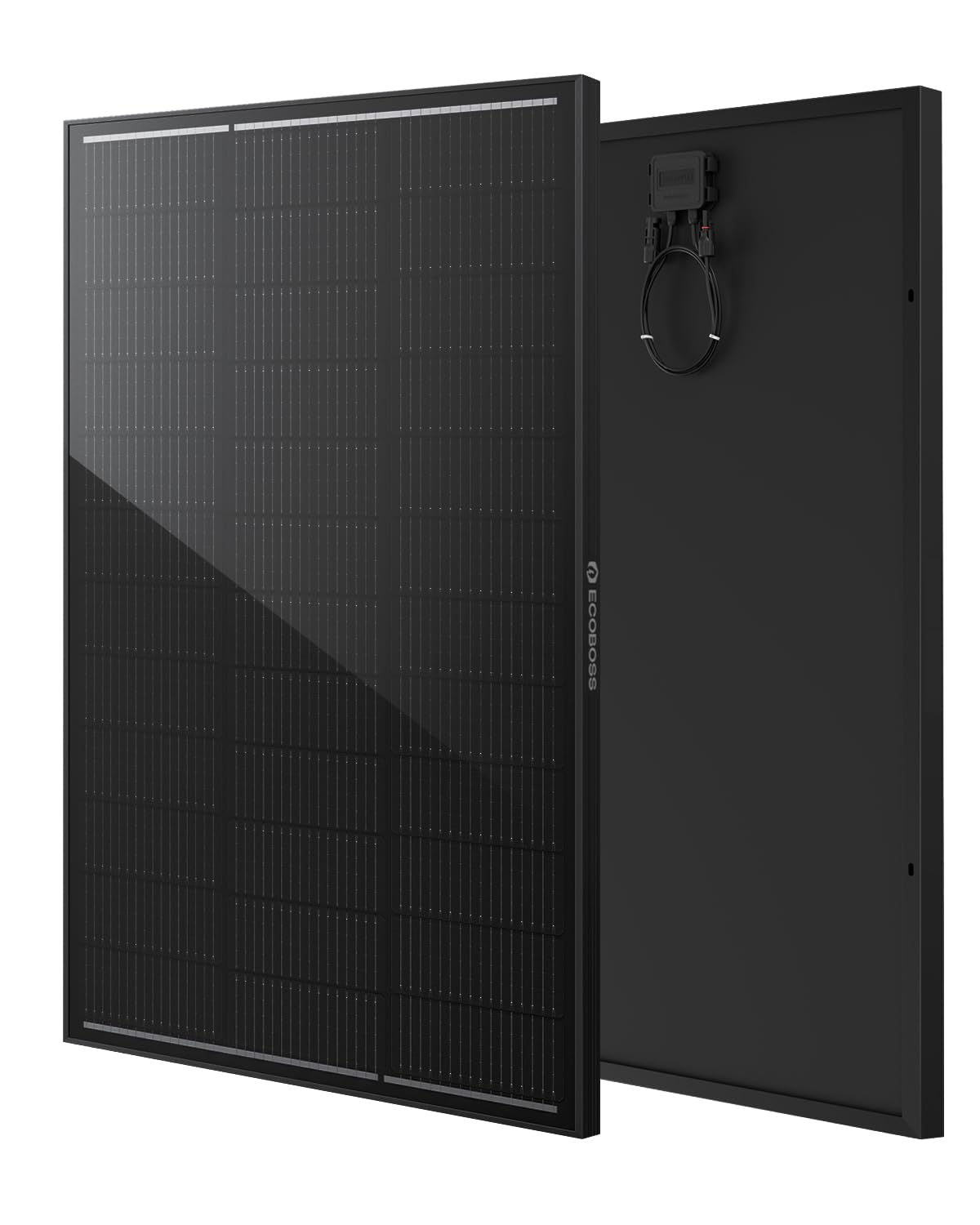
2. 100W TÜV Certification Solar Panel, N-Type 16BB 25.8% Efficiency
The highest conversion figure here, bolted to a frame built to outlast the roof it sits on.
Nothing else in this lineup tops its 25.8% conversion efficiency, and the gap is small but real: that is a hair above the Renogy’s 25%, and roughly three points above the 23% panels further down. Its real advantage is mechanical. The 3.2mm anti-reflective tempered glass sits in a corrosion-resistant aluminium frame with an IP68-rated junction box, and the whole module is rated to 2400Pa wind load and 5400Pa snow load — which is the language of a panel meant to stay screwed down through a bad winter rather than travel in a car.
It is also the one pick that carries independent certification, tested to IEC 61215, IEC 61730 and UL 61730 for design durability and electrical safety. For an RV, a boat or a fixed cabin install that a surveyor or insurer might look at, that paperwork has a value the spec sheet alone does not show. The low temperature coefficient is the practical bonus: heat saps most panels, and this one is designed to hold more of its output when the afternoon sun turns the mounting surface hot. Maximum voltage is 20.88 volts, a shade above the JJN’s 20.8 volts.
Output is what buyers here talk about most, and it is the number they are happiest with — matched to spec in full sun is the common report. The caution is longevity: a minority report the module giving up after a few months, so the one-year warranty is the shortest on this list. Mount it where you can inspect it every couple of weeks for leaves and bird mess, and stay inside the stated limit of three panels in parallel or three in series.
The certification argument: IEC and UL testing plus a 5400Pa snow rating makes this the pick for a permanent, inspected installation rather than a weekend toy.
What to weigh: at 12 pounds it is not a carry panel, and a one-year warranty asks you to trust the build more than the paperwork does.
Choose this for: a fixed roof, boat or cabin where certification and snow load matter.
Look elsewhere for: a panel you plan to fold into a backpack — this one weighs 12 pounds.
3. JJN 100 Watt Solar Panel, 10BB Monocrystalline 12V
Rigid, heavy, and pushing the most amps of any rigid panel on this list.
If you are building a small array rather than charging one battery, the amperage figure is the one to watch, and this panel leads it at 6.42 A — 34% more current than the ECOBOSS panel’s 4.79 A. More amps means a faster bulk-charge stage into a 12V bank, so a cabin setup that used to crawl through the morning gets to float sooner. The trade is weight: 13.7 pounds against the Renogy’s 7.3 pounds makes this a bolt-down panel, not a carry one.
The build is the reason owners trust it. Grade A+ monocrystalline cells at 23% conversion sit in a black corrosion-resistant aluminium frame rated to 2100Pa wind and 5100Pa snow load, with an IP65 junction box and IP67 connectors. In the field that translates to roughly 500Wh in a day on five hours of direct sun, and the manufacturer backs the power output with a 30-year transferable warranty — the longest here by a wide margin. Pre-drilled mounting holes mean a straightforward bracket job.
Quality is the theme the feedback keeps landing on, and it leads the pack by a good margin, with output running second. Charge times fit the numbers: most owners see 80-90% of capacity inside a couple of hours of good sun. The one thing to size correctly is the footprint — at 38.2 by 22.7 inches it is a genuinely large panel, so measure your roof space or rack before ordering. A few owners find it produces less than they hoped in flat, hazy light, which is a fair reminder that any fixed-tilt panel rewards correct angling.
The array-builder’s case
- 6.42 A is the highest current output on this list
- 30-year transferable power output warranty
- IP65 junction box with IP67 connectors
- 5100Pa snow rating suits northern roofs
Where it pushes back
- 13.7 pounds rules out regular carrying
- Large 38.2 x 22.7 inch face needs planned space
- Flat, hazy conditions cut output more than the rating suggests
The fit: off-grid cabins, farms and multi-panel banks where amps and warranty length drive the decision.
The mismatch: anyone who needs to move the panel between trips.
4. Callsun 12V 100W Solar Panel
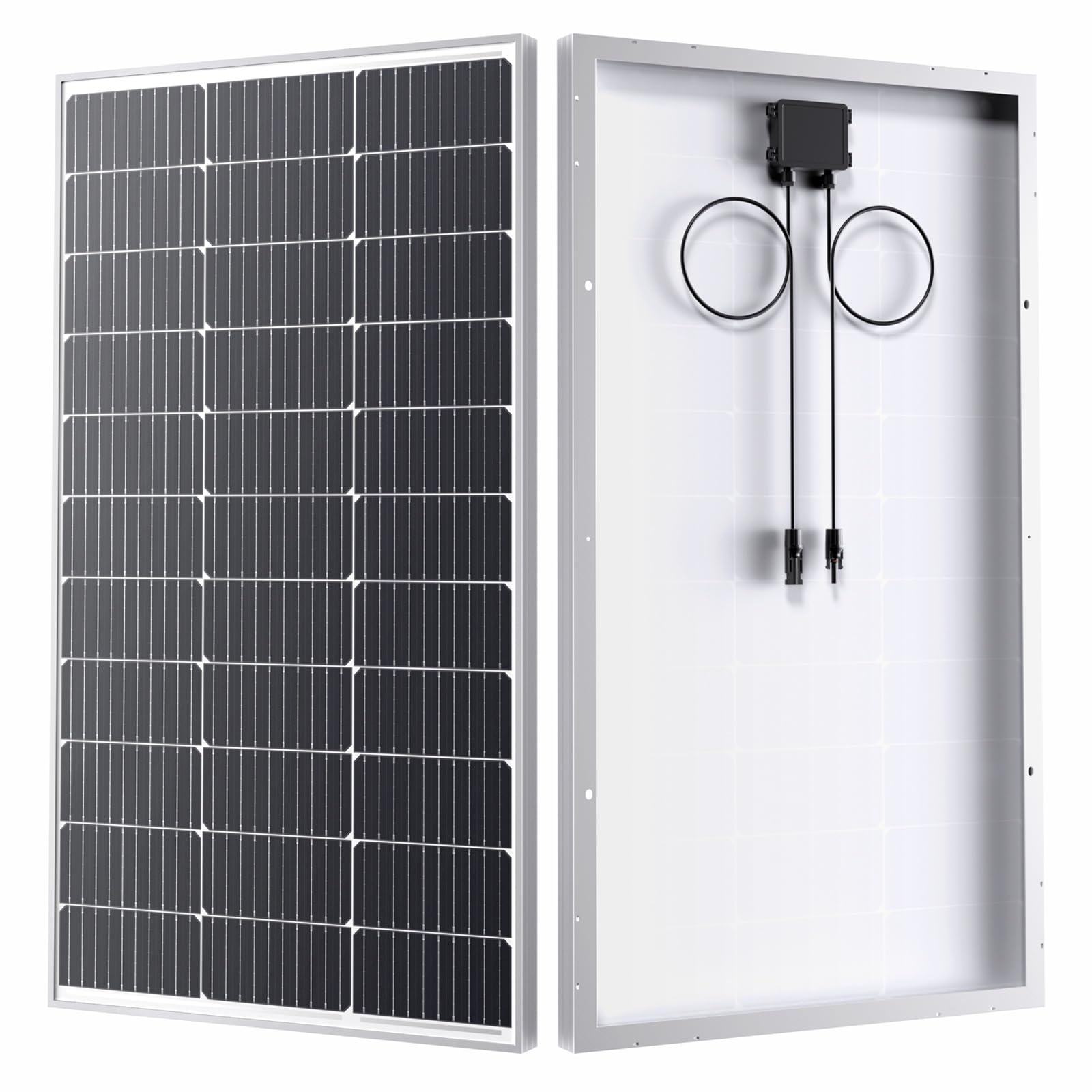
A rigid panel that quietly beats its own nameplate, which is rarer than it should be.
The pitch here is blunt: a true 100W configuration rather than an inflated label. Owners back it up, with reports of the panel pushing well past its rated figure in full sunshine rather than hovering under it. For an RV or cabin where every watt goes into a battery bank, a panel that over-delivers at 100W is the whole game.
At 10.58 pounds with a 42.13 by 22.68 inch face, it stays in rigid territory — light enough for one person to lift onto a roof, heavy enough that it wants to stay there. Low-iron tempered glass and a corrosion-resistant aluminium frame carry the IP67 rating, and four pre-drilled mounting holes are laid out for a quick bracket install. Series or parallel wiring both work, so one panel now and a second later is a realistic path.
Quality is the headline in the feedback, with power output close behind. The warranty package carries real weight too: 10 years of technical support on materials and workmanship, backed by a 30-year guarantee to hold 87.4% of linear output. One practical warning worth heeding — this is a large glass item, so inspect the box on arrival and photograph any damage before you sign. It is also, per the maker’s own reminder, not a foldable, so budget roof or rack space accordingly.
Why it lands mid-list: genuine over-rating performance plus a 30-year linear guarantee is a strong combination for a fixed install.
Handle with care: glass this size can arrive damaged, so check the package before the courier leaves.
Suits you if: you want one rigid panel that reliably exceeds its rating for an RV or cabin roof.
skip it if: your install plan depends on carrying the panel from place to place.
5. ECO-WORTHY Bifacial 100 Watt 12 Volt Solar Panel

Collects light from both faces, so grey skies do not shut it down completely.
Bifacial means the panel is built to gather sunlight hitting the back as well as the front, using a backsheet with up to 91.5% light transmittance. On a rainy or overcast day, that scattered light is exactly what a normal panel wastes — this one keeps feeding the system instead. Conversion rate is 23% on 12BB cells, and to get the most from the rear face the maker suggests a solar tracker bracket with open light space underneath.
Everything else is standard rigid construction done properly: MC4 connectors, a pre-assembled diode in an IP68 junction box, and a pair of pre-assembled 2.95 ft cables already attached. Pre-drilled rear holes let it drop onto a roof or bracket quickly. Wind load holds to 2400Pa and snow load to 5400Pa, so a canopy or sunshed in snow country is fair game.
Two numbers to weigh. At 14.6 pounds it is the heaviest panel here, so plan the lifting. And the bifacial gain only shows up when the back of the panel has light to work with — mounted flat against a solid roof, it behaves like a standard 23% panel. Mount it on the suggested tracker or a raised bracket and the extra face earns its keep. Quality and performance are what the feedback highlights, and several owners find it out-shining ordinary 100W mono panels outright.
Best matched to: sunsheds, canopies and raised brackets where light reaches both faces.
Waste of money if: you bolt it flat to solid decking — the rear cells get no light.
6. FlexSolar 100W Foldable Portable Solar Panel
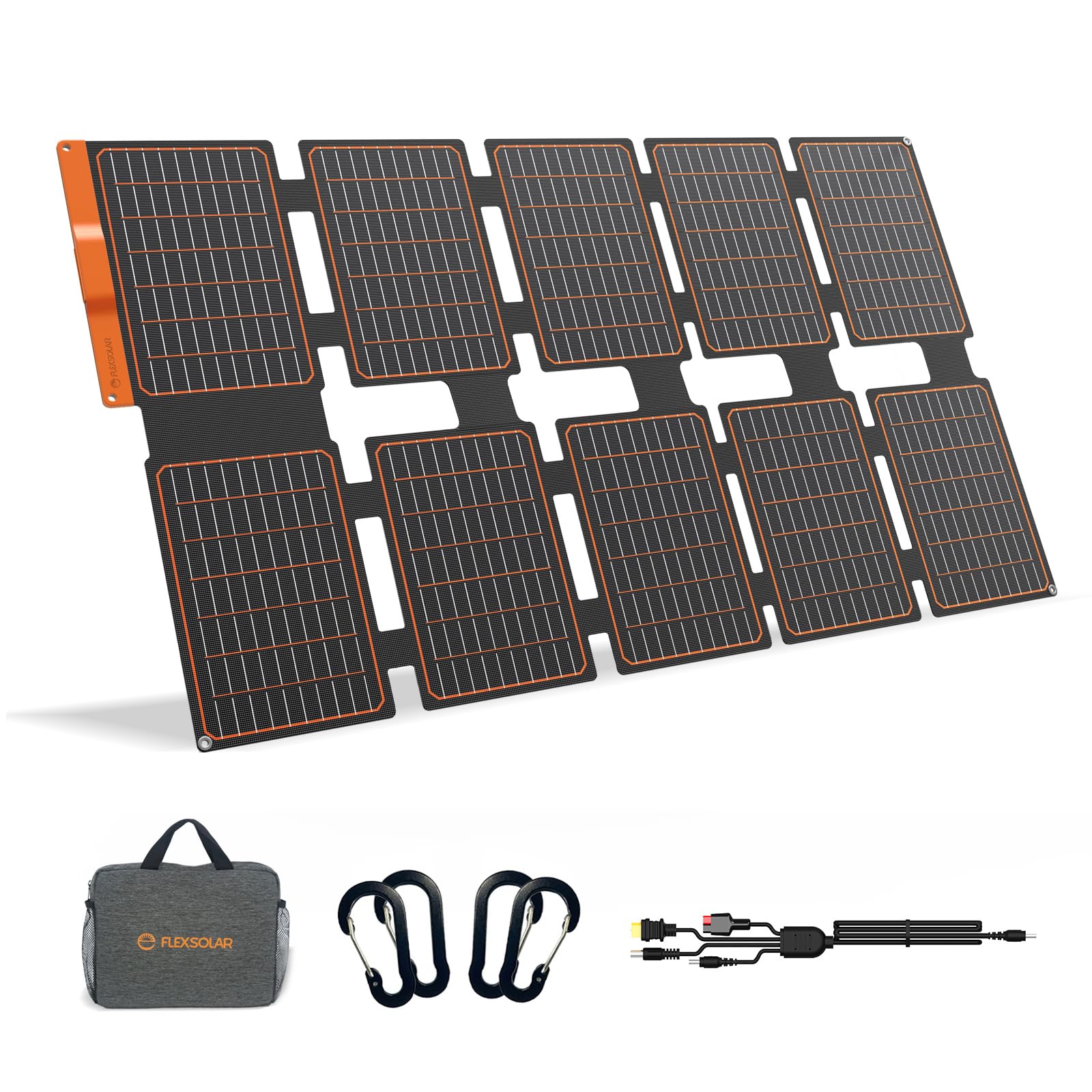
At 4.1 pounds it is the lightest panel here, and it folds into a 0.59-inch stack.
Weight is the whole reason this one exists. Folding to a compact 12.99 x 10.43 x 2.17 inches with a carry bag included, it disappears into a hiking pack without becoming a burden. Unfolded it opens to 45.47 x 26.18 inches, so the capture area is real, not a compromise. Monocrystalline cells with E-Film lamination deliver better than 23% conversion, and low-light charging is the target of that cell choice — overcast afternoons included.
The port setup is unusually complete: a PD 3.0 45W USB-C, an 18W USB-A and a 100W DC output, plus a 4-in-1 charging cable covering DC5521, DC7909, Anderson and XT60. In plain terms, most portable power stations and a fair number of phones will plug straight in with no adapter hunt. The IP67 rating covers rain, dust and sand, which matters for something this portable — a panel that lives outside has to tolerate weather.
Portability and quality are what the feedback keeps returning to, and one concrete result stands out: an iPad taken from 9% to 95% in 7 hours. The honest limit is that the panel often sits in the 84W range in real sky rather than hitting 100W, which is normal behaviour for folded panels and worth understanding before you buy — the cables also need the right connection type, so check your station’s input.
Why weight wins here
- 4.1 lbs is the lightest in the lineup
- 0.59-inch profile with a carry bag included
- Three built-in outputs: PD 3.0 45W USB-C, 18W USB-A, 100W DC
- 4-in-1 cable handles DC5521, DC7909, Anderson and XT60
Where the spec softens
- Real-world output often near 84W, not 100W
- Foldable design limits the rigidity a roof install needs
- Cable compatibility needs checking before the first charge
The pick for: hikers and campers where a couple of pounds decides what comes along.
Cause to pause: expect to land near 84W rather than the full label in ordinary sky.
7. Ecosonique 100W Portable Solar Panel with USB-C/A & XT60
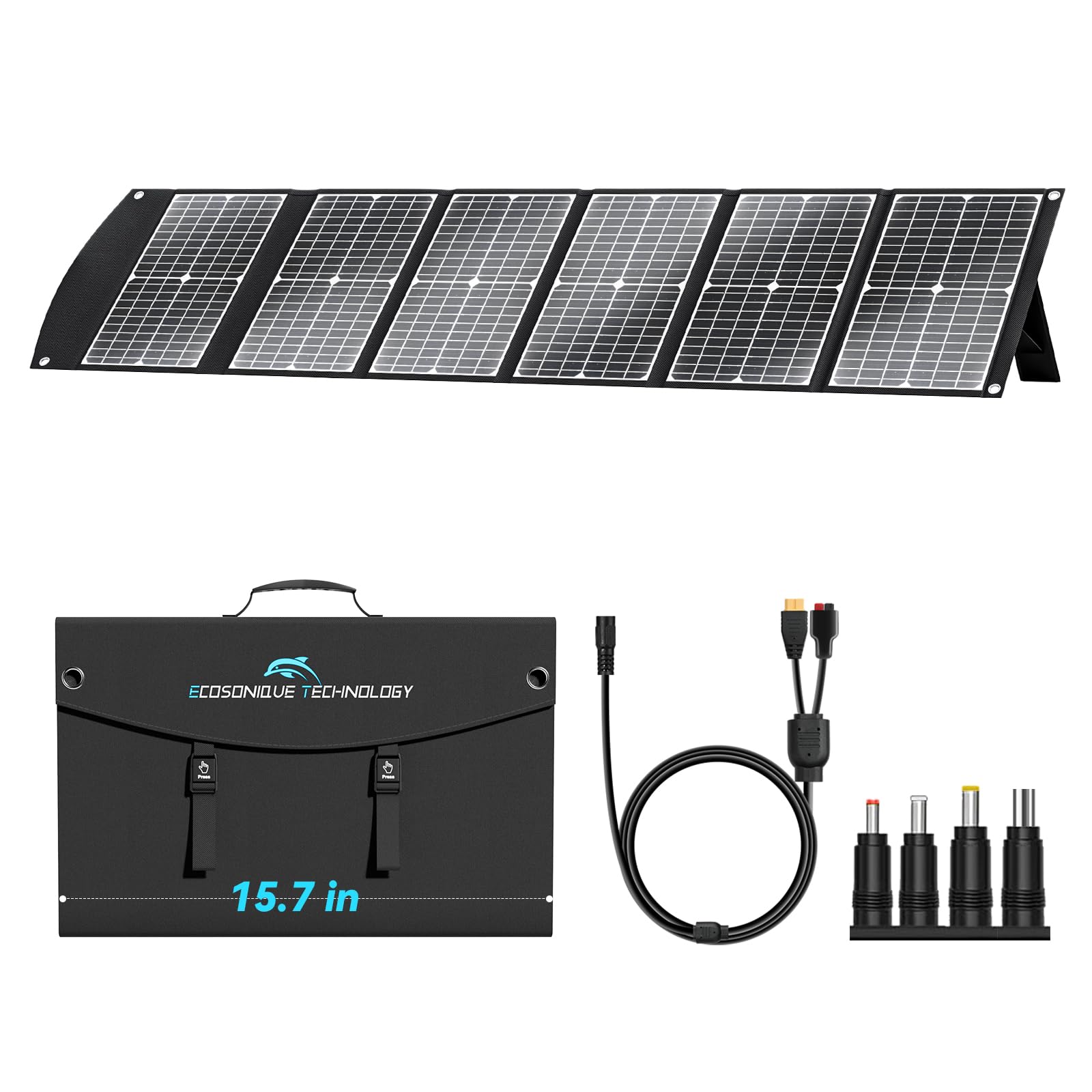
The one that plugs into nearly everything from the start, adapters already in the bag.
Six pounds, folding to roughly laptop-bag size at 15.68 x 10.44 x 2.96 inches — light enough for camping, hiking, fishing and RV trips, and small enough to store under a seat. Built-in grommets let you hang it off a tent or awning when the ground is uneven. Grade A+ monocrystalline cells deliver a 24% conversion rate, and the intelligent chip inside guards against over-current, over-voltage and short-circuit — quietly useful when you charge an expensive station.
Connectivity is the actual reason to pick this one. QC3.0 USB-A at 24W max, PD3.0 USB-C at 45W max and a 20V DC port are all onboard, and the included adapter set reaches EcoFlow DELTA and RIVER, Bluetti Elite 30V2 and EB3A, Anker C300 and C200 DC, and several Jackery models through DC7909 and Anderson. A 3-meter DC5521 cable means the panel can sit in full sun while your power station stays in shade. The six adjustable kickstands set the panel to a 45° angle, which the maker says captures up to 25% more light than laying it flat.
Quality and performance are the aspects that carry the most weight in the feedback, and charging speed earns its place too — one owner reports pushing a 300-watt Bluetti bank from 13% to 100% in an hour. The honest concerns are durability and stability: this is a fabric-skinned panel, and the recurring note involves the frame and its footing in wind. Guy it down and it does the job; leave it freestanding in a gust and it will not stay put.
The connector win: XT60, Anderson, DC7909 and DC5521 adapters ship in the box, which removes the usual first-trip frustration.
Where to be careful: the kickstand footing wants staking on open ground, and the panel is happier pegged than propped.
Worth choosing when: your power station’s input is odd or you swap between brands.
Second-guess it if: you want a panel to stand free on a windy beach with no tie-down.
8. ALLPOWERS SE100 100W Portable Solar Panel Charger
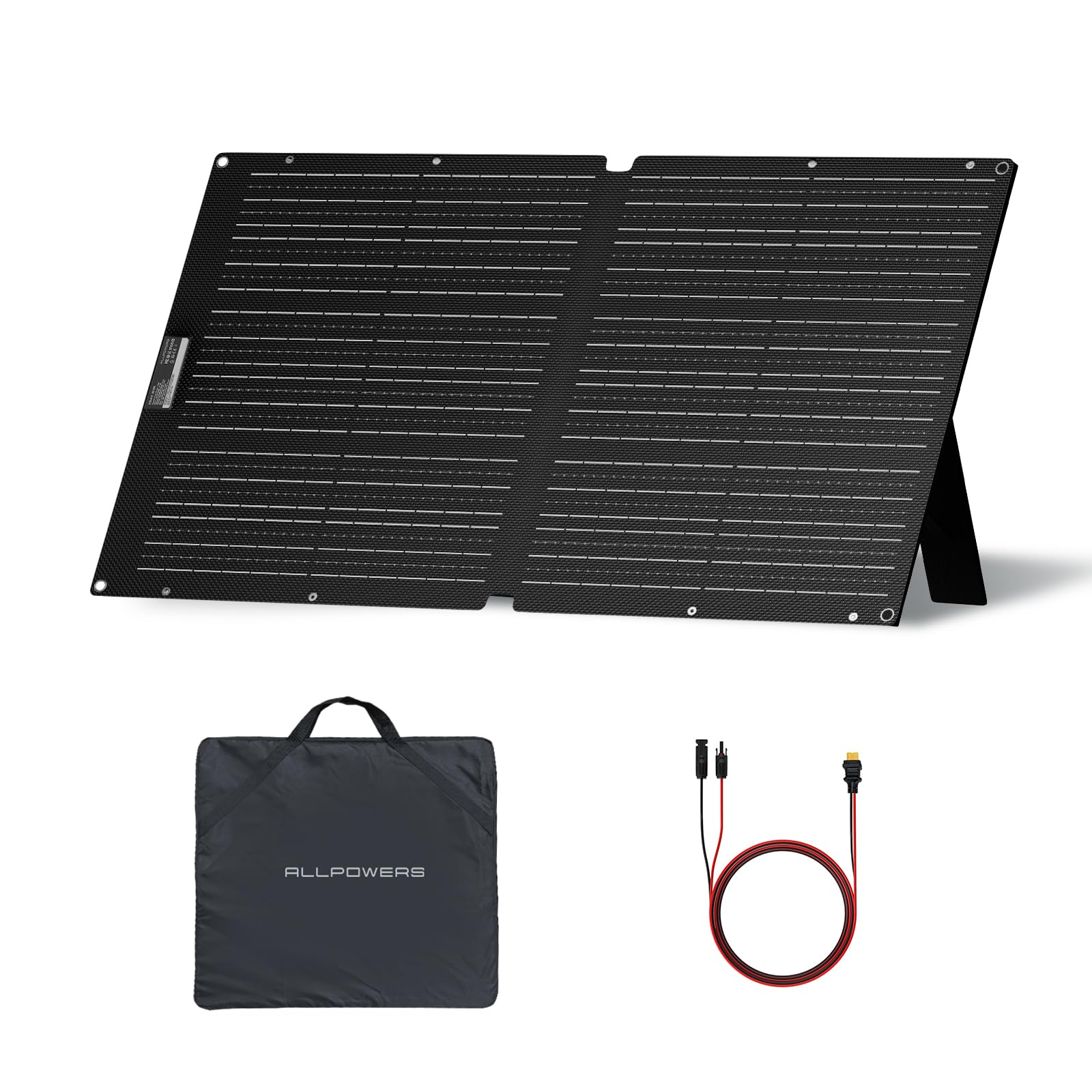
Built to be chained, so a short camping trip can scale its solar input.
The chainable design is the standout idea: with the included solar cable you can link more than one SE100 together and feed a single power station, so the panel grows with your needs rather than needing to be replaced. At 8.8 pounds folded into 23.11 x 21.46 x 0.98 inches, it carries comfortably and stores flat. The flexible bracket adjusts from 0 to 180 degrees, letting you tilt the face at the sun instead of lying flat and handing away output.
The skin is a durable fabric made to shrug off occasional rain, and 25% monocrystalline cells sit underneath. Connectors in the box cover the main power-station input shapes via a solar port to XT60 adapter set, and the package includes solar cable connectors, a three-year warranty and customer support. Three years is the longest warranty among the foldable picks, which matters for an item designed to be thrown in and out of a vehicle.
Two honest notes. Power output is the split point in the feedback — some owners find it performs decently, a few report it working for only about a day, so buy it with the expectation of real-sky figures rather than lab numbers. And on a fabric panel, keep the junction end out of standing water even though the cells tolerate rain.
Reach for this if: you want to add a second panel later without replacing the first.
Look elsewhere if: you need rock-solid, predictable output above all — the results here vary.
9. SOKIOVOLA N-Type 16BB 100W Portable Solar Panel
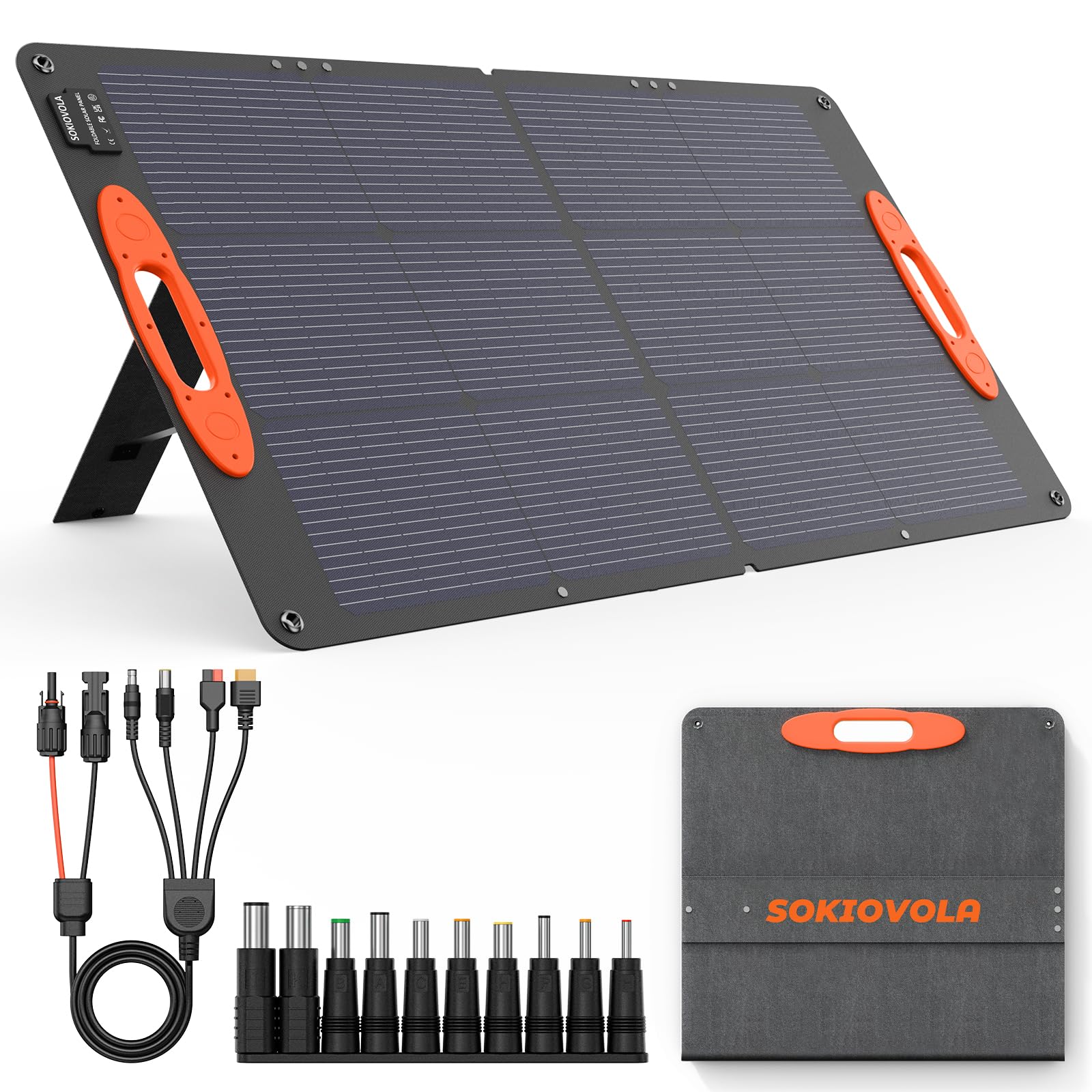
N-Type cells and a full adapter set, folded into a bag you can carry.
A+ grade 16BB monocrystalline cells at up to 25% conversion put this panel in the same efficiency league as the Renogy, which is unusually strong for a value foldable. The ETFE coating has a slightly convex surface that increases the light-catching area, and the two built-in brackets let it stand on any flat surface at a good angle. At 8.81 pounds folded to 21 by 23 inches, it is a carry panel rather than a roof panel.
The included kit is generous for the tier: a 7.2 ft 4-in-1 extension cable covering XT60, DC5521, DC7909 and Anderson, plus a 9-in-1 DC connector set for broader power-station compatibility across Jackery, EcoFlow, BLUETTI, Goal Zero and Anker. A 12-month warranty and 30-day refund window round out the package.
Here is the catch worth knowing before you order: many portable power stations cap their input watts, and the panel’s real-world delivery is only as high as that cap allows. Owners split on output — some see far less than nameplate, others report strong figures — so check your station’s maximum input before blaming the panel. Quality and portability are where this one genuinely holds up, with some owners finding it outruns pricier panels on the same trip.
Where the value sits
- N-Type 16BB cells at up to 25% conversion
- Complete 4-in-1 and 9-in-1 adapter kit included
- Two built-in brackets for angled placement
- 12-month warranty with a 30-day refund window
The fine print
- Output is capped by your power station’s input limit
- Real-sky results vary widely between owners
- 8.81 pounds is a lot for a fabric panel
Most useful for: campers on a tighter budget who want N-Type cells and adapters in one buy.
Think twice if: your station has a low input cap — the panel cannot exceed it.
Understanding the Specs
Conversion Efficiency
The percentage of sunlight hitting the panel that becomes usable electricity. A 25.8% panel turns more of the same sunlight into charge than a 23% one, so on a roof with limited space or in hazy light the higher figure does real work. Pair that with the busbar count — 10BB or 16BB strips per cell — which gives current more paths to escape and helps stability in heat.
IP Water and Dust Ratings
The first digit is dust, the second is water. IP65 handles rain and spray, IP67 tolerates brief immersion, IP68 is the toughest. For a rooftop panel the junction box is the weak point where moisture gets in, so a high rating on that box is worth more than a high rating stamped on the glass.
Amperage and Maximum Voltage
Amperage is the current flowing into your battery or station, and it sets how fast the bulk-charge stage finishes. Maximum voltage tells your charge controller the ceiling it must handle. Match both to your controller and battery, not just the 100W label — a panel with more amps can charge a 12V bank noticeably faster.
Wind and Snow Load
Measured in Pascals, these numbers describe how much force a mounted panel survives without warping or tearing free. A higher snow-load figure matters for any fixed roof in a cold climate; a higher wind figure matters for boats, canopies and open ground.
FAQ
Will a 100W solar panel charge a 12V battery directly?
How many amps does a 100W panel actually put out?
Can I connect two 100W panels together?
Will a 100W panel run a portable power station?
Why does my 100W panel only show 80W or less?
Is a bifacial panel better than a standard panel?
How do I stop a folding panel blowing over?
What does IP67 or IP68 mean on a solar panel?
Are rigid or foldable panels better in snow?
Can I mount a foldable panel permanently?
Final Thoughts: The Verdict
For most buyers the winner is the Renogy 100W Portable Solar Panel because 25% N-Type efficiency holds up in weak light and its IP67 body handles weather a fabric panel cannot. If your panel is going on a fixed roof or boat, grab the 100W TÜV Certification panel for its 25.8% efficiency and 5400Pa snow rating. And for a cabin or farm running a 12V bank, the JJN gives the highest current at 6.42 A along with a 30-year power warranty.
If you need something that fits in a hiking pack, look at the FlexSolar at 4.1 pounds, or the Ecosonique if odd connectors have stopped you before. A last honest note: match the panel to your power station’s input cap and connector before anything else, because that mismatch is the most common reason these panels get returned. Get the connector and input cap right, and the wattage label matters far less.
How We Picked
We do not accept paid placement. Every pick is matched to a real buyer and a real use-case; we do not hands-on test units.
Sources & Methodology
Specifications: manufacturer listings and product documentation. Review insights: verified customer reviews, as of November 2026. Pricing: not shown on this page (it changes often); check the current price via the retailer link.
As an Amazon Associate, Gadgets Feed earns from qualifying purchases. This does not affect which products we feature.