
Trying to spot a .22 caliber hole in a paper target at a thousand yards, or distinguishing the subtle plumage of a raptor perched on a distant ridgeline, pushes most spotting scopes past their breaking point. That kind of distance demands a specific combination of large objective lens diameter, high-quality glass, and stable magnification—compromising on any one of these variables leaves you staring at a heat-shimmered blur.
I’m Min — the co-founder and writer behind Gadgets Feed. This guide comes from hundreds of hours combing through side-by-side optical tests, customer field reports, and technical datasheets to isolate exactly which models deliver true 1000-yard clarity without forcing you to mortgage your gear budget.
Whether you are bench-rest shooting at extreme distance, scanning canyon walls for bighorn sheep, or digiscoping the lunar terminator, these recommendations will help you lock onto a 1000 yard spotting scope that turns that distant haze into a sharply defined image.
How To Choose The Best 1000 Yard Spotting Scope
A spotting scope that can deliver a crisp, bright image at 1000 yards has to excel in four areas: light gathering, glass quality, mechanical stability, and environmental sealing. If any one of those pillars is weak, the image will fall apart the moment you push magnification past 40x on a distant target.
Objective Lens Diameter and Light Transmission
This is the foundation. An 80mm objective lens gathers roughly 78% more light than a 60mm lens, and a 100mm lens gathers about 56% more light than an 80mm lens. At 1000 yards, that extra light is what keeps the image from looking dim or muddy, especially in low-angle morning or evening light. Scopes with an 85mm or 100mm objective are the baseline for serious long-range use.
Glass Quality: ED vs. Standard and Prism Type
Extra-low Dispersion (ED) glass is not a luxury for 1000-yard work—it is a necessity if you want to avoid color fringing along high-contrast edges like a white target against a dark backstop. BAK4 prisms with phase coatings further improve contrast and resolution at the edges of the field, preventing the image from softening at the periphery when you are zoomed all the way in.
Magnification Range and Exit Pupil
A zoom range starting at 20x and reaching 60x or higher gives the flexibility to find your target at low power and then zoom in for detail. The exit pupil (objective diameter divided by magnification) determines how much light reaches your eye. At 60x with an 80mm lens you get a 1.33mm exit pupil, which is borderline in low light; a 100mm lens yields a 1.52mm exit pupil, providing a noticeably brighter image at max power.
Quick Comparison
On smaller screens, swipe sideways to see the full table.
| Model | Category | Best For | Key Spec | Amazon |
|---|---|---|---|---|
| Leupold SX-4 Pro Guide HD | Premium | Professional long-range shooting | 20-60x85mm, DiamondCoat 2 lens coating | Amazon |
| Celestron TrailSeeker 100 | Premium | Low-light birding and digiscoping | 22-67x100mm, XLT coatings, phase-coated BAK4 | Amazon |
| Vanguard Endeavor HD | Mid-Range | All-around wildlife observation | 20-60x82mm, ED glass, dual focus | Amazon |
| SVBONY SV406P | Mid-Range | Digiscoping with WiFi camera | 20-60x80mm, ED glass, dual focus, IPX7 | Amazon |
| Celestron Ultima 100 | Mid-Range | Maximum light gathering on a budget | 22-66x100mm, multi-coated optics | Amazon |
| Athlon Optics Argos HD | Mid-Range | Target shooting at the range | 20-60x85mm, HD glass, argon-purged | Amazon |
| WOZEL 25-75×100 | Value | Entry-level long-range viewing | 25-75x100mm, BAK4 prism, leather exterior | Amazon |
| Nexiview 25-75×80 | Value | Budget-friendly range spotting | 25-75x80mm, BAK4 prism, 64in tripod | Amazon |
| Gosky 20-60×80 HD | Value | First scope for digiscoping | 20-60x80mm, BAK4 prism, includes phone adapter | Amazon |
In‑Depth Reviews
1. Leupold SX-4 Pro Guide HD 20-60x85mm Spotting Scope

The Leupold SX-4 Pro Guide HD sits at the top of this list because it delivers professional-grade optical performance without reaching the absurd price territory of European alpha brands. The 85mm objective lens and HD glass produce a bright, contrast-rich image that holds up remarkably well at 60x in the shoulder-hour light when most scopes start to wash out. The DiamondCoat 2 ion-assist lens coating pushes light transmission to the high end while also providing serious abrasion resistance against grit and dust in the field.
Field reports from long-range shooters consistently praise the smooth, precise focus mechanism and the ability to track bullet trace and spot impacts on steel at distances well past 800 yards. The built-in rotatable tripod adapter makes it easy to balance the scope on any standard tripod head, and the rubber armor gives a positive grip even with wet hands. The straight eyepiece configuration on this model is preferred by many bench shooters, though a 45-degree angled version is also available for more natural wildlife viewing positions.
The only real compromise here is the relatively high entry cost, which puts it out of reach for casual users. Additionally, it is a large and heavy scope—not something you would toss in a daypack for a casual hike. But for the shooter or birder who demands reliable 1000-yard clarity in all conditions and wants a scope that will survive years of hard use, the SX-4 Pro Guide HD is the definitive choice.
Why it’s great
- DiamondCoat 2 provides exceptional light transmission and scratch resistance.
- HD glass delivers sharp, color-accurate images throughout the zoom range.
- Fully waterproof and fogproof with fast, precise focus action.
Good to know
- Premium pricing places it well above mid-range options.
- Large and heavy, requiring a stable, heavy-duty tripod.
2. Celestron TrailSeeker 100 22-67x100mm Spotting Scope
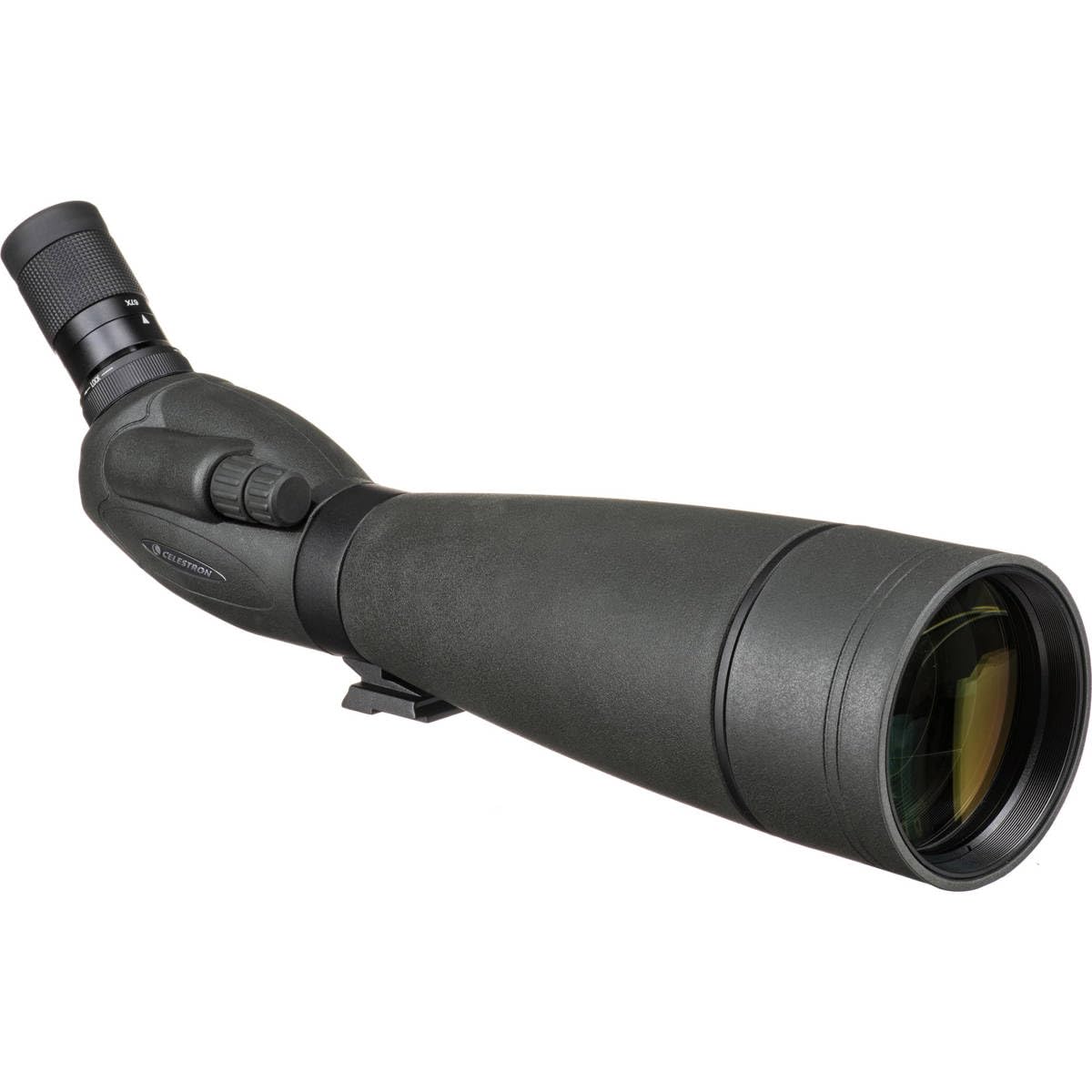
The Celestron TrailSeeker 100 is a masterclass in putting a massive objective lens into a well-engineered package without inflating the price to the stratosphere. With its 100mm objective and Celestron’s proprietary XLT fully multi-coated optics, this scope collects more light than any other model in this review. Phase-coated BAK4 prisms ensure that the light reaching your eye is not only abundant but also free from the internal scattering that blurs edge detail at high magnification.
Birders and wildlife spotters will love the 22-67x zoom range, which gives you plenty of reach without needing to swap eyepieces. The dual-focus mechanism—a coarse wheel and a fine adjustment ring—allows for critically sharp focusing even when the target is moving. The magnesium alloy chassis keeps the weight manageable for a 100mm scope, and the rotating tripod collar lets you switch between landscape and portrait orientation for comfortable viewing over long sessions.
On the downside, the included tripod and case are functional but basic, and you will want to invest in a sturdier support system to fully exploit the optical capabilities at 67x. Some users also note that the image quality degrades slightly at the very top of the zoom range, but this is a very minor trade-off given the extraordinary low-light performance. This is the scope you want when you need to see at dawn or dusk.
Why it’s great
- 100mm objective and XLT coatings deliver unmatched low-light brightness.
- Phase-coated BAK4 prisms produce edge-to-edge sharpness.
- Dual focus wheels allow rapid coarse adjustment and fine-tuning.
Good to know
- Included tripod is too light for stability at max magnification.
- Edge sharpness drops slightly at 67x.
3. Vanguard Endeavor HD 20-60x82mm Angled Spotting Scope
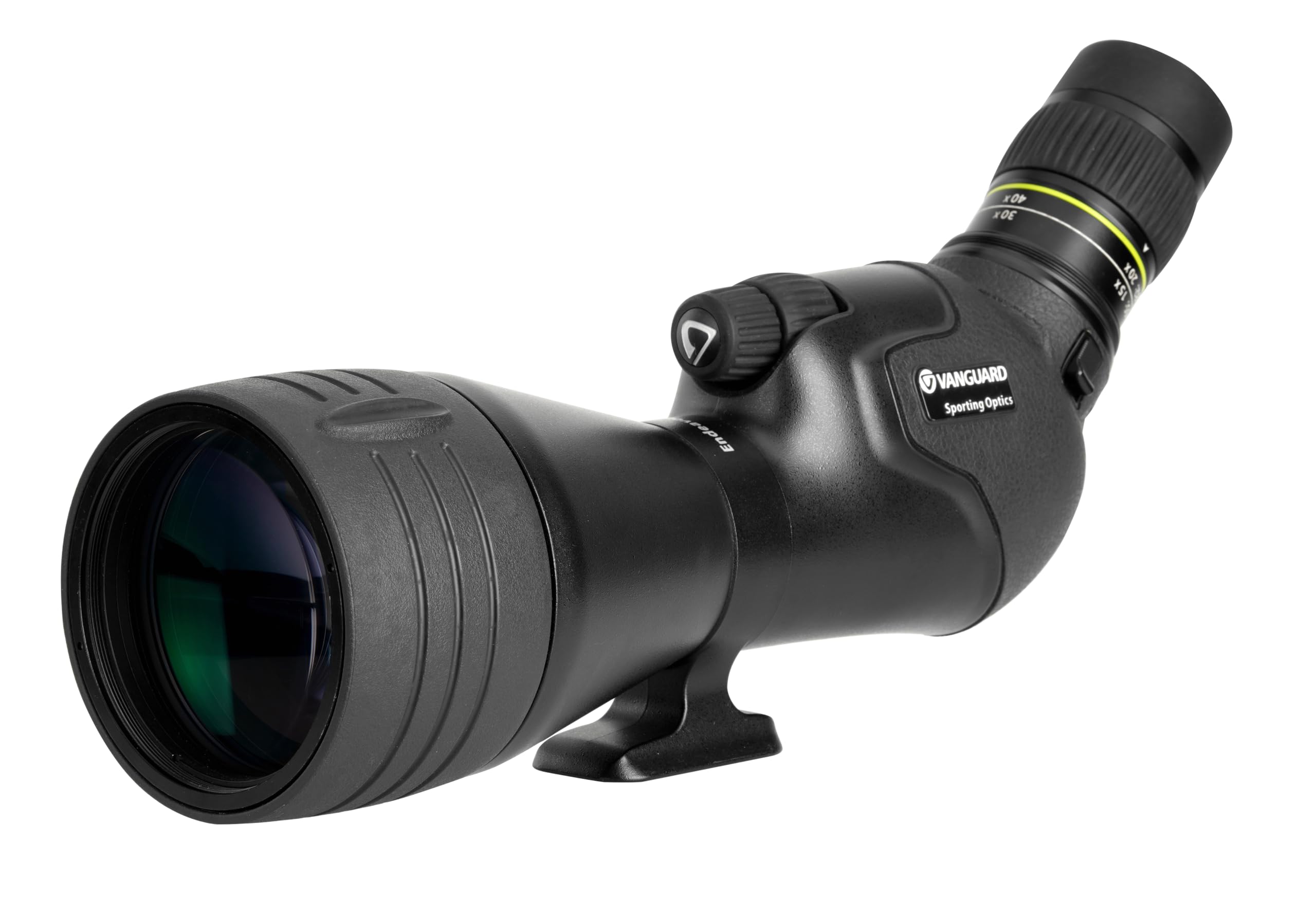
The Vanguard Endeavor HD occupies a sweet spot where genuine Extra-low Dispersion (ED) glass and a robust magnesium body meet a price that undercuts most competing HD scopes. The 82mm objective is large enough to support bright 1000-yard viewing, and the ED glass does an excellent job of suppressing chromatic aberration—that purple-green fringing that plagues standard optics when you are looking at high-contrast edges like tree branches against a bright sky or a black target on a white backstop.
Users consistently report that the color fidelity and sharpness of the Endeavor HD rival scopes costing twice as much, especially in the 20-40x range where the scope performs at its absolute peak. The dual focus system is genuinely useful for long-range precision, allowing you to dial in the image with the fine wheel after the coarse focus is set. The detachable angled eyepiece with its long 19-20mm eye relief is comfortable for users who wear glasses, and the built-in sunshield cuts glare when you are shooting into the sun.
Where the Endeavor HD gives up ground to the premium tier is at the very top end of the magnification range—above 50x, the image softens more noticeably than on the Leupold or Celestron TrailSeeker. It also weighs over four pounds, so a solid tripod is non-negotiable. Still, for the observer who wants true ED-grade clarity without breaking into the + bracket, this is the pick.
Why it’s great
- ED glass effectively eliminates chromatic aberration at long range.
- Dual focus wheels for precise image sharpening.
- Long eye relief and excellent color rendering in the 20-40x range.
Good to know
- Image sharpness declines more than premium options above 50x.
- Heavy chassis demands a sturdy tripod.
4. SVBONY SV406P 20-60×80 ED Angled Spotting Scope

The SVBONY SV406P challenges the assumption that you need to spend a fortune to get ED glass and a dual-focus system. This is the only scope in the mid-range tier that uses Extra-low Dispersion glass, and it makes a real difference at 1000 yards. Color fringing is dramatically reduced compared to non-ED scopes in the same price class, and the image remains crisp and contrasty from the center to the edge of the field of view at 60x.
One of the standout features is the detachable 1.25-inch eyepiece, which allows you to directly connect SVBONY’s SC001 WiFi camera or any standard 1.25-inch astronomical eyepiece without adapters. This makes the SV406P a fantastic digiscoping platform for photographers who want to capture distant wildlife or celestial objects at high magnification. The dual-focus system—a large wheel for coarse adjustments and a smaller, geared wheel for fine-tuning—lets you achieve a critically sharp focus that typical single-wheel scopes cannot match.
The compromises are mostly in build and packaging. The IPX7 waterproof rating is excellent, but the included soft case and aluminum tripod are entry-level at best. Some users also note that the instruction manual is virtually nonexistent, and the eyepiece assembly can be confusing on first use. But for the digiscoper or long-range observer who prioritizes optical quality per dollar, the SV406P is a standout.
Why it’s great
- ED glass suppresses chromatic aberration effectively at a value price.
- Detachable 1.25-inch eyepiece enables direct use with WiFi cameras or astronomy eyepieces.
- IPX7 waterproof rating and dual-focus system provide real utility.
Good to know
- Included tripod and soft case are adequate but not durable.
- No printed user guide; initial setup can be confusing.
5. Celestron Ultima 100 22-66x100mm Angled Spotting Scope

The Celestron Ultima 100 is a classic for a reason: it offers a massive 100mm objective lens at a price point that undercuts virtually everything else with comparable light gathering. This scope is an absolute light bucket. When you are peering through it at 66x on an overcast afternoon, that extra 15-20mm of objective diameter over an 80mm scope makes the difference between a usable image and a dark tunnel. The multi-coated optics are not ED grade, but they still produce a surprisingly bright and sharp image for the money.
Target shooters at the range rave about the Ultima 100’s ability to resolve .22 caliber holes in paper at 300 meters. The large focus dial is easy to manipulate even with gloved hands, and the 22-66x zoom eyepiece includes an integrated T-adapter for digiscoping with DSLR cameras. The 45-degree angled body makes it comfortable for both seated bench viewing and standing wildlife observation.
The trade-offs are real: the scope weighs 4.5 pounds, the included lens cap is notorious for falling off at the slightest bump, and the tripod mounting foot is positioned in a way that can make balancing difficult on lightweight tripods. You absolutely must pair this scope with a heavy-duty tripod to avoid vibration at high magnification. But if your priority is maximizing light at 1000 yards on a limited budget, the Ultima 100 is the undisputed champion.
Why it’s great
- 100mm objective provides exceptional brightness in low-light conditions.
- Integrated T-adapter in the zoom eyepiece for digiscoping.
- Large, smooth focus wheel works well with gloves.
Good to know
- Heavy design requires a rugged tripod for stability.
- Lens cap is poorly designed and falls off easily.
6. Athlon Optics Argos HD 20-60x85mm Spotting Scope

The Athlon Argos HD is built specifically for the range. The 85mm objective paired with HD glass produces an image that is noticeably sharper and more color-accurate than the standard multi-coated scopes in its price bracket. Reviewers consistently mention that it can pick out .22 caliber splash impacts on steel targets at 275 yards, and several long-range shooters report using it effectively out to 1700 yards in good light conditions.
What sets the Argos HD apart in the mid-range field is the combination of an angled eyepiece and a rotating tripod ring, which lets you dial in the perfect viewing angle for any scenario. The twist-up eyecup works well for users with or without glasses, and the large focus ring is easy to grip even with cold fingers. Argon purging keeps the internal optics free from fogging, which is critical when moving between air-conditioned vehicles and humid outdoor ranges.
The weaknesses are minor but consistent: the 45-degree field of view feels slightly narrow compared to competition, and the eye relief at high magnification can be tight for some users. A few shooters also note that the included neoprene case is too snug to accommodate the scope while mounted. Nevertheless, for the dedicated range shooter who wants HD clarity without stepping into the + tier, the Argos HD is a compelling choice.
Why it’s great
- HD glass delivers sharp, true-to-life color at extended range.
- Angled eyepiece with rotating tripod ring for flexible positioning.
- Argon purging ensures fog-free performance in changing temperatures.
Good to know
- Field of view is a bit narrow compared to some options.
- Eye relief may feel restrictive at 60x for glasses wearers.
7. WOZEL 25-75x100mm Angled Spotting Scope
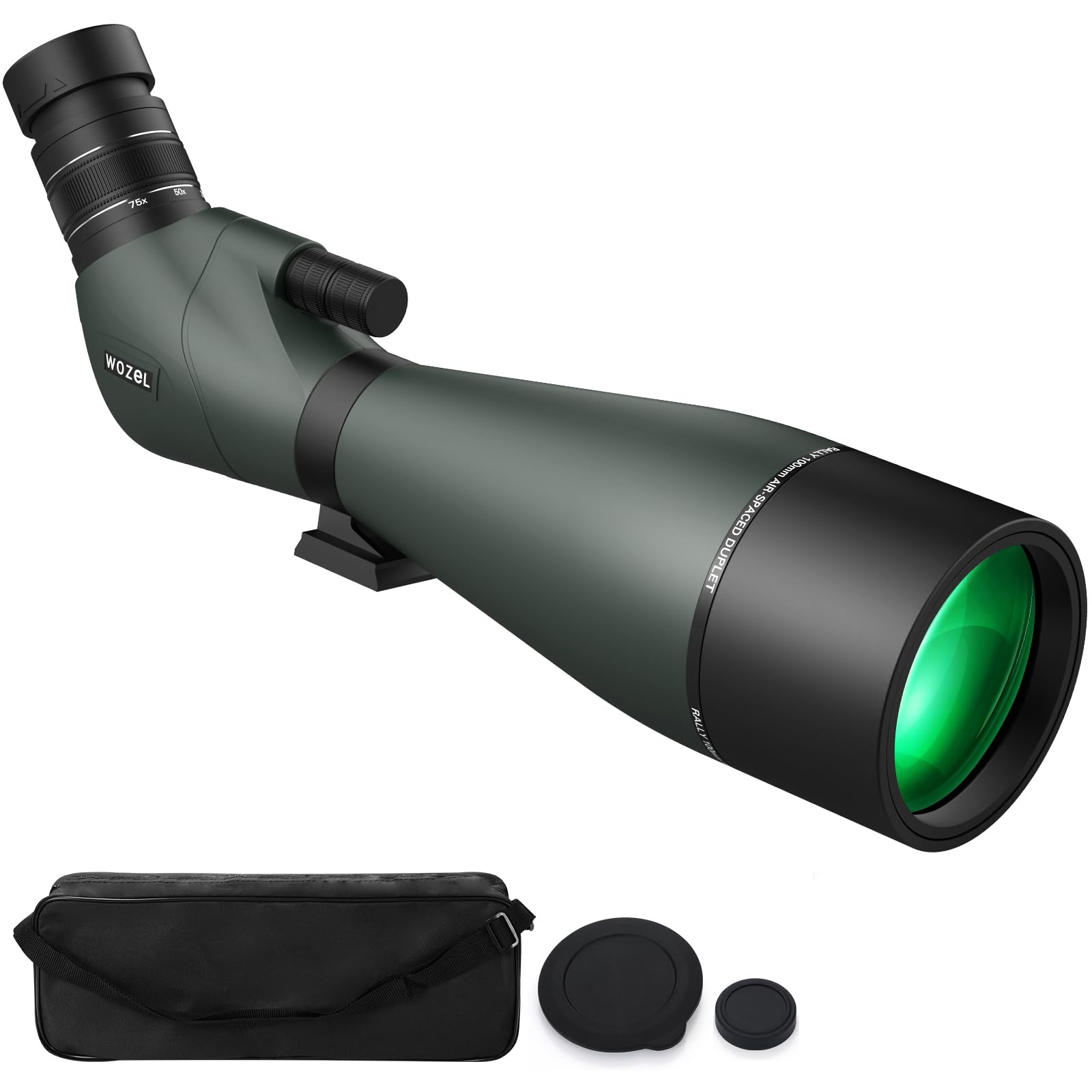
The WOZEL 25-75×100 is a testament to how far the budget segment has come. For a very modest outlay, you get a 100mm objective lens, BAK4 prisms, and a zoom range that tops out at 75x—specifications that would have seemed impossible at this price point a decade ago. The generous 100mm objective pulls in enough light to keep the image bright even at 75x on a clear day, and the BAK4 prisms do a solid job of maintaining edge-to-edge contrast.
Shooters at the range report being able to spot hits on steel plates out to 500 yards with this scope, and the 45-degree angled eyepiece makes it comfortable to use for extended sessions. The leather exterior looks more upscale than typical neoprene armor and provides a decent non-slip grip. The package includes a tripod, a smartphone adapter, and a carrying bag, making it a true out-of-the-box solution for a newcomer to long-range viewing.
Where the WOZEL reveals its budget origins is in the mechanical feel and the included accessories. The tripod is lightweight and prone to vibration at high magnification, and the focus wheel lacks the buttery-smooth action of more expensive scopes. The smartphone adapter is functional but finicky to align. None of these issues spoil the fundamental value proposition, however—if you need a large-aperture scope to get started with 1000-yard spotting without financial risk, this is the one.
Why it’s great
- 100mm objective provides huge light-gathering capability at a low price.
- BAK4 prisms deliver good contrast across the field.
- Includes tripod, phone adapter, and bag for immediate use.
Good to know
- Included tripod is too light for stable use at maximum zoom.
- Focus mechanism feels less precise than mid-range options.
8. Nexiview 25-75x80mm Spotting Scope with Tripod

The Nexiview 25-75×80 is a no-frills entry point that focuses its budget on the two things that matter most for 1000-yard spotting: a BAK4 prism and a 75x maximum magnification. The 80mm objective is adequate for gathering light in good conditions, and the BAK4 prism ensures that the image retains decent contrast and brightness from center to edge. For the price, the image clarity at the shooting range is genuinely impressive at distances up to 100 yards, as confirmed by multiple verified purchasers.
The 64-inch tripod included in the package is a step up from the mini tripods that usually come with budget scopes, offering a wider stance and more height flexibility. The smartphone adapter works with any phone model, making it easy to record or share what you see. The 25x low end of the zoom range is slightly less forgiving for finding your target than a 20x minimum, but it is a minor trade-off for the power ceiling.
The primary concerns with this scope are quality control and the tripod’s structural integrity. Several users report that the tripod mounting base feels weak and that the scope can detach unexpectedly. Customer service has been difficult to reach in some instances. This makes the Nexiview a choice for the extremely budget-conscious user who is willing to roll the dice on build quality in exchange for the lowest possible entry cost to a BAK4 75x scope.
Why it’s great
- BAK4 prism and 75x magnification at a very low price point.
- Tall 64-inch tripod provides better stability than typical mini tripods.
- Smartphone adapter included for easy digiscoping.
Good to know
- Quality control concerns around the tripod mounting base.
- Focus wheel is overly sensitive, making fine adjustments tricky.
9. Gosky 20-60×80 HD Angled Spotting Scope

The Gosky 20-60×80 HD is arguably the most popular entry-level spotting scope on the market, and its success comes down to a simple formula: acceptable optical performance for the price, a generous accessory bundle, and a durable enough build to survive the field. The 80mm fully multi-coated objective and BAK4 Porro prism produce a view at 60x that is bright enough for daytime 1000-yard use, and the 20x wide end makes it easy to scan and locate targets before zooming in.
The accessory package is where Gosky really differentiates itself. In addition to the scope, you get a smartphone digiscoping adapter, an SLR mount that is compatible with Nikon cameras, a tabletop tripod, lens caps, and a padded carry case. This is a complete kit that lets a new user start taking photos and videos through the scope immediately. The magnesium alloy framework and rubber armor provide a level of ruggedness that exceeds expectations at this price tier.
The trade-offs become apparent when you push the scope to its limits. At 60x, the image softens noticeably, and chromatic aberration is visible along high-contrast edges, a limitation of the standard multi-coated glass rather than ED glass. The tabletop tripod is really only usable for stationary observation on a flat surface—you will need a full-size tripod for serious range work. For the absolute beginner who wants a functional 1000-yard scope with a full accessory ecosystem to learn digiscoping, the Gosky is a perfect starting point.
Why it’s great
- Complete kit with phone adapter, Nikon camera mount, and case.
- BAK4 prism and fully multi-coated optics provide decent brightness for the price.
- Rugged magnesium alloy body with shock-absorbing rubber armor.
Good to know
- Image softens and chromatic aberration appears at 60x.
- Included tabletop tripod is inadequate for field use.
FAQ
What is the minimum objective lens size needed to see clearly at 1000 yards?
Is ED glass really necessary for shooting at 1000 yards?
Can I use a cheap tripod with a 1000-yard spotting scope?
What does the exit pupil number mean for 1000-yard use?
Final Thoughts: The Verdict
For most users, the best 1000 yard spotting scope is the Leupold SX-4 Pro Guide HD because it combines professional-grade HD glass and DiamondCoat 2 lens coatings with rugged field reliability, delivering exceptional clarity across the entire 20-60x zoom range. If you want maximum light gathering for low-light observation, grab the Celestron TrailSeeker 100 for its massive 100mm objective and XLT coatings. And for the budget-conscious shooter who needs a complete digiscoping kit, nothing beats the accessory-loaded Gosky 20-60×80 HD as a starting point for 1000-yard viewing.