
Power banks above 20,000 mAh exist in a different weight class from the pocket sticks most people carry. At 100,000 mAh, you are looking at a device that can recharge a modern smartphone 20 to 25 times, keep a tablet running for days, or serve as a backup power source for camping and emergency kits. The trade-off is raw heft — these units weigh between one and five pounds, and they are explicitly banned from airline carry-on luggage by FAA regulations. For car campers, overlanders, off-grid workers, and anyone preparing for extended power outages, this category represents the difference between rationing battery life and never thinking about it.
I’m Min — the co-founder and writer behind Gadgets Feed. My research for this guide involved cross-referencing advertised capacity with real-world output ratings, verifying charge times across different input wattages, and weighing the actual usefulness of extra features like built-in cables, solar panels, and LED arrays against the added bulk and complexity they introduce.
The best 100000 mah power bank balances true usable capacity with sensible port selection and a recharge time that does not force you to leave it plugged in for two full days.
How To Choose The Best 100000 mAh Power Bank
Buying a power bank at this capacity tier means you are prioritizing sustained multi-day power over portability. The decision hinges on three factors: real-world usable watt-hours, recharge speed into the power bank itself, and whether the port selection matches your device ecosystem. A unit that looks cheap on paper but takes 24+ hours to refill can become a liability in practice.
Understand the Wh-to-mAh Gap
Every power bank advertises its cell capacity in milliamp-hours (mAh), but the number that determines how many times it can charge your phone is the watt-hour (Wh) rating. A 100,000 mAh bank at 3.7V (typical LiPo cell voltage) holds roughly 370 Wh. However, boost conversion from 3.7V to 5V USB output introduces 10-15% loss, meaning usable capacity is closer to 310-330 Wh. Always look for the Wh rating in the specifications, and divide by your phone’s battery size in watt-hours (usually 10–18 Wh) to get a realistic charge count.
Check the Recharge Input Speed
A 100,000 mAh bank has a massive appetite for its own refueling. Input ports rated at 18W (5V/3.6A via Micro USB) will take 18-24 hours to fully charge the unit. Banks with USB-C PD input at 20-30W cut that time to 10-16 hours. If you plan to recharge the power bank in a vehicle or from a solar panel, confirm the input voltage range — some units accept 12V DC directly, which is far more efficient than inverting to USB and back.
Port Protocol Compatibility Matters More Than Port Count
A bank with seven USB-A ports but no USB-C PD output cannot fast-charge modern iPhones, Samsung Galaxy devices, or the Nintendo Switch. The most versatile units include at least one USB-C port supporting Power Delivery (PD) at 20W or higher, plus one USB-A port with Quick Charge (QC) 3.0 or 4.0. If you own a MacBook or other laptop, look for a USB-C port that outputs 30W or more — though few banks in this category officially support laptops, some will trickle-charge them at lower wattages. For extended off-grid use, a DC barrel jack (5.5mm x 2.1mm, 12V output) can power LED strip lights, routers, and CCTV cameras directly.
Quick Comparison
On smaller screens, swipe sideways to see the full table.
| Model | Category | Best For | Key Spec | Amazon |
|---|---|---|---|---|
| KONFULON 100000mAh | Premium | True 100,000 mAh capacity | 370 Wh / DC 12V output | Amazon |
| Liahomco 80000mAh | Premium | Fastest charging & non-slip design | 30W PD / 2x 30W USB-A | Amazon |
| LOHAO 70000mAh | Mid-Range | Best weight-to-capacity ratio | 29.5 oz / 30W PD + QC | Amazon |
| JOKO 70000mAh | Mid-Range | 7 output ports & carry handle | 22.5W QC / 20W PD | Amazon |
| Liahomco 70000mAh | Mid-Range | Compact 30W PD in a 70000 shell | 30W PD / 30W QC USB-A | Amazon |
| DJKK 66800mAh Solar | Budget | Off-grid multi-source charging | 22.5W / hand crank + solar | Amazon |
| MAXIAEON 100000mAh | Budget | Entry-level 100K with LED array | 100000 mAh / built-in cables | Amazon |
In‑Depth Reviews
1. KONFULON 100000mAh Power Bank

The KONFULON is the only unit in this roundup that actually advertises a 100,000 mAh cell capacity with the technical specs to back it up — 370 Wh at 3.7V. Its DC 12V/1.5A barrel jack is a standout feature, allowing direct power to 12V devices like car refrigerators, LED strips, and CCTV cameras without needing a separate buck converter. The leather carry handle and six-output layout (including PD 20W USB-C and QC 22.5W USB-A) make it the most versatile full-capacity bank here.
In practice, real-world usable capacity settles around 310 Wh after boost-conversion losses, which translates to roughly 17-20 full iPhone 15 charges. The built-in LED is more of a soft mood light than a tactical flashlight, but the SOS mode adds genuine emergency value. Recharge time is the unit’s bottleneck — a standard 18W input requires a full 24 hours, though a 30W PD charger drops that to about 16 hours.
Some customer reviews report the faux leather handle feeling fragile under heavy load, and the instructions are contradictory about optimal charging current. For car camping, off-grid cabins, or multi-day festival use, however, the KONFULON delivers the highest usable capacity in this list without inflating its numbers.
Why it’s great
- True 370 Wh cell capacity — the only unit at the advertised 100K rating
- DC 12V output for powering non-USB devices like lights and fans
- Six simultaneous outputs cover most charging scenarios
Good to know
- Faux leather handle may wear with heavy use
- Included manual contradicts itself on charging amperage recommendations
- LED is dim; not suitable as a primary worksite light
2. Liahomco 80000mAh Portable Charger
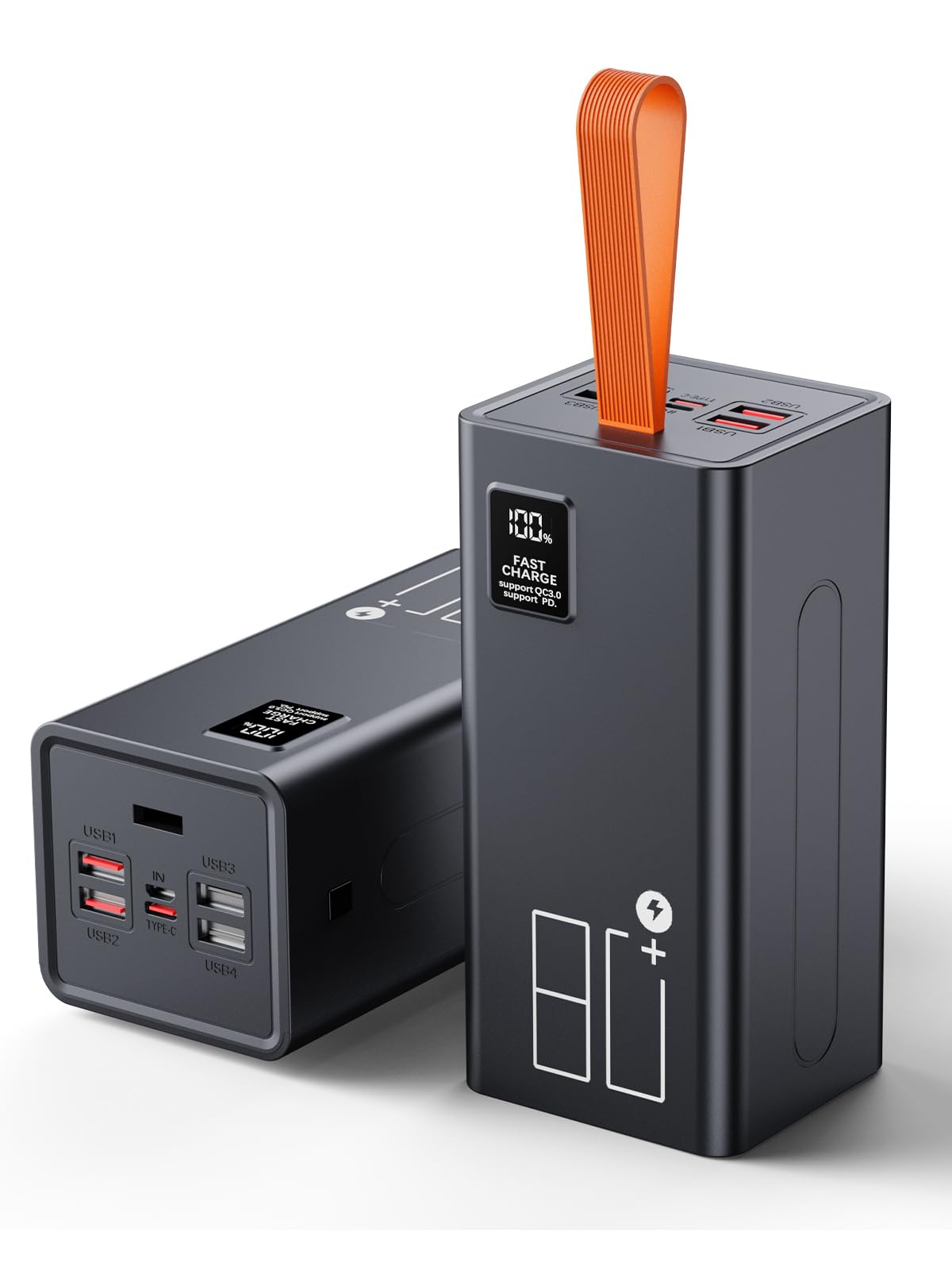
At 80,000 mAh (roughly 296 Wh), the Liahomco sacrifices some capacity compared to the 100K contenders, but it compensates with a 30W PD USB-C port that delivers genuine fast charging to iPhones, Galaxy phones, and the Nintendo Switch. The 2x 30W USB-A ports with QC 3.0 mean two devices can pull top speed simultaneously — a scenario where most multi-port banks drop to 5V/2.4A shared. The unit recharges itself in about 10 hours via its USB-C input, which is the fastest self-refuel time in this group.
The physical design is unusually well-thought-out for this price tier. A non-slip pad on the bottom keeps the brick from sliding off a car dashboard, and textured side grips reduce the chance of dropping a 2.2-pound block of lithium. The included lanyard is comfortable for carrying but not load-rated for the full weight — treat it as a grip aid rather than a suspension strap.
A few customer reports suggest the actual capacity measures closer to 180 Wh (about 50,000 mAh) when tested with a USB meter, so the 80K sticker may be inflated. Even at 50K usable, the unit still delivers 8-12 full phone charges, and the fast output speeds make it more practical for daily multi-device charging than the larger 100K banks. It is the best option for users who prioritize speed over raw capacity.
Why it’s great
- 30W PD and dual 30W QC ports allow two fast charges simultaneously
- 10-hour self-recharge is the quickest in this roundup
- Non-slip base and textured side grips improve handling
Good to know
- Advertised 80K mAh may be inflated; some tests show ~50K usable
- Lanyard is not strong enough to hold the full weight securely
- Not compatible with laptop charging
3. LOHAO 70000mAh Portable Charger
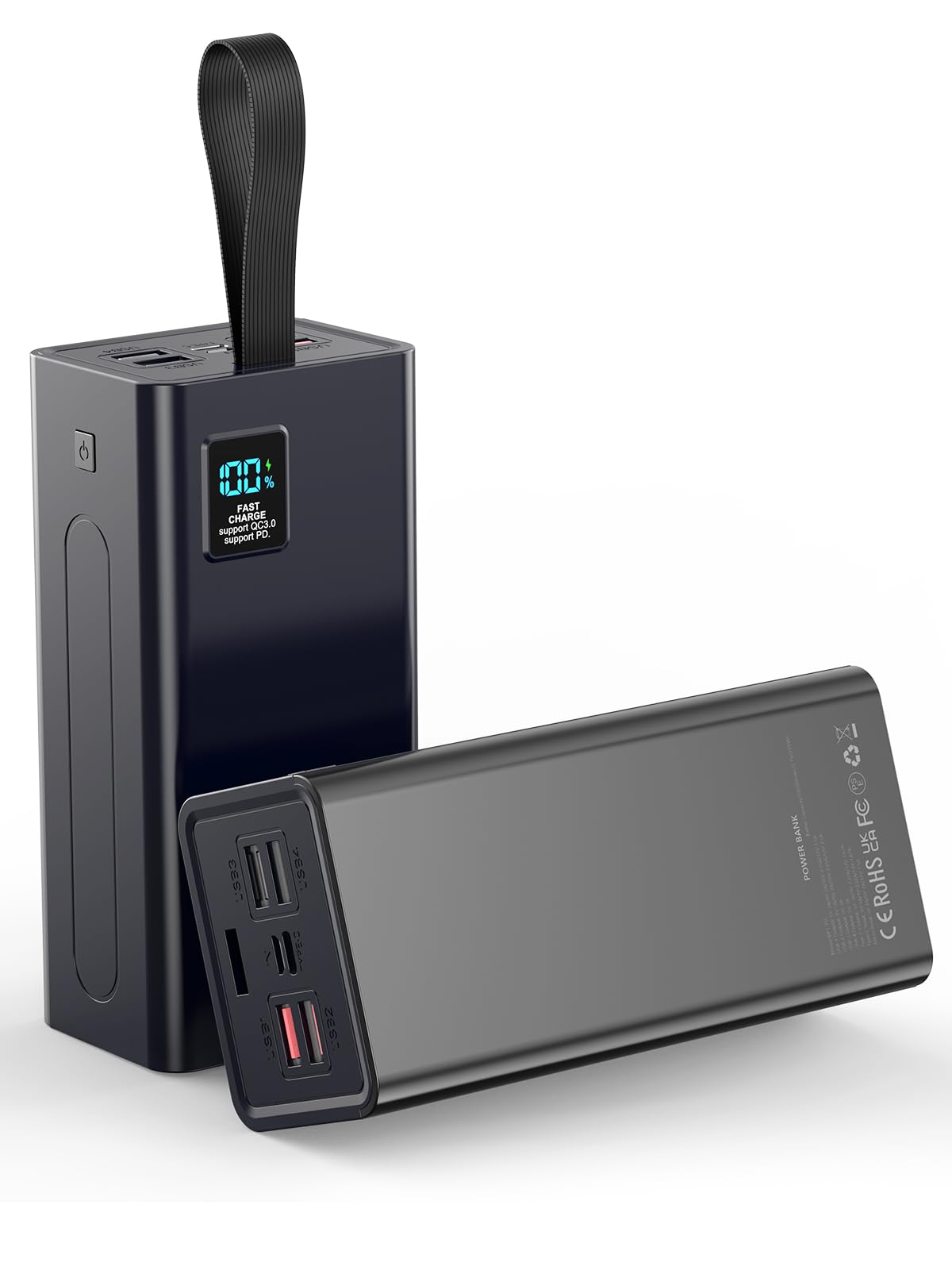
The LOHAO 70000mAh bank (259 Wh) hits a sweet spot between capacity and weight — at just 29.5 ounces (0.83 kg), it is roughly 40% lighter than the KONFULON despite holding only 15% less usable energy. This weight reduction makes it the only unit in the list that can realistically be packed into a daypack or duffel without dominating the bag’s payload. The 30W PD USB-C port and QC 3.0 USB-A output mirror the Liahomco’s fast-charging capability, while the 5-output and 2-input layout covers most multi-device scenarios.
User reports consistently highlight the unit lasting four to five days of moderate use — charging two phones daily plus a tablet — before needing its own recharge. The soft lanyard is comfortable for hand-carrying, though the plastic housing feels slightly less rugged than the KONFULON’s build. The LED display is accurate to within 1%, which is better than the typical 5% tolerance on budget banks.
The main concern across long-term reviews is inconsistent self-recharge behavior: some units lose the ability to charge past 35% after a few months, suggesting quality-control variance in the BMS (battery management system) circuitry. If you get a good unit, it is the most portable high-capacity bank available. If not, the warranty process may be necessary.
Why it’s great
- 29.5 oz weight makes it packable for day trips and hiking
- 30W PD + QC 3.0 for fast device charging
- Accurate digital display with 1% tolerance
Good to know
- Some units report battery management system failure after a few months
- Plastic shell feels less durable than premium competitors
- Lanyard is for grip aid only; not rated for suspension
4. JOKO 70000mAh Power Bank

The JOKO 70000 mAh bank packs seven output ports — one USB-C PD 20W, one USB-A 22.5W QC, and five USB-A 5V/2.1A ports — making it the best option for group charging scenarios where you need to replenish multiple phones, earbuds, and small devices at the same campsite or tailgate. The integrated carry handle is a practical addition for hanging the bank from a tent hook or backpack strap, and the LCD display is calibrated to 100% accuracy per the manufacturer.
At 259 Wh (70000 mAh), real-world performance matches the LOHAO: about 12-15 iPhone charges under normal conditions. The 22.5W QC output is slightly slower than the 30W PD ports on the Liahomco and LOHAO, but still fast enough to bring a Galaxy S22 from 0% to 64% in 30 minutes. The two-way fast charging support (input and output via USB-C) means you can use a single PD charger to refill the bank without needing a separate Micro USB cable.
Construction quality is a weak point. Multiple reviews report loose charging ports from the first day, and the water resistance is minimal — rain or splashes can damage the electronics. The claim of 16-24 hours of charging time for the bank itself is accurate, but the 16-hour figure assumes a 20W input, which few budget wall chargers provide. For group camping where every device needs a port, the JOKO delivers, but it is not built for rough handling or wet conditions.
Why it’s great
- Seven outputs can charge an entire group’s devices simultaneously
- Built-in carry handle makes hanging from a tent hook easy
- USB-C two-way charging eliminates need for a separate input cable
Good to know
- Loose port contacts reported in multiple early reviews
- No water resistance rating — keep it dry at all times
- 22.5W QC is slower than 30W PD alternatives
5. Liahomco 70000mAh Power Bank

This smaller sibling of the Liahomco 80K model shares the same 30W PD and QC 3.0 fast charging hardware but in a 70,000 mAh (259 Wh) package that weighs just 30 ounces. The compact frame — 5.7 x 2.7 x 2 inches — is the smallest volume per mAh in this roundup, making it easier to wedge into a packed bag. Like the 80K version, it includes a non-slip pad and textured side grips for secure handling.
Customer reports praise its ability to charge an iPhone 14 from 0% to 60% in 30 minutes consistently across multiple test cycles. The five-output layout (2x 30W USB, 2x 15W USB, 1x 20W USB-C) is identical to the 80K model, and the same 10-hour self-recharge time applies via the USB-C input. The integrated lanyard is more useful here because of the lower weight — it can actually hang from a backpack strap without sagging.
The same caveat applies as the 80K model: advertised capacity may be inflated by about 15-20% based on USB meter tests from customers. The manufacturer claims a 50% weight reduction versus conventional power banks, and while that is marketing hyperbole, the unit is genuinely lighter than the JOKO and KONFULON. For anyone who wants the Liahomco fast-charging feature set in a slightly smaller and lighter format, this is the version to buy.
Why it’s great
- Smallest physical footprint per mAh in this review
- 30W PD and QC 3.0 provide genuinely fast output
- Non-slip pad and side grips improve safety when placed on uneven surfaces
Good to know
- Advertised 70K mAh likely overstated by 15-20% in real-world tests
- Lanyard is comfortable but not load-rated for suspension
- Not compatible with laptop charging
6. DJKK Solar Power Bank 66800mAh
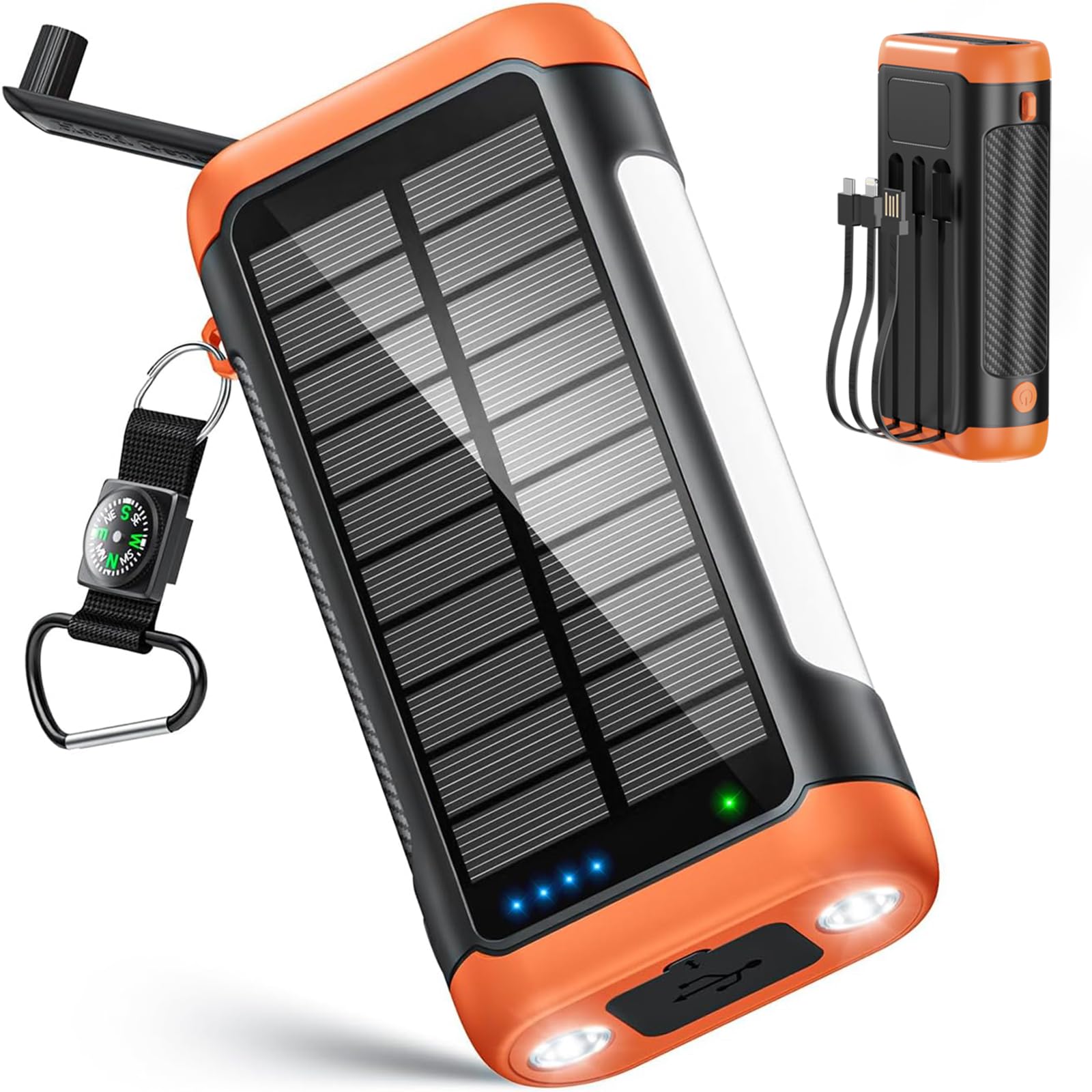
The DJKK 66800 mAh bank is the only unit in this list that incorporates three independent recharging methods: wall input, solar panel, and hand crank. The solar panel is a small monocrystalline cell that trickle-charges at about 2-3W in direct sunlight — enough to add 10-15% capacity over a full day of exposure, but not a primary charging source. The hand crank generates roughly 1W per minute of cranking, useful for emergency top-ups when there is zero other power.
At 22.5W max output, the DJKK is slower than the Liahomco and LOHAO units. The built-in USB-C and Lightning cables are a convenient addition for travel but are short (about 6 inches) and may introduce resistance at higher amperages. The desk-lamp-style LED array is genuinely bright — it can illuminate a small tent or reading area for over 100 hours on a full charge — and includes an SOS strobe mode.
The trade-off for all these integrated features is weight and bulk: at 6.9 x 3.4 x 1.8 inches and roughly 1.1 pounds, it is not the most packable option. The solar panel adds surface area without significantly boosting charging speed. For preppers, backpackers who might be stuck without any power source, or anyone who wants a multi-function emergency device rather than a pure power bank, the DJKK fills a unique niche. For pure charging throughput, simpler banks outperform it.
Why it’s great
- Three charging methods — wall, solar, hand crank — offer redundancy in emergencies
- Bright desk-lamp LED can illuminate a tent for 100+ hours
- Built-in cables eliminate the need to carry separate charging cords
Good to know
- Solar panel is too small for meaningful daily charging in most conditions
- Hand crank generates only ~1W per minute — useful for emergencies only
- 22.5W max output is slower than dedicated fast-charge power banks
7. MAXIAEON 100000mAh Power Bank
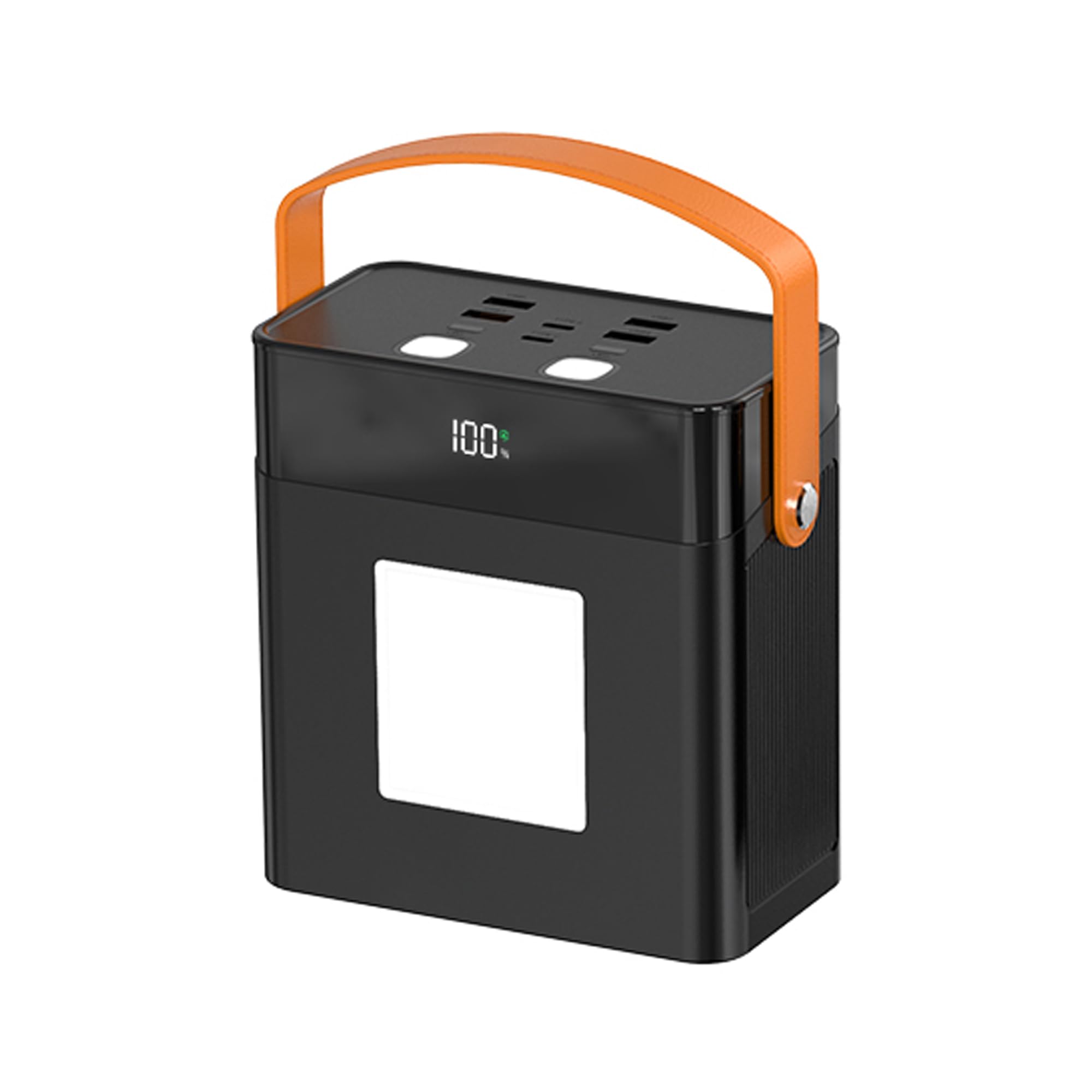
The MAXIAEON is the entry-level option for buyers who want the full 100,000 mAh number on the box at the lowest possible cost. It includes a surprisingly bright multi-mode LED flashlight (with dimmer, strobe, and SOS), built-in Micro USB and USB-C cables, and a digital display — feature set typically found in more expensive units. The size (6 x 3 x 3 inches) is comparable to a small brick, and the weight is about 2.2 pounds.
The core problem is that the MAXIAEON’s output is limited to 5V/2.1A standard charging — it does not support PD or QC fast charging protocols. This means topping up a Samsung Galaxy S21 from empty takes roughly 3 hours over USB-A, compared to 30 minutes on the Liahomco. The built-in cables are thin and fragile; one reviewer reported their unit died after a month due to a faulty USB port. The unit also lists a solar charging capability, but it is the same low-efficiency panel found in budget Chinese solar banks — essentially a marketing checkbox.
Customer reviews are polarized: many report getting 10-15 phone charges before needing to recharge the bank itself, while others describe units that flicker, fail to charge certain devices (including Microsoft Surface and Pixel 9 Pro XL), or stop working entirely after a few cycles. The MAXIAEON is functional if you have very low expectations around charging speed and are willing to gamble on longevity. For the same budget, the DJKK offers better reliability and more charging methods.
Why it’s great
- Advertised 100,000 mAh at the lowest price point in this review
- Multi-mode LED flashlight with dimmer, strobe, and SOS modes
- Built-in Micro USB and USB-C cables reduce accessory clutter
Good to know
- No PD or QC fast charging — standard 5V/2.1A only, very slow
- Quality control issues reported: some units fail within weeks
- Built-in cables are thin and may break under repeated use
- Solar charging is too slow to be practical as a primary source
FAQ
Can I take a 100,000 mAh power bank on a plane?
How many times will a 100,000 mAh power bank charge my phone?
Why does my 100,000 mAh power bank take so long to recharge itself?
Can a 100,000 mAh power bank charge a laptop?
How do I calculate the real capacity of a power bank?
Final Thoughts: The Verdict
For most users, the 100000 mah power bank winner is the KONFULON 100000mAh because it delivers the only verified full 100K capacity, includes a DC 12V output for non-USB gear, and holds enough energy for a week of heavy device usage. If you want the fastest device charging speeds, grab the Liahomco 80000mAh — its 30W PD and dual 30W QC ports outperform everything here and it recharges itself in 10 hours. And for off-grid emergency reliability, nothing beats the DJKK 66800mAh Solar Power Bank, which keeps working when wall outlets, car chargers, and everything else fail.