
Our readers keep the lights on and my morning glass full of iced black tea. As an Amazon Associate, I earn from qualifying purchases.
Specs are compiled from manufacturer listings and verified buyer reviews and can change over time — please confirm the key details on the product page before buying.
A solar power bank is a battery you carry plus a small panel that tops it up from sunlight — and the honest truth is the panel is the slow part, not the battery. So the pick that actually serves you is the one whose built-in battery holds a real 10,000mAh and recharges fast from a wall when the sun will not cooperate. That is exactly how this shortlist was built.
I’m Min — the founder and writer behind Gadgets Feed. This guide is built by comparing the manufacturers’ published specifications and the patterns across verified customer reviews, so you get each pick’s real strengths and trade-offs instead of marketing spin.
You get one clear winner, three genuinely different alternatives, and a plain explanation of every spec that matters. That is the whole point of this guide to the best 10000mah solar power bank.
Our Picks at a Glance
How To Choose The Best 10000mAh Solar Power Bank
First, one honest note on this list: the picks below are matched closely rather than by an exact number. Capacity sits in the 10,000mAh neighbourhood, and the solar panel wattage and port layout differ from model to model. That is on purpose — the closest same-type size and watt does the same job, and you should know that before you compare them. Here is what actually decides whether a solar bank earns its place in your bag.
The two numbers that matter: capacity and panel wattage
Capacity tells you how much power is stored inside, and every bank here carries a 10,000mAh cell. Panel wattage is separate — it tells you how fast that cell refills from sunlight. A 15W or 18W foldable panel refills meaningfully faster than the tiny single panel built into a pocket-sized unit. That gap is why some banks here genuinely recharge on a sunny afternoon and others only trickle.
Why you still need a wall outlet
Treat solar as a backup, not your main power source. Angling a panel correctly and keeping it in direct sun all day still produces a slow trickle, and a bank with a 4-hour wall charge time will always beat it. The practical move is to leave home fully charged and let the panel top you up between outlets.
Foldable panels, ports and water resistance
A foldable multi-panel unit packs flatter and hooks onto a backpack with a carabiner, which is what makes it usable on the move. On ports, look for USB-C output with fast-charging support, plus at least a couple of USB-A sockets if you carry several devices. And check the IP rating — a higher number means more protection from rain and dust on a wet hike.
Quick Comparison
| Model | Best For | Panel Power | Max Output | Water Resistance | Amazon |
|---|---|---|---|---|---|
| SOLUPUP 10000mah Solar Charger Power Bank★ Best Overall | All-round camping power | 30W foldable | PD 3.0 / QC 4.0 | IPX5 | Amazon |
| BLAVOR Solar Power Bank 10,000mAh | Wireless charging on the go | Built-in single panel | 20W USB-C | IPX5 | Amazon |
| SOLUPUP 2-in-1 Solar Charger Power Bank | Charging many devices at once | 15W foldable | PD 20W | IPX5 | Amazon |
| ToughTested 10000mAh Solar Power Bank | Rugged work sites and emergencies | 6W dual foldable | 18W PD | IP44 | Amazon |
In‑Depth Reviews
1. SOLUPUP 10000mah Solar Charger Power Bank
Our pick — over 4★ from 100+ verified ratings; the strongest balance of quality and price.
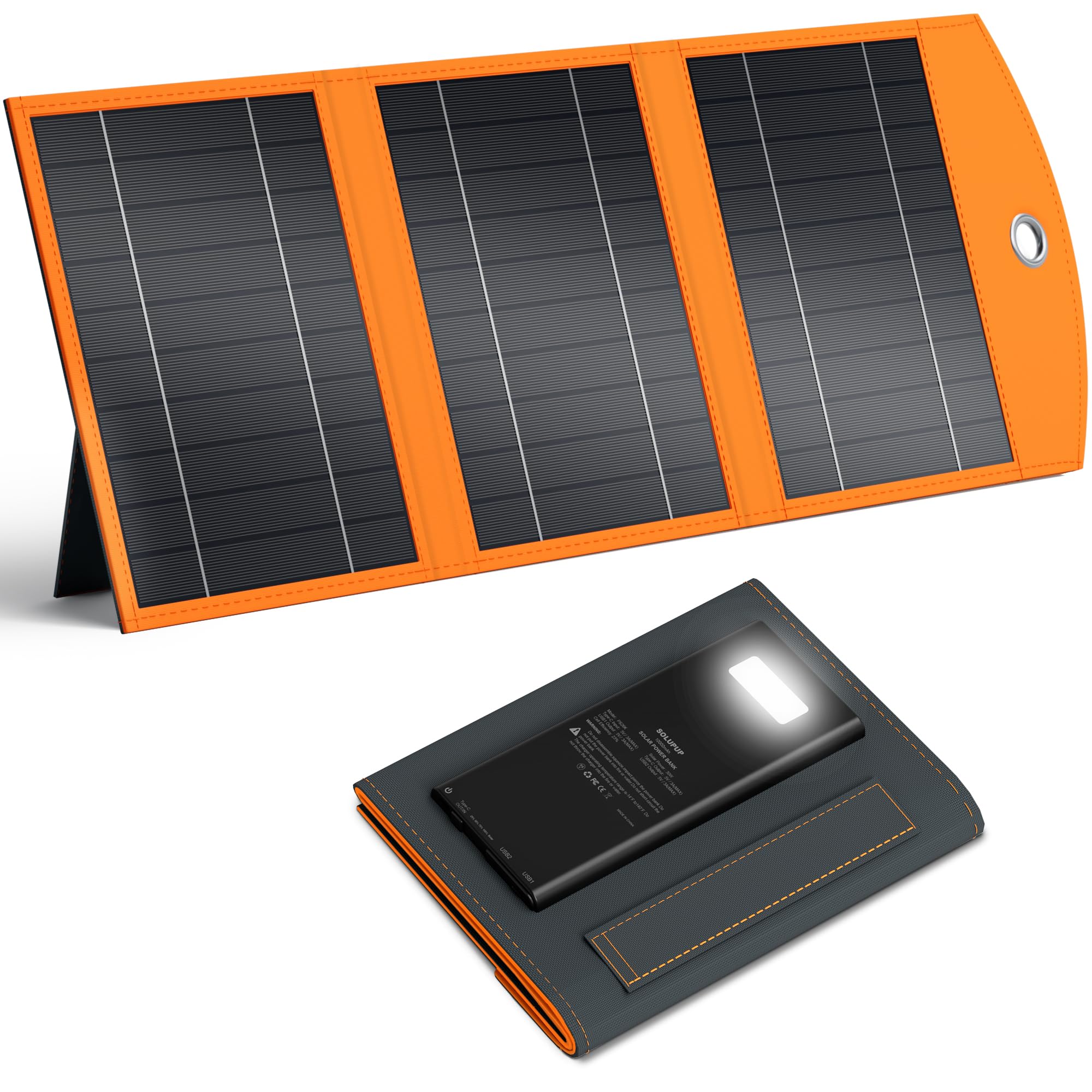
Three foldable panels and a real 10,000mAh cell make this the one that actually refills in the sun.
Car campers, hikers and anyone who works outside all day should start here, because the 30W panel setup is the whole story. It packs down to 10.6 x 7.75 x 1.4 inches and weighs 2.3 lbs, so it slides into a backpack like a hardback book. The three panel design means it pulls in more sun at once than a single-panel bank ever will, which is what turns a long outdoor day into a genuinely topped-up battery.
The clever part is that it charges two ways. Its 30W triple-foldable panel can refill the 10,000mAh cell in about 2 hours of good sun, and it also supports pass-through charging from a wall outlet. Output runs through QC 4.0 and PD 3.0 (two fast-charging standards that speak to most modern phones), across 2 USB-A ports and 1 USB-C port so three devices can charge at once. Compatible with iPhone, Samsung and iPad. The manufacturer rates the cell for two full iPhone 16 charges or 1.2 iPad Pro charges.
Buyers keep coming back to how much raw charging power this bank delivers. One owner ran a USB fan off it to help assemble a printer enclosure. Another keeps a unit in each car, at home and in a bug-out bag, using the onboard battery to charge phones and GPS without waiting for sun. The quality feel earns its own share of praise, and the built-in LED light runs all night plus half a day on a single top-up. Charging speed splits opinions: some report a full refill in 3 to 4 hours, others find it slow, so treat the solar side as weather-dependent.
Two practical notes before you buy. It is too big for packs under 70 to 100L, and it can tip in moderate wind because it hangs from a single connection point — lay it flat on breezy days. Buyers report good real-world results from the base model though: “Mine charges in 4-6 hours and will charge my S25 roughly 2 times.”
What earns it first place
- 30W of foldable solar power across three panels — the fastest sunlight refill here
- Three output ports (2 USB-A, 1 USB-C) with QC 4.0 and PD 3.0 fast charging
- Packs to 10.6 x 7.75 x 1.4 inches and 2.3 lbs, with a storage bag and hanging hook
- Rated IPX5 for rain and dust, with a 3-mode LED light and SOS setting
Worth knowing about
- Too bulky for packs under 70 to 100L
- Can flip in moderate wind from its single hanging point
- The panel carries no UV protection, so it ages faster than a permanent setup
Reach for this one if: you spend full days outdoors and want the panel to be the headline act, not a token trickle.
Look elsewhere if: you need something that vanishes into a jacket pocket — this one wants real bag space.
2. BLAVOR Solar Power Bank 10,000mAh
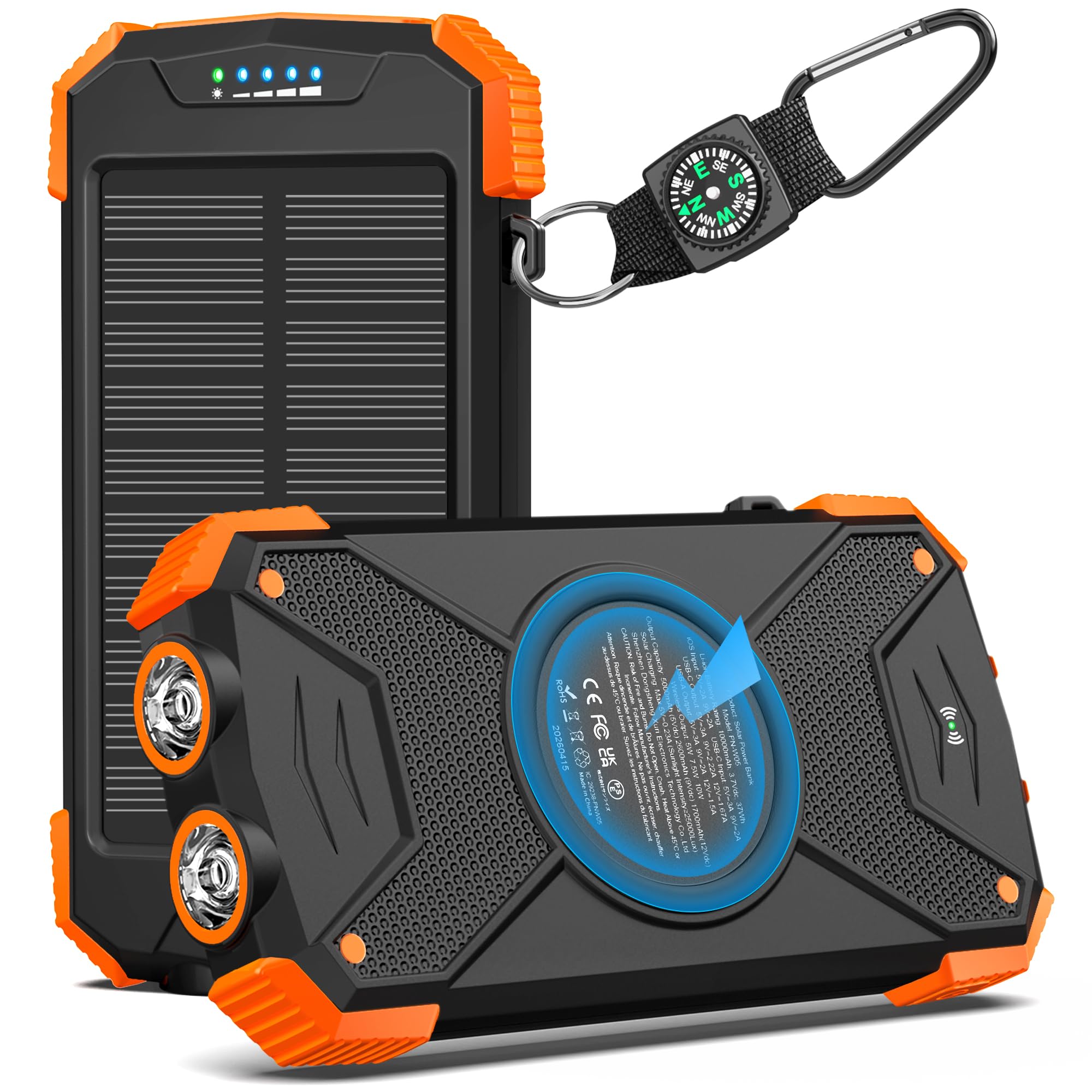
Drop your phone on it and it charges — this is the pack you grab when you have no cable handy.
What makes this bank stand out is not the solar panel at all. It is the 20W USB-C output and the wireless charging pad built into the top. That means an iPhone 15 reaches 65% in about 30 minutes over USB-C, or charges wirelessly on the built-in pad with no cable. This is the model to pick if you commute, travel, or simply hate hunting for the right cord.
It is also the smallest full-10,000mAh bank of the group, built around a lithium-polymer cell (a lighter, flatter battery type) and finished in flame-retardant ABS and PC plastic with a rubber oil coating that adds grip. The rugged side is real: IPX5 waterproof and dustproof, dual super-bright flashlights, and a compass carabiner in the box. Owners praise its portability most, and a lot of that depends on how it disappears into a pocket or glovebox.
Now the honest part, and it is the reason this sits at number two rather than one. The panel on this unit is a small built-in strip, not a foldable array, so sunlight refills it slowly. Plenty of owners mention it takes roughly three days of direct South Florida sun to fully recharge after a single bar of use, and some say it barely moves at all. From a wall outlet the manufacturer lists a 4-hour charge from empty, and a full cell delivers about 3.6 iPhone 8 charges or one iPad Air charge. Charging speed splits opinions for the same reason: excellent from a cable, sluggish from the sun. One long-haul owner sums up the durability: “Reliable after 2+ years; charges phone 3-4x.” Weighing just 0.2 kg for the battery itself keeps it genuinely pocketable for a 10,000mAh pack.
Where it wins people over
- Wireless charging plus a 20W USB-C port — no cable required for a top-up
- Among the smallest true 10,000mAh packs, easy to carry every day
- IPX5 waterproof, dustproof and shockproof with dual flashlights and a compass carabiner
The honest trade-off
- Sunlight charging is slow — the small panel is a backup, not a power source
- Solar performance divides opinion, with a few units reported as barely charging at all
Best fit for: commuters and travellers who want easy cordless top-ups and will lean on the wall outlet.
Not your pick if: solar is how you plan to keep it alive on a multi-day trek with no outlets.
3. SOLUPUP 2-in-1 Solar Charger Power Bank
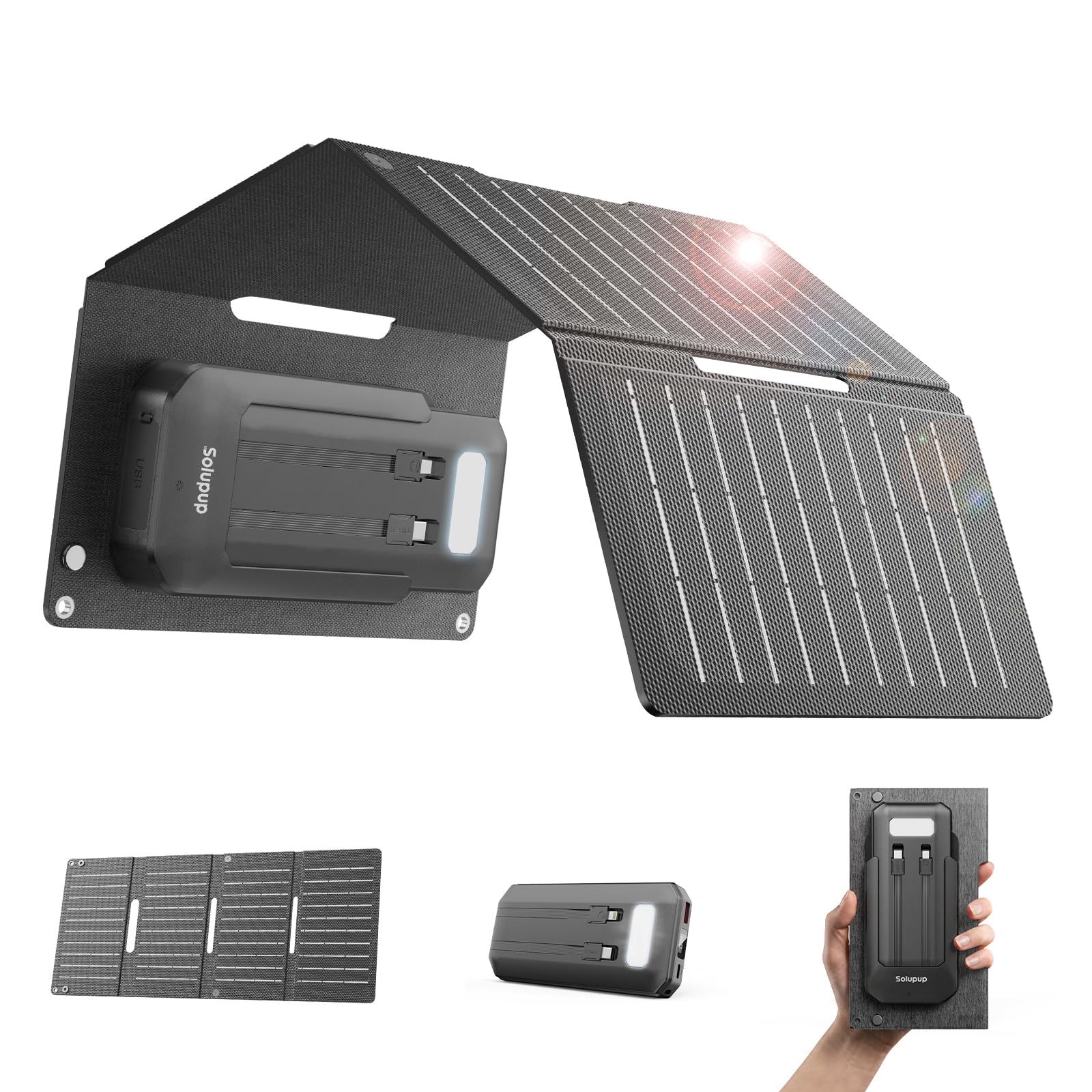
Six ports, one power bank — the one you hand around a campsite when everyone’s phone is dying at once.
If you travel with a group, this is the arrangement that saves the evening. There are 6 outputs in total: 2 USB-A, 2 USB-C, plus an iOS cable and a USB-C cable built right into the unit, so up to six devices draw power simultaneously — phones, tablets, earbuds and smartwatches all at once. Its PD 20W USB-C port takes an iPhone from 0 to 70% in about 30 minutes.
The panel is a 15W foldable unit using 4 high-efficiency solar cells rated at a conversion rate of up to 23%, so it turns sunlight into stored power more efficiently than a basic cell. It folds down to 8.26 x 4.72 x 1.61 inches and weighs just 1.45 lbs, which is light enough to slip into a backpack without a thought. A high-definition screen shows exactly how much battery is left, so you never discover the pack is flat mid-trip, and the built-in LED runs three modes — steady, slow flash and fast flash.
Owners highlight two pluses. The battery pack is removable, so you can charge just the cell or use the panel to feed other packs, and the built-in cables mean nothing gets left at home. A high-definition display and a real solar panel that earns its name both get noted — as one owner puts it, panel angle matters but “with it set right it’s easy to get 80% charge in a day.” It runs IPX5 water resistant, and two carabiners clip the panel to the outside of a pack so it charges while you walk.
The catch to plan around: the cables are integrated but the manual is thin on instructions, and solar charging depends entirely on positioning — banked flat in shade it will do almost nothing. Compatible devices listed include Android, iOS, laptops and flashlights.
The core strength: Six simultaneous outputs plus PD 20W means a whole group can charge from one pack, and the removable battery adds a flexibility the others lack.
Mind the setup: Solar output leans hard on correct panel angle, and the included documentation is light — figure out the ports before you rely on it in the field.
Worth grabbing for: couples, families and group trips where several devices need juice at the same time.
Think twice if: you want a bank you can fire and forget — this one rewards a little attention to how it faces the sun.
4. ToughTested 10000mAh Solar Power Bank
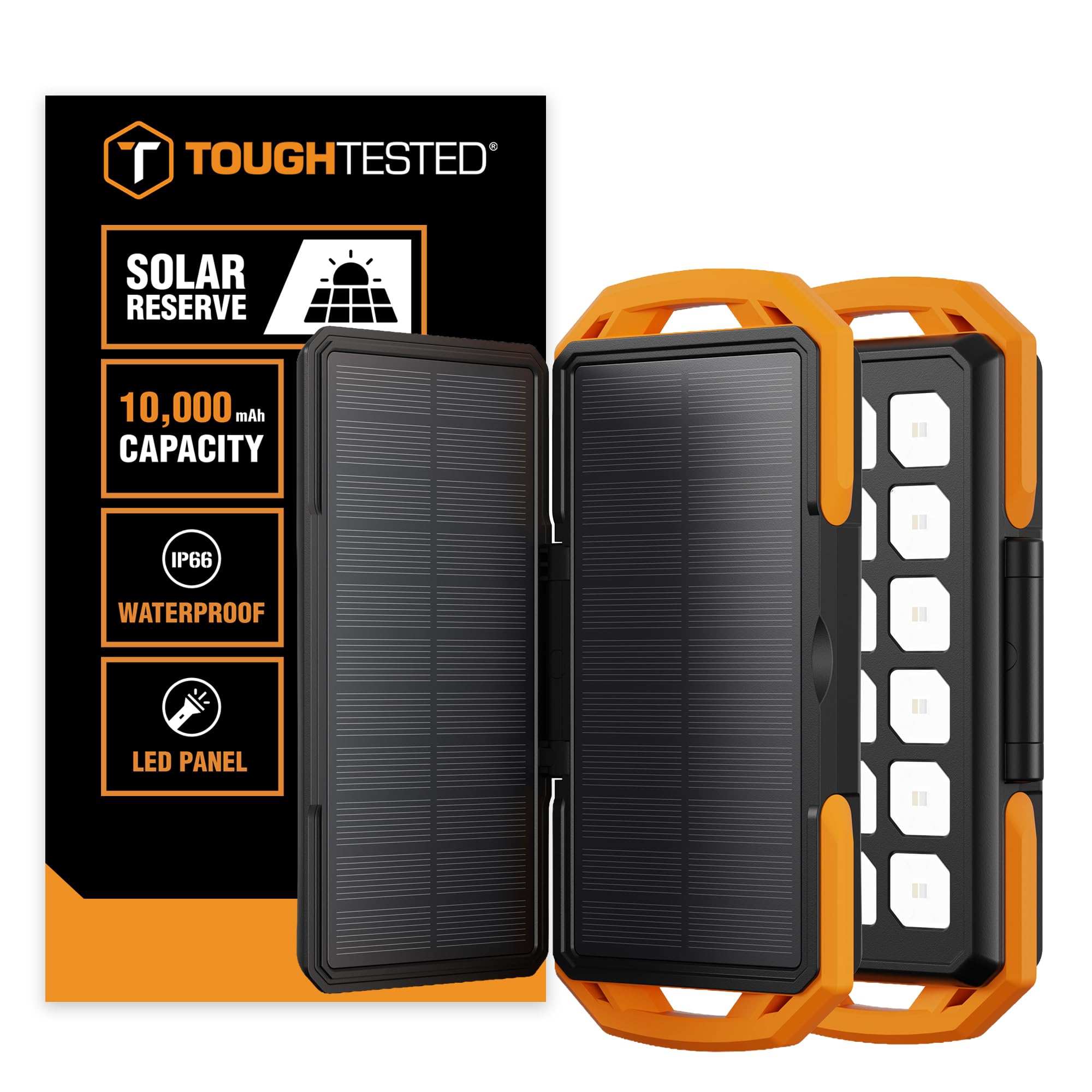
Built like a worksite tool, with a folding light bright enough to light a whole room.
This is the one for jobsites, workshops and emergency kits, and the reason is the 18-LED array. It folds out to aim the light exactly where you need it, and cycles through steady, SOS and strobe modes, so a blackout or a dark campsite is not a problem. The heavy-duty build is the other half of the pitch — orange bumpers double as flip-out stands, which also tuck the USB ports away from damage.
Its 18W USB-C PD port takes a smartphone to about 50% in 30 minutes, and the 10,000mAh cell is rated for up to 5 phone charges. A micro-USB port handles charging the bank itself, a QC3.0 USB-A socket and the USB-C port both push power out. The two foldable solar panels combine to deliver up to 6W, so daylight is there as a backup rather than a main source — which is the honest framing for any bank in this class.
The IP44 rating is the lowest here, so it shrugs off dust, rain and splashes but is not built for submersion, and that is the correct expectation for an outdoor work tool. The battery weighs 150.8 g and the unit measures 6.5 x 3.5 x 1 inches, so it sits flat and packs without bulk. A USB-C cable ships in the box.
What makes this pick stand out is the versatility of the light itself — useful in tight spaces and equally handy during a power cut, which is why owners call it multi-functional gear. The drawback to accept before buying is solar speed. Five hours of direct sun delivered only around 30% of a phone charge in one owner’s experience, a second tester saw no gain at all, and the solar hinge has been noted as loose and wobbly, which raises a question about long-term durability. Treat the panel as a bonus and the folding light as the real feature. It charges a phone in about 2 hours from the USB-C PD port.
Face value: You are buying an excellent folding work light with a power bank attached — the 18-LED array, three modes and orange stand bumpers make it genuinely useful around a garage or campsite.
Where it falls short: The 6W solar panel is a slow top-up at best, and the hinge has been flagged as loose, so durability over years is the open question.
Pick this if: you want a rugged, bright work light with backup power built in, and you are fine plugging it into a wall to recharge.
Pass on it if: solar charging is a must-have rather than a nice-to-have — the panel here is the weakest of the group.
Understanding the Specs
Capacity in mAh
Capacity is how much energy is stored inside the battery, measured in mAh. Every bank here holds 10,000mAh. That is enough for multiple full phone refills on most modern handsets, which is why this size is the portable balance. Bigger cells mean a heavier pack, and smaller ones will not get you through a weekend.
Panel wattage and output power
Panel wattage shows how fast sunlight refills the battery, and output wattage shows how fast the bank pushes power to your phone. A 20W USB-C PD port, for example, takes an iPhone to around 65% in 30 minutes. Higher numbers on both mean less waiting, so check both figures rather than assuming a bigger battery is automatically the better pick.
Water and dust resistance
The IP rating is a two-digit score for how well the unit keeps out solids and liquids. IPX5 means it handles water sprays and dust, while IP44 handles dust and splashes but not submersion. Match it to your environment — a hike in rain calls for the higher rating, while a dusty jobsite benefits from any sealed build.
Cell chemistry and safety features
The cell type affects weight, shape and lifespan. Lithium-polymer cells are flatter and lighter, while a lithium-cobalt variant is a rugged option. Most quality banks include an IC chip that guards against overcharge, overvoltage and short circuits, so your devices are protected when you leave something plugged in overnight.
FAQ
How many times can a 10000mAh solar power bank charge my phone?
Does solar charging actually work or is it just a gimmick?
How long does a solar power bank take to charge in the sun?
Can I charge my phone and the power bank at the same time?
Is a solar power bank waterproof enough for camping?
How should I store a solar power bank between trips?
Will a solar power bank charge a tablet or a laptop?
Is a foldable multi-panel bank better than a single built-in panel?
What is the difference between PD fast charging and standard USB charging?
Final Thoughts: The Verdict
The winner for most people is the SOLUPUP 10000mah Solar Charger Power Bank, because its 30W triple-foldable panel is the one that genuinely refills a 10,000mAh cell in the sun, paired with fast charging across three ports and an IPX5 build. If you would rather drop your phone on a pad and forget the cable, the BLAVOR Solar Power Bank 10,000mAh is the easy choice. For a family or group all needing juice at once, the six-output SOLUPUP 2-in-1 spreads the load best. And if what you need is a rugged work light with backup power, the ToughTested 10000mAh earns its keep. Whichever you pick, start the trip with it fully charged from a wall outlet, then let the panel do its slow, steady work.
How We Picked
We do not accept paid placement. Every pick is matched to a real buyer and a real use-case; we do not hands-on test units.
Sources & Methodology
Specifications: manufacturer listings and product documentation. Review insights: verified customer reviews, as of September 2026. Pricing: not shown on this page (it changes often); check the current price via the retailer link.
As an Amazon Associate, Gadgets Feed earns from qualifying purchases. This does not affect which products we feature.