
Our readers keep the lights on and my morning glass full of iced black tea. As an Amazon Associate, I earn from qualifying purchases.
Specs are compiled from manufacturer listings and verified buyer reviews and can change over time — please confirm the key details on the product page before buying.
If you are trying to push a gigabit connection between two buildings, a garage, or a switch in the next room, copper cable hits a wall fast — and single-mode fiber is how you blow past it. The catch is that the little module you slide into your switch, called an SFP (a hot-swappable transceiver that turns an SFP port into a fiber link), has to match the exact standard your gear expects. Get it wrong and you get a dead port and an afternoon of guessing. Here is exactly which 1000Base-LX SFP modules actually link up, which ones are worth the money, and where the compatibility traps are hiding.
I’m Min — the founder and writer behind Gadgets Feed. This guide is built by comparing the manufacturers’ published specifications and the patterns across verified customer reviews, so you get each pick’s real strengths and trade-offs instead of marketing spin.
A good 1000Base-LX module should link instantly, run cool, and reach the distance you need without a fight. The picks below cover every budget and distance, and each one tells you plainly whether it fits your switch before you buy a 1000base lx sfp.
Our Picks at a Glance


How To Choose The Best 1000Base LX SFP
The number one reason a fiber module fails has nothing to do with quality — it is a mismatch. Your switch expects a specific standard, reach, and wavelength, and if the module does not speak that language, the port stays dark. Before you buy anything, answer three questions: what standard does my switch port want, how far does the run actually go, and what fiber cable do I already own.
Match the standard first — LX means single-mode, not multimode
If you need to connect switches or buildings over single-mode fiber, a 1000Base-LX module is the right tool. It sends light at 1310nm (the infrared wavelength the signal travels on). Its cousin, 1000Base-SX, uses multimode fiber and a shorter wavelength. They are not interchangeable. If your switch port and your cable say single-mode, you want an LX module. The modules below all meet the 1000Base-LX single-mode standard, so they are the right shelf — the choice depends on reach, port count, and brand compatibility.
Reach is a ceiling, not a target
Modules here reach anywhere from 10km to 20km (about 6 to 12.4 miles), which is far more than a typical building-to-building run. Buying more reach than you need is harmless — light travels the distance your cable dictates. What matters is that the module’s minimum and maximum ratings suit your run, and that your fiber’s core size (measured in microns, like 9/125um) matches. A generic 20km module will happily light a 200-foot run between a house and a workshop.
Coded versus uncoded modules
Some brand-name gear, especially older Cisco switches, only accepts modules carrying that brand’s coding. Many modules in this list are “uncoded” or open-standard and work in switches that accept uncoded modules — which covers most Ubiquiti, Netgear, Mikrotik, and TP-Link gear. If you are running enterprise Cisco, check the compatibility list on the product before you buy.
Quick Comparison
| Model | Best For | Reach | Wavelength | Quantity | Amazon |
|---|---|---|---|---|---|
| 10Gtek 1.25G SFP Transceiver (2 Pack)★ Best Overall | First-time fiber builders | up to 13km | 1310nm | 2 | Amazon |
| Omada (TP-Link) SM311LSBest Value | TP-Link switch owners | 20km | 1310nm | 1 | Amazon |
| 10Gtek 1000Base-LX (2 Pack) | Fortinet and Cisco links | up to 10km | 1310nm | 2 | Amazon |
| GESD 2 Pack Gigabit SFP | Storm-prone outdoor runs | up to 20km | 1310-nm | 2 | Amazon |
| H!Fiber 4 Pack Single Mode SFP | Multi-port installs | up to 20km | 1310nm | 4 | Amazon |
| ipolex 4-Pack 1000Base-LX SFP | Spare-heavy racks | up to 20km | 1310-nm | 4 | Amazon |
| StarTech Cisco Compatible SFP (SFPGLCLHSMST) | Enterprise Cisco gear | up to 20km | 1310nm | 1 | Amazon |
In‑Depth Reviews
1. 10Gtek 1.25G SFP Transceiver 1000Base-LX (2 Pack)
Our pick — over 4.5★ from 250+ verified ratings; the strongest balance of quality and price.
The pair that clears a 200-foot fiber run without a single tweak.
You get two modules in the box, each rated to 1.25 Gbps over single-mode fiber at 1310nm, with a reach of up to 13km. That covers the common home-and-small-business job easily: two switches, one run of fiber, done. It carries DDM, which is real-time monitoring that lets your switch report the live signal strength on each link — handy when you are chasing a flaky connection instead of guessing. You also get full hot-swap support and ESD protection, so you can pull a module without powering anything down.
What wins people over is the price per module paired with a compatibility list covering Cisco GLC-LH-SMD, Meraki, Ubiquiti UniFi, Fortinet, Mikrotik, and TP-Link. It is coded to play nicely with a long list of gear — Cisco GLC-LH-SMD, Meraki MA-SFP-1GB-LX10, Ubiquiti UniFi, Fortinet, Mikrotik, and TP-Link TL-SM311LS among them. As owners put it, the module is “definitely plug N play” even for someone using SFP or fiber for the first time. Buyers report building whole campground fiber backbones on these, replacing lightning-prone copper runs and getting clean gigabit links across every node. And yes, the metal tin it ships in is a small thing that earns real praise — modules arrive protected, not rattling loose in a bag.
The honest catch: 13km is shorter than the 20km the Omada and GESD modules offer. For a house-to-garage or switch-to-switch run that ceiling is irrelevant, but if you are linking two sites far apart, the shorter reach is the one thing to weigh. Support matters too — 10Gtek has a 3-year warranty and lifetime tech support, and buyers specifically call that support out as helpful when choosing the right model.
Where It Wins
- Two modules per pack — ready for a matched pair instantly
- DDM lets you watch live signal health from the switch
- Hot-swappable with ESD protection, plus a metal tin for safe arrival
- Broad compatibility list covering Cisco, Meraki, Ubiquiti, and more
Worth Knowing
- 13km reach falls short of the 20km modules below
- Not codable for older enterprise Cisco that rejects uncoded modules
Settle in here if you want a proven, affordably-priced pair for a typical home or small-business fiber run.
Keep looking if your link stretches past 13km or your switch demands brand-coded optics.
2. Omada (TP-Link) SM311LS 1.25GBase-LX SFP Module
One long-reach module that doubles the distance of the 10km packs.
Reach is the headline here. The SM311LS runs at 1310nm over 9/125um single-mode fiber for a maximum cable length of 12.4 miles (20km) — twice the 10km handled by 10Gtek’s shorter 1000Base-LX pack. If your fiber run is long enough to worry you, that extra headroom is exactly what you are paying for. It supports full-duplex traffic, carries DDM, and comes from TP-Link, so it slots natively into any TP-Link SFP port.
For TP-Link owners it is the obvious fit — JetStream switches and the MC220L and MC210CS media converters all accept it directly. A buyer linked two buildings on a business install estimating roughly 2,000 feet of cabling between them and had it running fine, though their Cisco 2960 Catalyst switches needed a few lines of config to accept the modules. That is a common quirk with uncoded optics in enterprise Cisco: the module is fine, the switch just needs to be told to trust it. In a plain TP-Link setup, no dance is required.
The trade-off to plan around is quantity and price-per-module. This is a single module, so a two-endpoint link means buying two, and the per-unit cost sits higher than the multi-packs above. You do get a 2-year warranty and a clean install with an included manual. One practical tip the listing stresses: leave the protective dust plug on the optical bores until you are ready to make the connection — a cheap habit that saves the connector face from a stray scratch.
Who it fits: TP-Link and media-converter owners who want native, guaranteed compatibility without scrolling a compatibility chart.
Plan around this: single-module packs, so a two-end job needs two buys — the multi-packs give better per-port economics.
Pick this one when your gear is TP-Link and you want the extra 20km reach with zero compatibility doubt.
Look elsewhere if you are wiring several rooms at once and want modules bundled cheaply.
3. 10Gtek 1000Base-LX SFP LC Single-Mode Transceiver (2 Pack)

The shorter-reach sibling that nails short runs and Fortinet gear.
This is 10Gtek’s 10km variant — same brand, same 1310nm single-mode standard, same DDM and hot-swap support, but a shorter reach ceiling than the 13km pack. The 2-pack weighs 2.39 ounces total. It ships with a 30-day money-back guarantee, a 3-year warranty, and lifetime tech support, matching the brand’s service reputation. The compatibility list is essentially identical: Cisco GLC-LH-SMD, Meraki, Ubiquiti, Fortinet, Mikrotik, D-Link, Supermicro, Netgear, and TP-Link.
Two owner patterns stand out. First, it is a favorite in Fortinet setups — “Worked perfect with Fortinet Firewall,” one buyer reports without drama. Second, it delivers full speed on real cable. One owner running OS2 cable reports hitting full speed over 350 feet with no trouble. That is the whole point of an LX module: short, clean runs that behave. If you are linking a switch to a firewall across the room or pulling fiber from a core switch to an outbuilding, this pack does exactly what you need without overspending on reach you will never use.
The 10km ceiling is the clear limit versus the 13km and 20km options, and this pack carries fewer reviews overall than the top pick. Neither is a problem for the typical sub-kilometer run. Just confirm your gear accepts uncoded modules before relying on it in strict enterprise Cisco environments.
Why It Earns Its Slot
- Fires up instantly in Fortinet gear and OS2 cable runs
- Full gigabit over a 350-foot OS2 link without issues
- 2-pack with 30-day return, 3-year warranty, lifetime support
The Fine Print
- 10km reach is the shortest of the 1000Base-LX picks here
- Tighter review history than the 13km sibling
Built for the short building-to-building or rack-to-rack run where 10km is more than enough.
Step up if your link approaches the double-digit kilometers — the 13km and 20km modules give more margin.
4. GESD 2 Pack Gigabit SFP Module 1310nm-SMF (Up to 20km)
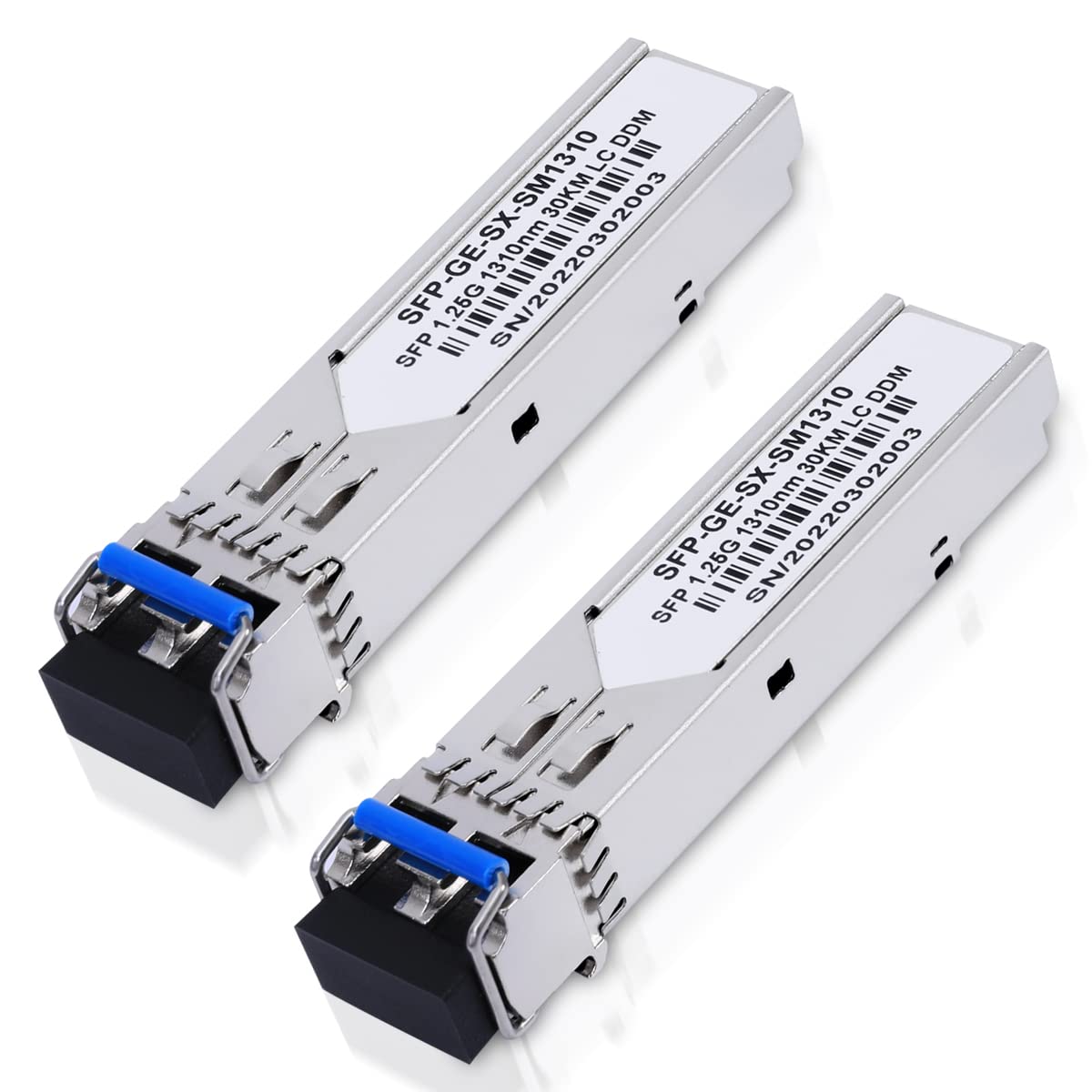
The 20km pack that shrugs off lightning-prone copper runs.
GESD pairs two dual-LC single-mode modules with a reach of up to 20km at 1310nm, plus advanced DDM for watching live link parameters. Where it stands out is efficiency at the extremes: it draws less than 1 watt, with power dissipation listed under 1.05W, and a heat-conducting gasket helps move heat away from the transceiver. Each module is individually tested before packing, and the 2-pack carries a 2-year warranty with a 30-day return window. It is rated IEEE 802.3z compliant and coded for Cisco, Meraki, Ubiquiti UF-SM-1G, Mikrotik, Fortinet, TP-Link, and D-Link.
The real-world story here is outdoor durability: owners run these across open water to a boathouse, where copper would invite lightning damage. Owners mention using these for lake-house-to-boathouse fiber links over water — immune to electromagnetic interference and free of the lightning-surge risk that plagues copper Cat6. One long-term user runs six-plus units over two years in storm-heavy conditions with zero issues, feeding cameras, Wi-Fi, and an NVR through cheap SFP and PoE switches. That is the exact scenario fiber was invented for, and this module handles it without complaint. Note the width-of-reach detail: the listing says up to 20km while the physical unit labels 30km — either way you have more than enough runway for any realistic property.
The install is standard hot-swap: rotate the ring latch down at 90 degrees to open up and pull the module free. As with any uncoded module, double-check that your specific switch model appears on the compatibility list — GESD makes many coded variants and will point you to the right one. The only genuine limit versus the pricier packs is brand recognition; for a storm-exposed run, the performance record speaks for itself.
Standout strength: EF-certified efficiency (under 1.05W dissipation) and a heat-conducting gasket keep the module cool in enclosed switch bays.
Confirm first: your switch model is on the compatibility list — for uncoded modules that check is always worth thirty seconds.
Reach for this when your fiber crosses open ground, water, or anywhere lightning makes copper risky.
skip it if you prefer a name-brand coded module for a locked-down corporate network.
5. H!Fiber 4 Pack 1.25G Single Mode SFP LC Module (20km, DDM)
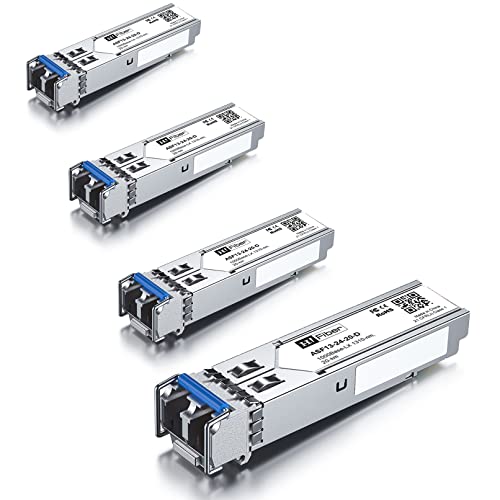
Four modules in one box for the installer wiring more than two ports.
Here you get four 1.25G single-mode modules, each at 1310nm with a dual LC interface and a reach of up to 20km over OS1, OS2, or OS3 LC/UPC fiber. The 4-pack weighs 3.84 ounces total. Every module carries DDM for real-time link monitoring, supports hot-swap, and draws less than 1.05W. It is rated SFP MSA compliant and IEEE 802.3z compliant, with low EMI and advanced ESD protection. The compatibility list is one of the broadest on this page — Cisco GLC-LH-SMD, Meraki, Ubiquiti UniFi, Mikrotik, Intel, Fortinet, Netgear, D-Link, and TP-Link.
What wins people over is the per-module cost when four ports are populated at once. Owners run them on paired Netgear GC110 switches spanning roughly 360 feet between two buildings and report a stable 1gbps link. One buyer faced an urgent Cisco single-mode optics order and needed direct plug compatibility — “The packaging is unusual (metal box) but who cares. They worked,” they note, after comparing against genuine brand-name modules that ran many times the cost. If you are populating a switch with multiple fiber drops, the four-up pack is the sensible buy. Support is generous too: 24/7 service, 30-day free return, a 3-year warranty, and lifetime tech support.
Honesty matters on the reliability picture. Most modules arrive and work; a small share do not, and one buyer found a couple of units in their set dead on arrival. That is a one-off among many satisfied installs, but it is why the multi-pack and generous return window earn their keep — a bad module is swapped, not a project-killer. Also worth noting: these are gigabit modules, not 10G or 40G capable, so do not expect them to upshift.
What Buyers Rave About
- Four modules per pack for multi-port installs
- 20km reach with DDM and under 1.05W draw
- Very wide compatibility list and a metal box for protection
- 24/7 support, 3-year warranty, 30-day returns
What to Weigh
- Occasional dead-on-arrival unit reported; returns cover it
- Gigabit only — not built for 10G or 40G links
Ideal for the person wiring several fiber ports at once and wanting the per-module cost to stay low.
Think twice if you only need a single link — a 2-pack is the smarter spend.
6. ipolex 4-Pack 1000Base-LX SFP LC Fiber Module

A four-pack tuned for racks spanning Cisco, Netgear, and mixed switches.
Four modules at 1.25Gb/s, 1310nm, with dual LC connectors and DDM/DOM support. The reach tops out at 20km on OS2 single-mode cable, and the pack supports OS1, OS2, and OS3 fiber, weighting 3.2 ounces in total. Each transceiver is individually tested on a live switch before it ships, and the compatibility list is wide — Cisco, Meraki, Ubiquiti UniFi, Mikrotik, Intel, Fortinet, Netgear, D-Link, Supermicro, TP-Link, Broadcom, and Linksys. Backed by a 3-year warranty with free return and exchange.
The installation story is consistently low-effort: customers note first-try links in Cisco SG300-10P, SG350-10P, and 3750 switches alongside Netgear managed switches. Reviewers point out these linking up first-try from the start, running cleanly in Cisco SG300-10P and SG350-10P switches, and playing well with a Cisco 3750 and Netgear managed switches at the same time. One buyer running them in a busy environment sums up the fiber-versus-copper case bluntly. The mixed-switch compatibility is the real draw here — you can keep a spare on the shelf that fits whatever rack you plug it into next.
Know the one honest wrinkle: this pack’s compatibility record is more mixed than the others on this page. At least one owner hit a wall trying to run these in Ubiquiti UniFi equipment, where official modules linked instantly and these did not — a reminder that Unifi gear can be picky about uncoded optics. If your network runs on UniFi, favor a module buyers specifically confirm for Ubiquiti instead. For everything else in the Cisco and Netgear world, the install record is solid.
Smart move: the four-pack spread across mixed-brand racks makes it a practical spare to keep on hand — one module that fits several switch families.
Check before you commit: UniFi compatibility is the weak spot here; official-brand modules win on Ubiquiti kit.
Choose this if you run Cisco and Netgear switches and want four modules plus a spare for future gear.
Pass on it if your whole network is Ubiquiti and you want certainty on the first plug-in.
7. StarTech Cisco GLC-LH-SM Compatible SFP Module (SFPGLCLHSMST)

The single coded module for Cisco gear that rejects the cheap stuff.
StarTech builds this one specifically to be 100% compatible with Cisco’s GLC-LH-SM, the coded module enterprise Cisco switches expect. It runs 1000BASE-LX/LH at 1 Gbps, supports both single-mode and multimode fiber, uses an LC connector, transmits at 1310nm, and reaches distances up to 20km (12.4mi). Because it carries the Cisco coding, it is hot-swappable in Cisco routers and switches that would otherwise refuse a generic module — the exact problem several cheaper modules on this page need configuration tricks to solve. It also works in MSA-compliant switches from Ubiquiti, D-Link, Netgear, Supermicro, and TP-Link that accept uncoded modules.
This is the pick for the Cisco environment where “it might work if I tweak the config” is not good enough. It slots into Cisco switches like the IE3400, IE3300, IE3200, ME1200, and ME2400, and its Cisco GLC-LH-SM coding means the switch treats it as a first-party optic. The buy-it-again sentiment is straightforward — one owner calls it inexpensive and trouble free, and has ordered more. Where the generic packs ask you to confirm compatibility yourself, this module arrives pre-coded for the job.
The trade-off lives in the pricing and quantity. This is a single module, so a two-endpoint link doubles the outlay, and it costs more per unit than any multi-pack on this page. You are paying for Cisco coding and brand support, not for extra modules. The specs do list the distance as up to 20km, so reach is not the compromise — the compromise is purely the single-unit economics and the premium over uncoded alternatives you would not need on Cisco-free networks.
Why Cisco Owners Pick It
- 100% Cisco GLC-LH-SM compatible — no switch config needed
- 20km reach at 1310nm with LC connectors
- Works in Cisco IE and ME series switches plus MSA-compliant gear
Where It Costs You
- Single module only — two-end links need two buys
- Premium per-unit pricing versus the uncoded multi-packs
Made for enterprise or registered Cisco deployments where a coded optic saves a troubleshooting afternoon.
Not the value play if your switches accept uncoded modules — the multi-packs cost far less per port.
Understanding the Specs
Wavelength (1310nm)
Every module here transmits at 1310 nanometers — the infrared light wavelength the 1000Base-LX standard uses over single-mode fiber. You do not need to tune anything; matching the wavelength to the standard is what the module handles for you. What you should watch is that both ends of your link use the same standard, because an LX module and an SX module will not speak to each other.
Reach and Fiber Type
Reach is quoted in kilometers and describes how far the light can travel before the signal degrades — here it ranges from 10km to 20km. That is far more than most home or business runs need, so treat the number as headroom rather than a requirement. What actually matters is fiber type: single-mode cable like OS1 or OS2 pairs with an LX module, and connector type (dual LC) has to match your patch cables.
DDM (Digital Diagnostic Monitoring)
DDM means the module can report live data — transmit and receive signal levels and status — back through the switch. In plain terms, it lets you see whether a link is weakening before it fails, so you can troubleshoot a flaky connection without swapping parts blindly. Not every module lists it; the ones here that do give you an extra troubleshooting tool at no design cost.
Hot-Swap and Compatibility Coding
Hot-swappable means you can insert or remove a module with the switch powered on, so no downtime to swap a component. Compatibility coding is the other half: some enterprise Cisco switches only accept modules bearing Cisco’s coding, while most Ubiquiti, Netgear, and TP-Link gear accepts uncoded modules. Match the coding style to your switch to avoid a dead port.
FAQ
Will a 1000Base-LX SFP work with my existing single-mode fiber cable?
What is the difference between a coded and an uncoded SFP module?
Do I need to match the reach rating to my actual distance?
How many modules do I need for a simple two-switch link?
Are these modules hot-swappable, or do I need to power down the switch?
Why did my LX module not link up even though it is the right standard?
What does DDM actually do for me in daily use?
How long should a 1000Base-LX SFP module last in normal use?
Can I mix a cheap uncoded module on one end and a coded module on the other?
What does the 1310nm figure mean, and does it change anything I do?
Final Thoughts: The Verdict
For most people running a fiber link between buildings or switches, the 1000base lx sfp to pick is the 10Gtek 1.25G SFP Transceiver (2 Pack), because it pairs two compatible modules with DDM (digital diagnostics monitoring, which lets you check signal strength), hot-swap support (you can swap it without powering down), and a broad compatibility list at a price that suits the job. If your gear is TP-Link and you want the full 20km reach, grab the Omada SM311LS. And for the storm-exposed outdoor run where lightning makes copper risky, the GESD 2 Pack is the one to reach for. If you run enterprise Cisco that refuses third-party optics, spend up on the coded StarTech module and save yourself the config dance.
How We Picked
We do not accept paid placement. Every pick is matched to a real buyer and a real use-case; we do not hands-on test units.
Sources & Methodology
Specifications: manufacturer listings and product documentation. Review insights: verified customer reviews, as of September 2026. Pricing: not shown on this page (it changes often); check the current price via the retailer link.
As an Amazon Associate, Gadgets Feed earns from qualifying purchases. This does not affect which products we feature.