
Our readers keep the lights on and my morning glass full of iced black tea. As an Amazon Associate, I earn from qualifying purchases.
Specs are compiled from manufacturer listings and verified buyer reviews and can change over time — please confirm the key details on the product page before buying.
If you are shopping for a generator around the 1000W mark, the honest answer up front is this: buy on battery chemistry and surge output, not on the headline wattage. A unit rated at 1000W continuous can still grunt through a fridge compressor start if it has enough surge headroom, and that single number decides whether your blackout night is calm or chaotic. Every pick below was checked for real AC output near 1000W or above, LiFePO4 or comparable battery life, and how it behaves when the grid drops.
I’m Min — the founder and writer behind Gadgets Feed. This guide is built by comparing the manufacturers’ published specifications and the patterns across verified customer reviews, so you get each pick’s real strengths and trade-offs instead of marketing spin.
You’ll see units slightly above and below an exact 1000W rating in this list. That’s on purpose: they all do the same job of running fridges, laptops, and camp gear off-grid. So you compare the nearest same-class machine instead of being boxed in by one number. Use this 1000w solar generator comparison to match a unit to your real load, not to a spec sheet.
Our Picks at a Glance
How To Choose The Best 1000W Solar Generator
The number in the product name is a starting point, not the finish line. Two units can both say 1000W and behave nothing alike when you plug in a fridge, a CPAP machine, or a circular saw. Your real job is to match four things to your life: what you need to run, for how long, how fast you need it recharged, and whether the sun will do the refilling.
Start with continuous watts, then check the surge
Continuous watts are the steady power the unit can hold all day — the figure you plan around. Surge watts are the brief spike a motor demands when it first kicks on, often two or three times the running load. A fridge might idle along at a modest draw but pull hard for a second at startup. If the surge rating is thin, the station trips off and you are resetting buttons at 2 a.m. Pick a unit whose surge comfortably clears your biggest motor-driven appliance, not just its running wattage.
Battery chemistry sets the clock on your purchase
Most serious units now use LiFePO4 (lithium iron phosphate), a battery chemistry that handles deep discharges and holds its capacity across thousands of cycles. Older lithium-ion cells fade faster and don’t like being run flat. Read the charge cycles together with the capacity retention figure. For example, a battery that keeps over 70% of its original capacity after thousands of cycles tells you more about year-five performance than a warranty badge does. Match that cycle count to how often you expect to cycle the unit: a weekend camper and a daily blackout worrier wear a battery very differently.
Recharge speed and solar input decide your independence
From a wall outlet, recharge time ranges widely: some units hit 80% in well under an hour, others take several. That matters most in the hours before a forecast storm. For true off-grid use, look at the solar input ceiling in watts and how long a full solar charge takes. A unit that accepts only a modest panel will sit on the charger all day; one with a high solar input can refill from the sun in a few hours. Also confirm the panel connector type — some brands accept only their own solar panels, which locks your future purchases.
Portability, outlets, and the UPS question
Weight climbs with capacity, so a 1000Wh-class unit typically lands somewhere in the low-to-mid twenties in pounds or more, and a premium high-capacity model can push well past that. If it lives in a closet and only emerges during outages, weight barely matters; if it rides in a camper van, it matters a lot. Count the outlet types you actually use — USB-C for laptops, USB-A for phones, 12V car sockets for accessories, and enough AC plugs for your appliances. Finally, check UPS switchover time if you plan to protect a desktop computer or networking gear; a switch measured in single-digit or low-double-digit milliseconds keeps sensitive electronics from rebooting.
Quick Comparison
| Model | Best For | Battery Capacity | AC Output (Surge) | Battery Chemistry | Amazon |
|---|---|---|---|---|---|
| Jackery Explorer 1000 v2★ Best Overall | All-round home and camp backup | 1024Wh | 1500W (3000W peak) | LiFePO4 | Amazon |
| DJI Power 1000 V2Most Power | High-output DIY and drone charging | 1024Wh | 2600W | LFP | Amazon |
| GRECELL 1000W Pure Sine WaveCompact Pick | Compact campsite power with SOS light | — | 1000W | — | Amazon |
| DARAN 1000W | Lightweight carry with 9-device output | 576Wh | 1000W (2000W peak) | LiFePO4 | Amazon |
| EBL 1000W | Ten-device charging hub for camping | 999Wh | 1000W | LiFePO4 | Amazon |
| Anker SOLIX C1000 | Fast recharge and compact footprint | 1056Wh | 1800W (2400W SurgePad) | LiFePO4 | Amazon |
| BLUETTI AC180 | Fridge runtime and app-boosted output | 1152Wh | 1800W (2700W boost) | LiFePO4 | Amazon |
| EcoFlow DELTA 3 Classic | Bundled solar panel starter kit | 1024Wh | 1800W (3600W surge) | LiFePO4 | Amazon |
| Jackery Solar Generator 1000 v2 + 100W Panel | Solar-ready home emergency kit | 1024Wh | 1500W (3000W peak) | LiFePO4 | Amazon |
| EcoFlow DELTA 3 Max | Whole-home blackout muscle | 2048Wh | 2400W (3400W X-Boost) | LiFePO4 | Amazon |
| BLUETTI Elite 200 V2 | Longest-cycle durability | 2080Wh | 2600W (3900W lifting) | LiFePO4 | Amazon |
In‑Depth Reviews
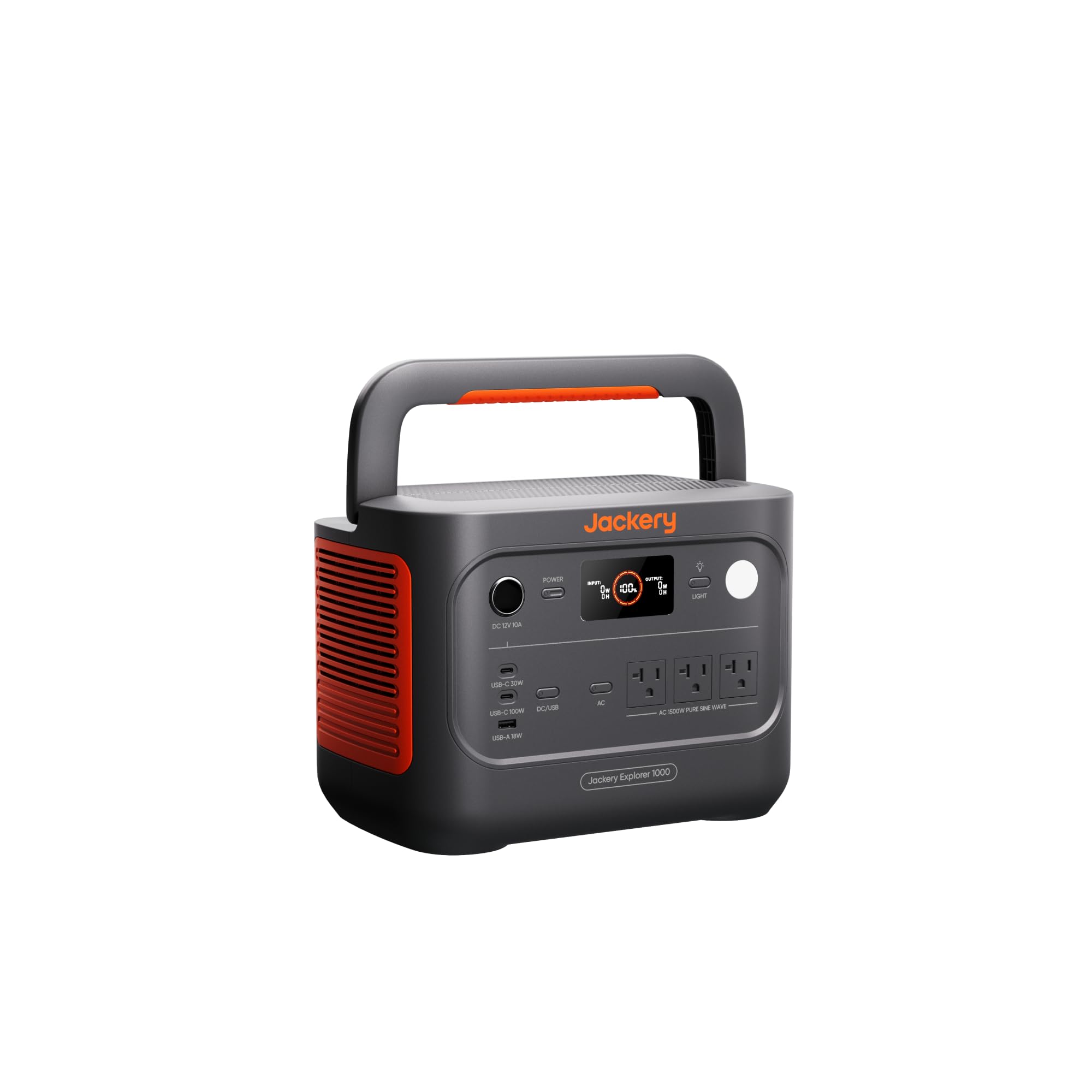
1. Jackery Explorer 1000 v2 Portable Power Station, 1024Wh LiFePO4 Battery
Our pick — 4.5+★ from 3,500+ verified ratings; the strongest balance of quality and price.
A fridge-friendly all-rounder that shrugs off a blackout without asking you to reboot your router.
Crowned the Best Overall here, the Jackery Explorer 1000 v2 pushes 1,500W of continuous AC power with a 3,000W surge peak — the number that lets a compressor motor start without tripping the unit. The 1,024Wh LiFePO4 battery rides in a 23.3 lb body with a foldable handle, light enough to carry from closet to kitchen during an outage and just as happy in a campsite. Across tens of thousands of owners it holds a 4.5+ star average, and reliability is the trait that wins people over most.
Charging is the headline trick: 0% to 100% in 50 minutes with emergency charging switched on in the Jackery App, defaulting to 1.25 hours to protect the battery. It can also run as a 10ms UPS (uninterruptible power supply) — the gap before backup power takes over — so your essential devices keep running when the grid blinks. For cold nights in a van, the 30 dB quiet overnight charging mode means you will barely hear it while it tops up.
Owners regularly report it powering a full-size 16 cu ft refrigerator for about six and a half hours, and keeping car fridges cold for up to two days. The LiFePO4 cells are rated to hold over 70% capacity after 4,000 charge cycles. The recurring gripe is durability chatter rather than a hard fault — treat the body with a little care and it settles down. One catch worth flagging early: it charges from solar only with Jackery’s own panels, which boxes you in on future panel purchases.
What earns its place
- 1,500W continuous with a 3,000W surge peak clears fridge startup load
- 50-minute emergency fast charge for storm-ready prep
- 10ms UPS switchover protects routers and desktops
- 23.3 lb with a foldable handle — genuinely carryable
What to weigh first
- Solar charging works only with Jackery-brand panels
- Fastest charge requires enabling emergency mode in the app each time
Reach for this if: you want one unit that handles fridge backup, camping, and laptop charging without a second thought.
Look elsewhere if: you plan to mix solar panels from other brands into your setup.
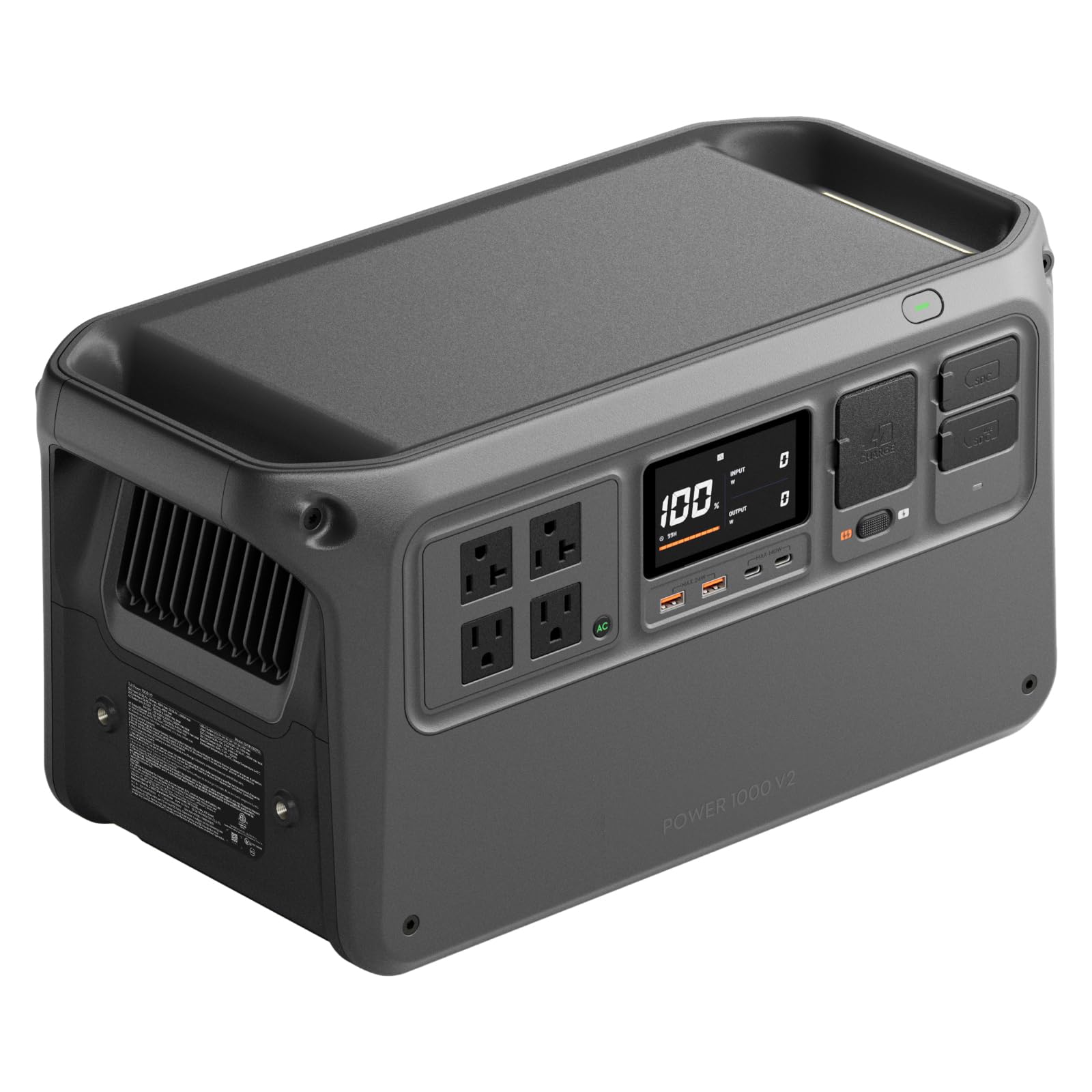
2. DJI Power 1000 V2 Portable Power Station, 1024Wh LFP Battery
The quiet workhorse that hits 80% recharge in 37 minutes and still sleeps at 26 dB.
Here is the number that separates the DJI Power 1000 V2 from most of this list: a 2,600W stable output, against the 1000W on the GRECELL unit — a 2.6x gap. That headroom runs kettles, cookers, saws, and drills that would send a 1000W station into overload. Its 1,024Wh LFP (lithium iron phosphate) battery sits inside the same capacity class as the Jackery Explorer 1000 v2, so you are paying for output and charge speed more than raw storage.
Recharging is blistering: 0% to 80% in roughly 37 minutes, compared to 50 minutes on the Jackery Explorer 1000 v2 — a 35% difference that matters when a storm is moving in. For anyone who flies drones, dual 140W USB-C ports deliver 280W total, and owners consistently point to fast drone-battery top-ups as a real-world win. It also runs a 10ms UPS switchover to keep a desktop going during a short outage.
What buyers value most is build quality — it feels solid in the hand, and a peak in-rush current up to 4500W means it can ride through a heavy startup spike. Nighttime use is where the 26 dB operation shines; in a camper van, you will sleep right through it. The honest trade-off: charging time and value opinions split, with a few owners finding it slower to top up than expected and pricier for the capacity. A separate adapter is also needed to connect a solar panel, so budget for that.
Worth knowing: the 2,600W output is the biggest single advantage on this pick, and the 26 dB quiet mode is real comfort on overnight trips.
The catch: solar and car charging need an add-on adapter, and per-capacity value is a dividing line among owners.
Best fit for: drone flyers, DIY builders, and anyone who needs high wattage in a compact frame.
Think twice if: you expect solar charging to work straight from the start.
3. GRECELL 1000W Pure Sine Wave Portable Power Station
A small-frame campsite unit that keeps clean power flowing and flashes an SOS when you need it.
The GRECELL is the most compact pick on this list, measuring 7.9″ x 7.9″ x 11.6″ — think of it as a box that tucks into a car footwell or a tent corner without eating your floor space. Its 1,000W rated pure sine wave output (clean power shaped like a wall socket, safe for sensitive electronics) runs mini-fridges, CPAP machines, laptops, and outdoor gear. Power quality is the trait buyers approve of most, and it is understandable why: pure sine wave protects delicate electronics in a way a modified wave cannot.
The port lineup is unusually generous for the size: dual 100–120V AC outlets, a 60W PD USB-C port, multiple QC3.0 USB-A ports, a 12V car socket, dual DC ports, and a 10W wireless charging pad. Each output has its own on/off button, so you are not draining the battery through an idle circuit. Pass-through charging lets it power your gear while it refills from the wall, and the LCD shows real-time wattage. The double-click SOS flash works independently of the main power switch, which matters in a remote campsite at dusk.
The honest fit note here is battery life — it is the most-discussed topic, and a share of owners found it stopped charging over time or felt output fell short of the advertised figure. That does not make it a bad buy; it makes it a pick for lighter, shorter loads where you are not leaning on it as a daily fridge anchor. Value for money is the second thing people praise, and for campsite lighting, phones, and a mini-fridge over a weekend, it delivers.
Reasons it stands out
- Compact 7.9″ x 7.9″ x 11.6″ footprint slips into tight spaces
- Pure sine wave output suits CPAP and sensitive devices
- Ten output types including 10W wireless charging
- SOS flash works even with the main power off
Where it bites
- Battery life is the most-divisive topic in owner feedback
- A few report output short of the advertised wattage
Suits you if: you need compact clean power for camping, CPAP, and phones over a weekend.
skip it if: your plan is to run a large fridge as your daily anchor load.
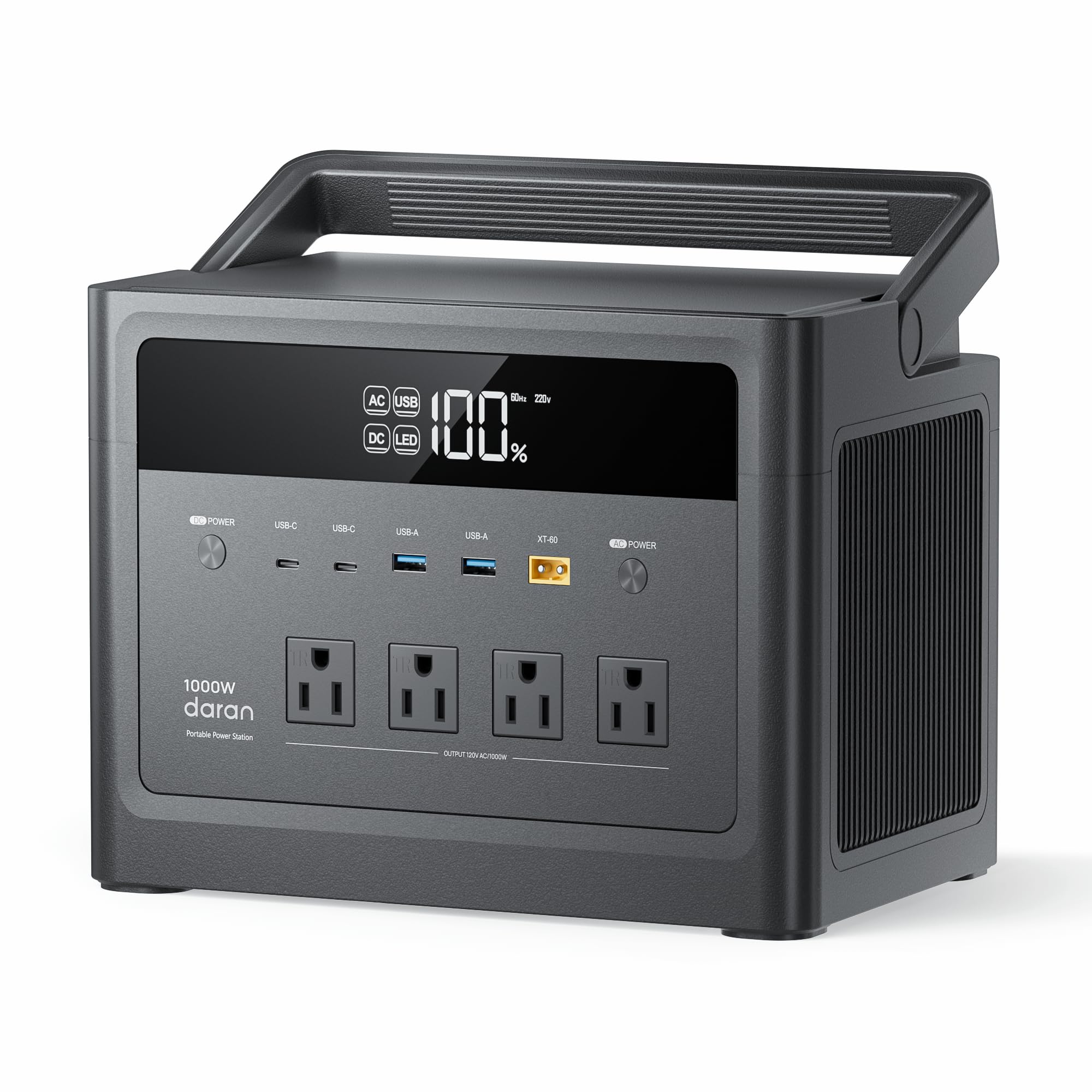
4. DARAN Portable Power Station 1000W, 576Wh
Fourteen-point-eight pounds of grab-and-go power that fires up nine devices at once.
At 14.8 lbs with an integrated carry handle, the DARAN is the easiest unit on this list to sling into a trunk or haul up a trail. It pairs a 1,000W continuous, 2,000W surge output with a 576Wh LiFePO4 battery — smaller in capacity than the 1,024Wh Jackery Explorer 1000 v2, but the trade pays you back in weight and portability. For a camper or tailgater who wants to toss a station in the car without a second trip, that matters.
Counting outlets, the DARAN covers four AC plugs, a 100W PD USB-C, an 18W USB-C, two 18W USB-A ports, and an XT60 output — enough to keep laptops, phones, drones, and a camera charging in parallel. The 100W USB-C is genuinely quick for a laptop top-up. Recharge is flexible too: 70% in about 1.4 hours via solar or car input, or 1.8 hours from the wall, with built-in MPPT squeezing more from a solar panel on a hazy day.
Night use is quiet — a fanless design running under 35 dB, so you can sleep beside it. The LiFePO4 cells are rated for 3,500+ charge cycles and up to 10 years of lifespan. This listing has only a modest number of ratings so far, so the buyer picture is still forming, and the smaller 576Wh battery means heavy loads drain it faster than a 1,024Wh unit would. For light-to-moderate demand and easy carrying, it is a strong budget-tier value.
The trade math: you give up capacity versus the bigger 1,000Wh-class units, and you get the lightest carry here plus nine ports in return.
Fine print: a fresh listing with limited ratings history, so weigh it as an early-value bet rather than a proven veteran.
Made for: the camper or tailgater who cares about weight and port count more than maximum runtime.
Not ideal if: you need long hours of fridge backup on a single fill.
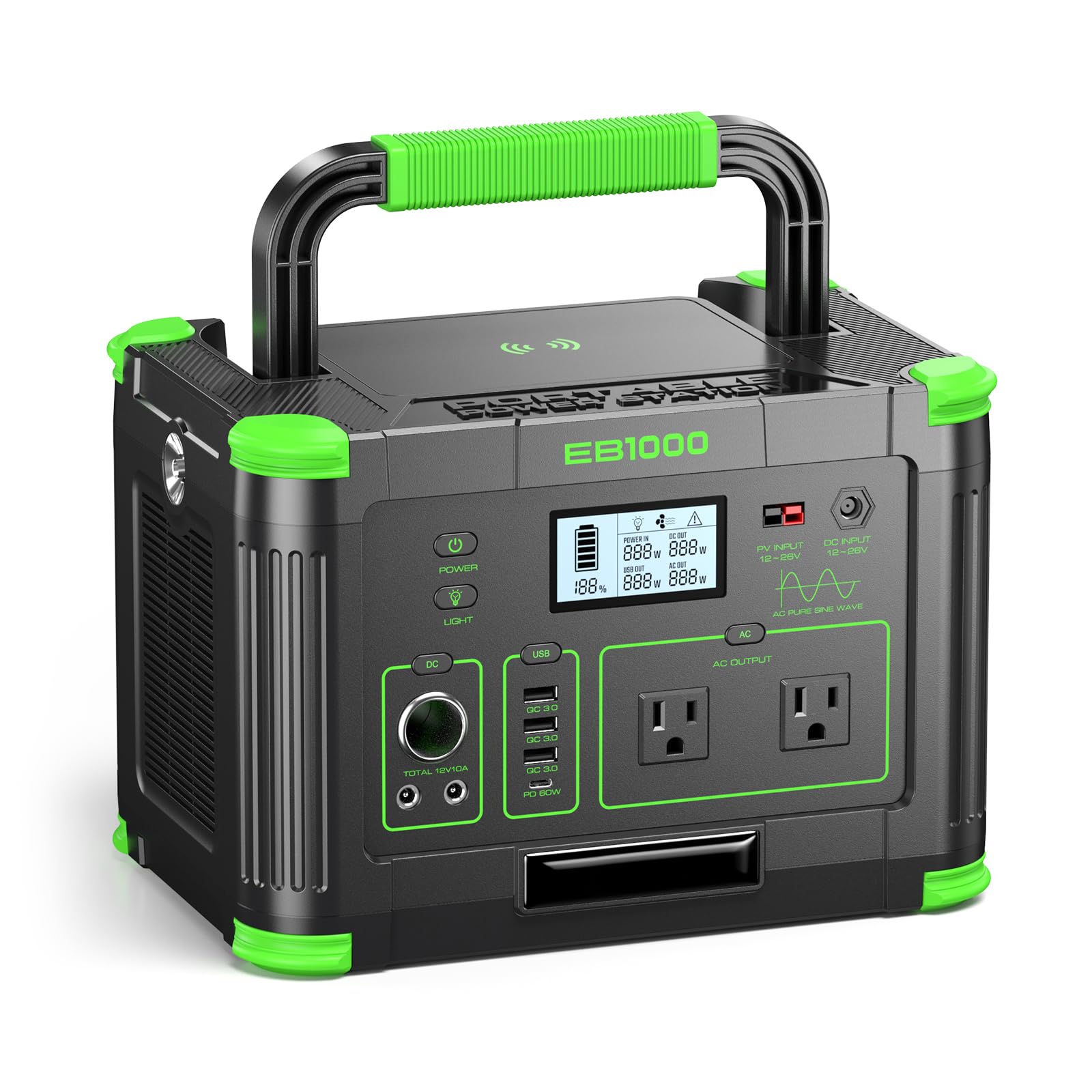
5. EBL 1000W Portable Power Station
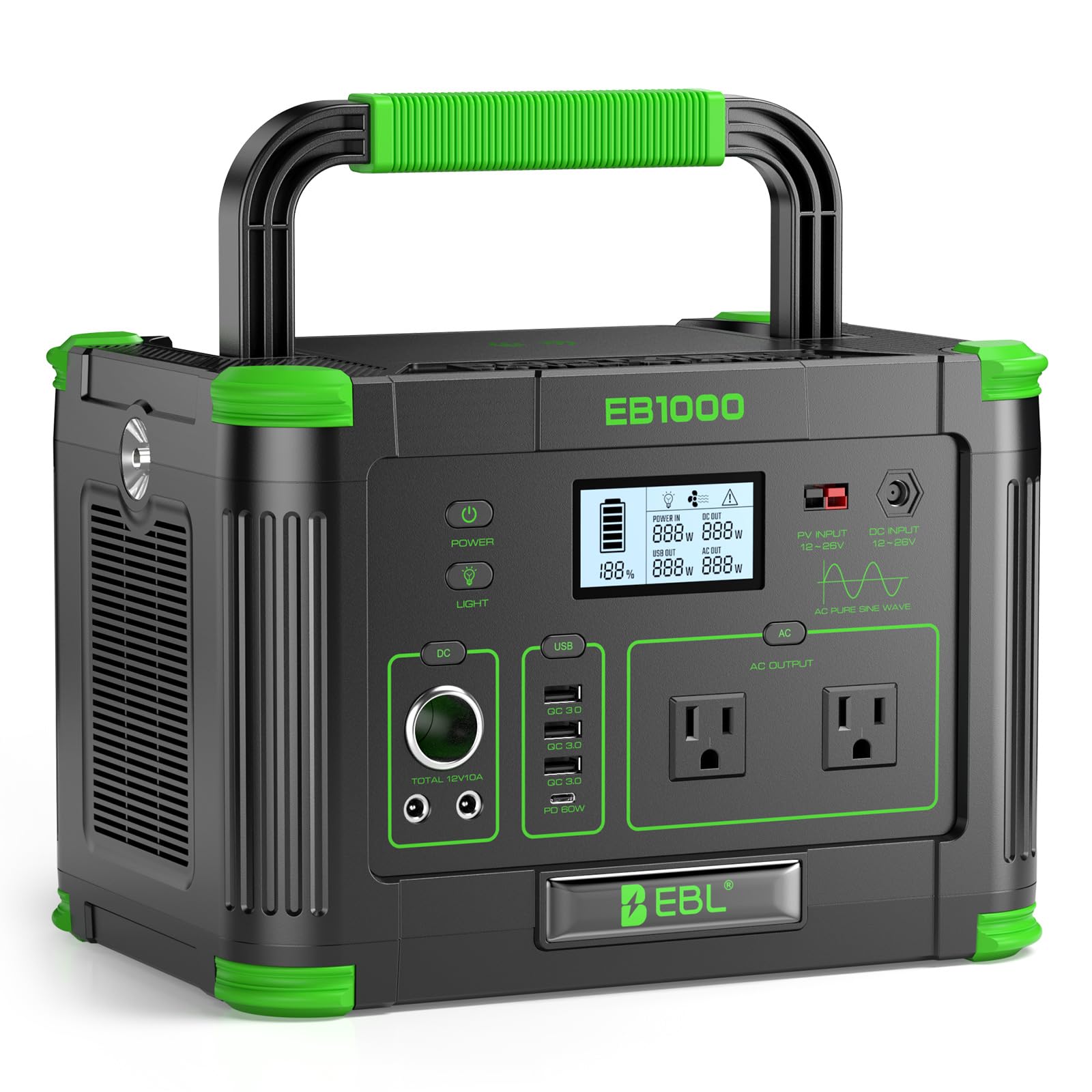
Ten devices, one box, and a smart LCD that tells you exactly how long the juice will last.
The EBL is the charging hub of this group because it can feed ten devices at once, as long as the combined draw stays under 1,000W. It packs a 999Wh battery into 22 lbs and offers 2 AC sockets, a 60W PD USB-C port (a fast-charging USB-C port), three USB-A QC 3.0 ports (Quick Charge ports for compatible phones), a wireless charging pad, a 12V car port, and two DC outputs. For a family campsite where everyone’s phone, tablet, and camera need feeding overnight, that device count is the reason to look here.
Each module has its own switch, so you are not powering every circuit just to charge one phone. The smart LCD shows real-time wattage, battery level, and runtime estimates, removing the guesswork about whether the heaters will still run at dawn. Recharging offers the full triple play — AC wall, solar, or car port — and built-in MPPT (power-point tracking that pulls the most from a panel) makes the most of variable sunlight. A 60W PD USB-C port charges a MacBook at full speed, and every USB-A does Quick Charge 3.0.
Owners find it exceeds expectations and calls it well worth the money, with plenty of praise for output and versatility. The battery-life picture is more divided — some find runtime longer than promised, others find it falls short of the advertised figure, which is a common reality when you push a high load. Note the maker’s own advice: keep rated device power under 1,000W and switch the AC output off when idle to avoid slow drain. Size it to your expectations and it works well.
Standout strengths
- Ten simultaneous device outputs plus wireless charging
- 60W PD USB-C and Quick Charge 3.0 on every USB-A
- Smart LCD tracks wattage and runtime live
- MPPT solar charging pulls more from a panel
Honest limitations
- Mixed reports on real-world runtime versus the advertised figure
- AC output must be switched off manually to stop slow drain
Pick this for: gadget-heavy camping trips where ten devices need charging at once.
Pass on it if: you expect every surge-heavy appliance to run without watching the load.
6. Anker SOLIX C1000 Portable Power Station, 1,056Wh
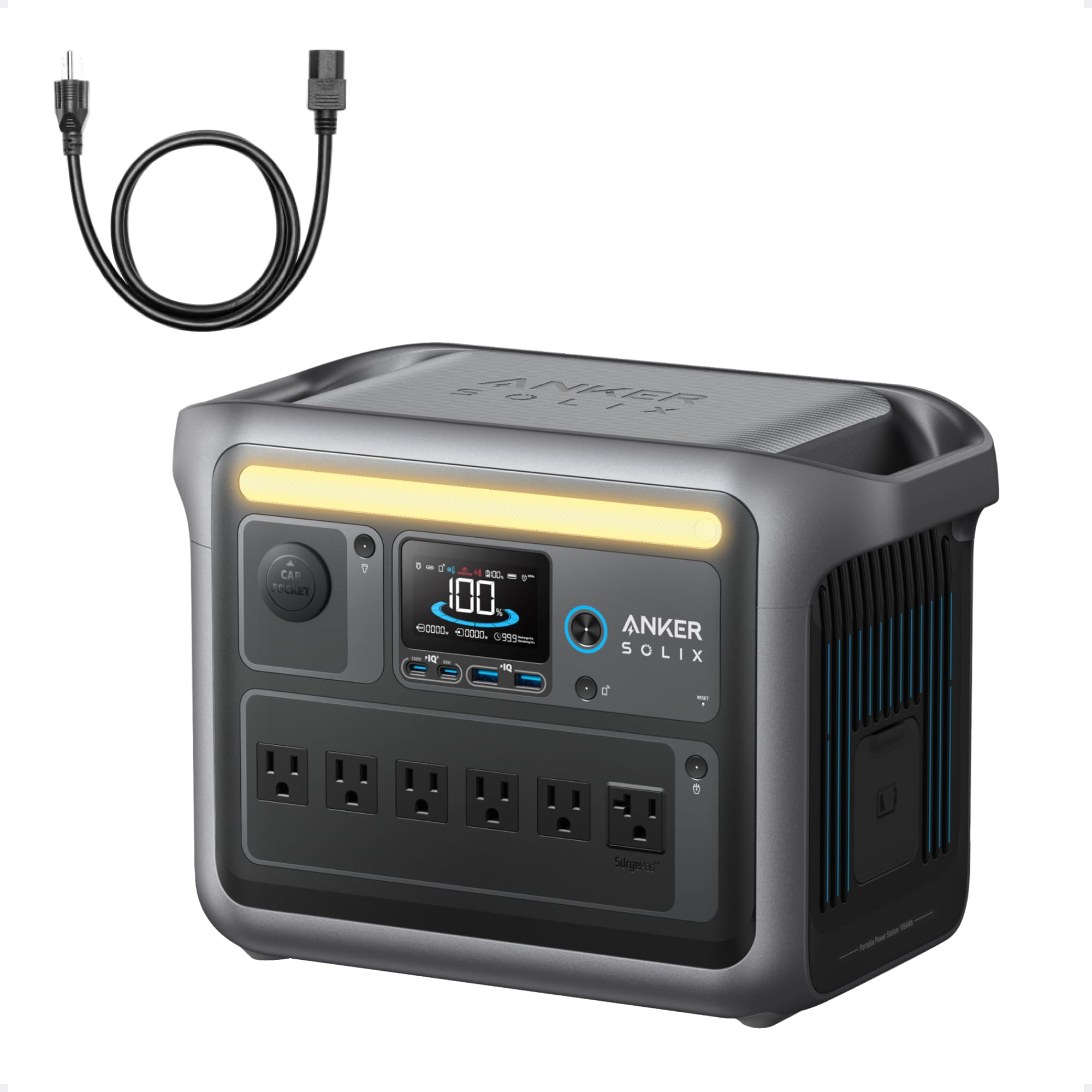
The compact heavyweight that sprints to 80% in 43 minutes and fits where bigger units won’t.
Anker’s UltraFast recharging takes the SOLIX C1000 to 80% in 43 minutes and a full charge in under an hour, all switched through the Anker app. That is the speed you want when the forecast turns and you have an hour to prepare. The 1,056Wh LiFePO4 battery is rated at 3,000 charge cycles across a 10-year lifespan.
SurgePad delivery pushes 2,400W through 11 ports, giving you room for a home outage and a road trip in the same unit. Solar recharging runs at up to 600W, reaching full in 1.8 hours when the sun cooperates. On size, it is 15% smaller than comparable 1kWh units — a real advantage when storage is tight in a closet or an RV cabinet, and the reason portability is the trait owners praise most.
The trade-off to size honestly is weight: at 27.6 lbs it is heavier to lift than the 23.3 lb Jackery Explorer 1000 v2, so if you are hauling it up stairs that extra heft shows up. Battery life is the most-discussed topic and opinions vary, so plan around moderate loads rather than assuming marathon runtime. Owners consistently call it quick to charge and genuinely good value, which is why it sits near the top of this list on merit.
Where it wins: 43-minute 80% recharge and a 15%-smaller body make it the tight-space, fast-turnaround choice.
The honest limit: 27.6 lbs is heavier than the Jackery Explorer 1000 v2, so weigh how often you actually lift it.
The smart buy for: households that want fast storm prep and a compact footprint.
Consider a lighter pick if: you move the unit up and down stairs regularly.
7. BLUETTI AC180 Portable Power Station 1152Wh 1800W

The fridge protector that stretches a blackout into a full day of cold food.
The BLUETTI AC180 brings a 1,152Wh LiFePO4 battery and an 1,800W output that climbs to 2,700W with a tap in the BLUETTI App — the app boost lets you run higher-draw tools when you really need them. It is the fridge runtime that wins people over: owners describe keeping refrigerators running for about 12 hours and stretching a session from 8:00 am to 8:45 pm. For a home that loses power for a day, that is the difference between a cooler full of ice and a cooler full of worry.
Charging is one for the record: a full 1,152Wh battery in just about one hour at 1,440W AC input, which is the kind of turnaround that lets you prep in the morning for an evening storm. Solar charging runs at a 500W input to reach full in 2.8 to 3.3 hours using only the sun. A 20ms UPS (the backup switch gap) adds a layer of home protection, and eight outlets give you room to spread out. Quality is the trait owners value most here, with quick charging a close second.
One honest caveat: reliability opinions carry some mix, so if you plan to lean on it as a mission-critical server backup, verify the warranty terms first. Otherwise, the AC180 is among the most versatile units on this list — camping, off-grid, and outage duty all fit the same body. Pick it when keeping food cold is your top priority.
If your priority is cold food: the AC180’s 12-hour fridge runs make it the pick.
The one hesitation: mixed reliability sentiment means you should check warranty coverage up front.
8. EF ECOFLOW Solar Generator Delta 3 Classic with 110W Solar Panel, 1024Wh
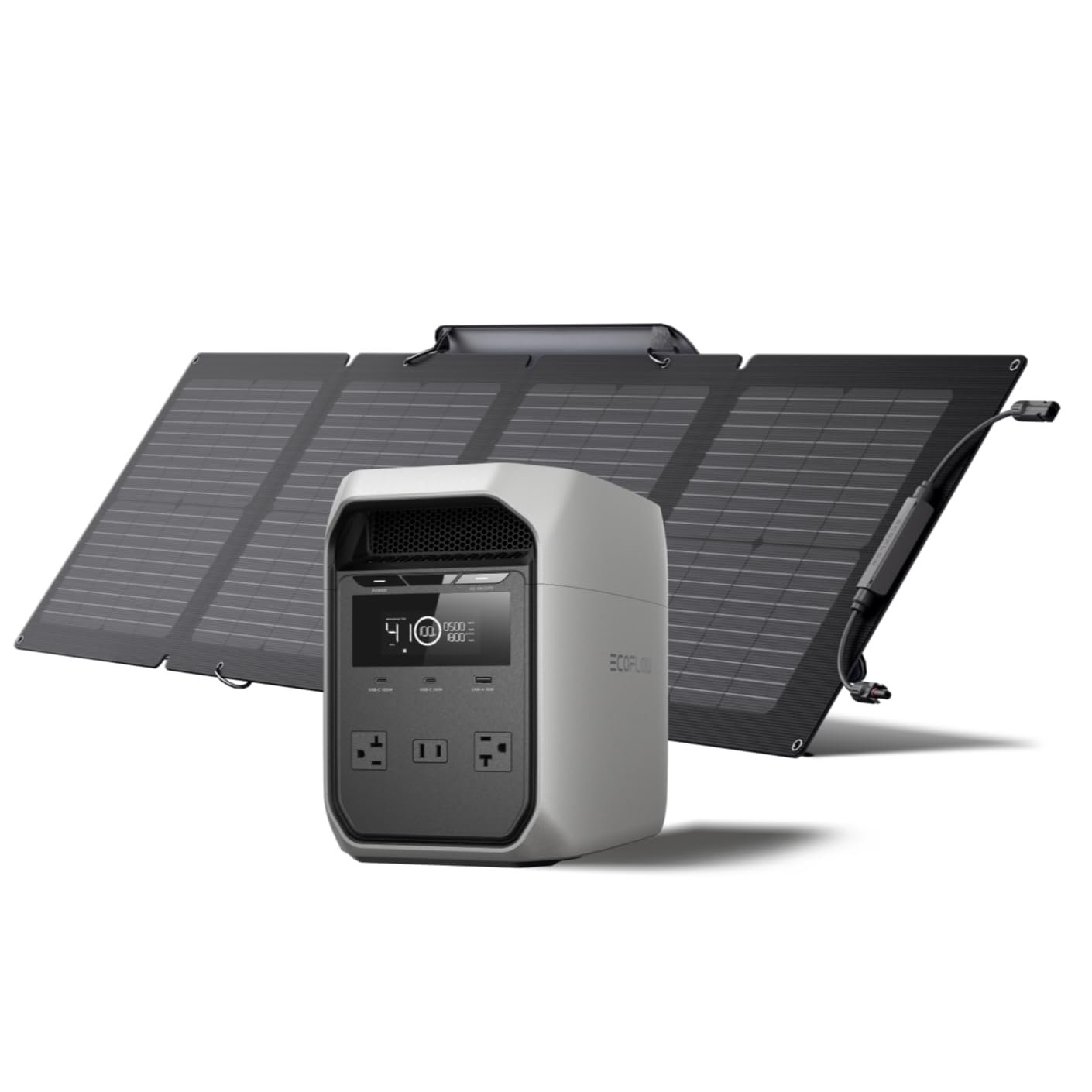
A ready-to-go solar kit — panel in the box, 23% conversion efficiency, and 3600W surge on tap.
Most picks on this list sell you the battery and leave the panel as a separate buy. The EcoFlow DELTA 3 Classic bundle puts a 110W solar panel in the box, so you can start harvesting sunlight the day it arrives. That 110W panel carries a 23% conversion rate (how much of the sun’s energy it turns into usable power) — higher than many panels at this size, which means shorter solar recharge sessions. A full solar charge with the included panel takes about 11.6 hours, so plan for a day in the sun to top it off.
Grid charging is far quicker: 0% to 80% in 45 minutes with X-Stream AC charging. Output sits at 1,800W with a 3,600W surge, and X-Boost can stretch usable output upward when you need to run heavier gear. A sub-10ms UPS keeps computers, servers, and sensitive electronics from rebooting during an outage. The LiFePO4 cells are rated for 10+ years of daily use, backed by EcoFlow’s EV-grade CTC design (cell-to-chassis mounting that improves durability).
What users note most is the overall build quality, followed by the charging speed — quick to top up from the wall or under the sun. It is easy to use, and owners describe keeping a mini fridge running for 18 hours. Two practical catches: the DELTA 3 Classic and the panel can arrive separately, so expect two deliveries, and solar charging from a 110W panel is slow compared with a higher-wattage array. If you want an all-in-one solar starter with no add-on purchases, this is the one.
The draw card
- 110W solar panel included in the box
- 23% panel conversion rate for efficient sun harvest
- 3,600W surge with X-Boost headroom
- Sub-10ms UPS protects sensitive electronics
Set your expectation
- About 11.6 hours for a full solar charge with the 110W panel
- Battery and panel may arrive as two separate shipments
Go here if: you want a solar generator kit complete on arrival with no extra panel to buy.
Don’t expect: a fast off-grid refill from the 110W panel alone.
9. Jackery Solar Generator 1000 v2 and 100W Solar Panel, 1024Wh, 1500W AC
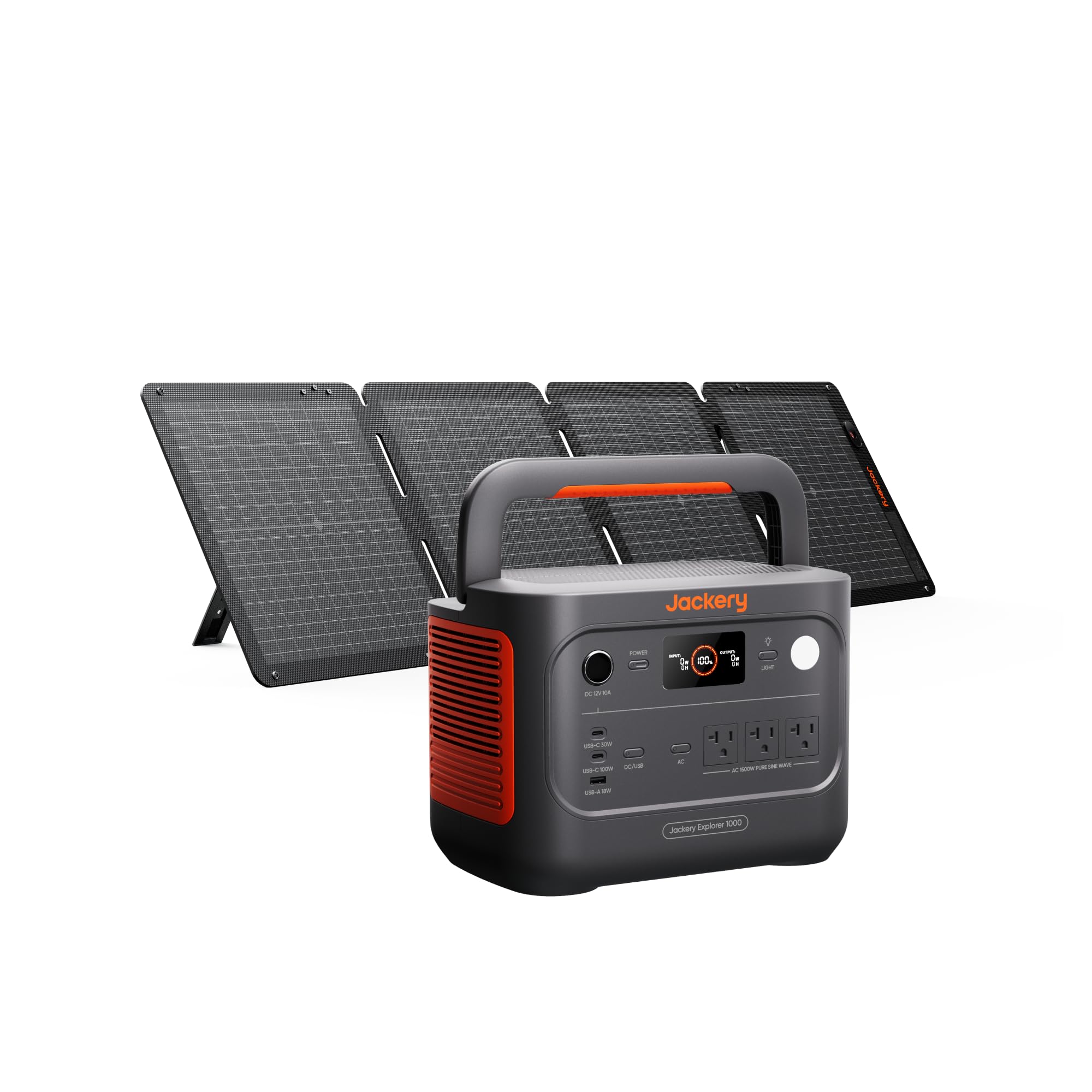
Same dependable Explorer you already trust, now paired with a 100W panel for true off-grid running.
If you read the Best Overall pick and wished the solar side came in the box, this is that exact pairing. It carries the same 1,500W AC output and 3,000W surge peak as the standalone Explorer 1000 v2, with a 1,024Wh LiFePO4 battery and a foldable handle at 23.3 lbs. Added to that is a 100W solar panel, so you can top up in the field without buying anything extra — the practical definition of a solar generator.
The performance is the same story you have heard from the standalone unit: 0% to 100% in 50 minutes with emergency charging enabled, and a 10ms UPS switchover to keep essentials alive during an outage. Solar charging is the slower path but the independent one. Owners describe it powering a mid-sized fridge for most of a day, and the charging runs about three hours from the wall. Performance and reliability are the traits buyers value most.
One split in the feedback worth flagging: power output opinions are mixed, with a portion of owners feeling it is less powerful than expected for larger draws. That makes this bundle a fit for outage prep and camping rather than heavy tool running. Two separate boxes may arrive (the generator and panel ship separately), so keep an eye on your tracking. For the buyer who wants one brand, one app, and a panel in the kit, the logic is clean.
Why the bundle earns its spot: you get the proven 1,000W-class Explorer body plus a matching 100W panel in a single purchase.
Be aware: generator and panel ship separately, and some feel output runs light under heavy loads.
Best if: you want a solar-ready Jackery kit rather than sourcing a panel on your own.
Look elsewhere if: your main need is running power tools at full rated draw.
10. EF ECOFLOW DELTA 3 Max Portable Power Station, 2048Wh, 2400W
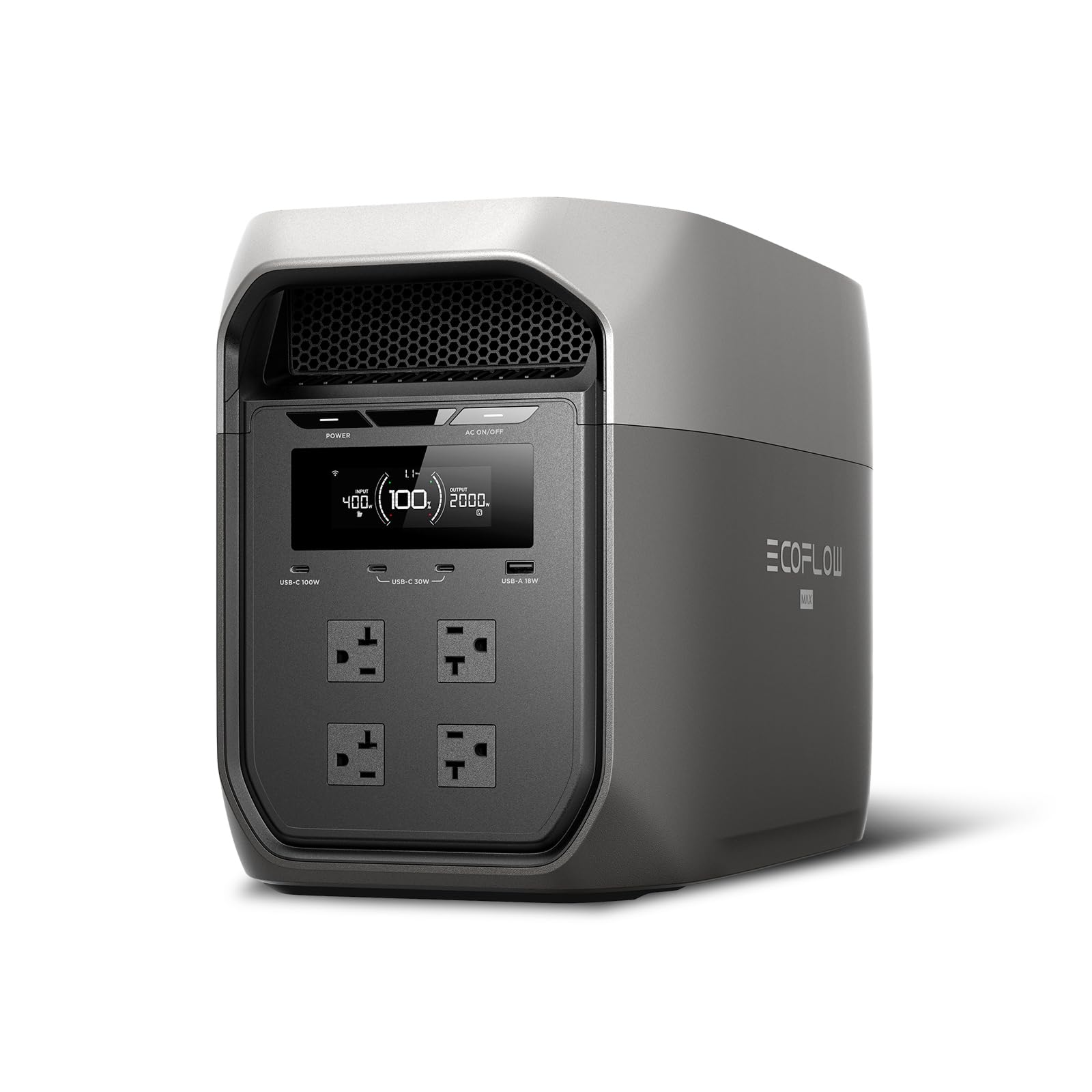
Double the storage and whole-home attitude — the unit you bring when a storm means business.
The DELTA 3 Max doubles the storage you get from a 1,024Wh unit, carrying a 2,048Wh LiFePO4 battery. With 2,400W output rising to 3,400W in X-Boost mode, it can run fridges, microwaves, and even power tools that would stall a 1000W-class station. For blackout nights where you want the TV, the fridge, and the coffee maker all going at once, that headroom is what you are buying. Performance is the attribute owners are most enthusiastic about.
Charging runs 0% to 80% in just over an hour (1.13 hours) on X-Stream, so you are never waiting long for it to be ready. A sub-10ms transfer time keeps computers and sensitive electronics safe from the switch, and the quiet operation keeps the room livable at night. The LiFePO4 cells are rated for a decade of daily use, and the EcoFlow app lets you monitor energy use and schedule charging. Owners note they can run a TV for about 12 hours, and that it handles most tasks around the house.
The honest note is durability sentiment is a little mixed, so treat it as a reliable-but-not-indestructible piece of gear. If your goal is genuine whole-home coverage during multi-day outages, this is a big step up in capacity from most of the list — just accept the heavier, larger frame that comes with it.
Where the muscle shows
- 2,048Wh storage runs multiple appliances for hours
- 3,400W X-Boost handles fridges, microwaves, and power tools
- 0–80% recharge in 1.13 hours via X-Stream
- Sub-10ms transfer protects computers and servers
Worth a second look
- Larger, heavier body than 1,000Wh-class units
- Durability feedback is mixed enough to warrant care
Choose it for: multi-day blackout coverage where you want the whole house running.
pass on it if: you want a compact unit to toss in a camper without the bulk.
11. BLUETTI Elite 200 V2 Portable Power Station 2080Wh 2600W

Built for the long haul — over 6,000 cycles and a rated lifespan that outpaces almost anything here.
If you plan to keep a power stationfor a decade and then some, the BLUETTI Elite 200 V2 is the pick that thinks in decades. Its automotive-grade LiFePO4 cells are rated for over 6,000 cycles and a 17-year lifespan — the longest durability figure on this list. The 2,080Wh battery backs a 2,600W continuous output that lifts to 3,900W in power-lifting mode, enough to run refrigerators, hair dryers, and coffee makers, with nine devices going at once.
Charging is adjustable across three modes in the BLUETTI app. Turbo Mode hits 0% to 80% in 1 hour at 1,800W AC, Standard Mode runs to a full charge in 1.6 hours, and Silent Mode settles at 800W AC or solar with a full charge in 3 hours. Standby draw is trimmed to 10W, three times lower than comparable stations, so idle drain does not eat your reserves. Solar fills it in 2.4 hours with 1,000W of panels, and a dual AC plus DC charge reaches 0% to 80% in 50 minutes.
Performance is what owners rave about most, and it shines in the moments that count — powering a 10,000 BTU portable AC unit and multiple refrigerators at once, running fridges for 24 hours during an outage. The weight is the one real gripe; at 44.5 lbs it is the heaviest unit here, so treat it as a stationary backup rather than a grab-and-go carry. For a home that wants a genuine decade-plus workhorse and maximum output, this is the ceiling of the list.
The long game: over 6,000 cycles and a 17-year lifespan rating mean you are buying far past the warranty window on most rivals.
The honest weight penalty: 44.5 lbs makes it a home fixture, not a portable one.
Made for: the buyer who wants maximum lifespan and 2,600W of output from a single anchored home unit.
Look elsewhere if: you need to carry it between home, RV, and campsite regularly.
Understanding the Specs
Continuous vs. Surge Watts
Continuous watts are the power a station can hold steadily — the number you plan your appliances around. Surge watts are the short burst a motor demands at startup, often far above its running draw. A fridge might hum along at a modest load but pull hard for a second when the compressor kicks on. If the surge rating is thin, the unit trips off. Look for surge well above your largest motor-driven appliance, and remember X-Boost and power-lifting modes can stretch usable output further on some models.
LiFePO4 Battery And Charge Cycles
LiFePO4 (lithium iron phosphate) is the chemistry to favor for backup power. It tolerates deep discharges and holds capacity across thousands of cycles — the numbers to read are cycle count and retained capacity. A battery rated to keep over 70% of its original capacity after several thousand cycles will behave far more predictably in year five than one with a lower figure. Match the cycle count to your habits: a weekend camper and a daily blackout user put very different wear on the same battery.
UPS Switchover Time
A UPS, or uninterruptible power supply, is the feature that keeps a device running the instant grid power drops. The spec is a millisecond figure — the gap before the station’s battery takes over. A single-digit or low-double-digit millisecond switch keeps a desktop computer or router from rebooting. A longer gap may let sensitive electronics blink off mid-task. If you plan to protect work gear or networking equipment, check this number before anything else.
Solar Input And Panel Compatibility
Solar input wattage is the ceiling on how fast the sun can refill the battery. A high input paired with the right panel means a few hours to full; a modest input means the unit sits charging all day. Compatibility matters too — some brands accept only their own panels, which limits future flexibility. Check the connector type and the maximum supported wattage, so you know what panel you can add later and how long a real off-grid recharge will actually take.
FAQ
Can a 1000W solar generator run a refrigerator?
How long does a 1000Wh power station actually last during an outage?
Is LiFePO4 better than standard lithium-ion for a solar generator?
Do these power stations need a separate solar panel to charge from the sun?
What does the UPS switchover time mean in real use?
How fast can these units recharge from a wall outlet?
Can I use a 1000W station for power tools or a microwave?
Is it safe to run a CPAP machine overnight on one of these?
Should I buy the battery alone or the panel bundle?
How heavy are these units to move around?
Final Thoughts: The Verdict
For most buyers, the 1000w solar generator that strikes the best balance is the Jackery Explorer 1000 v2. It pairs a 1,024Wh LiFePO4 battery with a 1,500W output, a 3,000W surge peak, a 50-minute fast charge, and a 10ms UPS — a full toolkit for outages and camping in one 23.3 lb body. If raw output and near-instant charging top your list, the DJI Power 1000 V2 delivers 2,600W and a 37-minute recharge to 80%. And for a decade-plus home workhorse with the longest lifespan here, the BLUETTI Elite 200 V2 is the one to reach for, with over 6,000 cycles and 2,600W of output.
Size the battery to your real worst-case night: go bigger on watt-hours for long fridge backup, and favor the lighter models for easy carrying. Get the surge rating to clear your biggest motor, and you will never regret the choice.
How We Picked
We do not accept paid placement. Every pick is matched to a real buyer and a real use-case; we do not hands-on test units.
Sources & Methodology
Specifications: manufacturer listings and product documentation. Review insights: verified customer reviews, as of November 2026. Pricing: not shown on this page (it changes often); check the current price via the retailer link.
As an Amazon Associate, Gadgets Feed earns from qualifying purchases. This does not affect which products we feature.