
A superzoom camera is the only tool that can turn a speck on the horizon into a recognizable face, a distant bird into a species you can name, or a far-off mountain ridge into a textured landscape. The promise of extreme focal length — 1000x optical zoom and beyond — is what separates these specialized cameras from the standard kit lens that tops out at a modest 3x or 5x. But achieving a sharp, usable image at those extreme magnifications isn’t just about the zoom number on the box; it’s about the marriage of optical quality, sensor performance, and image stabilization technology.
I’m Min — the co-founder and writer behind Gadgets Feed. I’ve spent hundreds of hours analyzing the technical specifications, real-world user reports, and lens performance data of every superzoom camera to hit the market, comparing how each model handles the unique challenges of extreme telephoto photography.
Whether you’re capturing wildlife, moon craters, or far-away landscapes, understanding the interplay of focal length, aperture, and stabilization is critical. After deep analysis, I’ve narrowed down the top contenders for the best 1000x optical zoom camera to help you make a confident decision.
How To Choose The Best 1000X Optical Zoom Camera
Choosing a superzoom camera is a balancing act between reach, image quality, and portability. The highest zoom number isn’t always the best choice if the camera can’t deliver a steady, sharp image at that distance. Focus on these three factors to find the right tool for your needs.
Optical Zoom Range vs. Image Stabilization
The core feature is the optical zoom ratio, which determines how far you can reach without losing pixel-level detail. A camera boasting 125x optical zoom, like the Nikon P1100, can bring subjects 3000mm away into a tight frame. However, at these extreme magnifications, even the slightest hand movement creates massive frame shift. A powerful optical image stabilization (OIS) system — measured in stops of compensation — is non-negotiable. Look for models with dual-detect or five-axis stabilization that actively counteracts motion, especially when shooting handheld at the telephoto end.
Sensor Size and Low-Light Performance
Almost all superzoom cameras use a small 1/2.3-inch sensor to accommodate the huge zoom range inside a compact body. This sensor size is a trade-off: it allows for a 24-3000mm equivalent lens, but its performance in low light is limited. You will see more noise above ISO 800 compared to a DSLR or mirrorless camera. If you plan to shoot in dawn, dusk, or shaded forests, a camera with a backside-illuminated (BSI) CMOS sensor, like the Nikon P1000 or P1100, can offer a marginal but noticeable improvement in light gathering and dynamic range.
Autofocus Speed and Accuracy
At extreme zoom ranges, autofocus (AF) needs to be both fast and precise. Contrast-detection AF, common in this category, can struggle with low-contrast subjects like a bird against a bright sky. Some premium models incorporate hybrid AF systems that add phase-detection points to lock focus faster. The number of AF points and the ability to manually override focus are critical for capturing wildlife or sports action where the subject may move unpredictably within the frame.
Quick Comparison
On smaller screens, swipe sideways to see the full table.
| Model | Category | Best For | Key Spec | Amazon |
|---|---|---|---|---|
| Nikon COOLPIX P1000 | Premium Superzoom | Maximum Optical Reach | 125x optical zoom (24-3000mm) | Amazon |
| Nikon COOLPIX P950 | Mid-Range Superzoom | Wildlife & Birding | 83x optical zoom (24-2000mm) | Amazon |
| Nikon COOLPIX P1100 (Bundle 1) | Ultra-Zoom Premium | Advanced Reach & Video | 125x optical zoom (24-3000mm) | Amazon |
| Nikon COOLPIX P1100 (Bundle 2) | Ultra-Zoom Premium | Extended Battery Life | 125x optical zoom (24-3000mm) | Amazon |
| Canon Powershot SX70 (Renewed) | Premium Mid-Range | Travel & Versatility | 65x optical zoom (21-1365mm) | Amazon |
| Panasonic LUMIX FZ80D | Mid-Range Feature Set | 4K Video & Post-Focus | 60x optical zoom (20-1200mm) | Amazon |
| Panasonic LUMIX ZS99 | Premium Compact | Pocket-Size Travel Zoom | 30x optical zoom (24-720mm) | Amazon |
| Kodak PIXPRO AZ653 | Entry-Level Bridge | Budget Superzoom Intro | 65x optical zoom (24-1560mm) | Amazon |
| Minolta Pro Shot 20MP | Budget Superzoom | Value & Long Zoom | 67x optical zoom | Amazon |
| Minolta MNB10Z 64MP | Entry-Level Bundle | First-Time Camera Buyer | 10x optical zoom | Amazon |
| Canon VIXIA HF G70 | Prosumer Camcorder | Professional 4K Video | 20x optical zoom, 4K UHD | Amazon |
In‑Depth Reviews
1. Nikon COOLPIX P1000
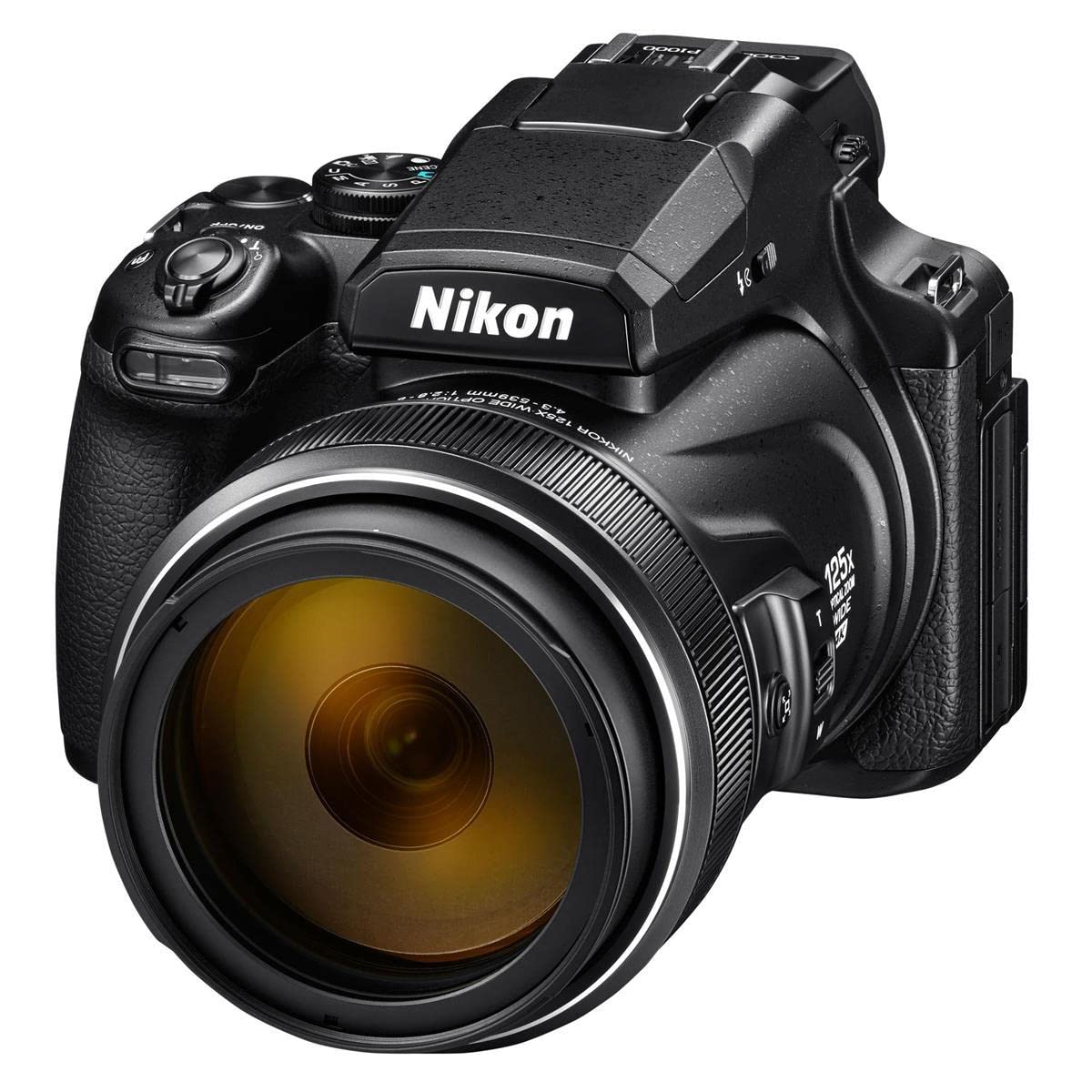
The Nikon COOLPIX P1000 remains the king of optical reach with its 125x zoom (24-3000mm equivalent), a feat that allows you to photograph the moon’s craters or a bird’s feather detail from hundreds of yards away. It packs a 16MP BSI CMOS sensor and Dual Detect Optical Vibration Reduction to stabilize that extreme reach. The 4K UHD video recording with an accessory hot shoe makes it a hybrid tool for both stills and cinematic footage.
At the full 3000mm end, image quality is heavily dependent on stability; a sturdy tripod is almost mandatory for critically sharp shots. The autofocus is contrast-detection based, which can hunt in low-contrast situations, and the camera body is noticeably large and heavy (over 3.1 pounds). The vari-angle LCD and high-resolution electronic viewfinder (EVF) are excellent for composing shots from awkward angles.
For the serious enthusiast who prioritizes raw focal length over portability and wants the single longest optical zoom available, the P1000 is the undisputed champion. The small 1/2.3-inch sensor means you’ll need good light, but for daylight wildlife, moon photography, and distant landscapes, nothing else touches its reach.
Why it’s great
- Unmatched 125x optical zoom (24-3000mm).
- Dual Detect OIS works well for handheld shooting.
- 4K UHD video with hot shoe for external mics/lights.
Good to know
- Heavy and bulky body.
- Autofocus can hunt at extreme zoom ranges.
- Small sensor struggles in low light.
2. Nikon COOLPIX P950

The Nikon COOLPIX P950 strikes a compelling balance between extreme zoom and usability. Its 83x optical zoom (24-2000mm equivalent) provides massive reach, while dedicated scene modes for Bird and Moon photography automate complex settings for sharp results. The addition of a manual focus wheel on the lens barrel is a welcome improvement over its predecessor, giving you more control at high magnifications.
Image stabilization is effective for handheld shots at 2000mm, though a monopod or tripod is still recommended for the absolute best sharpness. The 16MP sensor delivers good detail in good light, but like its larger sibling, the P1000, the small sensor limits performance in dim conditions. The rotating LCD screen and Wi-Fi connectivity for easy sharing add to its travel-friendly profile.
For birders and wildlife photographers who want significant optical reach without the literal bulk and higher cost of the P1000, the P950 is the sweet spot. It’s easier to carry on a hike while still delivering the capability to photograph a distant eagle with clarity.
Why it’s great
- Excellent 83x optical zoom for wildlife photography.
- Dedicated Bird and Moon scene modes simplify shooting.
- Manual focus ring on lens for precise control.
Good to know
- Contrast-detect AF can be slow for fast action.
- Image quality degrades noticeably above ISO 800.
- Macro performance is not as strong as some competitors.
3. Nikon COOLPIX P1100 (Bundle 1)
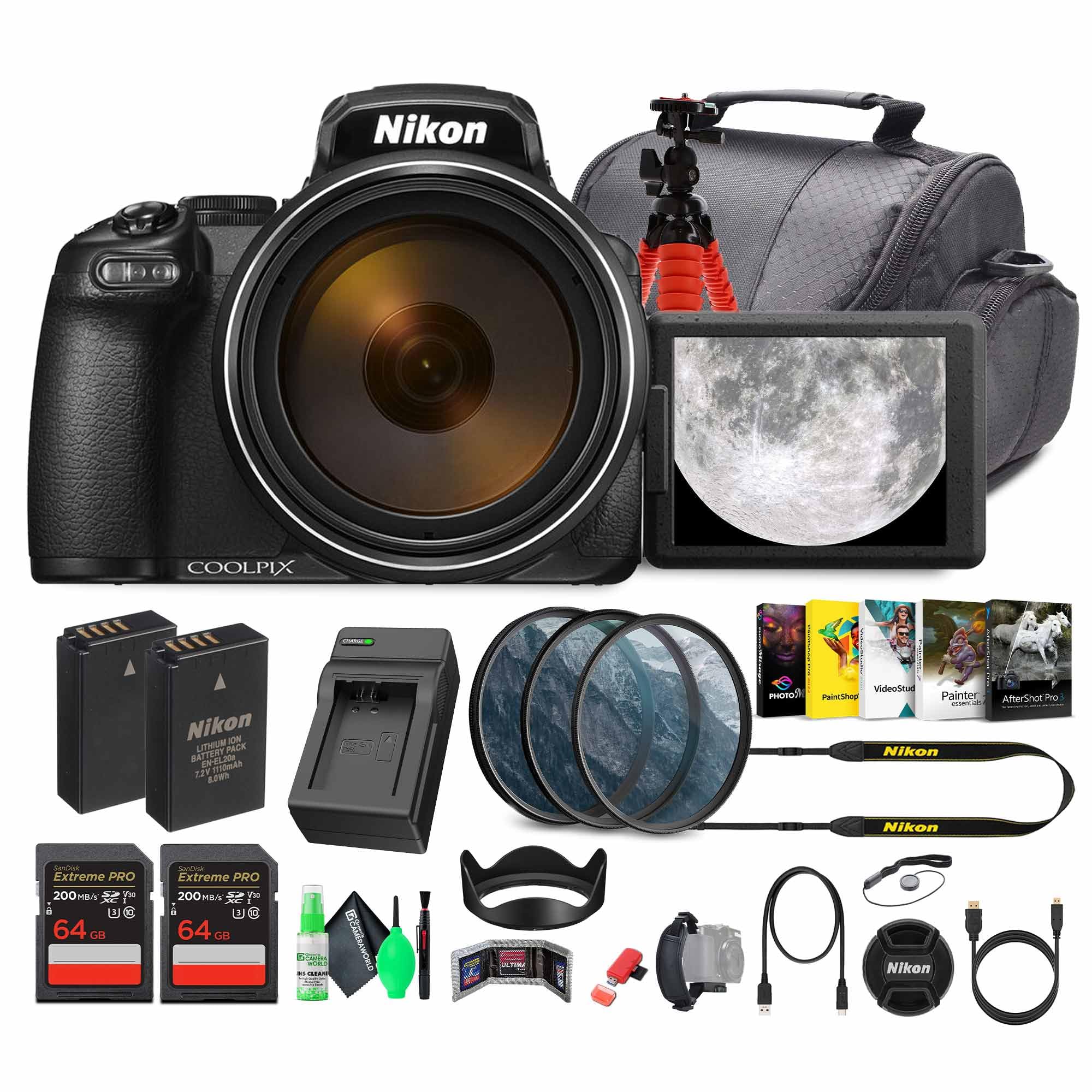
The Nikon COOLPIX P1100 is the successor to the P1000, retaining the same 125x optical zoom (24-3000mm equivalent) and 16MP BSI CMOS sensor but refining the overall package for slightly better usability. It features a Dual Detect Optical Vibration Reduction system that helps maintain a steady image at full telephoto, and the vari-angle 3.2-inch LCD screen combined with an electronic viewfinder offers flexible composition. This bundle includes essential accessories like memory cards, a bag, and a tripod.
While the core photographic capabilities are very similar to the P1000, the P1100 benefits from subtle refinements in firmware and handling. The 4K UHD video recording at 30fps remains a strong feature for capturing distant subjects in motion. The lens itself is identical in focal length, meaning that same incredible reach is available, but the P1100 bundles often represent a better overall value when you factor in the included accessories.
If you are looking for the absolute maximum optical zoom available in a current-generation model and want a complete kit out of the box, the P1100 is the logical choice. It replaces the P1000 as Nikon’s flagship superzoom and is purpose-built for distance shooting in good light.
Why it’s great
- Industry-leading 125x optical zoom (24-3000mm).
- Dual Detect OIS provides steady handheld shots.
- Comprehensive bundle includes cards, bag, and tripod.
Good to know
- Same small 1/2.3-inch sensor as the P1000.
- Large and heavy for a compact camera.
- Phone app connectivity can be finicky.
4. Nikon COOLPIX P1100 (Bundle 2)

This second bundle of the Nikon COOLPIX P1100 emphasizes extended shooting sessions by including two EN-EL20 replacement batteries alongside the camera, a charger, memory cards, and a padded bag. The core camera is identical to the P1100 in Bundle 1, meaning you get the same 125x optical zoom lens with a 24-3000mm focal range and a 16MP BSI CMOS sensor. This model also features a hybrid autofocus system with 179 AF points.
The P1100’s lens is a marvel of engineering, but the small sensor’s dynamic range is limited. Users report excellent results for birding in good light, and the 4K video quality is a strong tool for amateur naturalists. The vari-angle LCD is particularly useful when trying to track a subject high in a tree while the camera is on a tripod. The included external charger is a huge convenience over charging the battery inside the camera.
For any photographer planning a full day of shooting—a birding trip, a safari, or a sporting event—this bundle is the smarter buy. The extra batteries mean you’ll be shooting while others are waiting for their camera to charge, and the bundle value is hard to beat for the serious field user.
Why it’s great
- Two extra batteries for all-day field use.
- 125x optical zoom delivers exceptional reach.
- Hybrid AF system with 179 points for faster locking.
Good to know
- Sensor and overall image quality identical to P1000.
- Camera bag in bundle may be a tight fit.
- Phone transfer requires a free app.
5. Canon Powershot SX70 (Renewed)

The Canon Powershot SX70 delivers a powerful 65x optical zoom (21-1365mm equivalent) from a lightweight body, making it an excellent choice for travelers who need long reach without a huge backpack. Its 20.3MP CMOS sensor and DIGIC 8 image processor provide good color science and fast performance, and the 0.39-inch OLED electronic viewfinder (2.36 million dots) is crisp for composing in bright sunlight. The 4K time-lapse movie mode is a unique creative bonus.
As a renewed product, the SX70 offers premium features at a more accessible price point. Image quality is strong in good light, and the optical image stabilization does a commendable job at the long end of the zoom. However, like all small-sensor superzooms, low-light performance is a limitation. The autofocus is snappy for general use, though it may struggle a bit with very fast-moving subjects.
If you prioritize a compact, lightweight superzoom with excellent Canon color science and a high-quality EVF, the SX70 is a fantastic pick. It’s less cumbersome than the Nikon P950 but still offers serious reach for travel, events, and wildlife.
Why it’s great
- Lightweight and compact for a 65x zoom camera.
- Excellent OLED electronic viewfinder.
- Canon color science produces pleasing jpegs.
Good to know
- No USB-C charging (uses older connector).
- Low-light noise above ISO 800.
- Renewed product may show signs of use.
6. Panasonic LUMIX FZ80D

The Panasonic LUMIX FZ80D offers a compelling mix of reach and advanced video features at a mid-range price point. Its 60x optical zoom (20-1200mm equivalent) provides excellent wide-angle to telephoto coverage, and the Power O.I.S. (Optical Image Stabilizer) effectively suppresses shake at the tele-end. The standout feature is its 4K Photo mode, which lets you extract 8MP photos from 4K video bursts, and the Post Focus mode that allows you to change the focus point after the shot.
The camera’s 18.1MP sensor is a standard 1/2.3-inch type, so image quality matches the category expectations. The contrast-detect autofocus is fast and accurate for its class, though it can hunt in low light. The large 2,360K-dot live viewfinder (LVF) is excellent, making it easy to track subjects. The lack of Wi-Fi is a notable omission in a modern camera.
For a photographer who wants the versatility of a long zoom with the creative freedom of 4K photo extraction and post-focus adjustment, the FZ80D is a strong contender. It’s a great tool for travel, family events, and nature, where you can leverage its unique video-based features.
Why it’s great
- 4K Photo mode captures perfect moments from video.
- Post Focus lets you adjust focus after shooting.
- Excellent high-resolution electronic viewfinder.
Good to know
- No built-in Wi-Fi for easy sharing.
- Small sensor limits low-light performance.
- Battery life drains faster when using zoom.
7. Panasonic LUMIX ZS99

The Panasonic LUMIX ZS99 is a compact travel zoom camera that prioritizes portability without sacrificing reach. Its 30x optical zoom (24-720mm equivalent) Leica DC lens delivers sharp images across the range, and the 5-Axis HYBRID O.I.S. ensures steady shots. The tiltable 1,840k-dot touchscreen is great for selfies or low-angle compositions, and the built-in Bluetooth v5.0 makes for effortless image transfer to a phone via the dedicated Send Image button.
With a 20.3MP sensor, the ZS99 captures detailed images, but the small sensor and aperture constraints mean it’s best used in good daylight. The autofocus is contrast-detect and can be slow to lock in low contrast or dim conditions. The camera offers 4K video recording at 30p and even 120fps HD slow-motion, adding to its versatility for capturing travel moments.
If you want a camera you can slip into your pants pocket for a concert, family outing, or day hike, but still want a meaningful 30x zoom, the ZS99 is an excellent choice. It sacrifices ultimate reach for ultimate portability, making it the camera you’ll actually bring everywhere.
Why it’s great
- Truly pocketable size with a 30x Leica zoom.
- Bluetooth v5.0 for seamless auto image transfer.
- Tiltable touchscreen for flexible composition.
Good to know
- Autofocus struggles in low-light conditions.
- No RAW photo format option.
- Small sensor performance limits low-light shots.
8. Kodak PIXPRO AZ653
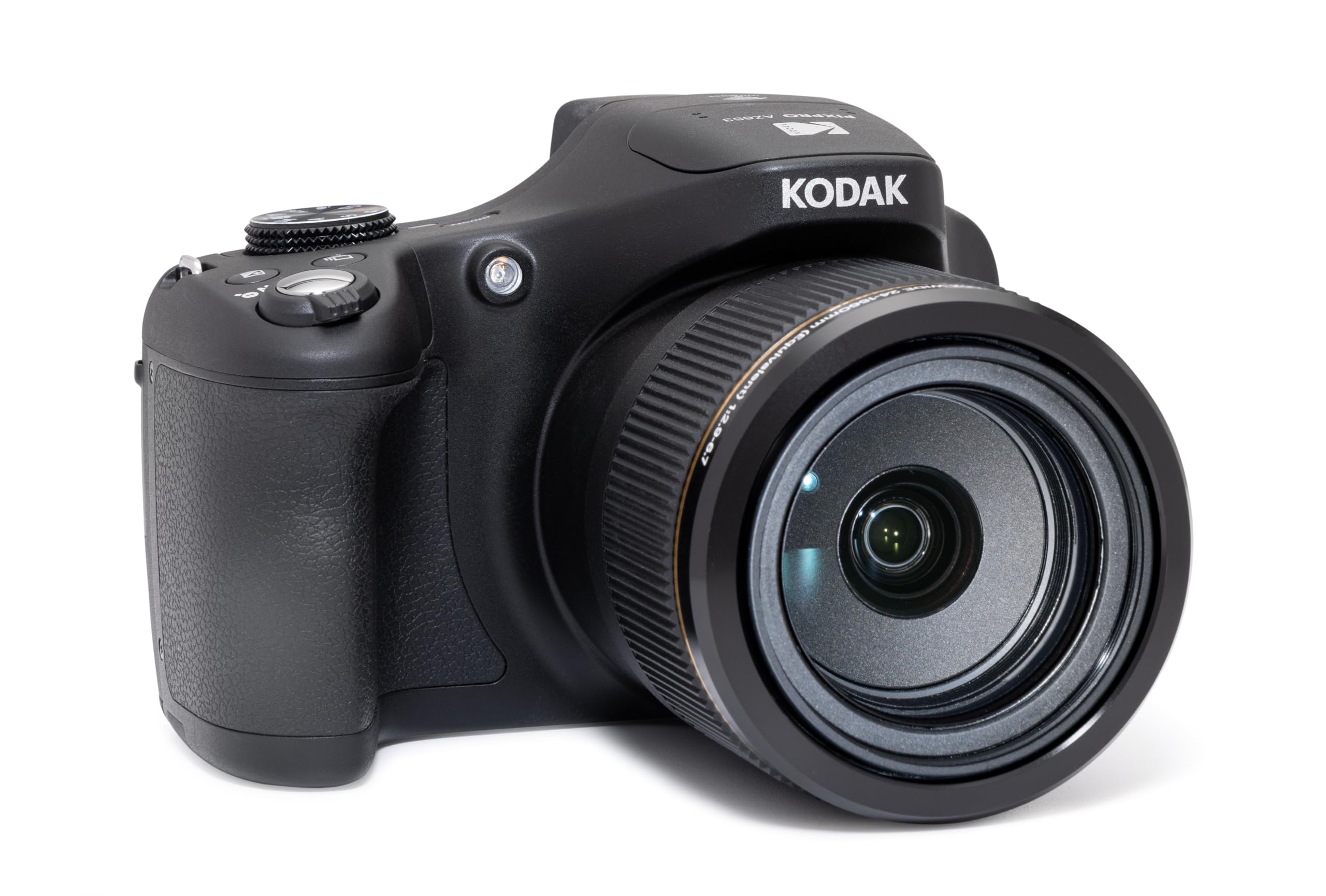
The Kodak PIXPRO AZ653 enters the superzoom market with a very strong price-to-feature proposition. It offers a 65x optical zoom (24-1560mm equivalent) with a 20MP BSI CMOS sensor, and crucially, supports RAW file shooting which is rare at this price point. The camera includes a built-in flash, optical image stabilization for video, and both an electronic viewfinder and a 3-inch LCD screen, making it a fully featured bridge camera for beginners.
The image quality is typical of the category: good in bright daylight, with noticeable noise and softness in low-light or at the long end of the zoom. The autofocus uses contrast-detection, which is adequate for static subjects but can be slow for action. The PIXPRO Remote Viewer app allows for wireless image transfer and remote control, adding functionality not always found at the entry-level.
For the budget-conscious photographer who wants a genuine 65x optical zoom and the flexibility of RAW post-processing, the Kodak AZ653 is a fantastic value. It’s a great learning tool or a second camera for a family trip where you don’t want to risk a premium kit.
Why it’s great
- Excellent 65x zoom for a very competitive price.
- RAW file support for advanced editing.
- Includes EVF and LCD, plus Wi-Fi connectivity.
Good to know
- Image quality softens significantly at full zoom.
- Autofocus is slow in challenging conditions.
- Battery life can be inconsistent.
9. Minolta Pro Shot 20MP

The Minolta Pro Shot 20MP delivers a hefty 67x optical zoom in a package that emphasizes value and ease of use. Its hybrid autofocus system helps lock onto subjects faster than purely contrast-detect models, and the optical image stabilization is effective for reducing handheld blur at the telephoto end. The 3-inch articulating LCD screen is useful for shooting over crowds or from low angles, and built-in Wi-Fi allows for app-based remote control and file transfers.
The image quality is decent for the category, producing vibrant colors that appeal to beginners. The menu system, however, has a learning curve and can be unintuitive. The camera can operate in manual modes, supporting RAW format, which gives advanced users more flexibility. It comes with a 16GB SD card and other basic accessories in the box.
For someone seeking a long-zoom camera on a budget who is willing to spend time learning the menus, the Minolta Pro Shot offers a strong set of features for the price. Its 67x zoom will bring you closer than any phone, and the inclusion of Wi-Fi makes sharing simple.
Why it’s great
- 67x optical zoom provides excellent reach for the cost.
- Hybrid AF helps with faster subject acquisition.
- Wi-Fi and articulating screen for flexible shooting.
Good to know
- Menu system is non-intuitive and requires patience.
- Image quality is not comparable to more expensive models.
- Variable quality control reported by some users.
10. Minolta MNB10Z 64MP
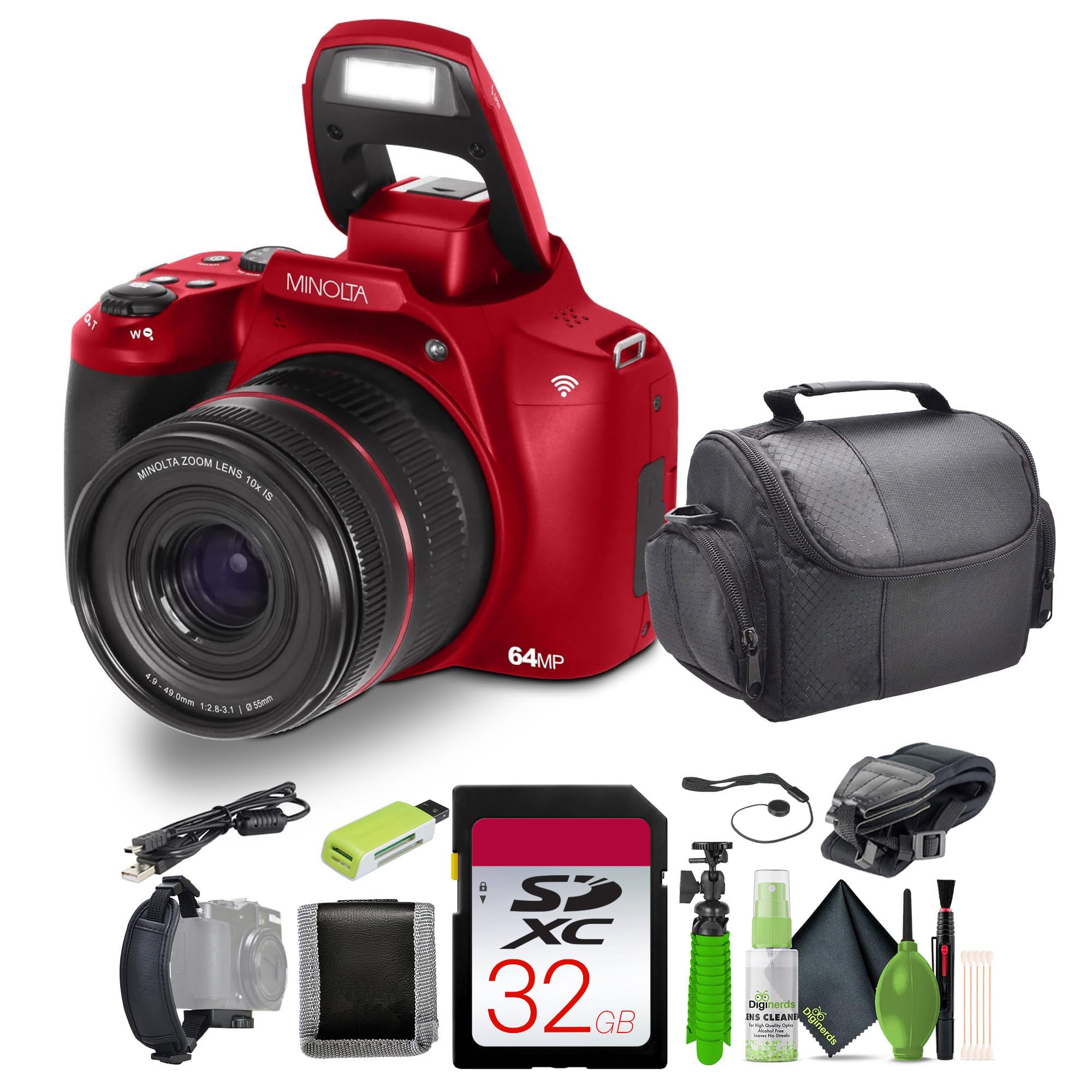
The Minolta MNB10Z is an entry-level bridge camera designed for beginners who want a complete kit right out of the box. It features a 64-megapixel sensor and a 10x optical zoom lens, capturing 4K Ultra HD video. The bundle includes a 32GB memory card, a flexible vlogging tripod, a cleaning kit, and three other accessories, making it a true “starter set.”
The 10x optical zoom is modest compared to the superzoom giants in this guide, but it’s a significant step up from a phone’s digital zoom. The image quality is best described as decent for the price; users report it produces acceptable photos in good light but struggles with blurriness and darkness in less-than-ideal conditions. The camera lacks a built-in flash, which limits its usability in low-light environments.
This camera is best suited for a young photographer, a complete beginner, or someone looking for a very affordable camera with a bundle of accessories to learn the basics of photography. It is not a replacement for the long-reach superzooms, but a very accessible entry point into the world of interchangeable-lens-style cameras.
Why it’s great
- Exceptional value with a huge accessory bundle.
- High 64MP sensor resolution for large prints.
- 4K video recording for vlogging beginners.
Good to know
- Only 10x optical zoom, not a true superzoom.
- No built-in flash for low-light shooting.
- Image quality is not comparable to higher-tier models.
11. Canon VIXIA HF G70
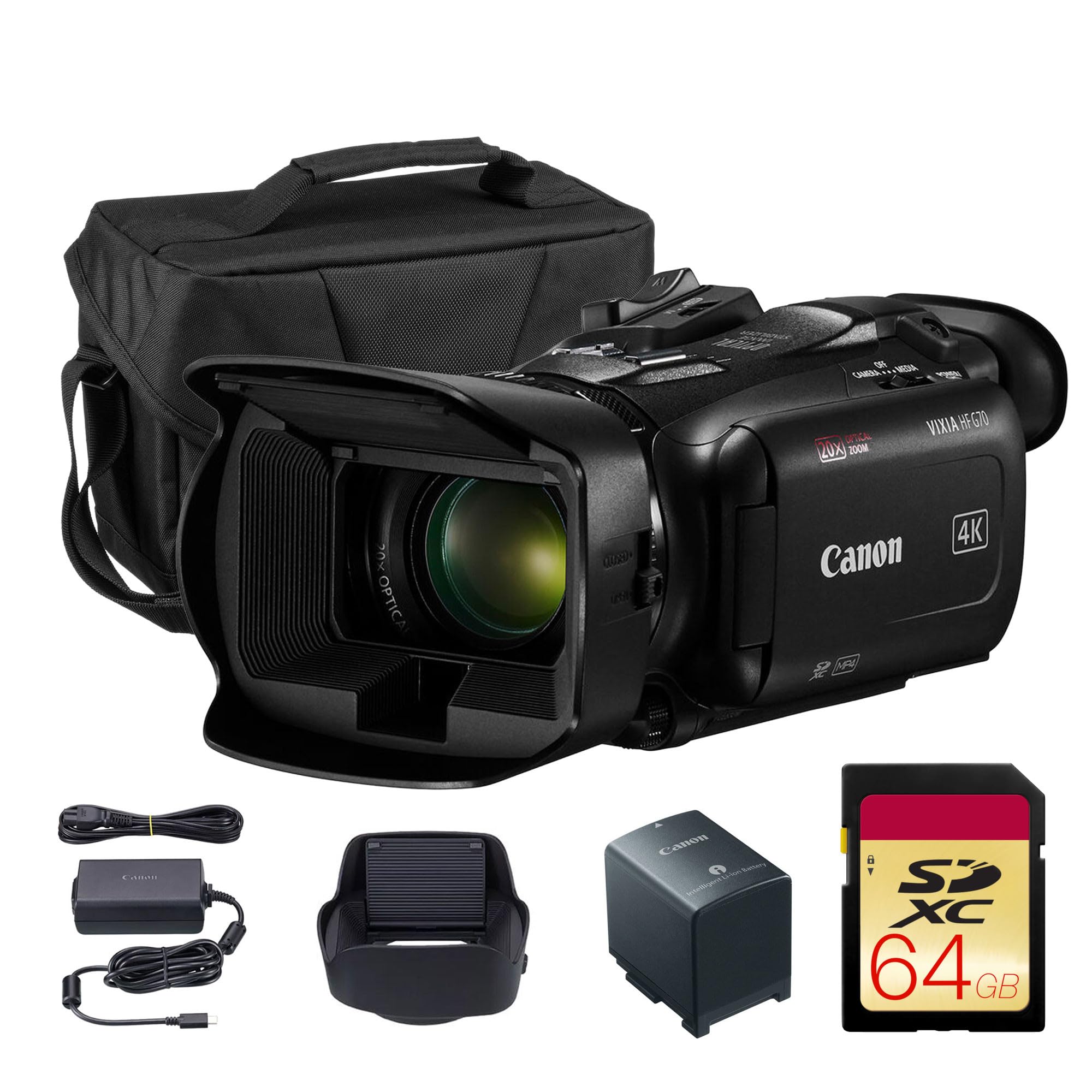
The Canon VIXIA HF G70 is a dedicated 4K camcorder with a 20x optical zoom lens, optimized purely for video production. Its 1/2.3-inch CMOS sensor and DIGIC DV 6 processor deliver “True 4K” UHD video with excellent color depth and detail. The touchscreen interface makes setting custom modes quick, and the manual control ring on the lens allows smooth, cinematic zoom pulls. Dual SD card slots are critical for professional workflows, allowing for relay recording or instant backup.
Unlike stills-based cameras, the G70 is designed for continuous recording and superior ergonomics for video. The image stabilization is effective for run-and-gun shooting, though it can be challenged in high-vibration environments like near train tracks. The HDMI output allows for clean 4K feed to external monitors or recorders, making it viable for livestreaming or higher-end post-production.
This is the choice for the videographer—someone shooting events, documentaries, or interviews—who needs a dedicated camcorder with professional video features, dual storage, and a reliable optical zoom. It is not a stills camera, so it fills a different niche than the superzoom cameras above.
Why it’s great
- Professional-grade 4K video quality with great color.
- Dual SD card slots for reliable recording.
- Excellent ergonomics and manual controls for video.
Good to know
- 20x zoom is much less than superzoom stills cameras.
- Slow startup time (7-8 seconds).
- Image stabilization can be weak in extreme vibration.
FAQ
Does a 1000x optical zoom camera require a tripod?
Can a superzoom camera replace a DSLR for wildlife photography?
What is the difference between optical zoom and digital zoom?
Final Thoughts: The Verdict
For most users, the best 1000x optical zoom camera winner is the Nikon COOLPIX P1000 because it delivers the longest available optical reach in a complete, reliable package. If you want the latest generation with a comprehensive accessories bundle, grab the Nikon COOLPIX P1100. And for a more portable balance of reach and value, nothing beats the Nikon COOLPIX P950.