
Our readers keep the lights on and my morning glass full of iced black tea. As an Amazon Associate, I earn from qualifying purchases.
Specs are compiled from manufacturer listings and verified buyer reviews and can change over time — please confirm the key details on the product page before buying.
If you are shopping for a 100Ah deep cycle battery, you have likely already run into the biggest pain point in this category: lead-acid batteries are heavy, die early, and simply cannot keep up with modern energy demands. The real question is which lithium chemistry and battery delivers the most usable power per dollar.
I’m Min — the founder and writer behind Gadgets Feed. This guide is built by comparing the manufacturers’ published specifications and the patterns across verified customer reviews, so you get each pick’s real strengths and trade-offs instead of marketing spin.
if you need a battery for an RV, a trolling motor, or a solar off-grid system, this roundup of the best 100ah deep cycle battery options cuts through the specs to show you what each one truly delivers — no clutter, just comparisons that matter.
Quick Picks
- Wattcycle 12V 100Ah LiFePO4 Lithium Battery — Top Performer
- HumsiENK 12V 100Ah LiFePO4 Battery — Best Value
- Dumfume 12V 100Ah LiFePO4 Battery — Budget Champion
- Redodo 12V 100Ah LiFePO4 Battery — Versatile Install
- power queen 12V 100Ah LiFePO4 Battery — Light & Compact
- Litime 12V 100Ah Trolling Motor LiFePO4 Battery — Marine Grade
- Battle Born Batteries 100Ah 12V LiFePO4 — Premium Long-Term
How To Choose The Best 100Ah Deep Cycle Battery
Deep cycle batteries are built to be drained and recharged repeatedly — unlike a car’s starter battery which delivers a huge burst for a few seconds. Choosing the right one means understanding the specs that define real-world performance.
Chemistry First: Why LiFePO4 Wins
Deep cycle battery chemistry choices are essentially lead-acid (AGM or flooded) versus LiFePO4 (lithium iron phosphate). You will want LiFePO4 for demanding use because it gives you more usable capacity — typically 100% depth of discharge (DoD) vs. only 50% for lead-acid — meaning you do not damage the battery by draining it lower. LiFePO4 also lasts thousands of cycles versus a few hundred, weighs a fraction of lead-acid, and holds voltage steady even near empty so your inverter or trolling motor runs at full power until the very end.
Cycle Life: 6000 vs 15000 — What the Numbers Really Mean
A “cycle” means discharging the battery and recharging it. But the advertised number (say, 6000 or 15000) depends on how deep you discharge it each time. Discharge to 100% capacity and you may get 4000 cycles. Discharge only to 80% and you could get 6000 cycles. Discharge only to 60% and you could get 15000 cycles. So if you only use half of the battery’s capacity daily, it lasts years longer. Always check which depth-of-discharge (DoD) percentage applies to the cycle claim.
The BMS: The Hidden Safety Guard
The Battery Management System (BMS) is a small circuit board inside every LiFePO4 battery that prevents overcharging, over-discharging, short circuits, and overheating. A good BMS also prevents charging in freezing temperatures — a critical feature because charging a lithium battery below freezing (32°F or 0°C) can permanently damage the cells. All batteries on this list have at least a 100A BMS, which dictates the maximum continuous load you can draw (e.g., 100A at 12V supports about 1200W of continuous power).
Physical Fit: Group Size, Weight, and Terminals
Battery dimensions are standardized by BCI Group sizes (Group 24, Group 31, etc.). A Group 24 battery is shorter and narrower than a Group 31, so measure your existing battery compartment. Weight matters for carrying — a 100Ah LiFePO4 battery typically weighs between 22 and 24 pounds, compared to ~64 pounds for lead-acid. Also, check the terminal bolts: some use M8 (8mm) threads, others use 5/16″ SAE. Having the right hardware makes installation far less frustrating.
Quick Comparison
On smaller screens, swipe sideways to see the full table.
| Model | Best For | Weight | Max Cycles | Group Size | Amazon |
|---|---|---|---|---|---|
| Wattcycle 100Ah | Top Performer | 23.2 lbs | 15000 | Group 24 | $199.99Amazon |
| HumsiENK 100Ah | Best Value | 24.9 lbs | 15000+ | Group 24 | $169.99$179.99Amazon |
| Redodo 100Ah | Versatile Install | 22.04 lbs | 15000 | Group 31 | $249.88Amazon |
| power queen 100Ah | Light & Compact | 22.05 lbs | 15000 | Group 31 | $259.99Amazon |
| Litime 100Ah (TM) | Marine / Trolling | 22.16 lbs | 4000+ | Group 31 | $309.99Amazon |
| Dumfume 100Ah | Budget Pick | 22.05 lbs | 15000+ | — | $150.96$168.66Amazon |
| Battle Born 100Ah | Long-Term Premium | 31 lbs | 3000-5000 | Group 27/31 | $799.00Amazon |
In‑Depth Reviews
1. Wattcycle 12V 100Ah LiFePO4 Lithium Battery
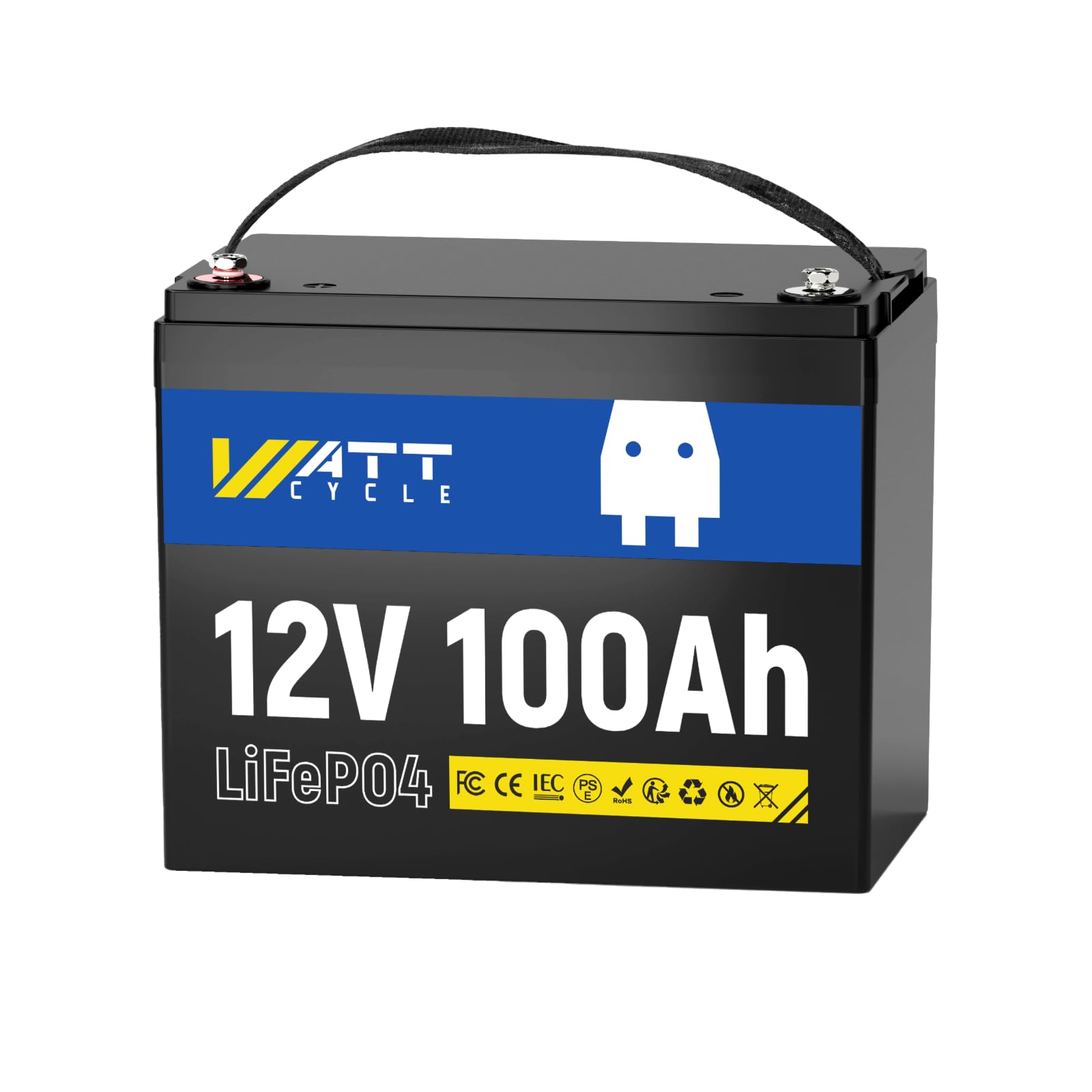
A Group 24 powerhouse that balances a massive 15000-cycle rating with genuine buyer-verified capacity.
The Wattcycle delivers the one-two punch serious buyers want: a dense 100Ah capacity held in a BCI Group 24 box, which means it slims down into spaces where many larger Group 31 batteries will not fit. It weighs only 23.2 pounds, making it a clean fit for an RV battery tray or a boat compartment without needing to rework brackets. Buyers report that it delivered exactly the rated capacity under real-world testing — one reviewer charged from 50% SoC and got ~47Ah in 3h46m, then ~46Ah in another 3h38m, confirming the 100Ah rating is genuine.
Under the hood, it uses A+ grade LiFePO4 cells (lithium iron phosphate, a stable chemistry) and a 100A BMS (battery management system, an internal circuit board that protects the battery) that automatically disconnects if the discharge current hits 300±50A. This is important: the BMS protects against the most common overload and short-circuit scenarios. The operating temperature range stretches from -4°F to 158°F, with low-temperature protection that shuts down charging in freezing weather to prevent cell damage. Unlike the HumsiENK below, which also carries a 15000-cycle claim, the Wattcycle needs a visual check on the bolts — a buyer found the stock M8 bolts were only 1/2″ long, sometimes too short for parallel connections, and recommended replacing them with M8x16mm bolts.
For tight spaces, the Wattcycle’s Group 24 size packs 100Ah without sacrificing capacity.
What Stands Out
- Compact BCI Group 24 size saves space over Group 31 models like the Redodo
- Buyer-verified full capacity with measured charge acceptance data
- Full safety certifications: SDS, UN38.3, FCC, CE, ROHS
One Thing to Note
- Stock bolt posts are short — plan to buy M8x16mm bolts for secure parallel connections
- No Bluetooth monitoring built-in (a third-party monitor may be needed)
Best for you if: you need a high-capacity battery for an RV, solar system, or boat with limited compartment space and want proven capacity from a well-reviewed mid-range option.
Consider something else if: you want a built-in Bluetooth app or prefer the heavier-duty terminal hardware of a Group 31 battery.
2. HumsiENK 12V 100Ah LiFePO4 Battery

An IP67 waterproof battery that packs 15000+ cycles and a built-in nylon handle for true portability.
The HumsiENK brings two rare features to the table: an IP67 waterproof rating (meaning it is dust-tight and can survive immersion in up to 1 meter of water for 30 minutes) and a built-in nylon handle that makes lugging the 24.9-pound battery noticeably easier. At 15000+ deep cycles, it claims the longest lifespan on this list — 2.5 times the cycle count of many 6000-cycle batteries — and the BMS recovers automatically from low temperature, over-discharge, overcharge, and short circuits without needing manual resets. Owners mention that one unit ran an 8000 BTU air conditioner for 11 hours straight and only dropped to 50% charge, which backs up the real-world energy density.
This battery supports fast charging in as little as 2 hours using a solar panel, generator, or grid power — six times faster than traditional lead-acid. It is expandable up to 4S4P, allowing you to build a 48V 400Ah (20.48kWh) bank. If you are comparing it to the Wattcycle above, the key difference is physical fit: the HumsiENK is a Group 24 size with slightly larger dimensions, and it weighs 11.3 kg versus 10 kg.
The IP67 waterproof build makes this a standout for wet compartments.
Why Buy This One
- IP67 waterproof — no other battery on this list matches this level of environmental protection
- Fast-charging: 2 hours to full from 0% with a compatible charger
- Buyer-verified runtime: 8000 BTU A/C for 11 hours to 50% DoD
The Trade-off
- Heavier than some competitors at 24.9 lbs vs the Wattcycle’s 23.2 lbs
- No Bluetooth app integration for real-time monitoring
Reach for this if: you need a weatherproof battery for a boat, outdoor solar setup, or any installation where moisture is a concern — and you want the fastest charging in the category.
Look elsewhere if: saving every ounce matters, or you need Group 31-size terminal spacing for your existing tray.
3. Dumfume 12V 100Ah LiFePO4 Battery

The entry-level champion that delivers 1280Wh of usable energy at a price that punches well below its weight class.
The Dumfume is the budget-friendly option on this list, but that does not mean it skimps on capability. It holds 1.28kWh of energy in a case that weighs just 22.05 pounds — 2/3 lighter than a conventional 100Ah AGM battery (which runs about 63.9 pounds). Buyers confirm that it works reliably for solar backup and PC power: one reviewer explicitly noted the “full capacity confirmed for PC backup” and praised the “low price, great performance.” The 100A BMS protects against overcharging, over-discharging, short circuits, overheating, and overcurrent, and the battery is built with Grade A lithium iron phosphate cells.
Cycle life scales with depth of discharge (DoD, how much you drain it): you get 4000+ cycles at 100% DoD, 6000+ cycles at 80% DoD, and up to 15000+ cycles at 60% DoD. The ABS casing is high-strength, impact-resistant, heat-resistant, weather-resistant, and fire-resistant, but it is important to note the manufacturer states it is “dustproof and weather resistant (not waterproof)” — so it should not sit exposed to rain or direct hose spray. It also requires temperatures above 41°F (5°C) for charging, lower than the HumsiENK’s -4°F rating, so this is not for a freezing garage in winter.
If you are on a tight budget but still want real LiFePO4 performance with a solid BMS, this is the most honest value in the lineup.
What You Get
- Strong value: lowest price in the roundup with verified full capacity
- Fire-resistant ABS casing for added safety in tight compartments
- Supports series and parallel (up to 4S4P for 51.2V 400Ah systems)
The Catch
- Not waterproof — do not install in wet compartments
- Requires charging temperatures above 41°F, limiting cold-weather use
Best suited for: first-time lithium buyers on a budget who need a reliable 100Ah battery for a camper or small solar system and can keep it dry and above 41°F.
Not ideal if: you need IP67 waterproofing or plan to charge the battery in freezing conditions.
4. Redodo 12V 100Ah LiFePO4 Battery
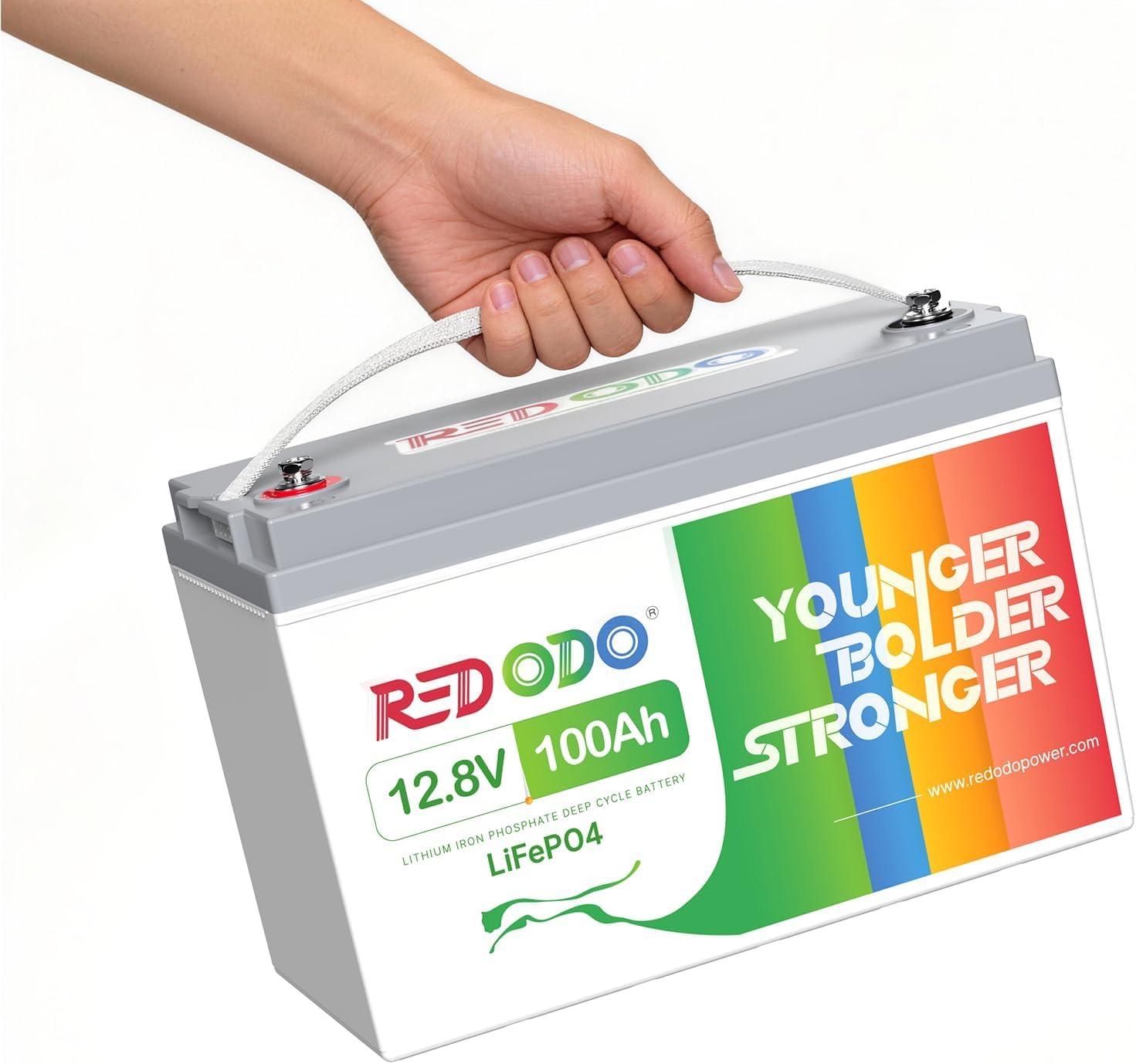
A Group 31 battery built for drop-in replacement — 60% lighter than lead-acid with the same footprint.
The Redodo is designed specifically as a drop-in replacement for Group 31 lead-acid batteries. It measures 13 x 6.77 x 8.43 inches and weighs just 22.04 pounds, a 60% weight reduction from the typical 63.89-pound lead-acid equivalent. That weight saving makes a real difference on a travel trailer tongue or a boat. The battery is rated at 4000 cycles at 100% depth of discharge and up to 15000 cycles at 60% DoD, and the built-in 100A BMS covers overcharge, over-discharge, over-current, short circuit, and high temperature. Buyers have used it for solar backup systems running a router, WiFi, desktops, a fish tank, and a freezer 24/7 — the battery stayed above 80% charge even after hours of use.
One creative buyer retrofitted it into an electric mower, replacing the original lead-acid batteries: they reported consistent high voltage with no bogging in tall grass and extended runtime from 20 minutes to an entire lawn with 90% charge left. The battery supports four charging methods (LiFePO4 charger, solar panel with controller, alternator, and generator). However, the manufacturer warns that the 100Ah battery is suggested for a 30-70 lbs thrust trolling motor and is not suitable as a starter battery.
The Redodo is a proven drop-in replacement for Group 31 lead-acid trays at a reasonable price.
Reasons to Pick It
- True Group 31 drop-in size — identical footprint to standard lead-acid
- Buyer-verified use as an electric mower battery: entire lawn on one charge
- Excellent customer support: staff helped configure a Renogy Rover controller
Limitation
- Not suitable for starting engines or high-cranking applications
- The maximum capacity at Group 31 size is 100Ah — no higher Ah option in the same case
Choose this if: you are swapping out a dead lead-acid battery in a Group 31 tray and want the lightest, most reliable lithium equivalent that fits without modifications.
skip it if: you need a Group 24 size for a smaller compartment.
5. power queen 12V 100Ah LiFePO4 Battery
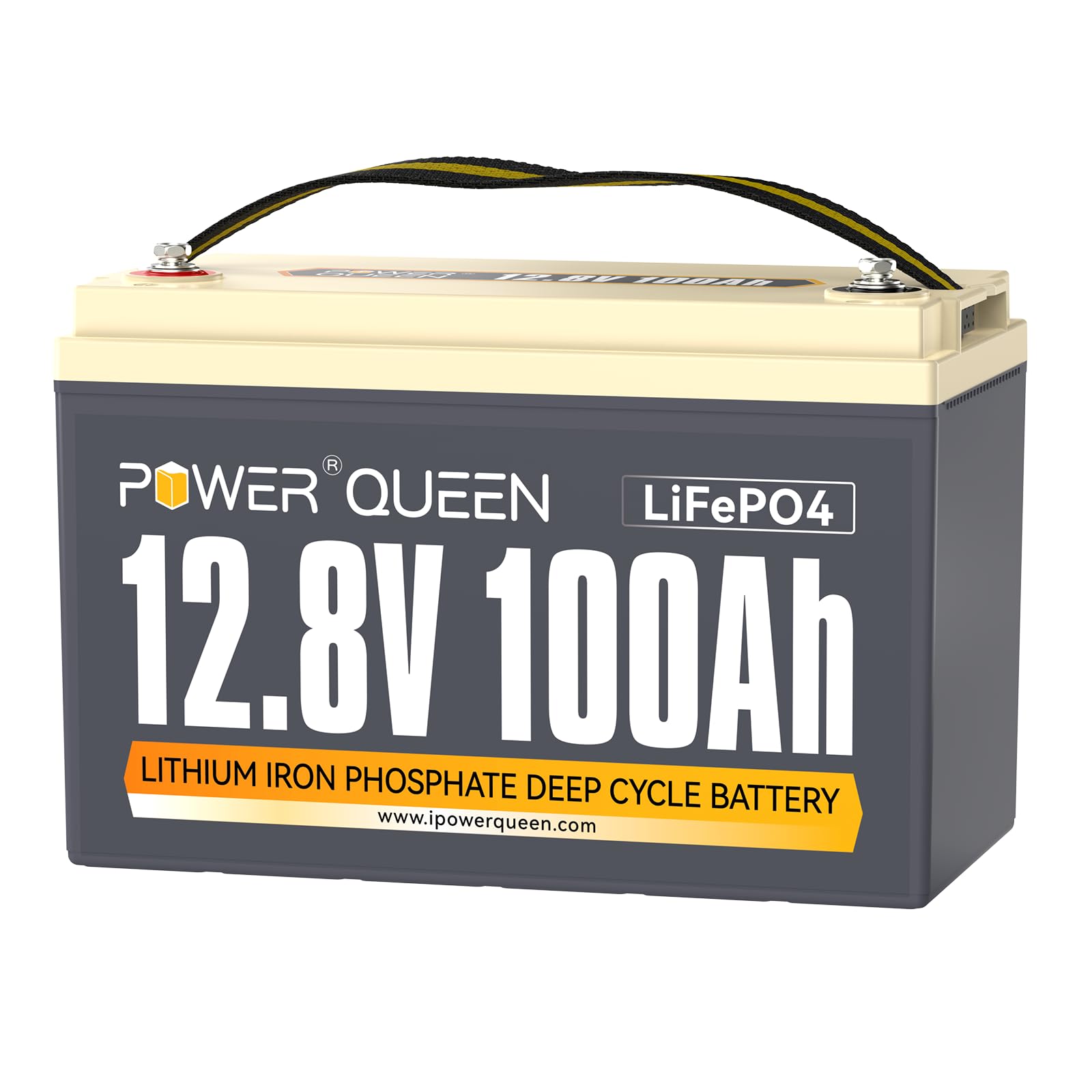
A Group 31 battery that genuinely weighs only 22 pounds and delivers 1280Wh of reliable energy storage.
The power queen is a straightforward no-frills Group 31 battery that gets the basics right. It uses Grade-A LiFePO4 cells for stable voltage, and at 22 pounds for a Group 31 size it is 2/3 lighter than a comparable lead-acid battery. This weight difference is meaningful: a buyer with arthritis specifically mentioned it was “very light, easy to lift” — not just a spec sheet claim but a real accessibility advantage. The battery comes with a 100A BMS covering overcharge, over-discharge, short circuits, and overheating. One buyer tested it on a sailboat with three units in parallel and measured a true 102 Ah from full charge, slightly above the rated capacity.
Series and parallel connections support up to 4S4P (51.2V 400Ah, or 20.48kWh). The battery is also rated for use with 30-70 lb trolling motors. However, the manufacturer’s included bolt is just a 6mm diameter with a 13mm head, which a reviewer noted “feels easy to cross-thread” — they recommended an aftermarket terminal adapter kit for a more durable connection. There is no built-in Bluetooth, unlike the Litime below.
The power queen is a lightweight Group 31 battery tested above its 100Ah rating.
What We Like
- Genuinely lightweight for a Group 31 at only 22 lbs — one buyer with arthritis praised the easy lifting
- Buyer test showed 102 Ah actual capacity, exceeding the rated 100 Ah
- Grade-A LiFePO4 cells for stable voltage delivery
Watch Out For
- 6mm terminal bolts feel fragile — consider an adapter kit for secure connections
- No Bluetooth or integrated monitoring
Grab this if: you need a genuinely lightweight Group 31 battery for a sailboat, trolling motor, or small RV and value verified capacity over fancy features.
Think twice if: you prefer Bluetooth monitoring or plan to connect heavy-gauge cables frequently.
6. Litime 12V 100Ah Trolling Motor LiFePO4 Battery

A marine-focused LiFePO4 battery with ABYC E-13 compliance and built-in TVS spike protection for trolling motors.
The Litime is built for the marine environment in a way few others are. It meets the ABYC E-13 standard (American Boat and Yacht Council, covering safe electrical practices on boats) and includes triple BMS protection against dust, water, and salt spray. It also adds a TVS (Transient Voltage Suppressor, a component that absorbs sudden voltage spikes) that shields 12V-36V trolling motors from voltage spikes in rough water — a feature unique among this roundup. The low-temperature protection is also particularly sturdy: the battery stops charging below 32°F and stops discharging below -4°F, preventing cold-related cell damage. Buyers confirm it handles hard use: one ran a 36V Minnkota Ultrex brushed motor on a bass boat for 5 hours and used only 10% of the 100Ah capacity, while another pushed a 16-foot jonboat with three large adults into an 8 mph headwind for 4 hours and hardly discharged it.
At 22.16 pounds in a standard Group 31 case, it is 64% lighter than a 100Ah lead-acid battery. Cycle life is rated at 4000+ cycles at 100% DoD, and it expands up to 4P4S (51.2V 400Ah, 20.48kWh). The only catch is that batteries can arrive in “sleep” mode with no wake-up instructions — a buyer noted needing a Noco charger in force mode to wake them, but once activated they worked perfectly. The Litime also includes Bluetooth app monitoring, which the power queen and Wattcycle lack.
This battery is purpose-built for corrosive, vibration-heavy marine environments.
Marine-Specific Pros
- ABYC E-13 certified with triple protection against dust, water, salt spray
- TVS spike protection extends trolling motor life in rough water
- Bluetooth app for real-time charge and health monitoring
Consider This
- May arrive in sleep mode — requires a Noco charger force mode to wake
- 4000+ cycle count is lower than the 15000-cycle claims of other brands
Get this if: your primary use is a trolling motor or any saltwater/rough-water marine application — the TVS protection and ABYC certification add real durability that land-based batteries lack.
Consider another option if: you only need a battery for a stationary solar system and do not need the marine-specific hardware.
7. Battle Born Batteries 100Ah 12V LiFePO4
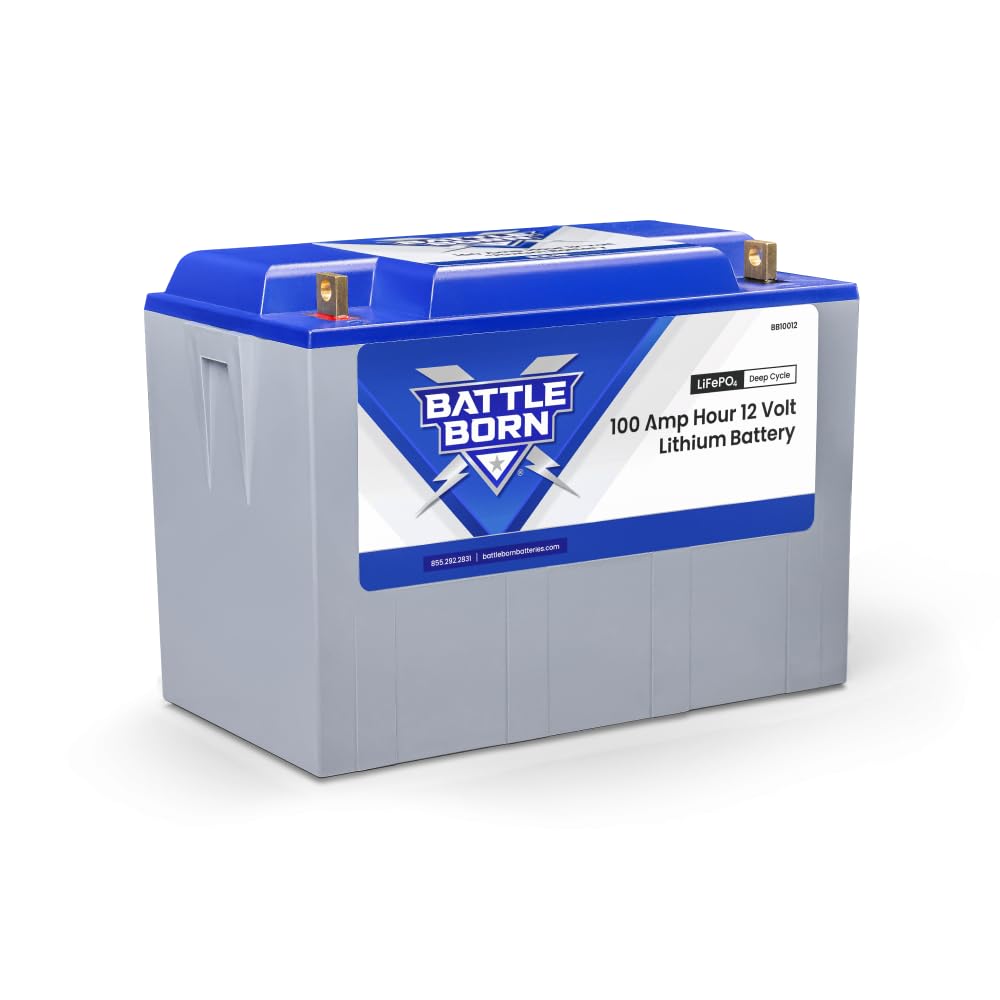
The premium name that backs its product with a 10-year warranty and decades of proven field reliability.
Battle Born is the most established brand on this list, and you pay for that trust. The BB10012 offers 3,000-5,000 deep discharge cycles (up to 10-15 years of use), a 10-year warranty, and a battle-tested internal BMS covering low-temperature protection, high and low voltage, and short circuits. It is a drop-in replacement for both Group 27 and Group 31 battery trays, weighs 31 pounds (heavier than the 22-pound LiFePO4 options above because of thicker casing and heavier-duty internal components), and comes with installation hardware including 5/16″ bolts. Customers note it running an RV for 28 hours versus just 8 hours with lead-acid, and one user powered a 450W heater for 1.5 hours, raising the RV temperature 12°F — all on a single charge.
The catch is real: this is the most expensive battery in the roundup, and the warranty process has drawn complaints. One reviewer noted a slow 8-week warranty claim with a postage cost and a claim of misuse on a 5-year-old battery. That said, other buyers praised the company for replacing a battery free of charge when a BMS issue appeared at 1 year. The battery is designed for RV, camper van, boat, trolling motor, and off-grid systems, and its heavier weight suggests a more sturdy internal build that many long-term users prefer.
The Battle Born offers the longest warranty and brand trust, but at a premium cost per capacity.
Advantages
- 10-year warranty is the longest in this roundup
- Proven reliability across thousands of RV and marine installations
- Buyer confirmed 28-hour runtime vs 8 hours with lead-acid
Downsides
- At 31 lbs, it is the heaviest battery in the roundup
- Warranty fulfillment was criticized for slow turnaround and high return shipping cost
- Cycle life (3000-5000) is lower than the 15000-cycle claims of cheaper competitors
Pick this if: you want the most recognized name in the category, the longest warranty, and are willing to pay a premium for a proven track record in RVs and marine applications.
pass on it if: budget is a primary concern — you can get similar capacity for a fraction of the cost from the Dumfume or Wattcycle.
Understanding the Specs
Cycle Life vs Depth of Discharge
This is the single most important spec for a deep cycle battery. Cycle life is the number of times you can drain and recharge the battery before its capacity drops below 80% of the original. But the number depends entirely on how deep you discharge it each time. A battery rated for 4000 cycles at 100% DoD will last 15000 cycles if you only discharge it to 60% each time. Know your typical daily energy use — if you only use half the battery, you effectively triple its lifespan without paying extra.
The 100A BMS Limit
The Battery Management System’s current rating determines the maximum continuous load you can safely draw. A 100A BMS at 12V supports roughly 1200W of continuous power (100A × 12V = 1200W). That is enough for most RV appliances, a trolling motor, or a small inverter. But if you plan to run a 2000W inverter at full load, you would exceed the 100A limit and the BMS would shut down the battery to protect it. For high-draw applications, consider wiring two batteries in parallel to split the load.
FAQ
Can I use a 100Ah LiFePO4 battery as a starter battery for my car or truck?
How many 100Ah batteries do I need to run a 2000W inverter?
What is the difference between Group 24 and Group 31 battery size?
Can I charge a 100Ah LiFePO4 battery with my existing lead-acid charger?
How long will a 100Ah battery run a 12V refrigerator?
Is it safe to connect a 100Ah LiFePO4 battery in series to get 24V or 48V?
What temperature is too cold for charging a LiFePO4 battery?
How often should I fully recharge a 100Ah deep cycle battery to maximize its life?
Final Thoughts: The Verdict
For most buyers, the best 100ah deep cycle battery is the Wattcycle 12V 100Ah LiFePO4 because it delivers a massive 15000-cycle rating, buyer-verified capacity, and a compact Group 24 size that fits nearly any RV or boat tray without the premium price tag. If you need a weatherproof battery that can handle rain and salt spray, the HumsiENK 12V 100Ah IP67 rating and fast 2-hour charging make it the clear choice. And for those on a tighter budget who still want genuine LiFePO4 performance, the Dumfume 12V 100Ah offers the best value-to-capacity ratio in the entire roundup.
How We Picked
We do not accept paid placement, and we did not hands-on test every unit. Instead, we match each pick to a real buyer and use-case by comparing the manufacturers’ published specifications against the patterns in verified customer reviews — so you get each pick’s real strengths and trade-offs instead of marketing copy.
Sources & Methodology
Specifications: manufacturer listings and product documentation. Review insights: verified customer reviews, as of July 2026. Pricing: not shown on this page (it changes often); check the current price via the retailer link.
As an Amazon Associate, Gadgets Feed earns from qualifying purchases. This does not affect which products we feature.
Product prices and availability are accurate as of the date/time indicated and are subject to change. Any price and availability information displayed on Amazon at the time of purchase will apply to the purchase of this product. As an Amazon Associate I earn from qualifying purchases.
CERTAIN CONTENT THAT APPEARS ON THIS SITE COMES FROM AMAZON. THIS CONTENT IS PROVIDED "AS IS" AND IS SUBJECT TO CHANGE OR REMOVAL AT ANY TIME.
Amazon and the Amazon logo are trademarks of Amazon.com, Inc. or its affiliates.