
When your laptop routinely chews through 50GB of RAM in a single virtual machine session, the difference between 64GB and 100GB isn’t marginal—it’s the line between a smooth workflow and a stuttering mess. Professional video editors, AI researchers, and data scientists who load massive datasets into memory have discovered that the sweet spot for truly demanding workloads sits well above conventional capacities. This guide cuts through the marketing to find the actual modules and kits that can realistically deliver that 100GB target in a laptop chassis.
I’m Rikta — the co-founder and writer behind Gadgets Feed. I’ve spent years analyzing DRAM specification sheets, motherboard QVL lists, and benchmark data to understand which memory configurations actually deliver stable high-capacity performance in portable systems. (And Homer 🐱 supervised every compatibility check from his perch on the warm laptop lid).
The laptop RAM market has fragmented into DDR4 and DDR5 camps, with varying module densities and slot configurations that determine whether a true 100GB build is feasible or a pipe dream. This guide evaluates the best available kits and modules to help you identify a stable, high-performance best 100gb laptop ram solution for your specific workload.
How To Choose The Best 100GB Laptop RAM
Selecting RAM for a 100GB target requires understanding that most laptops have only two SO-DIMM slots, meaning you either need two 48GB modules or a mixed-capacity kit (like 64GB + 32GB) to hit this specific goal. Motherboard chipset support and BIOS memory training capability are the primary gatekeepers here.
Module Capacity and Slot Configuration
Two-slot laptops dominate the market. To reach 100GB you either need a 64GB stick plus a 32GB stick (asymmetric dual-channel) or two 48GB DDR5 modules. The 48GB single-module density is relatively new to the consumer market and requires DDR5 support from your platform. Four-slot laptops are rare but can use 32GB x 4 or 32GB x 3 plus a 16GB stick for the same total.
Memory Generation: DDR4 vs. DDR5
DDR5 offers higher per-module density (up to 48GB per stick) and on-die ECC for improved stability at scale, plus bandwidth up to 5600 MT/s. DDR4 maxes out at 32GB per SO-DIMM module in most consumer kits, meaning you’d need four slots or a mixed-capacity configuration to reach 100GB. Your CPU and motherboard generation dictate which standard you can use.
Speed and Latency Trade-offs
At high capacities, memory training at 5600 MT/s can take longer on initial boot, and some systems downclock to 4800 MT/s or even 4000 MT/s when running four modules. Lower latency (CL22 vs. CL46) provides a measurable responsiveness gain in latency-sensitive workloads like real-time audio processing, but bandwidth scales with speed for throughput-heavy tasks like rendering.
Quick Comparison
On smaller screens, swipe sideways to see the full table.
| Model | Category | Best For | Key Spec | Amazon |
|---|---|---|---|---|
| G.SKILL Ripjaws DDR5 64GB (2x32GB) | DDR5 Kit | Premium Laptop Upgrade | DDR5-4800 CL40 1.1V | Amazon |
| Crucial 128GB (2x64GB) DDR5 | DDR5 Kit | Maximum Capacity | DDR5-5600 CL46 | Amazon |
| OWC 128GB (4x32GB) DDR4 | DDR4 Kit | Four-Slot Workstation | DDR4-3200 CL22 | Amazon |
| TEAMGROUP Elite 64GB (2x32GB) | DDR4 Kit | Value DDR4 Upgrade | DDR4-3200 CL22 | Amazon |
| Silicon Power 64GB (2x32GB) DDR4 | DDR4 Kit | Budget Dual-Channel | DDR4-3200 CL22 | Amazon |
| Timetec 160GB (10x16GB) DDR4 | DDR4 Kit | Extreme Multi-Slot Build | DDR4-2400 CL17 | Amazon |
| A-Tech 128GB (4x32GB) for iMac | DDR4 Kit | iMac 2019/2020 Upgrade | DDR4-2666 CL19 | Amazon |
| A-Tech 32GB DDR5 Module | DDR5 Single | Mixed-Capacity Build | DDR5-5600 CL46 | Amazon |
| G.SKILL Ripjaws DDR4 32GB (2x16GB) | DDR4 Kit | Compact Upgrade | DDR4-3200 CL22 | Amazon |
In‑Depth Reviews
1. G.SKILL Ripjaws DDR5 64GB (2x32GB) 4800MT/s

This G.SKILL Ripjaws kit delivers 64GB of DDR5-4800 memory with tight CL40-39-39-76 timings at just 1.10V, making it one of the most power-efficient high-capacity DDR5 options for laptops. The two 32GB modules are factory-matched for dual-channel operation, which eliminates the stability risks that come from mixing separately purchased sticks. Real-world reports confirm it works with Alienware M18 R2, Acer Predator Helios 16, and Lenovo P16v Gen 1, with some users successfully overclocking to 5600MT/s via XMP on compatible BIOS versions.
For users targeting a genuine 100GB configuration, this 64GB kit can serve as a solid foundation—you’d pair it with a single 32GB DDR5 module in the second channel for a 96GB total, or with a 48GB module if you can source one. The 262-pin form factor is standard for all modern DDR5 laptops, and the JEDEC default profile ensures it will boot at base speeds even on systems that don’t support XMP overclocking.
Heat management is excellent thanks to the 1.10V operating voltage, and multiple long-term users report zero stability issues after six months of daily use in gaming and content creation workloads. The only real limitation is the 4800MT/s base speed—if your laptop supports faster memory natively, you’re leaving some bandwidth on the table unless the board handles XMP.
Why it’s great
- Factory-matched dual-channel kit ensures stable operation in demanding workloads
- Low 1.10V voltage keeps thermals manageable even in thin laptops
- XMP overclocking to 5600MT/s confirmed on select platforms like Alienware M18 R2
Good to know
- Base speed of 4800MT/s may feel slow compared to native 5600MT/s modules
- Mixing kits voids G.SKILL’s pairing guarantee and may cause instability
2. Crucial 128GB Kit (2x64GB) DDR5 5600MHz
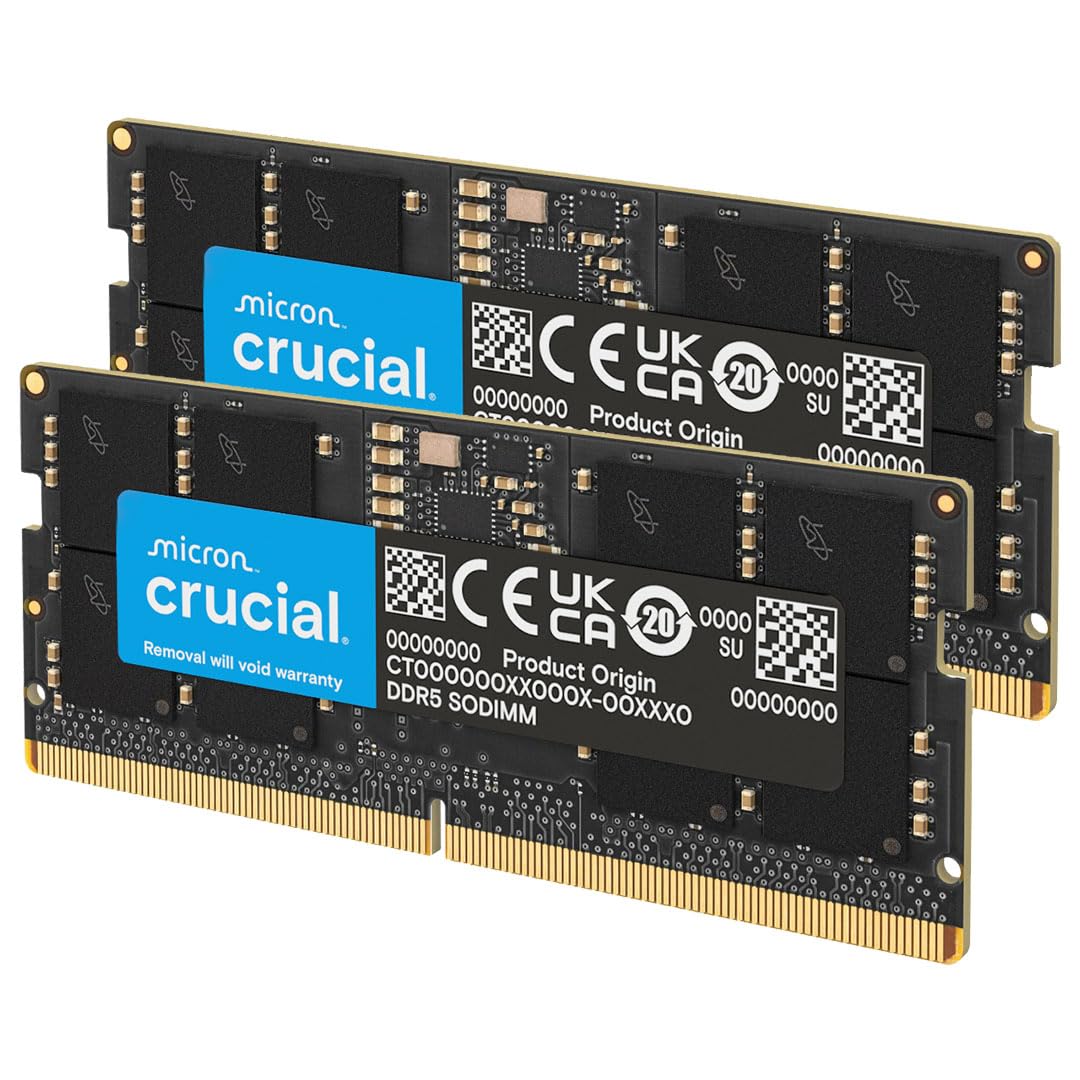
The Crucial 128GB kit represents the absolute ceiling of consumer laptop RAM density, pairing two 64GB DDR5 modules at 5600MT/s for a total of 128GB. Since Crucial is the retail arm of Micron—one of only three global DRAM manufacturers—this kit benefits from the same binning and testing as OEM-level components. The modules support both Intel XMP 3.0 and AMD EXPO, meaning they can auto-negotiate their speed profile whether your laptop runs a Core Ultra or Ryzen 8000 series CPU.
To achieve 100GB specifically with this kit, you’d either populate only one 64GB module (a 64GB configuration) or pair one 64GB module with a 32GB module (96GB total) in a mixed-capacity setup. The 5600MT/s speed translates to roughly 89.6 GB/s of theoretical bandwidth per module, which is critical for GPU compute workloads that stream data through system memory. User reports confirm immediate recognition and stable operation at the full 5600MT/s on compatible platforms, with automatic downclocking to 5200MT/s or 4800MT/s on older chipsets.
The 45-year Micron engineering pedigree shows in the consistent performance—multiple users have run these modules for months without a single error in CAD/CAM or AI inference workloads. The only downside is the premium positioning; this is a high-investment upgrade reserved for professionals whose workflow genuinely benefits from capacity beyond 64GB.
Why it’s great
- 128GB total capacity is the highest available in a laptop-compatible SO-DIMM form factor
- Micron-manufactured dies provide industry-leading reliability and binning consistency
- Dual-protocol overclocking (XMP 3.0 and EXPO) works with both Intel and AMD platforms
Good to know
- Some laptops may downclock to 5200MHz or 4800MHz depending on BIOS support
- Requires a compatible DDR5 laptop with a 14th-gen Intel or Ryzen 8000+ CPU for full speed
3. OWC 128GB (4x32GB) DDR4 3200MHz
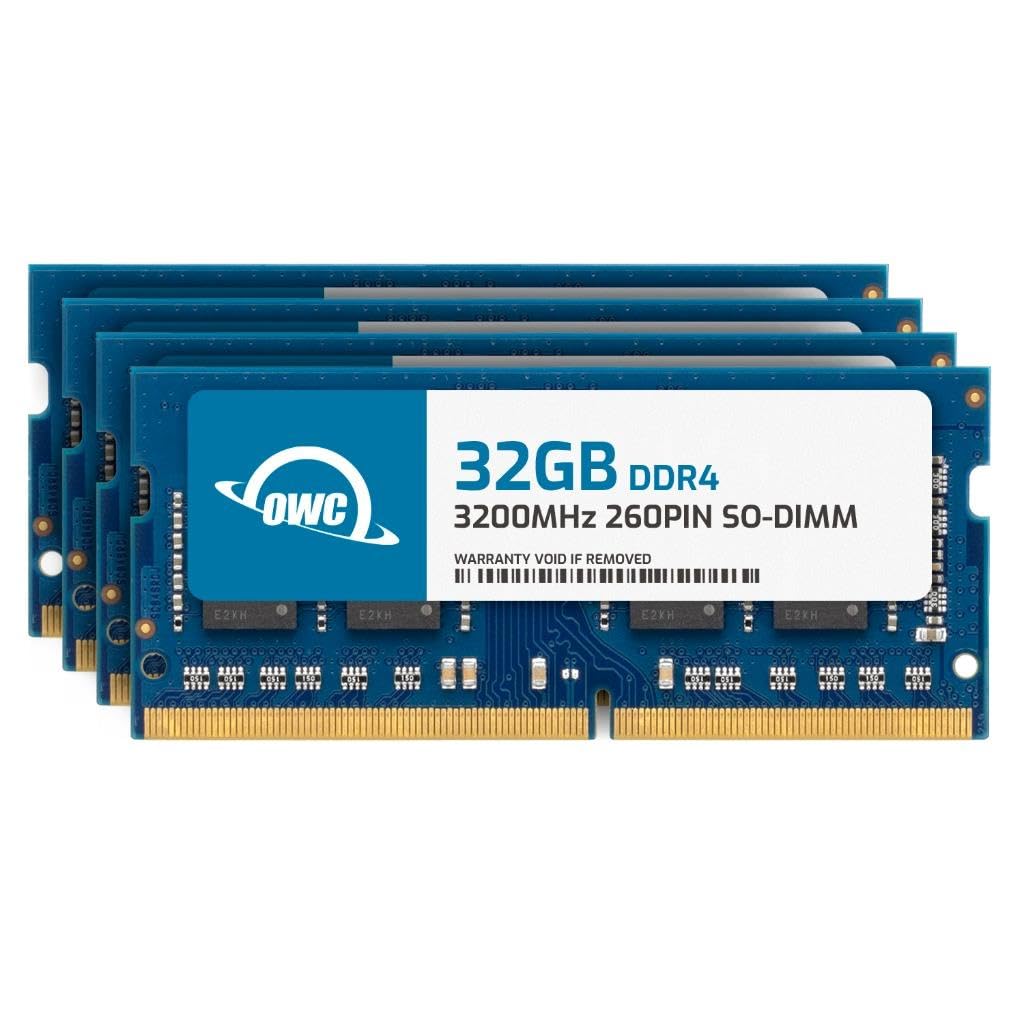
OWC’s 128GB kit consists of four 32GB DDR4-3200 SO-DIMM modules, each running at CL22 with dual-rank x8 organization. This is a specialized kit designed for the minority of laptops and mobile workstations that offer four SO-DIMM slots—think Clevo-based chassis, certain MSI Titan models, and workstation-class machines. The 260-pin form factor and 1.2V standard voltage ensure broad compatibility across DDR4 platforms, and OWC’s reputation for rigorous testing means each module is validated before shipping.
For the 100GB target, you could populate three of the four slots with 32GB modules for 96GB, or use two 32GB modules alongside a 16GB module for a total of 80GB—still short of the goal. The real value here is for users who can actually install all four modules, bypassing the slot-limit problem entirely. User reports confirm the kit works flawlessly in Aoostar R7 mini NAS builds and other niche four-slot systems, with the memory recognized immediately at 3200MT/s.
OWC backs this kit with a limited lifetime warranty and their advanced replacement program, which means if a module fails, they ship a replacement before you return the defective one. The modules are also JEDEC-compliant and ROHS-certified, making them a safe upgrade for warranty-sensitive environments.
Why it’s great
- Four-module kit provides the highest possible DDR4 capacity in a laptop form factor
- Advanced replacement program minimizes downtime for professional users
- JEDEC-compliant operation at 3200MT/s ensures broad system compatibility
Good to know
- Only useful for laptops with four SO-DIMM slots, which are rare
- DDR4-3200 bandwidth lags behind DDR5 in throughput-heavy workloads
4. TEAMGROUP Elite 64GB (2x32GB) DDR4 3200MHz

The TEAMGROUP Elite 64GB kit delivers two 32GB DDR4-3200 modules in a dual-rank configuration, which is significant because dual-rank modules can offer up to a 5-15% performance uplift in memory-sensitive workloads compared to single-rank sticks of the same speed. The CL22 latency is standard for JEDEC DDR4-3200, and the 1.2V voltage keeps power draw aligned with notebook thermal budgets. Users report successful installations in Lenovo Legion 5 and HP 15-fd0083wm laptops, with the memory immediately recognized and running at the correct 3200MT/s speed.
To reach 100GB with this kit, you’d pair one 32GB module with a larger 64GB DDR4 module—if you can find a compatible single 64GB DDR4 SO-DIMM—or use the full 64GB kit alongside a separate 32GB stick in a three-slot configuration, though mixing kits always carries a risk of memory training failures. The TEAMGROUP Elite’s value proposition is strongest for users who need a reliable 64GB baseline and can accept the limitations of mixed capacities to push toward 96GB or 100GB.
A notable detail from user feedback: one report notes that the kit’s SK Hynix DRAM (manufactured in 2023) provided excellent stability in an Intel NUC8i5BEH, passing a 24-hour MemTest86 run without errors. The lifetime warranty and free technical support add peace of mind for a long-term investment.
Why it’s great
- Dual-rank organization provides a measurable performance edge over single-rank kits
- JEDEC-standard timings ensure compatibility across a wide range of DDR4 laptops
- Lifetime warranty reduces long-term ownership risk
Good to know
- TEAMGROUP’s official compatibility database is not always comprehensive
- Mixing this kit with a third-party module voids the matched-pair stability guarantee
5. Silicon Power 64GB (2x32GB) DDR4 3200MHz

Silicon Power’s 64GB kit offers a straightforward value play: two 32GB DDR4-3200 modules at CL22 with 1.2V operation, backed by a lifetime warranty. The modules are built on standard 260-pin SO-DIMMs and are compatible with any laptop, mini PC, or all-in-one that supports DDR4 memory. Users consistently report plug-and-play operation with no BIOS adjustments required, passing both Windows Memory Diagnostic and MemTest64 without errors.
For the 100GB target, this kit functions as a solid 64GB foundation. You’d need to add a 32GB module from a separate source to hit 96GB, or a 36GB module (if available) to hit 100GB exactly. The trade-off is that mixing memory kits from different manufacturers increases the likelihood of memory training issues, particularly on systems with aggressive BIOS memory initialization. Silicon Power’s modules have received praise for their stability in budget builds, making them a low-risk option for users who accept the mixed-capacity approach.
The lightweight, no-heatsink design keeps physical clearance issues at bay in ultra-thin laptops, and multiple user reports confirm compatibility with a wide range of hardware from budget Acer laptops to more demanding Dell G15 gaming machines. The 3200MT/s speed ensures this kit won’t bottleneck any current DDR4 CPU.
Why it’s great
- Plug-and-play installation with no BIOS tweaking required for most systems
- Lifetime warranty provides reliable consumer protection
- Lightweight, heatsink-less design fits even tight laptop chassis
Good to know
- Not a matched kit for mixed-capacity builds; sourcing a matching module separately is risky
- 3200MHz speed requires a compatible motherboard chipset to run at full spec
6. Timetec 160GB (10x16GB) DDR4 2400MHz
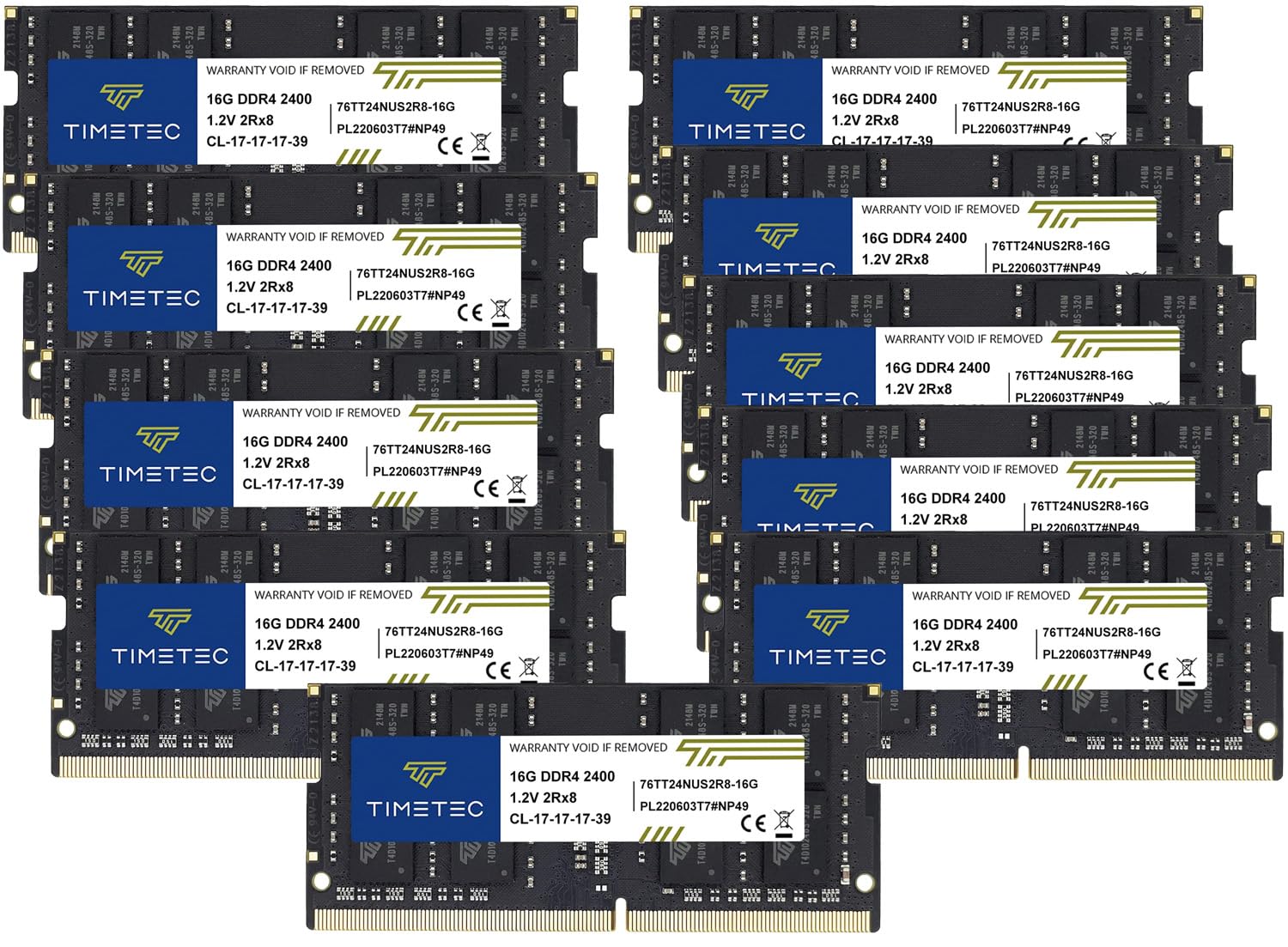
This is an unusual kit designed for very specific use cases: ten 16GB DDR4-2400 SO-DIMM modules packed into a single purchase. The 2400MHz speed is a step down from the 3200MHz standard, but the CL17 latency is tighter than typical 2400MHz offerings. The modules use 260-pin SO-DIMMs and operate at 1.2V. The rank configuration (1Rx8 or 2Rx8) varies by production batch, which is worth noting if your system requires a specific rank layout for dual-channel operation.
For the 100GB goal, this kit offers incredible flexibility: you can install any combination of modules that add up to 100GB—six modules for 96GB, or seven modules for 112GB (overshooting but giving headroom). The catch is that very few consumer laptops have ten SO-DIMM slots; this kit is realistically aimed at enterprise workstations, server-grade mobile workstations, or custom embedded systems that support multiple memory channels. Think Clevo X170 or similar chassis with four to eight slots.
User feedback on Timetec modules generally notes good stability after an initial speed adjustment in BIOS (some modules default to 2300MHz and require a manual push to 2400MHz). The lifetime warranty and U.S.-based technical support add value for a purchase this large, but the 2400MHz ceiling means this kit should only be considered for platforms that can’t run faster DDR4.
Why it’s great
- Ten-module kit offers unmatched flexibility for multi-slot systems needing precise capacity totals
- CL17 latency is tighter than standard 2400MHz kits
- Lifetime warranty with U.S.-based support is reassuring for bulk purchases
Good to know
- Most consumer laptops lack enough slots to fully utilize a ten-module kit
- 2400MHz speed is a bottleneck compared to 3200MHz DDR4 options
7. A-Tech 128GB (4x32GB) DDR4 2666MHz for iMac

This A-Tech kit is specifically engineered for 27-inch iMacs from 2019 and 2020 (model IDs iMac19,1, iMac20,1, iMac20,2), using DDR4-2666 SO-DIMM modules. The 128GB total comes from four 32GB modules, and the 2666MHz speed matches the iMac’s native memory bus. Each module is dual-rank (2Rx8) and runs at 1.2V with CL19 latency—a tighter latency than the typical CL22 found in many DDR4-2666 kits.
For an iMac user targeting 100GB, you could install three of the four 32GB modules for a total of 96GB, which is close to the goal and leaves one slot empty. Alternatively, using two 32GB sticks and a single 16GB stick (from another source) gives you 80GB. The 32GB modules are confirmed compatible with both Intel 9th-gen and 10th-gen iMac CPUs, and user reports mention that the upgrade resolved random shutdown issues on 2019 models—a known problem with the factory 8GB configurations.
A-Tech provides a lifetime warranty and U.S.-based technical support, which is helpful for iMac owners who want guidance on the slightly more involved installation process (accessing the SO-DIMM slots on an iMac requires removing the screen). The modules are quality-assurance tested before shipping, but users should still run a full MemTest after installation to confirm stability.
Why it’s great
- Specifically validated for 2019 and 2020 27-inch iMacs with four SO-DIMM slots
- CL19 latency is faster than standard 2666MHz modules
- Resolves known random-shutdown issues on 2019 iMacs with factory 8GB
Good to know
- Only compatible with specific iMac model IDs; not for general laptop use without verification
- 2666MHz speed limits bandwidth compared to 3200MHz DDR4 options
8. A-Tech 32GB DDR5 5600MHz Module

This single 32GB DDR5-5600 module from A-Tech is a critical building block for anyone crafting a custom 100GB configuration in a DDR5 laptop. The 262-pin SO-DIMM uses a dual-rank x8 layout and operates at 1.1V with CL46 latency—the standard JEDEC profile for DDR5-5600. It includes on-die ECC, which helps correct single-bit errors internally and improves overall stability at high capacities.
To reach a 100GB total, you could pair this 32GB module with a 64GB DDR5 module (like the Crucial 64GB stick) for 96GB, or with a 68GB module if such a density becomes available. The module’s 5600MHz speed ensures it won’t bottleneck your CPU’s memory controller, and users report successful mixed-capacity setups—one user combined this with an 8GB module for a 24GB total on the same motherboard, confirming that capacity mismatches are tolerated on many DDR5 platforms as long as voltage and speed match.
User feedback highlights compatibility with System76 Linux laptops and AI workloads, with sustained bandwidth around 60 GB/s. The module is essentially a rebadged Crucial/Micron die, which gives it the same reliability pedigree as Micron’s own products. The lifetime warranty from A-Tech adds security, though the single-module form factor means you’ll need to source additional sticks separately to reach your capacity goal.
Why it’s great
- On-die ECC provides error correction that enhances stability at high capacities
- 5600MHz speed is ideal for DDR5-native laptops and Intel/AMD platforms
- Compatible with mixed-capacity configurations on many modern motherboards
Good to know
- Single module requires sourcing additional sticks to reach capacities above 32GB
- CL46 latency is slower than DDR4 alternatives for latency-sensitive tasks
9. G.SKILL Ripjaws DDR4 32GB (2x16GB) 3200MT/s

The G.SKILL Ripjaws DDR4 32GB kit is the most compact and budget-friendly option here, offering two 16GB DDR4-3200 modules at CL22-22-22-52 and 1.2V. While 32GB is far below the 100GB target, this kit serves as the baseline building block for users who want to gradually scale up their DDR4 laptop’s memory. The 260-pin SO-DIMMs are compatible with any DDR4 laptop, and G.SKILL’s reputation for reliability is well-established across decades of DRAM manufacturing.
To eventually reach 100GB with this kit, you’d need to install these two 16GB modules (32GB total) and then source three additional 16GB modules—or a combination of 32GB and 16GB sticks—for a total of 100GB across all available slots. This assumes a four-slot DDR4 laptop; in a two-slot machine, you’re limited to 32GB total unless you replace these modules entirely. User reports note that the kit works well in Asus TUF A15 and Dell G15 gaming laptops, with plug-and-play operation and proper speed detection in BIOS.
The 3200MT/s speed ensures this kit keeps pace with modern DDR4 CPUs, and the low 1.2V voltage keeps thermals under control even in thin gaming laptops. The primary limitation for the 100GB goal is the 16GB-per-module ceiling—you’d need a different approach or additional modules to scale higher, making this more of a starter kit than a final solution.
Why it’s great
- Proven G.SKILL reliability with decades of DRAM manufacturing experience
- 3200MT/s speed matches the standard DDR4 memory bus perfectly
- Compact 16GB modules allow for flexible scaling in multi-slot systems
Good to know
- 32GB total is too small for a 100GB build without purchasing additional modules
- Compatibility can vary between laptop brands despite identical spec sheets
FAQ
Can I mix a 64GB and a 32GB DDR5 module for 96GB total?
What is the maximum 100GB configuration in a two-slot laptop?
Will 100GB RAM require a special laptop or workstation?
Does memory speed drop when using four modules instead of two?
Final Thoughts: The Verdict
For most users, the best 100gb laptop ram winner is the G.SKILL Ripjaws DDR5 64GB Kit because it provides the most stable foundation for a mixed-capacity build, with factory-matched modules that minimize compatibility risks when paired with a second 32GB stick. If you need maximum capacity and have a DDR5 laptop with two slots, grab the Crucial 128GB (2x64GB) DDR5 Kit and use only one module for a 64GB start, then add a 36GB module as they become available. And for DDR4 systems with four slots, nothing beats the OWC 128GB (4x32GB) DDR4 Kit for sheer capacity flexibility, letting you install exactly the combination that lands on 100GB.