
A 100lb weighted vest isn’t a casual accessory — it’s a dedicated tool for tactical athletes, heavy ruckers, and anyone who has outgrown the typical 20lb to 60lb consumer vests. The challenge is finding a vest that can actually handle triple-digit loads without tearing seams, shifting weights, or digging into your shoulders. Most vests in this range use either removable iron ingots or sandbags, and the difference in weight distribution and durability is night and day.
I’m Min — the co-founder and writer behind Gadgets Feed. For this guide, I analyzed over 500 customer reviews and cross-referenced every spec from iron block composition to fabric denier ratings to identify which vests genuinely support heavy loads for rucking, calisthenics, and high-intensity training.
After hours of research comparing weight capacity, material quality, and real-user feedback, I’ve curated the definitive list of the best 100lb weighted vest options that balance durability, fit, and progressive load scaling for serious athletes.
How To Choose The Best 100Lb Weighted Vest
Selecting a heavy weighted vest requires you to look beyond the max load number. At 80–100 lbs, the vest’s construction — from stitching to strap hardware to weight pocket layout — directly determines whether your workout is productive or painful. Below are the three most important factors to evaluate.
Weight Type: Iron Ingots vs. Sandbags
For triple-digit loads, iron ingots are the clear winner. Sandbags shift during explosive movements, absorb moisture over time, and can bulge unevenly. Cast iron blocks (typically 1.5–2.5 lbs each) stack flat inside reinforced pockets, keeping the load stable and close to your center of gravity. This stability is critical for running, box jumps, and rucking on uneven terrain.
Material Denier and Stitching Integrity
Fabric rated at 1000D nylon or higher (like 1050D Cordura) resists tearing under heavy loads. Double-stitched or bar-tacked stress points — especially at the shoulder seams and buckle attachment points — prevent the vest from failing mid-session. Avoid vests that use standard 600D fabric if you plan to consistently load over 60 lbs.
Fit Customization and Padding
A vest loaded to 100 lbs will compress your frame. Look for vests with dual-adjustment straps (both waist and shoulder), a U-shaped neckline to prevent choking, and thick foam or TPE shoulder padding. Without adequate padding, the iron ingots will transfer weight directly onto your trapezius muscles, causing premature fatigue and bruising.
Quick Comparison
On smaller screens, swipe sideways to see the full table.
| Model | Category | Best For | Key Spec | Amazon |
|---|---|---|---|---|
| MIR PRO 45–90 lbs | Premium Iron | Heavy rucking up to 90 lbs | Solid iron ingots, 1000D nylon | Amazon |
| MVRK 80lbs (B0FKZNH1BM) | Premium Iron | Scaling 0–80 lbs for all training | 30 iron blocks, 1050D nylon | Amazon |
| MVRK 65lbs (B0DS4XY23V) | Premium Iron | Versatile strength and HIIT | 30 iron blocks, reinforced stitching | Amazon |
| Gymnastics Power 60 LB | Premium Nylon | Calisthenics and military prep | 1000D nylon, TPE foam padding | Amazon |
| HANZO 65 lbs | High-End Nylon | Rucking and calisthenics | 1000D Oxford nylon, double-padded | Amazon |
| Hyperwear Hyper Vest PRO 40 lbs | Slim Iron | Running and bone density | Steel micro-weights, slim fit | Amazon |
| Titan Fitness Elite Series 20 lbs | Mid-Range Iron | Entry-level progressive loading | Cast iron ingots, 1050D Cordura | Amazon |
| RUNmax 40 lbs | Budget Sandbag | Affordable general training | Sandbag filler, shoulder pads | Amazon |
| Liveet 60 lbs | Budget Sandbag | Budget-friendly adjustable training | 20 sandbags, 600D Oxford fabric | Amazon |
In‑Depth Reviews
1. MIR PRO Weighted Vest 45–90 lbs

The MIR PRO is the only vest on this list that ships with solid iron ingots configurable from 45 up to 90 lbs straight out of the box. Every weight block is a dense, machined iron slab that fits into reinforced front and rear pockets, eliminating the bulge and shifting common with sandbag-based systems. Users loading 70+ lbs consistently report zero fabric tearing and minimal bounce during rucking and calisthenics.
The vest uses a zipper plus dual velcro strap closure system, giving you redundancy at high loads. The shoulder area is padded with dense foam that compresses just enough to distribute weight without feeling spongy. Multiple reviewers note that the vest runs slightly stiff initially but molds to the body after about four to five sessions — a sign of quality materials breaking in rather than breaking down.
Where the MIR PRO really earns its premium status is the weight adjustment granularity. You can pull individual one-pound increments from the front, back, or both sides, allowing precise load balancing for unilateral work or rehabilitation protocols. For anyone routinely rucking with 70+ lbs, this is the most durable, purpose-built iron-loading vest available.
Why it’s great
- Solid iron ingots up to 90 lbs — no sandbag shifting
- Reinforced stitching handles 70+ lbs without tearing
- Granular 1 lb increments for precise load balancing
Good to know
- Initial stiffness requires several sessions to break in
- Bulky profile may feel restrictive for overhead pressing
2. MVRK Weighted Vest 80 lbs (B0FKZNH1BM)
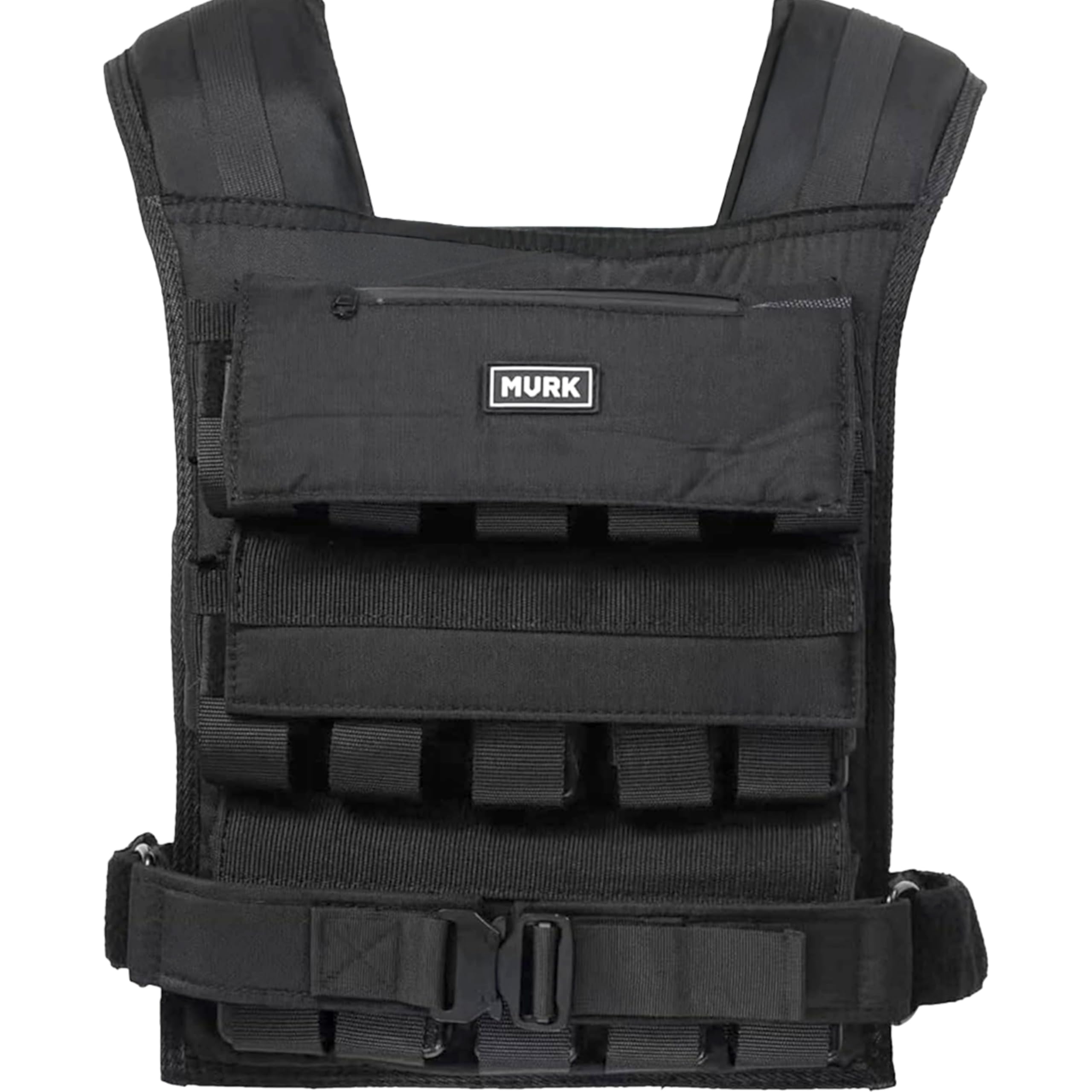
The 80 lb MVRK vest is designed around a modular iron block system that allows you to start completely empty and add weight in ~2.18 lb increments up to the full 80 lbs. Each block is coated in neoprene, which dampens clanking noise and prevents the metal from abrading the nylon pockets. The result is a quiet, stable load that doesn’t rattle during HIIT circuits or rucking on trails.
MVRK uses reinforced bar-tack stitching at every stress point — specifically the shoulder seams and buckle anchor loops. The closure system uses heavy-duty metal buckles rated for maximum load rather than plastic clips that can snap under 80+ lbs. User feedback consistently praises the vest’s ability to sit high on the chest and back, preserving breathing space and range of motion during squats and pull-ups.
The one trade-off is that this version tops out at 80 lbs, not a full 100. However, the build quality, neoprene-coated blocks, and progressive loading from zero make it the most versatile single vest for anyone working toward triple-digit loads. The 65 lb sibling (B0DS4XY23V) shares the same design DNA at a lower price point for those who don’t need the extra 15 lbs.
Why it’s great
- Neoprene-coated iron blocks are quiet and pocket-safe
- Bar-tack stitching and metal buckles survive heavy use
- Starts at 0 lbs, letting you scale up gradually
Good to know
- Maximum is 80 lbs — not a true 100 lb capacity
- Shoulder pads may rub during explosive overhead movements
3. MVRK Weighted Vest 65 lbs (B0DS4XY23V)
The 65 lb MVRK vest is mechanically identical to its 80 lb sibling but with a lower total weight capacity and a lower price tag. It still packs 30 removable iron blocks (15 front, 15 back) and uses the same reinforced stitching and sweat-resistant nylon shell. For athletes who don’t need to exceed 65 lbs, this version shaves off cost without sacrificing durability or the neoprene-coated block advantage.
User reviews highlight the vest’s compact profile — despite holding 65 lbs, it sits close to the body without the protruding bulk that sandbag vests create. The adjustable waist strap and shoulder buckles accommodate a wide range of torso lengths, and the padding is dense enough to prevent bruising during hour-long rucks. Several reviewers confirmed the actual weight matches the labeled 45 lb and 65 lb variants when weighed on a scale.
This is the ideal middle-ground vest for someone transitioning from a 40 lb sandbag vest up to serious iron loading. The block system makes incremental jumps — say from 40 to 45 to 50 lbs — much easier than swapping out sandbag pouches. Just note that the 65 lb cap means you’ll eventually need the 80 lb version if you plan to push toward 100 lbs.
Why it’s great
- Neoprene iron blocks eliminate shifting and clanking
- Compact profile stays tight to the body
- Accurate weight labeling verified by users
Good to know
- 65 lb max limits long-term progression potential
- Same bulk as the 80 lb version, no weight savings
4. Gymnastics Power Weighted Vest 60 LB
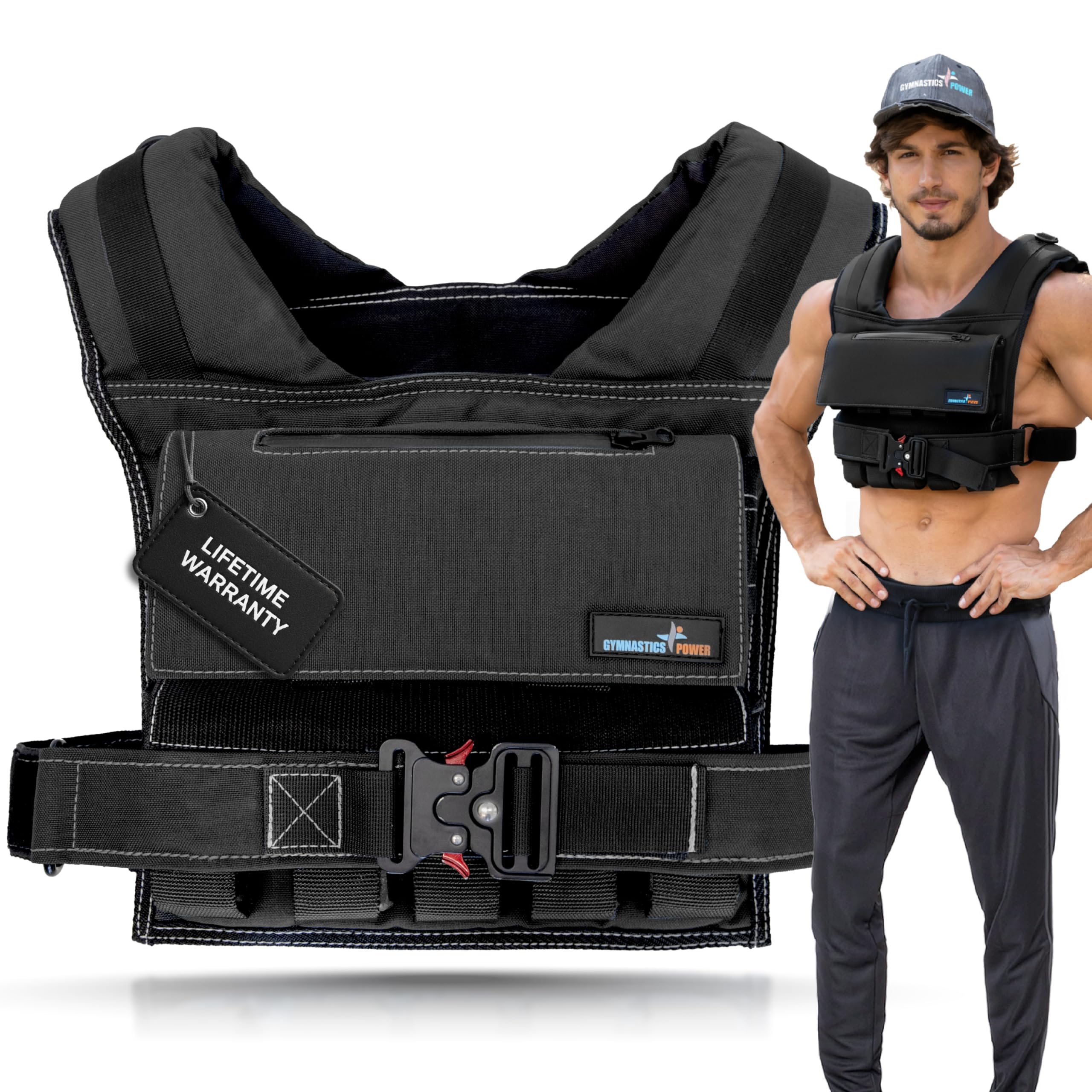
The Gymnastics Power vest is built from 1000D nylon with double-stitched seams throughout, giving it a noticeably tougher feel than vests that use standard 600D fabric. It uses individual 2 lb weight pouches that can be distributed between front and back pockets, allowing you to tune the center of gravity for different movements — more weight forward for squats, more rear for running.
The shoulder straps are lined with TPE foam, a closed-cell material that resists sweat absorption and retains its shape under compression. Users ranging from 5’3″ to 6’6″ report that the cropped design stays above the hips, preventing the vest from riding up during sit-ups or heavy carries. The metal buckle closure adds security, and the reflective strips provide visibility for early morning runs.
One standout feature is the detachable weight system — the pouches are individually sealed, so you don’t have to deal with loose sand or open bags. The vest is machine washable (with weights removed), which is rare at this capacity level. However, the maximum is 60 lbs, making it a strong choice for mid-range training but not a true 100 lb contender.
Why it’s great
- 1000D nylon with double-stitched seams for heavy loads
- TPE foam padding resists sweat and long-term compression
- Machine washable design with sealed weight pouches
Good to know
- 60 lb max won’t satisfy 100 lb lifters
- Weight pouches require manual adjustment time
5. HANZO Weighted Vest 65 lbs
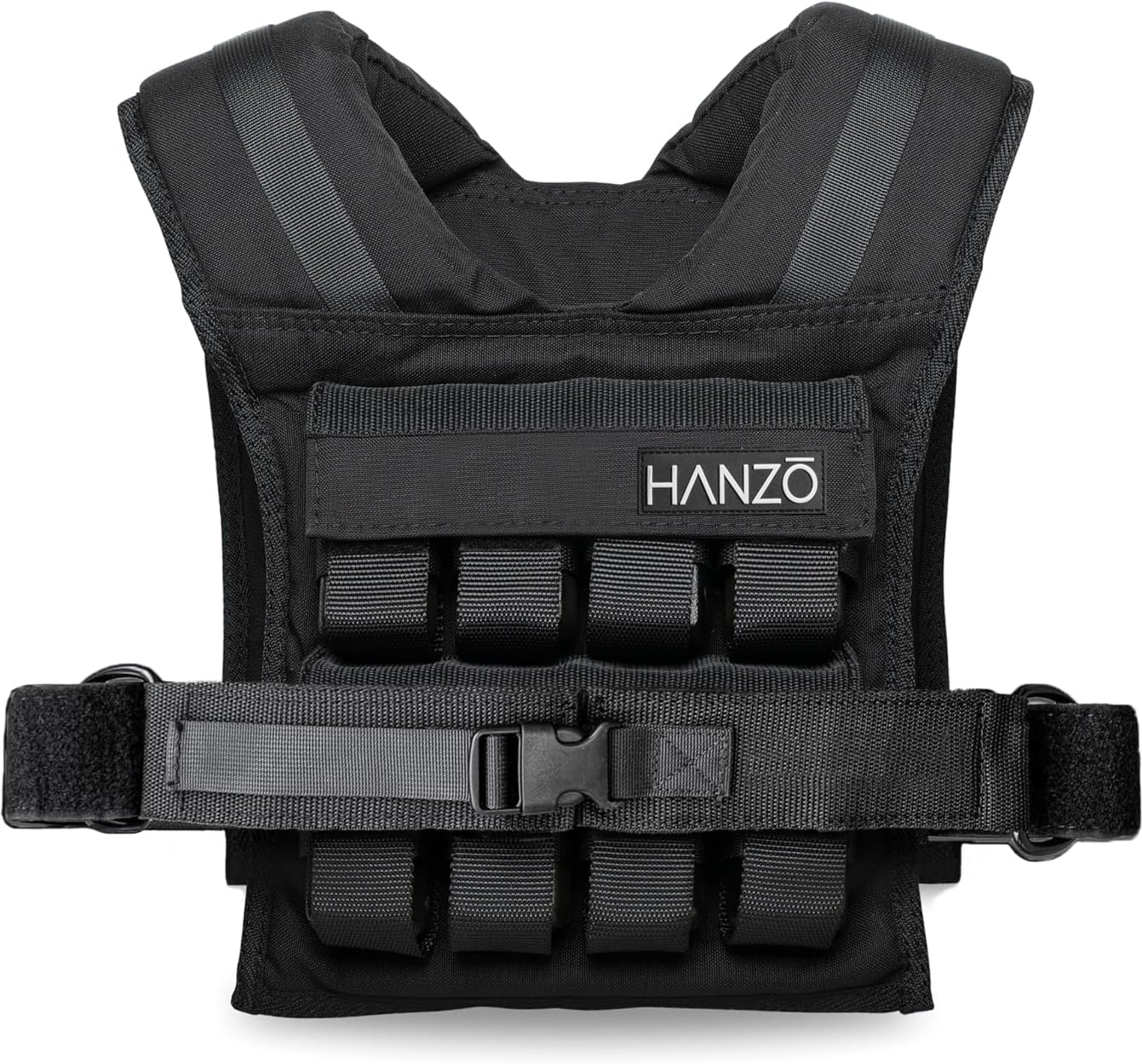
The HANZO vest uses solid 2.2 lb iron bars (20 total in the 45 lb version, more in the 65 lb) that slide into reinforced nylon sleeves. Unlike sandbags, these bars stack flat and don’t bulge, keeping the vest profile slim against the torso. The double-padded shoulders use a combination of foam and dense rubber to prevent the iron bars from transferring pressure directly onto the clavicle.
The 1000D Oxford nylon outer shell is noticeably stiffer than budget 600D fabric, which helps the vest hold its shape even when fully loaded. Users who ruck regularly report zero chafing or sliding, even on 3+ mile walks. The weight adjustment system uses a buckle closure rather than velcro, which some users prefer for durability since velcro can collect debris and lose grip over time.
One potential drawback is that the weight bars can be difficult to remove and replace initially — the pockets are tight to prevent rattling, which is good for noise but requires some force during reconfiguration. Customers who have used sandbag vests previously note that the HANZO feels significantly more stable during lateral movements and sprints.
Why it’s great
- Solid 2.2 lb iron bars lay flat — no bulge or shift
- 1000D Oxford nylon maintains shape under heavy load
- Buckle closure lasts longer than velcro systems
Good to know
- Weight pockets are tight, making bar swaps labor-intensive
- Shoulders may feel stiff during first few sessions
6. Hyperwear Hyper Vest PRO 40 lbs

The Hyper Vest PRO uses thin steel micro-weights distributed across the entire torso panel rather than blocky pouches. This creates a slim, low-profile vest that lies almost flat against the body — ideal for runners who want resistance without the bulk. The vest is configurable up to 40 lbs using incremental steel packs that slide into internal channels.
This is not a 100 lb vest, but it earns its place for a specific use case: high-mileage running and bone density training. The weight distribution is the most even of any vest on this list, and the elastic cinching system allows a full range of motion for overhead movements. Users report running 6 miles without the vest shifting or rubbing, and the fabric breathes better than nylon-heavy alternatives.
The trade-off is durability at higher loads. Some users report that the fabric around the weight channels can wear through after repeated use, particularly if the vest is worn during high-friction movements like bear crawls. At its ~ price point, it’s an investment for runners who prioritize low bounce and comfort over raw maximum load capacity.
Why it’s great
- Steel micro-weights create a flat, bulge-free profile
- Elastic cinching allows full range of motion
- Excellent for high-mileage running without chafing
Good to know
- Only supports up to 40 lbs — not a heavy-load vest
- Weight channel fabric may wear over many sessions
7. Titan Fitness Elite Series 20 lbs
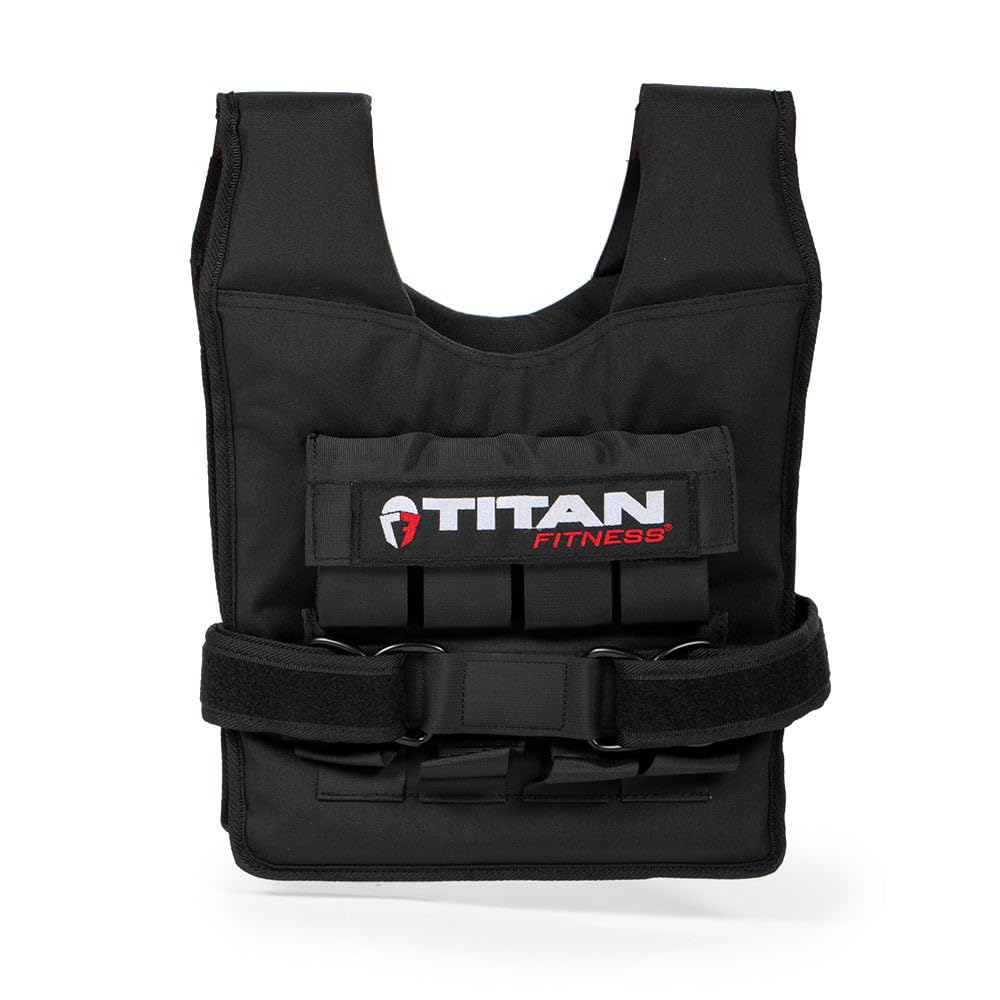
The Titan Fitness Elite Series is built from 1050D Nylon Cordura — the same fabric used in tactical gear — making it one of the most abrasion-resistant vests at its price tier. It comes with sixteen 2.5 lb cast iron ingots that fit into velcro-secured pockets on the front and back. The round-cornered ingots prevent pocket wear, a design detail that extends the vest’s lifespan.
The ergonomic design includes a U-shaped neckline and spacious shoulder cutouts that prevent the vest from riding up during presses or pull-ups. Integrated D-rings on the front allow you to attach a running parachute or sled, adding a second resistance dimension that few vests at this level offer. The velcro closure system is adjustable enough to accommodate a range of torso sizes.
At a 20 lb maximum, this vest is best suited for beginners or as a recovery-day option for heavy lifters. The fabric and ingot quality are excellent, but the weight cap prevents it from being a long-term tool for progressive overload. Several users mention that the vest runs slightly snug for taller athletes with longer torsos.
Why it’s great
- 1050D Cordura fabric is extremely tear-resistant
- 2.5 lb cast iron ingots with round corners prevent pocket damage
- D-rings allow parachute or sled attachment
Good to know
- 20 lb max won’t support progressive overload to heavy weights
- Snug fit for athletes with longer torsos
8. RUNmax Adjustable Weighted Vest 40 lbs

The RUNmax vest uses a sandbag filler system with 10 individual bags that can be inserted or removed to adjust weight from 20 to 40 lbs. It’s available with optional shoulder pads for added comfort, which help distribute the sandbag load across a wider surface area. The nylon shell is machine washable (with all sandbags removed), making maintenance straightforward.
Users praise the weight distribution, noting that the sandbags sit evenly across the front and back without excessive sagging. The velcro closure allows quick adjustments mid-workout, and the vest can accommodate larger frames up to 270 lbs. For the price point, the build quality is solid, with reinforced stitching at the shoulder seams and waist strap anchor points.
The main limitation is the sandbag system itself — sand shifts during dynamic movements like running and burpees, causing the load to redistribute unevenly over time. Several customers also note that the velcro can weaken after extended use, especially when the vest is loaded to its maximum capacity. It’s a capable entry vest for walking and squats, but not suitable for heavy rucking or explosive training.
Why it’s great
- Affordable price with shoulder pad option for comfort
- Machine washable design for easy maintenance
- Accommodates larger frames up to 270 lbs
Good to know
- Sandbags shift during running and HIIT exercises
- Velcro may lose grip after repeated use at max load
9. Liveet Adjustable Weighted Vest 60 lbs
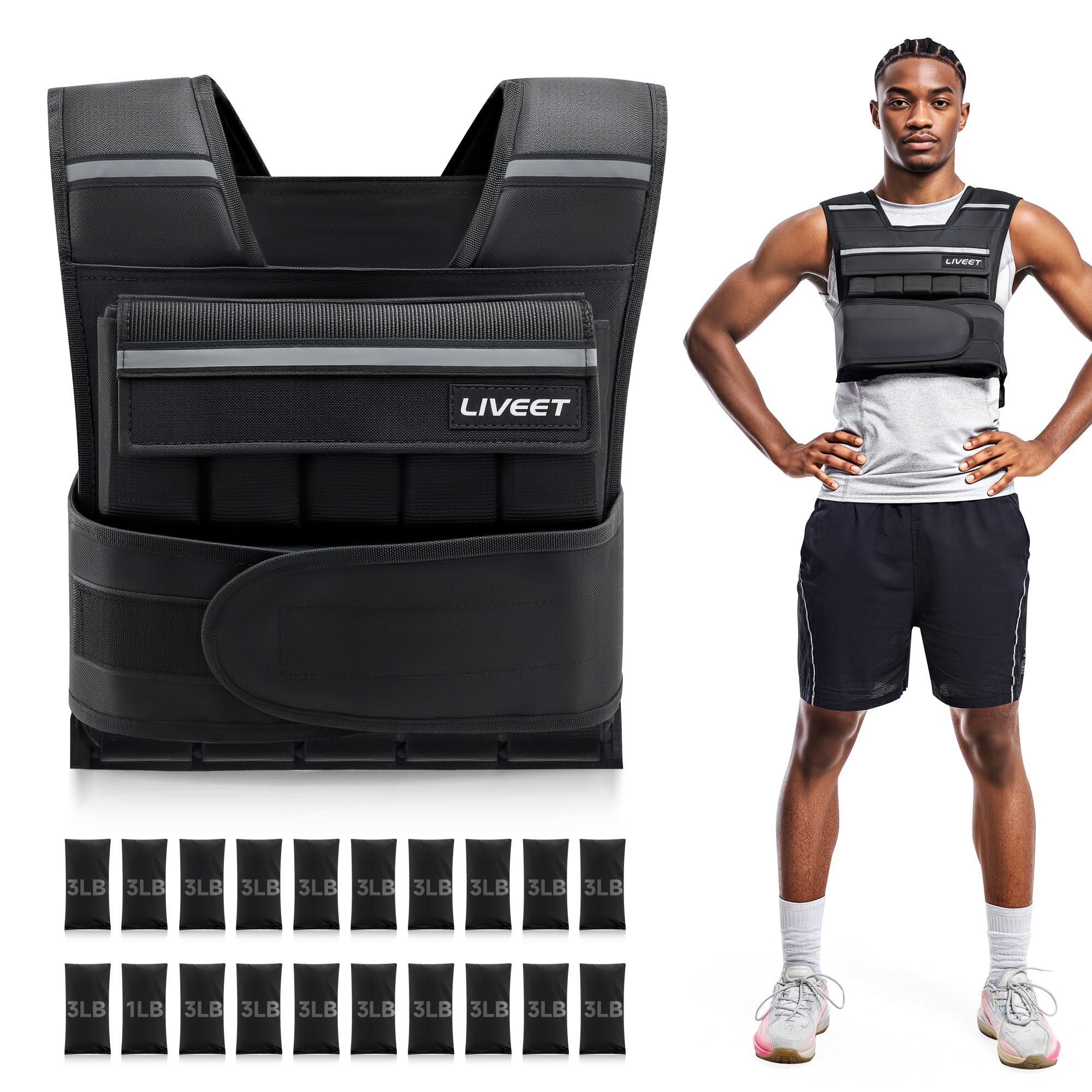
The Liveet vest comes with 20 removable 3 lb iron sand bags — a hybrid between pure sandbags and solid iron blocks. The iron sand compresses into a stable form inside the sealed pouches, reducing the shifting that plagues loose-sand systems. The 600D Oxford fabric outer shell includes foam padding at the shoulders and chest to reduce pressure points during extended wear.
The hook-and-loop waist strap allows micro-adjustments, and the reflective strips provide 360-degree visibility for early morning or late evening training. Users report that the vest stays secure during walking, squats, and moderate-intensity strength work without excessive bounce. The variety of weight options (20, 30, 45, and 60 lbs) gives beginners a clear upgrade path without switching brands.
At this price point, the 600D fabric is a compromise. It holds up well for moderate use but shows wear faster than 1000D nylon under heavy daily training. The iron sand bags also cannot be removed and reconfigured as quickly as solid ingots, slowing down mid-session weight changes. It’s the best value for someone who wants a capable 60 lb vest without spending premium dollars.
Why it’s great
- Iron sand bags shift less than loose sand systems
- Foam shoulder and chest padding for extended wear
- Reflective strips improve low-light safety
Good to know
- 600D fabric wears faster than higher-denier alternatives
- Weight changes are slower than solid ingot systems
FAQ
Can I run in a 100 lb weighted vest?
How do I know if my vest can actually handle 100 lbs?
What is the best vest for progressive overload from 20 lbs to 100 lbs?
Should I get a zipper or velcro closure for a heavy vest?
Final Thoughts: The Verdict
For most users, the best 100lb weighted vest winner is the MIR PRO 45–90 lbs because it ships with solid iron ingots, uses 1000D nylon that survives 70+ lb sessions, and offers precise one-pound incremental adjustments. If you want to start lighter and scale up from zero without buying a second vest, grab the MVRK 80 lb vest. And for dedicated runners who prioritize low bounce and a slim profile over maximum weight, nothing beats the Hyperwear Hyper Vest PRO.