
Our readers keep the lights on and my morning glass full of iced black tea. As an Amazon Associate, I earn from qualifying purchases.
Specs are compiled from manufacturer listings and verified buyer reviews and can change over time — please confirm the key details on the product page before buying.
If you want to run a wall plug on the road, the Goal Zero Sherpa 100AC is the pick to beat: it packs a 95Wh battery (watt-hours, the number airlines check for carry-on) plus a built-in 100W AC inverter (a socket that takes a normal two-prong plug) and a 100W USB-C port. If you want the longest runtime for the least cash, the AFERIY Nano100 fits a 31000mAh cell into a compact brick. One note before you scroll: this list matches the spirit of the search — power banks rated roughly around the 100 watt-hour mark that airlines treat as carry-on friendly — so a couple of picks sit slightly under or over that exact figure and still do the same job. Watt-hour ratings, not milliamp-hour bragging, decide whether a battery is allowed in the cabin, so every pick here is judged on that number first.
I’m Min — the founder and writer behind Gadgets Feed. This guide is built by comparing the manufacturers’ published specifications and the patterns across verified customer reviews, so you get each pick’s real strengths and trade-offs instead of marketing spin.
Laptop-class batteries live or die on watt-hours, port count, and honest recharge times, and the picks below sort the carry-on legal from the rest. Everything you need to choose the right 100wh power bank is here, from TSA math to real port layouts.
Our Picks at a Glance

How To Choose The Best 100Wh Power Bank
Buying a laptop-class battery is really about three questions: will the airline let it on the plane, can it run what you actually carry, and how fast does it refill before your next meeting. Get those right and the rest is detail. Get them wrong and you own a heavy brick that sits in a drawer.
Start With The Watt-Hour Number, Not The Milliamp-Hour Number
Airlines count energy in watt-hours (Wh) — the total energy the battery stores — not milliamp-hours, which only tell you capacity at a specific voltage. Anything rated under 100Wh is generally cleared for carry-on in the cabin, which is why so many of the picks here cluster right around 90 to 99.5Wh. The Goal Zero Sherpa 100AC lists 95Wh, the UGREEN Nexode Pro lists 90Wh, and the Anker Prime lists 99.54Wh. Those figures are the ones you quote at the security desk.
Match The Ports To The Devices You Carry
One high-watt USB-C port is enough for a laptop, but if you also travel with a tablet and a phone you want more than one output running at once. Check total output wattage as well as per-port wattage: the AsperX Laptop Power Bank can split a total of 145W across two devices, while the UGREEN Nexode Pro pushes 200W max output with 100W on each USB-C port. If you want to plug in something with a normal wall plug, you need a unit with a built-in AC inverter (a socket that takes a standard plug), like the Goal Zero Sherpa 100AC or the Portable Power Bank with AC Outlet.
Weigh Recharge Time Against Bag Weight
Faster refills mean bigger, heavier batteries. The EF ECOFLOW Rapid Pro X claims a full recharge in only 20 minutes with 320W input, and the Anker Prime claims a full recharge in just 37 minutes using dual chargers. Both are substantial in the hand. If you mostly top up overnight in a hotel, a slower, lighter unit like the Baseus does the same daily job with less to lug around.
Quick Comparison
| Model | Best For | Capacity | Max Output | Ports | Amazon |
|---|---|---|---|---|---|
| Goal Zero Sherpa 100AC★ Best Overall | Wall-outlet power on the move | 25600mAh / 95Wh | 100W USB-C | USB-C, AC outlet, wireless | Amazon |
| AFERIY Nano100Best Value | Compact laptop charging on a budget | 31000mAh / 99.2Wh | 145W | 2x USB-C, 1x USB-A | Amazon |
| Baseus 25000mAhMost Portable | Built-in cables and slim carry | 25000mAh / 91.25Wh | 145W | 2 built-in USB-C, plus USB ports | Amazon |
| AsperX Laptop Power Bank | Multi-device workdays | 25000mAh / 92.5Wh | 145W | USB-C, USB-A | Amazon |
| Portable Power Bank with AC Outlet | CPAP and AC devices | 27000mAh / under 100Wh | 100W AC / 65W USB-C | 1 AC, 1 USB-C, 2 USB-A | Amazon |
| UGREEN Nexode Pro | Travelers who hate loose cables | 25000mAh / 90Wh | 200W | 2 built-in USB-C, USB-C, USB-A | Amazon |
| AOHI Future Starship | Two laptops at once | 27600mAh / 99.36Wh | 240W | 2x USB-C, 1x USB-A | Amazon |
| Anker Prime | App-managed multi-device power | 27650mAh / 99.54Wh | 250W | 2x USB-C, 1x USB-A | Amazon |
| EF ECOFLOW Rapid Pro X | Fastest possible refills | 27650mAh / 99.54Wh | 300W | 3x USB-C, built-in cable | Amazon |
In‑Depth Reviews
1. Goal Zero Sherpa 100AC Wireless AC Power Bank, 100W USB-C, 25600mAh
Our pick — over 4.5★ from 100+ verified ratings; the strongest balance of quality and price.
The one pick with a real wall outlet built in — 100W of AC power you can carry.
Most power banks can only feed USB, which leaves anything with a wall plug stranded. The Sherpa 100AC packs an integrated 100W AC inverter, so a standard two-prong plug works anywhere you go — that is the whole reason it earns the top slot. Owners plug in Starlink Mini terminals with it, and as buyers report: “I get about 3-hours of battery life when my Starlink Mini is plugged in, which is pretty impressive.” It rates at 4.6 stars, and what wins people over is the build — a rugged aluminum unibody that feels like a tool rather than a toy.
On the numbers front it carries a 25600mAh cell rated at 95Wh, which sits comfortably under the airline carry-on line. You also get a 100W USB-C port for laptop-speed charging and 15W wireless charging for a phone you just want to drop on top. The full-color display shows watts and remaining time, which turns guesswork into a glance. For a pack this capable it is still compact: 7.69 x 5.49 x 1.02 inches, so it slides into a laptop sleeve without bulging.
The honest catch is weight and battery behavior. At 1.45 kg it is a genuine bag anchor, and owners consistently flag that the AC inverter drains the cell faster than pure USB charging does — you trade runtime for the convenience of a wall plug. A few also note added luggage heft on longer trips. Neither is a defect; it is simply what a 95Wh battery with an inverter inside weighs and does. Compared with the slimmer Baseus below, the Sherpa is heavier and pricier, but no other pick here hands you a working AC socket.
What it nails
- 100W AC inverter lets you run normal wall-plug devices anywhere
- Rugged aluminum unibody with a 2-year warranty behind it
- 100W USB-C output plus 15W wireless charging on top
- Full-color display shows real watts and time remaining
Where it costs you
- 1.45 kg makes it a heavy carry for long days
- Running the AC inverter burns through the cell faster than USB-only charging
Grab it if: you need to run something with an actual wall plug — a small appliance, a satellite terminal, a CPAP — and want the build quality to match.
Think twice if: you want the lightest possible brick for phone-only top-ups; the Baseus and UGREEN options carry far less weight for that job.
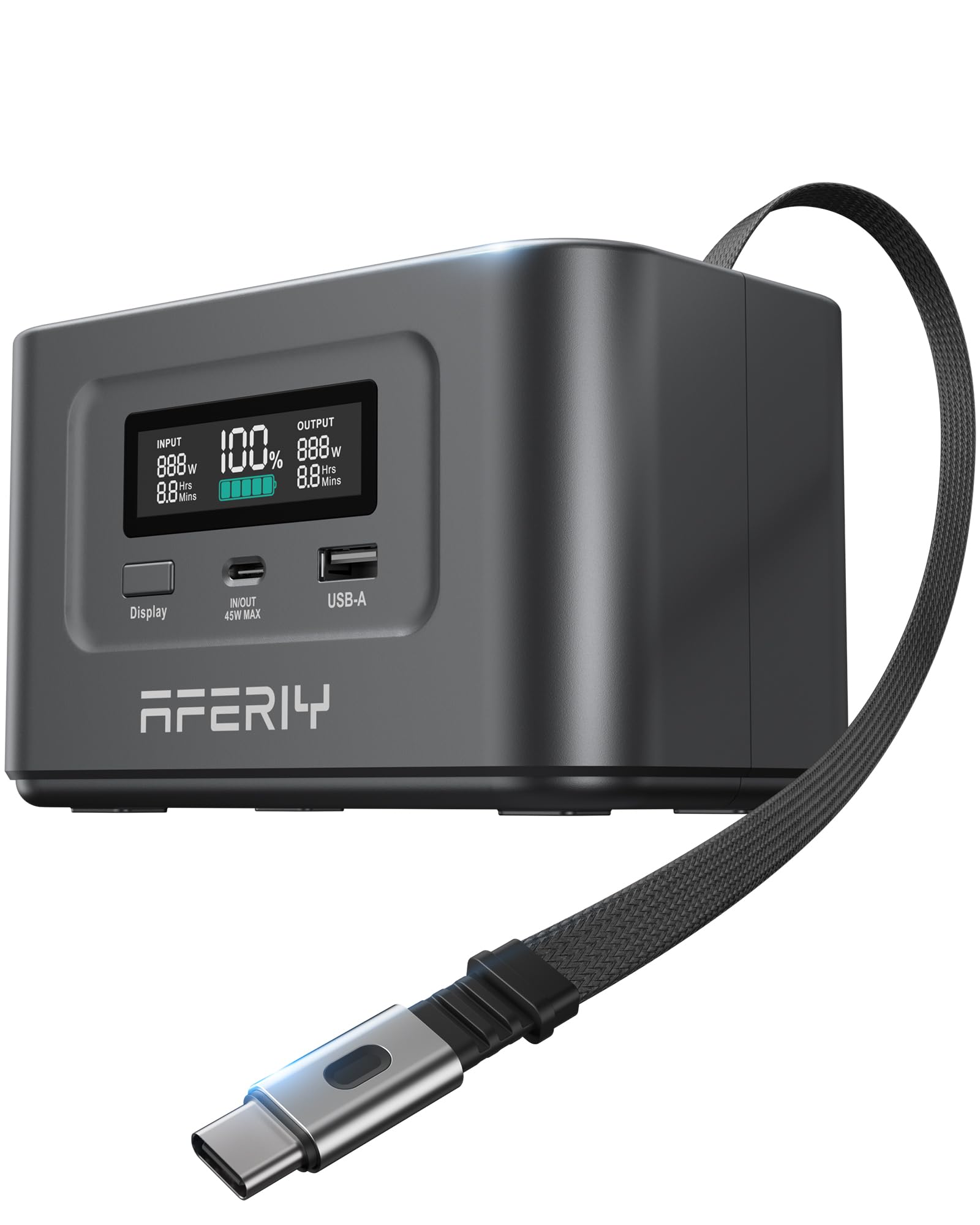
2. AFERIY Nano100 31000mAh Power Bank Station, 100W PD Laptop Portable Charger
A power-station-sized cell shrunk into something that actually fits a purse.
The AFERIY Nano100 leads with the biggest raw cell in this budget-leaning group: 31000mAh, or 99.2Wh. Compare that directly with the Goal Zero Sherpa above at 25600mAh and the gap is real — the AFERIY holds 21% more capacity in its tank. It manages that in a body measuring 5.8 x 3.46 x 3.43 inches, which is 33% smaller in footprint than the Sherpa’s 7.69 x 5.49 x 1.02 inches. Remarkable density for the money, and the thing everyone raves about is the power on tap — 145W maximum output through a 100W USB-C PD3.0 port, a 45W USB-C port, and an 18W USB port.
Under the hood it uses lithium iron phosphate cells, the same chemistry family as the AOHI Future Starship further down, and the maker claims over 80% capacity after 3,000+ cycles. A built-in retractable USB-C cable with a magnetic end means you can leave the loose cords at home, which daily-carry owners call out as the standout convenience. The display is clean and shows charge, time, and watts at a glance.
The recurring gripe is port ambition. Owners mention that only one port actually delivers 100W, not two, and as one review sums up: “It’s a missed opportunity for the brand to offer 100W on 2 ports, not just one.” A separate thread flags that a phone may be capped below its top speed on the corded port. Add the missing lanyard or handle and you have a compact brick that does the big job but leaves a little versatility on the table. Recharge from empty takes 1.5 hours.
The value math: At this entry-level tier you get more stored energy than the Goal Zero at a fraction of the size, plus LFP cells rated for thousands of cycles.
The honest trade-off: That single high-watt port means one fast device at a time; a second 100W device would have to settle for the slower outputs.
Reach for this if: you want maximum capacity per dollar and travel light, charging one laptop plus a phone or tablet.
Look elsewhere if: you routinely fast-charge two laptops at once — the AOHI or UGREEN picks handle that better.
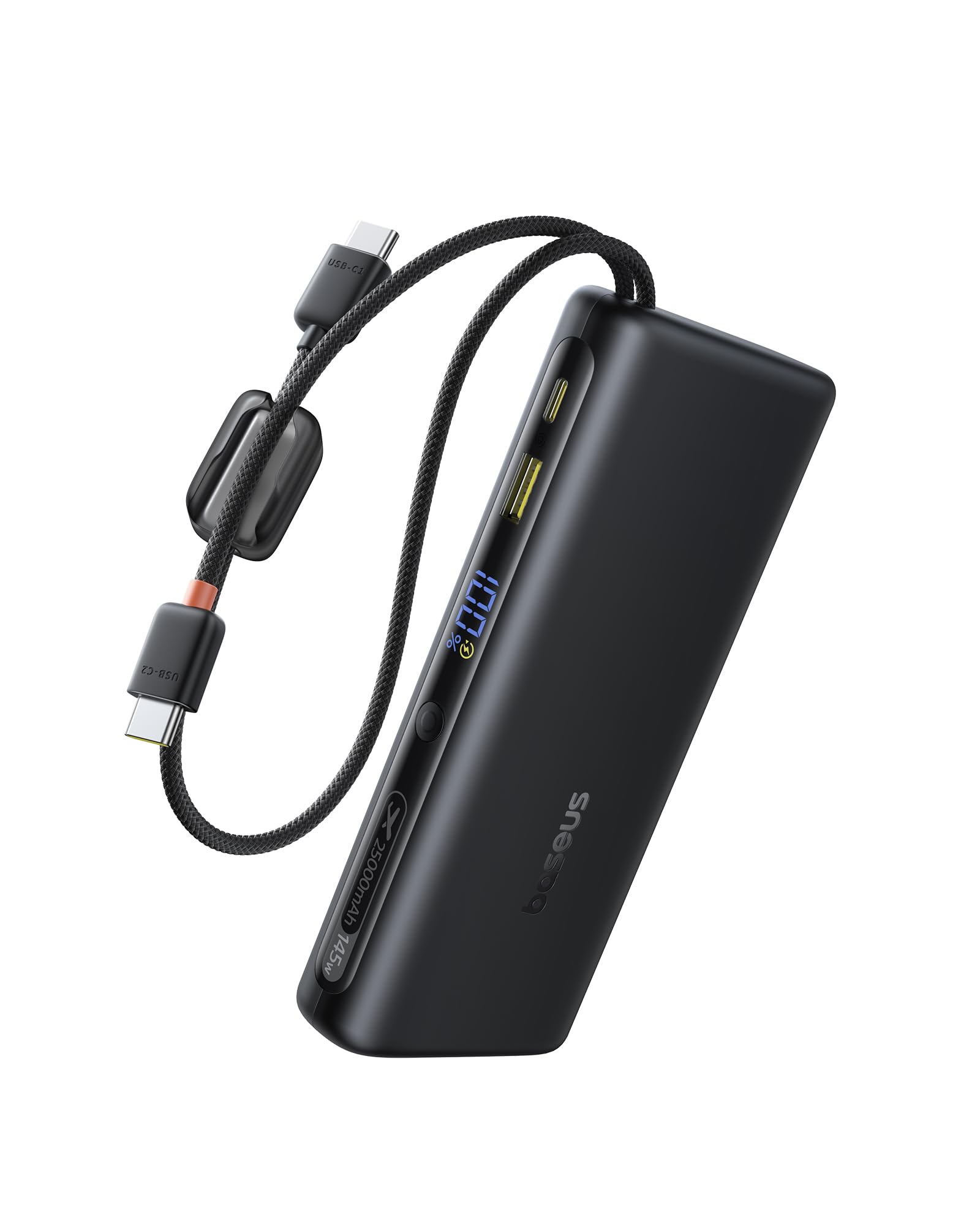
3. Baseus 25000mAh Power Bank, CCC Certified 145W Laptop Portable Charger
Two braided cables built in and no charge to guess — the definition of grab-and-go.
If you keep forgetting cords, the Baseus solves that by fusing two USB-C cables directly to the body. They double as a carrying strap, so the whole thing hangs off a backpack loop. It is also the thinnest pick in this group at 0.5 inches thick, sliding into a carry-on laptop pocket with room to spare. At the entry-middle tier you get a 25000mAh battery — 91.25Wh, safely under the airline line — and a 140W USB-C1 port that pushes an iPhone 17 Pro to 68% or a 13.3″ MacBook Air to 50% in just 30 minutes.
Plug in four devices at once and the pack keeps everything alive, including pass-through charging so you can work while it tops up. A digital LED shows exactly how much power is left rather than three vague dots. Charge retention comes up as a strength here — owners describe no ghost drain when the pack sits idle. The build feels solid in the hand and the daisy-chain cable arrangement is genuinely clever until you coil it away.
Two things temper the shine. First, weight: buyers flag it as heftier than the slim profile suggests, which is simply what a 25000mAh lithium-polymer cell costs in grams. Second, the cables you love when in use become the same cables that are awkward to stow — they loop and bulk up when packed, partly cancelling the slim body. It is a fit-and-preference call rather than a flaw, and it is the pick for anyone who values not digging for a cord.
Why it wears the slim crown
- Two built-in braided USB-C cables double as a carry strap
- 0.5 inches thin — the most packable shape in this group
- 140W USB-C1 port powers a MacBook Air to 50% in 30 minutes
- Digital LED shows real-time charge, no guessing
The small catch
- Heavier than the slim profile implies at 25000mAh
- The daisy-chained cables are awkward to stow when not in use
Its balance: the commuter who wants a flat, thin charger that lives in a laptop sleeve and never needs a separate cord.
Skip it for: stash-only travel where you want the smallest, lightest brick and do not mind packing a cable separately.
4. AsperX Laptop Power Bank, 25,000mAh 140W PD 3.1 Fast Charging USB C
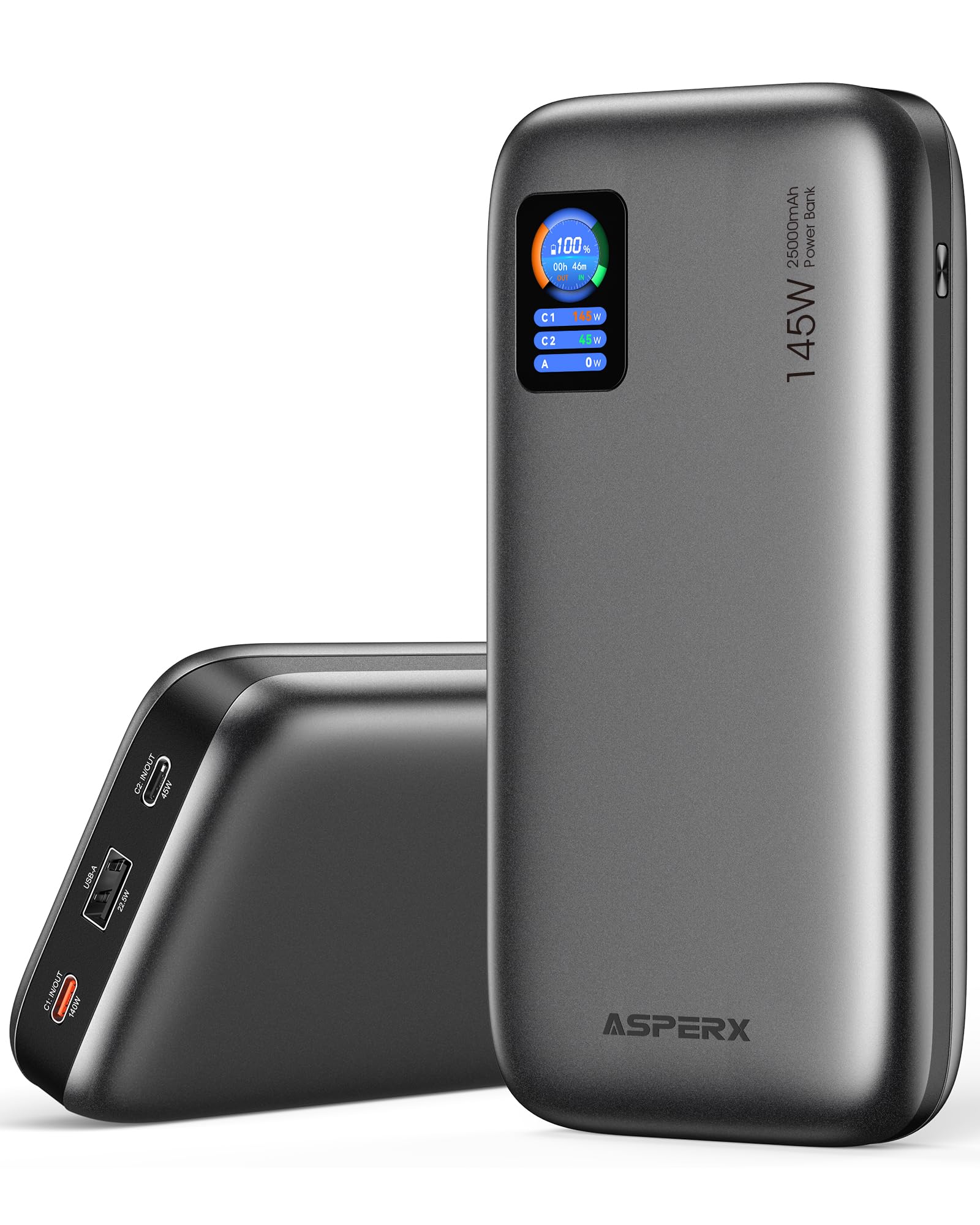
A workhorse that spreads 145W across two devices and tells you exactly why.
The AsperX makes its case on output flexibility. It distributes a total of 145W across two devices, with a single USB-C1 port that can deliver up to 140W — enough to keep a laptop and phone charging side by side without either crawling. Its 25000mAh cell is rated 92.5Wh, comfortably within the airline carry-on bracket, and the maker claims a MacBook Pro 1.3 times or an iPhone 16 4.5 times on one fill. It is also the pick with the most reviews backing it up here, which is note for anyone who wants a crowded field of long-term feedback before committing.
The two-way USB-C port recharges the pack itself at up to 65W, refilling it in about 1.8 hours — roughly the length of a lunch break. A bright TFT display shows battery level, remaining time, and live input/output wattage, which kills the “how full is it really” question. Owners add a carrying pouch and braided cable to the box, and a low-power mode handles finicky small gear like earbuds and smartwatches by holding the power button.
What buyers discover the hard way is cable sensitivity. The 145W claim only holds with a certified high-wattage cable — a generic cord throttled an iPhone 14 Pro Max to 6-7W in one person’s testing, while an Apple-branded cable hit 27W. So pack the included 5A cable and treat it like part of the product. On the plus side the simultaneous-output behavior is real: laptop at 88W plus phone at 27W while both run. This is the grab for anyone who fills a work bag with more than one device and wants proof on a screen.
Screen over specs-hiding: That TFT panel showing live wattage is the feature that separates a confident charger from a mystery box — you see exactly how much power each device pulls.
What trips it up: A generic USB-C cable can gut the output to a fraction of the claim, so the included certified 5A cable is a must, not a nice-to-have.
Points to it: remote workers and multi-device travelers who want a screen confirming every charge and a huge pool of buyer feedback behind the choice.
Do not pick it for: minimalist phone-only trips — it carries heft and capacity you would rarely use.
5. Portable Power Bank with AC Outlet, 100W Laptop Charger, 98Wh/27000mAh

The AC-outlet pick people buy in pairs for CPAP machines on long flights.
This one earns its keep in a specific niche: running small AC-powered devices away from a socket. A 100W AC outlet sits alongside a 65W USB-C PD port, a 12W USB port, and an 18W USB port, all fed by a 27000mAh cell — 98Wh, TSA-friendly for carry-on. Customers note it ran a CPAP for a full 8 hours on multiple nights of an Alaska trip, and recharged a laptop for 5+ hours on the road. What earns the most praise is exactly that power capacity and the ability to run things most power banks cannot touch.
On recharge there is no drama: the USB-C port refills the whole pack in about 1.5 hours. A carry case and cable come in the box, which keeps it easy to toss in a bag. Its 6.7-inch length makes it more of a packed item than a pocket one, but it is manageable for travel, fishing, or camping as its specs intend. The AC port needs a button press to activate, whereas USB fires up automatically — one small ritual to learn.
The fair caveat is that long-term reliability and battery longevity get a mixed reception in owner feedback, so this is a pack best suited to straightforward, planned use rather than heavy daily abuse. Read the pattern honestly: it does an excellent job for occasional travel and outage backup, and it is not built to be a suitcase workhorse every single week. For the CPAP traveler specifically, the combination of a real AC outlet and 98Wh under the airline ceiling is hard to argue with.
Ideal owner: the traveler or remote worker who needs a genuine AC socket for a medical or hobby device and wants the largest legal cell to power it.
Less ideal for: someone who needs a daily-driver battery rated for constant heavy use — treat it as a specialized travel tool.
6. UGREEN Nexode Pro 25000mAh 200W Laptop Power Bank with Retractable Cables
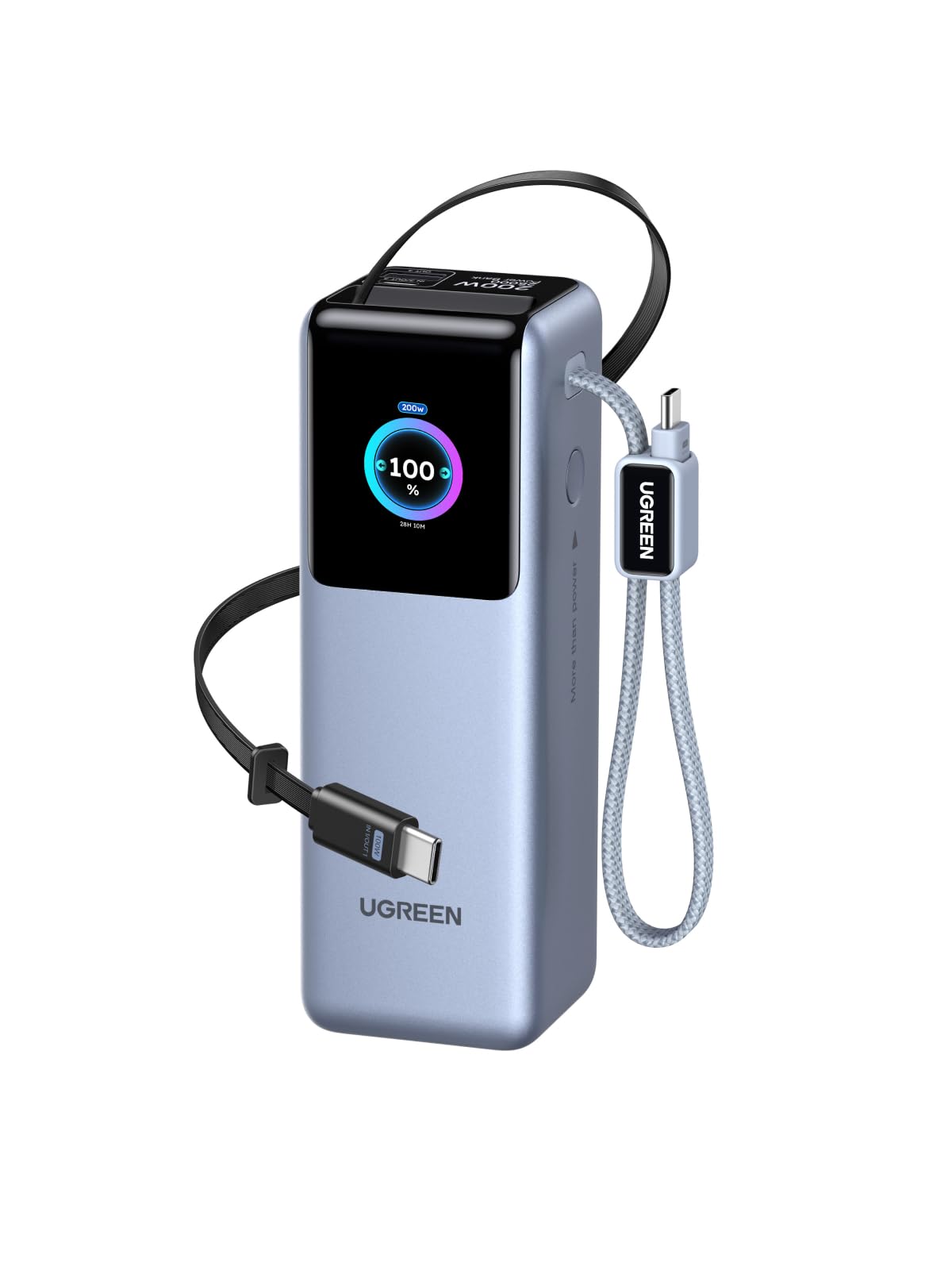
Retractable cables that vanish with one pull — built for people who hate cord spaghetti.
The UGREEN Nexode Pro attacks the messiest part of travel charging: the tangle. A built-in 26.7-inch retractable USB-C cable slides out when needed and retracts when done, tested to over 25,000 pulls, and a second 13.8-inch strap cable hides behind it. That retract-and-go design is the feature that sells this pack to frequent flyers. The cell is 25000mAh rated 90Wh, and the maker claims it charges an iPhone 17 Pro 4.7 times, a Galaxy S25 Ultra 3.4 times, or an iPad Pro 1.8 times — a lot of runway in a case measuring 6.22 x 2.13 x 1.97 inches.
Raw output is where it flexes hardest: 200W maximum, with 100W per USB-C port, enough to charge two MacBook Pro 16″ laptops to 43% in 30 minutes. The TFT screen reports output wattage, battery health, cycles, and estimated time left, and a low-current mode switches on for small gear like earbuds. Charging-speed praise runs high and the pack clearly keeps up with power-hungry laptops, running a high-draw machine at a sustained 100W in owner testing.
The trade-offs are straightforward. It is heavy for a 25000mAh brick, and the fast laptop charging sustains for a while then needs a cool-down before a full recharge. The listed 90Wh rating wins the airline argument for Asia travel, but owners will feel the bulk in a purse. None of that undercuts the core pitch — for the person who travels with two laptops or a laptop plus a tablet, the integrated cables and 200W ceiling make this the easiest pick here. It is the second-highest-rated pack in this group for a reason.
One-pull convenience
- Retractable 26.7-inch USB-C cable plus a second strap cable, no loose cords
- 200W max output, 100W per port, two laptops at once
- Smart TFT display with wattage, health, cycles, and time left
- Low-current mode for earbuds and smartwatches
Best kept in mind
- Heavy for its 25000mAh capacity
- Sustained 100W charging needs a cooldown before a full recharge
Made for: two-device travelers who want a laptop charger and a phone charger fused into one cord-free brick.
Overkill for: single-phone commuters — you would pay in weight for output you would not use.
7. AOHI 240W Laptop Power Bank 27600mAh Portable Fast Charger (99.3Wh)

Two laptops at once, a Starship name, and build quality that matches the badge.
The AOHI Future Starship is a 27600mAh pack rated 99.36Wh — just under the airline line and among the largest legal cells you can fly. Its headline act is dual-laptop charging: 240W total output across two USB-C ports, with one delivering up to 140W while the other supplies up to 100W, plus a 22.5W USB-A port. The maker claims a 16-inch MacBook Pro hits 50% in 28 minutes. Same recharge philosophy runs in reverse: both USB-C ports accept up to 140W input, so the pack refills to 50% in about 30 minutes from either port, and the 140W cable is tucked under the foam in the box.
Quality is the note that repeats most in owner feedback — a premium build with a real-time digital display showing remaining capacity and live input/output power. A three-stage LED indicator tells you charging status from across a room without touching the screen. Its automotive-grade cells are rated for over 1,000 charge cycles and backed by 15 layers of safety protection. Color, display, and durability all draw praise, and the pack performs exactly as the spec sheet promises in daily use.
Set expectations on a couple of fronts. Output is not uninterrupted like a UPS — if you disconnect the input while devices are running, the pack drops the charge and you must renegotiate. And it will not deliver max wattage on a weak source: without a 40-100W PD charger the pack itself recharges slowly. A minority also reports periodic hiccups mid-charge on laptops. Treat it as a premium tool for planned, high-power use rather than a fire-and-forget backup, and it delivers.
Fits best: professionals running two laptops and a phone who want the highest legal capacity with fast two-way charging and a display worth watching.
Not for: casual users who need an always-on uninterrupted backup — the pack intentionally renegotiates power on input changes.
8. Anker Prime Power Bank, 27,650mAh 3-Port 250W Portable Charger
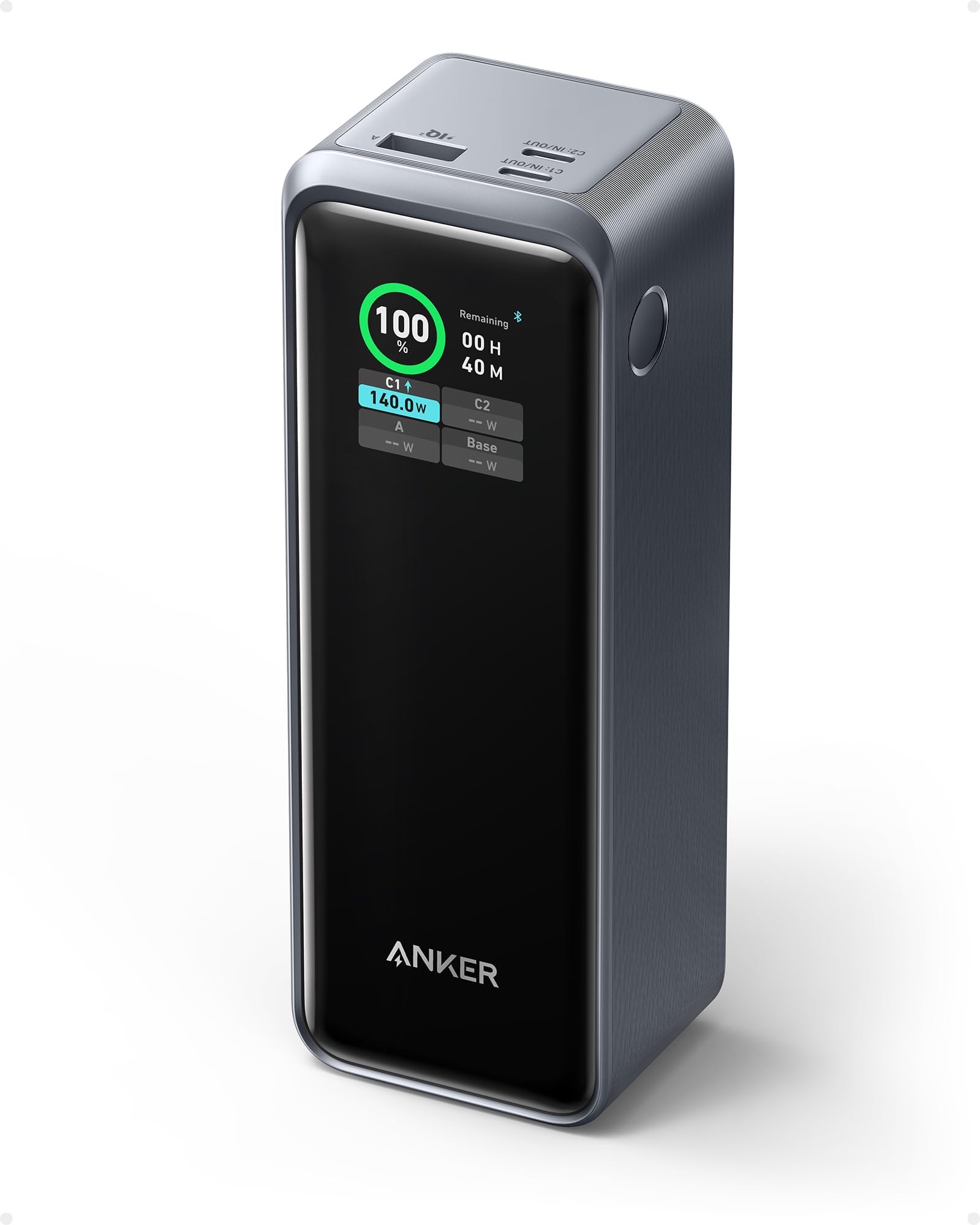
A 250W multi-device charger you can find and monitor from your phone.
The Anker Prime takes the smart-device angle farther than any other pick here. The Anker app shows charging status and can locate the power bank when it goes missing in a bag or hotel room — a small thing that becomes big on the third trip of the month. Under that is a 27650mAh cell rated 99.54Wh for airline carry-on, feeding 250W of multi-device fast charging: a laptop held at 140W while a tablet and phone charge alongside. The maker claims a 16-inch MacBook Pro hits 50% in 28 minutes, and the pack refills in 37 minutes with 170W input from dual chargers. The available base station (sold separately) is optional, not required.
Performance is where this pack shines. It juggles a power-hungry laptop, tablet, and phone at the same time, and dual USB-C input doubles the recharge speed when both ports are fed. The screen shows current in and out, and the app translates that into estimated remaining charges for each device. Buyers describe it as excellent for long travel days where public outlets are sketchy — one favorite use is avoiding unknown airport USB ports entirely, plugging into this instead.
Two honest points. It is heavy — a necessity of a 27650mAh cell — and long-term reliability gets a mixed reception, with a minority reporting units that stopped charging after some months. That minority sits inside a large pool of satisfied owners, so it is a “treat it well” note rather than a defect pattern. The 99.54Wh rating is one of the highest legal carry-on figures here, and the smart-app convenience is genuinely class-leading. If bulk is not a deal-breaker and you want maximum power plus phone-level control, this delivers.
Smart control wins: The Anker app turns a dumb brick into a monitored device — see remaining charges, current wattage, and even locate it when forgotten in a hotel drawer.
Sizing your expectations: At 27650mAh the pack is chunky, and reliability complaints from a small subset of owners are worth reading before committing to heavy daily use.
Choose this if: you value app-based visibility and the highest legal carry-on capacity, and want to stop borrowing airport USB ports.
Wrong pick if: you hate carrying bulk or want the lightest possible pack — the Anker is a substantial piece of kit.
9. EF ECOFLOW Rapid Pro X Power Bank, 27650mAh 4-Part with 300W Output
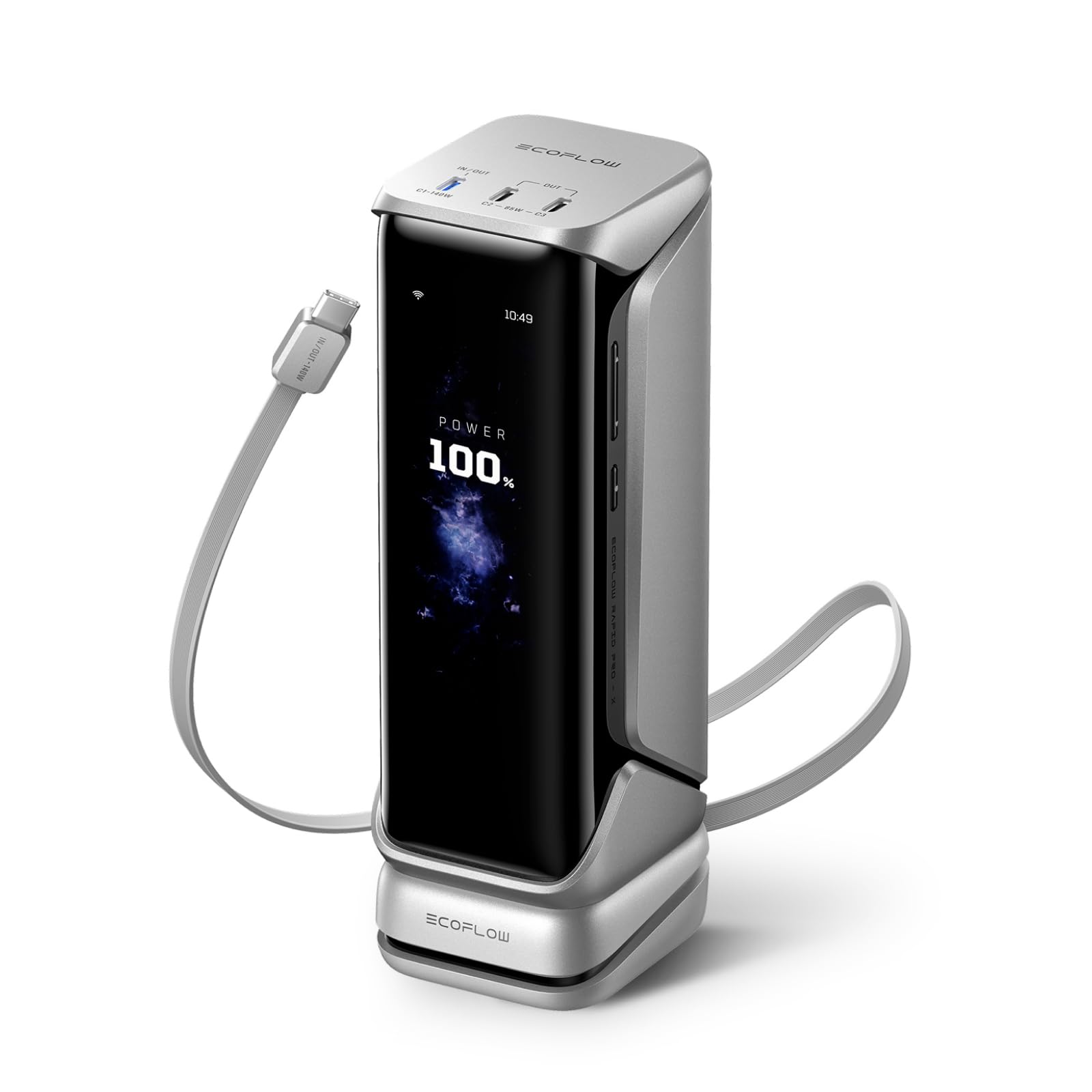
Refills in 20 minutes flat — the fastest turnaround of any pack here.
The EF ECOFLOW Rapid Pro X makes its pitch on speed. A full recharge takes only 20 minutes with 320W input, or 80% in 40 minutes over a single 140W port, or 80% in 26 minutes using multi-port input at 280W. That is the whole point: you plug it into a high-wattage charger between meetings and walk out with a topped-up 27650mAh cell. The battery is rated 99.54Wh, TSA-approved for carry-on, and the maker claims it charges an iPhone 16 up to 4.5 times, a MacBook Air up to 1.3 times, or a Steam Deck up to 1.4 times. Prefer to skip the cords entirely? A 2 ft retractable USB-C cable is built in for grab-and-go charging.
Output flexibility is generous: 300W total across four devices at once, with one 140W USB-C port and two 65W USB-C ports, enough to fast charge phones and laptops side by side. The 3.9-inch LCD screen displays real-time charging data and can be themed via the app, with standby modes and charging settings customizable to taste. Performance and size draw praise — owners call it well-designed and high quality, and the built-in cable plus AC prongs make it a tidy travel companion. Its compact footprint also slips into a bag organizer with room left for cables.
The honest catch is heat. Under sustained high-wattage output, reviewers point out the pack warms up and throttles — several find it settles around 25-30W for long stretches despite the peak claim. There is also a mixed reception for the built-in cable, with a few reporting issues. Treat the Rapid Pro X as a sprinter: brilliant for rapid top-ups and multi-device charging, less suited to a marathon session at max wattage. For the traveler whose bottleneck is charge time, though, nothing else here refills as fast.
Speed you can feel
- Full recharge in 20 minutes with 320W input
- 300W output across four devices at once
- Built-in 2 ft retractable USB-C cable
- 3.9-inch LCD with app themes and standby modes
Where it throttles
- Sustained high-wattage output runs warm and settles lower than peak
- Built-in cable draws a mix of praise and gripes
Built for: travelers who value ultra-fast refills over every other specification and pack multiple devices.
Second-guess if: you need sustained peak wattage for long sessions — heat management will pull it below the headline number.
Understanding the Specs
Watt-Hours (Wh) — The Airline Number
Watt-hours measure the total energy a battery holds, and for air travel it is the only figure that matters. Carriers and TSA generally allow batteries rated under 100Wh in carry-on luggage, so a pack listed at 99.54Wh flies while a larger model often does not. This is why picks here cluster under the ceiling. A number like 99.54Wh or 90Wh tells you instantly whether the pack is cabin-legal — milliamp-hour figures alone do not.
Output Wattage (W) — What It Can Run
Output wattage dictates which devices a pack can charge and how fast. A 100W USB-C port can keep most laptops topped up, while 200W to 300W total output lets you run several devices at once. The AOHI Future Starship delivers 240W total across two USB-C ports, and the UGREEN Nexode Pro pushes 200W with 100W per port. Look at both the per-port figure and the total, since a high total may still split across slower individual ports.
AC Inverter vs USB-C Only
Only some packs include an AC inverter — the component that turns stored DC power into the same 100V-to-110V wall-style current your home outlet provides. A pack with a 100W AC port, like the Goal Zero Sherpa or the Portable Power Bank with AC Outlet, can run devices that have no USB input at all, from small appliances to certain medical machines. USB-only packs are lighter and cheaper but cannot power anything that plugs into a wall.
Battery Chemistry — LiFePO4 vs Lithium-Ion
Lithium iron phosphate (LiFePO4 or LFP) cells trade a little energy density for longer cycle life and steadier behavior under abuse, which is why some packs advertise thousands of cycles. The AFERIY Nano100 uses LFP, claiming over 80% capacity left after 3,000+ cycles. Traditional lithium-ion and lithium-polymer cells are lighter for the same capacity but typically carry shorter rated lifespans. Pick LFP for longevity and safety feel; pick lithium-ion for the lightest possible carry.
FAQ
What is the difference between watt-hours and milliamp-hours in a power bank?
Can I bring a 100Wh power bank on a plane?
How many times can these power banks charge a laptop?
How long does it take to recharge a 100Wh power bank?
What is an AC outlet on a power bank used for?
Do these power banks charge themselves while powering a device?
Which power bank charges a laptop the fastest?
How long do these batteries last before they need replacing?
Is a higher wattage power bank always better?
Can these power banks charge small devices like earbuds and smartwatches safely?
Are these power banks safe to leave charging overnight?
Final Thoughts: The Verdict
For most people, the 100wh power bank winner is the Goal Zero Sherpa 100AC, because nothing else here hands you a genuine 100W AC wall outlet, a 100W USB-C port, and a 95Wh cell that stays under the airline line. If your priority is maximum legal capacity with the fastest recharge on the planet, grab the EF ECOFLOW Rapid Pro X, which tops off in 20 minutes flat. And for the traveler who wants cable-free convenience with a 200W ceiling, the UGREEN Nexode Pro is the one to reach for. Whichever you pick, confirm the printed watt-hour rating before you fly, and enjoy never hunting for an outlet again.
How We Picked
We do not accept paid placement. Every pick is matched to a real buyer and a real use-case; we do not hands-on test units.
Sources & Methodology
Specifications: manufacturer listings and product documentation. Review insights: verified customer reviews, as of September 2026. Pricing: not shown on this page (it changes often); check the current price via the retailer link.
As an Amazon Associate, Gadgets Feed earns from qualifying purchases. This does not affect which products we feature.