
Bridging the gap between a distant subject and a frame-filling shot is the singular obsession of any wildlife, birding, or astrophotography enthusiast. A lens that can resolve the fine detail on a bird’s eye at half a mile or capture the texture of a lunar crater without interpolation isn’t just a tool — it’s a new way of seeing the world. The challenge is that true super-telephoto reach introduces trade-offs in weight, aperture speed, stabilization demands, and overall system cost that can overwhelm even experienced photographers if they don’t approach the selection process with a clear-eyed understanding of the specs that actually matter.
I’m Min — the co-founder and writer behind Gadgets Feed. I have spent countless hours analyzing the technical specifications, real-world optical performance reports, and user feedback across the full spectrum of super-telephoto solutions to bring a data-driven perspective to this buying decision.
Whether you are building out a mirrorless system or looking at an all-in-one bridge camera, this guide breaks down the best options for reaching extreme distances in the search for the 100x optical zoom lens.
How To Choose The Best Super-Telephoto Lens
Selecting a lens that delivers true 100X optical reach involves more than just comparing the longest number on the box. The usability of that focal length in the field depends on a chain of interacting specifications: the lens mount, maximum aperture, stabilization system, and the camera body’s sensor size all determine whether your distant subject will be tack sharp or a blurry mess.
Effective Focal Length vs. Real Reach
The focal length written on the lens is only half the story. Full-frame systems use that number directly, but APS-C cameras (like Canon R7, Nikon Z50, Fujifilm X-T5) apply a 1.5x crop factor, while Micro Four Thirds sensors apply a 2x crop factor. A 400mm lens on a Micro Four Thirds body delivers an 800mm equivalent field of view — dramatically more reach without a larger, heavier lens. The trade-off is that the smaller sensor reduces high-ISO noise performance and dynamic range compared to full-frame.
Aperture and the Low-Light Ceiling
The maximum aperture determines how much light reaches the sensor, which directly dictates the shutter speeds you can achieve. A lens that opens to f/6.3 at the long end lets in roughly half the light of an f/4.5 lens at the same focal length. In overcast conditions or deep shade that wildlife photographers often encounter, that difference can require raising ISO from 3200 to 12800 to maintain a shutter speed fast enough to freeze motion — introducing noise that post-processing cannot fully clean.
Stabilization: The Difference Between Keepers and Throwaways
At focal lengths of 600mm and beyond, camera shake becomes the primary enemy of sharp images. Image stabilization (IS) rated in stops — 4.0, 5.0, or 6.0 stops — tells you how much slower a shutter speed you can use while still capturing a sharp image. A 5-stop system on a 500mm lens lets you shoot at 1/15 second instead of 1/500 second. When paired with a camera body that has in-body stabilization (IBIS), the combined system (Sync IS) can push correction to 6.0 or 7.0 stops, making handheld shooting at extreme focal lengths viable for the first time.
Quick Comparison
On smaller screens, swipe sideways to see the full table.
| Model | Category | Best For | Key Spec | Amazon |
|---|---|---|---|---|
| Nikon COOLPIX P1000 | Bridge Camera | Maximum Reach on a Budget | 125x optical / 24-3000mm equivalent | Amazon |
| Nikon NIKKOR Z 100-400mm VR S | Full-Frame Interchangeable | Premium Mirrorless Sharpness | 5.5-stop VR / f/4.5-5.6 | Amazon |
| Fujifilm XF150-600mmF5.6-8 R LM OIS WR | APS-C Interchangeable | Fuji X-Series Wildlife | 229-914mm equiv. / internal zoom | Amazon |
| OM SYSTEM 150-600mm F5.0-6.3 IS | Micro Four Thirds | Ultimate 1200mm Reach | Sync IS 7.0 stops / 1200mm equiv. | Amazon |
| Panasonic Leica DG 100-400mm F4.0-6.3 II | Micro Four Thirds | MFT Telephoto Performer | f/4.0 wide / dust-splash-freeze proof | Amazon |
| Tamron 50-400mm f/4.5-6.3 Di III VC VXD | Full-Frame (Sony E) | Travel-Friendly Wide-to-Tele | 8x zoom / VXD linear AF | Amazon |
| Nikon NIKKOR Z 28-400mm f/4-8 VR | Full-Frame (Nikon Z) | All-in-One Travel Zoom | 14.2x zoom / 1.6 lbs | Amazon |
| OM SYSTEM 100-400mm F5.0-6.3 IS | Micro Four Thirds | Lightweight 800mm Equivalent | 200-800mm equiv. / splashproof | Amazon |
| Canon RF100-400mm F5.6-8 IS USM | Full-Frame (Canon RF) | Budget EOS R Telephoto | 5.5-stop IS / Nano USM | Amazon |
| Nikon COOLPIX P950 | Bridge Camera | Stabilized 83x Zoom | 83x optical / 166x Dynamic Fine Zoom | Amazon |
| Nikon COOLPIX P1100 | Bridge Camera | Updated 125x Zoom Bridge | 125x optical / 24-3000mm equiv. | Amazon |
In‑Depth Reviews
1. Nikon COOLPIX P1000 Superzoom Digital Camera
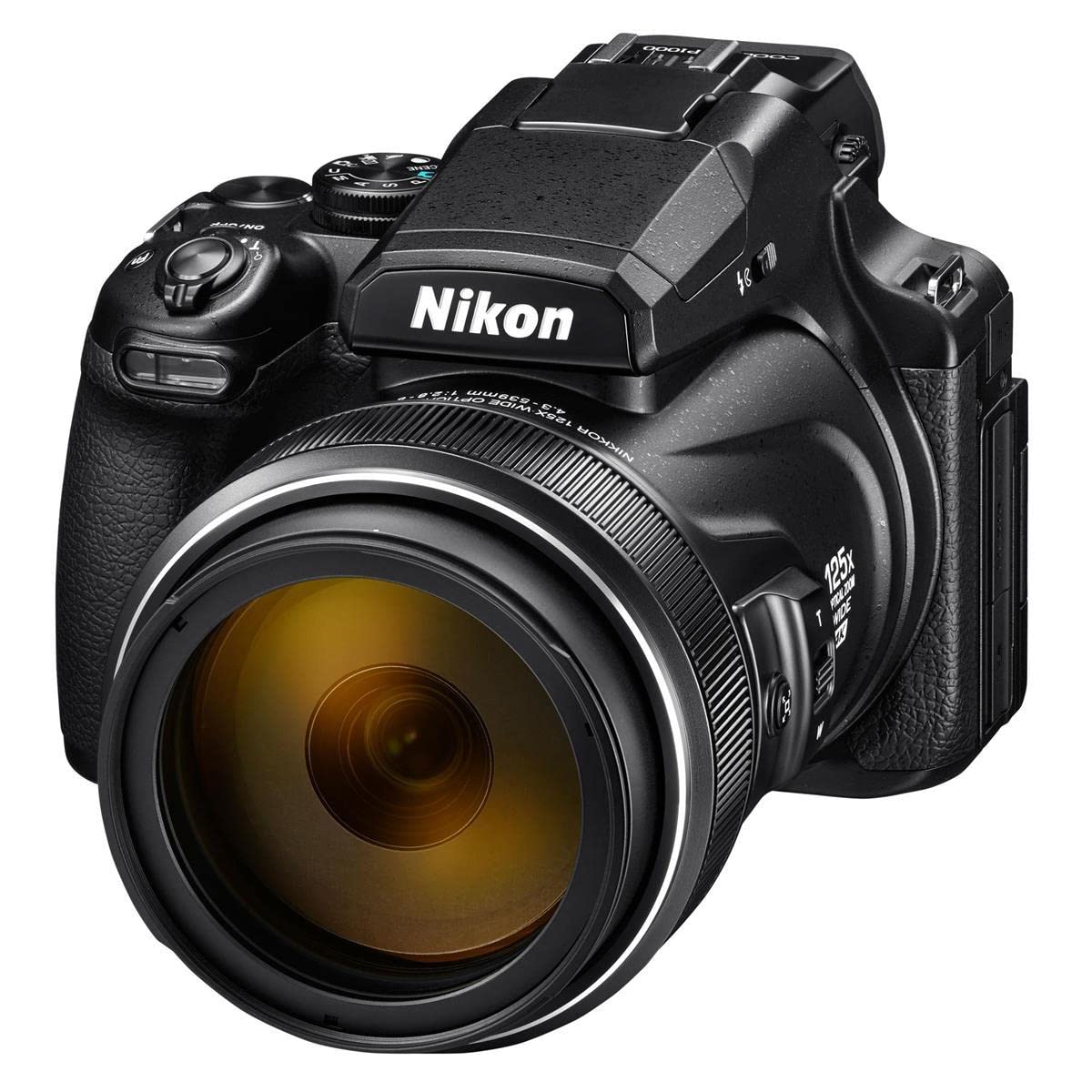
The Nikon COOLPIX P1000 holds the crown for the most extreme optical zoom ever built into a consumer camera, delivering a 125x optical zoom that reaches an effective 24-3000mm in full-frame terms. This single-lens bridge camera eliminates the need for carrying multiple heavy telephoto lenses and adapter rings, putting lunar surface detail and distant wildlife within reach of a single handheld device. The Dual Detect Optical VR provides 5.0 stops of shake correction, which is necessary for holding the image steady at the 2000mm to 3000mm end of the range — though many users report needing a tripod beyond 1500mm for consistent sharp results.
The small 1/2.3-inch 16 MP sensor is the critical compromise. At base ISO the images are detailed enough for web sharing and moderate prints, but the sensor’s limited dynamic range means that high-contrast scenes — a bright sky with a dark bird — often clip shadows or highlights. The f/2.8 to f/8.0 aperture range is acceptable in good light, but in overcast or twilight conditions the noise floor rises dramatically, forcing the user into either high-ISO grain or slower shutter speeds that risk motion blur. The contrast-detect autofocus is generally reliable for static subjects but struggles with birds in flight at the long end of the zoom.
For photographers who prioritize sheer optical reach above all other image quality metrics and who work primarily in good daylight, the P1000 is a category-defining tool that no interchangeable lens system can match at this price point. The RAW file support provides some latitude in post-processing, and the inclusion of both 4K UHD video and time-lapse modes makes it a versatile creative instrument. The weight of 3.2 pounds and the prominent lens barrel make it front-heavy, so a properly balanced tripod plate is a strongly recommended addition for serious use.
Why it’s great
- Unrivaled 24-3000mm optical zoom in a single all-in-one body
- Dual Detect VR provides usable handheld performance up to 1500mm
- RAW + 4K video capability for a superzoom bridge camera
Good to know
- Small sensor limits dynamic range and high-ISO noise performance
- Autofocus speed struggles with fast-moving subjects at max zoom
- Significant barrel weight requires tripod support beyond 1500mm
2. Nikon NIKKOR Z 100-400mm VR S

The NIKKOR Z 100-400mm VR S represents Nikon’s premium telephoto zoom for the Z mirrorless system, delivering the exceptional optical sharpness and contrast expected from the S-Line designation. The lens uses two high-speed STM stepping motors that lock onto subjects with speed and near-silence, making it a strong choice for wildlife video and covert bird photography. The 5.5-stop VR system, when paired with a Z-series camera body featuring 5-axis IBIS, delivers a stabilization performance that produces usable handheld images at 400mm at shutter speeds as low as 1/30 second.
The f/4.5-5.6 maximum aperture is faster than the f/5.6-8 alternatives in this roundup, providing a meaningful advantage in low-light scenarios such as dawn and dusk photography. The lens is compatible with both the Z 1.4x and 2x teleconverters, extending the reach to 560mm and 800mm respectively without significant loss of resolution — though autofocus speed does slow in dim conditions. The weather-sealing proved itself in polar expeditions, with consistent performance in freezing and wet conditions.
The 3.2-pound weight combined with the internal zoom mechanism keeps the lens balanced even when fully extended, and the customizable control ring adds tactile control over aperture, exposure compensation, or manual focus. For travel and hiking, the lens pairs naturally with a 24-70mm or 24-120mm standard zoom, covering everything from wide landscapes to distant peaks in two lenses. The premium investment buys instant access to Nikon’s best-in-class telephoto sharpness across the entire Z system.
Why it’s great
- S-Line optics deliver edge-to-edge sharpness with minimal chromatic aberration
- STM motors provide fast, silent autofocus for video and wildlife
- 1.4x and 2x teleconverter compatible with maintained resolution
Good to know
- Premium price places it above many competitors in the 400mm class
- Aperture is f/5.6 at the long end, requiring higher ISO in low light
- Heavier than some alternatives at 3.2 pounds
3. OM SYSTEM Olympus M.Zuiko 150-600mm F5.0-6.3 IS

The OM SYSTEM M.Zuiko Digital ED 150-600mm F5.0-6.3 IS harnesses the Micro Four Thirds 2x crop factor to deliver a massive 1200mm equivalent field of view at the long end, and with the optional MC-20 teleconverter that reach extends to 2400mm. The lens uses 25 elements in 15 groups including 4 Super ED lenses that control chromatic aberration effectively even at the extreme telephoto range. The Sync IS system — combining the lens’s optical stabilization with the camera’s in-body IS — achieves up to 7.0 stops of correction on the wide end and 6.0 stops on the tele end, which is the highest stabilization rating in this comparison.
At 5 pounds, this is a heavy lens for the Micro Four Thirds system, and field use overwhelmingly recommends a monopod or tripod for extended shooting sessions. The IPX1 splash and dust-proof construction, along with fluorine-coated front element, makes it practical for use in rain, sea spray, and dusty environments that are common in birding and nature photography. The autofocus is responsive in good light but slows noticeably in overcast conditions, and users report that fast-moving birds in flight put the contrast-detection AF to its limit.
Image quality from the lens is sharp across the entire zoom range, with excellent contrast and color reproduction that holds up well even at 1200mm. At ISO 12800, modern denoising software like DxO PhotoLab can produce clean images that would have been impossible with previous generations of sensor technology. For the dedicated wildlife photographer who prioritizes absolute reach and who works with a monopod, this lens delivers a field of view that rivals much larger full-frame setups.
Why it’s great
- 1200mm equivalent reach delivers frame-filling detail on distant subjects
- Sync IS provides 7.0 stops of stabilization for handheld telephoto shooting
- Robust weather sealing for reliable use in challenging outdoor conditions
Good to know
- 5-pound weight makes it demanding for long handheld sessions
- f/6.3 aperture at the long end requires high ISO in low light
- Autofocus speed slows in overcast and twilight conditions
4. Fujifilm Fujinon XF150-600mmF5.6-8 R LM OIS WR

The Fujifilm XF150-600mmF5.6-8 R LM OIS WR was purpose-built for the X-series APS-C system, providing a 35mm equivalent focal length range of 229-914mm that pairs naturally with Fujifilm’s renowned film simulations. The internal zoom mechanism is a standout engineering feature — the lens does not extend during zooming, meaning it maintains its weather resistance and prevents dust ingress even when changing focal lengths in sandy or dusty environments. The 24-element design includes 4 Super ED and 3 ED elements that deliver exceptional sharpness and contrast that matches well with the 40 MP X-Trans sensor found in cameras like the X-T5.
The autofocus performance is the fastest among Fujifilm telephoto options, with linear motors that lock onto bird eyes reliably even in challenging light. With the 1.4x teleconverter, the maximum aperture becomes f/8-11, which pushes the camera into contrast-detect territory on some bodies — a limitation that photographers should test before committing to the teleconverter for action work. The 3.53-pound weight is lighter than the OM SYSTEM 150-600mm, making it more manageable for all-day hiking and handheld use.
The f/5.6-8 aperture range is the lens’s primary limitation. In overcast conditions or deep woodland shade, the high ISO requirement can reach ISO 6400-12800, which on Fujifilm’s APS-C sensors produces image quality that benefits significantly from AI-based noise reduction software. For wildlife photographers working in open, well-lit environments and who want the best possible integration with Fujifilm’s color science, this lens is a near-perfect match. The combination of internal zoom, weather sealing, and high-speed AF makes it a field-ready tool for serious birders.
Why it’s great
- Internal zoom mechanism prevents dust ingress and maintains balance
- Fast linear motor AF locks onto bird eyes with excellent precision
- Outstanding sharpness and contrast across the entire zoom range
Good to know
- f/8 aperture at 600mm limits low-light performance significantly
- 1.4x teleconverter reduces AF speed on some camera bodies
- Premium investment for the Fujifilm X system
5. Panasonic Leica DG 100-400mm F4.0-6.3 II

The Panasonic Leica DG Vario-Elmar 100-400mm F4.0-6.3 II ASPH brings the Leica optical pedigree to the Micro Four Thirds system, delivering 200-800mm equivalent reach in a lens that meets Leica’s stringent standards for sharpness and contrast. The second-generation version carries dust, splash, and freeze-resistant construction that allows operation in temperatures as low as -10°C, making it the most rugged telephoto option for MFT shooters who work in extreme conditions. The Power O.I.S. system works in conjunction with Panasonic’s Dual I.S. 2 to deliver stabilized handheld performance at the 800mm equivalent range.
The f/4.0 maximum aperture at the 100mm end is wider than most super-telephoto zooms in this class, providing an advantage in low-light and portrait work that benefits from background separation. The 0.5x maximum magnification (35mm equivalent) enables close-up work with small subjects like butterflies and dragonflies, adding macro capability to the lens’s telephoto reach. The zoom ring and focus ring offer smooth, damped rotation, and the tripod collar is removable for handheld use.
This lens competes directly with the OM SYSTEM 100-400mm, and user reports consistently rate the Leica version higher in terms of sharpness and autofocus reliability on Panasonic bodies. The 2.17-pound weight is lighter than the OM SYSTEM 150-600mm and the Fujifilm 150-600mm, making it more practical for all-day hiking. The primary drawback is the lens hood design — the bayonet mount can loosen over time, and some users find it less secure than screw-on alternatives. For MFT shooters who want the best optical quality in a portable telephoto package, this is the benchmark.
Why it’s great
- Leica-certified optics deliver exceptional sharpness and color rendition
- Dust, splash, and freeze-proof construction for extreme environments
- f/4.0 at wide end provides better low-light capability than most super-tele zooms
Good to know
- Lens hood bayonet mount can become loose over time
- Zoom ring rotation direction may feel unfamiliar to some users
- Premium investment for the MFT system
6. Tamron 50-400mm f/4.5-6.3 Di III VC VXD
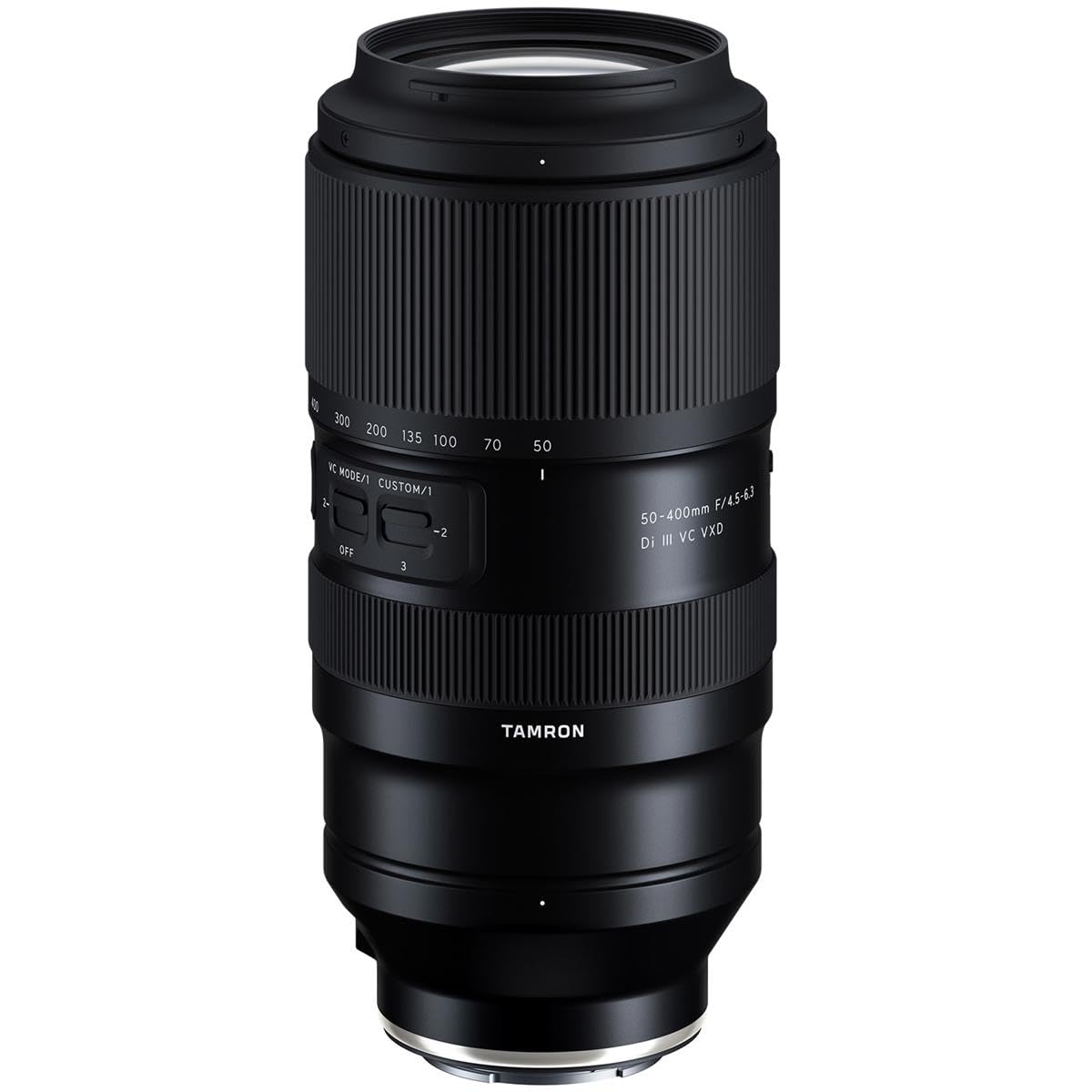
The Tamron 50-400mm f/4.5-6.3 Di III VC VXD is an 8x zoom that covers the standard-to-super-telephoto range in one compact package for Sony full-frame E-mount cameras. The 50mm starting point is a major differentiator — it eliminates the gap between a standard 24-70mm zoom and the telephoto range, so a single lens can handle everything from street portraits to distant wildlife without needing to swap on the trail. The VXD (Voice-coil eXtreme Drive) linear motor provides fast, quiet autofocus that handles most wildlife scenarios with ease, though users report roughly a 60/40 hit rate on fast-moving subjects at the 400mm end.
The VC (Vibration Compensation) image stabilization is effective for handheld shooting, and the lens’s compact size makes it genuinely travel-friendly. The optical construction uses 24 elements in 18 groups including XLD and LD elements that effectively control chromatic aberration and axial chromatic aberration. The Broad-Band Anti-Reflection Generation 2 coating reduces flare and ghosting in backlit conditions, which is valuable when shooting birds against bright skies. The lens also features a USB-C port for firmware updates and can be tuned with Tamron’s Lens Utility software.
The trade-off for the extended wide end is that the 50-400mm does not reach 500mm or 600mm like dedicated super-telephoto zooms. For Sony shooters who need a single-lens travel solution that can handle both landscapes and wildlife, this is the most versatile option available. The f/6.3 aperture at 400mm is consistent with other lenses in its class, which means the same low-light considerations apply. The weather sealing is good but not at the level of sealed professional lenses, so care is needed in heavy rain.
Why it’s great
- 50-400mm range covers standard to super-telephoto without lens changes
- Compact and lightweight design for a full-frame 400mm zoom
- VXD AF motor provides fast, silent autofocus for video and stills
Good to know
- AF hit rate on fast-moving subjects at 400mm is around 60%
- f/6.3 aperture requires high ISO in overcast conditions
- Weather sealing is not as robust as premium alternatives
7. Nikon NIKKOR Z 28-400mm f/4-8 VR

The NIKKOR Z 28-400mm f/4-8 VR is Nikon’s ultra-range travel zoom for the Z mount, offering a 14.2x zoom ratio that stretches from wide-angle street photography to super-telephoto wildlife shots in a single lens weighing just 1.6 pounds. This is the lightest lens in its class by a significant margin, meaning that for day-long hikes or air travel where every gram matters, the 28-400mm is a strong candidate. The VR system provides 5.0 stops of stabilization on its own and 5.5 stops when paired with compatible Z cameras featuring Synchro VR.
The f/4-8 aperture range is the lens’s most significant compromise. At 400mm the maximum aperture narrows to f/8, which is slower than any other lens in this comparison. This forces higher ISO settings in all but the very brightest daylight, and the autofocus system can struggle to acquire lock in low-contrast or twilight conditions. The 400mm focal length on full-frame is also the shortest in the comparison, meaning that for maximum reach you will need to crop images significantly or pair with a DX-format Z camera for a 600mm equivalent field of view.
Despite the aperture limitations, the lens delivers sharp images across the range for a superzoom, and the minimum focus distance of 0.2m at the wide end enables dynamic close-up compositions with good background separation. The linear MF drive is smooth for video work, and the overall size reduction makes this an ideal companion for a compact Z5 or Z6II body. For photographers who prioritize packability and versatility over absolute reach, and who understand the ISO trade-off at f/8, this lens is a unique proposition in the Z system.
Why it’s great
- Exceptionally lightweight at 1.6 lbs for the 28-400mm range
- VR stabilization delivers 5.0 to 5.5 stops for handheld use
- Versatile zoom range from wide-angle to telephoto in one lens
Good to know
- f/8 aperture at 400mm severely limits low-light performance
- 400mm is the shortest maximum focal length in this comparison
- Autofocus reliability drops in low-contrast and twilight conditions
8. OM SYSTEM Olympus M.Zuiko 100-400mm F5.0-6.3 IS

The OM SYSTEM M.Zuiko Digital 100-400mm F5.0-6.3 IS delivers 200-800mm equivalent reach on Micro Four Thirds bodies, making it a strong entry point for wildlife photographers entering the MFT system. The lens features in-lens image stabilization providing 3 EV steps at the 800mm equivalent, and when paired with OM-D or OM-1 series IBIS, the combined Sync IS adds meaningful stability for handheld shooting. The 1.3m minimum focus distance allows for close-up work with insects and flowers that takes advantage of the telephoto range’s subject isolation.
The weather-sealed construction with splash and dust protection makes it suitable for outdoor shooting in damp conditions that would stop a non-sealed lens. Compatibility with the MC-14 1.4x and MC-20 2.0x teleconverters is a major advantage — with the MC-20 the lens reaches a 1600mm equivalent field of view, though sharpness does degrade noticeably with the 2x converter. The f/6.3 aperture at the long end is a known limitation, requiring ISO 6400 and higher in overcast conditions, which is manageable with modern denoising tools.
Image quality for static subjects is excellent, with good contrast and color rendition across the frame. Autofocus is slower than the premium Panasonic Leica option, and fast-moving birds in flight will test the system’s capability — many users recommend using the single-point or small-area AF modes rather than wide-area tracking. The zoom ring has a smooth but slightly loose feel that should be checked on individual copies. For the price, this lens offers the best reach-per-dollar ratio for MFT users who need a dedicated wildlife telephoto.
Why it’s great
- Excellent reach-per-dollar ratio with 200-800mm equivalent coverage
- Weather-sealed construction for reliable outdoor use
- Compatible with 1.4x and 2x teleconverters for extended reach
Good to know
- Autofocus speed is slow for fast-moving wildlife subjects
- f/6.3 aperture requires high ISO in overcast conditions
- Zoom ring can feel loose and may vary between units
9. Canon RF100-400mm F5.6-8 IS USM

The Canon RF100-400mm F5.6-8 IS USM is the most budget-friendly way to get serious telephoto reach into the Canon EOS R mirrorless system. The Nano USM motor provides fast, smooth, and near-silent autofocus that works well for both stills and video, and the optical image stabilizer delivers up to 5.5 stops of shake correction, which expands to 6 stops on cameras with in-body IBIS like the R5 and R6. The zoom range covers a versatile 100mm to 400mm, and on APS-C R-series bodies like the R7 and R10, the effective field of view extends to 160-640mm, putting wildlife reach within grasp of a very portable package.
The f/5.6-8 maximum aperture is the lens’s most notable limitation. At 400mm the f/8 aperture restricts light more than any other lens in its class, and on the smaller APS-C sensor of the R10 or R50 it pushes ISO to the upper limits in anything other than full sun. The minimum focusing distance of 2.89 feet at 200mm and maximum magnification of 0.41x at 400mm allows for impressive close-up capability, enabling small subjects like insects and flowers to fill the frame with good detail.
The lens is noticeably lightweight and compact for its range, making it a strong choice for hiking and travel where weight is a primary concern. The zoom ring rotation direction is opposite to some other Canon lenses, which takes a brief adjustment period. There is no weather sealing, so use in rain or dusty conditions requires care. For Canon RF system users who are starting out in wildlife photography and want a quality telephoto without a major investment, this lens provides a solid foundation that can be upgraded later when the aperture limitation becomes the binding constraint.
Why it’s great
- Budget-friendly entry point into the Canon RF telephoto ecosystem
- Nano USM provides fast and quiet autofocus performance
- Compact and lightweight design for travel and hiking
Good to know
- f/8 aperture at 400mm limits low-light capability severely
- No weather sealing for use in rain or dust
- Zoom ring rotates opposite to some Canon lenses
10. Nikon COOLPIX P950 Superzoom Digital Camera

The Nikon COOLPIX P950 succeeds the highly popular P900 with an 83x optical zoom that delivers a 24-2000mm equivalent range, making it a more affordable alternative to the P1000 that still provides extreme reach for birding and nature photography. The 16 MP sensor is paired with Dual Detect Optical VR that provides noticeably better stabilization than the P900, allowing users to get usable handheld shots at the full 2000mm end. The built-in Bird and Moon modes are convenience additions that optimize settings for specific subjects, reducing the learning curve for new users.
The small sensor faces the same fundamental limitations as the P1000 — limited dynamic range and noise performance that require good lighting conditions to produce clean images. The autofocus system is contrast-detect and is adequate for static and slow-moving subjects, but fast-moving birds and action shots prove consistently difficult. The digital zoom option up to 166x Dynamic Fine Zoom is largely unusable due to the interpolation artifacts, and experienced photographers will keep the camera firmly in the optical zoom range.
The P950’s advantage over the P1000 is its lower entry price and slightly smaller size. For the bird watcher or nature enthusiast who wants recognizable photos of distant subjects and does not plan to print larger than 8×10, the P950 provides excellent value. The RAW format support gives some latitude for exposure correction, and the 4K UHD video capture at the full zoom range adds versatility. The camera does not have weather sealing and should be protected from rain.
Why it’s great
- 83x optical zoom provides 24-2000mm reach at a lower price than P1000
- Improved stabilization over P900 enables more handheld shots at max zoom
- Built-in Bird and Moon modes help beginners get good results quickly
Good to know
- Small 1/2.3-inch sensor limits image quality in low light
- Contrast-detect AF struggles with fast-moving subjects
- Digital zoom above 83x introduces interpolation artifacts
11. Nikon COOLPIX P1100 Superzoom Digital Camera

The Nikon COOLPIX P1100 is the current-generation bridge camera that inherits the 125x optical zoom range (24-3000mm equivalent) from the legendary P1000 while adding a dedicated Bird-watching mode on the mode dial for faster access to optimized settings. The Dual Detect Optical VR provides 4.0 stops of shake correction, and the 250x Dynamic Fine Zoom extends the digital range even further — though results at that level are soft. The customizable control ring on the lens barrel allows manual focus override or direct adjustment of exposure compensation and white balance, giving experienced users more control than the P950 offers.
The 16 MP 1/2.3-inch sensor is identical in size to the P1000 and P950, which means the same fundamental limitations apply: excellent results in bright sunlight, rapid image quality degradation as ISO rises, and limited dynamic range. The Bird-watching mode is a genuine upgrade from previous models, automatically selecting exposure settings and focus modes appropriate for birding, but the tracking system still struggles with birds in flight. The plastic, lightweight body feels less durable than interchangeable-lens cameras, and the video stutters noticeably when panning at high zoom without a tripod.
The P1100 represents the most refined version of Nikon’s extreme-zoom bridge concept, offering the full 3000mm range plus the convenience of the new mode dial. For users who want the maximum optical reach available in any consumer camera and who understand the sensor’s daylight-only sweet spot, the P1100 is the best-implemented version of this concept. The lack of sensor dust issues compared to interchangeable systems is a genuine convenience for outdoor shooters who change lenses in the field rarely.
Why it’s great
- 125x optical zoom reaches 3000mm equivalent for extreme distance subjects
- Dedicated Bird-watching mode optimizes settings for avian photography
- Customizable control ring adds manual exposure control
Good to know
- Small sensor limits performance to bright daylight conditions
- Plastic body feels less durable than higher-end systems
- Video stutters during panning at high zoom without tripod support
FAQ
Does a built-in lens VR replace the need for a tripod at 2000mm?
How does sensor size affect the usability of a 400mm lens for bird photography?
What is the practical difference between 83x and 125x optical zoom in real-world use?
Can I use a full-frame telephoto lens on an APS-C camera for extra reach?
Final Thoughts: The Verdict
For most users, the 100x optical zoom lens winner is the Nikon COOLPIX P1000 because it provides the highest optical zoom ratio available in a consumer product, delivering 24-3000mm equivalent reach in a single all-in-one body without the complexity of interchangeable lenses. If you want the best image quality and compatibility with a mirrorless system, the Nikon NIKKOR Z 100-400mm VR S offers S-Line sharpness with teleconverter options. And for the ultimate 1200mm equivalent reach in a rugged, weather-sealed package, nothing beats the OM SYSTEM 150-600mm F5.0-6.3 IS.