
Your old office desktop or pre-built SFF tower has a silent bottleneck that is holding a perfectly capable CPU back. The integrated graphics on most business-class motherboards choke when asked to drive a 4K display for spreadsheet-heavy workflows or stream smooth 1080p video. This is exactly where a low-profile, low-power discrete card reclaims an entire machine, turning a five-year-old OptiPlex or ProDesk into a competent multimedia hub.
I’m Min — the co-founder and writer behind Gadgets Feed. I’ve spent dozens of hours cross-referencing GPU core clock speeds, memory bandwidth, board dimensions, power draw, and real-world customer feedback to identify which version of this entry-level Pascal card actually delivers on its promise without hidden compromises.
Every DDR5-based model reviewed below runs on roughly 30 watts from the PCIe slot, requires zero external power cables, and fits into low-profile cases with the included half-height bracket — making this the definitive decision guide for the best 1030 video card to revive a legacy system today.
How To Choose The Best 1030 Video Card
The GT 1030 occupies a narrow performance band, yet its variants differ dramatically in real-world usability. The single most important decision you will make is not between brands but between memory types: GDDR5 versus GDDR4. A GDDR4 card can be up to 50 percent slower in memory bandwidth, which directly impacts frame pacing and video playback smoothness. Always prioritize the GDDR5 version unless the price difference is trivial and your tasks are limited to basic 2D desktop work.
Form Factor and Bracket Inclusion
Not all GT 1030 cards ship with the low-profile bracket you need for a small-form-factor case. Several buyers have reported receiving a full-height bracket only, making the card physically uninstallable in Dell OptiPlex or HP ProDesk towers. Confirm the product description explicitly states “low-profile bracket included” before you buy, and check that the bracket matches your case’s port layout — some use DVI, others HDMI-only.
Power Delivery and Thermal Limits
Every legitimate GDDR5 GT 1030 draws approximately 30 watts through the PCIe slot, so it will work with even a 240-watt power supply. Passive-cooled fanless designs run silently but can reach 80–85°C under sustained load in a poorly ventilated case. If your SFF chassis has minimal airflow, opt for a single-fan active-cooling model that keeps temperatures below 70°C and extends component lifespan.
Quick Comparison
On smaller screens, swipe sideways to see the full table.
| Model | Category | Best For | Key Spec | Amazon |
|---|---|---|---|---|
| ASUS GT1030-2G-CSM | Passive GDDR5 | Silent HTPC | 1506 MHz Boost / 2GB GDDR5 | Amazon |
| ZOTAC ZT-P10300A-10L | Active GDDR5 | Budget Gaming | 2GB GDDR5 / Low Profile | Amazon |
| maxsun GT 1030 2GB GDDR5 | SFF GDDR5 | Office Revival | 1468 MHz / 2GB GDDR5 | Amazon |
| MSI GT 1030 4GD4 LP OC | DDR4 Gaming | 1440p Office | 1430 MHz / 4GB GDDR4 | Amazon |
| MSI GT 1030 2GHD4 LP OC | Compact DDR4 | Ultra-Small Cases | 2GB GDDR4 / DisplayPort | Amazon |
| maxsun GT 1030 4GB GDDR4 | Large Memory | High VRAM Wants | 1380 MHz / 4GB GDDR4 | Amazon |
| MSI GT 1030 4GHD4 LP OC | Silent DDR4 | 4K Video Only | 4GB GDDR4 / Passive | Amazon |
In‑Depth Reviews
1. ASUS GeForce GT 1030 2GB GDDR5 (GT1030-2G-CSM)

The ASUS GT1030-2G-CSM is the gold standard for a silent office or HTPC upgrade. Its boost clock reaches 1506 MHz out of the box — the highest among all the cards in this roundup — and the passive aluminum heatsink eliminates fan noise entirely. The Auto-Extreme manufacturing process and Super Alloy Power II components give this card a build quality edge that justifies its place at the top of the list.
Customer reports confirm this card drives 4K desktops without fan whine and handles light gaming like Fortnite at playable frame rates when paired with a decent CPU. On Linux systems running the NVidia 470 driver, the card is recognized immediately and performs identically to its Windows behavior. The low-profile bracket is included in the box, so no extra shopping for SFF installations.
The only real trade-off is the passive thermal design: in a cramped, poorly ventilated case, the heatsink can reach 80°C under sustained gaming load. Keep this card in a case with at least one exhaust fan and it will serve reliably for years without a single moving part to fail.
Why it’s great
- Highest boost clock at 1506 MHz for snappy 4K desktop response
- Completely silent passive cooling — zero moving parts
- Aerospace-grade power components and low-profile bracket included
Good to know
- Runs hot in tight SFF cases without active exhaust
- Limited to 2GB GDDR5, not enough for modern AAA games
2. ZOTAC GeForce GT 1030 2GB GDDR5 (ZT-P10300A-10L)
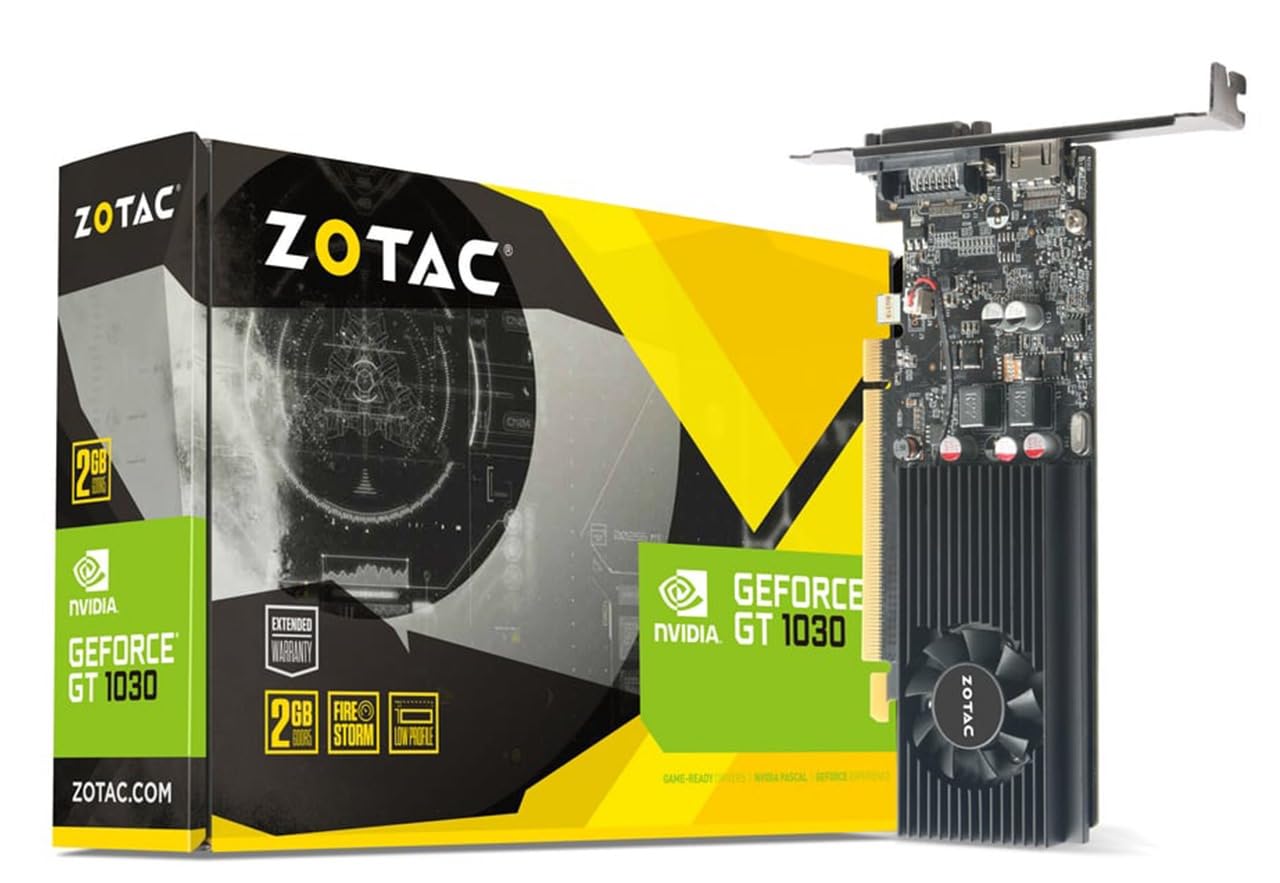
ZOTAC’s entry is the safest pick for anyone running a proprietary 200-watt power supply. Multiple verified buyers confirm the entire system draws roughly 120 watts at the wall, leaving enough headroom even for older Dell and HP workstations. The active cooling fan keeps temperatures well below 70°C, and the card includes both a full-height and a low-profile bracket out of the box.
At 1080p low settings, this card pushes older titles like Euro Truck Simulator 2 and Grim Dawn to a steady 60 FPS. For more demanding games such as Forza Motorsport 7, it delivers around 45 FPS at 720p low. The GDDR5 memory runs at an effective 6000 MHz, giving it a clear bandwidth advantage over any DDR4 variant of the same chip.
The 4K output is limited to 30 Hz over HDMI, so this is not the card for high-refresh productivity monitors above 1080p. But if your goal is to turn a cramped office SFF into a playable low-end gaming rig, the ZOTAC is the most reliable choice in the lineup.
Why it’s great
- Proven 30W TDP works with 200W PSUs without issue
- GDDR5 memory offers double the bandwidth of DDR4 variants
- Active fan keeps temperatures low in tight spaces
Good to know
- HDMI 2.0 limited to 4K at 30 Hz
- No ShadowPlay support on this Pascal revision
3. maxsun GEFORCE GT 1030 2GB GDDR5

The maxsun GDDR5 card delivers genuine Pascal performance at an entry-level price point that undercuts the big brands. Its silver-plated PCB and all-solid-capacitor design are marketing claims backed by real customer reports of stable 30-watt operation inside 360-watt power supplies with no voltage dips. The boost clock of 1468 MHz is within striking distance of the ASUS card, making this the best price-to-clock ratio in the field.
Buyers consistently report that this card solved monitor blanking and no-signal issues on Dell PCs, and it drives 2560×1080 ultrawide resolutions with crisp clarity for video streaming and office work. The low-profile bracket is included — though one verified purchase reported the bracket was missing from the box, so confirm inclusion immediately upon delivery.
While the maxsun brand lacks the recognition of ASUS or MSI, the card’s performance in basic tasks — web browsing, Netflix in 4K, 2D productivity — is indistinguishable from the premium alternatives. If you are strictly budget-constrained and need a working low-profile GDDR5 card, this is the one to buy.
Why it’s great
- 1468 MHz boost clock outperforms many similarly-priced GDDR5 cards
- Silver-plated PCB for improved thermal and electrical efficiency
- Proven solution for solving Dell PC monitor blanking issues
Good to know
- Low-profile bracket not always included despite description claims
- Smaller brand with less customer support infrastructure
4. MSI Gaming GeForce GT 1030 4GB DDR4 (GT 1030 4GD4 LP OC)

MSI’s 4GB DDR4 card is the only model in this roundup that offers a DisplayPort 1.4a output, which is a genuine advantage if you need to drive a modern 1440p or 4K monitor at a higher refresh rate than HDMI 2.0 allows. The 4GB frame buffer, while using the slower DDR4 memory, provides headroom for texture caching in less bandwidth-sensitive applications like photo editing or running multiple browser windows.
Customer reviews from Linux Mint and Ubuntu users are unusually strong for this model — the card is plug-and-play on modern kernels, and the NVIDIA driver’s overscan slider solved TV picture-fit issues on Panasonic displays. The 1430 MHz boost clock is respectable for the DDR4 class, and the single fan keeps load temperatures below 75°C in most cases.
The DDR4 memory is the clear compromise here. Users who expected 300–400 FPS in Minecraft were disappointed with a 60 FPS cap, which is a direct result of the 2100 MHz effective memory speed bottleneck. If your workflow benefits from the extra 2GB of VRAM and the DisplayPort, this card makes sense; for pure gaming, the DDR5 alternatives are stronger.
Why it’s great
- DisplayPort 1.4a for high-refresh 1440p output
- 4GB frame buffer handles multi-monitor setups well
- Excellent Linux compatibility with plug-and-play driver support
Good to know
- DDR4 memory is 50% slower than GDDR5 for gaming
- MSI Afterburner overclocking may cause instability
5. MSI GT 1030 2GHD4 LP OC

The MSI 2GHD4 is the most physically compact GT 1030 available at 5.9 inches in length, making it the go-to choice for the tightest Dell, HP, and Lenovo SFF chassis where every millimeter counts. It includes both HDMI and DisplayPort outputs, which is rare for a DDR4-based 1030 and gives you flexibility for connecting modern monitors without adapter dongles.
User reports confirm this card works flawlessly in Photoshop and Linux environments for 4K desktop output — the DisplayPort connection enables native 4096×2160 resolution without the 30 Hz cap that plagues HDMI-only variants. The passive heatsink keeps operation completely silent, which buyers consistently praise for home theater PC builds.
The hard truth is that this is a DDR4 card, and multiple informed buyers have noted the GDDR5 version offers double the memory bandwidth for roughly the same price point. If your workload is purely 2D productivity and 4K video playback, the 2GHD4 is a capable silent performer. But if you ever plan to game, even casually, step up to the GDDR5 version.
Why it’s great
- 5.9-inch length fits the smallest proprietary SFF cases
- DisplayPort output supports native 4K without HDMI limits
- Completely silent passive operation for HTPC builds
Good to know
- DDR4 memory provides only half the bandwidth of GDDR5 variants
- Product naming does not clearly indicate it is the slower DDR4 version
6. maxsun GEFORCE GT 1030 4GB GDDR4

The maxsun 4GB DDR4 card appeals to buyers who believe more VRAM automatically translates to better performance. In reality, the 4GB frame buffer is paired with GDDR4 memory running at only 2100 MHz, creating a bandwidth bottleneck that prevents the extra capacity from being fully utilized in gaming scenarios. Still, for specific applications like holding large texture files in memory for photo editing, the 4GB allocation can be beneficial.
The card’s 3.5-inch fan provides reasonable airflow while keeping noise low, and the ITX form factor means it will fit in virtually any chassis. Verified buyers report that it enabled 4K video playback and editing from a Pixel 6 phone, reviving an old Dell T3400 that previously struggled with even 1080p YouTube. The install process takes under five minutes on Windows 7 through Windows 11.
One consistent theme in customer feedback is that this card handles basic productivity and 4K desktop resolution well but chokes on full-screen 4K video playback and cannot maintain smooth frame rates in any modern game at 1080p. It is a pure productivity and media playback card, not a gaming card in any practical sense.
Why it’s great
- 4GB frame buffer for photo editing and multi-tab workflows
- Compact ITX design fits virtually any case
- Proven to revive very old PCs (Dell T3400) for 4K media
Good to know
- GDDR4 memory bandwidth throttles 4K video playback performance
- Not suitable for any modern gaming at playable settings
7. MSI GeForce GT 1030 4GHD4 LP OC

The MSI 4GHD4 LP OC is the silentest option among all the 4GB DDR4 cards, employing a fully passive heatsink that produces zero noise. Buyers consistently highlight that it flawlessly plays 4K video on older desktops — one verified user confirmed it made their HP ProDesk 400 G7 feel “much better, close to a gaming PC but less expensive.” The 1430 MHz boost clock is standard for the DDR4 variant, and the card supports a maximum resolution of 2560×1600.
This card is a solid fit for audio/video media collections, music production rigs, and home theater PCs where silence is the top priority. The included low-profile bracket and compact 5.91-inch length mean it will slide into almost any SFF case without clearance issues. On older motherboards with Windows 7, the NVIDIA 391.35 driver provides immediate compatibility.
Like all DDR4-based GT 1030 cards, the 4GHD4 is strictly a productivity and media playback solution. The 2100 MHz memory speed creates a hard performance ceiling that no amount of VRAM can overcome. If you are building a silent HTPC that never runs games, this is a perfectly adequate choice; if you might ever install Steam, look to the GDDR5 alternatives.
Why it’s great
- Fully passive cooling for completely silent operation
- Compact size fits the tightest HP and Dell SFF cases
- Excellent 4K video playback performance for media centers
Good to know
- Display resolution maxes out at 2560×1600, not true 4K
- DDR4 memory limits gaming performance to sub-HD levels
FAQ
Will a GT 1030 work in my Dell OptiPlex SFF with a 240W power supply?
Which memory type is better for a GT 1030: GDDR5 or the 4GB DDR4 version?
Final Thoughts: The Verdict
For most users, the best 1030 video card winner is the ASUS GT1030-2G-CSM because it pairs the highest boost clock of 1506 MHz with silent passive cooling, premium build quality, and an included low-profile bracket. If you need an active fan for a tightly-packed SFF case, grab the ZOTAC ZT-P10300A-10L. And for the tightest budget where every dollar counts, nothing beats the maxsun 2GB GDDR5 for reviving an old office PC with genuine Pascal performance.