
The GTX 1080 and 1080 Ti remain the ultimate high-refresh-rate 1080p warriors years after launch — raw rasterization that still embarrasses many modern cards at the same price. Their GDDR5X memory bandwidth and generous VRAM pools punish any game you throw at them, provided you don’t need hardware ray tracing.
I’m Min — the co-founder and writer behind Gadgets Feed. I have spent hundreds of hours cross-referencing spec sheets, scrutinizing real-world benchmark deltas, and parsing customer longevity reports across multiple generations of Pascal, Turing, and RDNA hardware to bring you this focused analysis.
After filtering through dozens of listings by clock speeds, memory configurations, thermal performance, and build quality, this roundup of the best 1080 graphics card options arms you with the data to make a confident purchase in a market full of variable refurbished stock.
How To Choose The Best 1080 Graphics Card
The GTX 1080 and 1080 Ti are now exclusively sold as renewed or used hardware. Your buying process must shift from comparing MSRP to evaluating thermal paste condition, fan bearing wear, and the specific bin of the GPU die you’re getting from a particular AIB partner. Here is what separates a card that runs at 1960 MHz boost for years from one that throttles down to 1500 MHz within weeks.
VRAM Capacity: 8GB vs 11GB
The GTX 1080 packs 8GB of GDDR5X on a 256-bit bus, while the 1080 Ti carries 11GB on a 352-bit bus. That extra VRAM and wider bus directly impacts high-resolution texture streaming in modern titles like Hogwarts Legacy and Cyberpunk 2077 at 1440p. For pure 1080p gaming, 8GB remains sufficient for virtually every title at ultra settings, but the 11GB card gives you headroom for texture mods and future game installs.
Cooler Architecture: Blower vs Open-Air Dual/Triple Fan
Founders Edition and Turbo cards use a radial blower fan that exhausts heat directly out of the case — ideal for small form factor builds or cases with poor front intake. Open-air coolers from MSI, EVGA, ASUS, and Gigabyte use two or three axial fans that run quieter and keep the GPU several degrees cooler inside standard mid-tower cases, but they dump hot air into your chassis. Your case airflow determines which is safe.
Power Delivery: Phase Count and Connector Type
The 1080 draws up to 180W and the 1080 Ti up to 250W. Higher-end AIB cards like the EVGA FTW use 10 power phases and dual 8-pin connectors for cleaner voltage delivery during overclocking. A card that ships with a single 8-pin connector (like many G1 Gaming models) will still hit stock boost clocks fine but may limit your headroom for aggressive voltage overclocking or long-term degradation compensation.
Warranty and Seller Reputation for Renewed Units
Since every 1080 series card on the market is refurbished or used, the warranty length and ease of return become the single most important differentiator. EVGA’s transferable warranty was legendary but ended for 10-series cards in 2022. Third-party renewed sellers who offer 90-day or 1-year warranties provide a safety net against the common failure modes — fan bearing noise, thermal paste pump-out, and memory solder joint fatigue.
Quick Comparison
On smaller screens, swipe sideways to see the full table.
| Model | Category | Best For | Key Spec | Amazon |
|---|---|---|---|---|
| EVGA GTX 1080 FTW | Premium | High OC headroom & dual BIOS | Boost 1860 MHz, 10 power phases | Amazon |
| MSI GTX 1080 Armor 8G | Premium | Silent operation & 1440p gaming | Boost 1797 MHz, 8GB GDDR5X | Amazon |
| Gigabyte GTX 1080 G1 Gaming | Premium | Quiet Windforce cooling & RGB | Boost 1860 MHz OC mode | Amazon |
| NVIDIA GTX 1080 Founders | Mid-Range | SFF builds & stock aesthetic | Boost 1733 MHz, blower cooler | Amazon |
| ASRock Intel Arc B580 | Mid-Range | Modern features & low power draw | 12GB GDDR6, XeSS 2 upscaling | Amazon |
| XFX RX 7600 SWFT210 | Mid-Range | Low power & Linux compatibility | Boost 2655 MHz, 8GB GDDR6 | Amazon |
| EVGA GTX 1080 Ti Black | Premium | 11GB VRAM & brute raster | Boost 1582 MHz, 11264 MB GDDR5X | Amazon |
| ASUS GTX 1080 Ti Turbo | Premium | Blower cooling for tight cases | Boost 1582 MHz, 3584 CUDA cores | Amazon |
| NVIDIA GTX 1080 Ti Founders | Premium | Stock reliability & 11GB VRAM | Boost 2 GHz, 11GB GDDR5 | Amazon |
In‑Depth Reviews
1. EVGA GeForce GTX 1080 FTW GAMING ACX 3.0
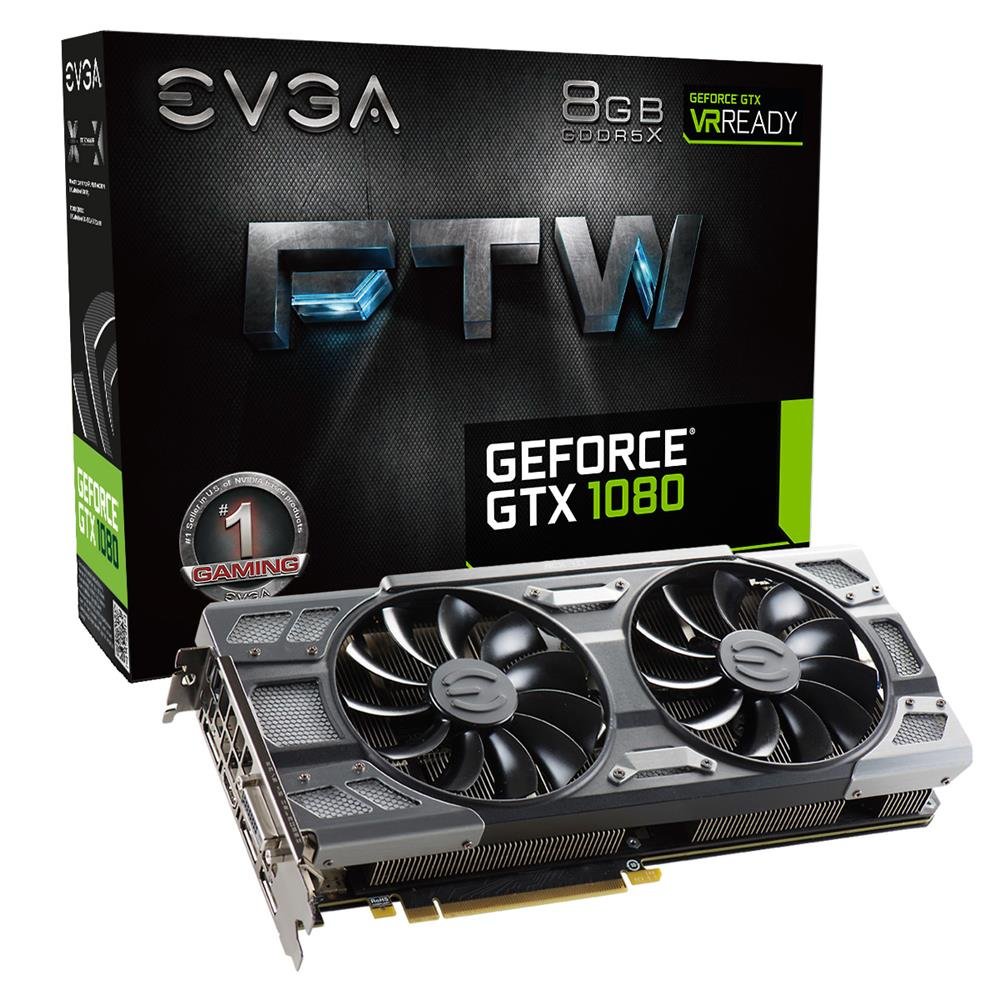
The EVGA FTW represents the peak of Pascal 1080 binning and board design. With a factory boost clock of 1860 MHz and 10 power phases on the VRM, this card reaches 2012 MHz out of the box on the core and 2050 MHz with manual tuning — a delta that translates to 6–8 extra FPS at 1440p compared to a reference 1080. The ACX 3.0 dual-fan cooler keeps the die below 65°C under sustained load while operating nearly inaudibly at 1350 RPM.
Real-world performance is punishing: Battlefield 1 runs at 100+ FPS on ultra DX12 at 1440p with G-Sync enabled, and Doom Eternal stays above 144 FPS at 1080p. The dual BIOS switch lets you flip between a silent fan curve and a performance profile without software, and the RGB LEDs can be tuned via EVGA Precision XOC. Idle temperatures drop to 19–23°C after adjusting the fan curve — a testament to the high-quality heatsink surface area and generous thermal pad coverage.
The one catch is that these units are now fully out of EVGA’s transferable warranty window, so your protection depends entirely on the third-party renewed seller’s return policy. The card measures 10.5 inches long and requires a single 8-pin power connector, so it fits most mid-tower cases without hassle. For buyers chasing the highest stable boost clocks available on a GTX 1080, this card remains the gold standard.
Why it’s great
- Ships with 1860 MHz boost — fastest factory OC among 1080 cards
- 10-phase VRM delivers rock-solid voltage for sustained overclocks
- Dual BIOS lets you toggle silent/performance profiles without software
Good to know
- No transferable EVGA warranty on 10-series cards
- Requires 8-pin power; no 6-pin fallback on this model
2. MSI Gaming GeForce GTX 1080 Armor 8G OC

The MSI Armor 1080 strikes a rare balance between 1440p gaming performance and near-silent acoustics. The factory boost clock of 1797 MHz is modest compared to the FTW, but this card consistently GPUs at 1961 MHz out of the box and overclocks to 2050 MHz on the core and 5404 MHz on the memory — delivering 62 FPS average at 1440p in Unigine Heaven stock and 66.8 FPS OC’d. The dual-fan open-air cooler keeps load temperatures at 64°C stock and 75°C under max overclock, all while the fans spin below audible thresholds.
A critical user-reported caveat is the default fan curve — MSI configured the Armor to hold fans at zero until the GPU hits 60°C, and the curve doesn’t ramp fully until 90°C. This causes quick thermal throttling under sustained load. The fix is straightforward: use MSI Afterburner to set a manual curve of 50% at 50°C, 90% at 70°C, and 100% at 80°C. After that adjustment, the card never breaks 75°C even during long gaming sessions.
The card draws power from one 6-pin and one 8-pin PCI-E connector and measures 279 mm in length, so it fits comfortably in standard mid-tower cases. There is no backplate — purely cosmetic, but something to note if you value visual polish or worry about PCB sag in a vertical orientation. For buyers who prioritize quiet operation and are comfortable with a one-time fan curve tweak, this is the best silent 1080 on the market.
Why it’s great
- Idle and load fan noise is effectively inaudible over a CPU cooler
- Overclocks cleanly to 2050 MHz core with stable memory at 5404 MHz
- Outputs three DisplayPort, one HDMI, and one DVI-D for multi-monitor
Good to know
- Default fan curve causes thermal throttling — must adjust in Afterburner
- No backplate leaves the PCB exposed and prone to sag in some cases
3. GIGABYTE GV-N1080G1 GAMING-8GD GeForce GTX 1080 G1 Gaming

Gigabyte’s G1 Gaming 1080 brings a factory OC of 1860 MHz in OC mode, identical to the EVGA FTW on paper, but achieves it with a quieter Windforce 2X fan setup. The card hits a maximum of 75°C under sustained load at 2000 MHz and never breaks 74°C in a standard mid-tower case — outperforming many triple-fan cards in thermal efficiency per decibel. The RGB lighting on the clean black backplate with a white logo adds a subtle aesthetic touch without looking garish.
At 1440p 144Hz, the card delivers 80–144 FPS in most titles depending on graphical intensity, with The Witcher 3 and Fallout 4 seeing a 20 FPS minimum framerate improvement over reference designs. The card requires a single 8-pin power connector and fits into the Cooler Master 130 micro ITX case, making it one of the more compact high-performance 1080s available. Users report that the stock 1695 MHz gaming mode is more stable for daily use, while the 1860 MHz OC mode requires Gigabyte’s software running in the background to maintain the boost.
The dual-ball bearing fans engage at low temperatures for passive cooling during desktop use — they stay completely off at idle, eliminating noise entirely for non-gaming workloads. The only consistent complaint across reviews is minor coil whine at low load and a blank installation CD, but neither affects real-world gaming performance. For a card that runs cool, fits small builds, and includes functional RGB, the G1 Gaming is a compelling pick in the premium tier.
Why it’s great
- Windforce 2X cooling keeps the GPU at 75°C under load while staying quiet
- Compact 280 mm length fits many micro ITX cases without modification
- RGB backplate and logo provide clean visual customization
Good to know
- Factory OC mode requires software always running to sustain 1860 MHz
- Minor coil whine reported at low load levels
4. NVIDIA GeForce GTX 1080 Founders Edition

The Founders Edition 1080 is the baseline reference design that every aftermarket card was measured against. Its radial blower fan pulls air from inside the case and exhausts it directly out the rear I/O bracket, making it the only safe choice for small form factor cases or older chassis with restricted front intake. The boost clock of 1733 MHz is lower than premium AIB models, but the card still holds its own at 1440p with 60+ FPS on high settings in most modern titles.
A major risk to be aware of is inconsistent seller behavior in the renewed market. Multiple verified reviews report receiving a GTX 1070 instead of the advertised 1080 from certain third-party sellers — a classic bait-and-switch that requires careful inspection upon arrival. The unit itself, when authentic, works perfectly: 4K output at 60Hz via DisplayPort, quiet idle, and 80°C load temperatures that are well within Pascal’s safe thermal envelope. The card has a boost clock of 2 GHz under load according to some sellers, but real-world reviewers report closer to 1860 MHz sustained.
The single blower fan spins louder than any open-air cooler under load, which is the trade-off for its compact geometry and SFF compatibility. The card outputs DVI-D, HDMI 2.0b, and three DisplayPort 1.4 connections. For builders who absolutely need a blower-style card and are willing to vet the seller carefully, this remains a viable option at the right price.
Why it’s great
- Blower cooler exhausts heat directly outside the case — ideal for SFF builds
- Compact PCB fits nearly any case with a PCIe x16 slot
- Sustains 1860 MHz boost in most real-world gaming scenarios
Good to know
- Renewed market carries high risk of receiving wrong model from unscrupulous sellers
- Blower fan is noticeably louder than open-air designs under load
5. ASRock Intel Arc B580 Challenger 12GB OC

The Intel Arc B580 is not a Pascal card — it is a modern Xe2-HPG architecture part that competes directly with the GTX 1080 in 1080p performance while offering feature-set advantages that Pascal physically cannot match. The 12GB of GDDR6 memory on a 192-bit bus delivers 19 Gbps effective bandwidth, and the XeSS 2 AI upscaling provides a meaningful FPS boost in supported titles that the 1080 simply cannot replicate. At 2740 MHz boost clock and 20 Xe cores, the B580 matches or exceeds a GTX 1080 Ti in pure rasterization at 1080p depending on the title.
However, there is a critical system requirement: the Arc B580 requires Resizable BAR (ReBAR) support to achieve its full performance potential. Without ReBAR — which demands a 10th Gen Intel CPU or newer — the card performs significantly worse than Pascal equivalents. Power consumption is impressively low at under 150W full load, making it the most efficient card in this roundup. The dual-fan cooler includes 0dB Silent Technology where the fans stop completely under low load, and the LED indicator adds a subtle visual accent.
On the software side, Intel’s Arc drivers have matured significantly since launch but still trail NVIDIA’s mature 1080 drivers in game compatibility for older titles. The card supports DisplayPort 2.1 with UHBR13.5 and HDMI 2.1a, enabling 8K output at 60Hz — future-proofing that no Pascal card can offer. For buyers building a new system with a compatible CPU and wanting modern features like hardware AV1 encoding and XeSS, the B580 represents a compelling contemporary alternative that doesn’t require buying used hardware.
Why it’s great
- 12GB VRAM and XeSS 2 upscaling enable high-fidelity 1440p gaming
- Extremely low power draw (under 150W) keeps electricity costs and heat down
- DisplayPort 2.1 and HDMI 2.1a support future monitor standards
Good to know
- Requires ReBAR support (10th Gen Intel CPU or newer) for competitive performance
- Driver maturity is behind NVIDIA’s, especially for older or niche game titles
6. XFX Speedster SWFT210 Radeon RX 7600

The XFX RX 7600 offers a different value proposition from Pascal: it is a brand-new, current-gen card using AMD’s RDNA 3 architecture with a boost clock of 2655 MHz and 8GB of GDDR6 memory. For pure 1080p gaming, it delivers 60+ FPS on ultra settings in virtually every title, and its small 9.49-inch length fits into compact cases that would struggle with a full-size 1080 Ti. The SWFT dual-fan cooling solution keeps temperatures in the upper 70s after a driver update, and the card draws significantly less power than any 1080 Ti.
A standout advantage is its seamless Linux compatibility. Verified reviews confirm that on Arch Linux, the card works out of the box with all three display outputs functional immediately upon installation using open-source drivers. This is a stark contrast to the NVIDIA Pascal experience on Linux, which requires the proprietary 470 driver branch now lagging in feature support. For gamers or professionals running Ubuntu, Fedora, or Arch, the RX 7600 removes all the driver friction associated with older GeForce cards.
The 8GB VRAM buffer is a limitation at 1440p in texture-heavy titles like Hogwarts Legacy or Alan Wake 2, where it matches the GTX 1080’s 8GB but falls short of the 1080 Ti’s 11GB capacity. The card is also not built for high-refresh 1440p gaming — it excels at 1080p/1440p at 60 FPS, as well as emulators and indie titles. For buyers who prioritize Linux support, low power consumption, and a new-in-box product with a manufacturer warranty, the RX 7600 represents the safest long-term purchase in this roundup.
Why it’s great
- Native open-source driver support makes Linux gaming plug-and-play
- Brand new card with full manufacturer warranty — no used hardware risk
- Low power draw and compact size fit SFF builds without compromise
Good to know
- 8GB VRAM limits ultra texture settings at 1440p in modern heavy titles
- Not suitable for high-refresh 1440p gaming above 60 FPS in demanding games
7. EVGA GTX 1080 Ti Black Edition 11GB (Renewed)
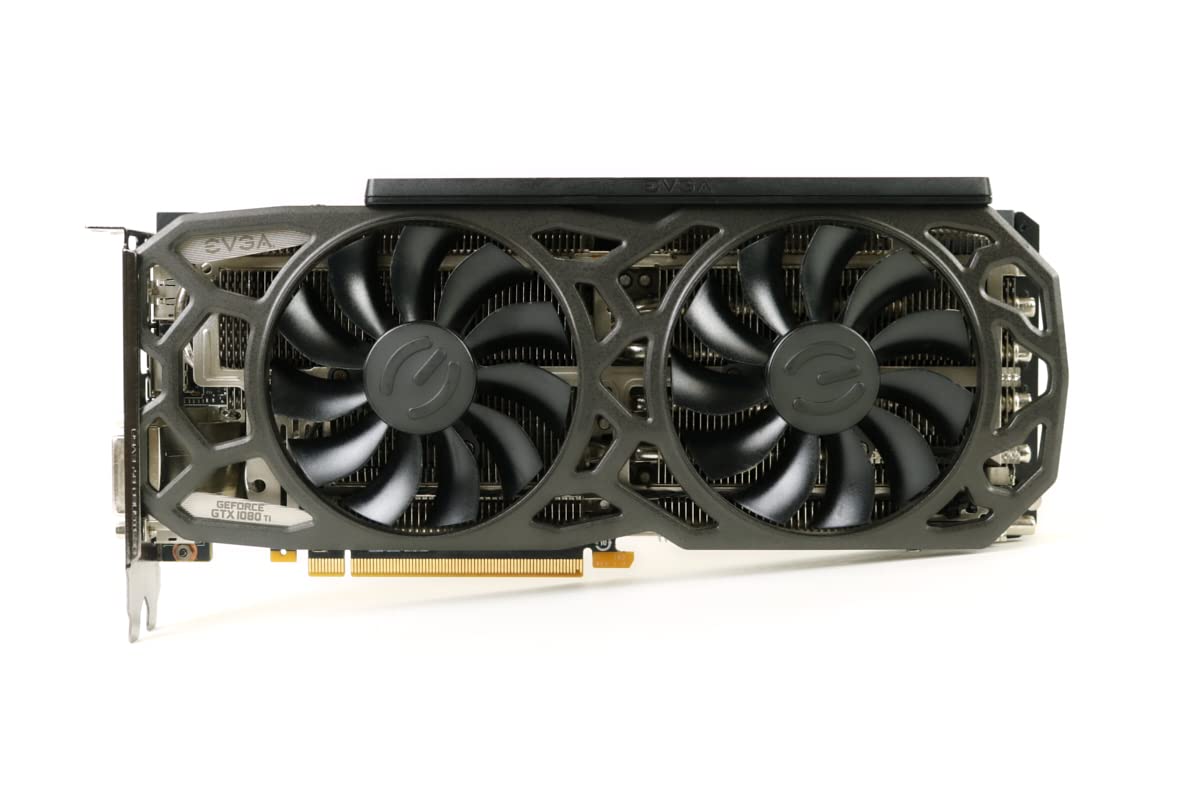
The EVGA 1080 Ti Black Edition delivers the raw rasterization power that made the Ti legendary — 11GB of GDDR5X on a 352-bit bus, 3584 CUDA cores, and a boost clock of 1582 MHz that regularly sustains 1800–1900 MHz in games. The iCX cooler uses L-shaped contact fins and a vented heatsink design to improve surface contact area, and verified users report load temperatures below 74°C after repasting. The card eliminates the memory allocation errors that plague 8GB cards in 3D rendering workloads.
At 1080p, this card is overkill for today’s titles — it will max out any game at 1440p 100+ FPS and handle 4K DLSS-adjusted gaming, a feat the standard 1080 cannot match. The 11GB buffer future-proofs you against increasing VRAM demands in 2025 and 2026 releases. More importantly, users upgrading from a GTX 970 report a massive leap in performance without shelling out for an RTX 40-series card. The downsides are the physical size — it is a 2.5-slot card that forced one user to relocate their hard drive for case fit — and the lack of ray tracing hardware.
Risk factors are inherent in the renewed market: while most units arrive in excellent condition, one verified report describes the card failing after three months with a burning smell during CS2 gameplay, though it was covered by the free return window. The card outputs one DVI-D, one HDMI 2.0b, and three DisplayPort 1.4 ports. For the price, this is the best pure-performance-per-dollar entry into the 1080 Ti class, provided you buy from a seller with a transparent return policy.
Why it’s great
- 11GB GDDR5X prevents VRAM exhaustion in 1440p/4K and rendering workloads
- iCX cooler with optimized fin design delivers excellent thermal performance
- Sustains 1800+ MHz boost in demanding titles for smooth high-FPS gaming
Good to know
- Large 2.5-slot form factor may cause case clearance issues in smaller builds
- Renewed unit reliability varies — choose sellers with strong return guarantees
8. ASUS GeForce GTX 1080 TI Turbo Edition 11GB (Renewed)

The ASUS Turbo 1080 Ti uses a blower-style cooler — the same architecture as the Founders Edition — making it the best option for Mini ITX builds, multi-GPU workstations, or any case where exhausting hot air out the rear is critical. The GPU features a boost clock of 1582 MHz in OC mode with the full 3584 CUDA cores enabled and 11GB of GDDR5X on a 352-bit bus. Auto-Extreme manufacturing and Super Alloy Power II components ensure consistent voltage delivery even under sustained 250W+ loads.
Gaming performance is identical to other 1080 Ti cards at the same clock speeds, with user reviews confirming that it plays Stray and Control at max settings with smooth frame rates and even handles medium ray tracing — an option the standard 1080 cannot offer. The customizable backlit logo plate is a unique feature: you can replace it with your own design for a personalized look. The card supports up to 8K display output at 60Hz via HDMI 2.0b and three DisplayPort 1.4 outputs.
The most notable downside is that renewed units may ship without cables or manuals, and at least one review noted the missing driver disk was a minor annoyance but not a functional issue. The blower fan spins at a higher pitch than the EVGA iCX or ASUS own open-air coolers, making it audibly louder under load. For builders who need the 1080 Ti’s monster rasterization performance but have a case that cannot accommodate open-air coolers, this is the clear choice.
Why it’s great
- Blower cooler is ideal for SFF cases and multi-GPU setups with restricted airflow
- 11GB VRAM and 3584 CUDA cores deliver full-fat Ti performance
- Customizable logo plate adds a personal aesthetic touch to your build
Good to know
- Blower fan is noticeably louder and runs hotter than open-air cooled Ti cards
- Renewed units may arrive without cables or documentation
9. NVIDIA GeForce GTX 1080 Ti Founders Edition (Renewed)

NVIDIA’s own GTX 1080 Ti Founders Edition is the reference card that set the benchmark for the entire Pascal generation. With 11GB of GDDR5 memory (the product data lists a 2 GHz GPU clock speed), it delivers the same 3584 CUDA core count and 352-bit bus width as the AIB cards in a standard blower-style package.
The build quality of the Founders Edition is excellent, with a die-cast aluminum shroud and vapor chamber cooling that outperforms the basic blower designs on entry-level AIB cards. Users specifically note that no thermal pad or paste replacement was needed — a strong sign of good storage and refurbishment practices. The card works as a direct drop-in replacement for older GPUs like the GTX 970, delivering 3x the performance in VR titles and modern 1440p gaming at max settings.
The primary risk is inconsistent seller behavior: while one buyer received three cards from a seller named DG Global with immaculate packaging and responsive service, another reported receiving a card in used condition that the seller then tried to charge a restocking fee to return after it was clearly worn. The physical size is standard for the FE at 10.5 inches, but the blower noise profile matches the ASUS Turbo version — louder than any open-air card. For buyers who find a trustworthy seller, this is the most authentic 1080 Ti experience available.
Why it’s great
- Vapor chamber cooling and die-cast shroud offer excellent stock thermal performance
- 11GB GDDR5 with 352-bit bus handles 1440p ultra with headroom to spare
- Direct drop-in replacement for older cards with massive performance uplift
Good to know
- Seller consistency is variable — some units arrive with used thermal paste or deceptive returns
- Blower cooler produces more noise than open-air designs during gaming loads
FAQ
Does the GTX 1080 Ti support ray tracing?
Is 8GB VRAM on the GTX 1080 enough for 1440p gaming in 2025?
What power supply wattage do I need for a 1080 or 1080 Ti?
Can I use a 1080 card with a modern PCIe 4.0 motherboard?
Should I repaste my renewed GTX 1080 after purchase?
Final Thoughts: The Verdict
For most users, the best 1080 graphics card winner is the EVGA GeForce GTX 1080 FTW GAMING ACX 3.0 because it combines the highest factory boost clock among 1080 cards with a robust 10-phase VRM, dual BIOS flexibility, and a proven dual-fan cooler that delivers excellent thermal performance at silent noise levels. If you want the extra VRAM headroom of a Ti, grab the EVGA GTX 1080 Ti Black Edition 11GB for its unbeatable pure rasterization and future-proofing against VRAM saturation. And for buyers building a new system who want modern features like XeSS upscaling and DP 2.1 without buying used hardware, nothing beats the ASRock Intel Arc B580 Challenger 12GB OC.