
Choosing a 1080p GPU means navigating a market flooded with cards that promise more than your monitor can ever show. You do not need a 16GB flagship to drive a 1920×1080 panel at high refresh rates — the real trick is finding the card that delivers the raw rasterization, memory bandwidth, and driver stability your specific games demand without burning cash on unused silicon. This guide cuts through the marketing hype to focus on what actually matters for 1080p resolution: clock speeds, VRAM capacity, power draw, and cooling efficiency.
I’m Min — the co-founder and writer behind Gadgets Feed. I have spent hundreds of hours dissecting GPU specifications, analyzing benchmark data, and cross-referencing real-world user feedback to separate meaningful upgrades from spec-sheet bloat for the 1080p segment.
Whether you are building a budget gaming rig, upgrading an office PC for light creative work, or chasing high frame rates in esports titles, this research-backed guide will help you confidently choose the best 1080p gpu for your exact setup and budget.
How To Choose The Best 1080P GPU
Selecting the right 1080p graphics card is about matching performance to your monitor’s refresh rate and your gaming library’s demands. A card that pushes 200 FPS in Fortnite may struggle to hit 60 FPS in a heavy single-player title at high settings. Focus on the specific factors below rather than getting distracted by flagship features you will never use at this resolution.
VRAM Capacity and Memory Interface
At 1080p, texture budgets rarely exceed 6GB of VRAM in current titles. An 8GB card provides future-proofing for the next two to three years, while 12GB or 16GB is overkill unless you play heavily modded games or run AI workloads. The memory interface is arguably more important: a 192-bit bus with 12GB of GDDR6 can deliver higher memory bandwidth than a 128-bit bus with 8GB of the same memory type, directly improving frame pacing in texture-heavy scenes.
Power Draw and Connector Requirements
Many entry-level and mid-range 1080p cards, especially those based on the RTX 3050 architecture, can draw all their power directly from the PCIe slot without needing a separate 6-pin or 8-pin connector. This is critical for upgrading pre-built OEM systems with proprietary power supplies. Higher-performance cards like the RX 7600 or RTX 5060 require a dedicated power cable, so verify your power supply has the appropriate connector before purchasing.
Cooling Solution and Form Factor
Single-fan low-profile designs fit small form factor (SFF) cases like the Dell Optiplex, but they tend to run louder under sustained load. Dual-fan and triple-fan open-air coolers keep temperatures lower and acoustics quieter but require more clearance inside your case. Check the card’s physical length and slot width against your chassis specifications — a 2.5-slot card will not fit in most SFF or slim tower cases.
Architecture and Driver Support
Newer GPU architectures like NVIDIA Blackwell (RTX 50 series) and AMD RDNA 4 (RX 9060 XT) introduce features like DLSS 4 and FSR 4, which can significantly boost effective frame rates at 1080p without sacrificing image quality. Older architectures such as NVIDIA Ampere (RTX 30 series) still deliver solid raw performance but lack the latest upscaling and ray tracing enhancements. Check whether the card requires Resizable BAR support for optimal performance — Intel Arc B580, for example, suffers without it.
Quick Comparison
On smaller screens, swipe sideways to see the full table.
| Model | Category | Best For | Key Spec | Amazon |
|---|---|---|---|---|
| GIGABYTE RTX 5060 Windforce OC 8G | Mid-Range | High FPS Gaming | 8GB GDDR7 128-bit | Amazon |
| ASUS Dual RTX 5060 OC Edition | Mid-Range | Balanced Performance | 8GB GDDR7 128-bit | Amazon |
| PNY RTX 5060 Epic-X ARGB OC | Mid-Range | Quiet Triple Fan Build | 8GB GDDR7 128-bit | Amazon |
| Sapphire Pulse RX 9060 XT OC 16GB | Premium | Creative Work & Gaming | 16GB GDDR6 128-bit | Amazon |
| GIGABYTE RX 9060 XT Gaming OC 16G | Premium | Max Settings 1080p | 16GB GDDR6 128-bit | Amazon |
| XFX Speedster SWFT210 RX 7600 | Mid-Range | VR & Emulation | 8GB GDDR6 128-bit | Amazon |
| ASRock Intel Arc B580 Challenger 12GB | Mid-Range | Content Creation Value | 12GB GDDR6 192-bit | Amazon |
| MSI Gaming RTX 3050 Ventus 2X 6G | Budget | OEM Upgrade | 6GB GDDR6 96-bit | Amazon |
| Maxsun GeForce RTX 3050 6GB LP | Budget | SFF & Optiplex Build | 6GB GDDR6 96-bit | Amazon |
In‑Depth Reviews
1. GIGABYTE GeForce RTX 5060 WINDFORCE OC 8G

The GIGABYTE RTX 5060 WINDFORCE OC represents the new baseline for high-refresh 1080p gaming. Powered by NVIDIA Blackwell architecture and DLSS 4, this card delivers over 250 FPS in lighter esports titles while maintaining 60–80 FPS in demanding single-player games like Cyberpunk 2077 at high settings. The 8GB of GDDR7 memory on a 128-bit bus provides a meaningful bandwidth uplift over the previous generation, effectively fixing the memory bottleneck that held back the RTX 4060.
The WINDFORCE cooling system keeps the card cool and quiet under sustained loads, with dual fans that only spin up under moderate to heavy gaming. The card’s compact 7.83-inch length makes it compatible with most mid-tower cases, and the PCIe 5.0 interface ensures full bandwidth even when paired with a newer motherboard. Installation is straightforward, though several users recommend running DDU to remove old drivers before swapping from a previous GPU.
For photo and video editing work, the RTX 5060 handles 4K timeline scrubbing and color grading with ease, though the 8GB VRAM may require settings management in heavy After Effects projects. The DLSS 4 implementation provides a visible image quality improvement over earlier versions, making this a truly versatile card for both gamers and creative users who prioritize 1080p output. A 750W power supply is recommended, though the card’s 150W TDP is notably efficient.
Why it’s great
- GDDR7 memory eliminates previous-gen bandwidth bottleneck
- DLSS 4 delivers major FPS uplift with minimal visual compromise
- Compact 7.83-inch length fits most cases
Good to know
- Only 8GB VRAM may limit ultra texture packs in future titles
- Requires a dedicated 8-pin power connector
2. ASUS Dual NVIDIA GeForce RTX 5060 OC Edition

The ASUS Dual RTX 5060 OC Edition brings premium build quality to the mid-range segment with an Axial-tech fan design that increases downward air pressure for better thermal performance. With an OC mode boost clock of 2565 MHz, this card consistently edges ahead of stock-clocked RTX 5060 counterparts in rasterization benchmarks, delivering performance roughly equivalent to a desktop RTX 2080 Ti or RTX 3070 in raw rendering tests. The 8GB GDDR7 memory paired with PCIe 5.0 support addresses the memory bandwidth limitations that plagued the RTX 4060.
The 2.5-slot design incorporates 0dB technology, meaning the fans remain completely silent during desktop use and light gaming. Under load, the thermal headroom is sufficient for overclocking without exceeding reasonable noise levels. The card is SFF-Ready, making it a strong candidate for compact builds that still demand solid 1080p and even 1440p performance at 60–100 FPS in most titles. The 150W TDP is highly efficient, with real-world gaming power draw often hovering around 100W.
Multiple user reports confirm rock-solid stability across Windows 11 and Linux systems with zero crashes during extended gaming sessions. The 3-year warranty provides peace of mind for a purchase that should last several GPU cycles. The only notable omission is RGB lighting — this card is designed for performance-focused builds that prioritize function over flash. Fortnite runs at around 140 FPS at high settings, and Cyberpunk 2077 remains playable with DLSS enabled.
Why it’s great
- 2565 MHz boost clock provides class-leading rasterization
- 0dB fan stop makes it inaudible at idle
- SFF-Ready certification for compact builds
Good to know
- 2.5-slot thickness may block adjacent PCIe slots
- No RGB lighting for those wanting visual flair
3. PNY NVIDIA GeForce RTX 5060 Epic-X ARGB OC Triple Fan
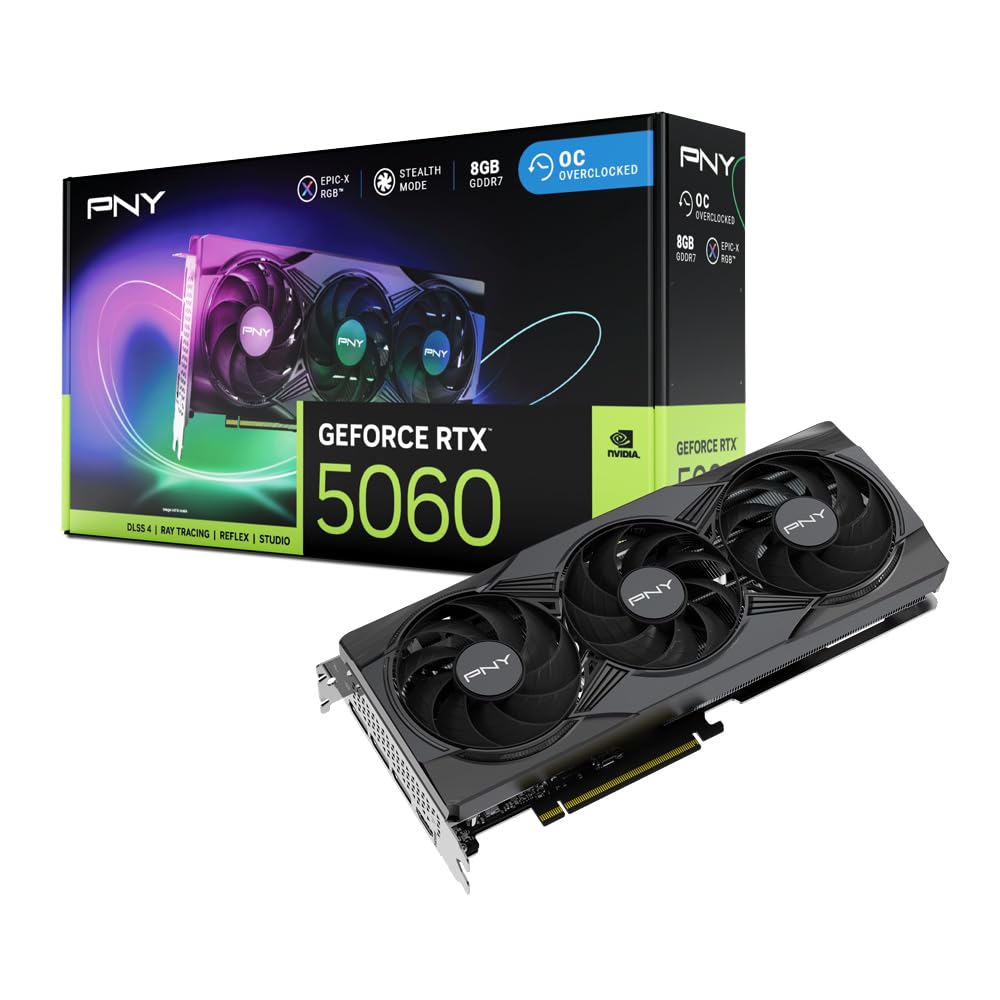
The PNY RTX 5060 Epic-X ARGB OC brings a triple-fan thermal solution to the RTX 5060 family, which is typically reserved for higher-tier cards. This generous cooling capacity allows the card to maintain higher boost clocks for longer periods without thermal throttling, directly benefiting 1080p high-refresh gaming where sustained performance matters. The card consistently delivers 100+ FPS on high settings across nearly every modern title, with users reporting excellent frame rates in games like Fortnite and Call of Duty.
The ARGB lighting adds visual customization without being overbearing, and the card’s compact 2-slot design makes it SFF-Ready despite the triple-fan arrangement. Power consumption is modest, with the card running efficiently and staying quiet under load thanks to the generous heatsink surface area. Installation requires a PCIe 8-pin power connector, and the card is compatible with PCIe 4.0 and 5.0 motherboards. Several reviewers noted that updating to the latest NVIDIA drivers was essential for full stability.
For competitive gamers, Reflex technology integrated into the RTX 5060 reduces system latency for faster target acquisition, which is a tangible advantage in fast-paced shooters. The PNY card also supports fifth-gen Tensor Cores and fourth-gen Ray Tracing Cores, enabling AI-accelerated workloads and ray-traced effects at playable frame rates at 1080p. The build quality is robust with a metal backplate, and the card ships well-protected for shipping.
Why it’s great
- Triple-fan cooler keeps temperatures and noise low
- ARGB lighting adds customization without excessive flash
- Reflex technology reduces input latency for competitive play
Good to know
- Requires driver updates for full stability out of box
- 8GB VRAM may limit ultra settings in future AAA releases
4. Sapphire Pulse AMD Radeon RX 9060 XT Gaming OC 16GB

The Sapphire Pulse RX 9060 XT Gaming OC delivers an exceptional combination of VRAM capacity and raw clock speed for the 1080p market. With 16GB of GDDR6 memory and a blistering 3290 MHz core clock, this card is overqualified for pure 1080p gaming but excels in hybrid workloads that mix gaming with creative applications like Blender, photo editing, and local LLM inference. The full PCIe 5.0 x16 interface ensures no bandwidth bottlenecks even in bandwidth-sensitive tasks.
Thermal performance is outstanding — the edge temperatures sit in the mid-to-high 50 degrees Celsius under load, with memory temperatures peaking around 70 degrees. The card is compact for its performance tier, drawing only 182W under full load, which can be raised to 200W with a firmware update for additional overclocking headroom. Undervolting by 50mV provides even better boost stability for those who want to maximize efficiency. Linux support is excellent with plug-and-play operation on Devuan and Arch.
In 1080p gaming, this card pushes most titles to well over 90 FPS at ultra settings, with optimized esports titles reaching 150–220 FPS. The 16GB VRAM makes it a future-proof choice for heavy texture mods and emerging titles that may exceed 8GB budgets. There is no coil whine reported, and the dual HDMI output configuration accommodates multi-monitor setups. The only consideration is that the thicker back bracket may cause a tight fit in some cases, so verify clearance before ordering.
Why it’s great
- 16GB VRAM provides headroom for mods and creative workloads
- Excellent thermal performance with quiet operation
- Full PCIe 5.0 x16 ensures no bandwidth bottleneck
Good to know
- Thick back bracket may cause fitment issues in some cases
- Ray tracing performance is decent but not class-leading
5. GIGABYTE Radeon RX 9060 XT Gaming OC 16G

The GIGABYTE RX 9060 XT Gaming OC is the definitive high-end 1080p card for users who want every frame possible at max settings. The WINDFORCE cooling system with Hawk fans and server-grade thermal conductive gel maintains low temperatures even during extended gaming sessions, with users reporting rock-solid stability and quiet operation. The card delivers 1080p performance that rivals last-generation 1440p cards, pushing Fortnite past 240 FPS and handling demanding titles like Battlefield 6 and Hogwarts Legacy at max settings without breaking a sweat.
The 16GB of GDDR6 memory provides ample room for ultra-high-resolution texture packs and future game installments that may increase VRAM requirements. The card supports FSR 4 upscaling, which provides a noticeable boost to effective frame rates in supported titles while maintaining solid image quality. AV1 encoding support makes it a strong choice for streamers who want to broadcast at high quality without taxing the CPU. The RGB lighting adds a subtle accent to the build, controllable through GIGABYTE’s software.
At 11.06 inches in length, this is the largest card in the roundup, so careful case measurement is essential before purchase. The dual-slot design is relatively slim for its performance class, but the length may conflict with front-mounted radiators or drive cages in smaller mid-tower cases. The power cap of 2700 MHz boost clock ensures consistent performance across all workloads, and the card is an excellent dollar-for-dollar value for 1080p high-FPS gaming.
Why it’s great
- Best-in-class 1080p raw performance with 16GB VRAM
- WINDFORCE cooling keeps noise and temps low
- FSR 4 and AV1 encoding for future-ready gaming and streaming
Good to know
- 11.06-inch length requires ample case clearance
- Ray tracing performance falls behind equivalently priced NVIDIA cards
6. XFX Speedster SWFT210 Radeon RX 7600 8GB

The XFX Speedster SWFT210 RX 7600 remains a strong contender for 1080p gaming in 2025, offering excellent value for those who prioritize raw rasterization over ray tracing. With a boost clock of up to 2655 MHz and 8GB of GDDR6 memory, this card handles 1080p gaming with ease, delivering 60+ FPS in most modern titles at high settings and excellent performance in VR applications like Half-Life Alyx and Assetto Corsa. The RDNA 3 architecture provides solid power efficiency with a modest power draw that keeps thermals manageable.
The dual-fan XFX SWFT cooling solution is effective at dissipating heat, though initial driver updates are recommended as some users reported high temperatures and crashes before updating. After proper driver installation, the GPU temperature settles into the upper 70s under load with fans running at only 60% speed. The card is small and lightweight at 900 grams, making it compatible with compact cases that cannot accommodate larger triple-fan designs.
Linux compatibility is excellent, with users reporting that replacing an NVIDIA card on Arch Linux was seamless — all three display outputs worked immediately after boot, and only required removing NVIDIA packages and installing Vulkan/Mesa drivers. For pure 1080p gaming and emulator usage, this card provides balanced performance at a competitive price point. The main drawback is that newer RDNA 4 cards are now available, offering better ray tracing and upscaling features for a modest premium.
Why it’s great
- Excellent 1080p raw gaming performance for the tier
- Solid VR performance with no issues in demanding titles
- Out-of-box Linux compatibility with display outputs working immediately
Good to know
- Driver updates are essential to resolve initial stability issues
- Ray tracing performance is weak compared to NVIDIA counterparts
7. ASRock Intel Arc B580 Challenger 12GB OC

The ASRock Intel Arc B580 Challenger 12GB OC offers a compelling mix of generous VRAM and modern connectivity for the 1080p market. The 12GB of GDDR6 memory on a 192-bit bus provides memory bandwidth that exceeds many competitors with narrower 128-bit interfaces, directly benefiting texture-heavy games and creative applications. Intel’s Xe2-HPG architecture with 20 Xe cores delivers solid 1080p performance, hitting 120+ FPS on high settings in most modern titles, though ray tracing should be approached modestly at this tier.
The dual-fan design with 0dB Silent Technology stops the fans completely under low loads, making this an exceptionally quiet card for desktop use. The metal backplate reinforces the PCB for enhanced durability, and the subtle LED indicator adds a touch of style without being distracting. DisplayPort 2.1 support with UHBR13.5 enables high-refresh-rate 1080p displays and future-proof connectivity. One critical requirement: this card needs Resizable BAR support to perform optimally — users without a 10th-gen Intel processor or newer will see significantly reduced performance.
Driver maturity has improved substantially since Intel Arc’s launch, with the B580 now offering stable performance across Windows and Linux. The card excels in content creation tasks thanks to its strong media encoder and generous VRAM, handling high bit-rate video encoding comparable to the RTX 3070 while drawing power similar to an RTX 3050. The 249mm length and 2-slot design fit most mid-tower cases, and the single 8-pin power connector simplifies installation.
Why it’s great
- 12GB VRAM on a wide 192-bit bus for excellent memory bandwidth
- 0dB Silent fan stop for silent desktop operation
- DisplayPort 2.1 with UHBR13.5 for future-proof connectivity
Good to know
- Resizable BAR support is mandatory for acceptable performance
- Driver installation process can be cumbersome on first setup
8. MSI Gaming RTX 3050 Ventus 2X 6G OC

The MSI Gaming RTX 3050 Ventus 2X 6G OC is the ultimate entry-level card for upgrading OEM systems with proprietary power supplies. Drawing only 70 watts entirely from the PCIe slot — no external power connector needed — this card unlocks 1080p gaming on machines that previously could not support a dedicated GPU. The 6GB GDDR6 memory on a 96-bit bus is modest, but for the price, it delivers a transformative upgrade from integrated graphics or ancient dedicated cards like the RX 6400, solving the PCIe bandwidth bottleneck that plagued those earlier budget options.
Thermals are outstanding, with users reporting temperatures below 62 degrees Celsius under full load and fans remaining very quiet. The card idles at a mere 10–15 watts, making it suitable for always-on systems like Unraid servers for hardware transcoding. Gaming performance is respectable for the tier: Cyberpunk 2077 runs at 50–60 FPS on high settings, and lighter titles easily exceed 100 FPS. Ray tracing is not recommended on this card, as the performance hit is substantial.
The 7.4-inch length and 2X fan design fit comfortably in most cases, and installation is plug-and-play with Windows 11 and Linux (RHEL 10) compatibility. The card also supports 8K resolution output via HDMI 2.1a for media consumption, adding versatility beyond gaming. The only caveat is that the 8GB version of the RTX 3050 offers noticeably better performance for a modest price increase, but the 6GB model’s slot-power operation makes it uniquely suited for restricted systems.
Why it’s great
- 70W slot power means no external power connector needed
- Excellent thermals under 62°C with quiet fans
- Ideal for proprietary PSU OEM upgrades and Unraid transcoding
Good to know
- 6GB VRAM and 96-bit bus limit performance in heavy games
- Ray tracing is essentially unusable at playable frame rates
9. Maxsun GeForce RTX 3050 6GB Low Profile

The Maxsun GeForce RTX 3050 6GB Low Profile is purpose-built for small form factor systems, particularly Dell Optiplex SFF and similar compact office machines. At just 6.65 inches long and 2.71 inches wide, this card fits into cases that cannot accommodate standard-height GPUs, making it the most powerful slot-powered graphics solution for ultra-compact builds. The 6GB GDDR6 memory and 1470 MHz boost clock deliver solid 1080p gaming performance, with users reporting 80+ FPS in Fortnite and Warzone at 1080p.
The low-profile design includes the necessary bracket adapters for standard SFF cases, and the PCIe 4.0 interface ensures full bandwidth when paired with a compatible motherboard. The card draws all power from the PCIe slot, eliminating the need for any power supply upgrades in proprietary Optiplex systems. It supports HDMI 2.1 and DisplayPort 1.4a for up to 8K output, and the included low-profile bracket ensures a clean installation. For professional use, this card works excellently with Solidworks and other 3D design applications after registry tweaks for RealView support.
The main trade-off for the compact form factor is acoustic performance — the single fan can become loud under sustained gaming loads, which is expected for any low-profile card. Thermal management requires some fan curve adjustment to balance noise and temperatures. The 1-year warranty is shorter than some competitors, but the card’s unique niche as the most powerful slot-powered low-profile option available makes it indispensable for SFF enthusiasts who want to game or work on ultra-compact systems.
Why it’s great
- Smallest form factor among slot-powered 1080p GPUs
- Fits Dell Optiplex SFF and similar office machines perfectly
- Works well for both gaming (80+ FPS) and 3D design (Solidworks)
Good to know
- Fan can be loud under full gaming load
- Only includes a 1-year warranty
FAQ
How much VRAM do I need for 1080p gaming in 2025?
Do I need Resizable BAR for the Intel Arc B580 to work well?
Can I upgrade an old Dell Optiplex with a 1080p GPU?
Is ray tracing usable on budget 1080p GPUs?
Final Thoughts: The Verdict
For most users, the best 1080p gpu winner is the GIGABYTE RTX 5060 WINDFORCE OC 8G because it combines GDDR7 memory, DLSS 4, and efficient WINDFORCE cooling in a compact package that delivers high frame rates across all 1080p titles. If you want the most VRAM for creative workloads, grab the Sapphire Pulse RX 9060 XT 16GB. And for upgrading a proprietary PSU office system, nothing beats the slot-powered convenience of the MSI RTX 3050 Ventus 2X 6G.