
Our readers keep the lights on and my morning glass full of iced black tea. As an Amazon Associate, I earn from qualifying purchases.
Specs are compiled from manufacturer listings and verified buyer reviews and can change over time — please confirm the key details on the product page before buying.
A 1080p video camera can be a compact webcam, a dedicated camcorder, a point-and-shoot, a mirrorless interchangeable-lens camera, or a pro PTZ live-streaming unit. Match the camera type to your workflow: desk streaming, vlogging on the move, or capturing a church service.
I’m Min — the founder and writer behind Gadgets Feed. This guide is built by comparing the manufacturers’ published specifications and the patterns across verified customer reviews, so you get each pick’s real strengths and trade-offs instead of marketing spin.
if you need plug-and-play simplicity for video calls or a full studio setup for live production, this breakdown of the best 1080p video camera options will help you zero in on the one that fits your space and budget.
Our Picks at a Glance


How To Choose The Best 1080P Video Camera
Not all 1080p cameras deliver the same image quality. Sensor size, lens quality, frame rate, and connectivity determine what you can shoot and how good it looks.
Sensor Size and Megapixels
The sensor is the light-catching chip inside the camera. A larger physical sensor (like the APS-C size in a mirrorless camera) captures more light, giving you cleaner footage in dim rooms and more natural background blur. Megapixels (MP) tell you how much detail the still photo holds — for pure video, 2MP is enough for sharp 1080p, so a 24MP sensor mainly helps with cropping photos, not improving video sharpness.
Zoom Type: Optical vs. Digital
Optical zoom uses the lens to magnify the scene physically, keeping every pixel crisp. Digital zoom simply crops the image and stretches it, which makes the picture look blurry or blocky. When you need to get closer to a distant subject — a speaker on stage or a bird in a tree — a camera with 5x or 20x optical zoom will deliver usable footage, while a digital-only camera will degrade fast.
Connectivity and Mounting
A webcam works straight from the start via USB for desk use. A camcorder or mirrorless camera needs an HDMI capture card to stream to a computer. A PTZ (pan-tilt-zoom) camera can connect over HDMI, USB, SDI, or Ethernet (PoE), making it ideal for multi-camera productions where you control everything from a central switch or a joystick. For plug-and-play simplicity, choose a USB webcam; for a permanent studio, invest in a PTZ with PoE.
Quick Comparison
| Model | Best For | Sensor / Resolution | Zoom | Frame Rate | Amazon |
|---|---|---|---|---|---|
| Logitech C922x★ Best Overall | Desktop streaming | 2MP | Autofocus (digital) | 1080p @ 30fps / 720p @ 60fps | $118.18Amazon |
| Canon EOS R100Also Great | Mirrorless beginners | 24.1MP APS-C | RF-S 18-45mm (optical) | Full HD 60fps | $539.95Amazon |
| Canon EOS Rebel T7Value Bundle | DSLR learners | 24.1MP APS-C | 18-55mm + 75-300mm (optical) | Full HD 30fps | $741.85Amazon |
| Tenveo VHD20H | AI auto-tracking PTZ | 2.07MP 1/2.8″ | 20X optical | 1080p 60fps | $379.00Amazon |
| iuZee PTZ Camera | AI auto-tracking PTZ | 2.07MP 1/2.8″ | 20X optical + 8X digital | 1080p 60fps | $319.00$379.00PrimeAmazon |
| KODAK PIXPRO FZ55 Bundle | Point-and-shoot convenience | 16MP CMOS | 5X optical | 1080p Full HD | $189.95Amazon |
| KODAK PIXPRO FZ55 | Budget daily carry | 16MP CMOS | 5X optical | 1080p Full HD | $159.95Amazon |
| Kimonie Camcorder | Budget vlogging | 36MP | 16X digital | 1080p @ 30fps | Amazon |
In‑Depth Reviews
1. Logitech C922x HD Pro PC Webcam, Full HD 1080p/30fps or 720p/60fps
Our pick — over 4.5★ from 17,000+ verified ratings; the strongest balance of quality and price.
The most popular streaming webcam on the market, proven by over 17,000 ratings and a 4.6-star average.
The Logitech C922x delivers Full HD 1080p video at 30fps for crisp video calls and streaming, or you can switch to 720p at 60fps for smoother motion during gaming or active presentations. Its 2MP sensor and autofocus system keep the image sharp and well-lit, thanks to HD Light Correction that adjusts exposure automatically in dim rooms. Buyers rave that the video quality is super clear at 1080p perfect for streaming or video calls and that the autofocus keeps everything sharp without manual tweaking. The camera also includes a 3-month XSplit VCam license that lets you remove, replace, or blur your background without a green screen, and it works natively with Microsoft Teams, Google Meet, Zoom, and even Nintendo Switch 2’s new GameChat mode.
Compared to the camera-type cameras above, the C922x has a much smaller sensor — 2MP effective still resolution versus the 36MP or 24.1MP of dedicated cameras — so its still photos are not suitable for large prints, and the digital-only zoom will degrade the image if you crop in. However, for pure video conferencing and desktop streaming it is the most plug-and-play option here: connect via USB, mount on a monitor, and the dual built-in mics capture natural audio without a separate microphone. One buyer mentioned that the camera is overpriced compared to newer competitors and it was originally released in 2016, but its reliability and proven track record keep it a top seller.
Best for laptop and desktop users: If you spend your day in video meetings and want crisp 1080p without any setup complexity, this Logitech is the most trusted pick.
Keep in mind: No privacy shutter, and digital-only zoom means you cannot optically zoom in on a whiteboard — you have to move the whole camera closer.
2. Canon EOS R100 Mirrorless Camera with RF-S 18-45mm f/4.5-6.3 is STM Lens
A compact mirrorless that brings pro-grade autofocus to first-time video creators.
This Canon R100 uses a 24.1MP APS-C CMOS sensor — a larger physical chip that pulls in more light than the smaller sensors inside webcams or budget camcorders, so your footage stays cleaner in living-room lighting. The Dual Pixel CMOS Autofocus system covers 143 AF zones and tracks faces or moving subjects without the hunting you get on older cameras, which matters when you walk toward the lens to start a vlog. It records Full HD at 60fps, giving you smooth motion for pans and action clips, and the included RF-S 18-45mm lens covers wide group shots and portrait zooms in one twist.
Buyers report that it is easy to learn for beginners and holds its battery well, though one owner mentioned the included neck strap can detach unexpectedly — so you might want to swap it for a third-party strap early. At its core, this is the platform you grow into: the RF mount gives you access to Canon’s full lens lineup, from a fast prime for low light to a telephoto for distant subjects, meaning you are not stuck with the starter lens forever.
Compared to the Canon EOS Rebel T7 below, the R100 packs a more modern autofocus system with 143 zones versus the T7’s 9-point system and shoots smoother Full HD at 60fps rather than 30fps. The trade-off is that the Rebel T7 bundle includes two lenses that cover a wider zoom range from the start, while the R100 starter kit gives you only the 18-45mm lens and a bag.
Best for first-time upgraders: If you are tired of smartphone video and want a real camera that auto-focuses like a pro without a steep learning curve, the R100 is your entry point.
One catch: The kit lens is just the start — you will likely want an extra lens for low-light or telephoto within a few months, which adds cost.
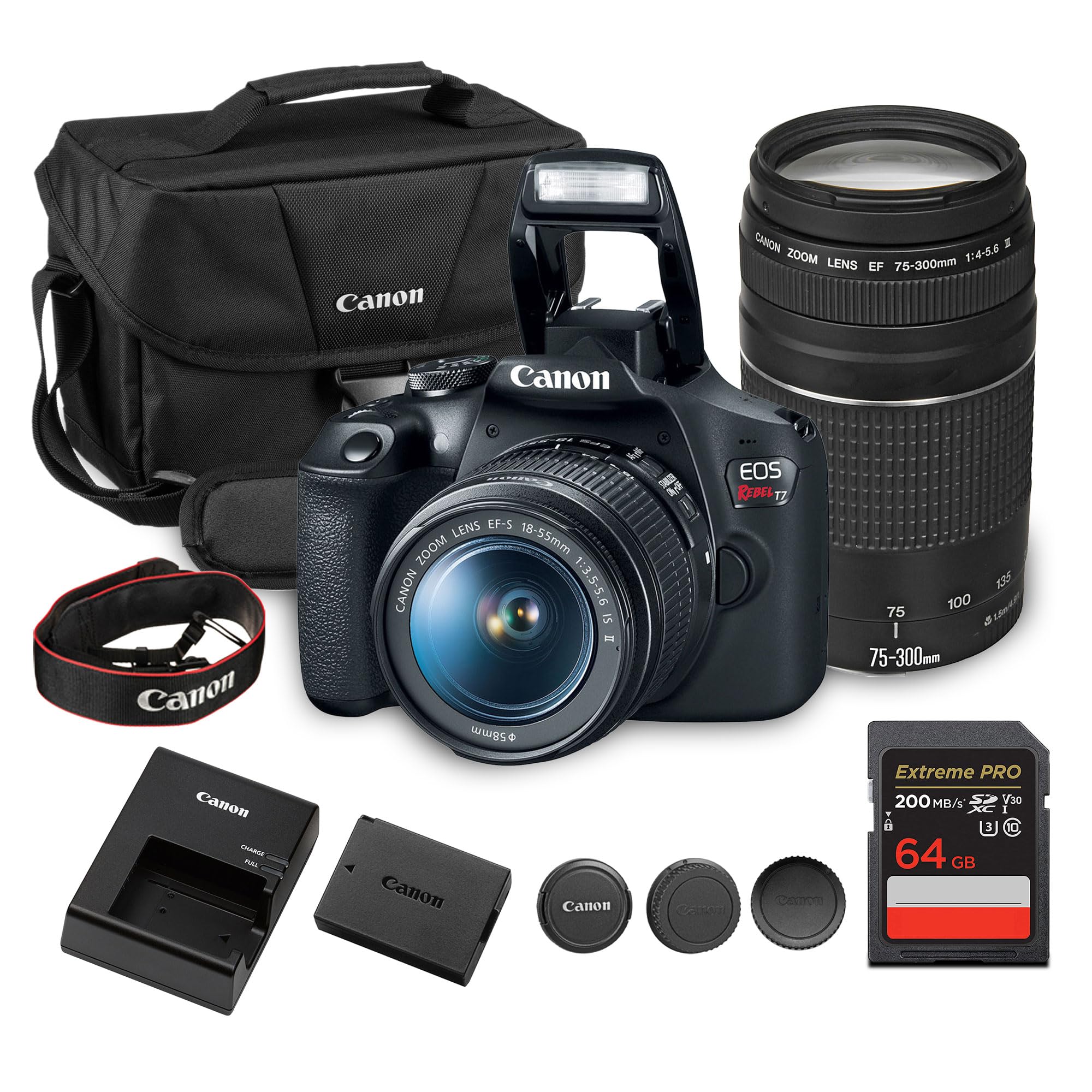
3. Canon EOS Rebel T7 DSLR Camera Kit with 18-55mm & 75-300mm Lenses
A classic DSLR bundle that gives you two lenses for the price of one body.
The Rebel T7 uses a 24.1MP APS-C CMOS sensor that delivers the same clean, colorful stills and video as the higher-end Rebels, but records Full HD 1080p at up to 30fps rather than 60fps — fine for talking-head clips and family videos, less ideal for fast action that benefits from a higher frame rate. The real winner here is the kit: you get the EF-S 18-55mm lens for everyday wide and standard shots plus the EF 75-300mm telephoto lens that reaches distant subjects, so you can shoot sports from the bleachers or wildlife from a respectful distance without spending extra. Its 9-point autofocus system is older and slower than the R100’s Dual Pixel AF, but owners mention that the automatic scene modes make it easy to get sharp results as a beginner right from the start.
Reviewers consistently say the Canon EOS Rebel T7 is very easy to use on auto focus and produces excellent picture quality for a beginner. The WiFi connection to a phone works flawlessly for quick sharing, and the included bag and 64GB card mean you can start shooting immediately without extra purchases. The trade-off is that at 30fps your video will look slightly less fluid than the R100’s 60fps, and the lens switching can feel awkward until you get used to swapping glass in the field.
Two-lens advantage
- Comes with 18-55mm and 75-300mm lenses for wide and telephoto coverage
- WiFi and app connection for fast photo transfer to phone
- Beginner-friendly with automatic scene modes
Video limitation
- Only 1080p at 30fps, no 60fps option for smoother motion
- 9-point autofocus is older and slower than newer mirrorless systems
4. Tenveo HDMI/USB3.0/LAN(PoE) PTZ Camera AI Auto-Tracking, 20X Optical Zoom
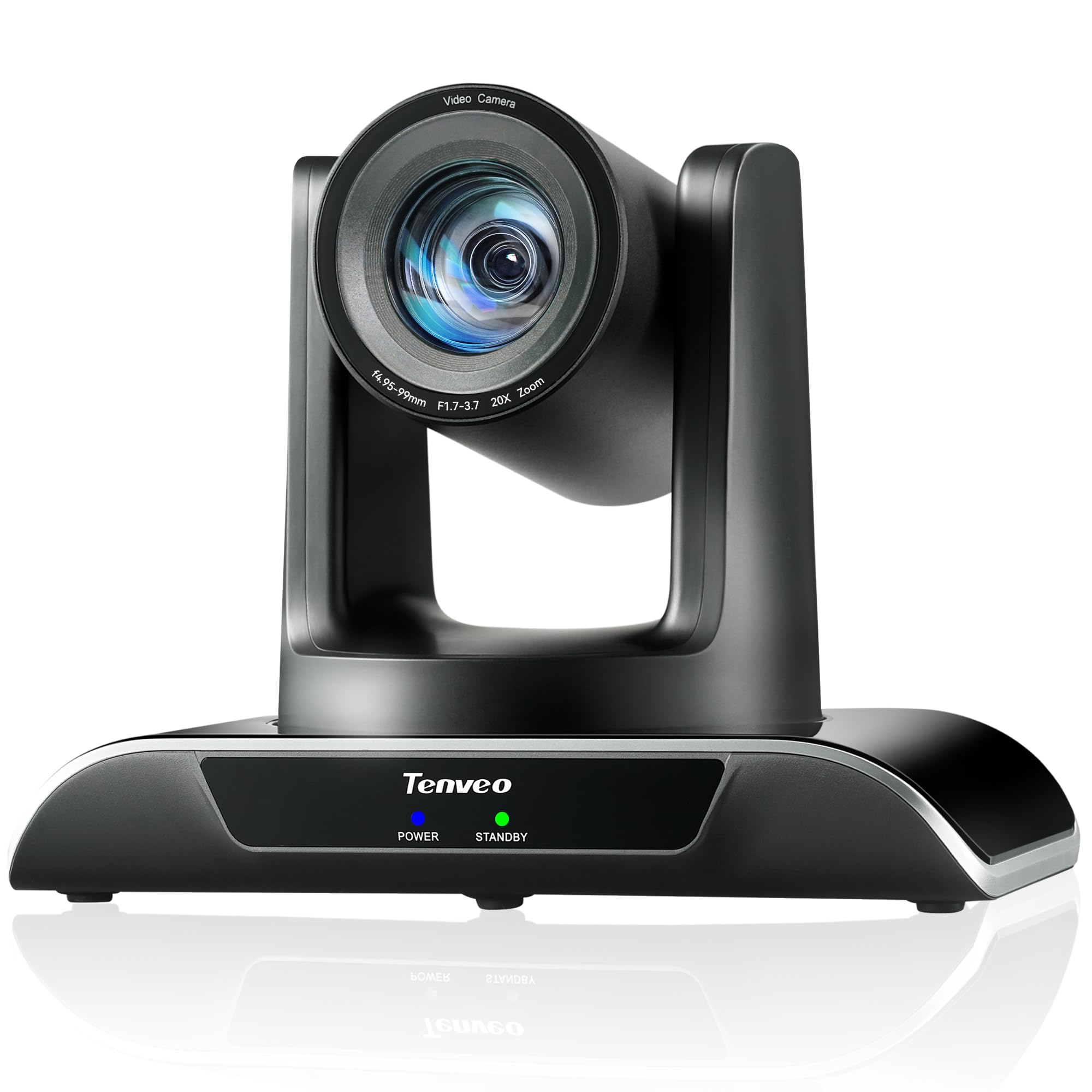
A motorized PTZ that tracks a speaker’s face and follows them across the stage.
This Tenveo VHD20H uses a 1/2.8-inch CMOS sensor with 2.07 megapixels — the standard resolution for clean 1080p — combined with a 20X optical zoom lens that brings distant speakers into sharp close-ups without the pixel mush of digital zoom. The standout feature is its AI humanoid and face auto-tracking powered by deep learning algorithms: once you enable tracking mode, the camera follows a person as they move, automatically panning, tilting, and zooming to keep them centered, even if they are temporarily blocked by another person. Customers note that its picture quality is crisp even in darker church settings and that the optical zoom transitions are smooth without jagged stepping.
It supports simultaneous HDMI, USB 3.0, and LAN (PoE) video output, meaning you can run a single Ethernet cable for both power and data to a PoE switch, which simplifies installation in a ceiling mount. The Tenveo includes a remote control, wall mount, and a USB 3.0 cable, and the company offers a 3-year warranty plus lifetime technical support. One caveat: the camera has no built-in microphone, so you will need an external audio source to capture voice.
Compared to the iuZee PTZ camera below, the Tenveo matches the same 20X optical zoom and 1080p 60fps output but adds more advanced humanoid-plus-face tracking that reportedly keeps lock even when the subject is partly blocked. The iuZee, on the other hand, includes an 8X digital zoom on top of the optical and is priced slightly lower.
Best for worship and conference spaces: If you need a camera that follows a presenter automatically while you manage other production tasks, this Tenveo delivers reliable AI tracking at a practical price.
Keep in mind: No internal microphone — you must supply your own audio capture for the recording or stream.
5. iuZee AI Auto Tracking PTZ Camera 3G-SDI/USB3.0/HDMI/LAN IP PoE

An auto-tracking PTZ with both optical and digital zoom for flexible framing.
The iuZee PTZ camera uses a 1/2.8-inch image sensor and delivers 1080p at 60fps through its 20X optical zoom lens, letting you fill the frame with a faraway speaker while retaining crisp detail. On top of that optical range it adds 8X digital zoom, though that extra reach trades resolution for magnification — usable for a quick punch-in but not for critical studio work. The built-in AI auto-tracking mode uses image recognition algorithms to follow a moving subject: once activated, the camera pans and tilts automatically to keep the target in center frame. Reviewers point out that the cameras track well and work smoothly with their existing switcher setups, though one owner had to use the 1080p setting instead of 4K for compatibility with their video mixer.
It connects via HDMI, SDI, USB 3.0, and LAN with PoE support, so you can power it through a single Ethernet cable and integrate it into professional live-streaming workflows for OBS, vMix, or YouTube. The package includes a remote control, wall mount, and a USB 3.0 cable, plus a 30-day money-back guarantee and a 3-year limited warranty. The main downside reported by users is that the included user manual is confusing, leading to a couple of days of frustration during initial setup.
Versatile zoom range
- 20X optical zoom keeps subjects crisp at a distance
- 8X digital zoom adds extra reach for tight framing
- Multiple outputs (HDMI/SDI/USB/LAN) with PoE simplify cabling
Setup friction
- User manual is confusing — expect a learning curve during first install
- Digital zoom degrades image quality beyond the 20X optical range
6. KODAK PIXPRO FZ55 16MP Digital Point & Shoot Camera Bundle with 32GB SD Card, Case, and Reader
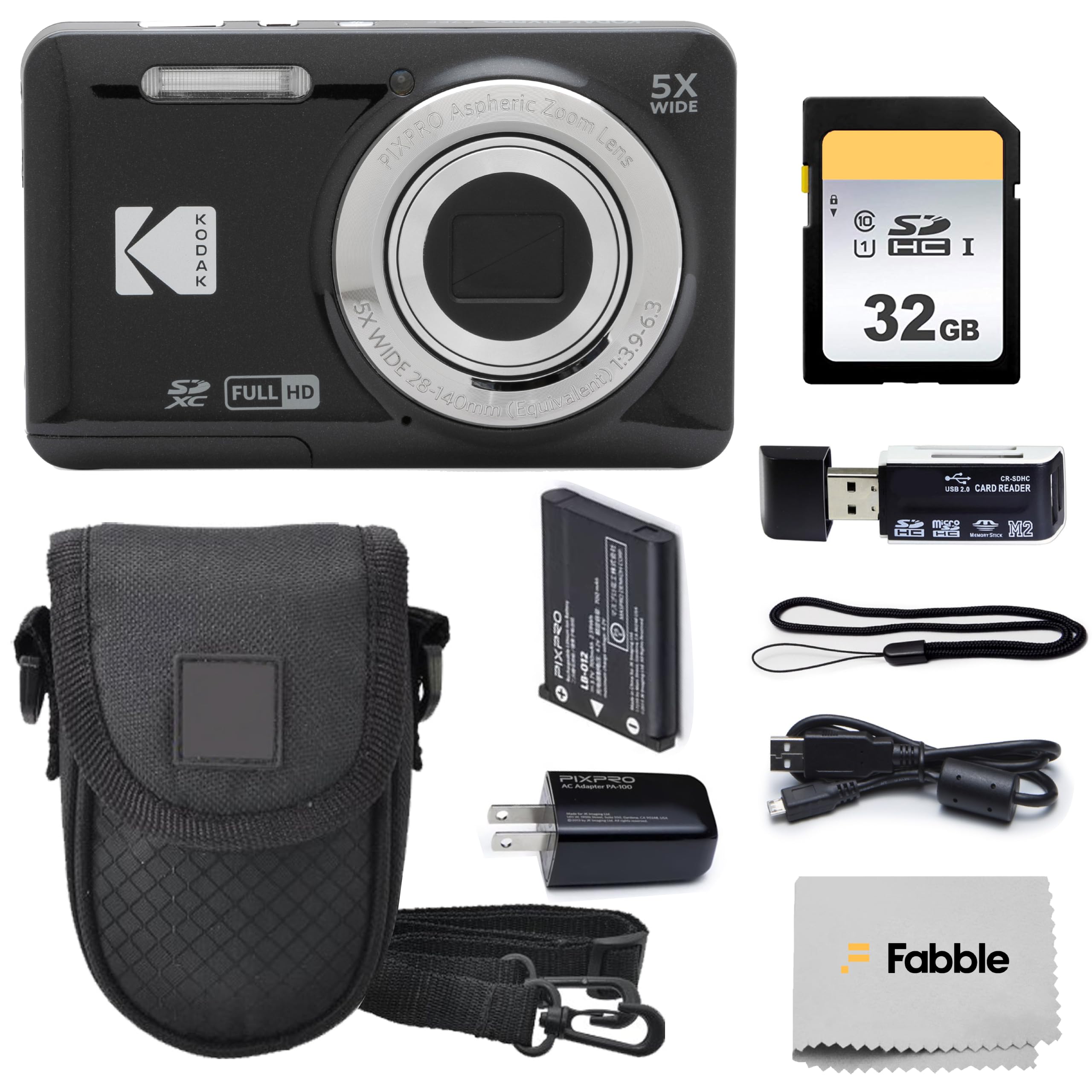
A ready-to-go point-and-shoot that includes the memory card, case, and reader so you never have to buy extras.
This KODAK PIXPRO FZ55 bundle eliminates the “what else do I need” headache by including a 32GB SD card, a protective carrying case, a high-speed USB SD card reader, and a lens cleaning cloth right in the box. The camera itself uses a 16MP CMOS sensor with a 5X optical zoom and a 28mm wide-angle lens, so you can capture a full group shot in a tight room or zoom in on a detail during a walk. It records 1080p Full HD video, making it suitable for quick family clips or vlog snippets, and the 2.7-inch LCD screen lets you frame shots and review footage without a phone connection. Shoppers say that the picture quality for the price is excellent with vibrant colors, that the battery lasts around 6 to 8 hours on a charge, and that the compact size fits easily into a small bag or even a large pocket.
One difference between this bundle and the standalone KODAK FZ55 below is the included accessories — the bundle saves you from buying a memory card and case separately. The 5X optical zoom here is optical, not digital, so zoomed shots stay sharp, unlike the digital-only zoom on some budget camcorders. The trade-off is that this camera lacks a flash for indoor evening shooting, so low-light video will require extra lighting.
Best for grab-and-go families: If you want a simple camera with everything in one box and no extra shopping, this KODAK bundle delivers great value straight out of the package.
One limitation: No built-in flash means you need an external light source for dim indoor scenes.
7. KODAK PIXPRO FZ55-GRY 16MP CMOS Sensor Digital Camera 5X Optical Zoom

A lightweight point-and-shoot that fits in a coat pocket without sacrificing optical zoom.
The KODAK PIXPRO FZ55 is built around a 16MP CMOS sensor and a 5X optical zoom lens with a 28mm wide-angle starting point, giving you the flexibility to capture a sweeping landscape at the wide end and zoom into a distant subject without losing image clarity. It records 1080p Full HD video, so your family footage looks clear on a TV or computer, and the 2.7-inch LCD screen makes framing easy even in bright daylight. Buyers consistently describe it as easy to use, lightweight, and beginner-friendly, with sharp pictures and vibrant colors that hold up when transferred to a phone. One reviewer noted that after nearly a year of use the photos still have a vintage look and great quality, and the compact size makes it convenient for travel.
Unlike the bigger interchangeable-lens cameras in this list, this KODAK uses a rechargeable Li-Ion battery and accepts SD cards up to 512GB (minimum Class 10). It has no flash, so shooting indoors at night requires a well-lit room or an external light. Compared to the bundle version above, this standalone unit gives you the same camera body but without the case, SD card, and reader — making it a lower upfront cost if you already have those accessories at home.
Compact versatility
- 5X optical zoom is sharp across the range
- Lightweight design fits anywhere
- User-friendly controls and auto modes
Missing extras
- No flash for dim indoor scenes
- No SD card included — must buy separately (Class 10, up to 512GB)
8. Kimonie Camcorder FHD 1080P Video Camera for YouTube with 36MP, 16X Digital Zoom, 3.0″ 270° LCD

A feature-packed budget camcorder with night vision, a remote, and an external microphone — all for under a hundred.
This Kimonie camcorder records 1080p HD video at 30fps and captures still images up to 36 megapixels, versus the Logitech C922x’s 2MP sensor — though that number applies to photo resolution, not video quality. The 16X digital zoom lets you get closer to the action, but because it is digital rather than optical, you lose detail as you zoom in. What sets this camcorder apart from simpler webcams is the package of accessories: it comes with two rechargeable batteries, an external microphone with noise-canceling technology, a remote control that works at up to 16 feet, a foldable handheld stabilizer, and a lens hood that blocks stray light and protects the lens from bumps. Buyers describe it as compact and amazing, with good video and sound quality for the price, and one owner reported it works well for ghost hunting on a budget thanks to its IR night vision mode that lets you shoot clear black-and-white footage in total darkness.
The 3.0-inch capacitive touch screen rotates 270 degrees, making it easy to frame selfie-style vlogs or low-angle shots, and it can double as a webcam when connected to a PC via Type-C cable. It includes motion detection that starts recording automatically when something moves in front of the lens — a useful feature for security or wildlife setups. The main compromise is the digital-only zoom: unlike the KODAK or Canon picks with optical zoom, pushing to 16X on this camera will make distant subjects look pixelated, so it is best for close-range filming where zoom is not critical.
Kit value
- Includes external mic, remote, stabilizer, lens hood, and two batteries
- 270-degree rotating touch screen for vlogging
- IR night vision mode for pitch-black environments
Zoom limitation
- 16X digital zoom degrades image quality — no optical zoom
- AVI video format may require conversion for some editing software
Best for absolute beginners on a tight budget: If you want a camcorder with a full accessory kit and night vision at the lowest cost, this is a functional starting point for YouTube or hobby projects.
Hard pass if you need clear zoomed video: The digital-only zoom means your subject will get blurry as you magnify — anyone shooting distant sports or wildlife should look at an optical-zoom camcorder or the KODAK above.
Understanding the Specs
Optical vs Digital Zoom
Optical zoom moves glass elements inside the lens to magnify the scene physically, preserving the full resolution of the sensor. Digital zoom crops the image and enlarges the remaining pixels, which makes the picture look blocky or soft — similar to pinching to zoom on a smartphone photo. For any situation where you need to get closer to a distant subject, choose a camera with at least 5X optical zoom; digital-only zoom is a red flag for serious video work.
Frame Rate: 30fps vs 60fps
Frame rate is how many individual pictures the camera captures each second, measured in fps (frames per second). 30fps is the standard for YouTube, TV, and most video content — it looks smooth for talking heads, interviews, and normal movement. 60fps captures twice as many frames per second, making fast action like sports or a walking pan look noticeably smoother and less juddery. If you plan to shoot a lot of motion or slow-motion footage, prioritize a camera that hits 1080p 60fps.
FAQ
Is 1080p video good enough in 2024 or should I get a 4K camera?
What is the difference between a 1080p webcam and a 1080p camcorder?
What does PTZ stand for in a video camera?
Can I use a DSLR or mirrorless camera as a webcam for streaming?
How many megapixels do I really need for 1080p video?
What does PoE mean on a PTZ camera and why does it matter?
Will a 1080p video camera work with OBS or vMix for live streaming?
How long do 1080p video camera batteries typically last?
What is the difference between a full-frame and an APS-C sensor for video?
What memory card speed do I need for 1080p video recording?
Final Thoughts: The Verdict
Across the board, the 1080p video camera winner is the Canon EOS R100 because it delivers a modern mirrorless platform with pro-grade autofocus and smooth 60fps video in a compact, beginner-friendly body. If you want a do-it-all two-lens kit that covers wide shots and distant telephoto without buying anything extra, grab the Canon EOS Rebel T7 bundle. And for a permanent studio installation with AI-powered auto-tracking that follows a speaker across the stage, the standout is the Tenveo PTZ camera.
How We Picked
We do not accept paid placement. Every pick is matched to a real buyer and a real use-case; we do not hands-on test units.
Sources & Methodology
Specifications: manufacturer listings and product documentation. Review insights: verified customer reviews, as of July 2026. Pricing: not shown on this page (it changes often); check the current price via the retailer link.
As an Amazon Associate, Gadgets Feed earns from qualifying purchases. This does not affect which products we feature.
Related Guides
Product prices and availability are accurate as of the date/time indicated and are subject to change. Any price and availability information displayed on Amazon at the time of purchase will apply to the purchase of this product. As an Amazon Associate I earn from qualifying purchases.
CERTAIN CONTENT THAT APPEARS ON THIS SITE COMES FROM AMAZON. THIS CONTENT IS PROVIDED "AS IS" AND IS SUBJECT TO CHANGE OR REMOVAL AT ANY TIME.
Amazon and the Amazon logo are trademarks of Amazon.com, Inc. or its affiliates.