
Our readers keep the lights on and my morning glass full of iced black tea. As an Amazon Associate, I earn from qualifying purchases.
Specs are compiled from manufacturer listings and verified buyer reviews and can change over time — please confirm the key details on the product page before buying.
A 10-inch miter saw only earns its bench space if every cut lands where you aimed it. Buy the wrong one and you fight the fence, chase a drifting laser, and eat a cloud of dust on every trim piece. The picks here are chosen for one thing above all: repeatable accuracy on the cuts you actually make — trim, crown molding, framing stock, and fascia.
I’m Min — the founder and writer behind Gadgets Feed. This guide is built by comparing the manufacturers’ published specifications and the patterns across verified customer reviews, so you get each pick’s real strengths and trade-offs instead of marketing spin.
Expect honest trade-offs, plain-English spec explanations, and no filler — just the saws worth a spot in your shop. Read on for a straight-shooting look at the 10in miter saw that fits how you actually work.
Our Picks at a Glance


How To Choose The Best 10In Miter Saw
Start with the cuts you make most. A saw that nails 90-degree crosscuts and 45-degree miters will handle most trim work, while crown molding and picture-frame joints push you toward a saw with wider bevel and rail travel. Know your material widths before you buy — a 2×6 or 4×4 needs a bigger cut capacity than a piece of baseboard.
Sliding Rails vs. Fixed Head
A sliding saw lets the head travel forward and back, so the blade reaches across wider stock without a bigger blade. That added rail length makes the saw heavier and takes up more bench depth. If most of your work is narrower trim, a fixed-head compound saw is lighter and simpler to carry.
Miter Angle Range and Positive Stops
The miter range is how far the table swivels left and right, given in degrees. Positive stops are notched positions at common angles like 15°, 22.5°, 30°, and 45° so the table locks in without re-checking a scale. Look for the number of stops and which angles they hit — more stops means faster setups on repeat work.
Bevel Capacity: Single vs. Dual
Beveling tilts the blade head sideways for angled cuts. A single-bevel saw tilts one direction; a dual-bevel saw tilts both ways, which saves you from flipping the workpiece on compound cuts. Dual-bevel is handy for crown molding and custom frames, but it adds weight and cost.
Quick Comparison
| Model | Best For | Blade Size | Motor Speed | Weight | Amazon |
|---|---|---|---|---|---|
| Makita LS1040★ Best Overall | Precise trim and miter work | 10 in. | 4,600 RPM | — | Amazon |
| Metabo HPT C10FCG2Best Value | Lightweight jobsite portability | 10 in. | 5,000 RPM | 24.2 lb | Amazon |
| Genesis GMS1015LCBudget Laser Pick | Budget home projects with laser | 10 in. | — | — | Amazon |
| Delta S26-262L | Framing 4×4 and 2×6 stock | 10 in. | 5,500 RPM | 25 lb | Amazon |
| DOVAMAN DMS01A | Multi-material sliding cuts | 10 in. | 5,000 / 3,200 RPM | — | Amazon |
| VEVOR Sliding Double Bevel | Wall-mounted compact shops | 10 in. | — | 39.7 lb | Amazon |
| DEWALT DW713 | Repeatable jobsite accuracy | 10 in. | 5,000 RPM | 35 lb | Amazon |
| RIDGID R4210 | Dual-bevel with 70° miter range | 10 in. | — | 69.2 lb | Amazon |
| Makita LS1019L | Crown molding with 12-inch capacity | 10 in. | — | 72.8 lb | Amazon |
In‑Depth Reviews
1. Makita LS1040 10″ Compound Miter Saw
Our pick — 4.5+★ from 650+ verified ratings; the strongest balance of quality and price.
A fixed-head compound saw that trades sliding rails for dead-simple accuracy and a blade worth keeping.
What you get for the money is a cutting tool that does the two most common jobs without asking — the dual post compound pivoting arm holds the head steady through 0°-45° left and 0°-52° right miter cuts. That 52° right range clears angles past 45° without repositioning the stock against the fence.
The head runs a 15-amp direct drive motor at 4,600 RPM, so trim and baseboard cut clean without bogging. Compare that to the Delta S26-262L’s 5,500 RPM — the Delta spins faster, but the Makita’s dual-post arm earns its keep through stability on the cut you repeat fifty times.
Nine positive miter stops lock at 15°, 22.5°, 30°, 45° left and right plus 0°, so repeat setups skip the scale. The included 10″ 40T micro-polished blade, vertical vise, wrench, and triangular rule mean you can cut on day one. Only a 1-year warranty covers it — shorter than the 5-year coverage on the Metabo HPT below.
Where It Earns Its Keep
- Dual post compound arm keeps the head locked through the whole cut
- 52° right miter range clears wider angles than most fixed-head saws
- Nine positive stops at 15°, 22.5°, 30°, 45° left and right plus 0°
- Full kit: 40T blade, vertical vise, wrench, and triangular rule included
Where It Gives Ground
- Fixed head stops short on wide stock that a sliding saw reaches
- Adjustability is the mixed spot — expect to dial the stops in carefully
- 1-year warranty only, shorter than several rivals here
Reach for this if: you cut trim, baseboard, and repeated 45s and want a saw that holds its settings without a rail to clean.
Look elsewhere if: wide fascia or 2×12 stock is routine — you need a slider’s travel.
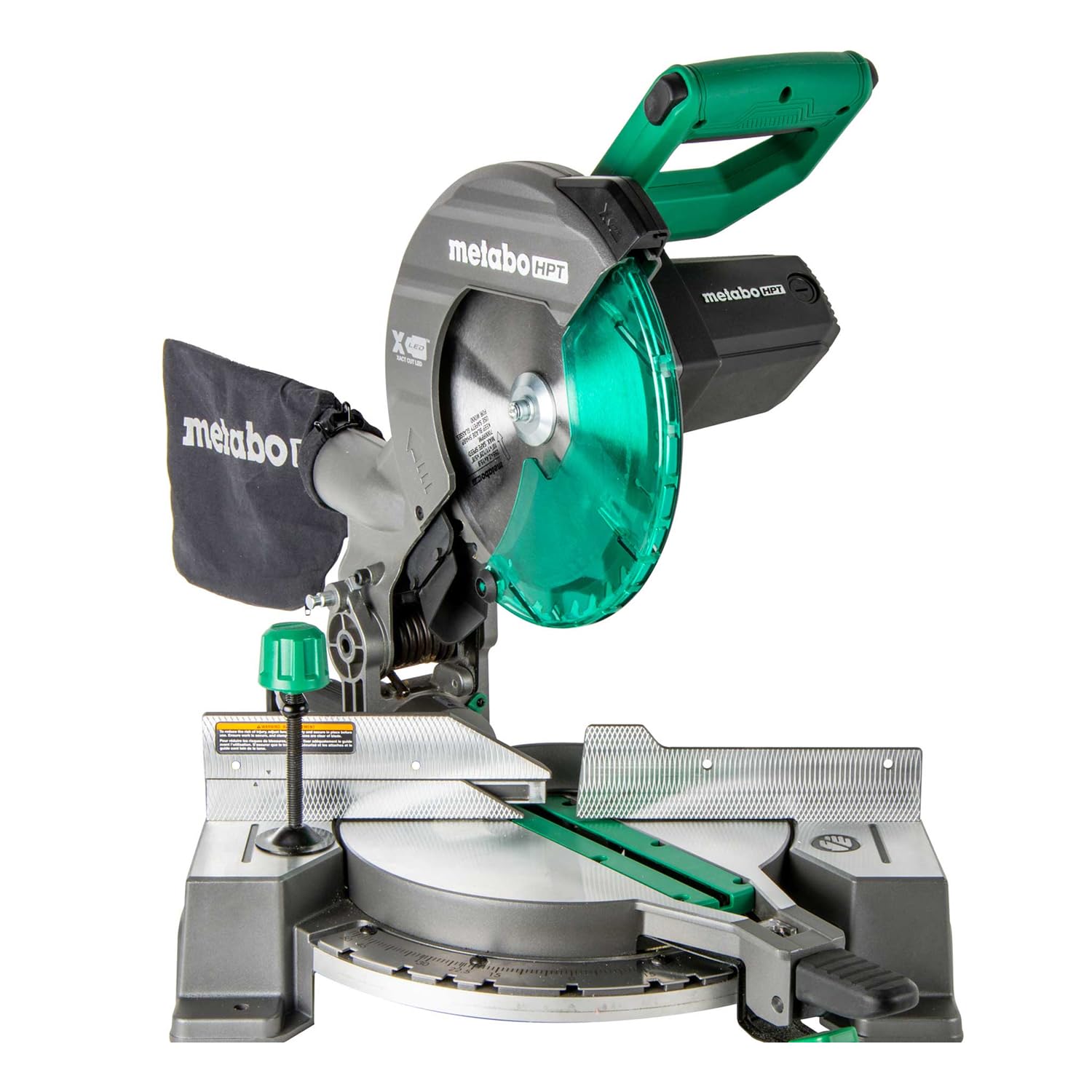
2. Metabo HPT 10-Inch Compound Miter Saw, 15-Amp, Single Bevel, C10FCG2
The saw that goes up a ladder and down a stairwell without costing you a motor.
At 24.2 pounds, this is the one you actually carry onto the job — well under the 35 pounds of the DEWALT DW713 and a fraction of the RIDGID R4210’s 69.2 pounds. That 10.8-pound gap over the DEWALT matters when you load the saw into a truck bed every morning.
The 15-amp motor spins up to 5,000 RPM with a 0-52° miter range left and right plus a 0-45° bevel to the left. Adjustable bevel stops hold your angle, and a vice clamping system locks the workpiece so shorter offcuts stay put. Buyers report the sure footing holds up on 4x4s and 2x6s with no trouble at all.
The five-year Metabo HPT warranty is the standout spec here — longer coverage than the 1-year Makita LS1040 offers. The catch: durability lands as a mixed note in owner feedback, and a single-bevel head means you flip the workpiece on compound angles rather than tilting the other way.
Weight Advantage: 24.2 pounds is the number worth caring about if you portage your saw between rooms or sites.
Be real about the bevel: single-direction tilt only, so complex compound cuts need planning on the workpiece side.
Pick this if: the saw leaves the shop, you want a five-year warranty, and your compound cuts are occasional rather than constant.
Step up if: dual-bevel crown work is the bulk of your day.
3. Genesis GMS1015LC 15-Amp 10-Inch Compound Miter Saw with Laser Guide
Laser line on the workpiece and an electric brake that stops the blade fast — home-shop features at the entry tier.
The value story leads here: owners mention this saw cuts clean through 2x4s without fight, and the out-of-the-box kit is unusually complete. You get a 60T carbide blade installed, hold-down clamp, dust bag, two extension wings, blade wrench, and even two AAA batteries for the laser.
Nine positive detent miter stops lock at common angles through 0-45° left and right, and the die cast aluminum base keeps the whole thing light enough to move around a home shop. Bevel cuts run up to 45° left with a max cut capacity at 45° x 45° of H 1-3/8″ x W 3-5/16″.
The laser is the tool most mentioned and the one with the most baggage — several users struggle to get the line aligned with the actual blade path. It works, but plan to spend a session dialing it true before you trust it on finish cuts. Adjustability likewise lands in mixed territory.
Good for a Home Bench
- Complete kit with 60T blade, clamp, dust bag, wings, and laser batteries
- Electric brake stops the blade in seconds for quicker repeat cuts
- Nine positive stops at common angles plus arbor lock for fast blade swaps
- Light die cast aluminum base keeps it mobile
Worth Knowing Before You Buy
- Laser alignment takes patience — it can drift off the true blade path
- Adjustability is mixed, so verify the stops on day one
- Bevel is limited to 45° left only
Best fit: weekend home projects where the saw stays in one shop and the laser saves layout time.
Not the one: for heavy day-in-day-out trim crews who need the laser dead-true from the first cut.
4. Delta Power Equipment Corporation S26-262L 10″ Shop Master Miter Saw with Laser

A 5,500 RPM head that chews nominal 4×4 and 2×6 stock at 90° in one pass.
The headline spec is the motor speed — 5,500 RPM is the fastest head on this list, and that is 20% faster than the Makita LS1040’s 4,600 RPM. Higher spin means less drag through tough stock and cleaner trim cuts.
Capacity is the other reason to pick it: it cuts nominal 4×4 and 2×6 at 90° and clears 2×6 in one pass, so framing and deck work do not need a second tool. The 5/8-inch arbor takes standard blades, and a spindle lock holds the shaft while you loosen the blade nut.
The laser draws mixed feedback — some units track true and others drift, and adjustability also runs mixed with angle settings needing attention. At 25 pounds it is 3% heavier than the Metabo HPT’s 24.2 pounds, but still a manageable carry. Owners broadly rate the build quality as the tool’s strong suit.
Speed Winner: 5,500 RPM is the fastest here, outspinning the Makita LS1040 by that 4,600 vs 5,500 gap.
Check on arrival: the laser and angle stops are the two spots owners most often want to fine-tune.
Choose it for: mixed framing-and-trim work where 4×4 and 2×6 stock shows up and you want the fastest head spinning.
Pause if: you want a laser you never think about — this one sometimes needs convincing.
5. DOVAMAN 10-Inch Sliding Miter Saw, Multi-Material, 2-Speed, 15A
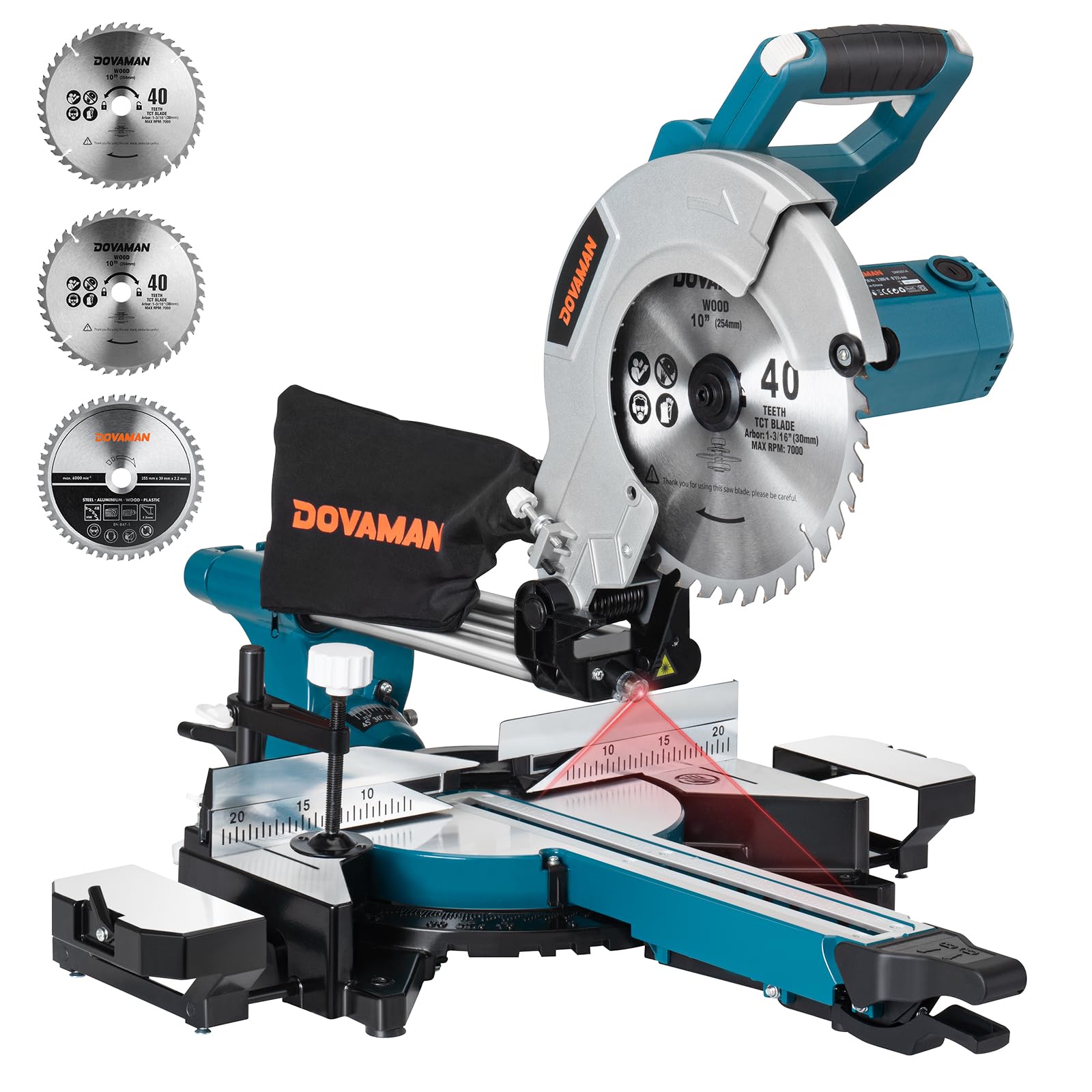
Three blades, two speeds, and a 13-inch rail that opens up wide crosscuts without a bigger blade.
No other saw here ships with this much blade hardware: two 40-tooth and one 48-tooth TCT blade in the box, so wood, PVC, and soft metals each get a matched edge. The two-speed setting — 5,000 RPM and 3,200 RPM — lets you drop to the slower head for material that burns or melts at full speed.
The 13-inch sliding rail pushes the cut range up to 4 x 13 inches, so wide boards and fascia clear the blade in one pass. The 34″ x 20″ x 15″ footprint is the longest body on this list — 74% more front-to-back length than the compact Genesis at 19.5″ x 16.25″ x 15″. That 34-inch body needs a full-depth bench, so the DOVAMAN stays mounted rather than carried to a jobsite.
An ambidextrous layout suits both left- and right-handed operators, and a built-in laser guides the cut. Blade durability, spin-up speed, and accuracy all land mixed in owner experience, with slow spin-up drawing specific gripes. Push the motor at 5,000 RPM and it cuts composite 1/2 x 12 facia cleanly, but be patient waiting for it to reach speed.
The Multi-Material Case
- Three TCT blades included — two 40T and one 48T — for wood, PVC, and soft metal
- Two-speed dial at 5,000 RPM and 3,200 RPM adapts the cut to the material
- 13-inch rail widens crosscuts to 4 x 13 inches
- Ambidextrous layout works for left- and right-handed operators
The Bench Space Trade
- Longest body of the group — needs a full-depth bench to sit safely
- Slow spin-up time before the blade reaches speed
- Accuracy is mixed; check the fence and stops on setup
Worth it when: one saw has to handle wood, PVC, and soft metal, and you have a permanent bench to mount it on.
Think twice if: you need a fast-spinning head or carry the saw up and down a truck every day.
6. VEVOR Sliding Compound Miter Saw 10″ Double Bevel
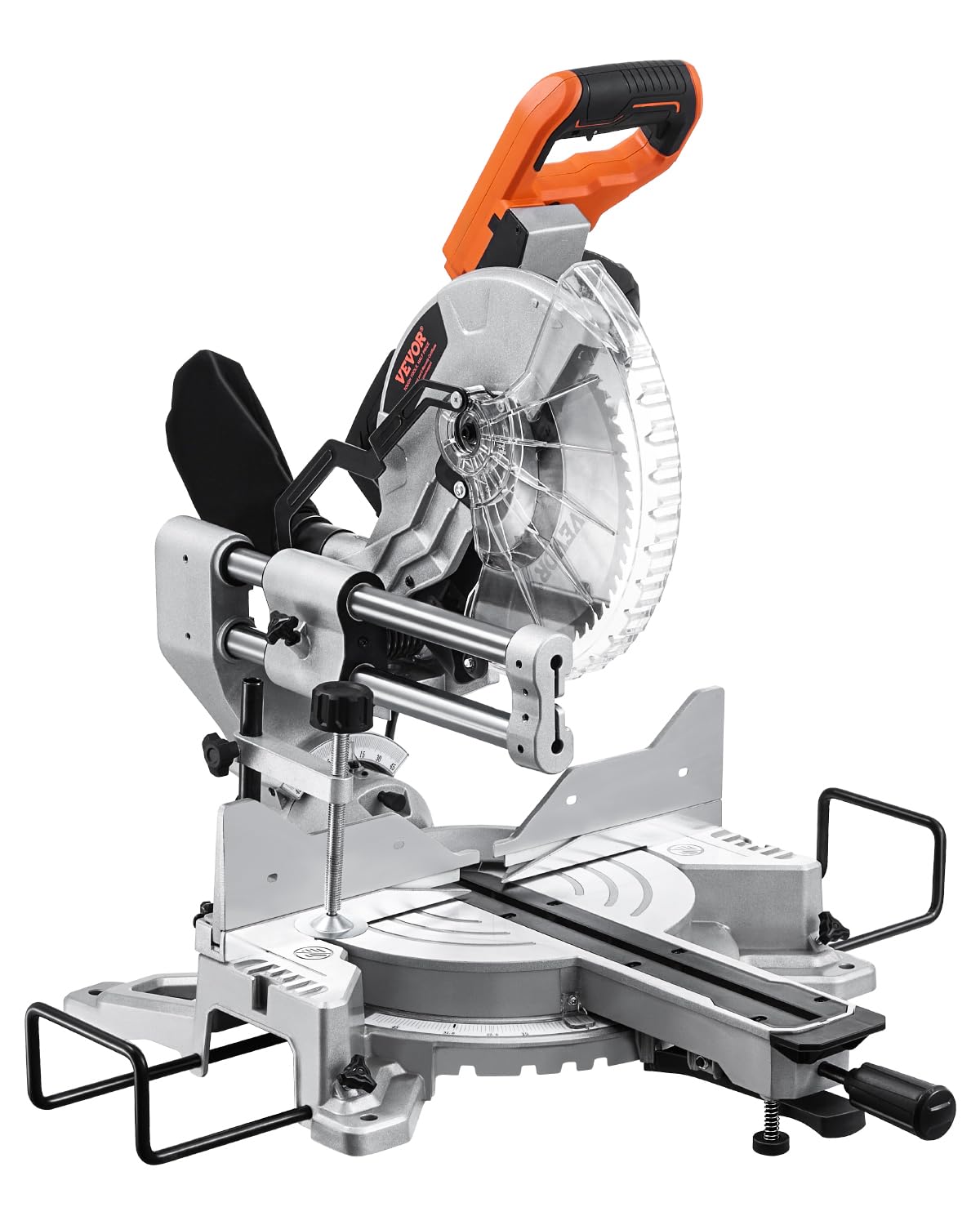
A wall-hugging slider that tilts both ways, made for workshops where floor space is the scarcest tool.
The axial sliding system runs forward and back to widen crosscuts without demanding a long runway — and the space-saving design allows wall-mounted placement. In a one-car garage, wall-mounting frees the floor for material and foot traffic.
The dual-bevel head tilts in both directions, cutting custom frames and wood art joints without flipping the stock. An upgraded aluminum base runs lighter than a cast iron one for easier shifting, while the integrated precision scales and locking hardware let you set an angle and trust it. A 60-tooth blade comes fitted.
Mobility and adjustability both land mixed in owner experience — several report trouble with the sliding mechanism itself, which is worth checking before you commit to a wall mount. At 39.7 pounds it is a bench saw, not a carry saw, and the LED shadow-line guide draws mixed feedback on how crisp it reads.
Space math: a wall-flush footprint beats a long bench for small shops — but only if the slider tracks true.
Dual-bevel payoff: two-way tilt means crown and frames work from either side without flipping stock.
Made for: compact shops where the saw lives against a wall and dual-bevel joints are on the list.
Skip if: a rock-solid slider is non-negotiable — test the rail travel on arrival before mounting it up.
7. DEWALT DW713 10 In. Portable Compound Miter Saw
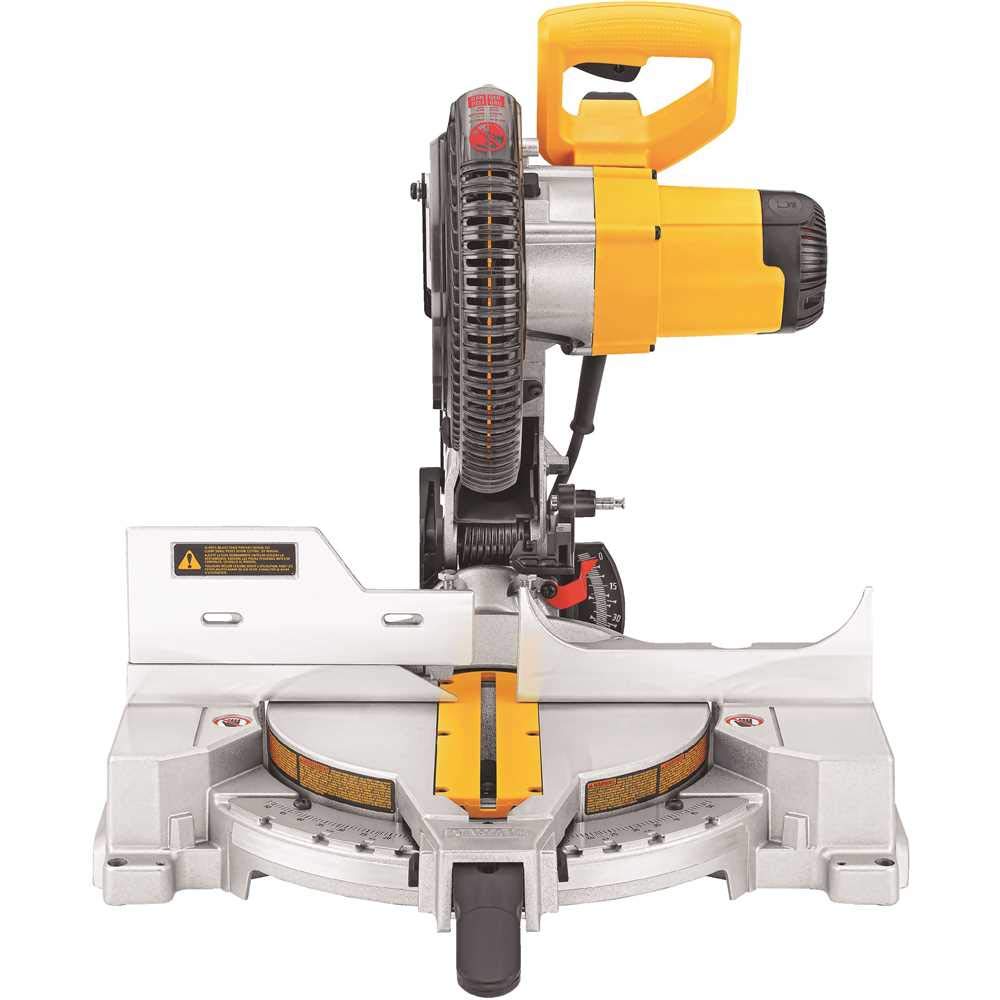
Eleven positive stops and tall sliding fences that hold crown molding upright at 4-1/2 inches.
Repeatable accuracy is the whole pitch, and the stainless steel detent plate backs it up with 11 positive stops. Owners describe dead-on calibration right from the start, so repeated trim cuts land in the same kerf without re-checking the detents.
Tall sliding fences support crown molding vertically up to 4-1/2 inches, then slide out of the way when you bevel. The miter table swivels 0-50° left and right, with a cam lock for quick positioning and a detent override for fine angles. Bevel range runs 3°-48° for extra cut capacity on the tilted side.
The 15-amp, 5,000 RPM motor matches the Metabo HPT’s speed spec, but at 35 pounds this DEWALT is noticeably heavier to carry. A machined-base fence support keeps the fence perpendicular to the blade, which is the quiet reason cuts land square. Crown molding up to 3-5/8 inches is reported to cut cleanly, and the saw pairs well with a matching miter stand.
Why Crews Trust It
- 11 positive stops on a stainless steel detent plate for repeat accuracy
- Tall sliding fences hold crown molding vertically to 4-1/2 inches
- 0-50° miter range both directions plus a cam miter lock
- 15-amp, 5,000 RPM motor matched to a machined fence support
The Weighty Side
- 35 pounds is heavy for one-person daily carry
- Fixed head — wide stock beyond its crosscut capacity needs a slider
- Built-in handle helps, but this is a two-hand lift
The right call for: trim and crown work where repeat accuracy matters more than portability.
Reconsider if: you move the saw solo all day — the Metabo HPT’s 24.2 pounds is friendlier to your back.
8. RIDGID R4210 15 Amp 10 Inch Corded Dual Bevel Sliding Miter Saw

A 70-degree miter swing and dual-bevel head built to take on the most difficult materials.
The miter capacity is the differentiator: 70° of swing on a 10-inch dual-bevel sliding saw clears angles that narrower tables cannot reach. A 15-amp motor powers through tough stock, and the dual-bevel design handles compound cuts from either side.
Sight lines are handled by an LED cut line indication and a work light that illuminates the work — so your mark stays visible in a dim garage. A built-in dust collection port accepts common 1-1/4 in. wet/dry vacuum adapters, which keeps the cut area clear. Crown stop mounting holes take common stops and available RIDGID crown molding stops, sold separately.
The honest catch is mass: at 69.2 pounds this is the heaviest fixed-bench saw of the group bar none. It belongs on a dedicated stand, not in a truck bed you load solo. It arrives as a bare tool, so plan for a blade and the crown stops as extras.
Angle range: a 70° miter capacity out-swings the fixed-head picks here for oddball corners and trim transitions.
Fixed address: 69.2 pounds means it lives where you build the stand — plan a permanent home.
Set it up if: your work includes extreme miter angles and dual-bevel joints on a permanent bench.
Look past it if: you need a saw that travels — this one stays put.
9. Makita LS1019L 10″ Dual-Bevel Sliding Compound Miter Saw with Laser

A 10-inch slider with the crown-molding reach of a 12-inch saw, built on ball-bearing rails.
The spec that sells it is cut capacity: 6-5/8 inch nested crown molding from a 10-inch blade — the reach a 12-inch saw normally delivers. For baseboard and crown work, that means a 10-inch blade with the nested capacity of a 12-inch saw.
A linear ball bearing system drives the slide, and the two-steel-rail design delivers single slide-glide operation that shrinks the footprint and allows cutting flush against a wall. Vertical cutting capacity reaches 5-1/4 inches from the direct drive gearbox and guard system. The dual-bevel head tilts both ways for compound cuts.
Owners praise the ball-bearing slide and the dust port, which pulls chips away instead of leaving a pile under the fence. Precision on 45-degree bevel cuts runs mixed, so plan to verify the bevel detents before finish work. At 72.8 pounds it demands a permanent stand, and value is debated among owners who find the price steep.
Crown capacity play: 6-5/8 inch nested crown from a 10-inch blade is the reason to pay up here.
Bevel check: verify the 45-degree bevel detents on arrival — that is the mixed spot owners flag.
Buy it when: crown molding is your daily work and a wall-flush slider with wide nested capacity is worth the stretch.
Hold off if: you are a light-duty home user — this is a lot of saw for occasional trim.
Understanding the Specs
Amps and RPM
Amps measure the motor’s power draw — a 15-amp motor gives headroom for tough stock without stalling. RPM is how fast the blade spins. Higher spin rates tend to leave cleaner cuts in hard material, but the number that matters most is whether the saw holds speed through the cut rather than dipping under load.
Miter vs. Bevel
The miter angle is how far the table swivels sideways — expressed in degrees left and right of 0°. The bevel is how far the blade head tilts. A compound cut uses both at once, which is why crown molding and picture frames need bevel capacity. A dual-bevel saw tilts both directions; a single-bevel tilts one way only.
FAQ
Can a 10-inch miter saw cut a 4×4 post in one pass?
Do I need a sliding miter saw or a fixed-head one?
What is the difference between single-bevel and dual-bevel?
What miter angle range should I look for?
Will a 10-inch miter saw cut crown molding?
How much does a 10-inch miter saw weigh?
Do I need a laser guide on a miter saw?
What arbor size do miter saw blades use?
Can a 10-inch miter saw cut metal or PVC?
What are positive miter stops and why do they matter?
Final Thoughts: The Verdict
For most buyers, the 10in miter saw to start with is the Makita LS1040 — its dual post compound arm, nine positive stops, and 52° right miter range handle trim and repeated 45s without railing to clean. It also carries the highest owner rating among the fixed-head saws here. If portability is your priority, the Metabo HPT C10FCG2 at 24.2 pounds and a five-year warranty is the carry-friendly choice. And for crown molding that wants the reach of a 12-inch saw in a 10-inch blade, the Makita LS1019L is the one to reach for.
How We Picked
We do not accept paid placement. Every pick is matched to a real buyer and a real use-case; we do not hands-on test units.
Sources & Methodology
Specifications: manufacturer listings and product documentation. Review insights: verified customer reviews, as of November 2026. Pricing: not shown on this page (it changes often); check the current price via the retailer link.
As an Amazon Associate, Gadgets Feed earns from qualifying purchases. This does not affect which products we feature.