
Our readers keep the lights on and my morning glass full of iced black tea. As an Amazon Associate, I earn from qualifying purchases.
Specs are compiled from manufacturer listings and verified buyer reviews and can change over time — please confirm the key details on the product page before buying.
You need a saw that cuts wide boards square without taking over your whole bench. The key is finding a sliding mechanism and motor that work together smoothly. Here is the best 10in sliding miter saw for your projects, from trim work to metal framing.
I’m Min — the founder and writer behind Gadgets Feed. This guide is built by comparing the manufacturers’ published specifications and the patterns across verified customer reviews, so you get each pick’s real strengths and trade-offs instead of marketing spin.
Whether you are trimming baseboards or cutting steel angle iron, the right saw saves time and material. Knowing which rails, motor, and bevel system fit your workflow makes all the difference.
Our Picks at a Glance


How To Choose The Best 10In Sliding Miter Saw
A 10-inch sliding miter saw is a precise tool, but the wrong choice can leave you frustrated with inaccurate cuts or a machine that takes up too much space. Focus on these key factors to match the saw to your actual work.
Sliding Mechanism: Rails vs. Axial Systems
The sliding system determines how the saw head moves forward and backward to cut wider boards. Traditional steel rails are sturdy but require clearance behind the saw. Newer axial or front-slide systems let you push the saw flush against a wall, saving a lot of bench space. Look for smooth glide and minimal play in the mechanism.
Bevel Capability: Single vs. Dual
A single-bevel saw tilts the blade to one side (usually left) for angle cuts. Dual-bevel tilts both left and right without flipping the workpiece — a huge time-saver for crown molding and complex joinery. If you only cut baseboards for rooms, single bevel is fine. For furniture or trim work with frequent compound angles, dual bevel is worth the premium.
Motor Power and Cutting Speed
Most 10-inch sliding saws run a 15-amp motor that spins the blade between 4500 and 5500 RPM. A motor with higher RPM (like 5500 RPM) will cut faster through hardwoods, but a consistent torque delivery matters more. Soft-start motors prevent the saw from jerking or tripping breakers in older workshops.
Quick Comparison
| Model | Best For | Motor / RPM | Bevel Type | Weight | Amazon |
|---|---|---|---|---|---|
| DOVAMAN DMS01A★ Best Overall | Versatile multi-material | 15 Amp / 5000 RPM | Single Bevel | 37.4 lbs | Amazon |
| Makita LS1019LAlso Great | Professional woodworking | 15 Amp / 5500 RPM | Dual Bevel | 72.8 lbs | Amazon |
| Evolution R255SMS-DB+Top Performer | Heavy metal cutting | 15 Amp / — | Dual Bevel | 44.8 lbs | Amazon |
| Evolution R255SMS+ PLUS | Multi-material flexibility | 15 Amp / — | Single Bevel | 41.8 lbs | Amazon |
| Delta S26-263L | Value / trusted brand | 15 Amp / 5500 RPM | Single Bevel | 30 lbs | Amazon |
| Hoteche P805218A | DIY trim work | 15 Amp / 4500 RPM | Single Bevel | 34.9 lbs | Amazon |
| Chicago Electric 792363981996 | Budget-conscious users | 15 Amp / — | Single Bevel | 29.6 lbs | Amazon |
| MarvTool JS-1013C3 | Lightweight portability | 15 Amp / 5000 RPM | Single Bevel | 25.6 lbs | Amazon |
| VEVOR J1G-ZP33-K255D | Dual bevel on a budget | 15 Amp / 5000 RPM | Dual Bevel | 39.68 lbs | Amazon |
In‑Depth Reviews
1. DOVAMAN DMS01A
Our pick — over 4★ from 650+ verified ratings; the strongest balance of quality and price.
The only saw here with a dual-speed motor and three included blades for wood, PVC, and soft metals.
You can pick 5000 RPM for wood or 3200 RPM for soft metals and plastics, which prevents burning the material. The 13-inch sliding rail with extendable side tables gives you a cutting range up to 4 x 13 inches — wider than many single-bevel saws in its price tier. The ambidextrous handle works for both left and right-handed users, and the built-in laser guide helps with accuracy.
Owners mention the saw is solid and well-made, with the laser guide being a huge bonus for precision. One customer observed “arrived damaged but seller quickly resolved,” which speaks to DOVAMAN’s customer service. It comes with three TCT blades (two 40-tooth, one 48-tooth) and two extra carbon brushes.
At 37.4 pounds it sits heavier than the 25.6-pound MarvTool, but the dual-speed and multi-blade kit make it far more flexible for different materials.
What We Like
- Dual-speed motor (5000 / 3200 RPM)
- Three TCT blades included
- 13-inch sliding rail for wide cuts
- Ambidextrous handle design
What We Don’t
- Loud during operation
- Takes a moment to reach full speed
Best for: A hobbyist who works with different materials — wood for furniture one day, PVC trim the next.
Not if: You prefer a quiet workshop or need a single-bevel saw that is ready at a moment’s notice.
2. Makita LS1019L
The 72.8-pound pro saw that cuts crown molding like a 12-incher but fits on a 10-inch footprint.
This saw uses a linear ball bearing system and a unique two-steel rail sliding design — so you can place it flush against a wall and still get a full slide for wide cuts. The direct drive gearbox delivers a powerful 5500 RPM while keeping vertical cutting capacity high at 5-1/4 inches. It also handles nested crown molding up to 6-5/8 inches, matching the capacity of many 12-inch saws in a lighter package.
Buyers report the dust collection catches over 80% when connected to a shop vacuum, and the laser guide projects a clean line. One reviewer noted the stock blade works great, but recommends checking the blade carriage alignment with a dial indicator — the target is less than 0.005 inches total play.
This is the most expensive option on the list, but if you are a serious woodworker or contractor who needs dead-on accuracy and professional durability, the Makita is the definitive pick.
Strengths
- Linear ball bearing system for smooth, accurate slides
- Cuts nested crown molding up to 6-5/8 inches
- Dual bevel without flipping the workpiece
- 80%+ dust collection with a vacuum
Trade-offs
- Heavy at 72.8 pounds — not for quick job-site moves
- Premium price point
- Laser guide is dim in bright light
Reach for this if: You demand professional-grade accuracy for crown molding, furniture, and fine woodworking and you don’t mind a heavier machine.
Look elsewhere if: You need a lightweight saw for daily portability or your budget is under the premium tier.
3. Evolution R255SMS-DB+
The multi-material dual-bevel saw that cuts wood, mild steel, and plastic with virtually no sparks.
The R255SMS-DB+ comes with a single TCT blade that handles wood, composite decking, nails, and mild steel — meaning you don’t switch blades every time you change material. It offers a 45°-45° dual bevel range and a 50°-50° miter range, giving you flexibility for complex cuts without repositioning the stock. The included 3-year warranty adds confidence.
One buyer mentioned it cut aluminum framing for a snake enclosure with zero tearout on 45° angles, needing no deburring. Another noted the included blade dulled quickly on thicker mild steel tubing, but Amazon provided a replacement. The saw has a soft-start motor (slow spin-up around 2 seconds) that avoids tripping breakers.
Compared to the single-bevel Evolution PLUS, this dual-bevel version costs more but saves serious time if you frequently cut compound angles on both sides.
What Stands Out
- Cuts wood, metal, and plastic with one blade
- Dual bevel 45° left and right
- Soft-start motor won’t trip sensitive breakers
- 3-year warranty included
What to Know
- Included blade dulls faster on thick steel
- Heavier than some single-bevel options at 44.8 lbs
Best suited for: A fabricator or builder who regularly switches between wood and metal framing.
You might skip it if: Your work is mostly softwood and you want a lighter, lower-cost single-bevel saw.
4. Evolution R255SMS+ PLUS

The utility player that cuts wood, nails, and steel with one blade while staying under the mark.
This is the single-bevel version of Evolution’s multi-material platform, but it shares the same core advantage: one blade that handles wood, embedded nails, composite decking, and mild steel. It also includes plus features like dual quick release clamps, an improved dust bag, taller fences, and a slide rail protector — all for less money than the dual-bevel version.
One reviewer found it cuts 1/8-inch steel “like butter” and noted it runs quietly. The miter range spans 50° left and right, so you can handle acute angles on crown molding. A buyer mentioned the included blade drags fibers on wood cuts, but the saw itself is sturdy with smooth head movement and solid angle detents.
If you do not need dual-bevel capability, this saw gives you the same multi-material versatility at a lower price than the DB+.
Pros
- Multi-material cutting without blade swaps
- Includes dual clamps, dust bag, taller fences
- Smooth soft start motor
- 3-year warranty
Cons
- Single bevel only tilts left
- Laser only aligns for the first few inches of cut
Grab this for: A homeowner or DIYer who works with wood and occasionally needs to cut metal for small projects.
Pass if: You need dual-bevel tilt for crown molding angles or you cut thick steel daily.
5. Delta S26-263L

A trusted brand name at 30 pounds and 5500 RPM — this is the weekend warrior’s saw for.
The Delta S26-263L is a single-bevel sliding miter saw that weighs 29.5 pounds, making it one of the lightest sliding saws in this roundup. Despite the low weight, it still packs a 15-amp motor spinning at 5500 RPM and can bevel left from 0° to 45° for cutting nominal 2x12s. The spindle lock allows quick blade changes.
One buyer described it as “very good for the money” and noted it was accurate from the start with a smooth slider clamp. However, another reviewer found the dust bag ineffective (recommending a shop vac connection) and the laser too dim for outdoor use. The cord exits out the rear of the slide bar to keep it away from the blade.
At 30 pounds it beats the 44.8-pound Evolution DB+ in portability, though you give up multi-material capability and dual bevel.
Highlights
- Lightweight at 30 pounds
- 5500 RPM motor
- Accurate from the start
- Spindle lock for easy blade changes
Drawbacks
- Laser guide is weak in bright environments
- Dust bag is mostly ineffective
- Louder than some similar saws
Ideal for: DIYers who need a portable, reliable saw for weekend projects and want a brand name without the premium price.
Not for: Anyone who needs dust collection out of the bag or dual-bevel cuts.
6. Hoteche P805218A
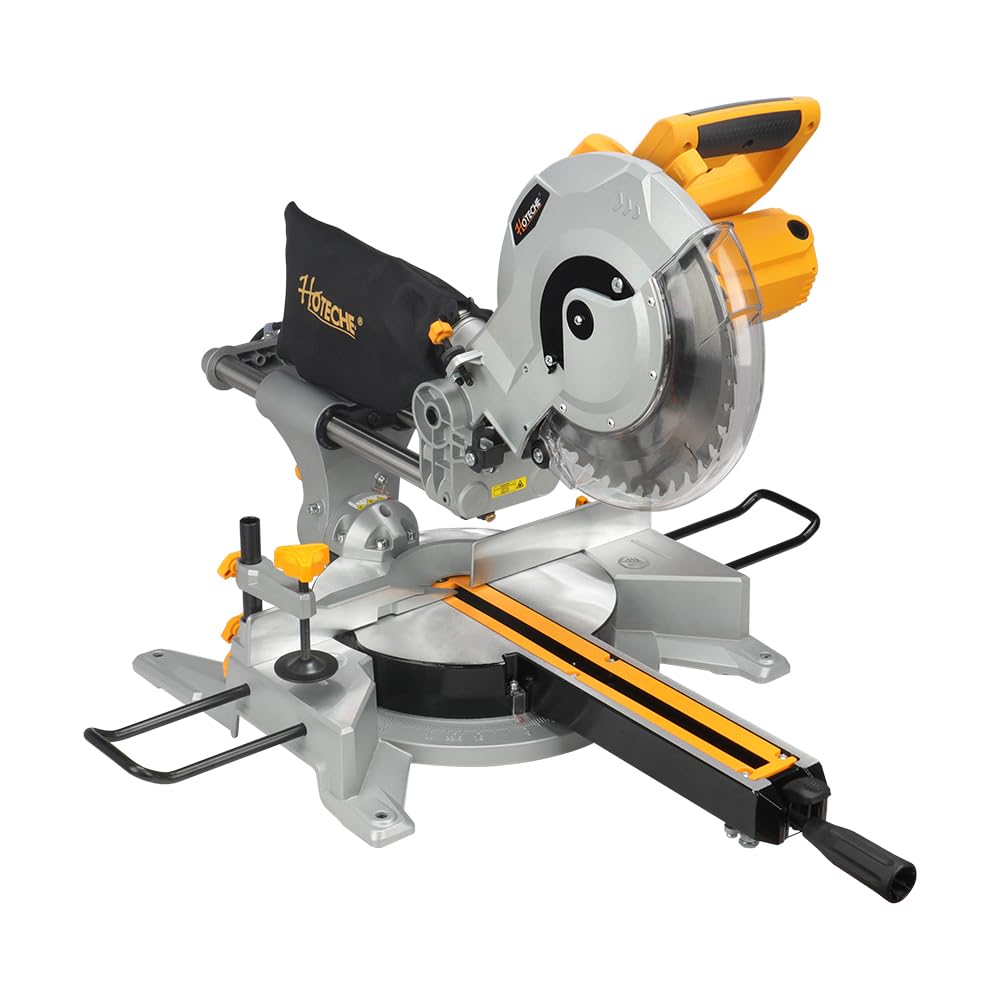
A laser-guided, 34.9-pound saw that delivers accurate cuts without emptying your wallet.
The Hoteche single-bevel saw runs a 1800-watt motor (equivalent to the standard 15-amp class) spinning at 4500 RPM. It includes a laser guide for aligning cuts, a sliding mechanism that supports up to 340mm cuts, and a complete kit with extension bars, dust bag, and a working clamp. The 10-inch blade has 40 teeth for smooth cuts in wood and plastics.
One owner reported it “works perfectly for small projects like window casing” and uploaded a video to help beginners understand the lock release mechanism. Another mentioned the G-clamp is effective but its mechanism is not obvious. The fence placement limits how wide a board you can cut at a right angle.
Like the MarvTool below, this is a solid entry-level choice, but the Hoteche is slightly heavier (34.9 lbs vs 25.6 lbs) and spins a bit slower (4500 RPM vs 5000 RPM).
Good Points
- Includes laser guide for alignment
- Comes with extension bars, dust bag, and clamp
- Smooth sliding mechanism for longer cuts
Weak Points
- 4500 RPM is slower than many competitors
- Fence could be set back further for wider cuts
- Clamp mechanism is not intuitive
Reach for: A first-time miter saw buyer who wants a laser guide but doesn’t want to overspend.
Avoid if: You need fast cuts in dense hardwood or require a dual-bevel tilt.
7. VEVOR J1G-ZP33-K255D
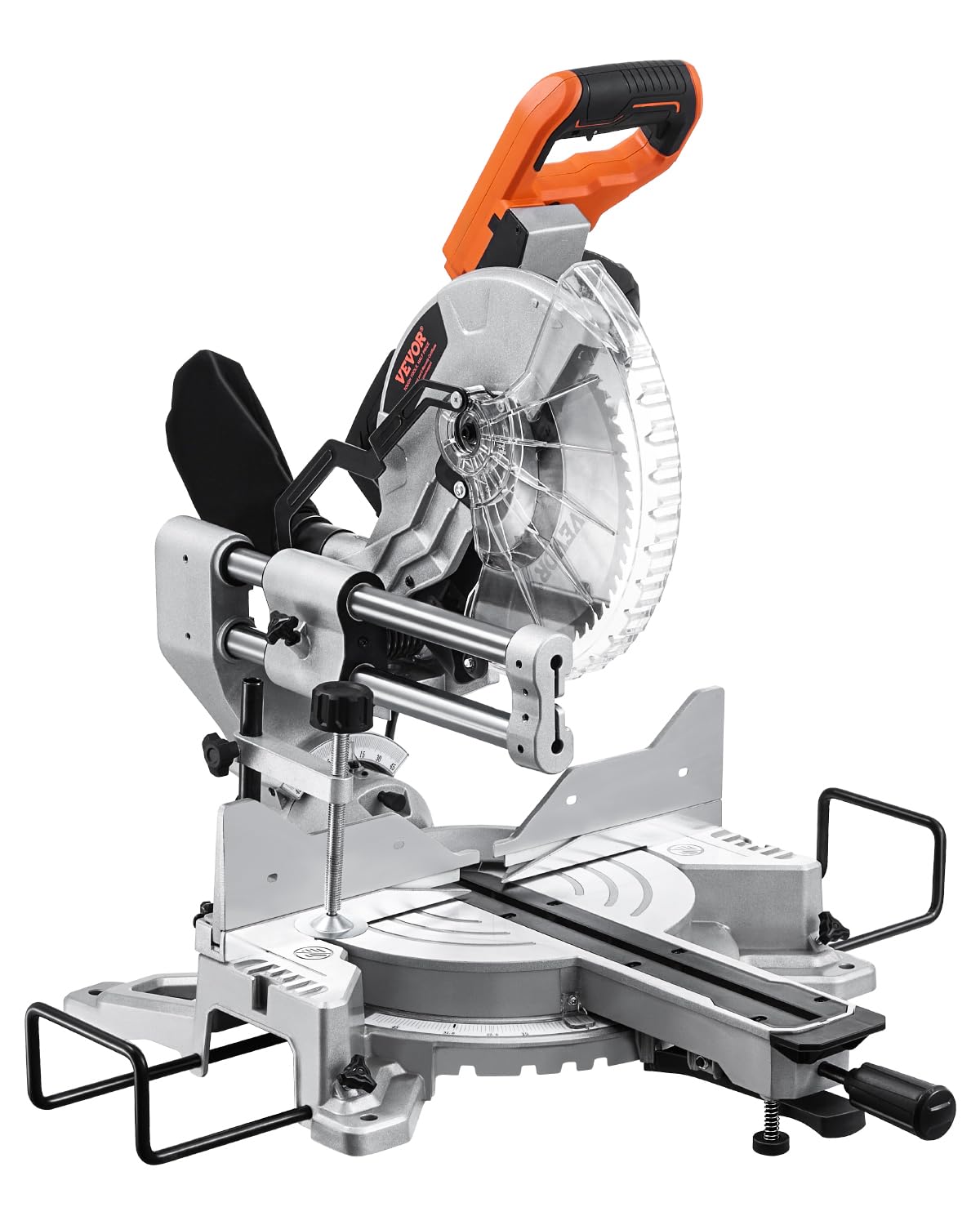
A dual-bevel saw with an advanced LED guide system that costs less than most single-bevel alternatives.
The VEVOR uses an axial sliding system (slides on the front rail) so you can place it against a wall, saving workspace. The 15-amp motor pushes 5000 RPM, with a straight-cutting power of 2300W and 2800W for bevel cuts. The upgraded aluminum base is lighter than cast iron but still holds the saw steady. Dual bevel goes 0° to 45° both left and right.
A buyer called it a “great budget dual miter saw” that packs well, cuts accurately, and has a great LED shadow line. However, another reviewer reported it arrived “missing blade and tool” and found customer service slow. When it works, the saw squares from the start, has a fast blade brake, and collects dust effectively.
Note the 39.68-pound weight — it is competitively heavy among dual-bevel saws but still beats the 44.8-pound Evolution DB+.
Strong Points
- Dual bevel at a budget-friendly price
- LED shadow line for accurate cuts
- Axial slide saves bench space
- Fast blade brake
Weak Points
- Inconsistent quality control on accessories
- Customer service can be unresponsive
Who it’s for: A budget-conscious woodworker who wants dual-bevel flexibility without paying for a big brand.
Who it’s not for: Anyone who depends on reliable out-of-box completeness and quick customer service.
8. Chicago Electric (792363981996)

A bare-bones slider at 29.6 pounds that gets the job done if you bring your own blade.
This Chicago Electric sliding compound miter saw runs a 15-amp motor and uses dual linear slide rails for stability. The bevel goes 45° left only, and miter cuts go left and right. It includes dust bag and extension bars, but does not come with a blade — you need to buy a 10-inch blade with a 5/8-inch arbor separately. The model number is 792363981996.
A buyer called it a “solid, durable 10″ sliding compound miter saw” and noted it cuts 12 inches wide. However, another review warns the saw has many plastic parts that break easily, with poor warranty support and no spare parts available. If you are on a tight budget, this is one of the cheapest entry points, but the lack of a blade and reported quality issues make it a gamble.
At 29.6 pounds it is the second-lightest saw here after the MarvTool, but you get what you pay for in terms of build quality.
Pros
- Very affordable entry price
- Lightweight at 29.6 lbs
- Dual linear slide rails for stability
Cons
- No blade included
- Many plastic parts prone to breakage
- No spare parts availability
Use this if: You have a tight budget and already own a good 10-inch blade.
pass on it if: You want a saw that will survive a few years of regular use without breaking plastic parts.
9. MarvTool JS-1013C3
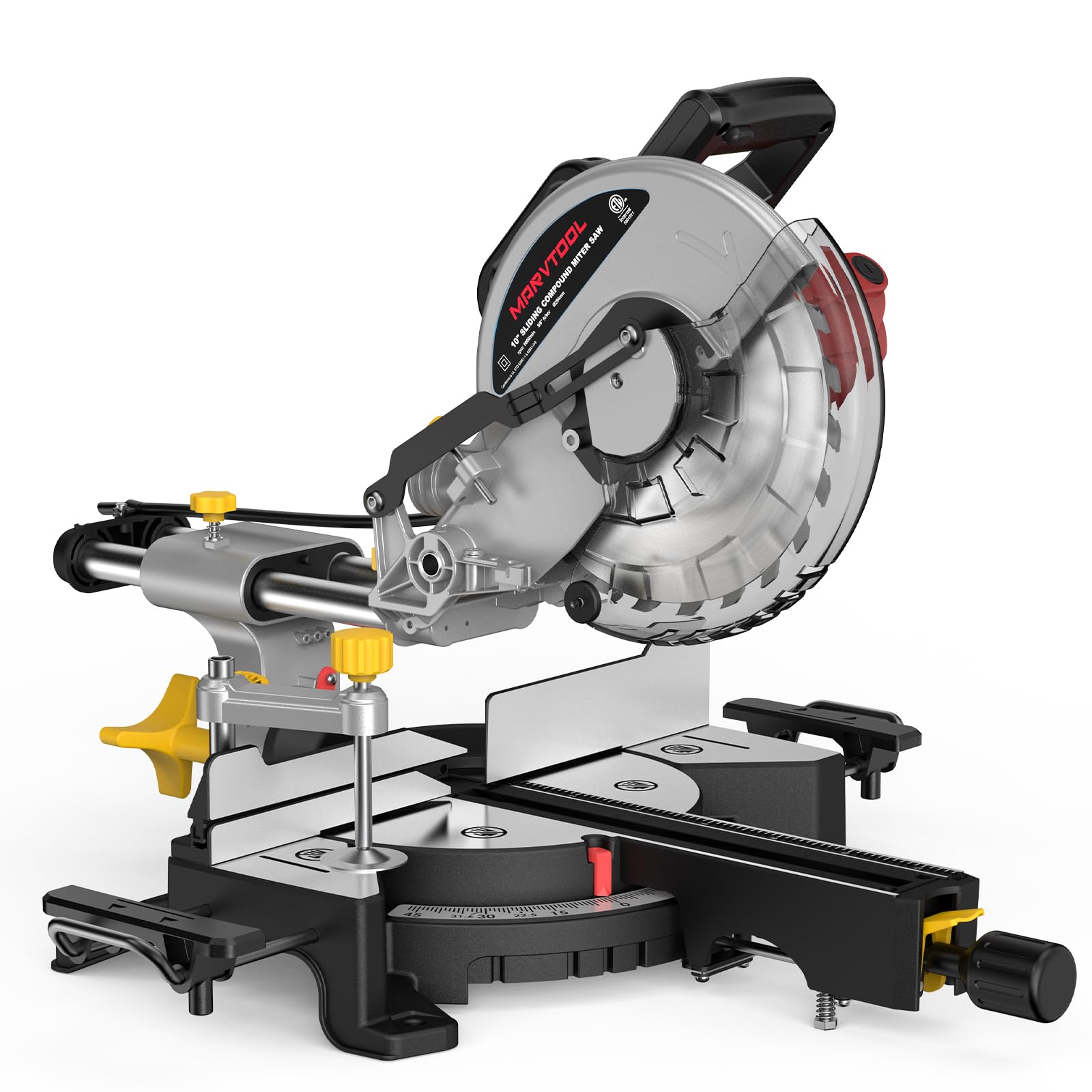
The featherweight at 25.6 pounds — at 25.6 pounds versus the 39.68-pound VEVOR, making it a breeze to haul.
The MarvTool JS-1013C3 is the lightest sliding miter saw in this lineup at only 25.6 pounds, yet it still delivers a 15-amp motor spinning at 5000 RPM. The single-bevel design tilts 0° to 45° left, and it includes a 36-tooth TCT blade, extension tables, and an Allen key. The head can lock into the base using the release knob for compact storage.
One user highlighted it is “affordable, easy setup, lightweight, accurate cuts” and perfect for trim work. Another noted it lacks a laser guide, but you can manage after practice. The included 2-year warranty and 24/7 customer support add reassurance. The item dimensions (25.3″L x 18.5″W x 20.4″H) are smaller than the DOVAMAN’s 34″L x 20″W x 15″H dimensions.
The trade-off is the plastic handle and a wish for longer material supports, but for the price and weight, it is a compelling grab-and-go saw.
Advantages
- Ultra-light at 25.6 lbs
- 5000 RPM motor
- Includes 36-tooth blade and extension tables
- 2-year warranty and 24/7 support
Disadvantages
- No laser guide
- Plastic handle
- Material supports could be longer
Ideal for: A DIYer or trim carpenter who moves between job sites and wants a capable saw that won’t break your back—or your budget.
Not for: Anyone who needs dual-bevel or a built-in laser for precise alignment without practice.
Understanding the Specs
Bevel Type: Single vs. Dual
Single bevel tilts the blade only one direction (usually left) to make angled cuts — fine for baseboards and most framing. Dual bevel lets you tilt the blade to the left AND the right without flipping the board over. This is a huge time saver for crown molding and picture frame work. The VEVOR and both Evolution models offer dual-bevel for complex projects.
Motor Power and RPM
Almost every 10-inch sliding saw uses a 15-amp motor, but the no-load RPM varies from 4500 (Hoteche) to 5500 (Makita, Delta). Higher RPM cuts faster through dense hardwoods, but torque and the quality of the blade matter just as much. A soft-start motor (like on the Evolution and Makita) is easier on electrical circuits and reduces the initial jerk.
Sliding Mechanism: Rails vs. Axial
Traditional sliding miter saws use steel rails that extend behind the saw, requiring rear clearance. Axial or front-slide systems (like the VEVOR) work with the saw pushed flush against a wall, saving space. The Makita uses a unique two-steel rail design that glides without rear protrusion. Before buying, measure your bench depth.
Weight and Portability
Lightweight saws (under 30 lbs, like the MarvTool at 25.6 lbs or the Delta at 30 lbs) are easy to carry from job to job. Heavier saws (over 40 lbs, like the Evolution models and the Makita at 72.8 lbs) offer more stability and build quality but are a pain to move. Consider if you are setting up a permanent station or hauling the saw weekly.
FAQ
What is the main difference between a sliding and a non-sliding miter saw?
How much bench space do I need for a sliding miter saw?
Can a 10-inch sliding miter saw cut through a 4×4 post?
What does “double bevel” mean and do I need it?
Are laser guides worth it on a miter saw?
How often do I need to replace the blade?
Can a 10-inch sliding saw cut metal?
What does a “soft-start motor” do?
Final Thoughts: The Verdict
If you want one dependable pick, the 10in sliding miter saw winner is the Makita LS1019L because it gives you dual-bevel (tilt left and right without flipping the workpiece) flexibility, a smooth linear rail system, and the cut capacity of a 12-inch saw in a 10-inch frame. If you want dual-bevel multi-material cutting for less, grab the Evolution R255SMS-DB+. And for the best value in a lightweight single-bevel package, the MarvTool JS-1013C3 is the one to get.
How We Picked
We do not accept paid placement. Every pick is matched to a real buyer and a real use-case; we do not hands-on test units.
Sources & Methodology
Specifications: manufacturer listings and product documentation. Review insights: verified customer reviews, as of July 2026. Pricing: not shown on this page (it changes often); check the current price via the retailer link.
As an Amazon Associate, Gadgets Feed earns from qualifying purchases. This does not affect which products we feature.