
Choosing the right 10W-40 ATV oil isn’t just about keeping the engine lubricated—it’s about protecting the wet clutch from slippage, managing extreme heat from sustained low-speed trail riding, and ensuring consistent shifting torque after hours of abuse. The wrong viscosity or a missing JASO MA2 certification can turn a smooth ride into a grinding, slipping mess.
I’m Min — the co-founder and writer behind Gadgets Feed. I’ve spent over a thousand hours analyzing technical data sheets, cross-referencing JASO and API certifications, and reading real-world owner reports across thousands of gallons of powersports lubricants to separate genuine performance from marketing hype.
This guide breaks down the best 10W-40 ATV oil options on the market, rated by shear stability, clutch compatibility, and thermal protection. You’ll learn exactly which oils deliver reliable protection for your quad without wasting money on the wrong spec. best 10w40 atv oil starts with understanding what your specific engine and clutch actually need to survive.
How To Choose The Best 10W40 ATV Oil
Your ATV engine and wet clutch share the same oil bath. That means the oil must simultaneously lubricate the top-end, cool the bottom end, and allow the clutch plates to grab without slipping. The three most critical factors are viscosity-grade accuracy, the JASO certification level, and the base oil type.
JASO MA vs MA2 vs MB — Which One Your Clutch Needs
JASO MA and MA2 are certifications specific to 4-stroke motorcycle and ATV oils designed for wet clutches. JASO MB oils contain friction modifiers that reduce clutch grip, causing slippage under load. MA2 is the stricter standard with a higher friction coefficient threshold, making it the safest choice for high-torque ATV engines and aggressive clutch engagement.
Shear Stability — Why Viscosity Holds Up Under Heat
ATV engines run hotter than car engines because of constant load at low speeds and limited airflow. A 10W-40 oil with weak shear stability will thin out after a few hours of trail riding, dropping to a 30-grade or lower. Look for oils that list high-shear viscosity (HTHS) numbers above 3.5 cP, and prefer ester-based or Group IV full-synthetics over hydrocracked Group III blends for sustained shear resistance.
Zinc and Phosphorus — The Anti-Wear Debate
ZDDP (zinc dialkyldithiophosphate) levels around 1200 to 1500 ppm are ideal for flat-tappet ATV engines. Modern API SP car oils reduce ZDDP to protect catalytic converters, which may leave your cam lobes and rocker arms under-protected. Purpose-built ATV and motorcycle oils maintain higher ZDDP concentrations specifically for these engines.
Quick Comparison
On smaller screens, swipe sideways to see the full table.
| Model | Category | Best For | Key Spec | Amazon |
|---|---|---|---|---|
| Royal Purple Max-Cycle 10W-40 | Premium Full Synthetic | Extreme heat & high-load racing | Synerlec additive chemistry | Amazon |
| Motul 7100 4T 10W-40 | Ester Full Synthetic | High-performance sport ATV & UTV | 100% ester base oil | Amazon |
| Maxima Extra 10W-40 | Premium Full Synthetic | Aggressive street & track riding | Regenerative shear-stable polymers | Amazon |
| Honda Pro GN4 10W-40 | OEM Mineral | Honda ATV owners who want factory spec | Genuine Honda part number | Amazon |
| Kawasaki K-Tech 10W-40 | OEM Mineral | Kawasaki ATV/UTV warranty compliance | JASO MA certified | Amazon |
| Castrol EDGE High Mileage 10W-40 | Full Synthetic Car Oil | Older ATVs with seal leaks | Phosphorus replacement tech | Amazon |
| ULTRA 1PLUS 4T 10W-40 | Value Full Synthetic | Budget-friendly JASO MA2 for daily rides | Flash point 215°C | Amazon |
In‑Depth Reviews
1. Royal Purple Max-Cycle 10W-40 (Case of 6)

Royal Purple’s proprietary Synerlec additive chemistry delivers 3X to 4X the load-carrying capacity of other synthetic motorcycle oils, which directly translates to reduced piston scuffing and better protection for crankshafts and buckets under sustained high-RPM operation. Owner reports from heavily modified XR650L builds in 105°F Arizona desert conditions show oil temperature drops from above 300°F down to 210-225°F, extending rebuild intervals from 5,000 to 7,000-10,000 miles.
One CBR 600F4i owner with 48,000 miles noted that switching from Rotella T6 to Royal Purple produced a noticeably quieter engine, dramatically smoother shifting, and eliminated the rough engagement that had plagued the bike when warm. The JASO MA2 certification means the oil provides the correct static and dynamic friction coefficients for wet clutches, preventing the slippage that can occur with car oils.
The quart case format gives you six quarts at a per-unit cost that undercuts many lesser synthetics, making this a strong value proposition for owners who want race-grade protection without stepping up to boutique ester oils. If you ride in extreme heat or push your ATV hard through deep sand and hill climbs, this oil’s thermal stability is a genuine safety margin.
Why it’s great
- Proven 75-90°F oil temp reduction in air-cooled ATVs
- Synerlec chemistry extends engine life under hard use
- Dramatically improves shift smoothness in older transmissions
Good to know
- Premium pricing compared to conventional blends
- Not marketed specifically for wet clutch, but JASO MA2 certified
2. Motul 7100 4T 10W-40 (4 Litre)

Motul 7100 uses a 100% synthetic ester base stock — not a Group III hydrocracked oil — which provides naturally high polarity that makes the oil cling to metal surfaces even when the engine is off. This film strength translates to lower wear on startup, which is critical for ATVs that sit for weeks between rides. The ester chemistry also offers superior natural detergency, keeping piston rings and valve trains cleaner than Group IV PAO blends.
Owners running Kawasaki Z900 and ZX-6R engines report that the oil stays visually red for over 2,000 miles, indicating strong oxidation resistance, and note that engine noise drops noticeably compared to semi-synthetic options. The JASO MA2 and API SP certifications mean it’s backward-compatible with older engines while meeting the latest emissions and catalyst protection standards.
At a 4-liter jug size, you get enough for most ATV sump changes with some left over for top-offs. The shear stability is robust enough for high-rpm sport riding, and the oil maintains 10W-40 viscosity even after extended track sessions. If your ATV sees a mix of high-speed dune running and technical single-track, this ester oil provides the widest protection envelope.
Why it’s great
- 100% ester base provides superior film strength at high temps
- Stays visibly clean and red for over 2,000 miles
- Excellent shear resistance for sustained high-RPM use
Good to know
- Higher price per liter than PAO-based synthetics
- 4-liter jug may be slightly more than some ATVs need
3. Maxima Extra 10W-40 (1 Gallon)
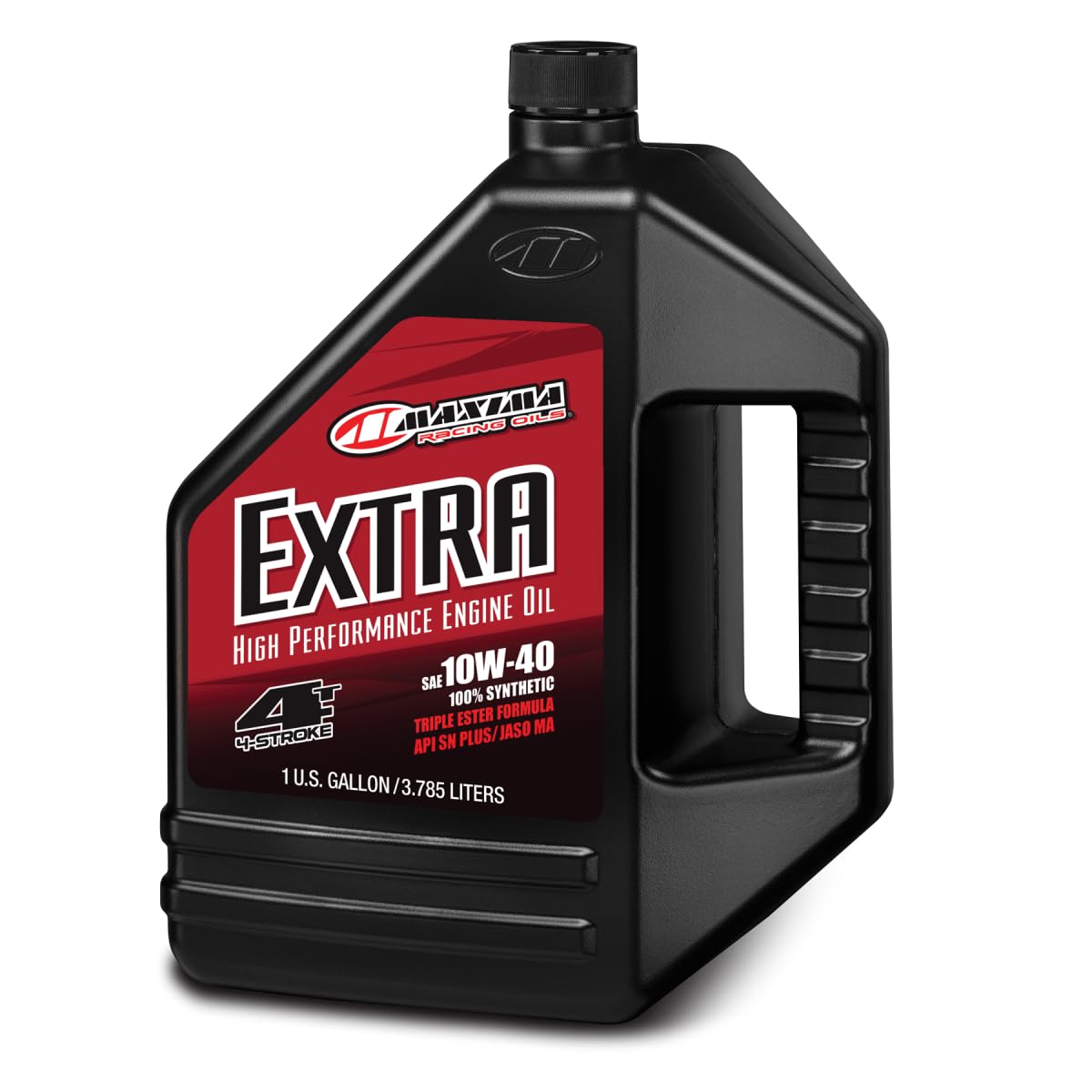
Maxima Extra stands out for its “surface-active chemistry,” which aggressively attaches to engine surfaces and keeps them clean even under extreme conditions. The use of shear-stable regenerative polymers means that as the oil is mechanically sheared in the transmission, the polymers “re-link” to maintain viscosity and film thickness longer than conventional viscosity-index improvers. This is especially relevant for ATV gearboxes that share oil with the engine and subject the oil to heavy mechanical shearing.
Race teams using Maxima Extra in everything from GSX-R 1000s to ZX-14s report improved shift smoothness — one Ninja 250 racer noted that the oil resolved perceived transmission issues after just one race weekend, with shifts becoming crisp and positive. Owners also report that the oil keeps engines cooler, with one 07 GSX-R 1000 owner stating the bike runs noticeably cooler on Maxima than on other synthetics.
At a one-gallon format, this is ideal for ATV owners who want to stock up for multiple changes without committing to a case of quarts. The flash point of 392°F indicates excellent high-temperature stability, and the proprietary additive system virtually eliminates oxidation and wear in shared sump applications. For aggressive trail riders, this oil offers near-ester performance at a non-ester price.
Why it’s great
- Regenerative polymers resist viscosity breakdown better than typical synthetics
- Surface-active chemistry keeps internals visibly clean
- Proven shift improvement in race-track conditions
Good to know
- Gallon jug may be less convenient than quart bottles for precise measurement
- Some older Honda engines may prefer OEM-spec oil for optimal clutch feel
4. Honda Pro GN4 10W-40 (Twin Pack)

Honda Pro GN4 is the factory-fill oil for Honda ATVs and motorcycles — the same spec that comes in the crankcase from the factory. While it’s a mineral-based formulation rather than a full synthetic, the additive package is specifically calibrated for Honda engines and wet clutches, providing the exact friction characteristics that Honda engineers designed for. For owners who want zero guesswork about clutch feel and no risk of voiding a warranty, this is the safest choice.
Verbatim owner reports note that the twin-pack often ships as eight individual quarts rather than two gallons, which actually makes pouring and measurement easier since you can precisely meter out the sump capacity. Users of pre-2000 Honda Magnas and current-generation FourTrax models confirm that the oil delivers predictable shift feel and consistent clutch grab across the temperature range.
The main trade-off is that as a mineral oil, its service interval is shorter than a full synthetic — generally 2,000 to 3,000 miles versus 5,000 to 7,000 miles for a high-quality synthetic. However, for seasonal ATV riders who change oil annually anyway, the shorter interval is irrelevant. If your ATV is a Honda and still under factory warranty, this oil is the only choice that carries no coverage risk.
Why it’s great
- Zero warranty risk for Honda ATV owners
- Clutch engagement calibrated specifically for Honda transmissions
- Twin-pack often ships as 8 individual quarts for easier measuring
Good to know
- Shorter oil-change interval than full synthetics
- Not ideal for extreme heat racing applications
5. Kawasaki K-Tech 10W-40 (12-Pack)
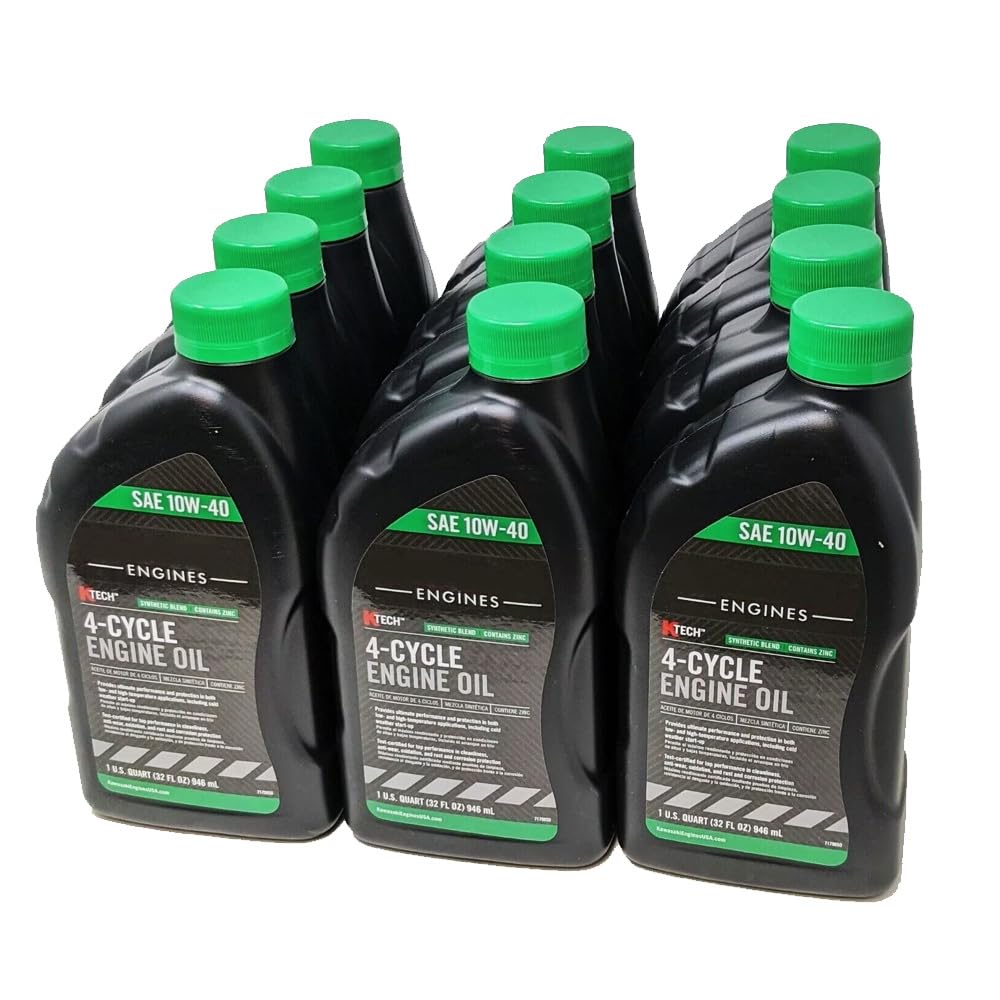
Kawasaki’s K-Tech 10W-40 is the official OEM oil recommended for all Kawasaki ATVs, UTVs, and motorcycles with 4-cycle engines. It meets JASO MA standards and API service CJ-4 and SL, meaning it’s formulated with conservative zinc levels suitable for flat-tappet engines without overwhelming modern emission systems. Owners note that the high zinc content protects cam lobes and rocker arms under constant high-load conditions, making it a popular choice for Kawasaki Mule UTVs and Brute Force ATVs that see heavy utility work.
The 12-quart case gives you enough oil for approximately three full ATV oil changes, depending on sump size. The quart bottles feature a wide opening that makes pouring clean and reduces spills — a detail owners consistently appreciate. However, several long-term users note that the per-quart price is higher than aftermarket synthetics, and once the factory warranty period expires (typically five years), they plan to switch to a less expensive JASO MA2 full synthetic.
One mower and motorcycle owner reports using K-Tech in a Kawasaki FX engine with excellent results, noting the oil’s ability to maintain viscosity under sustained high-RPM operation. For Kawasaki owners who prioritize warranty compliance and factory-recommended protection during the first years of ownership, this 12-pack delivers peace of mind in bulk.
Why it’s great
- Factory-engineered additive package for Kawasaki engines
- High zinc content protects rotating assemblies under hard use
- 12-quart case covers multiple oil changes
Good to know
- Expensive per-quart compared to aftermarket synthetics
- Only JASO MA certified, not the stricter MA2 standard
6. Castrol EDGE High Mileage 10W-40 (6-Pack)
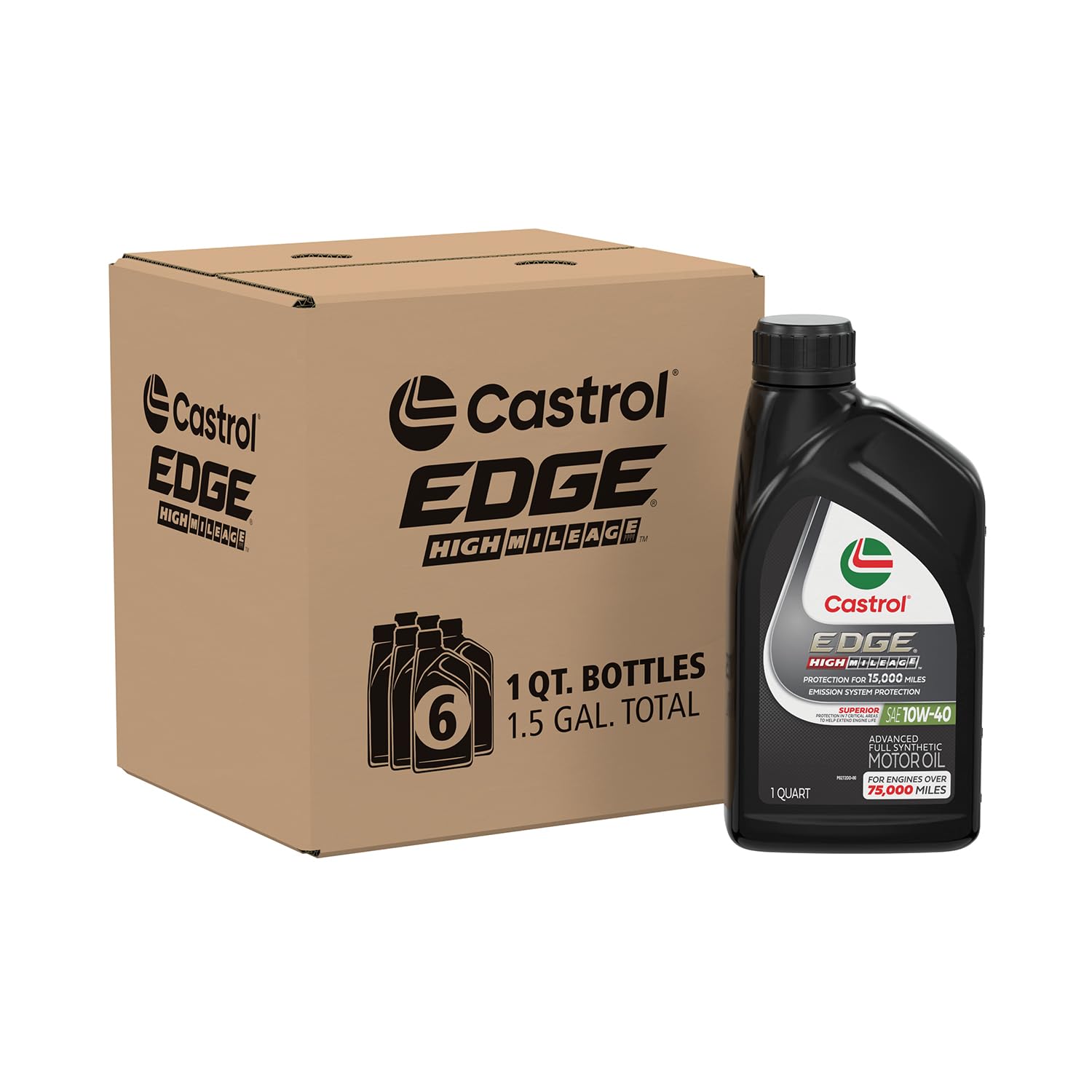
Castrol EDGE High Mileage 10W-40 is primarily a car oil, but it deserves attention for ATV owners dealing with older, high-mileage engines that have seal leaks or worn oil pumps. The formulation includes seal conditioners that reduce oil burn-off and leaks, and the phosphorus replacement technology helps extend the life of emission systems. One owner of a high-mileage car with a worn oil pump reported that switching from Castrol EDGE 10W-30 to this 10W-40 eliminated their low oil pressure warning light, proving the viscosity’s ability to maintain adequate film thickness in tired engines.
The API SP rating ensures compatibility with modern catalytic converters, making it suitable for newer ATVs with emissions equipment. However, this oil is NOT JASO MA or MA2 certified, which means it contains friction modifiers that can cause wet clutch slippage in some ATVs. It is best reserved for utility ATVs with dry clutches or older machines where the clutch system is independent of the engine oil.
At a six-quart case, this is a cost-effective option for riders who own multiple machines and need a bulk supply of quality 10W-40 for non-clutch applications. The 15,000-mile change interval claimed for automotive use is not applicable to ATV service, but the extended drain capability reflects the oil’s robust additive package and oxidation resistance.
Why it’s great
- Seal conditioners reduce leaks in high-mileage engines
- Thicker 10W-40 film helps worn oil pumps maintain pressure
- Budget-friendly bulk option for multiple machines
Good to know
- No JASO MA/MA2 certification — not safe for wet clutch ATVs
- Automotive drain interval claims do not apply to ATV service
7. ULTRA 1PLUS 4T 10W-40 (3 QTS)

ULTRA 1PLUS 4T 10W-40 is a full synthetic 4-stroke oil that exceeds both API SN and JASO MA2 standards, yet sits at a price point competitive with mid-range semi-synthetics. The flash point of 215°C (419°F) indicates excellent thermal stability, meaning the oil won’t boil off or form varnish in ATV engines that run at sustained high temperatures during slow technical trail riding or heavy towing.
Despite the low per-quart cost, the JASO MA2 certification is genuine — confirmed by the official JASO directory — ensuring correct friction characteristics for wet clutch engagement. Owners report that the oil allows smooth, reliable shifting across multiple motorcycle and scooter platforms, with engine quietness improving noticeably after the first oil change. The universal fit rating means it works in everything from sport ATVs to utility UTVs and dirt bikes.
The three-quart size is intentionally compact — enough for a single ATV oil change on most 300-500cc machines, but not enough for large-displacement engines or cases requiring a full sump fill. The 2-year manufacturer warranty provides additional peace of mind. If you’re on a tight budget but refuse to compromise on JASO MA2 certification, this is the oil that makes that trade-off work without risk.
Why it’s great
- Full synthetic at near-conventional oil prices
- Genuine JASO MA2 certification for wet clutch safety
- High flash point resists thermal breakdown in hot engines
Good to know
- 3-quart size may not fill larger ATV sumps completely
- Less proven track record than established motorcycle oil brands
FAQ
Can I use car 10W-40 oil in my ATV?
How often should I change 10W-40 ATV oil?
What’s the difference between 10W-40 and 15W-40 for ATVs?
Is more expensive ATV oil always better for my engine?
How do I check if my ATV oil is JASO MA2 certified?
Final Thoughts: The Verdict
For most ATV owners, the best 10w40 atv oil overall is the Royal Purple Max-Cycle because its Synerlec additive chemistry provides proven oil temperature reduction and shift smoothness improvements that directly extend engine life. If you want maximum film strength and thermal stability for high-performance or racing use, grab the Motul 7100 4T with its 100% ester base. And for Honda or Kawasaki owners who prioritize factory warranty and clutch calibration, nothing beats the Honda Pro GN4 or the Kawasaki K-Tech OEM oils.