
Selecting the right 10W40 oil for your motorcycle isn’t just about topping off the crankcase — it’s about ensuring your wet clutch grabs without slipping, your gearbox shifts without grinding, and your engine bearings survive sustained highway pulls or trail abuse. The wrong viscosity or a formulation missing JASO MA2 certification can turn a smooth-running bike into a noisy, slipping, overheating headache within a single season.
I’m Min — the co-founder and writer behind Gadgets Feed. I dissect technical specifications and real-world owner feedback across dozens of 10W40 formulations to separate marketing claims from measurable protection, focusing on shear stability, ester content, and wet-clutch friction characteristics that matter most to riders.
After comparing full-synthetic, synthetic-blend, and premium ester-based options from seven leading brands, this guide delivers a clear verdict on the best 10w40 bike oil for everything from daily commuters to heavily modified desert sleds.
How To Choose The Best 10W40 Bike Oil
Motorcycle engine oil must lubricate the transmission and wet clutch simultaneously, which places demands that passenger-car oils simply aren’t designed to handle. A 10W40 bottle labeled for bikes needs the right friction modifiers to prevent clutch slip, the shear resistance to maintain viscosity under gear-mesh stress, and thermal stability to avoid thinning out when your air-cooled twin is roasting at 230°F. Here are the three criteria that separate a top-tier choice from a budget compromise.
JASO MA / MA2 Certification
JASO MA and its stricter update, MA2, are the only industry standards that certify an oil’s friction characteristics are appropriate for wet clutches. Oil without this certification — including many passenger-car synthetics — may contain friction modifiers that cause the clutch to slip under load, robbing power and accelerating wear. Always look for the JASO MA2 logo on the back label; if it isn’t there, the oil was not designed for your bike’s shared sump.
Base Oil Type: Synthetic vs. Synthetic Blend vs. Ester
Synthetic-blend oils use a mix of Group III synthetics and conventional mineral base stocks, offering decent protection at a lower price point. Full-synthetic oils (Group III+ or Group IV PAO) provide superior oxidation resistance and shear stability for longer drain intervals. Ester-based full-synthetics (Group V) form a molecular bond with metal surfaces that persists even after shutdown, delivering the highest film strength and thermal resistance — ideal for high-performance, high-RPM, or air-cooled engines that see extreme heat.
Shear Stability and Viscosity Retention
A 10W40 oil can shear down to a thinner grade inside your transmission if its viscosity index improvers are weak. Sheared oil means less film thickness on bearings and gear teeth, leading to increased wear and noisier operation. Premium oils publish their shear-stability data or use high-shear-stable base stocks (like esters or PAO) that resist permanent viscosity loss. Checking owner forums for long-term shear reports is one of the smartest moves a rider can make before buying a case of oil.
Quick Comparison
On smaller screens, swipe sideways to see the full table.
| Model | Category | Best For | Key Spec | Amazon |
|---|---|---|---|---|
| Motul 7100 4T | Full Synthetic Ester | High-RPM & Wet Clutch | Flash Point 236°C / JASO MA2 | Amazon |
| Royal Purple Max Cycle | Full Synthetic | Air-Cooled & Heat Reduction | Flash Point 204°C / Synerlec Additive | Amazon |
| Red Line 11404 | Full Synthetic Ester/PAO | Extended Drain & Cleanliness | Polyol Ester / Group V Base | Amazon |
| Mobil 1 Racing 4T | Full Synthetic | Sport Bike Performance | Full Synthetic / 1 Liter | Amazon |
| Kawasaki K61021-202A | OEM Conventional | Warranty Compliance | Manufacturer Spec / 1 Quart | Amazon |
| Quicksilver Synthetic Blend | Synthetic Blend | ATV/UTV & Mini Bikes | Wet Clutch Compatible / 1 Quart | Amazon |
| Kimpex 10W40 | Synthetic Blend | Budget Multi-Vehicle | 3.78 Liter Jug / 4-Stroke | Amazon |
In‑Depth Reviews
1. Motul 7100 4T 10W-40 Full Synthetic Motorcycle Oil
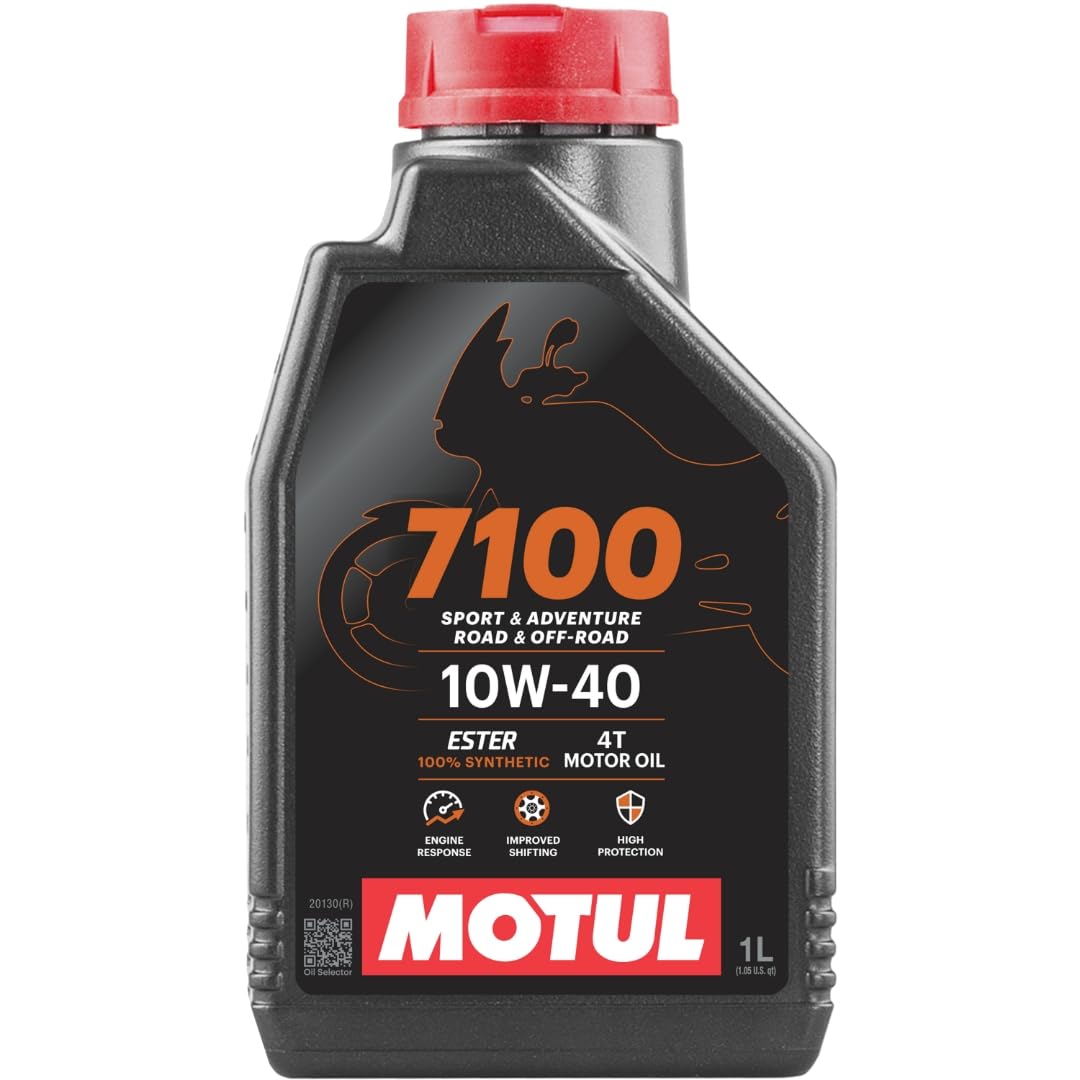
Motul’s 7100 4T is a 100% synthetic ester formula that sets the standard for wet-clutch motorcycles demanding both shear stability and thermal resistance. The ester base stocks form a molecular bond with metal surfaces, maintaining a protective film even after the engine is shut down — reducing dry-start wear that accounts for a significant portion of engine degradation. Certified to JASO MA2 (T903:2023) and API SP, it delivers the precise friction characteristics required for confident clutch engagement across the full RPM range.
Riders consistently report noticeably smoother gear shifts after switching to the 7100, particularly in bikes with integrated gearbox lubrication. The 236°C flash point is among the highest in this category, meaning the oil resists volatilization and viscosity increase under sustained high-RPM or high-load operation. It is fully miscible with other synthetic and mineral oils, so no special flush is needed when switching brands — a practical advantage for those trying it for the first time.
Extended drain intervals of up to 5,000 km are realistic under normal street riding, though hard track or off-road use will shorten that range. Owners of Ninja 400s, Brozz 250s, and Goldwings alike report that the oil stays visually cleaner longer and reduces the characteristic “Kawi tick” valve-train noise. For riders who want one oil that covers street, sport, and adventure applications without compromise, this is the prime pick.
Why it’s great
- Ester backbone delivers extreme film strength and shear resistance
- JASO MA2 certified for slip-free wet clutch operation
- 236°C flash point provides class-leading high-temp stability
Good to know
- Premium price per quart compared to synthetic-blend alternatives
- Extended intervals require monitoring if ridden hard off-road
2. Royal Purple Max Cycle 10W-40 High Performance Synthetic Motorcycle Oil

Royal Purple’s Max Cycle oil is engineered around the company’s proprietary Synerlec additive technology, which modifies the oil’s surface chemistry to reduce friction and lower operating temperatures. Real-world data from a heavily modified XR650L running in Arizona’s 105°F summers showed oil temperatures dropping from over 300°F to a range of 210-225°F after switching to Max Cycle 10W-40 — a reduction that directly extends top-end rebuild intervals from 5,000 to as much as 10,000 miles.
The formulation includes robust rust and corrosion inhibitors that protect internal components during storage and infrequent use, making it a strong choice for seasonal riders. It also contains high levels of zinc and phosphorus (ZDDP) for cam and lifter protection, which is especially critical for flat-tappet designs found in many air-cooled V-twins and dual-sport engines. Multiple owners of CBR 600F4i and Can-Am Spyder models report that clutch engagement improved noticeably after switching, with no slip under hard acceleration.
At a 204°C flash point, the Max Cycle sits mid-pack among the premium synthetics here, but its real strength lies in active heat reduction rather than sheer thermal tolerance. The price per quart is slightly higher than entry-level synthetics, but riders who push air-cooled engines in hot conditions often find the extended top-end life easily justifies the premium. If your bike runs hot enough to trigger radiator fans on every ride, this oil is worth a serious look.
Why it’s great
- Proven 75°F+ oil temperature drop in air-cooled desert riding
- High ZDDP content protects flat-tappet cams and lifters
- Synerlec technology improves clutch feel and shift smoothness
Good to know
- Premium cost per quart may exceed budget for high-mileage riders
- Some users report it can cause clutch slip in very specific bike models
3. Red Line 11404 SAE 10W40 Fully Synthetic Motor Oil

Red Line’s 11404 is a blend of polyol ester (Group V) and PAO (Group IV) base stocks that avoids unnecessary viscosity-index improvers, instead relying on the natural multi-grade properties of the esters themselves. This approach results in an oil that is inherently shear-stable — it won’t thin down to a 30-weight after a few thousand miles in your transmission. The high detergency formula allows extended drain intervals while keeping piston rings and valve trains remarkably clean.
Users of motorized bicycles and small 4-stroke engines report that the oil stays clean for 60+ hours of operation, with magnetic dipsticks remaining nearly spotless — an excellent indicator of reduced wear particle suspension. The oil also contains a high level of ZDDP for anti-wear protection, which independent testing has shown to outperform both Mobil 1 and Amsoil in extreme-pressure scenarios. Owners of Mercedes CLK430s who cross-refenced 10W40 into their M113 engines noted smoother and cooler operation than with the recommended 0W40.
Red Line does not hold JASO MA2 certification on this specific product (it is API SN/SM/SL/SJ rated for automotive use), so riders with wet-clutch motorcycles should verify compatibility before buying. The bottle is clearly labeled for passenger cars, light trucks, and heavy-duty gasoline engines — not explicitly for motorcycle sumps. For those with separate transmission oil or dry-clutch bikes, however, this is arguably the most technically advanced 10W40 available in the quart bottle segment.
Why it’s great
- Group V polyol ester base delivers unmatched shear stability
- High detergent action keeps engines exceptionally clean internally
- Natural multi-grade viscosity eliminates weak VI improvers
Good to know
- Not JASO MA2 certified — verify wet-clutch compatibility before use
- Labeled for automotive/truck applications, not explicitly for motorcycles
4. Mobil 1 Racing 4T 10W-40 Full Synthetic Motor Oil

Mobil 1 Racing 4T is a full-synthetic formulation designed specifically for 4-stroke motorcycles, bringing Mobil’s decades of motorsport lubricant experience to the quart bottle. It uses a high-performance additive package optimized for the shared sump of sport bikes and street machines, balancing engine protection with wet-clutch compatibility. The 1-liter bottle size is convenient for European and Asian bikes that specify metric fill volumes.
Owners of Honda RC51s report it as the only oil they trust in their V-twins, citing consistent performance across track days and daily riding. A Honda Fury VTX1300 rider noted that switching from Honda’s recommended lighter oil to this 10W-40 produced smoother shifting and improved fuel economy over two oil change cycles. The oil’s thermal stability helps keep air-cooled engines cooler during high-rev sprints, though it lacks the extreme flash point of ester-based competitors.
Pricing lands right at the mid-range mark, making it a accessible entry point into full-synthetic motorcycle oil without the premium attached to boutique ester brands. Availability is excellent through Amazon and most auto parts retailers, which matters when you need oil mid-tour. For riders of middleweight sport bikes who want a proven full-synthetic from a household name, this is a solid and predictable choice.
Why it’s great
- Trusted Mobil 1 synthetic base with motorsport-derived additives
- Improved shifting and fuel economy reported in V-twin applications
- Widely available and priced competitively among full synthetics
Good to know
- Flash point (not published) likely lower than ester-based options
- Some users report the 1L bottle is slightly smaller than a US quart
5. Kawasaki 4-Stroke Motorcycle Engine Oil 10W40 K61021-202A

Kawasaki’s factory-fill 10W40 is a conventional mineral-based oil blended to meet the exact specifications of Kawasaki’s engine and transmission designs. It is optimized for improved engine cleanliness, reduced oil volatility, and outstanding bearing and wear protection across the brand’s street, off-road, and utility vehicle lineup. For owners still under warranty or who prefer brand-specific peace of mind, this is the safest possible choice.
The oil is rated for universal fit across ATVs, UTVs, street sport motorcycles, cruisers, touring bikes, scooters, snowmobiles, and even marine personal watercraft — a broader compatibility range than most competitors. Owners of Versys 650s report the engine runs like new after many miles on OEM oil, though several reviewers note that buying a 4-quart jug costs about the same as two single quarts, making the individual bottle pricing feel steep for a conventional oil.
Performance-wise, this oil will meet the needs of most street riders and weekend adventurers without issue, but it lacks the shear resistance and thermal stability of a full-synthetic or ester-based alternative. If you ride hard in hot weather or plan extended drain intervals, you will get better protection from a synthetic. For low-stress commuting and warranty retention, the Kawasaki bottle is a reliable factory-option choice.
Why it’s great
- Official Kawasaki product — maintains warranty compliance
- Proven engine cleanliness and wear protection across Kawasaki models
- Extremely broad vehicle compatibility in one bottle
Good to know
- Conventional base stock — less shear and heat resistant than synthetics
- Per-quart pricing is high relative to comparable conventional oils
6. Quicksilver 10W-40 Synthetic Blend ATV, UTV, Motorcycle Oil
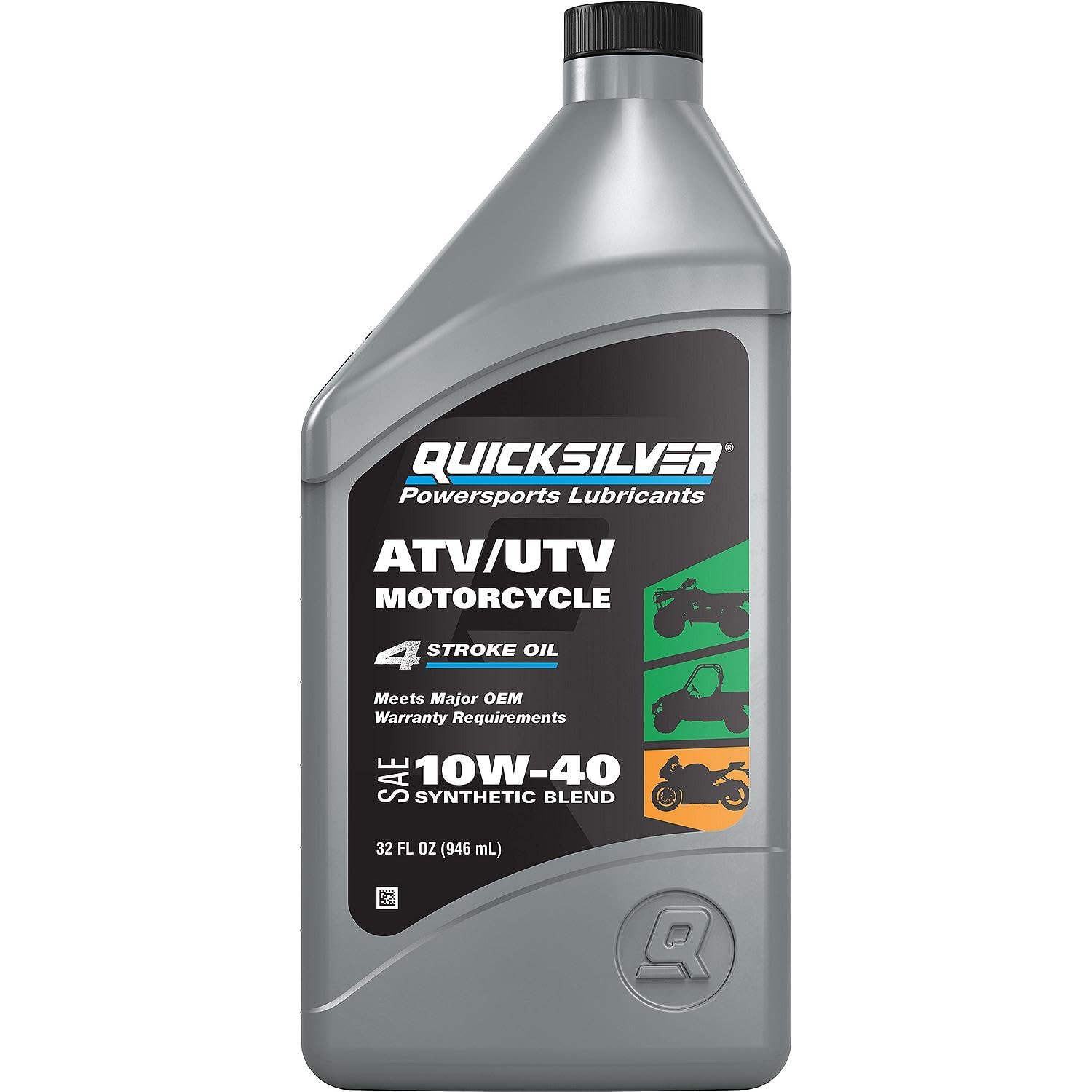
Quicksilver’s 10W-40 is a synthetic-blend oil formulated for 4-stroke ATVs, UTVs, and motorcycles, with a wet-clutch-compatible formula that prevents clutch slippage in shared-sump designs. It meets warranty specifications for Yamaha, Honda, Kawasaki, and Suzuki — covering the vast majority of Japanese-brand recreational vehicles. The 1-quart bottle size is standard and fits most fill procedures without measuring.
Owners of Coleman-style mini bikes and XPRO 200cc machines report that this oil stands up well to the high oil-consumption rates typical of these air-cooled small-displacement engines, with no performance loss or overheating after nearly a month of daily use. Side-by-side and UTV operators note clean clutch engagement and consistent shift feel over extended riding sessions. The synthetic-blend formulation offers a meaningful step up in protection compared to conventional mineral oils without the full-synthetic price tag.
The oil’s viscosity is rated as medium to high, which helps maintain film strength in air-cooled engines that run hotter than liquid-cooled designs. While it lacks the extreme shear stability of a full ester-based oil, for the price point it delivers dependable protection for recreational riders who change oil on a regular schedule. If you own a mix of Japanese ATVs and motorcycles and want one oil that works across the fleet, this is a very practical option.
Why it’s great
- Wet-clutch compatible formulation prevents slip in shared sumps
- Meets OEM specs for Yamaha, Honda, Kawasaki, and Suzuki
- Synthetic blend offers upgraded protection at an accessible price
Good to know
- Synthetic blend, not full synthetic — less shear stable than premium options
- Not labeled as JASO MA/MA2 certified, verified by user reports only
7. Kimpex 10W40 Moto/ATV 4-Strokes Engine Oil

Kimpex’s 10W40 is a synthetic-blend oil designed specifically for 4-stroke ATVs, street bikes, and UTVs, sold in a generous 3.78-liter (1-gallon) jug that offers the lowest per-liter cost in this comparison. The oil is formulated to meet the viscosity and performance requirements of a wide range of recreational powersports vehicles, making it a practical choice for households with multiple machines that need routine oil changes.
User reports from Arctic Cat 400 ATV owners indicate smooth cold starts and consistent performance under normal trail riding conditions, with no clutch slip or shifting issues observed. Dirt bike owners confirm the oil meets the listed specifications and performs adequately for recreational riding. The synthetic-blend chemistry provides a step up in thermal stability over conventional mineral oils, though it does not approach the extreme shear resistance or high-temp film strength of full-synthetic or ester-based options.
The 90-day manufacturer warranty is shorter than what premium brands offer, and the lack of a published flash point or JASO certification means riders with high-performance or heavily modified engines may want to look higher in this list. For the budget-conscious rider who changes oil every 1,000-1,500 miles and needs to keep multiple vehicles running, this gallon jug delivers honest value without the premium branding markup.
Why it’s great
- Gallon-sized jug provides the lowest cost per quart in this guide
- Synthetic blend formulation upgrades protection over basic conventional oil
- Compatible across ATV, UTV, and street bike 4-stroke applications
Good to know
- No JASO MA/MA2 certification listed — verify wet-clutch compatibility
- Limited 90-day manufacturer warranty and no published flash point data
FAQ
Can I use automotive 10W40 in my motorcycle?
What does JASO MA2 mean for my wet clutch?
How often should I change 10W40 motorcycle oil?
Is synthetic blend 10W40 good enough for my bike?
Final Thoughts: The Verdict
For most riders, the best 10w40 bike oil winner is the Motul 7100 4T because its ester-based full-synthetic formula delivers the highest shear stability and wet-clutch confidence available at a price that still feels reasonable. If you want proven heat reduction in air-cooled engines, grab the Royal Purple Max Cycle. And for the budget-conscious rider maintaining multiple machines, nothing beats the per-liter value of the Kimpex 10W40 gallon jug.